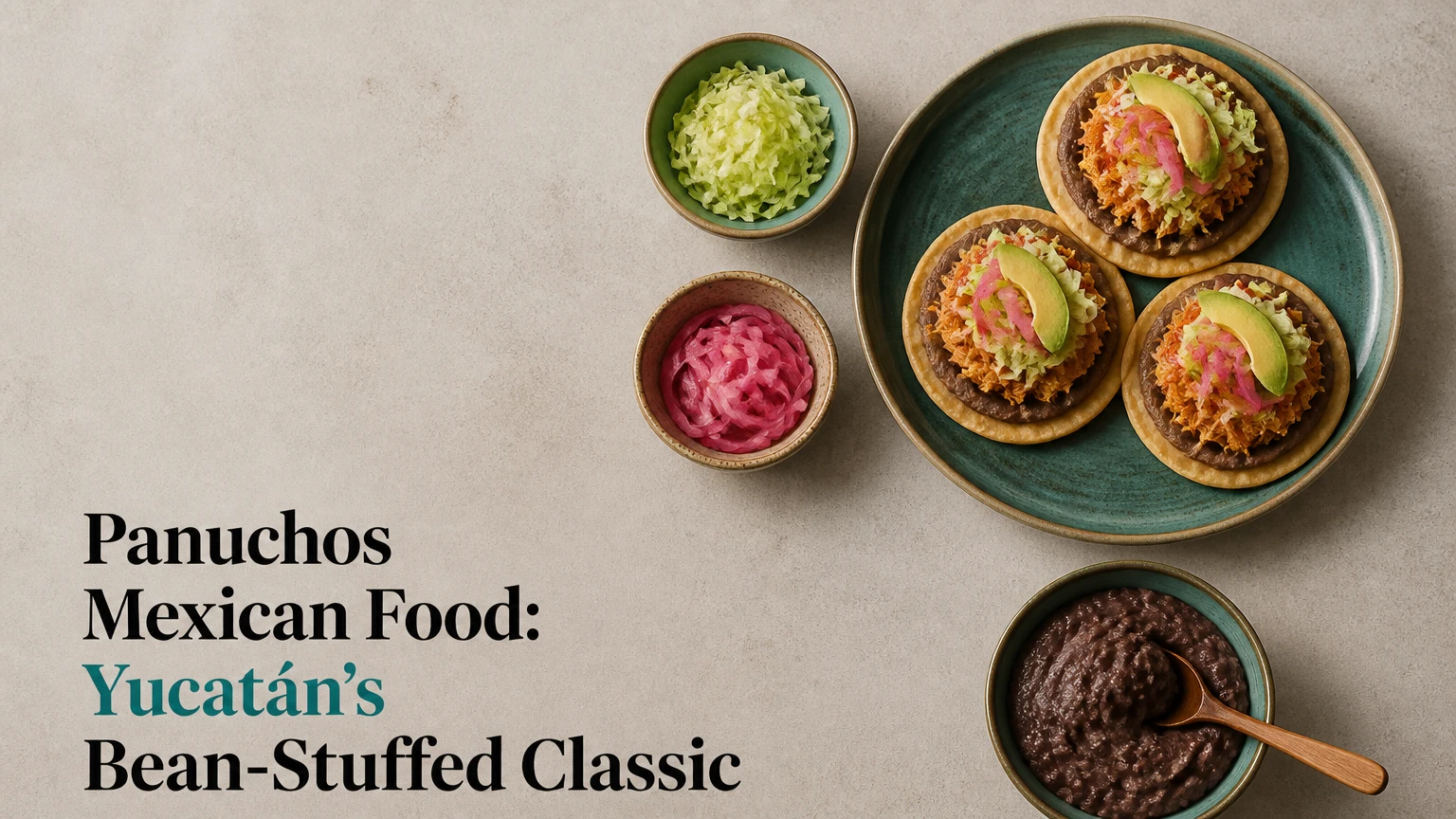
Panuchos are Yucatecan Mexican antojitos made from corn tortillas filled with seasoned refried black beans, lightly fried until crisp, and topped with shredded meat, pickled onions, vegetables, and salsa. Their defining feature is the bean layer sealed inside the tortilla, which creates a crisp shell, tender center, and more substantial bite than a plain tostada.
Key Facts at a Glance
- Panuchos originated in the Yucatán Peninsula, especially the culinary tradition associated with Mérida and surrounding communities.
- A traditional panucho contains a pocket of seasoned refried black beans inside a corn tortilla.
- The tortilla is cooked on a comal first, opened while warm, filled, and then fried in oil or lard.
- Common toppings include shredded chicken or turkey, cochinita, pickled red onions, tomato, cabbage, avocado, and habanero salsa.
- Panuchos differ from salbutes because salbutes do not contain an internal bean pocket.
- Typical restaurant portions contain two to four panuchos, while individual pieces commonly cost about 30-60 Mexican pesos in Mexico.
What Are Panuchos and Where Did They Come From?
Panuchos are crisp, bean-stuffed corn tortillas from the Yucatán Peninsula. The name refers to the finished antojito rather than a single topping combination, so panuchos may be prepared with turkey, chicken, cochinita, roast meat, vegetables, or beans alone.
Yucatecan food traditions developed around nixtamalized corn, black beans, sour citrus, achiote, chiles, and slow-cooked meats. Panuchos fit that pattern because the tortilla provides the corn base, the bean paste adds richness, and the toppings supply acidity, heat, freshness, and protein.
The dish is strongly associated with evening food stalls, market counters, family kitchens, and casual restaurants in Mérida and other Yucatecan cities. Yucatán Travel groups panuchos with traditional regional snacks alongside salbutes, although recipes vary between households and vendors.
Panuchos are not a standard taco. A taco folds a tortilla around its filling, while a panucho integrates the beans into the tortilla before frying and receives its toppings afterward.
How Do You Pronounce Panuchos?
Panuchos is commonly pronounced pah-NOO-chos, with the strongest emphasis on the middle syllable. The singular form is panucho, and the plural form is panuchos.
English menus may use “Yucatecan panuchos,” “panuchos yucatecos,” or “bean-stuffed tortillas.” Those descriptions refer to the same general dish, although the filling and topping choices can differ by vendor.
Why Does a Panucho Have a Bean Pocket?
A panucho has a bean pocket because a fresh corn tortilla can puff into separate layers when steam forms inside the masa. A cook opens the warm tortilla, spreads refried black beans between the layers, closes the opening, and fries the filled tortilla until firm.
The process depends on timing. A tortilla that has cooled too much may seal shut, while a tortilla that is too thin or dry can tear when opened. The interior beans must be smooth enough to spread but thick enough to stay inside during frying.
| Stage | Typical condition | Practical target | Failure if mismanaged |
|---|---|---|---|
| Masa mixing | 5-8 minutes | Soft, cohesive dough | Dry edges and weak puff |
| Tortilla thickness | 2-3 millimeters | Thin but flexible disc | Thick center or tearing |
| Comal cooking | 45-75 seconds total | Visible steam puff | Flat, sealed layers |
| Pocket opening | Within 5-15 seconds | Warm, flexible tortilla | Split or closed tortilla |
| Bean filling | 1-2 tablespoons | Thin, even coating | Leaking or heavy center |
| Frying | 1-2 minutes | Golden, crisp exterior | Greasy or burned shell |
The often-repeated instruction to cut within exactly three seconds is too rigid. The useful rule is to open the tortilla while it remains hot and visibly inflated, because heat keeps the layers flexible.
What Should Refried Beans Feel Like?
Refried black beans for panuchos should have a dense, spreadable paste texture similar to smooth hummus. Watery beans escape through the seam, while dry beans drag across the tortilla and create holes.
Cooked black beans can be mashed with a small amount of cooking liquid, salt, onion, and a little fat. A teaspoon of lard or neutral oil per cup of beans improves spreadability, but the mixture should remain firm enough to hold a shallow ridge on a spoon.
What Goes on Traditional Panuchos?
Traditional panuchos commonly receive shredded chicken or turkey, pickled red onions, cabbage or lettuce, tomato, avocado, and a chile-based salsa. No single topping is universal across Yucatán, so “mandatory” lists should be treated as serving conventions rather than strict rules.
Pickled red onions provide the sharp acidity that balances the fried tortilla and rich beans. Yucatecan versions often use sour orange when available, although white vinegar with lime juice produces a practical substitute.
| Component | Typical ingredient | Amount per panucho | Function |
|---|---|---|---|
| Base | Refried black beans | 1-2 tablespoons | Adds earthy flavor and moisture |
| Protein | Shredded chicken or turkey | 30-45 grams | Provides savory bulk |
| Acid | Pickled red onion | 1-2 tablespoons | Cuts richness |
| Fresh topping | Cabbage or romaine | 10-20 grams | Adds crunch |
| Vegetable | Roma tomato | 2-3 slices | Adds juiciness |
| Fat-rich garnish | Avocado | 2-3 slices | Softens chile heat |
| Salsa | Habanero or chiltomate | 1-2 teaspoons | Adds heat or roasted tomato flavor |
Habanero salsa is traditional in the region but can be extremely hot. A mild roasted tomato salsa, often called chiltomate, gives panuchos a more accessible flavor without removing the Yucatecan character.
Cochinita is a popular topping because its achiote, citrus, and slow-cooked flavor complement black beans. Chicken and turkey in escabeche offer a lighter, tangy alternative, while grilled beef creates a less traditional but common restaurant variation.
How Do You Make Panuchos at Home?
A home cook can make panuchos in about 45-60 minutes when using prepared chicken or turkey, cooked black beans, and fresh masa. The most important success factor is a moist, flexible tortilla that puffs before the bean pocket is opened.
Before You Start
| Item | Typical requirement | Cost or setting | Purpose |
|---|---|---|---|
| Fresh masa | 500 grams | $2-$5 | Makes 12-14 tortillas |
| Cooked black beans | 2 cups | $2-$4 | Fills the tortillas |
| Shredded chicken or turkey | 450 grams | $6-$12 | Provides topping |
| Frying oil | 750 milliliters | $4-$8 | Fries 12 panuchos |
| Tortilla press | 1 | $15-$35 purchase | Forms even discs |
| Comal or skillet | 1, 25-30 centimeters | Medium-high heat | Cooks tortillas |
| Total time | 45-60 minutes | Moderate difficulty | Includes assembly |
Step 1: Prepare the Masa
Mix 500 grams of fresh nixtamalized corn masa with 1-2 grams of salt and enough water to create a soft, cohesive dough. Knead for 3-5 minutes, then cover the masa with a damp towel so the surface does not dry.
Form balls weighing 35-40 grams each. That size produces tortillas about 12-14 centimeters wide, which are large enough for toppings but small enough to handle during stuffing.
You will know the masa is ready when a pressed disc has smooth edges rather than cracks. Cracked edges indicate that the dough needs a teaspoon of water at a time.
Step 2: Press and Cook the Tortillas
Place each masa ball between two sheets of plastic and press it into a thin disc. Cook the tortilla on a dry, preheated comal over medium-high heat for about 20-30 seconds on the first side, 20-30 seconds on the second side, then briefly return it to the first side.
A successful tortilla develops brown cooking spots and inflates as steam separates the layers. If the tortilla remains flat, extend the cooking time slightly and check whether the masa is too dry.
Step 3: Open the Warm Tortilla
Remove the puffed tortilla and make a small slit near the edge with a paring knife. Open the upper layer carefully while the tortilla is still flexible, creating a pocket without cutting through the bottom layer.
The opening does not need to measure exactly two inches. It only needs to allow a spoon to spread beans across the interior without forcing the tortilla apart.
Step 4: Fill With Black Beans
Spread 1-2 tablespoons of thick refried black beans inside the tortilla. Keep the bean layer even and leave a narrow border around the opening so the flap can close.
Press the tortilla gently to distribute the filling. If beans squeeze out, remove some before frying because exposed paste can burn and make the oil splatter.
Step 5: Fry Until Crisp
Heat neutral oil or lard to approximately 170-180°C, or 340-355°F. Fry each stuffed tortilla for 60-120 seconds, turning once if needed, until the outside is crisp and lightly golden.
A thermometer gives better results than visual judgment. Oil below about 160°C encourages excess absorption, while oil above 185°C can darken the tortilla before the center warms.
Drain panuchos upright or on a rack rather than stacking them immediately. A rack allows steam to escape and helps preserve the shell.
Step 6: Add Toppings and Serve
Top each hot panucho with shredded chicken or turkey, pickled red onions, cabbage or lettuce, tomato, avocado, and a small amount of salsa. Serve within 5-10 minutes for the best contrast between crisp tortilla and soft beans.
Do not overload the tortilla with wet toppings. A large spoonful of salsa or watery tomato can soften the shell before the first bite.
Which Fillings Work Best?
Chicken or turkey in escabeche is the most balanced choice for a first panucho because its acidity offsets the fried tortilla and beans. Cochinita provides the strongest regional association and a richer, achiote-forward flavor, while vegetables offer the easiest meat-free adaptation.
| Filling | Preparation style | Typical portion | Best pairing |
|---|---|---|---|
| Chicken escabeche | Vinegar, garlic, oregano, onion | 30-45 grams | Pickled onion and tomato |
| Turkey escabeche | Tangy seasoned broth | 30-45 grams | Cabbage and habanero |
| Cochinita | Achiote and sour citrus | 35-50 grams | Pickled onion and avocado |
| Roast meat | Oven-cooked and shredded | 35-50 grams | Chiltomate salsa |
| Grilled beef | Thinly sliced and chopped | 35-45 grams | Cabbage and tomato |
| Mushroom or squash | Sautéed with onion and chile | 30-45 grams | Black beans and avocado |
Vegetarian panuchos remain structurally authentic when the tortilla contains black beans and the toppings use mushrooms, squash, chaya, cabbage, avocado, or roasted vegetables. Ask whether the beans were cooked with animal fat, since restaurant preparation differs.
Panuchos vs. Salbutes vs. Tostadas
Panuchos are the best choice when you want a crisp tortilla with a substantial bean center; salbutes are better for a soft, puffy bite; tostadas are better when you want a fully crunchy base with a broad range of toppings.
| Feature | Panucho | Salbute | Tostada |
|---|---|---|---|
| Internal beans | 1-2 tablespoons | 0 tablespoons | 0 tablespoons |
| Tortilla texture | Crisp outside, tender center | Puffy and soft | Dry, brittle crunch |
| Main cooking sequence | Comal, fill, fry | Fry or puff raw tortilla | Bake or fry until dry |
| Typical diameter | 12-14 centimeters | 12-15 centimeters | 12-15 centimeters |
| Best eating window | 5-10 minutes | 2-5 minutes | 10-20 minutes |
| Structural strength | High under heavy toppings | Medium | Low when overloaded |
| Typical toppings | Meat, onion, cabbage | Meat, onion, tomato | Beans, cheese, seafood, vegetables |
A salbute is not simply a panucho without beans. The two dishes use related corn dough, but the internal structure and final texture differ.
A tostada is also not interchangeable with a panucho. A tostada is generally dehydrated until the whole tortilla becomes hard, whereas a panucho retains a softer interior because the beans remain sealed inside.
What Do Panuchos Taste Like?
Panuchos taste earthy, savory, crisp, acidic, and chile-forward. The black beans create a creamy center, the fried tortilla contributes toasted corn flavor, and pickled onions or citrus-seasoned meat prevent the dish from becoming heavy.
Texture drives much of the appeal. The outer tortilla breaks with a firm crunch, the bean layer remains soft, and shredded meat or cabbage adds either chew or freshness. The exact balance depends on frying time and topping moisture.
A panucho with chicken escabeche tastes brighter than one with cochinita. A panucho with habanero salsa can be dominated by heat, so first-time diners should add salsa gradually rather than covering the entire surface.
How Much Do Panuchos Cost and How Long Do They Take?
Typical panuchos cost about 30-60 Mexican pesos per piece at casual food stalls in Mexico, or approximately $1.50-$3.50 USD using a broad restaurant comparison. Restaurants outside Mexico commonly charge about $4-$7 per piece, with regional labor and ingredient costs causing wide variation.
| Setting | Price per piece | Typical serving | Service time |
|---|---|---|---|
| Yucatán market stall | 30-45 MXN | 2-4 pieces | 3-8 minutes |
| Yucatán casual restaurant | 40-60 MXN | 2-3 pieces | 8-15 minutes |
| United States restaurant | $4-$7 | 2-3 pieces | 10-20 minutes |
| Home cooking with prepared fillings | $1.25-$2.75 | 3-4 pieces | 45-60 minutes |
| Home cooking from dried beans and raw filling | $1.50-$3.50 | 3-4 pieces | 2-4 hours |
Prices are typical ranges, not fixed menu standards. A dish topped with cochinita or grilled beef usually costs more than a bean-only or vegetable version.
At home, prepared tortillas and canned beans reduce the active cooking time to about 25-35 minutes. The shortcut changes the texture because factory tortillas rarely puff into a clean pocket, but careful cutting and shallow frying still produce a useful approximation.
Common Panucho Problems and Their Fixes
Panucho failures usually result from dry masa, weak puffing, late pocket opening, thin bean paste, or low frying temperature. Each problem has a specific recovery method, so discarding the entire batch is rarely necessary.
| Problem | Likely cause | Recovery method | Prevention |
|---|---|---|---|
| Tortilla does not puff | Dry masa or cool comal | Add water and reheat comal | Keep dough covered |
| Tortilla tears | Excessive pressure or thin edge | Use less filling and patch gently | Press 2-3 millimeters thick |
| Beans leak | Watery paste or overfilling | Remove excess and reseal | Use 1-2 tablespoons |
| Panucho absorbs oil | Oil below 160°C | Raise heat before next batch | Fry at 170-180°C |
| Shell burns | Oil above 185°C | Lower heat and shorten fry | Check thermometer |
| Finished shell turns soft | Wet toppings or stacking | Drain on rack and top at service | Serve within 5-10 minutes |
The most counterintuitive rule is that hotter is not always better. A very hot comal can brown the tortilla before steam has enough time to separate its layers, producing a flat disc that cannot be opened cleanly.
A second practitioner rule is to correct masa hydration before changing the cooking temperature. Cooks often increase heat when the real problem is cracked, dry dough.
A third rule is to treat the topping as part of the texture system. Even a perfectly fried panucho becomes soft when covered with excess salsa, wet tomato, or a large pile of un-drained pickled onions.
Can You Use Store-Bought Corn Tortillas?
Store-bought corn tortillas can produce shortcut panuchos, but they usually will not form the same natural pocket as fresh masa tortillas. Warm a thick, flexible tortilla, cut a shallow slit, insert thick refried beans, press the opening closed, and shallow-fry it carefully.
Choose tortillas with corn listed as the primary ingredient and avoid products that contain wheat flour if gluten-free preparation matters. Tortillas that are too thin tend to split, so a slightly thicker supermarket tortilla is often easier to fill.
Are Panuchos Gluten-Free?
Panuchos are naturally gluten-free when made with 100% corn masa, beans, meat, vegetables, and gluten-free seasonings. Cross-contact remains possible at restaurants because wheat flour, shared fryers, prepared sauces, or mixed masa products may be present.
People with celiac disease should ask whether the tortilla contains wheat, whether the frying oil is shared, and whether the beans or meat were thickened with flour. Corn masa harina is not automatically safe if the production facility handles wheat without suitable controls.
A home kitchen offers the clearest control. Use certified gluten-free masa harina when required, separate utensils, and fresh oil in a clean pan.
How Should You Store and Reheat Panuchos?
Panuchos are best eaten immediately, but leftovers can be refrigerated for up to two days without toppings. Remove lettuce, tomato, avocado, salsa, and pickled onions before storage, then reheat the shell in a 200°C, or 400°F, oven for 6-10 minutes.
A toaster oven or air fryer restores more crispness than a microwave. Microwave reheating softens the tortilla because steam remains trapped around the beans.
| Storage method | Maximum typical time | Reheating method | Expected texture |
|---|---|---|---|
| Unassembled, refrigerated | 48 hours | Oven at 200°C for 6-10 minutes | Moderately crisp |
| Fully topped, refrigerated | 24 hours | Oven at 190°C for 8-12 minutes | Soft shell |
| Frozen, unassembled | 30 days | Thaw, then oven at 200°C | Crisp edges, softer center |
| Room temperature | 2 hours | Immediate oven refresh | Safe only for short holding |
Do not store panuchos at room temperature for extended periods when they contain cooked poultry or other perishable toppings. Refrigerate the filling separately and assemble after reheating.
How Should You Order Panuchos in Yucatán?
Order two panuchos for a light meal or three to four for a substantial meal, then request the salsa separately if you are unfamiliar with habanero heat. Start with chicken or turkey escabeche if you want acidity, or choose cochinita for a richer achiote profile.
At a market stall, look for tortillas fried to a dry, lightly golden surface rather than dark brown. Freshly fried panuchos should feel firm at the edges and should not leave a large film of oil on the serving plate.
Ask whether the panuchos are made to order. A short wait is usually preferable to receiving shells that have sat under wet toppings. Agua de jamaica or horchata can provide a nonalcoholic pairing, while citrus and cooling dairy-based sauces can moderate chile heat when available.
Panuchos are not ideal for long takeaway trips. If transport is necessary, pack shells, meat, onions, vegetables, and salsa separately and assemble immediately before eating.
The Bottom Line
Panuchos Mexican food is a Yucatecan corn tortilla antojito defined by its internal layer of refried black beans. The tortilla is cooked until it puffs, opened while warm, filled, fried until crisp, and finished with regional toppings such as chicken, turkey, cochinita, pickled red onions, cabbage, tomato, avocado, and salsa.
The strongest panucho has three controlled contrasts: a crisp exterior against a soft bean center, rich filling against acidic toppings, and toasted corn against chile heat. Choose panuchos over salbutes when the bean pocket matters, and choose them over tostadas when you want a sturdy shell with a tender interior.
Frequently Asked Questions
Are panuchos tacos?
Panuchos are not tacos because they do not fold around their filling. The black beans are inserted between layers of the tortilla before frying, and the finished panucho lies flat with meat, vegetables, and salsa placed on top.
Are panuchos spicy?
Panuchos themselves are usually mild because the tortilla and black beans contain little chile. Heat generally comes from habanero salsa, so diners can control the spice level by adding salsa in small amounts.
Can panuchos be made without meat?
Panuchos can be made without meat by using black beans with mushrooms, squash, chaya, cabbage, avocado, tomato, and pickled onions. Confirm that the beans were cooked without animal fat if a fully vegetarian preparation is required.
What is the difference between panuchos and garnachas?
Panuchos are specifically associated with Yucatán and contain an internal bean layer inside the tortilla. Garnacha is a broader name used for several regional masa-based snacks, so its shape, toppings, and cooking method depend on the region.
Why are my panuchos soggy?
Panuchos become soggy when the shell is under-fried, the oil is below about 160°C, or wet toppings remain on the tortilla too long. Drain the shell on a rack, keep toppings separate, and serve within 5-10 minutes.
Can I make panuchos with flour tortillas?
Flour tortillas do not provide the same corn flavor or puffing behavior and are not a traditional base for panuchos. Use fresh corn masa or thick corn tortillas for a closer structure and better bean-pocket result.