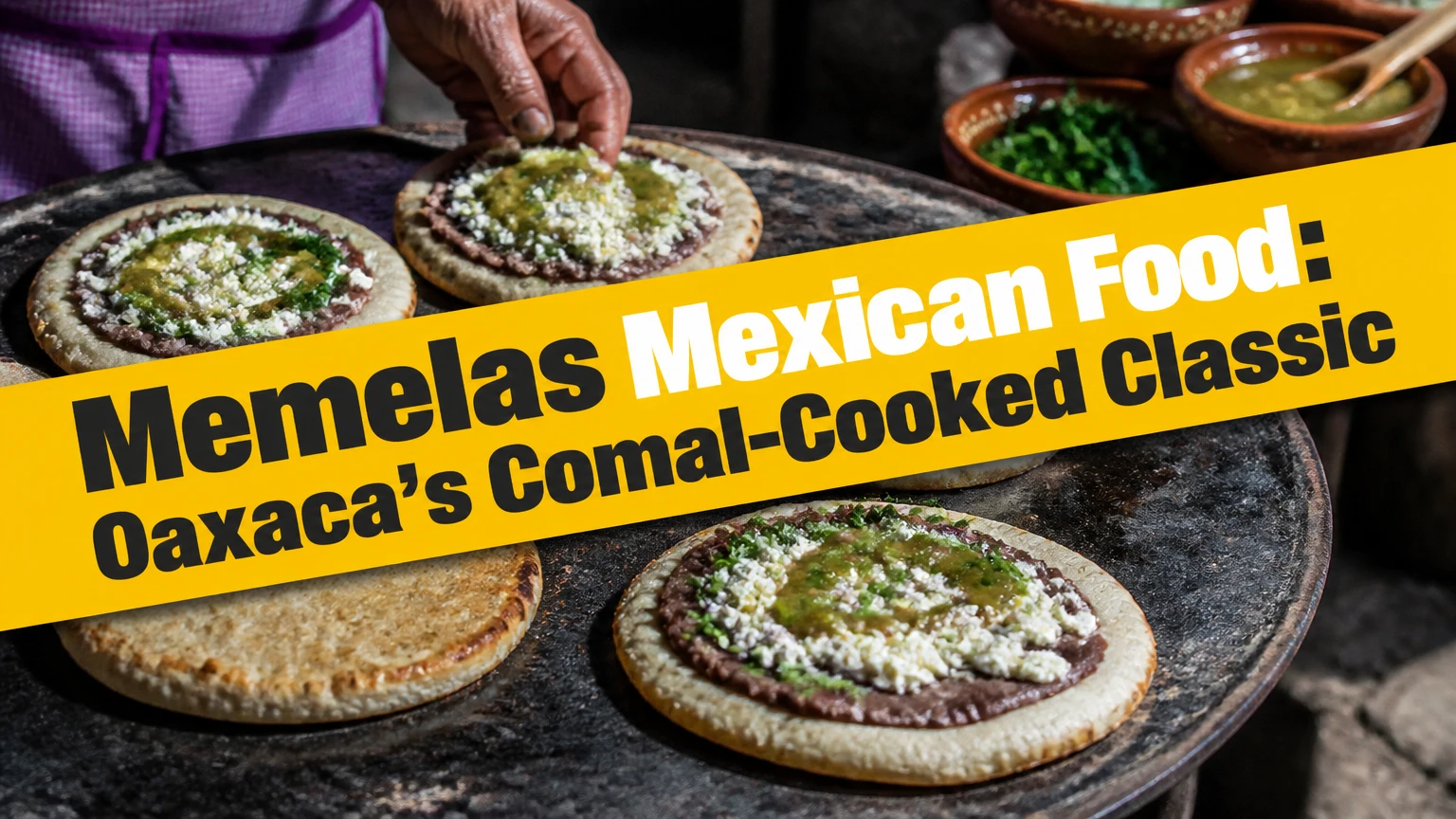
Memelas are thick, oval Mexican corn-masa cakes associated especially with Oaxaca, cooked on a comal and finished with asiento or another cooking fat, refried beans, salsa, and crumbly cheese. Their defining feature is a lightly raised edge pinched into the hot masa, which helps hold toppings while the base develops a toasted, tender-crisp texture.
Key Facts at a Glance
A traditional memela is an oval, open-faced masa antojito rather than a filled tortilla.
Oaxaca is the region most strongly associated with modern memela traditions.
A typical memela is 4-6 inches wide and about 1/4 inch thick before toppings.
The classic topping sequence is fat, beans, salsa, cheese, then optional meat or vegetables.
Six homemade memelas usually take 25-35 minutes and cost about $8-$16 in ingredients.
Memelas differ from tlacoyos because tlacoyos contain a filling inside the masa.
What Are Memelas?
A memela is a small, thick, oval masa base cooked on a comal and topped after cooking. The simplest version uses asiento, refried beans, salsa, and queso fresco, while restaurant versions may add quesillo, tasajo, cecina, chorizo, mushrooms, greens, or mole.
Memelas belong to the broad Mexican category called antojitos, which includes small masa-based foods prepared for breakfast, snacks, markets, and informal meals. The word can refer to related preparations in different parts of Mexico, so shape and toppings are not perfectly standardized nationwide.
The Oaxacan style is the reference point for most English-language discussions. Oaxacan memelas are usually open-faced, oval, moderately thick, and cooked until the underside carries toasted brown spots without becoming brittle. The edge is often pinched while the masa remains hot.
The raised rim is functional, not decorative. It slows the movement of salsa and melted fat toward the plate, but it is too shallow to hold the deep filling associated with a sope.
What does memela mean in Mexican food?
In Mexican food, memela generally identifies a regional masa antojito, with Oaxaca providing the best-known version. The term does not describe one fixed national recipe, because local cooks vary the dough thickness, fat, beans, salsa, and finishing ingredients.
A useful working definition is: an oval comal-cooked masa cake with a shallow rim and toppings spread across its surface. That definition separates a memela from a plain tortilla, although both use nixtamalized corn, and from a tlacoyo, whose principal filling is enclosed within the dough.
Why Does a Memela Have a Pinched Edge?
The pinched edge creates a shallow retaining rim while the cooked masa is still flexible. That rim improves handling, gives the outer band a firmer chew, and keeps thin salsa from immediately running off the top.
The best time to shape the rim is after the first cook, when the surface has set but the interior still contains enough moisture to bend. If the dough is completely dry, the edge cracks; if it is too soft, fingerprints flatten the cake.
Nixtamalization changes corn’s texture and cooking behavior by treating the kernels with an alkaline solution before grinding. Commercial masa harina has already undergone that process, so the home cook needs only water, salt, and kneading.
Memela anatomy
| Component | Typical specification | Function |
|---|---|---|
| Masa base | 4-6 inches wide, 1/4 inch thick | Provides structure and toasted corn flavor |
| Raised edge | 1/4-1/2 inch high | Retains salsa and melted fat |
| Bean layer | 1-2 tablespoons | Adds moisture, protein, and adhesion |
| Salsa layer | 1-2 teaspoons | Supplies acidity, chile flavor, and moisture |
| Cheese finish | 1 tablespoon crumbled | Adds salt, dairy richness, and texture |
How Do You Make Memelas?
You can make six memelas in about 25-35 minutes with 2 cups masa harina, 1 1/2 cups warm water, 1/2 teaspoon salt, 3/4 cup refried beans, salsa, cheese, and cooking fat. Medium-high comal heat and correct dough hydration determine whether the bases stay flexible rather than cracking.
Before You Start
| Requirement | Typical amount or setting | Practical note |
|---|---|---|
| Yield | 6 memelas | Each uses about 2 1/2 ounces of dough |
| Masa harina | 2 cups, about 240 g | White, yellow, or blue corn works |
| Warm water | 1 1/2 cups, adjusted as needed | Add gradually because brands absorb differently |
| Comal or skillet | 425-475°F surface temperature | A dry cast-iron skillet is suitable |
| Total time | 25-35 minutes | Includes mixing, cooking, and topping |
| Ingredient cost | $8-$16 for six | Cheese and prepared meats raise the total |
Step 1: Mix and Rest the Masa
Combine 2 cups masa harina, 1/2 teaspoon salt, and 1 1/4 cups warm water. Knead for 2-3 minutes, then add the remaining water one tablespoon at a time until the dough feels smooth and pliable.
Cover the dough for 10 minutes. Resting allows the masa harina to hydrate evenly, which reduces edge splitting during pressing.
You will know the dough is ready when a walnut-sized piece forms a smooth disk without ragged cracks. A few hairline marks at the edge indicate that the mixture needs more water.
Step 2: Divide and Press Oval Bases
Divide the dough into six equal portions of approximately 70 g each. Roll each portion into a ball, then press it between plastic sheets into an oval measuring 4-6 inches across and about 1/4 inch thick.
A tortilla press produces even thickness, but a heavy skillet or flat plate also works. Press from the center outward and leave the oval slightly thicker than a standard tortilla.
The center should be flexible and opaque, not translucent. A translucent center is too thin and will dry before the edge develops enough color.
Step 3: Cook and Pinch the Rim
Heat the dry comal over medium-high heat. Cook each oval for 60-90 seconds on the first side and 45-75 seconds on the second side, until the surface releases easily and brown spots appear.
Remove the masa from the comal and pinch the perimeter into a shallow rim while it remains hot. Use a folded kitchen towel or dampened fingertips for protection rather than placing wet fingers directly on a very hot surface.
A properly cooked base bends without tearing and has a visible border around most of its circumference. If the edge breaks, patch it with a small piece of moist masa and return the cake briefly to the comal.
Step 4: Add Fat and Beans
Return the memela to the comal. Spread about 1/2 teaspoon of asiento, vegetable oil, or another chosen fat over the surface, then add 1-2 tablespoons of warm refried beans.
Traditional Oaxacan preparations often use asiento, a savory rendered fat with toasted solids. Refined vegetable oil gives a cleaner flavor, while avocado oil provides a neutral high-heat option. Vegan cooks can use avocado oil and dairy-free cheese.
The beans should be warm and spreadable. Thick, cold beans tear the surface; watery beans soak through the masa before the underside becomes crisp.
Step 5: Add Salsa and Cheese
Spoon 1-2 teaspoons of salsa over the beans, leaving the raised edge visible. Finish with about 1 tablespoon of queso fresco, queso añejo, or shredded quesillo.
Cook for 1-2 minutes, until the underside is crisp at the rim and the cheese is warmed. Add meat, mushrooms, squash blossoms, or greens after the salsa so the heavier ingredients do not drag across the soft base.
A finished memela should lift from the comal in one piece. The underside needs brown toasted patches and slight rigidity, while the center remains tender enough to bite without shattering.
Which Toppings Are Traditional?
The traditional baseline is asiento, refried beans, salsa, and crumbled cheese. Meat, vegetables, mole, and additional garnishes are common variations, but a heavily loaded version can lose the crisp-to-tender contrast that defines the base.
Common topping combinations
| Style | Fat or spread | Main topping | Finish |
|---|---|---|---|
| Memela sencilla | Asiento | Black beans and salsa roja | Queso fresco |
| Bean and green salsa | Vegetable fat or asiento | Pinto or black beans | Quesillo and cilantro |
| Meat-topped | Asiento | Tasajo, cecina, or chorizo | Cheese and onion |
| Mole variation | Asiento or neutral oil | Thin mole layer and beans | Sesame or crumbled cheese |
| Vegan version | Avocado oil | Beans, salsa, mushrooms, or squash | Cashew or almond cheese |
Black beans are strongly associated with Oaxacan cooking, but pinto beans can work when seasoned with onion, garlic, epazote, or avocado leaves. The bean layer should taste seasoned before it reaches the masa because the corn base itself is only lightly salted.
Salsa roja usually supplies dried-chile depth and heat. Salsa verde contributes tomatillo acidity and a sharper finish. Mild diners can use a roasted tomato salsa, but sweetness should remain restrained so it does not overwhelm the toasted corn.
For a meat topping, slice the cooked ingredient into pieces small enough to distribute across each cake. Large strips make the memela difficult to cut or lift and place too much weight on the center.
How Do Memelas Differ From Sopes, Tlacoyos, and Huaraches?
Memelas are oval, open-faced masa cakes with a shallow pinched rim and a toasted comal finish. Sopes typically have thicker walls and a deeper surface, tlacoyos enclose a filling inside the dough, and huaraches are longer, larger masa preparations designed for a broader topping area.
| Food | Shape and size | Filling or topping structure | Typical cooking profile |
|---|---|---|---|
| Memela | Oval, 4-6 inches | Toppings spread on top | Comal-cooked, lightly crisp |
| Sope | Round, 3-5 inches | Thick raised wall, toppings on top | Often griddled or fried |
| Tlacoyo | Oval, 6-8 inches | Beans or other filling enclosed | Comal-cooked, dense center |
| Huarache | Long oval, 8-14 inches | Broad topping surface | Comal-cooked or lightly fried |
| Tostada | Flat round, 5-7 inches | Toppings on a crisp shell | Fried or oven-crisped |
The categories overlap in family and ingredients. A vendor may use local terminology differently, and thickness can shift from one market stall to another.
The most reliable distinction is construction. Memelas receive their defining toppings on top of a moderately thick, open masa base, while tlacoyos are recognized by their filled interior.
Which one should you order?
Choose a memela when you want a smaller, toasted masa snack with a restrained topping load. Choose a sope when you prefer a deeper rim, a tlacoyo when you want beans inside the dough, and a huarache when you need a larger meal-sized surface.
Memelas are not ideal for carrying very wet toppings over a long distance. Their shallow rim protects against moderate salsa, but broth-like sauces will soften the underside within minutes.
How Much Do Memelas Cost?
Typical Mexican market prices range from 15-35 MXN per memela, while United States restaurant prices commonly fall around $4-$8 before tax and service charges. Ingredient cost at home is usually $1.30-$2.70 per serving when six plain memelas are prepared together.
Prices vary with location, labor, cheese, and added meat. A simple bean-and-cheese memela costs less than one topped with specialty cheese and sliced grilled meat.
| Buying situation | Typical price | Portion | Main cost driver |
|---|---|---|---|
| Mexican market, simple | 15-25 MXN | 1 memela | Masa, beans, salsa |
| Mexican market, meat-topped | 25-35 MXN | 1 memela | Tasajo, cecina, or chorizo |
| United States restaurant | $4-$8 | 1 memela | Labor, rent, imported ingredients |
| Home-cooked, simple | $1.30-$2.00 | 1 memela | Cheese and prepared salsa |
| Home-cooked, meat-topped | $2.00-$2.70 | 1 memela | Meat and larger portions |
Calories are highly variable, so a fixed number would mislead. A plain bean-and-cheese memela may reasonably fall near 180-280 calories, while a larger fat-rich version with meat can exceed 350 calories.
What Are the Best Masa and Fat Choices?
Commercial masa harina is the easiest starting point because it provides consistent nixtamalized corn flour. Fresh masa gives a more expressive corn aroma and often a softer texture, but its moisture content varies by mill and requires more visual judgment.
| Ingredient choice | Amount for six | Result | Best use |
|---|---|---|---|
| White masa harina | 240 g | Mild corn flavor, pale color | Beginner preparation |
| Yellow masa harina | 240 g | More pronounced toasted note | Strong salsa pairings |
| Blue masa harina | 240 g | Earthier flavor, dark color | Specialty presentation |
| Fresh masa | 420-450 g | Softer, more aromatic dough | Experienced cooks |
| Asiento | 3 teaspoons | Savory, toasted richness | Traditional-style finish |
| Avocado oil | 3 teaspoons | Clean, neutral richness | Vegan or lighter version |
The fat should be used sparingly. A thin film supports browning, but flooding the comal makes the base greasy and can loosen the bean layer.
A practical rule is to cook one test memela before shaping the entire batch. The test reveals whether the dough needs water, whether the comal runs too hot, and whether the salt level in the beans and salsa is sufficient.
What Problems Affect Memelas?
Most memela failures come from uneven hydration, incorrect heat, or excessive moisture in the toppings. The most effective fixes address the cause before adding more fat or cooking time.
| Problem | Likely cause | Immediate fix | Prevention |
|---|---|---|---|
| Cracked edges | Dry masa | Knead in water, 1 tablespoon at a time | Rest covered for 10 minutes |
| Brittle center | Base too thin or overcooked | Add a fresh, moist base | Keep thickness near 1/4 inch |
| Soggy underside | Wet beans or low heat | Cook uncovered on a hotter comal | Warm and thicken the beans |
| Burnt surface | Comal above about 500°F | Reduce heat and wipe loose flour | Test one base first |
| Toppings slide off | Too much salsa or weak rim | Use less salsa and pinch higher | Leave a visible border |
| Tough texture | Excessive cooking time | Serve immediately with fresh salsa | Limit final cook to 1-2 minutes |
Do not dip fingers into ice water and then touch a hot comal. The safer method is to use a folded towel, a tortilla basket liner, or lightly dampened fingertips kept away from the metal surface.
Memelas also become tough when held uncovered. Steam escapes from the masa, and the rim hardens first. Cover finished bases with a clean towel for no more than 10 minutes, then top them close to serving time.
Can You Store and Reheat Memelas?
Memelas are best eaten immediately, but cooked untopped bases can be refrigerated for up to 2 days or frozen for about 1 month. Reheat them on a dry skillet for 2-3 minutes per side, then add fat, beans, salsa, and cheese during the final minute.
Cool the bases completely before stacking them with parchment between layers. Store beans and salsa separately, because refrigeration combined with wet toppings accelerates softening.
Avoid microwaving a fully topped memela when texture matters. A microwave warms the center quickly but leaves the underside soft; a dry skillet restores more of the original toasted surface.
Are Memelas Healthy or Vegan?
Memelas can fit a vegetarian or vegan meal, but the traditional fat and cheese require checking. Use avocado oil instead of asiento, seasoned beans for protein, and a plant-based crumbly cheese or toasted seeds for a dairy-free finish.
A plain memela provides corn carbohydrates, beans, and variable amounts of fat and protein. Portion size matters: two bean-and-cheese memelas can form a substantial meal, especially with cabbage, radish, nopales, or a fresh salad.
For lower-fat preparation, brush the base with 1/4 teaspoon oil rather than 1/2 teaspoon and use a hotter, well-seasoned cast-iron surface. The result will be less rich but can remain crisp if the beans are thick.
How Should You Order Memelas in Oaxaca or Elsewhere?
Ask whether the memela is sencilla, what salsa is available, and which toppings are included in the listed price. At a market, vendors may prepare the masa to order, while restaurants may offer larger versions with meat or mole.
Useful ordering questions include:
- Is the base made from fresh masa or masa harina?
- Which fat is used on the comal?
- Are beans, cheese, and salsa included?
- Which toppings contain dairy?
- Is the salsa mild, medium, or very hot?
- Can the vendor prepare a meat-free version?
A good restaurant memela should arrive hot, with a firm underside and a tender center. The beans should remain spreadable, the salsa should be bright rather than watery, and the cheese should complement rather than bury the corn flavor.
Frequently Asked Questions
Are memelas gluten-free?
Traditional memelas made solely from nixtamalized corn masa are naturally gluten-free. Cross-contact can occur when a restaurant shares surfaces, utensils, or fryers with wheat products, so people with celiac disease should ask about preparation practices before ordering.
What is asiento on a memela?
Asiento is a savory cooking fat containing toasted solids left from rendering. Oaxacan cooks spread a small amount over the hot masa before adding beans, which gives the memela a deeper flavor and a richer mouthfeel than neutral oil.
Can I make memelas without a tortilla press?
You can make memelas without a tortilla press by pressing each dough ball between plastic sheets with a flat skillet, plate, or cutting board. Apply even pressure, then shape the oval by hand until the center is close to 1/4 inch thick.
What beans work best on memelas?
Seasoned black beans are the classic choice for Oaxacan-style memelas, but pinto beans also work. Mash the beans until spreadable and cook off excess liquid, because watery beans soften the masa before the underside becomes crisp.
Should memelas be eaten with utensils?
Small memelas are commonly eaten by hand once cool enough to handle, although utensils are sensible when salsa, mole, or meat makes the topping heavy. Hold the rim rather than pressing the center, which can force toppings over the edge.
The Bottom Line
Memelas Mexican food is best understood as a comal-cooked Oaxacan masa antojito with a shallow pinched rim, seasoned beans, salsa, cheese, and optional toppings. The defining technique is controlled hydration followed by quick cooking, careful edge shaping, and a final crisping stage. Start with six simple bean-and-cheese memelas before adding heavier toppings.