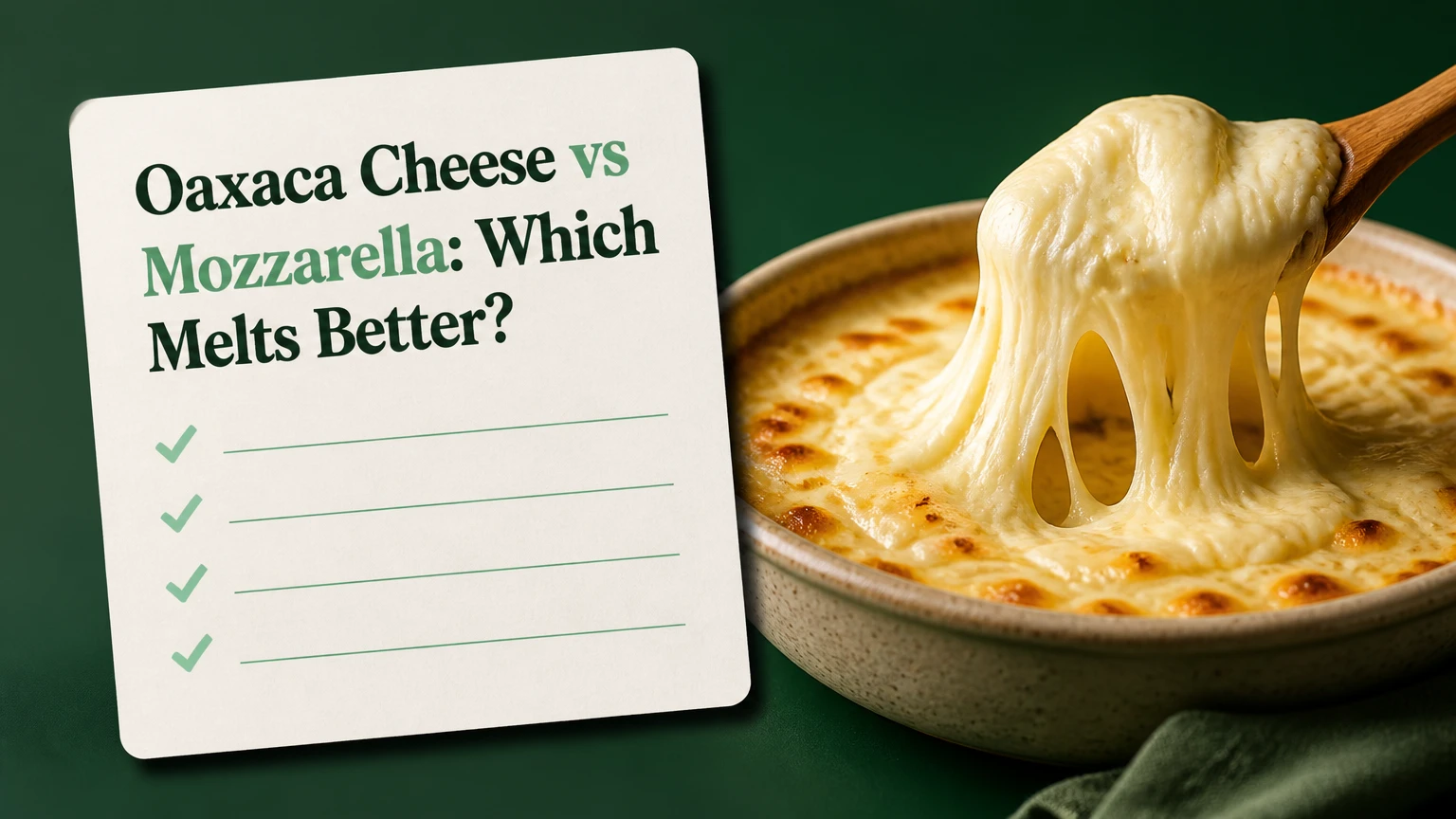
Oaxaca cheese is usually the better choice for Mexican-style dishes because it has a saltier buttery flavor, peels into long strands, and melts into a cohesive filling. Mozzarella is usually better for pizza, baked pasta, and applications requiring predictable browning, especially low-moisture mozzarella. Fresh mozzarella is milder and wetter than either standard Oaxaca or low-moisture mozzarella.
Key Facts at a Glance
Oaxaca cheese and mozzarella are both pasta filata cheeses made by stretching acidified curd in hot water.
Oaxaca cheese usually tastes saltier and more buttery, while mozzarella tastes milder and milkier.
Oaxaca cheese is formed into ribbons and wound into a ball, so it should be peeled or pulled into strands.
Fresh mozzarella contains more water than low-moisture mozzarella and can make pizza or pastry soggy.
Low-moisture mozzarella usually browns more evenly than Oaxaca cheese in a domestic oven.
Oaxaca cheese is the closest functional substitute for mozzarella in quesadillas, while low-moisture mozzarella is the stronger pizza substitute.
What Is the Difference Between Oaxaca Cheese and Mozzarella?
Oaxaca cheese is a Mexican stretched-curd cheese, traditionally associated with Oaxaca state and often called quesillo. Mozzarella is an Italian stretched-curd cheese with several distinct forms, including fresh cow’s-milk mozzarella, buffalo mozzarella, and low-moisture block mozzarella.
Both belong to the pasta filata family. Their curds are acidified, heated, stretched, and shaped while warm, but their final forms and intended uses differ. Oaxaca is commonly pulled into ribbons, cooled in salted water, and wound into a ball that resembles yarn. Fresh mozzarella is shaped into smooth balls and stored in water, whey, or light brine.
The comparison becomes misleading when “mozzarella” means several different products. A wet fior di latte ball behaves very differently from a dry pizza block. Typical Oaxaca sold in a vacuum pack sits between those products in moisture and cooking behavior.
Are Oaxaca Cheese and Mozzarella the Same Cheese?
Oaxaca cheese and mozzarella are related cheeses, not identical cheeses. They share the stretched-curd technique and an elastic casein structure, but their cultures, salting, shapes, moisture levels, and culinary traditions create different results.
Oaxaca’s ribbon structure makes hand-pulling easy and gives fillings a pronounced fibrous texture. Mozzarella’s smooth ball or block structure supports slicing, grating, portioning, and standardized baking. Some commercial Oaxaca products are intentionally mild and dry, so the label and package condition matter more than the name alone.
How Does the Pasta Filata Method Affect the Melt?
Pasta filata cheese melts because acidification changes the curd’s calcium balance, then hot water and kneading align casein proteins into elastic strands that hold fat and moisture. The final moisture, acidity, salt level, and shape determine whether the cheese stretches, flows, browns, or releases liquid.
Cheesemaking references from the Wisconsin Center for Dairy Research describe pasta filata as a process in which curd is heated and stretched to develop mozzarella’s characteristic fibrous body. The method creates a family resemblance, not a fixed finished texture.
The usual sequence is:
- Milk is acidified with starter cultures, food-grade acid, or both.
- Rennet helps form a casein curd.
- The curd is cut, cooked, and drained from whey.
- The curd reaches a workable acidity, often near pH 5.1-5.4.
- Hot water relaxes the protein network.
- Stretching and kneading align the proteins.
- The cheese is shaped, cooled, salted, and packaged.
A curd that is too acidic can become fragile and grainy. A curd that is insufficiently acidified may resist stretching and produce a firm, broken texture. At home, the more common failure is excessive cooking: temperatures above roughly 85°C can drive out moisture and fat, leaving a greasy or rubbery result.
Oaxaca and Mozzarella Production Differences
The most important production difference is the shaping stage. Oaxaca cheese is pulled into long ribbons before cooling and winding, whereas mozzarella is commonly portioned into balls or formed into blocks for later slicing or shredding.
| Production attribute | Oaxaca cheese | Fresh mozzarella | Low-moisture mozzarella |
|---|---|---|---|
| Traditional region | Oaxaca, Mexico | Southern Italy | Industrial and regional dairy production |
| Curds | Acidified cow’s-milk curd | Cow’s-milk or buffalo-milk curd | Cow’s-milk curd |
| Stretching medium | Hot water, typically 70-80°C | Hot water, typically 70-80°C | Hot water, followed by drying |
| Final shape | Ribbons wound into a ball | Balls, knots, or small spheres | Blocks, loaves, or shreds |
| Salting method | Salted cooling water or brine | Light brine, whey, or salted water | Brine followed by drainage and drying |
| Typical commercial time | Same day to several days | Same day to several days | Several days to longer, depending on drying |
| Main structural trait | Peelable fiber bundles | Smooth, moist elastic body | Dense, grateable baking body |
The overview’s production times of 3-8 hours are plausible for some factory processes, but they are not universal specifications. Culture activity, milk composition, curd size, cooling, drying, and packaging can extend the process.
How Do Oaxaca Cheese and Mozzarella Compare?
Oaxaca cheese is generally saltier, more buttery, and easier to peel into long strands. Mozzarella is generally milder and milkier, with fresh mozzarella releasing more liquid and low-moisture mozzarella producing a drier, more controlled melt.
| Decision criterion | Oaxaca cheese | Fresh mozzarella | Low-moisture mozzarella |
|---|---|---|---|
| Typical moisture | About 40-50% | About 52-60% | About 45-52% |
| Flavor | Salty, buttery, lightly tangy | Mild, milky, lightly tangy | Mild, savory, sometimes bland |
| Texture before heating | Fibrous and peelable | Soft, wet, delicate | Firm, sliceable, grateable |
| Stretch | Long, visible strands | Soft, fluid stretch | Strong, controlled pull |
| Melt flow | Moderate and cohesive | High and watery if over-portioned | Moderate and even |
| Browning in home oven | Patchy to moderate | Limited when very wet | Reliable and even |
| Best format | Hand-peeled strands | Torn or sliced pieces | Grated or shredded block |
| Typical United States retail price | $8-$15 per pound | $7-$16 per pound | $4-$9 per pound |
These are typical retail and composition ranges, not legal identities. A dry Oaxaca product may behave closer to low-moisture mozzarella, while a very wet mozzarella may act more like a fresh curd cheese than a pizza cheese.
Which Cheese Tastes Saltier?
Oaxaca cheese usually tastes saltier than mozzarella because its ribbon strands are commonly cooled and seasoned in salted water, while many mozzarella styles are designed around a mild, milky profile. Salt intensity varies by brand, package age, and whether the cheese is rinsed or combined with seasoned ingredients.
Salt affects more than flavor. Salt draws water toward the surface, modifies protein interactions, and can make a melt feel firmer. A salty Oaxaca ball can season beans, vegetables, or folded tortillas without additional cheese. Low-salt mozzarella gives a cleaner base when tomato sauce, cured toppings, or a heavily seasoned filling supplies the flavor.
Which Cheese Melts Better?
Low-moisture mozzarella usually melts and browns best on a standard home-oven pizza. Oaxaca cheese usually gives the most attractive hand-pulled stretch in a skillet or folded tortilla, while fresh mozzarella offers the softest, wettest melt and performs best when its liquid is controlled.
“Melt” has four separate meanings:
| Melt result | Best option | Typical reason | Common application |
|---|---|---|---|
| Long strand pull | Oaxaca cheese | Ribbon fibers remain visible | Quesadilla or stuffed pepper |
| Smooth liquid coverage | Fresh mozzarella | High moisture softens the body | Caprese-style bake |
| Browning and crust control | Low-moisture mozzarella | Lower free water supports surface color | Pizza or baked pasta |
| Salty cohesive filling | Oaxaca cheese | Brined strands hold together | Tortilla filling or casserole |
Oaxaca can brown, but its surface may darken or release fat before it develops the uniform golden pattern associated with low-moisture mozzarella. Fresh mozzarella can brown in a very hot oven, although a large wet portion often steams before it colors.
Which Cheese Is Better for Pizza, Quesadillas, and Baking?
Oaxaca cheese is better for quesadillas, tortas, chiles rellenos, and other fillings where strand formation and savory flavor matter. Low-moisture mozzarella is better for pizza and baked pasta, while fresh mozzarella suits high-temperature, short-bake dishes when the cheese is drained first.
| Dish or technique | Preferred cheese | Portion guidance | Preparation | Expected result |
|---|---|---|---|---|
| Skillet quesadilla | Oaxaca cheese | 45-60 g per tortilla | Peel into 1-2 cm strands | Fast, cohesive melt |
| Home-oven pizza | Low-moisture mozzarella | 100-140 g per 30 cm pizza | Grate from a block | Controlled melt and browning |
| High-heat pizza | Fresh mozzarella | 80-120 g per 30 cm pizza | Drain 20-30 minutes | Soft pools with less runoff |
| Stuffed poblano | Oaxaca cheese | 60-90 g per pepper | Peel into strands | Stretchy interior |
| Baked pasta | Low-moisture mozzarella | 100-150 g per 450 g pasta | Grate and combine with sauce | Even coverage |
| Tomato and cheese salad | Fresh mozzarella | 100-125 g per serving | Tear by hand | Moist, delicate texture |
| Grilled sandwich | Oaxaca or low-moisture mozzarella | 50-70 g per sandwich | Peel or grate | Melting center without excess water |
Is Oaxaca Cheese Good on Pizza?
Oaxaca cheese works on pizza when the cook wants a stretchy, salty topping and accepts less predictable browning. Use 90-120 grams on a 30-centimeter pizza, peel it thinly, and bake it with moderate toppings so its moisture does not soften the crust.
For a conventional home oven at 230-260°C, low-moisture mozzarella is usually the safer primary cheese. Oaxaca can be blended with it at a ratio of 1:2, adding flavor and pull without making the entire surface wet. This blend is particularly useful when a pizza needs a more pronounced cheese character than mild block mozzarella provides.
Is Oaxaca Cheese Better for Quesadillas?
Oaxaca cheese is usually better for quesadillas because its ribbon structure melts quickly between tortillas without requiring fine grating. Peel the ball along its natural grain, distribute the strands in a thin layer, and cook over medium heat until the tortilla is crisp and the center reaches roughly 60-70°C.
A thick layer is a common mistake. Excess cheese delays melting and can force the tortilla to burn before the center softens. Oaxaca’s salt also means that a filling with salty beans, seasoned vegetables, or prepared sauces may need less added seasoning.
Can Oaxaca Cheese Replace Mozzarella?
Oaxaca cheese can replace mozzarella in quesadillas, stuffed vegetables, sandwiches, casseroles, and many baked dishes. Oaxaca is a less reliable substitute for low-moisture mozzarella on pizza when uniform browning and low water release are the main goals.
| Original mozzarella use | Oaxaca substitution | Adjustment required | Substitution result |
|---|---|---|---|
| Quesadilla | 1:1 by weight | Peel instead of grate | Excellent |
| Stuffed pepper | 1:1 by weight | Reduce added salt | Excellent |
| Baked pasta | 1:1 by weight | Drain surface moisture | Very good |
| Home pizza | 0.75-1:1 by weight | Use thinner strands and fewer toppings | Good, softer crust risk |
| Fresh tomato salad | 1:1 by weight | Serve in smaller torn pieces | Different, saltier |
| Cheese sauce | 0.5-0.75:1 by weight | Grate finely and combine with a smoother cheese | Variable |
| Fried cheese filling | 1:1 by weight | Chill before shaping | Very good |
Mozzarella can replace Oaxaca when the recipe needs a mild, elastic cheese rather than Oaxaca’s salty, buttery identity. For a quesadilla, low-moisture mozzarella may need extra salt or a more strongly seasoned filling, and fresh mozzarella should be drained so the tortilla does not steam.
How Should Each Cheese Be Prepared Before Cooking?
Oaxaca cheese should be peeled into strands, while mozzarella preparation depends on its form: drain and tear fresh mozzarella, or grate low-moisture mozzarella from a block. Preparation controls moisture distribution, melting speed, and the size of the exposed surface.
Follow these handling rules:
- Peel Oaxaca by hand. Unwind the outer ribbon and pull with the grain. Avoid cutting the ball into cubes, which produces uneven melting.
- Drain fresh mozzarella. Place slices or torn pieces on absorbent towels for 20-30 minutes. Replace the towel if the surface remains visibly wet.
- Grate low-moisture mozzarella cold. Refrigerate the block for 20 minutes before grating for cleaner shreds.
- Avoid very fine shreds. Shreds around 3-5 millimeters melt evenly without drying as quickly as powder-fine particles.
- Add cheese late to a hot dish. Prolonged exposure above 75-80°C increases the chance of fat separation and a rubbery protein network.
Pre-shredded cheese can melt less smoothly because cellulose or starch-based anti-caking coatings separate the particles. Whole cheese that is peeled, sliced, or grated immediately before cooking usually provides a more cohesive surface.
Why Does Oaxaca Cheese Become Rubbery?
Oaxaca cheese becomes rubbery when excessive heat removes moisture and tightens the casein network. The same failure can occur with mozzarella, especially when a dry cheese is cooked too long after it has already melted.
Use medium heat in a skillet and remove the dish as soon as the strands merge. Under a broiler, keep the cheese 10-15 centimeters from the element and watch continuously because surface browning can progress faster than internal melting.
How Do Cost, Nutrition, and Storage Compare?
Low-moisture mozzarella is usually the least expensive option, while Oaxaca cheese and specialty fresh mozzarella often cost more per pound. Nutrition varies by brand, but all three products commonly provide substantial protein, fat, and sodium, so the package’s serving data is more reliable than the cheese category.
| Product | Typical calories per 28 g | Typical protein | Typical fat | Typical sodium | Opened storage |
|---|---|---|---|---|---|
| Oaxaca cheese | 80-100 kcal | 5-7 g | 6-8 g | 150-250 mg | 7-14 days refrigerated |
| Fresh cow mozzarella | 70-85 kcal | 5-6 g | 5-6 g | 80-180 mg | 3-5 days in liquid |
| Buffalo mozzarella | 80-100 kcal | 4-6 g | 6-8 g | 100-220 mg | 2-4 days in liquid |
| Low-moisture mozzarella | 80-90 kcal | 6-7 g | 6-7 g | 150-220 mg | 2-3 weeks refrigerated |
The ranges above are typical label ranges, not standardized values. Reduced-fat mozzarella may contain less fat but can melt differently because manufacturers adjust protein, moisture, and stabilizers.
Keep unopened cheese according to its package date and refrigeration instructions. Once opened, wrap Oaxaca or block mozzarella tightly, limit air exposure, and discard cheese with unexpected slime, strong sour odor, pink or green discoloration, or visible mold. Do not rely on the longer storage range for wet mozzarella stored in liquid.
Which Cheese Is Healthier?
Neither Oaxaca cheese nor mozzarella is automatically healthier. Fresh mozzarella often has less sodium per serving, while low-moisture mozzarella can provide slightly more protein by weight because it contains less water; the label, portion, and dietary requirement determine the practical choice.
For sodium reduction, compare brands directly and select a product with lower milligrams per serving. For calorie control, weigh the portion because a large handful of shredded cheese can exceed the package’s 28-gram serving quickly. For lactose sensitivity, aged cheese is often lower in lactose than fresh cheese, but Oaxaca and mozzarella are generally fresh or lightly matured products, so individual tolerance matters.
What Are the Main Oaxaca and Mozzarella Varieties?
Oaxaca cheese is sold primarily as traditional quesillo or as pasteurized commercial balls and blocks. Mozzarella has a wider market vocabulary, with fresh cow’s-milk, buffalo-milk, smoked, stracciatella-filled, shredded, and low-moisture forms.
| Variety | Milk or format | Moisture behavior | Flavor profile | Best use |
|---|---|---|---|---|
| Traditional quesillo | Usually cow’s milk | Moderate, strand-forming | Salty and buttery | Quesadillas |
| Commercial Oaxaca | Pasteurized cow’s milk | Moderate, often firmer | Mild to salty | Everyday Mexican dishes |
| Fior di latte | Fresh cow’s milk | High, liquid-packed | Clean and milky | Salads and fast bakes |
| Mozzarella di bufala | Water buffalo milk | High and creamy | Rich, tangy, milky | Fresh serving |
| Low-moisture block | Cow’s milk, dried body | Lower free water | Mild and savory | Pizza and casseroles |
| Smoked mozzarella | Cow’s milk, smoked surface | Moderate to low | Smoky and salty | Sandwiches and baked dishes |
Traditional production claims deserve careful reading. Oaxaca cheese is not automatically raw-milk, handmade, or more intensely flavored; many commercial products use pasteurized milk and standardized equipment. Likewise, mozzarella is not automatically bland because buffalo mozzarella and carefully made fresh cow’s-milk versions can have pronounced dairy sweetness and acidity.
What Problems Occur When Cooking These Cheeses?
The main failures are excess water, oil separation, rubbery texture, weak browning, and uneven melting. Each problem usually comes from a mismatch between cheese moisture, portion size, surface area, and cooking temperature.
| Failure mode | Likely cause | Correction | Prevention |
|---|---|---|---|
| Wet pizza center | Fresh mozzarella was not drained | Bake longer on a preheated surface | Drain 20-30 minutes |
| Greasy surface | Cheese overheated or portion was excessive | Blot and reduce heat | Use 100-140 g per 30 cm pizza |
| Rubbery strands | Cooking continued after melting | Remove at first full melt | Use medium heat |
| Bland quesadilla | Low-salt mozzarella replaced Oaxaca | Add seasoned filling or a small amount of salt | Choose Oaxaca for flavor |
| Uneven Oaxaca melt | Ball was cut into cubes | Peel along the ribbon | Use 1-2 cm strands |
| Weak browning | Cheese contains too much water | Use low-moisture mozzarella | Choose a drier block |
| Grainy cheese sauce | Cheese was boiled | Lower heat and add gradually | Keep sauce below a simmer |
One practitioner rule is especially useful: choose cheese by the water your dish can absorb. A tortilla, crisp crust, or flaky pastry has little tolerance for released liquid, while a saucy casserole can accommodate more moisture.
Another counterintuitive point is that more stretch does not mean a better melt. Long strands can remain elastic and chewy after the surrounding fat has separated, whereas a shorter, smoother melt may be preferable for a thin pizza or sauce.
A final rule concerns surface area. Fine shreds melt quickly but dry quickly; thick strands melt slowly but retain a stronger pull. Oaxaca’s natural ribbons offer a practical middle ground when peeled rather than chopped.
Which Cheese Should You Choose?
Choose Oaxaca cheese for quesadillas, stuffed peppers, Mexican sandwiches, and fillings where salt and strand texture matter. Choose low-moisture mozzarella for home pizza, baked pasta, and reliable browning. Choose fresh mozzarella for salads or short, hot bakes where a moist, soft texture is desirable.
Choose Oaxaca Cheese If You Need
- A salty, buttery flavor that can season the dish.
- Long strands that pull apart visibly.
- A filling that remains cohesive inside a tortilla or vegetable.
- A cheese associated with Mexican culinary tradition.
- A moderate-moisture cheese that is less wet than water-packed mozzarella.
Choose Fresh Mozzarella If You Need
- A mild, milky flavor.
- Soft pieces that tear easily.
- A wet, creamy texture for fresh serving.
- A short, high-temperature bake.
- A cheese that pairs with uncooked tomatoes and herbs.
Choose Low-Moisture Mozzarella If You Need
- Consistent melting across a broad surface.
- Predictable browning in a domestic oven.
- Lower water release on pizza.
- Easy grating and portion control.
- A lower typical price than specialty Oaxaca or buffalo mozzarella.
FAQ
Does Oaxaca cheese taste like mozzarella?
Oaxaca cheese tastes similar to mozzarella because both are mild stretched-curd cheeses, but Oaxaca usually has more salt and a buttery, savory character. Fresh mozzarella is softer and milkier, while low-moisture mozzarella is denser and can taste more neutral. Brand-level variation can narrow or widen the difference.
Can you shred Oaxaca cheese?
Oaxaca cheese is better peeled or pulled into strands than shredded with a box grater. Unwind the yarn-like ball along its natural ribbon, then separate the strands into pieces about 1-2 centimeters wide. This method preserves its fibrous structure and produces a more even melt.
Can you freeze Oaxaca cheese and mozzarella?
You can freeze both cheeses, but freezing changes texture by creating ice crystals that disrupt the protein and moisture structure. Low-moisture mozzarella tolerates freezing best for cooked dishes, while fresh mozzarella may become crumbly and watery after thawing. Thaw refrigerated, then use the cheese in a baked recipe.
Why is fresh mozzarella watery on pizza?
Fresh mozzarella is watery on pizza because its moisture is packaged in the cheese’s soft body and surrounding liquid. Drain sliced or torn pieces on towels for 20-30 minutes, use a moderate portion, and bake on a fully heated surface. Low-moisture mozzarella avoids most of this problem.
Is Oaxaca cheese suitable for baked pasta?
Oaxaca cheese works well in baked pasta when peeled into thin strands and combined with a sauce that can absorb moderate moisture. Its saltiness may require less added seasoning. For a browned top, combine Oaxaca with low-moisture mozzarella or use the Oaxaca beneath a thinner layer of drier cheese.
Which cheese is closer to string cheese?
Oaxaca cheese is structurally closer to string cheese when pulled by hand because its ribbons separate into long fibers. String cheese itself is usually a low-moisture pasta filata product shaped into individual rods, while Oaxaca is wound into a larger ball and often has more salt and moisture.
The Bottom Line
Oaxaca cheese vs mozzarella is a choice between a saltier, peelable Mexican stretched-curd cheese and a broader Italian cheese family with fresh and low-moisture forms. Oaxaca is the stronger choice for quesadillas and stuffed fillings. Low-moisture mozzarella is the stronger choice for pizza and browning. Fresh mozzarella is the strongest choice for soft, moist serving and short high-heat bakes.