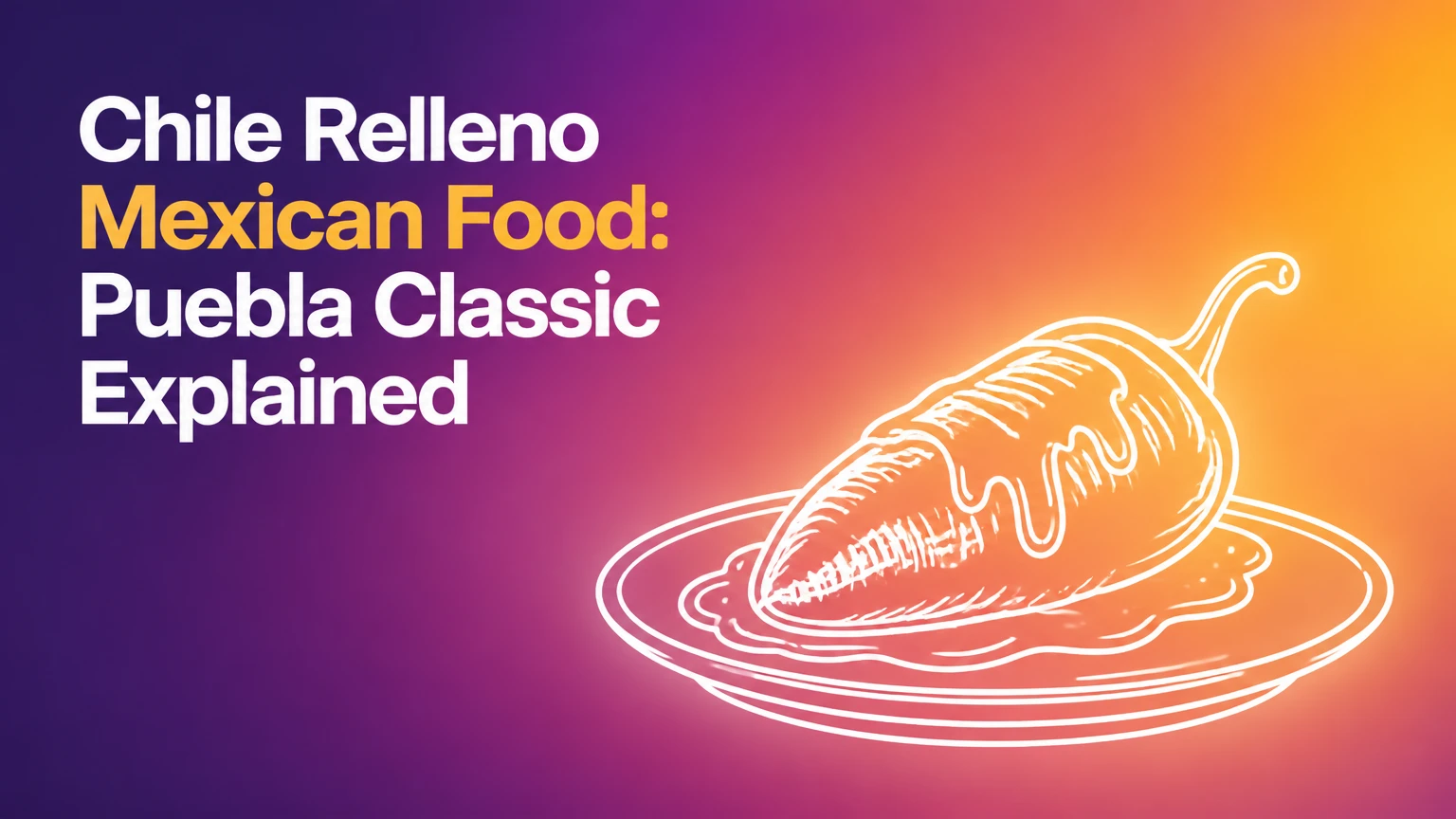
Chile relleno is a Mexican dish made by stuffing a roasted poblano pepper with cheese, seasoned meat, or another filling, coating it in whipped-egg capeado, and frying it until golden. The finished pepper is commonly served with tomato caldillo, although sauces, fillings, and cooking methods vary by region and household.
Key Facts About Chile Relleno
- “Chile relleno” means “stuffed chile” in Spanish.
- A traditional restaurant-style version usually uses a roasted poblano pepper.
- Capeado is an egg-based batter made from separated eggs, rather than a thick breadcrumb coating.
- Caldillo de jitomate is the classic light tomato sauce served with many fried versions.
- A traditional preparation typically takes 60-90 minutes from roasting to serving.
- Typical restaurant prices range from $12-$22 in the United States, with seasonal chiles en nogada often costing more.
What Is Chile Relleno Mexican Food?
Chile relleno Mexican food is a stuffed, roasted chile prepared as a main dish, usually with a tender poblano, a savory filling, an airy egg coating, and a thin sauce. The combination gives the dish four contrasting elements: smoky pepper, molten or hearty filling, crisp capeado, and bright tomato flavor.
The word relleno describes the preparation, not one fixed recipe. A cheese-filled poblano from a family kitchen, a picadillo-filled chile at a sit-down restaurant, and a battered seasonal pepper can all belong to the same culinary family.
The traditional form differs from a breaded jalapeño popper. Jalapeño poppers are usually small appetizers filled with cream cheese and coated with crumbs or flour. A chile relleno is generally larger, plated with sauce, and substantial enough to accompany rice, beans, or tortillas.
Where did the dish originate?
Chile relleno is strongly associated with Puebla and with the colonial-era blending of Indigenous Mexican ingredients and Spanish cooking practices. The exact origin is less certain than the popular summary suggests because stuffed peppers developed across Mexico, and regional cooks use different peppers, fillings, sauces, and coatings.
Puebla remains important because chiles en nogada, one of Mexico’s best-known stuffed poblano preparations, is associated with the city. Broader chile relleno traditions appear in central, western, northern, and border regions, where Anaheim, Hatch, ancho, or other peppers may replace poblano.
How Does a Traditional Chile Relleno Work?
A traditional chile relleno works because the pepper, filling, capeado, and sauce solve different culinary problems. Roasting softens the pepper and loosens its skin, the filling supplies weight and flavor, whipped egg creates a light protective coating, and caldillo adds moisture and acidity after frying.
The method is sensitive to moisture and timing. A wet pepper rejects flour, a loose seam allows cheese to escape, and oil below 350°F can produce a greasy coating before the center becomes hot. The best results come from preparing the sauce and filling first, then battering and frying immediately.
Why is the capeado light and fluffy?
Capeado becomes light because whipped egg whites trap air in a protein foam. Flour dusted onto the dry pepper gives that foam a surface to grip, while the yolks add richness and color without replacing the structure of the whites.
Serious Eats and ThermoWorks both emphasize immediate frying after battering because the foam loses volume as it sits. Egg whites should reach firm peaks, but excessive whipping creates a dry, grainy foam that folds poorly and breaks more easily.
What role does the caldillo play?
Caldillo de jitomate is a thin tomato sauce that balances the fried coating with acidity, salt, and moisture. The sauce should be warm and pourable, not thick like pasta sauce, because a heavy sauce can overwhelm the pepper and soften the capeado too quickly.
For a crisp exterior, place a shallow pool of caldillo under the chile rather than covering the entire top. Diners who prefer a softer, saucier dish can spoon more over the center immediately before eating.
Which Peppers and Fillings Work Best?
Poblano is the standard pepper for a full-size chile relleno because its broad cavity, thick wall, and moderate heat can hold a substantial filling. Pepper heat varies naturally, so two poblanos from the same market may taste very different.
Choose peppers that are broad, firm, and relatively straight, with unbroken skin and a stem attached. Curved peppers are harder to slit, peel, flour, and close without tearing.
| Pepper | Typical size | Flavor and heat | Best use |
|---|---|---|---|
| Poblano | 5-7 inches | Earthy, moderate and variable heat | Traditional cheese or picadillo relleno |
| Anaheim | 6-8 inches | Mild to medium, grassy flavor | Larger mild portions and northern-style versions |
| Hatch green chile | 5-8 inches | Roasted, vegetal, heat varies by variety | Southwestern adaptations |
| Pasilla | 6-8 inches | Dark, raisin-like, smoky flavor | Rich fillings and sauce-forward dishes |
| Jalapeño | 2-3 inches | Brighter, sharper heat | Small appetizers and popper-style versions |
What fillings are traditional?
Cheese and picadillo are the two broad filling categories most associated with battered chiles rellenos. Cheese should melt without releasing excessive water, while meat filling should be fully cooked, relatively dry, and cooled before it enters the pepper.
Queso Oaxaca, Chihuahua, and asadero provide useful melt and stretch. Low-moisture mozzarella or Monterey Jack can work as substitutes, but fresh high-water cheeses may leak or make the coating steam rather than crisp.
| Filling | Core ingredients | Preparation requirement | Texture after frying |
|---|---|---|---|
| Oaxaca cheese | Oaxaca cheese, optional epazote | Use a firm stick or folded piece | Stretchy and molten |
| Chihuahua cheese | Chihuahua cheese | Cut into a compact block | Smooth and rich |
| Picadillo | Ground beef, tomato, onion, raisins, almonds, spices | Cook until nearly dry and cool completely | Hearty and crumbly |
| Vegetable | Squash, corn, mushrooms, onion, cheese | Sauté until surface moisture evaporates | Tender with defined pieces |
| Seafood | Cooked shrimp or firm fish, aromatics | Chill and drain before stuffing | Delicate and savory |
A practical rule is to fill each pepper to about 70-80% of its usable cavity. Overfilling forces the seam open, while a small filling leaves an unstable, collapsed center.
Is chile en nogada the same dish?
Chile en nogada is a related stuffed poblano preparation, but it is not interchangeable with the everyday fried cheese chile relleno. Chiles en nogada traditionally use a sweet-savory picadillo, walnut-based white sauce, and pomegranate seeds, and the pepper may be served without capeado or with a lighter treatment depending on the recipe.
The dish has a strong seasonal association with late summer and early autumn in Mexico. Its white, green, and red presentation is linked to Mexican national symbolism, while ordinary chile relleno has no single required color scheme or filling.
How Do You Make a Traditional Cheese Chile Relleno?
A traditional cheese chile relleno takes about 60-90 minutes, including roasting, steaming, sauce preparation, battering, and frying. The method below makes four servings, and the factor that most determines success is keeping the peeled peppers dry while maintaining oil between 350°F and 375°F.
Before You Start
| Item | Typical requirement | Practical specification |
|---|---|---|
| Poblano peppers | 4 | Broad, firm, 5-7 inches long |
| Melting cheese | 8-12 ounces | Four compact sticks or blocks |
| Eggs | 4 large | Separate at room temperature |
| Frying oil | 4-6 cups | Use a neutral high-heat oil |
| Flour | 1/2 cup | For a dry coating before capeado |
| Tomatoes | 1 pound | For approximately 2 cups caldillo |
| Total time | 60-90 minutes | Frying begins after all peppers are stuffed |
| Typical home cost | $15-$30 | Varies by cheese and oil prices |
Step 1: Roast the Poblanos
Place the peppers under a broiler, over a gas flame, or on a very hot cast-iron surface. Turn them with tongs until roughly 80-90% of the skin is blistered and blackened, while the walls remain firm enough to hold filling.
Transfer the hot peppers to a covered bowl or paper bag for 10-15 minutes. You will know the roasting worked when the skin wrinkles and separates from the flesh. Do not roast until the pepper collapses.
Common mistake: Leaving peppers uncovered allows steam to escape, making the skin harder to remove.
Step 2: Peel and Clean Them
Rub away the charred skin with your fingers or a paper towel. Avoid rinsing the peppers under running water because extensive rinsing removes smoky oils and can leave the surface too wet for flour.
Make a vertical slit from just below the stem toward the tip. Remove the seed pod and visible ribs carefully, keeping the stem attached. Pat the outside and cavity dry with paper towels.
Success checkpoint: The pepper should feel pliable but retain a complete wall around the cavity.
Step 3: Prepare the Caldillo
Blend 1 pound of tomatoes with one small piece of onion, one garlic clove, and about 1/2 cup of water. Strain if you want a smoother sauce, then simmer the mixture with salt and Mexican oregano for 15-20 minutes.
The caldillo is ready when it coats a spoon lightly but still pours easily. Keep it warm in a separate pan while you fry the peppers.
Common mistake: Reducing the sauce until thick makes the final plate heavy and softens the egg coating rapidly.
Step 4: Stuff and Close the Peppers
Insert one compact cheese stick into each dry pepper, leaving enough room for the walls to overlap. Use a toothpick only when necessary, and position it across the seam so it can be removed before serving.
For picadillo, use approximately 1/2-3/4 cup of cooled filling per large poblano. Hot filling creates steam inside the pepper and can weaken the batter during frying.
Success checkpoint: The pepper closes with gentle pressure and no filling protrudes through the slit.
Step 5: Whip the Capeado
Separate four eggs. Beat the whites with a small pinch of salt until firm peaks form, then fold in the yolks one at a time. Fold in 1 tablespoon of flour if you want additional stabilization.
The mixture should look glossy and hold ridges from the whisk. Prepare it immediately before frying; waiting 20-30 minutes allows the foam to weaken.
Common mistake: Folding aggressively removes the air that gives capeado its characteristic light texture.
Step 6: Flour, Coat, and Fry
Roll each pepper in flour, covering the entire surface, then tap off the excess. Hold the pepper by its stem, dip it into the egg mixture, and turn it until the coating covers the body.
Heat 2-3 inches of oil to 350-375°F. Fry no more than two peppers at once for about 2-3 minutes per side, turning once when the underside is golden. Drain on a rack or paper towels, then serve over warm caldillo.
Success checkpoint: The coating is evenly golden, the pepper feels firm, and the cheese is soft without escaping into the oil.
What Are the Main Cooking Options?
Deep-frying gives traditional chile relleno the lightest capeado and most immediate contrast between crisp exterior and molten filling. Baking and air frying reduce oil handling, but they cannot reproduce the same egg-foam expansion because the batter heats more gradually and loses moisture differently.
| Method | Temperature | Typical time | Texture and best use |
|---|---|---|---|
| Deep fry | 350-375°F oil | 5-7 minutes per batch | Airy, crisp coating; traditional serving |
| Oven bake | 400°F | 18-25 minutes | Softer coating; weeknight preparation |
| Air fry | 375-400°F | 10-16 minutes | Drier exterior; small batches |
| Casserole | 375°F | 25-35 minutes | Family meal; no intact capeado |
| Unbattered roast | 425°F | 15-20 minutes | Lowest mess; sauce carries the dish |
Baked chile relleno is useful for meal preparation and lower-oil diets, but it is not a precise replica of the fried version. A casserole is better understood as a chile relleno-inspired dish because the peppers are usually arranged together and the coating cannot remain individually inflated.
How should you adapt the dish for dietary needs?
For a gluten-free version, replace wheat flour with rice flour or cornstarch for the pre-coating, and verify that the cheese, spices, and prepared sauce contain no wheat ingredients. For a vegetarian meal, use cheese, mushrooms, corn, squash, beans, or lentils while controlling their moisture.
A lower-oil version can use roasted peppers with warm caldillo and melted cheese, but the dish will lose the fried shell. That trade-off is honest and often preferable to a poorly baked egg coating that becomes leathery.
How Much Time, Nutrition, and Money Should You Expect?
A home cook should plan on 60-90 minutes for traditional chile relleno, while a restaurant kitchen can serve the dish faster because peppers, sauce, and fillings are prepared in advance. Typical restaurant pricing is approximately $12-$16 at casual establishments and $16-$22 at mid-scale Mexican restaurants in the United States.
| Factor | Typical range | Main variable | Practical interpretation |
|---|---|---|---|
| Home preparation | 60-90 minutes | Peeling and frying speed | Four servings from one active cooking session |
| Restaurant price | $12-$16 | Casual venue and combo plate | Often includes rice and beans |
| Restaurant price | $16-$22 | Sit-down specialty entree | More likely to include house sauce |
| Seasonal nogada price | $18-$25 or 300+ MXN | Walnuts, fruit, seasonality | Premium seasonal preparation |
| Energy estimate | 290-400 calories | Filling, oil absorption, portion | Typical medium cheese or meat version |
The calorie range is a planning estimate, not a universal nutrition value. Cheese quantity, batter thickness, oil temperature, and serving size can shift the result substantially, so a recipe-specific calculation is more reliable than a generic database entry.
How Does Chile Relleno Compare With Similar Dishes?
Chile relleno is defined by a whole pepper that remains the visible container for a filling. Enchiladas, stuffed peppers, and poppers may share ingredients, but their construction, coating, and serving format differ.
| Dish | Pepper format | Coating | Typical sauce or finish | Usual role |
|---|---|---|---|---|
| Chile relleno | Whole roasted poblano | Whipped egg capeado | Tomato caldillo | Main dish |
| Chile en nogada | Whole poblano | Variable, often no heavy batter | Walnut sauce and pomegranate | Seasonal main dish |
| Enchilada | Tortilla-wrapped filling | No egg coating | Red, green, or mole sauce | Main dish |
| Jalapeño popper | Small jalapeño | Crumbs or flour | Cream, cheese, or no sauce | Appetizer |
| Stuffed bell pepper | Whole sweet pepper | Usually none | Tomato, cheese, or pan sauce | Main dish |
The closest substitute depends on the goal. Choose an enchilada for a saucier, easier meal; a popper for a small appetizer; and a baked stuffed poblano when low-oil preparation matters more than traditional capeado.
What Commonly Goes Wrong?
Batter sliding, oiliness, and cheese leakage usually result from moisture, temperature, or structural problems rather than from the recipe itself. Dry peppers, compact fillings, firm egg peaks, and stable frying heat prevent most failures before they occur.
| Failure | Likely cause | Immediate fix | Prevention |
|---|---|---|---|
| Batter slides off | Wet pepper or missing flour | Pat dry and flour completely | Dry the cavity and exterior |
| Batter turns greasy | Oil below 350°F | Fry fewer peppers and restore heat | Use a thermometer |
| Batter burns | Oil above 375°F | Lower heat and replace dark oil | Monitor between batches |
| Cheese escapes | Torn seam or overfilling | Remove leaked cheese and finish carefully | Use a compact block |
| Coating collapses | Overmixed whites or delayed frying | Rewhip fresh eggs | Batter only when oil is ready |
| Pepper splits | Over-roasting or rough peeling | Use the least damaged pepper | Turn gently and retain the wall |
A counterintuitive practitioner rule is that a slightly under-roasted pepper is easier to fry successfully than an over-roasted pepper. The under-roasted skin takes more effort to remove, but the wall remains strong; a collapsed wall cannot protect the filling.
Another useful rule is to fry one test pepper first. The test reveals whether the batter is too thin, the oil is too hot, or the seam needs reinforcement before the remaining portions enter the pan.
Can you prepare chile relleno ahead of time?
Prepare the caldillo, roast the peppers, and cook the filling up to one day ahead, but stuff and batter the peppers shortly before frying. Refrigerated stuffed peppers accumulate condensation, and that moisture reduces flour adhesion and makes capeado less stable.
For leftovers, refrigerate the cooked peppers in a shallow covered container within two hours. Reheat them on a rack in a 375°F oven for 10-15 minutes; a microwave warms the center but makes the coating soft.
How Should You Order Chile Relleno at a Restaurant?
A good restaurant chile relleno should have a distinct pepper shape, a thin golden coating, a hot filling, and sauce that tastes freshly seasoned rather than concentrated or oily. Ask whether the kitchen fries the peppers to order when the menu description is unclear.
| Restaurant signal | What it suggests | Question to ask |
|---|---|---|
| “Capeado” on the menu | Egg-battered preparation | Is the batter made and fried to order? |
| Whole poblano listed | Traditional full-size format | Is the filling cheese or picadillo? |
| Specialty seasonal listing | Possible chiles en nogada | Is the pepper battered or served with nogada? |
| Very thick crumb coating | Nontraditional or popper-style method | Is the dish breaded rather than capeado? |
| Combo-only listing | Standardized portion | Can the kitchen serve it as a separate entree? |
Restaurant portions often include rice, beans, salad, or tortillas. A single large chile can be filling, while two smaller peppers may indicate an appetizer or lunch portion rather than a traditional dinner plate.
Frequently Asked Questions
Is chile relleno spicy?
Chile relleno can be mild, medium, or moderately hot because poblano heat varies by pepper and growing conditions. Removing seeds and ribs reduces some heat, but the pepper wall still carries flavor. Ask the restaurant about the current batch if you have low spice tolerance.
What cheese melts best in chile relleno?
Oaxaca, Chihuahua, and asadero are strong traditional choices because they soften smoothly and hold together inside the pepper. Low-moisture mozzarella and Monterey Jack are practical substitutes. Avoid very wet cheese unless you drain and pat it dry before stuffing.
What do you serve with chile relleno?
Serve chile relleno with tomato caldillo, Mexican rice, beans, tortillas, or a light salad. The side should provide contrast rather than another heavy fried component. A shallow layer of sauce under the pepper preserves more capeado texture than fully covering it.
Can chile relleno be made without eggs?
Chile relleno can be made without eggs by serving the stuffed roasted pepper unbattered, baking it with cheese, or using a flour-based coating. The result remains a stuffed chile, but it will not have the airy capeado associated with the traditional fried preparation.
Why is my chile relleno oily?
An oily chile relleno usually results from frying below 350°F, overcrowding the pan, or using a coating with excess moisture. Fry one or two peppers at a time, verify the oil temperature with a thermometer, and drain the finished peppers on a rack.
What is the difference between chile relleno and stuffed pepper?
Chile relleno usually refers to a roasted poblano that is filled, coated with egg batter, fried, and served with Mexican sauce. Stuffed pepper is a broader category that may use bell peppers, rice, grains, or meat without capeado or frying.
The Bottom Line
Chile relleno Mexican food is best understood as a flexible Mexican stuffed-pepper tradition rather than one rigid formula. For the classic experience, use a broad roasted poblano, a compact Oaxaca or Chihuahua cheese filling, freshly whipped capeado, oil at 350-375°F, and warm tomato caldillo served beneath the crisp pepper.