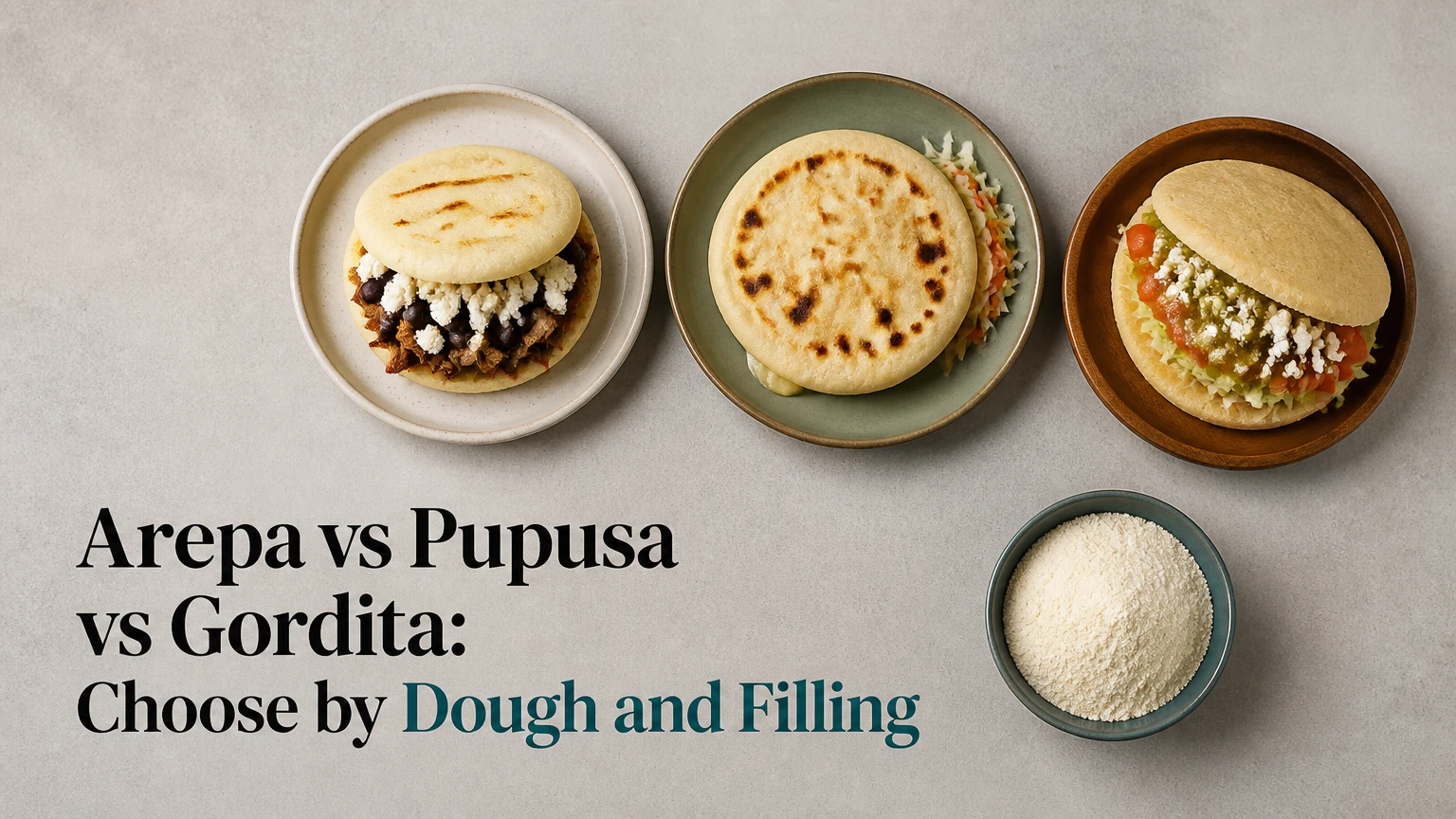
Arepas, pupusas, and gorditas are thick corn-based foods, but they are built differently: an arepa usually uses precooked corn flour and is opened after cooking, a pupusa encloses its filling before the griddle, and a gordita is typically slit after cooking and filled with stewed ingredients. Arepas come mainly from Colombia and Venezuela, pupusas from El Salvador, and gorditas from Mexico.
Key Facts at a Glance
- An arepa usually uses precooked corn flour, such as harina de maíz precocida, rather than nixtamalized masa harina.
- A pupusa seals cheese, beans, squash, or seasoned meat inside wet masa before cooking.
- A gordita is a thick Mexican masa preparation that may be griddled, baked, or fried before being opened.
- Arepas generally offer the largest filling cavity, while pupusas distribute filling through the center of the dough.
- Pupusas are traditionally served with curtido and tomato salsa; arepas and gorditas use more varied regional accompaniments.
- Typical home preparation takes 30-50 minutes, while cooking time per batch is usually 10-20 minutes.
What Separates an Arepa, Pupusa, and Gordita?
The decisive difference is not thickness. It is the relationship between the dough, the filling, and the cooking process. Arepas are normally cooked as plain patties and sliced open, pupusas are filled while raw and cooked as sealed discs, and gorditas are cooked thick enough to create a soft interior that can be opened afterward.
The foods also belong to different corn traditions. Arepa dough made with precooked flour hydrates quickly and produces a clean, dense crumb. Pupusa and gordita dough usually begins with fresh masa or masa harina made from nixtamalized corn, which has a more pronounced corn aroma and a softer, slightly more tortilla-like texture.
| Feature | Arepa | Pupusa | Gordita |
|---|---|---|---|
| Main regional identity | Colombia and Venezuela | El Salvador | Mexico |
| Usual dough | Precooked corn flour and water | Nixtamalized corn masa | Nixtamalized corn masa |
| Typical diameter | 10-15 cm | 10-13 cm | 8-12 cm |
| Typical thickness | 12-20 mm | 6-10 mm | 10-20 mm |
| Filling timing | After cooking | Before cooking | After cooking, usually |
| Main cooking method | Griddle, oven, or fryer | Comal or griddle | Comal, oven, or fryer |
| Typical texture | Firm shell, dense interior | Tender shell, melted center | Crisp or toasted shell, soft center |
| Signature accompaniment | Avocado, cheese, sauces | Curtido and tomato salsa | Salsa, onion, cilantro, lime |
A useful correction to simplified comparisons is that none of these rules is absolute. Colombian arepa de huevo is filled before frying, some gorditas are served plain, and regional arepas can be sweet, thin, grilled, or made with fresh corn.
Where Did These Foods Come From?
Arepas are strongly associated with Colombia and Venezuela, although related corn cakes occur across northern South America. Pupusas are identified with El Salvador, where the dish has national cultural importance. Gordita means “little fat one” in Spanish and describes a family of thick Mexican preparations rather than one single standardized recipe.
Pre-Columbian Indigenous corn cookery predates the modern national borders attached to these foods. That history explains why similar round corn preparations appear across Latin America, while local ingredients, cooking surfaces, and serving customs created distinct forms.
Merriam-Webster defines a gordita as “a thick tortilla” that is often filled, a concise definition that captures the form but not the regional variation. In practice, a gordita can refer to a griddled masa cake, a fried pocket, or a thicker tortilla opened for a guisado, depending on the Mexican region and vendor.
| Food | Geographic association | Historical food system | Modern restaurant identity |
|---|---|---|---|
| Arepa | Colombia, Venezuela | Indigenous ground-corn cakes | Filled breakfast, lunch, or street meal |
| Pupusa | El Salvador | Mesoamerican nixtamalized masa | Griddled filled dish with curtido |
| Gordita | Mexico | Regional masa and tortilla traditions | Stuffed masa cake with salsa or guisado |
The labels describe culinary families, not rigid international standards. A restaurant menu may use “gordita” for a fried shell, while a Mexican home cook may use the term for a thick comal-cooked tortilla.
How Does the Dough Change the Result?
Arepa dough uses precooked corn flour, so the flour has already undergone cooking and drying before it reaches the bowl. Pupusa and gordita dough usually uses nixtamalized corn, in which dried corn is treated with an alkaline solution, washed, and ground into masa or dried masa harina.
That processing changes handling. Precooked arepa flour absorbs water rapidly and forms a cohesive dough after a short rest. Nixtamalized masa has a more delicate structure, a stronger corn flavor, and a higher risk of edge cracking when the hydration is wrong.
| Dough choice | Water behavior | Best texture | Main risk | Typical correction |
|---|---|---|---|---|
| Precooked arepa flour | Hydrates in 3-8 minutes | Dense and sliceable | Dry edges | Add water by 5-10 ml |
| Fresh corn masa | Already hydrated | Soft and aromatic | Sticks or tears | Add masa or rest briefly |
| Masa harina | Hydrates in 10-20 minutes | Tender and flexible | Cracking after rest | Knead in water gradually |
| Rice flour for pupusas | Produces a softer, less corn-forward dough | Delicate and lightly chewy | Weak sealing | Use restrained filling |
Fresh masa is not an interchangeable substitute for precooked arepa flour. Masa harina can produce an edible arepa, but the result tends to be more tender and tortilla-like, with less of the characteristic arepa interior.
What Does Nixtamalization Actually Do?
Nixtamalization loosens the corn hull, improves dough cohesion, and changes the availability of nutrients such as niacin. It also gives masa its recognizable aroma and alkaline flavor. Precooked arepa flour follows a different processing route, so substituting one flour for the other changes both taste and structure.
The practical rule is simple: use precooked corn flour for a conventional arepa, masa harina or fresh masa for a pupusa, and fresh masa or masa harina for a gordita. Read the package carefully because “corn flour” can describe several products with very different cooking behavior.
When Should the Filling Go Inside?
Pupusa fillings go inside before cooking, while arepa fillings usually go inside after cooking. Gordita fillings are generally added after a shell forms, although some regional gorditas incorporate filling into the dough or cook it inside.
The filling sequence determines the eating experience. A pupusa creates a unified center because cheese, beans, and other ingredients heat alongside the masa. An arepa behaves more like a bread pocket, allowing cold fillings such as chicken salad or avocado to remain distinct. A gordita is especially suited to moist stews because the shell acts as a container.
| Filling method | Food | Common filling | Structural effect | Best serving temperature |
|---|---|---|---|---|
| Sealed before cooking | Pupusa | Cheese and refried beans | Integrated molten center | Hot |
| Split after cooking | Arepa | Shredded beef and cheese | Open pocket with layers | Hot or warm |
| Slit after cooking | Gordita | Braised meat or chicharrón | Crisp shell around moist stew | Hot |
| Filled before frying, regional exception | Arepa de huevo | Whole egg | Fried shell around soft egg | Hot |
Arepa fillings can be cold or warm, which gives the food unusual versatility. Pupusa fillings must be thick and relatively cool during assembly, because watery or hot ingredients weaken the raw masa seal.
Which One Has the Best Regional Varieties?
Arepas have the broadest internationally recognized filling vocabulary, pupusas have the clearest signature accompaniment, and gorditas show the greatest variation in shell texture and regional preparation. No variety is universally superior because each changes the balance between dough, filling, and sauce.
Venezuelan arepas often emphasize substantial fillings. Reina pepiada combines chicken salad, avocado, and mayonnaise, while pelúa commonly pairs shredded beef with yellow cheese. Colombian arepas range from plain cheese-topped cakes to arepa de choclo, a sweeter fresh-corn preparation, and arepa de huevo, which is fried with an egg.
| Food | Named variety | Typical contents | Preparation distinction |
|---|---|---|---|
| Arepa | Reina pepiada | Chicken, avocado, mayonnaise | Opened and filled after cooking |
| Arepa | Pelúa | Shredded beef, yellow cheese | Savory layered filling |
| Arepa | Arepa de choclo | Fresh sweet corn, cheese | Softer and sweeter dough |
| Arepa | Arepa de huevo | Egg | Filled before frying |
| Pupusa | Queso | Cheese | Cheese sealed in masa |
| Pupusa | Revuelta | Cheese, beans, seasoned meat | Mixed filling sealed before cooking |
| Pupusa | Ayote | Squash, often with cheese | Vegetable-centered filling |
| Gordita | Chicharrón prensado | Pressed seasoned pork rind | Usually inserted after cooking |
| Gordita | Picadillo | Ground meat, vegetables | Moist stew filling |
| Gordita | Gordita de horno | Sweet or savory masa mixture | Baked rather than griddled |
Regional names can overlap across menus. A dish called “stuffed corn cake” in English may conceal a meaningful difference in masa, filling order, or cooking surface.
How Do Cooking Methods Affect Texture?
A griddled arepa develops a browned exterior and a dense interior, then may finish in an oven for more even cooking. A pupusa cooks quickly on a hot comal, allowing the exterior to brown while the enclosed cheese or beans warm. A gordita can be toasted for a drier shell or fried for a crisper, richer crust.
The stated cooking temperature matters less than surface heat and moisture control. A typical home comal should be fully preheated, while excessive heat can burn the outside before a thick arepa cooks through.
| Food | Surface | Typical heat | Typical cooking time | Finished texture |
|---|---|---|---|---|
| Arepa | Oiled griddle plus oven | 190-205°C oven finish | 12-20 minutes | Brown outside, firm center |
| Arepa | Deep oil, Colombian style | 175-185°C oil | 6-10 minutes | Crisp, puffed shell |
| Pupusa | Dry or lightly oiled comal | Medium-high | 6-10 minutes | Brown spots, soft center |
| Gordita | Dry comal | Medium-high | 8-14 minutes | Toasted shell, tender interior |
| Gordita | Fryer or deep pan | About 175°C oil | 3-6 minutes | Golden, crisp, airy shell |
A gordita does not always puff dramatically. Puffing depends on moisture, thickness, surface heat, and whether a continuous skin forms around the dough. The common instruction to use a “smoking hot” comal can burn masa, so a properly preheated but controlled surface is safer for home cooks.
How Long and How Much Do They Cost?
A standard home batch of six to eight pieces takes about 30-50 minutes, including dough preparation, resting, filling, and cooking. In North American restaurants, a typical single serving often costs $3-$8, but local labor, filling size, and venue type create substantial variation.
Home cost is usually controlled by the filling rather than the dough. Cheese, avocado, braised meat, and specialty sauces can cost more than the flour or masa itself.
| Measure | Arepa | Pupusa | Gordita |
|---|---|---|---|
| Typical home batch | 6-8 pieces | 8-12 pieces | 8-12 pieces |
| Dough preparation | 8-15 minutes | 15-25 minutes | 15-25 minutes |
| Cooking time per batch | 12-20 minutes | 8-15 minutes | 8-18 minutes |
| Typical restaurant price in North America | $4-$8 | $3-$6 | $3-$7 |
| Typical dough cost per piece at home | $0.20-$0.60 | $0.15-$0.45 | $0.15-$0.50 |
| Skill level | Low | Moderate to high | Moderate |
Restaurant prices in a cook’s home country can be lower than these North American ranges, but a single universal “street price” is unreliable because tourist districts, food trucks, and neighborhood stalls operate under different costs.
Can Ingredients Be Substituted?
Masa harina works for gorditas and pupusas, but standard arepas require precooked corn flour for the closest texture. Fresh masa can replace masa harina after adjusting water, while regular cornmeal, polenta, and wheat flour do not provide equivalent dough structure.
Substitution is possible when the goal is a similar handheld meal rather than strict regional accuracy. Regular cornmeal remains gritty because it lacks the correct precooking or nixtamalization, and wheat flour changes the dish into a different flatbread.
| Available ingredient | Arepa result | Pupusa result | Gordita result |
|---|---|---|---|
| Precooked arepa flour | Correct conventional dough | Usable but nontraditional | Poorly suited |
| Masa harina | Softer, nonstandard arepa | Appropriate | Appropriate |
| Fresh corn masa | Possible with shaping changes | Excellent | Excellent |
| Regular cornmeal | Gritty and fragile | Gritty and fragile | Gritty and fragile |
| Rice flour | Not conventional | Regional alternative | Not conventional |
Check labels for added wheat ingredients and shared equipment when cooking for someone with celiac disease. The traditional base ingredients are naturally gluten-free, but restaurant cross-contact can still create a safety problem.
Which Should You Choose?
The best choice depends on whether you value easy dough handling, integrated filling, or a crisp shell around a stew. Arepas suit beginners and large fillings, pupusas suit diners who want cheese and masa cooked together, and gorditas suit people who prefer toasted or fried texture with a saucy filling.
For First-Time Cooks
Choose an arepa. Precooked flour hydrates predictably, the dough does not need to enclose a filling, and a cracked edge can often be repaired before cooking.
Use about 2 cups flour, 2 1/2 cups warm water, and 1/2 teaspoon salt for a typical batch, then rest the dough for 5-10 minutes. Shape patties 12-20 mm thick and cook them before slicing.
For Tangy, Savory Contrast
Choose a pupusa if curtido, tomato salsa, melted cheese, and tender masa appeal to you. The acidic cabbage slaw prevents the cheese-and-bean filling from tasting heavy.
Pupusas demand more technique. Keep the filling cold, use about 1-2 tablespoons per piece, seal without trapped air, and pat from the outside toward the center until the disc reaches roughly 6-10 mm.
For Maximum Crunch
Choose a fried gordita when shell texture matters most. Frying creates the strongest contrast between a crisp exterior and moist filling, although it also adds more oil than a dry-comal version.
Choose a griddled gordita instead when you want a toasted shell without deep frying. Gorditas are particularly effective with thick stews, nopales, beans, and salsa because their opened pocket can hold moist ingredients.
For a Large, Customizable Meal
Choose an arepa. A cooked arepa can hold roughly 1/2-1 cup of filling depending on diameter and thickness, which makes it easier to serve as a complete meal.
Arepas are less suitable when the desired experience is a filling fused into every bite. Pupusas distribute the center ingredients more evenly through the dough.
What Commonly Goes Wrong?
Cracked dough usually means insufficient hydration, while leaking pupusa filling usually means excessive moisture, overfilling, or a thin center. Gorditas fail to puff when the surface dries before cooking or the comal temperature does not create a sealed outer skin.
Professional kitchens solve these problems through dough feel rather than rigid water ratios because flour age, humidity, and masa moisture vary. Home cooks can still use practical checkpoints.
| Failure | Likely cause | Immediate fix | Prevention |
|---|---|---|---|
| Arepa edges crack | Dough too dry | Knead in water, 1 teaspoon at a time | Rest covered for 5-10 minutes |
| Arepa stays raw inside | Patty too thick or heat too high | Finish at 190-200°C in oven | Brown slowly before baking |
| Pupusa leaks | Warm, wet, or excessive filling | Patch with damp masa and lower heat | Use 1-2 tablespoons filling |
| Pupusa tears while patting | Center is too thin | Fold and reseal gently | Oil hands and rotate the ball |
| Gordita stays dense | Dry dough or weak heat | Add moisture and cook longer | Keep dough covered |
| Gordita burns outside | Excessive surface heat | Lower burner and turn often | Preheat, then cook at medium-high |
| Shell becomes greasy | Oil below proper heat | Drain on a rack | Maintain oil near 175°C |
The most useful practitioner rule is to judge dough by behavior: properly hydrated dough should feel like soft modeling clay, release from the hands without leaving a paste, and show no dry fissures after shaping.
How Should They Be Stored and Reheated?
Cooked arepas, pupusas, and gorditas keep for about 3 days in a refrigerator when cooled promptly and stored in airtight containers. Reheat them on a skillet, comal, toaster oven, or air fryer rather than in a microwave alone, because dry heat restores the exterior texture.
Separate wet fillings when possible. A filled arepa can become soggy overnight, while a pupusa reheats more evenly because its filling is enclosed.
| Storage situation | Best method | Time limit | Texture result |
|---|---|---|---|
| Plain cooked shells | Airtight refrigerator container | 3 days | Best reheated on comal |
| Filled arepas | Wrap individually, refrigerate | 1-2 days | Filling may soften shell |
| Uncooked pupusas | Covered tray, refrigerate | 12-24 hours | Cook directly while chilled |
| Fried gorditas | Rack, then airtight container | 1 day preferred | Crispness declines quickly |
| Frozen plain shells | Double-wrapped freezer storage | About 2 months | Reheat from thawed or low heat |
Freeze plain arepa or gordita shells between sheets of parchment. Pupusas can also be frozen uncooked, but they should be separated carefully so the raw masa does not stick or crack.
Are They Healthy or High in Calories?
None of the three has one fixed nutritional profile because filling and cooking method matter more than the name. A plain griddled shell with beans and vegetables differs substantially from a fried shell filled with cheese and a rich stew.
The main variables are portion size, added oil, cheese quantity, and filling density. Griddling generally uses less added fat than frying, while avocado and beans add fiber and satiety without requiring a large amount of cheese.
| Variable | Lower-energy direction | Higher-energy direction | Practical effect |
|---|---|---|---|
| Cooking method | Dry comal | Deep frying | Changes added fat |
| Filling | Beans, squash, vegetables | Cheese-heavy or rich stew | Changes density |
| Shell size | 8-10 cm | 13-15 cm | Changes total dough |
| Sauce | Tomato salsa | Creamy sauce | Changes added fat |
| Serving pattern | One shell with vegetables | Several fried pieces | Changes portion total |
Calling one food categorically healthy or unhealthy oversimplifies the comparison. A modest pupusa with beans can be more filling than a large arepa with a light salad filling, while a fried gordita can be a reasonable occasional meal when portion size is controlled.
Frequently Asked Questions
Are arepas made from masa harina?
Traditional arepas are made from precooked corn flour, commonly labeled harina de maíz precocida. Masa harina can produce a workable substitute, but nixtamalized masa gives the arepa a different aroma, crumb, and flexibility. The substitution is practical, not identical.
Are pupusas thicker than gorditas?
Pupusas are often about 6-10 mm after patting, while gorditas commonly remain 10-20 mm before opening. Actual thickness varies by cook and region. A gordita usually needs more interior volume for a post-cooking slit, while a pupusa spreads thinner to cook the sealed filling evenly.
Are gorditas the same as tacos?
Gorditas are not the same as tacos. A gordita is a thick masa preparation that is opened or topped with filling, whereas a taco normally uses a thinner tortilla folded around its contents. Some fried gorditas resemble pockets, but their thicker dough gives them a different texture.
Which one is easiest to eat without making a mess?
Pupusas are usually the least messy because the filling is sealed inside the dough. Arepas can drip when filled with sauces or avocado, and gorditas can release stew through the slit. A thick, cool filling reduces mess in both open-pocket styles.
Can vegetarians eat all three?
Vegetarian versions of all three are common. Suitable fillings include beans, cheese, squash, mushrooms, potatoes, avocado, and nopales. Ask about cooking fat and shared surfaces at restaurants, because a vegetarian filling does not guarantee vegetarian preparation.
What should I serve with an arepa?
Serve arepas with cheese, avocado, eggs, beans, shredded chicken, or a fresh tomato-based sauce. Unlike pupusas, arepas do not require one canonical side. Their open pocket makes them suitable for both warm breakfast fillings and chilled salad-style mixtures.
The Bottom Line
Arepa vs pupusa vs gordita is ultimately a comparison of dough processing and filling architecture. Choose an arepa for easy preparation and a generous open pocket, a pupusa for sealed cheese-and-masa comfort with curtido, and a gordita for a toasted or fried shell that carries moist fillings. None replaces the others.