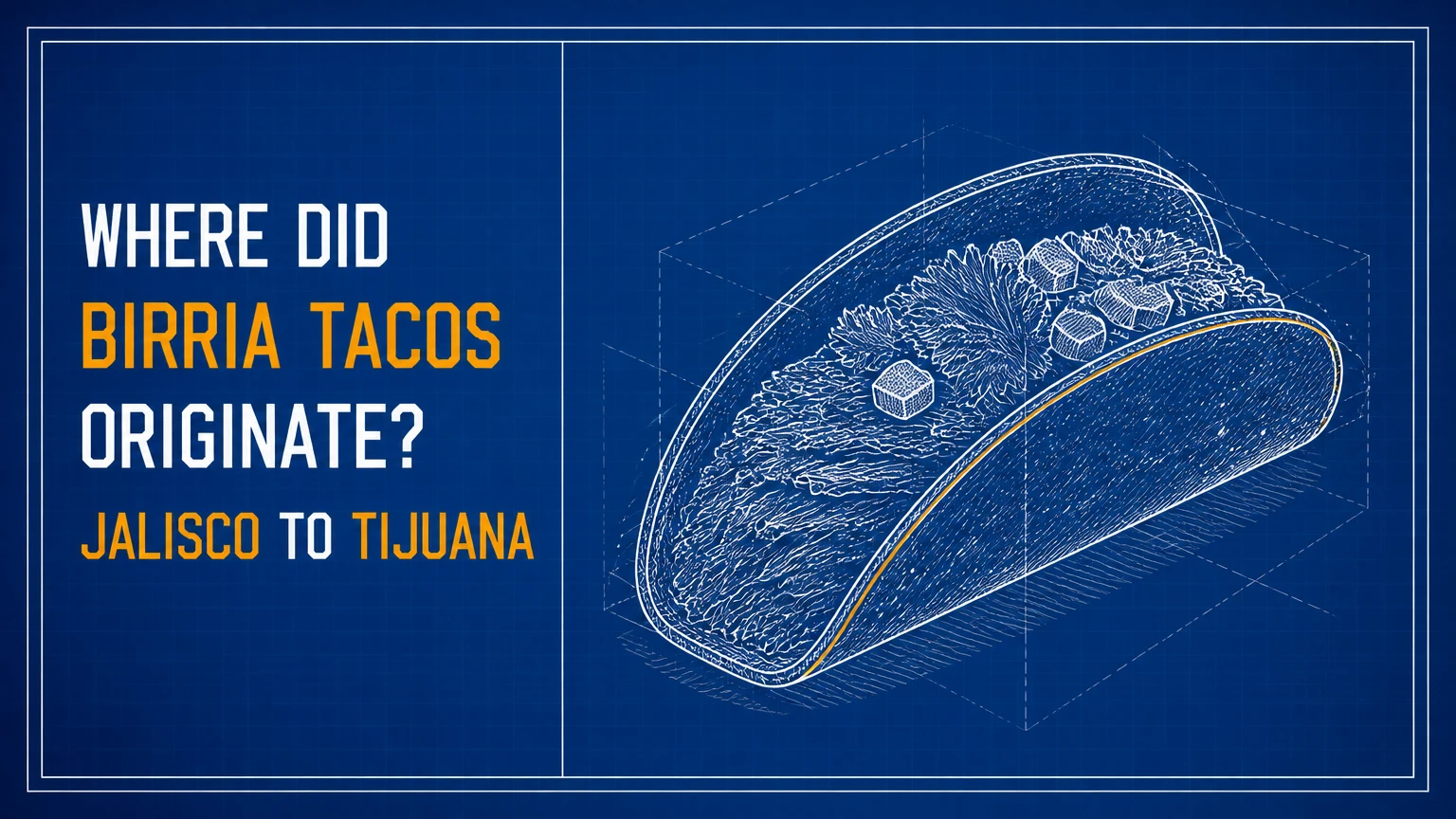
Birria tacos originated in Jalisco, Mexico, with Cocula commonly identified as the dish’s historic birthplace. The taco format developed later from birria, a slow-cooked meat preparation traditionally made with goat or sheep and served as a stew. Tijuana helped popularize beef birria tacos with fried tortillas and consomé, but no single inventor is securely documented.
Key Facts at a Glance
- Birria originated in Jalisco, Mexico, and Cocula is the town most often associated with its early development.
- Traditional birria is a saucy, slow-cooked preparation rather than a taco.
- Goat and sheep are historically important meats; beef is the dominant modern taco version in many restaurants.
- Tijuana-style birria helped establish the dipped, griddled taco served with consomé.
- Quesabirria is a newer cheese-filled variation, not the original form of birria.
- Popular stories credit individual vendors with inventing birria tacos, but surviving historical evidence does not establish one universally accepted creator.
Where Did Birria Tacos Originate?
Birria tacos trace back to Jalisco, particularly the Cocula area southwest of Guadalajara, while the modern red, griddled taco with a side of consomé became strongly associated with Tijuana. The distinction matters: Jalisco gave birria its culinary foundation, whereas northern Mexican and Mexican American vendors reshaped the dish into the taco now recognized worldwide.
Cocula lies in a region with longstanding traditions of chile-based meat cooking, clay-pot cookery, and barbacoa-style preparation. Birria developed as a seasoned way to cook meat with strong flavor and connective tissue, especially goat, which requires careful cooking to become tender.
The most accurate short answer is therefore two-part: birria comes from Jalisco, and the modern birria taco gained its defining street-food form through later regional evolution, especially in Tijuana.
Did birria begin as tacos?
No. Birria began as a meat dish commonly served in a bowl, with tortillas alongside it. Diners could eat the tender meat and broth separately or use tortillas to make informal tacos, but the now-standard process of dipping tortillas in red cooking fat, griddling them, filling them with meat, and serving consomé separately represents a later development.
The word itself also carries historical context. The Real Academia Española lists birria in Mexican usage as “cosa de poco valor o importancia,” or a thing of little value or importance. Food historians and cooks commonly connect the name with the early Spanish colonial view that goat meat was undesirable, although the exact naming pathway is not fully documented.
How Did Jalisco Birria Develop?
Jalisco birria developed through the interaction of introduced livestock, Indigenous cooking knowledge, local chiles, and colonial-era scarcity. Spanish colonists brought goats and sheep to New Spain, and cooks adapted existing slow-cooking and pit-roasting methods to prepare meat that could otherwise be tough, strongly flavored, or difficult to use.
The popular story that uncontrolled goats destroyed crops and directly caused birria has a plausible historical setting but is often repeated more confidently than the surviving evidence allows. The broad consensus concerns the ingredients and region, not every detail of the origin anecdote.
What cooking methods shaped birria?
Traditional birria uses prolonged moist or enclosed cooking, often with an adobo made from dried chiles, garlic, herbs, spices, and an acidic ingredient. Some preparations use an underground pit, an earth oven, a clay vessel, or a tightly covered pot. The exact method varies by household, town, meat, and restaurant.
Pit-roasting connects birria with wider Mexican barbacoa traditions, but birria and barbacoa are not identical dishes. Barbacoa describes a cooking tradition and method with many regional forms; birria refers to a particular seasoned meat preparation associated especially with Jalisco.
What is the historical timeline?
| Period | Place or context | Development | Confidence |
|---|---|---|---|
| 1500s | New Spain, including Jalisco | Goats and sheep enter local food systems | Well-established colonial context |
| 1600s-1800s | Jalisco | Regional goat and sheep preparations develop | Broad historical consensus |
| 1800s-early 1900s | Cocula and nearby towns | Birria becomes associated with celebrations and local commerce | Strong regional tradition |
| Mid-1900s | Tijuana | Beef versions and taco-oriented service expand | Well-attested culinary evolution |
| 2010s | Los Angeles and other cities | Quesabirria and consomé-centered presentation spread | Widely observable restaurant trend |
| 2020s | North America and beyond | Birria appears in ramen, pizza, grilled cheese, and packaged products | Contemporary adaptation |
How Did Tijuana Change Birria?
Tijuana changed birria by making beef more practical, emphasizing portable tacos, and using the rendered red fat to crisp corn tortillas. The city’s border economy, street-food culture, and access to beef helped produce a version that was easier to sell in tacos than traditional goat birria served primarily as a stew.
Some online accounts attribute the first modern birria tacos to a named vendor, often Guadalupe Zárate, who supposedly moved from Puebla to Tijuana and created the format in the 1950s. That story should be treated as a popular attribution rather than settled fact. Available public accounts do not provide enough independently verifiable archival evidence to prove that one person made the first birria taco.
The more defensible explanation is collective evolution. Tijuana cooks adapted birria to local prices, customer preferences, griddles, tortillas, and service speed. Beef also produces a useful layer of seasoned fat, which makes tortilla frying especially effective.
Why is Tijuana-style birria usually made with beef?
Beef became common because chuck, shank, brisket, and short ribs are widely available and familiar to customers. These cuts contain collagen and fat that survive long cooking, while goat can be more difficult to source consistently in large urban markets.
| Feature | Jalisco-style birria | Tijuana-style beef birria | Quesabirria |
|---|---|---|---|
| Common meat | Goat or sheep | Beef chuck, shank, or brisket | Beef, goat, or lamb |
| Typical service | Bowl with tortillas | Griddled tacos with consomé | Cheese-filled griddled taco |
| Texture | Soft, brothy, sometimes roasted | Shredded and richly fatty | Shredded meat with melted cheese |
| Signature fat use | May remain in broth or sauce | Tortilla dipped in red fat | Tortilla dipped in fat, then cheese added |
| Historical position | Older regional tradition | Later urban adaptation | Recent restaurant variation |
What Makes a Birria Taco Different?
A birria taco contains meat cooked in birria-style adobo and is usually served with consomé. The recognizable modern version has a corn tortilla colored and flavored with the stew’s red fat, then griddled until crisp before the shredded meat is added.
The taco does not become birria merely because it contains spicy shredded beef. The adobo, cooking liquid, meat preparation, and relationship between taco and consomé define the style more accurately than color alone.
What is consomé?
Consomé is the seasoned cooking liquid from the birria pot, often enriched by meat juices, bones, chile adobo, gelatin, and rendered fat. In birria service, consomé is commonly served in a small cup or bowl with chopped onion, cilantro, lime, and sometimes additional chile.
Traditional cooks may use the terms caldo, jugo, or consomé differently depending on region and family practice. Restaurant menus usually use “consomé” for the dipping broth accompanying tacos.
What is quesabirria?
Quesabirria is a birria taco with melted cheese, usually Oaxaca cheese, Chihuahua cheese, or a mild melting cheese. Cheese creates a richer, heavier taco and may form a crisp edge on the griddle, but quesabirria is a modern variation rather than the original Jalisco preparation.
Birria tacos without cheese are often the better choice for tasting the adobo, meat, and broth. Quesabirria suits diners who prioritize texture, richness, and a crisp cheese layer.
Which Meat Is Traditional?
Goat is the meat most strongly associated with traditional Jalisco birria, although sheep and mutton also appear in regional preparations. Beef is historically important to the modern Tijuana-style taco, but calling every beef birria “traditional Jalisco birria” erases the regional distinction.
| Meat | Traditional association | Best cuts | Typical cooking time | Flavor profile |
|---|---|---|---|---|
| Goat | Jalisco birria | Shoulder, leg, bone-in ribs | 3.5-5 hours | Distinctive, mineral, mildly gamey |
| Sheep or mutton | Regional birria and barbacoa traditions | Shoulder, neck, shank | 4-6 hours | Deep, savory, more pronounced |
| Beef | Tijuana-style birria tacos | Chuck, brisket, shank, short ribs | 3.5-5 hours | Familiar, fatty, gelatin-rich |
| Lamb | Modern restaurant adaptation | Shoulder, neck, breast | 3-5 hours | Rich, aromatic, tender |
Bone-in cuts improve body because collagen and marrow enter the cooking liquid. A practical beef combination is chuck for meat yield plus shank or short ribs for gelatin. Very lean round or sirloin often produces dry shreds and too little fat for tortilla frying.
How Is Birria Cooked?
Birria is cooked by combining meat with a chile-based adobo and holding it at a gentle simmer or enclosed roasting temperature until collagen converts into gelatin. A typical stovetop batch takes 3.5-5 hours after preparation, while pressure cooking often takes about 60-90 minutes at pressure, excluding heat-up and release time.
The main culinary mechanisms are straightforward:
- Collagen conversion: connective tissue softens during prolonged heating, producing gelatin and a supple texture.
- Adobo flavor transfer: dried chiles, garlic, vinegar, herbs, and spices season both the meat and broth.
- Fat separation: rendered fat rises above the liquid and can be used to fry tortillas.
- Surface browning: the griddle dries and browns the tortilla, creating crisp edges that broth alone cannot provide.
What is the practical cooking sequence?
| Stage | Typical time | Main action | Success checkpoint |
|---|---|---|---|
| Meat preparation | 15-25 minutes | Cut meat into large pieces and retain bones | Pieces remain large enough to stay moist |
| Chile preparation | 20-30 minutes | Toast briefly, soften, blend, and strain | Adobo tastes aromatic, not burned |
| Marination | 4-24 hours | Coat meat and refrigerate | Adobo clings evenly to all surfaces |
| Braising | 3.5-5 hours | Cook covered at a gentle simmer | Fork slides into meat with little resistance |
| Separation | 10-20 minutes | Shred meat and skim red fat | Fat forms a distinct surface layer |
| Taco griddling | 2-4 minutes per taco | Dip tortilla in fat, fill, fold, and crisp | Tortilla holds its shape without tearing |
A pressure cooker saves time but can produce a thinner broth because less liquid evaporates. An uncovered final simmer of 15-25 minutes can concentrate the liquid, although excessive reduction may make the adobo salty.
How Much Do Birria Tacos Cost and How Long Do They Take?
Typical restaurant prices in the United States range from $3-$6 per taco, with quesabirria usually costing more because of the cheese and additional griddle work. Home preparation commonly requires 4-24 hours of marination plus 3.5-5 hours of stovetop cooking, although a pressure cooker reduces the active cooking window.
| Item or method | Typical range | What changes the figure | Practical note |
|---|---|---|---|
| Street-style birria taco | $3-$5 | City, portion, meat, service format | Prices vary sharply by region |
| Quesabirria taco | $4-$7 | Cheese, size, cheese skirt | Usually heavier than a plain taco |
| Consomé side | $2-$5 | Portion size and restaurant | Often included with an order |
| Home beef batch | $35-$70 | Meat prices and batch size | Usually yields 10-20 tacos |
| Stovetop cooking | 3.5-5 hours | Cut size and meat type | Best for gradual reduction |
| Pressure cooking | 60-90 minutes at pressure | Bone-in cuts and batch volume | Requires release and finishing time |
A typical 1 kilogram batch of raw beef with bones and fat yields approximately 600-700 grams of cooked shredded meat. That amount usually makes 12-15 small street-style tacos, depending on whether each taco receives 40 or 50 grams of filling.
How Do the Main Birria Styles Compare?
The main birria styles differ by meat, cooking method, service format, and regional history. Jalisco goat birria offers the strongest connection to the dish’s older regional identity, while Tijuana beef birria is usually the practical choice for griddled tacos and consomé dipping.
| Style | Region or market | Meat | Defining feature | Best use |
|---|---|---|---|---|
| Birria de chivo | Cocula and Jalisco | Mature goat | Adobo-cooked or pit-roasted goat | Regional culinary exploration |
| Birria de res | Tijuana and wider Mexico | Beef | Shredded beef with rich broth | Tacos and large gatherings |
| Birria tatemada | Jalisco | Goat, sheep, or beef | Meat finished with high-heat roasting | Charred exterior and concentrated flavor |
| Quesabirria | Tijuana, Los Angeles, and diaspora markets | Usually beef | Melted cheese and crisp tortilla | Rich, crunchy street-food meal |
| Birriamen | Mexico City, Los Angeles, and fusion markets | Usually beef | Noodles cooked in consomé | Casual fusion meal |
Birriamen, birria pizza, and similar dishes should be understood as adaptations. They may use genuine birria, but they do not represent the historical form from Cocula.
What Are the Most Common Birria Problems?
The most common birria failures involve lean meat, burned chiles, weak broth, and tortillas dipped in watery liquid instead of separated fat. Each problem has a practical correction, and most can be prevented before the taco reaches the griddle.
| Problem | Likely cause | Result | Correction |
|---|---|---|---|
| Dry shredded meat | Lean cut or insufficient cooking | Chalky fibers | Add chuck, shank, or short ribs and continue covered cooking |
| Bitter broth | Chiles toasted too long | Burnt, harsh adobo | Toast briefly and discard blackened chiles |
| Soggy tortilla | Tortilla dipped into broth | Tearing and sticking | Skim surface fat separately before griddling |
| Thin consomé | Too much added water | Weak flavor | Reduce uncovered for 15-25 minutes |
| Tough meat | Cooking stopped too early | Chewy connective tissue | Continue until a fork enters easily |
| Gritty broth | Adobo not strained | Chile skins and seeds remain | Pass blended sauce through a fine sieve |
A useful practitioner rule is to judge doneness by resistance, not by the clock. A large bone-in goat shoulder may need longer than small beef chunks, even when both recipes specify four hours.
Another counterintuitive rule concerns chile seeds. Seeds are not the primary source of heat in every dried chile, but they can contribute bitterness, dust, and an uneven texture. Removing them and straining the sauce gives more control than relying on seeds for flavor.
Birria also benefits from resting before taco assembly. Ten to twenty minutes off the heat lets the fat rise, making it easier to separate a frying layer without removing all the flavorful liquid.
Can You Make Birria Without Goat?
Yes. Beef, lamb, and sheep can produce excellent birria, provided the meat contains enough collagen and fat for long cooking. Beef chuck is the easiest supermarket substitute, while lamb shoulder or sheep shoulder preserves a stronger connection to the flavor profile of goat.
| Situation | Recommended choice | Quantity guideline | Method | Trade-off |
|---|---|---|---|---|
| First-time home cook | Beef chuck | 1.5-2 kg | Covered stovetop braise | Less distinctive than goat |
| Traditional flavor goal | Bone-in goat shoulder | 1.5-2 kg | Pit, oven, or long braise | Harder to source |
| Mild flavor preference | Chuck plus brisket | 1.5-2 kg | Stovetop or pressure cooker | Higher fat content |
| Small batch | Beef shank and chuck | 750 g-1 kg | Pressure cooker | Less leftover consomé |
| Strong roasted flavor | Lamb or goat shoulder | 1.5-2.5 kg | Braise, then roast | More pronounced aroma |
Birria is not a good choice for extremely lean meat, quick pan cooking, or a broth that contains only water and mild seasoning. The dish depends on time, gelatin, chile depth, and controlled fat handling.
Where Is Birria Served Differently?
Jalisco remains the reference point for goat and sheep birria, especially in restaurants and markets that preserve regional methods. Tijuana is associated with beef-centered tacos, while Los Angeles and other diaspora cities have expanded the format through quesabirria and large-scale street-food service.
Regional labels help diners interpret menus:
- Cocula or Jalisco: expect goat, sheep, adobo, and stew-oriented service.
- Tijuana: expect beef, griddled corn tortillas, red fat, and consomé.
- Los Angeles: expect quesabirria, cheese, larger portions, and hybrid toppings.
- Mexico City and fusion markets: expect birria used in ramen, tortas, and other formats.
“Authentic” should describe a specific tradition, not function as a single pass-fail label. A goat stew from Cocula and a beef quesabirria from Los Angeles follow different histories, yet both can be carefully made and culturally meaningful.
FAQ
Is birria from Guadalajara?
Birria is from the state of Jalisco, and Cocula is more specifically associated with its origin. Guadalajara is the major nearby city and an important center for serving and promoting Jalisco cuisine, but identifying Guadalajara as the sole birthplace is less precise than naming Cocula and the surrounding region.
Are birria tacos originally from Mexico or the United States?
Birria tacos originated within Mexican culinary traditions. Jalisco supplied the birria foundation, and Tijuana played an important role in developing the modern taco format. United States cities, especially Los Angeles, later accelerated the dish’s international visibility through quesabirria and social-media-driven restaurant culture.
When did birria tacos become popular?
The taco format became especially prominent in the late 20th and early 21st centuries, with rapid expansion in the United States during the 2010s and 2020s. Birria itself is much older, so the recent popularity of birria tacos should not be confused with the age of the underlying dish.
What is the difference between birria and barbacoa?
Birria is a chile-seasoned meat preparation associated with Jalisco, while barbacoa is a broader cooking tradition involving slow cooking, often in a pit or enclosed environment. Both may use goat, sheep, or other meats, but their adobos, regional histories, and serving styles are not interchangeable.
Should birria tacos always have cheese?
No. Cheese is required for quesabirria but not for a standard birria taco. A cheese-free taco makes the adobo, meat, tortilla, and consomé easier to evaluate, while Oaxaca or Chihuahua cheese adds stretch, fat, and a crisp griddled layer.
The Bottom Line
Where did birria tacos originate? The most accurate answer is Jalisco, Mexico, with Cocula as the town most commonly identified with birria’s roots. Birria began as a slow-cooked meat dish, traditionally linked with goat and regional adobo techniques, rather than as a taco. Tijuana later popularized beef birria served in crisp, red-fat-fried tortillas with consomé, creating the format that spread internationally.
The named-inventor stories surrounding birria tacos remain less certain than the regional history. The strongest conclusion is therefore geographic and culinary: Jalisco originated birria, Tijuana helped define modern birria tacos, and Los Angeles helped make quesabirria a global restaurant phenomenon.