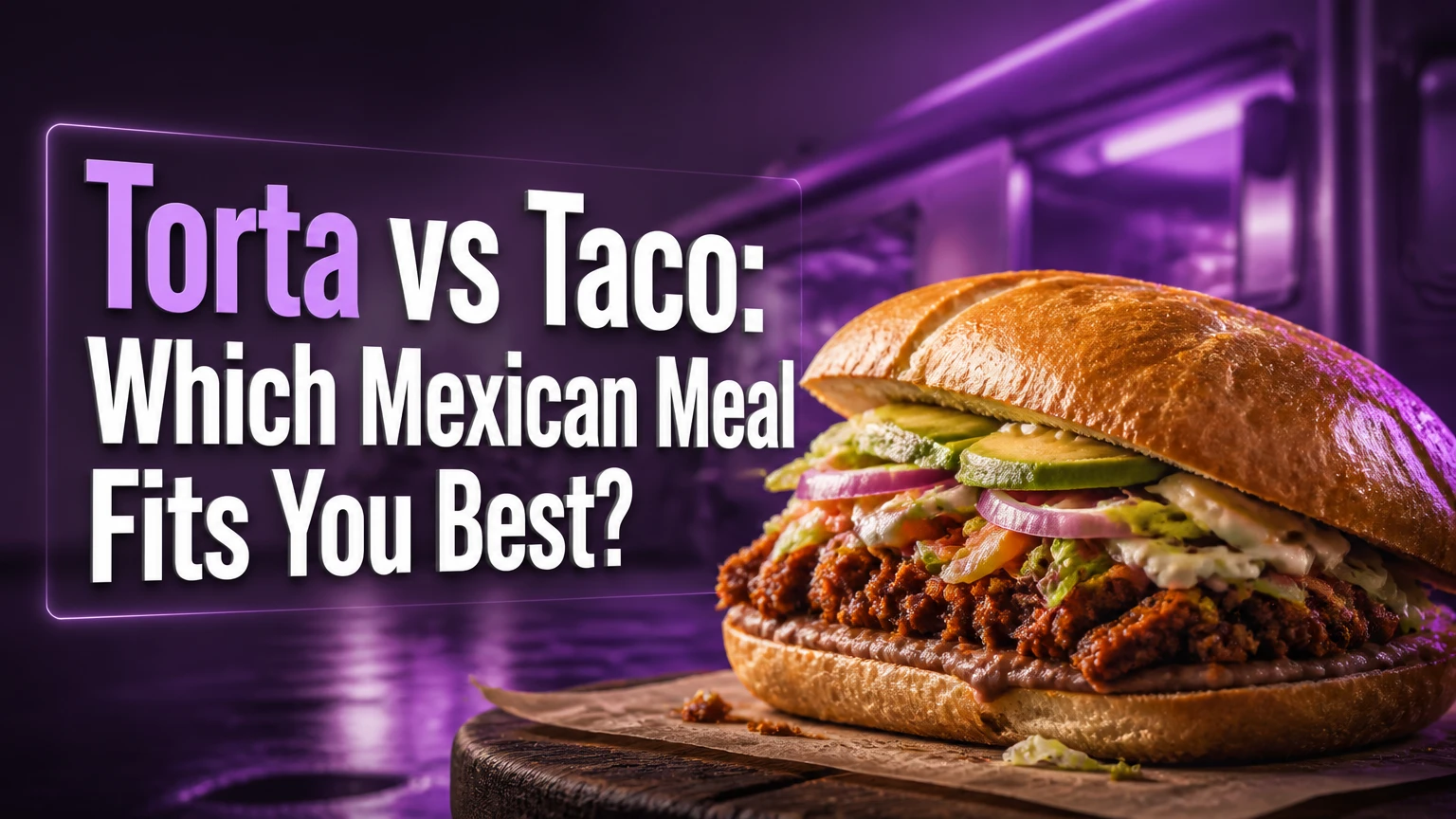
A torta is a Mexican sandwich made with a specialized bread roll, while a taco uses a corn or wheat tortilla folded around a filling. A torta usually provides one dense, complete meal with bread, spreads, protein, cheese, and vegetables; tacos offer smaller portions, faster customization, and more variety across several units.
Key Facts at a Glance
- A torta uses a telera, bolillo, birote, or another regionally appropriate bread roll; a taco uses a corn or flour tortilla.
- A typical torta weighs about 350-600 grams, while one street taco commonly weighs about 50-85 grams.
- One torta often equals a meal; most diners need 3-5 tacos for a comparable amount of food.
- Tacos usually offer more variety because each unit can contain a different filling, salsa, or tortilla style.
- A torta generally travels better when wrapped correctly, but a taco is faster to eat and easier to portion.
- Corn tacos are often suitable for gluten-free diners, but fillings, sauces, griddles, and shared utensils still require verification.
What Is the Difference Between a Torta and a Taco?
The defining difference between a torta and a taco is the starch vehicle: a torta encloses its filling in a bread roll, whereas a taco carries its filling in a soft or crisp tortilla. That distinction changes the meal’s weight, texture, moisture tolerance, portability, price, and serving size.
The word torta has different meanings across Spanish-speaking regions, but in Mexican food contexts it commonly means a filled sandwich. Mexican tortas often use telera, a round roll with shallow ridges, or bolillo, a smaller torpedo-shaped roll with a firmer crust. Guadalajara’s torta ahogada traditionally uses a crusty birote that can withstand sauce.
A taco has a simpler physical structure. A warm tortilla supports a measured portion of filling, then receives garnishes such as diced onion, cilantro, radish, cabbage, or salsa. Corn tortillas are associated with nixtamalized masa, while flour tortillas are common in northern Mexican cooking and in larger folded preparations.
The distinction is functional rather than merely visual. Bread creates a thick, absorbent platform for spreads and multiple layers; a tortilla creates a flexible wrapper that emphasizes the filling and its finishing salsa.
| Attribute | Torta | Taco |
|---|---|---|
| Starch vehicle | Telera, bolillo, birote, or regional roll | Corn or flour tortilla |
| Typical portion | 350-600 g | 50-85 g per taco |
| Usual meal quantity | 1 item | 3-5 items |
| Primary texture | Crusty, soft, creamy, layered | Warm, flexible, juicy, foldable |
| Typical eating method | Two-handed sandwich | Hand-held folded tortilla |
| Best structural feature | Supports spreads and stacked fillings | Supports fast portioning and variety |
How Is a Torta Built?
A torta is built by creating a moisture-resistant bread sandwich, then adding hot filling and fresh toppings in layers. The most reliable construction uses beans, mayonnaise, avocado, or another spread as a barrier, because juicy fillings can soften the lower half of the roll within minutes.
A typical assembly starts with a roll split horizontally. The inner crumb may be removed in moderation, especially from a dense bolillo, to create room without weakening the crust. The cut sides are warmed on a comal or flat-top surface, often with butter or lard, until lightly browned.
Refried beans commonly go on one side, and mayonnaise or mashed avocado may go on the other. These layers add flavor, but they also slow liquid migration. Hot milanesa, grilled beef, shredded chicken, or carnitas then goes closest to the bottom half, followed by cheese so residual heat can soften it.
Tomato, onion, lettuce, avocado, pickled jalapeños, and chipotle add contrast. A torta should close firmly without crushing the roll. Wrapping it in waxed paper and peeling the wrapper downward while eating is often cleaner than trying to hold an unwrapped, overfilled sandwich.
A Reliable Torta Assembly
- Split a telera or bolillo horizontally, leaving a hinge if portability matters.
- Spread 1-2 tablespoons of beans, mayonnaise, or avocado across the cut surfaces.
- Toast the open roll for about 2-3 minutes until the cut sides are lightly crisp.
- Add approximately 100-150 grams of hot filling.
- Place 20-30 grams of melting cheese over the hot filling.
- Add vegetables and pickled toppings in thin layers.
- Close, press gently, and wrap before the bread absorbs excess juices.
Expert rule: Toasting the cut face improves handling, but over-toasting makes the crust brittle and pushes filling out through the back. The goal is a sealed surface with a flexible outer crust.
How Is a Taco Built?
A taco is built by reheating a tortilla until flexible, adding a controlled amount of filling, and finishing it with garnishes and acidic salsa. The tortilla must remain warm at serving time because chilled corn tortillas become less elastic and are more likely to crack along the fold.
Corn tortillas are commonly heated on a dry comal for roughly 15-30 seconds per side, depending on thickness and starting temperature. A thin tortilla holding juicy meat may need a second warm tortilla underneath. The double layer is a structural solution, not merely a larger serving.
A practical street-taco portion is about 40-60 grams of filling, although restaurant tacos may contain substantially more. The filling should sit along the center rather than forming a mound near one edge. Onion, cilantro, salsa, lime, cabbage, or radish should enhance the filling without making the tortilla too wet to lift.
Flour tortillas generally provide greater flexibility and tear resistance. Corn tortillas contribute a stronger nixtamalized-corn flavor and are often the expected vehicle for tacos al pastor, carne asada, barbacoa, and many regional preparations.
A Reliable Taco Assembly
- Heat one corn tortilla, or two thin corn tortillas, until pliable.
- Add 40-60 grams of filling in a narrow line through the center.
- Add approximately 1 tablespoon of onion and cilantro or another appropriate garnish.
- Apply salsa in a narrow stripe rather than flooding the tortilla.
- Finish with lime only immediately before eating.
- Fold once and serve within a few minutes.
Expert rule: Salsa quantity should follow tortilla strength. A thick flour tortilla can tolerate more liquid than a thin corn tortilla, while a double corn tortilla can carry moisture longer without splitting.
Torta vs Taco: Which Performs Better?
For a complete, portable meal, the torta usually performs better; for variety, portion control, and rapid service, tacos usually win. The better choice depends on whether the priority is one substantial item, several distinct flavors, dietary flexibility, or clean eating in a particular setting.
| Decision criterion | Torta | Taco | Practical winner |
|---|---|---|---|
| Full-meal satisfaction | 1 item, about 350-600 g | Usually 3-5 items | Torta |
| Flavor variety | Usually 1 main filling | 3-5 fillings in one order | Taco |
| Typical ordering time | 4-8 minutes | 1-3 minutes | Taco |
| Portability | Strong when wrapped | Best for immediate eating | Torta |
| Moisture tolerance | Moderate with toasted bread and spreads | Low to moderate | Torta |
| Portion control | Less granular | One-unit increments | Taco |
| Typical street price | About $6-$12 | About $2-$4.50 each | Depends on quantity |
| Gluten-free potential | Usually low because of bread | High with verified corn tortillas | Taco |
The price comparison needs a meal-level calculation. Three tacos at $2.50 each cost $7.50, which can overlap with a $7-$10 torta, while five premium tacos can exceed the price of a large sandwich.
Which Is More Filling?
A torta is generally more filling than one taco because the bread roll, spreads, cheese, and larger protein portion increase total mass and energy. Three to five tacos can equal a torta in volume, but the result depends on tortilla size, protein quantity, rice or bean additions, and toppings.
| Typical serving | Approximate weight | Approximate energy range | Common use |
|---|---|---|---|
| One small corn taco | 50-65 g | 120-220 kcal | Snack or tasting portion |
| One larger flour taco | 80-120 g | 200-350 kcal | Light meal |
| One standard torta | 350-500 g | 600-1,000 kcal | Complete meal |
| One loaded torta | 500-700 g | 900-1,300 kcal | Very large meal |
| Three street tacos | 150-255 g | 360-660 kcal | Typical light meal |
| Five street tacos | 250-425 g | 600-1,100 kcal | Substantial meal |
These are typical planning ranges, not laboratory measurements. The United States Department of Agriculture’s FoodData Central database demonstrates why recipes need ingredient-level assessment: bread, cheese, frying oil, sauces, and avocado can change the total more than the category name.
Which Costs Less?
A single taco costs less than a single torta, but tacos are not necessarily cheaper when ordered as a full meal. Typical prices vary by city, vendor type, protein, and restaurant overhead, so compare the cost of the amount you expect to eat.
| Purchase scenario | Typical unit price in North America | Typical quantity | Estimated total |
|---|---|---|---|
| Basic street taco | $2-$3 | 3 | $6-$9 |
| Specialty taco | $3.50-$6 | 3 | $10.50-$18 |
| Standard torta | $6-$10 | 1 | $6-$10 |
| Large regional torta | $10-$16 | 1 | $10-$16 |
| Torta with side | $9-$15 | 1 meal | $9-$15 |
| Taco sampler with side | $14-$24 | 4-6 tacos | $14-$24 |
Decision rule: Choose tacos for low initial spending and sampling. Choose a torta when one order must deliver a predictable, filling meal.
Which Is Easier to Eat?
A wrapped torta is usually easier to eat during a commute or work break because its fillings remain enclosed inside a rigid bread shell. Tacos are faster but less forgiving; a wet salsa, weak tortilla, or overfilled center can cause spills within the first few bites.
Tacos work well at a counter, cart, or table where napkins and a plate are available. Their smaller size also lets diners stop after two units or continue to five. That granularity benefits children, light eaters, and groups sharing several fillings.
Tortas need more bite pressure and hand support. A soft roll can collapse, while an excessively crusty roll can force the filling backward. The best sandwich bread has a firm exterior, a soft interior, and enough thickness to resist compression without becoming tough.
Neither format is automatically cleaner. A dry taco with restrained salsa can be tidy, while a sauced torta can drip heavily. A torta ahogada is particularly unsuitable for eating over a keyboard or inside a moving vehicle.
Which Offers More Variety?
Tacos offer more variety within one meal because each tortilla can carry a separate meat, vegetable, seafood, or regional preparation. A single order might combine al pastor, carne asada, mushroom, fish, and barbacoa, while a torta usually commits the diner to one central filling.
| Variety | Main preparation | Typical finishing elements | Best reason to order |
|---|---|---|---|
| Al pastor taco | Marinated meat shaved from a trompo | Onion, cilantro, pineapple, salsa | Charred edges and sweet-acid contrast |
| Carne asada taco | Grilled beef, chopped after cooking | Onion, cilantro, lime | Smoky, direct beef flavor |
| Carnitas taco | Slow-cooked, tender shredded filling | Salsa, onion, cilantro | Rich texture and crisp bits |
| Barbacoa taco | Long-cooked beef, goat, or sheep | Consommé, onion, cilantro | Deep savory flavor |
| Baja fish taco | Battered or grilled fish | Cabbage, crema, lime | Crunch and cool toppings |
| Torta de milanesa | Breaded cutlet in a roll | Avocado, lettuce, tomato, pickled chile | Crispy, substantial sandwich |
| Torta ahogada | Carnitas in crusty birote | Tomato-chile sauce | Sauce-soaked regional specialty |
| Torta de tamal | Steamed tamal inside a roll | Salsa or pickled chile | Dense Mexico City breakfast |
Diana Kennedy described the taco as “the most basic form of Mexican food,” a useful explanation of its adaptability rather than a claim that every taco follows one national template. Regional tortilla size, cooking fuel, garnish, and protein all change the experience.
Which Is Better for Dietary Needs?
Corn tacos usually provide the clearer route for gluten-free eating, while tortas are generally wheat-based and require a bread substitute to meet that restriction. Neither choice is automatically low-calorie, low-sodium, dairy-free, or safe from cross-contact.
A corn tortilla can still be exposed to wheat on a shared griddle, and marinades or bottled sauces may contain wheat-based thickeners. Diners with celiac disease should ask whether tortillas are heated on a dedicated surface and whether utensils are shared.
A torta can be modified with gluten-free bread, but the result no longer follows the standard structure closely. Beans, grilled vegetables, salsa, and avocado may be suitable for dairy-free diners, while cheese, crema, mayonnaise, and some prepared sauces require ingredient checks.
| Dietary concern | More adaptable option | Main risk | Ordering question |
|---|---|---|---|
| Gluten avoidance | Corn taco | Shared griddle or thickened sauce | Are the tortilla and marinade wheat-free? |
| Dairy avoidance | Taco or modified torta | Cheese, crema, butter | Can the order be prepared without dairy? |
| Lower energy intake | 2-3 tacos | Fried fillings and creamy toppings | Can the portion use grilled filling and salsa? |
| Lower sodium | Fresh taco filling | Salted meat, cheese, bottled sauces | Can added salt and salty toppings be omitted? |
| Vegetarian eating | Vegetable or bean taco | Animal-based cooking fat | Are beans and vegetables cooked separately? |
| Celiac disease | Dedicated corn-tortilla setup | Cross-contact | Is a separate comal and utensil available? |
Nutrition depends on preparation. A fried fish taco with creamy sauce may contain more energy than a small grilled-beef taco, and a torta with lean grilled chicken can be lighter than a heavily fried taco order with cheese and crema.
What Are the Most Common Construction Mistakes?
The most common torta mistake is choosing bread that is too soft or too hard, while the most common taco mistake is overfilling a cold tortilla. Both failures come from treating the starch vehicle as decoration rather than as the structure that must carry moisture and weight.
Torta Failures
- Soggy bottom: Toast the cut surfaces and apply beans, mayonnaise, or avocado before juicy filling.
- Filling slides out: Reduce the protein mound, keep ingredients inside the bread’s perimeter, and wrap the sandwich.
- Bread collapses: Replace ordinary soft sandwich bread with telera, bolillo, or another sturdy roll.
- Crust tears the mouth: Warm the roll briefly rather than browning it until rigid.
- Vegetables make the sandwich wet: Drain pickled toppings and pat sliced tomatoes before assembly.
Taco Failures
- Tortilla cracks: Heat it again or add a second warm tortilla underneath.
- Taco spills from the back: Use less filling and place it in a narrow center line.
- Salsa overwhelms the tortilla: Add a teaspoon first, then increase only if the shell remains flexible.
- Taco tastes flat: Add a high-acid element such as lime or a fresh salsa immediately before eating.
- Garnishes wilt: Keep onion, cilantro, cabbage, and radish chilled until service.
Practitioner insight: The double-tortilla method is not always better. Two tortillas can mute the flavor of a delicate filling and increase the starch-to-protein ratio, so use the second layer when the tortilla is thin, the filling is wet, or the taco must travel.
Which Should You Choose?
Choose a torta for one filling, a substantial appetite, and a meal that must hold together for 10-15 minutes. Choose tacos for variety, faster service, adjustable portions, and the ability to compare several regional preparations in one sitting.
Choose a Torta for Work or Travel
A torta is the stronger choice when the meal must be wrapped and carried. Ask for the sandwich to be wrapped in paper rather than sealed immediately in airtight plastic, because trapped steam softens toasted bread.
Avoid a torta ahogada for desk eating. Its sauce is part of the identity of the dish, but the liquid makes it a poor option for a vehicle, office, or walking meal.
Choose Tacos for Sampling
Tacos are better for culinary exploration because three orders can represent three cooking methods. A diner can compare trompo-cooked al pastor, griddled carne asada, and slow-cooked barbacoa without committing to a large sandwich.
Order one or two tacos first if the vendor’s portions are unknown. Add more after checking tortilla size, protein amount, and richness of the toppings.
Choose Corn Tacos for Gluten Avoidance
Corn tacos are the practical starting point for gluten-free ordering, provided the vendor confirms the tortilla, filling, sauces, and cooking surface. Avoid assuming that a corn tortilla guarantees a gluten-free meal.
Choose a Torta for Maximum Satiety
A torta suits a long gap between meals because its bread and layered filling provide more total food in one item. Select grilled filling, beans, vegetables, and moderate cheese when fullness matters more than maximum richness.
Choose Tacos for Children or Mixed Appetites
Tacos allow precise portioning and simple customization. One child can choose a plain filling, another can add cheese, and an adult can order a spicy salsa without changing the entire meal.
How Do Torta and Taco Eating Times Compare?
A taco order commonly takes 1-3 minutes to assemble and 3-5 minutes to eat, while a torta usually takes 4-8 minutes to prepare and 10-15 minutes to finish. Vendor workload, pressing time, filling temperature, and queue length can change those ranges.
| Service factor | Torta | Taco |
|---|---|---|
| Assembly time | 4-8 minutes | 1-3 minutes |
| Typical eating time | 10-15 minutes | 3-5 minutes per small order |
| Holding limit before quality loss | 10-20 minutes | 5-10 minutes |
| Ideal serving temperature | Warm bread and hot filling | Hot tortilla and hot filling |
| Best service setting | Counter, desk, wrapped takeaway | Cart, counter, immediate table service |
Tacos lose quality quickly when tortillas cool, while tortas lose quality when moisture migrates into the bread. The two foods have different holding problems, so neither is ideal for prolonged storage.
For home preparation, warm tortillas in batches and keep them covered with a clean towel. Assemble tortas immediately after toasting the bread, and separate wet toppings from the roll if the sandwich will travel more than 15 minutes.
The Bottom Line
Torta vs taco is primarily a choice between a substantial bread-based sandwich and a flexible tortilla-based meal. Pick a torta for satiety, portability, and layered texture; pick tacos for variety, faster service, adjustable portions, and the strongest gluten-free potential. The best decision follows the setting, appetite, filling, and time available.
Frequently Asked Questions
Is a torta considered a sandwich?
A Mexican torta is generally considered a sandwich because a bread roll is split and filled with savory ingredients. It differs from an ordinary deli sandwich through its use of telera, bolillo, or birote, plus ingredients such as refried beans, avocado, pickled chiles, salsa, and milanesa.
Are tacos healthier than tortas?
Tacos are not automatically healthier than tortas, but smaller units make portion control easier. A grilled corn taco with fresh salsa may contain fewer calories than a loaded torta, while fried seafood, cheese, and creamy sauces can make a taco order equally rich.
Can a taco replace a full meal?
Three to five tacos can replace a full meal for many diners, depending on tortilla size and filling quantity. Two large flour tacos may provide more food than four small corn tacos, so count grams of filling and toppings rather than relying only on the number of tortillas.
Why do some tacos use two tortillas?
Some tacos use two tortillas to prevent a thin corn tortilla from tearing under juicy or heavy filling. The second tortilla also catches drips, but it adds starch and can obscure delicate flavors, so it is most useful for wet fillings and thin shells.
What bread is best for a torta?
Telera is a dependable all-purpose choice because its soft interior and lightly firm crust accommodate layered fillings. Bolillo works well for smaller, crisp-edged sandwiches, while birote is especially suitable for sauced regional preparations such as a torta ahogada.
Which option is better for leftovers?
Neither taco nor torta reaches peak quality after long refrigeration, but fillings store better than assembled starch vehicles. Refrigerate filling separately, reheat it thoroughly, warm fresh tortillas, and toast a new roll before rebuilding the meal.