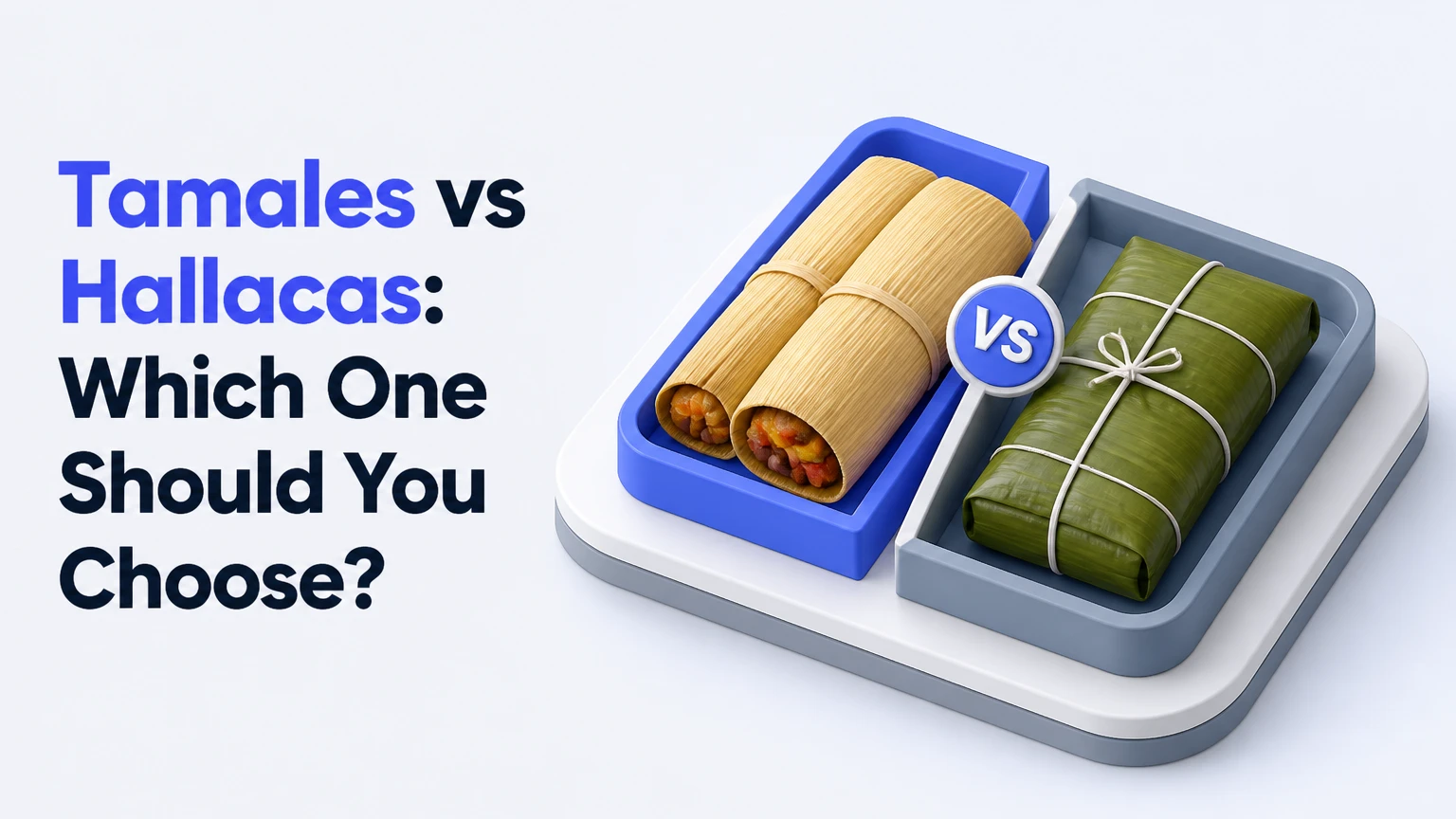
Mexican tamales and Venezuelan hallacas share a broad corn-dough-and-leaf format, but they are not interchangeable dishes. Tamales usually pair thicker masa with a cooked filling and steaming, while hallacas use a thin annatto-colored dough, a richly seasoned guiso with arranged garnishes, plantain leaves, and boiling. The best choice depends on flavor, occasion, labor, and availability.
Key Facts at a Glance
Mexican tamales commonly use corn husks, thicker masa, cooked chile-based fillings, and 60-90 minutes of steaming.
Venezuelan hallacas commonly use thin yellow masa, plantain leaves, a seasoned guiso, decorative garnishes, and about 45-70 minutes of boiling.
Hallacas are usually Christmas foods, while tamales may appear at breakfast, celebrations, markets, religious events, and ordinary family meals.
Tamales generally take 3-6 hours for a home batch, while hallacas often require 1-3 days because the guiso, leaves, and assembly are more involved.
Typical USA retail prices vary widely: tamales often cost $20-$40 per dozen, while hallacas commonly cost $90-$180 per dozen when sold as seasonal specialty foods.
Neither name describes one fixed recipe. Mexico has hundreds of tamale traditions, and Venezuelan families differ in guiso, garnishes, dough, and wrapping style.
What Is the Difference Between Tamales and Hallacas?
Tamales and hallacas differ most in dough thickness, filling structure, wrapper, cooking method, and cultural role. A tamal is commonly a portable individual portion built around masa and a central filling. A hallaca is a carefully assembled Venezuelan holiday packet in which thin dough, guiso, garnishes, leaf, and tying technique form one designed composition.
The comparison becomes more precise when “tamal” means a Mexican style. Tamales elsewhere in Latin America can contain vegetables, eggs, legumes, potatoes, or large quantities of meat, and some are wrapped in leaves rather than husks. Hallacas also vary by region and household, so no single ingredient count defines authenticity.
| Attribute | Mexican tamal, common style | Venezuelan hallaca, common style |
|---|---|---|
| Dough | 6-12 mm thick, soft and aerated | Often 2-4 mm thick, smooth and flexible |
| Corn base | Masa harina or freshly ground nixtamalized corn | Pre-cooked corn flour, broth, fat or oil |
| Color | White, cream, green, red, brown, or sweet pink | Yellow to orange from annatto, also called onoto |
| Filling | Shredded meat in chile sauce, beans, cheese, or vegetables | Guiso with meat, aromatics, seasoning, and garnishes |
| Wrapper | Rehydrated corn husk or banana leaf | Plantain or banana leaf, often in more than one layer |
| Cooking | Steaming in a rack or pot | Boiling while fully enclosed and tied |
| Typical role | Everyday food and celebration food | Christmas and New Year family tradition |
| Eating style | Often handheld after opening the husk | Usually plated with a fork and knife |
Are Hallacas Venezuelan Tamales?
Hallacas are related to tamales through a shared Indigenous American technique, but Venezuelan cooks generally treat hallacas as a distinct national dish rather than a type of tamal. The two foods belong to the same broad family of wrapped corn preparations, yet their recipes, ceremony, and culinary identities developed along different regional paths.
The word “tamal” is commonly linked to the Nahuatl tamalli, meaning a wrapped preparation. The origin of “hallaca” is less settled. Some accounts connect it to Indigenous terms associated with a bundle or mixed preparation, while other explanations remain debated. A careful description should identify the etymology as contested rather than present one theory as proven.
Calling a hallaca a Venezuelan tamal can help a newcomer understand its format, but the label loses important distinctions. Venezuelan families may spend a full day preparing hallacas together, assign roles across generations, and preserve a recipe tied to a particular state or city. That social function matters as much as the ingredient list.
How Do Tamales and Hallacas Work as Foods?
Tamales use masa as both wrapper and starch, while the filling contributes concentrated flavor in the center. Steam hydrates and sets the dough gradually, producing a tender structure that should release from the husk after a short resting period.
Hallacas use a thinner corn layer and rely on the guiso, leaf aroma, and garnishes for much of their character. The leaf packet keeps the dough and filling enclosed during boiling, while annatto oil colors the masa and contributes a mild earthy note. The resulting bite is generally more compact and savory-sweet than a standard Mexican tamal.
How Is Tamale Masa Different?
Tamale masa is usually thicker, fattier, and more aerated than hallaca dough. Cooks blend masa with broth and fat until it spreads easily but still has enough body to support filling, and many recipes add a small amount of leavening for a lighter texture.
A practical home ratio for 24 medium tamales is approximately 1.8-2.3 kg prepared masa, 350-500 g fat, and 500-750 ml broth, although fresh masa absorbs liquid differently from masa harina. The traditional “float test” can suggest aeration, but it is not a guarantee of quality. Proper hydration, sufficient fat, and correct steaming matter more than whether every spoonful floats.
How Is Hallaca Dough Different?
Hallaca dough is spread into a very thin sheet, often about 2-4 mm, on an oiled plantain leaf. The dough is made from pre-cooked corn flour mixed with broth and annatto-infused fat or oil, then kneaded until smooth enough to fold without cracking.
The thin layer prevents the hallaca from becoming a heavy block of starch. It also leaves room for guiso and garnishes. If the dough is translucent or tears while spreading, it is too thin for the leaf or lacks moisture and fat. Household methods differ, and some cooks prefer a somewhat thicker layer for easier handling.
Why Do the Fillings Taste So Different?
Tamale fillings are usually cooked before assembly and concentrated into a sauce, whereas hallaca guiso is a multi-ingredient stew whose flavor develops through long simmering and interaction with the dough and leaf. That distinction explains why tamales often taste focused and chile-forward, while hallacas offer layered sweet, salty, acidic, aromatic, and meaty notes.
A red tamale may feature dried chile, garlic, cumin, and shredded meat. A green version may use tomatillo, herbs, and chicken. Hallaca guiso commonly includes beef, poultry, or other meats with onion, leek, garlic, sweet pepper, stock, and regional seasonings. Olives, capers, and raisins are placed separately as adornos, so a single bite may contain contrasting textures and flavors.
| Filling feature | Tamales | Hallacas |
|---|---|---|
| Main preparation | Cooked filling before wrapping | Long-simmered guiso, sometimes cooked partly inside |
| Meat texture | Shredded, minced, sliced, or absent | Cubed, minced, shredded, or mixed by household |
| Sauce | Red chile, green chile, mole, bean sauce, or none | Thick savory gravy integrated with the guiso |
| Garnishes | Usually mixed into filling or added after cooking | Commonly arranged separately inside the dough |
| Flavor direction | Chile, herb, roasted, earthy, or sweet | Savory, briny, sweet, aromatic, and rich |
| Portion pattern | Filling concentrated in a central strip | Guiso spread with several intentional accents |
| Regional flexibility | Extremely high across Mexico | High across Venezuelan regions and families |
Are Hallaca Garnishes Always the Same?
Hallaca garnishes are traditional rather than mathematically fixed. Olives, capers, raisins, onion, and sweet pepper appear frequently, but the number and combination depend on the household, region, ingredient cost, and family preference.
The often-repeated instruction to use an exact number of olives, capers, and raisins should not be treated as a universal rule. Consistency can help a large assembly team, but authenticity does not depend on identical counts. The important structural idea is that the garnishes are intentionally placed rather than casually stirred into the guiso.
How Are Tamales and Hallacas Wrapped and Cooked?
Tamales are usually folded around a central filling and steamed upright, while hallacas are folded into rectangular leaf envelopes, tied, and boiled fully submerged. Both methods set corn dough through heat and moisture, but the wrapper geometry creates different textures and handling requirements.
For tamales, soak dried corn husks in hot water for about 20-40 minutes, spread masa on the smooth side, add filling, fold the sides inward, and position the packets upright in a steamer. Steam commonly takes 60-90 minutes, followed by 10-20 minutes of covered resting.
For hallacas, clean and soften plantain leaves, spread the thin dough, add chilled guiso and adornos, fold the leaf into a rectangular packet, add a reinforcing strip or second leaf, and tie firmly. Boil the packets for roughly 45-70 minutes, keeping the water at a steady boil rather than an aggressive churn.
| Process stage | Tamales | Hallacas |
|---|---|---|
| Wrapper preparation | Soak husks 20-40 minutes | Wash, wipe, trim, and soften leaves |
| Dough application | 6-12 mm layer on husk | 2-4 mm layer on oiled leaf |
| Filling temperature | Warm or room temperature cooked filling | Chilled guiso is easier to portion |
| Packet shape | Tapered or folded cylinder | Rectangular envelope |
| Fastening | Folded husk, optional tie | Cotton twine, often cross-tied |
| Cooking vessel | Steamer with rack | Large stockpot for immersion |
| Cooking duration | 60-90 minutes | 45-70 minutes |
| Resting | 10-20 minutes before opening | 5-15 minutes before serving |
What Is the Most Important Cooking Checkpoint?
The most reliable tamale checkpoint is a clean-peeling masa, while the most reliable hallaca checkpoint is a sealed packet with firm, cooked dough and no water inside. A timer alone cannot account for packet size, pot loading, dough hydration, or altitude.
Do not repeatedly open a steamer during the first hour because escaping steam extends cooking. For hallacas, maintain enough water to cover the packets and check the seal before immersion. Both dishes benefit from resting because starch continues to set after the heat is removed.
Which Regional Types Should You Know?
Mexican tamales have broader visible variety, while Venezuelan hallacas have a more recognizable national format with regional adaptations. A comparison is useful only when the specific regional style is named, because a banana-leaf Oaxacan tamal may resemble a hallaca more closely than it resembles a small corn-husk breakfast tamal.
| Regional preparation | Wrapper or dough | Defining filling or feature | Typical context |
|---|---|---|---|
| Central Mexican tamal | Corn husk, medium-thick masa | Red chile meat or green herb sauce | Breakfast, markets, celebrations |
| Oaxacan tamal | Banana leaf, flatter masa | Mole negro, chicken, or vegetables | Regional celebrations |
| Sweet Mexican tamal | Corn husk, sweetened masa | Raisins, fruit, sugar, or cinnamon | Breakfast and parties |
| Caraqueño hallaca | Plantain leaf, yellow masa | Mixed-meat guiso, olives, capers, raisins | Christmas gatherings |
| Andean hallaca | Plantain leaf, regional dough | Guiso may be raw-seasoned before cooking | Andean Venezuela |
| Oriental hallaca | Plantain leaf | Seafood or local ingredients in some versions | Eastern Venezuelan households |
| Zulian hallaca | Plantain leaf, sometimes sweeter dough | Plantain and regional seasoning influences | Zulia and western Venezuela |
Oaxacan tamales illustrate why wrapper alone cannot identify a dish. Banana leaf provides a smoky, herbal aroma and allows a flatter packet, but the masa, filling, and local tradition remain distinctly Oaxacan. Likewise, a Venezuelan hallaca is defined by its combined architecture, not by the leaf alone.
Which One Takes Longer and Costs More?
Hallacas usually demand more labor and a longer preparation window than tamales. A typical home tamale session takes 3-6 hours from preparation through cooking, while hallacas commonly require 8-20 active labor hours distributed across one to three days, especially when a family makes 50 or more.
Prices depend heavily on city, season, labor, imported ingredients, and whether the food comes from a home cook or restaurant. The figures below are typical USA planning ranges, not universal market prices. In Venezuela, local ingredient prices and exchange rates can produce very different totals.
| Planning metric | Tamales, typical range | Hallacas, typical range |
|---|---|---|
| Home batch size | 24-60 units | 30-100 units |
| Active preparation | 3-6 hours | 8-20 labor hours |
| Total calendar window | Same day or overnight | 1-3 days |
| Retail price in USA | $20-$40 per dozen | $90-$180 per dozen |
| Home ingredient cost per unit | $0.75-$2.50 | $1.50-$5.00 |
| Main labor bottleneck | Spreading masa and filling | Leaf prep, guiso, spreading, and tying |
| Typical cooking vessel | 8-16 quart steamer | 16-24 quart stockpot |
| Freezer storage | About 3 months for best quality | About 2-3 months for best quality |
The price gap does not mean hallacas contain proportionally more food. Specialty hallaca pricing reflects seasonal demand, leaf preparation, multiple meats or garnishes, skilled assembly, and the low production volume of many sellers.
How Many Should You Make?
Plan two to three tamales per adult for a main meal, or one to two when serving rice, beans, salad, or another substantial side. Hallacas are larger and denser, so one per adult is often sufficient for a holiday plate, with a second reserved for a particularly large appetite.
For a gathering of 20 adults, a practical plan is 40-50 tamales or 24-30 hallacas, depending on side dishes and whether leftovers are intended. Add 10-15 percent for torn wrappers, tasting, and unexpected guests.
Which Dish Is Easier for Beginners?
Tamales are usually easier for beginners because the ingredients are more available, the filling can be prepared in advance, and a steamer provides a forgiving cooking environment. Hallacas become manageable with a group, but their thin dough, leaf folding, guiso timing, and tying require more coordination.
Choose Tamales for a Weeknight or First Batch
Choose tamales when the goal is a practical family meal, a freezer batch, or a first experience with wrapped corn dough. Store-bought masa, prepared salsa, and cooked chicken can reduce the active work without changing the basic technique.
Tamales are also easier to customize. A cook can make separate fillings, vary the masa color, and use a small number of husks without committing to a large production line. Tamales are less suitable when the goal is to recreate a Venezuelan Christmas gathering, because the dish does not carry the same cultural meaning.
Choose Hallacas for a Holiday Assembly
Choose hallacas when several people can work together and the meal has Venezuelan cultural or family significance. One person can trim leaves, another can portion dough, another can distribute guiso, and another can tie packets, making the labor more social and consistent.
Hallacas are a poor choice for a rushed weeknight or a kitchen without a large pot and broad leaves. Their greatest strength is also their limitation: the dish rewards planning, repetition, and collective preparation rather than improvisation.
What Are the Main Advantages and Drawbacks?
Tamales offer easier sourcing, more regional variety, simpler portioning, and strong freezer performance. Their common weaknesses are dry masa, uneven filling distribution, and a tendency to become dense when the dough lacks fat or is packed too tightly.
Hallacas offer a more complex flavor sequence and a distinctive rectangular presentation. Their drawbacks include higher labor, expensive seasonal purchase prices, leaf preparation, and greater risk of leakage when packets are folded or tied poorly.
| Decision criterion | Tamales | Hallacas | Practical winner |
|---|---|---|---|
| Beginner accessibility | Masa and husks widely available | Leaves and specialty ingredients may require a Latin market | Tamales |
| Flavor complexity | Focused sauce and masa profile | Multiple sweet, salty, acidic, and aromatic contrasts | Hallacas |
| Speed | Same-day batch is realistic | Multi-day preparation is common | Tamales |
| Group cooking | Efficient with two to four people | Especially suited to an assembly line | Hallacas |
| Portability | Easy to unwrap and eat by hand | Usually better on a plate | Tamales |
| Holiday identity | Broad celebration use | Strong Venezuelan Christmas association | Hallacas |
| Filling flexibility | Meat, cheese, beans, vegetables, sweet styles | Regional guiso and garnish traditions | Tamales |
| Presentation | Rustic individual packet | Formal tied leaf parcel | Hallacas |
How Can You Avoid Common Failures?
Most tamale and hallaca failures begin before cooking, when dough hydration, filling temperature, wrapper condition, or packet tension is wrong. Correcting the process at the assembly stage is easier than trying to rescue a batch after steaming or boiling.
Dry or Crumbly Tamale Masa
Dry masa usually indicates insufficient broth or fat, coarse mixing, or excessive cooking. Add warm broth gradually, mix thoroughly, and test a small packet before assembling the entire batch.
The finished masa should feel spreadable and moist without becoming runny. If a tamale remains gritty after the full cooking time, the corn base was underhydrated or the dough layer was too thick.
Sticky Tamale Masa
Sticky masa can mean undercooking, excess liquid, or insufficient resting. Steam the tamales for another 10-15 minutes, turn off the heat, and leave the lid closed for 10 minutes before testing again.
A tamale should release from the husk when warm, though it may remain softer immediately after cooking. Opening every packet early creates a misleading comparison because the center sets last.
Cracked Hallaca Dough
Cracks usually result from a dough that is too dry, a leaf that was not oiled, or a layer thinner than the cook can handle. Add broth by spoonfuls, knead until flexible, and spread a slightly thicker sheet.
Do not compensate for fragile dough by adding a large amount of guiso. Heavy filling increases pressure on the packet and makes tearing more likely.
Water Inside a Hallaca
Water enters when the leaf has a hole, the fold is loose, or the twine does not hold the envelope closed. Use a second leaf patch over weak areas, tie at consistent intervals, and keep the packet seam facing inward during boiling.
A hallaca does not need to be airtight. It does need a secure fold that prevents direct water flow into the dough.
Bitter Annatto Flavor
Bitter annatto results from overheating the seeds during oil infusion. Warm the seeds over medium-low heat, remove them when the oil turns orange-red, and discard the seeds before they darken or smoke.
Annatto provides color more than intense heat. Excessive seeds do not create a more authentic hallaca; they create a harsher flavor.
Unsafe Cooling and Storage
Cool cooked packets promptly, refrigerate them within two hours, and store them in shallow containers rather than leaving a large hot batch at room temperature. Reheat refrigerated tamales or hallacas until steaming hot throughout, commonly 15-25 minutes in a steamer or 20-30 minutes in simmering water.
Freeze sealed, cooled packets in airtight bags. Thaw overnight in the refrigerator when possible, then reheat gently to protect the dough from splitting.
Can You Make Vegetarian or Lower-Fat Versions?
Both dishes can be adapted for vegetarian diets, but the substitution changes the center of the dish rather than merely removing meat. Tamales adapt especially well to beans, roasted vegetables, mushrooms, cheese, or spiced squash, while vegetarian hallacas need a substantial guiso built from legumes, mushrooms, eggplant, or textured vegetable protein.
For lower-fat tamales, reduce fat gradually and increase broth, but expect firmer masa and less tenderness. For hallacas, use vegetable oil in the dough and build richness through roasted vegetables, stock, olives, capers, and slow-cooked aromatics. Dairy-free versions are straightforward when cheese and butter are omitted.
Neither dish is automatically healthier. A serving’s nutrition depends on dough size, added fat, filling, salt, and accompaniments. The most controllable variables are portion size and the amount of fat mixed into the masa.
How Should You Serve and Reheat Them?
Serve tamales directly from the opened husk with salsa, beans, or a light garnish, while hallacas are usually unwrapped onto a plate and accompanied by salad, bread, or other holiday foods. The serving difference follows the structure: tamales are compact and casual, whereas hallacas are larger, more decorated packets.
Reheat tamales by steaming for 15-25 minutes from refrigerated or partially thawed. Reheat hallacas in simmering water or a steamer for approximately 20-30 minutes, taking care not to boil frozen packets aggressively because rapid expansion can split the leaves.
Do not microwave either dish uncovered. The dough dries quickly, and the filling can become unevenly hot. If using a microwave, wrap the packet in a damp paper towel and heat in short intervals, although steaming produces the better texture.
Which Should You Choose?
Choose tamales for faster preparation, easier ingredient sourcing, portability, broad dietary options, or a first batch. Choose hallacas for Venezuelan Christmas tradition, layered sweet-savory flavor, a group cooking project, or a formal holiday plate.
For First-Time Cooks
Tamales are the safer first project because the masa layer can be thicker and the filling can be corrected before assembly. Start with 12-24 units rather than a large holiday batch, and steam one test tamale before filling every husk.
For Venezuelan Families
Hallacas are the appropriate choice when preserving a family or regional tradition matters. Recipe details such as guiso texture, leaf size, garnish arrangement, and dough color may carry more cultural value than standardized measurements.
For a Large Community Gathering
Hallacas work well when four to six people can share defined roles and the kitchen has a large pot. Tamales are better when guests need handheld portions, several fillings, or staggered preparation over multiple days.
For Freezer Planning
Tamales usually win for flexible freezer planning because small batches, varied fillings, and reheating portions are easy to manage. Hallacas also freeze well, but their larger size and delicate leaf packets require more freezer space and gentler reheating.
FAQ
Do tamales and hallacas use the same corn flour?
Tamales and hallacas can use related corn products, but the dough is not identical. Mexican tamales commonly use fresh masa or masa harina formulated for tamales, while hallacas commonly use pre-cooked corn flour mixed with broth and annatto-infused fat. Hydration and thickness create different results even when the corn source is similar.
Which has more spice, tamales or hallacas?
Tamales generally offer more noticeable chile heat because red and green sauces are common filling components. Traditional hallacas focus more on seasoned guiso, aromatic vegetables, briny garnishes, and sweet accents than on intense chile heat. Regional recipes can reverse that pattern, so the specific tamal or hallaca matters.
Can you steam a hallaca instead of boiling it?
A hallaca can be steamed as an adaptation, but boiling is the conventional method for many Venezuelan preparations. Steaming may preserve a delicate packet, yet it changes the heat transfer and can leave the dough uneven if the packet is large. Use a tightly sealed leaf wrapper and verify the center is fully set.
Why are hallacas associated with Christmas?
Hallacas are associated with Christmas because Venezuelan families commonly prepare them as a seasonal collective activity, often alongside other holiday foods. The labor, ingredient planning, and inherited regional techniques make hallaca preparation a family ritual rather than a routine single-serving meal.
Which dish is larger?
Hallacas are often larger and heavier than standard Mexican tamales, although size varies by region and seller. A typical tamal may weigh about 120-220 g, while a hallaca may weigh roughly 250-450 g before serving, depending on dough, guiso, leaf layers, and garnish quantity.
Are hallacas difficult to buy outside Venezuela?
Hallacas are more difficult to find outside Venezuela because production is seasonal and many sellers operate through preorders. In major USA cities with Venezuelan communities, specialty restaurants and home cooks may offer them in November and December. Ordering early is usually more reliable than looking for daily retail stock.
The Bottom Line
Tamales vs hallacas is not a contest between interchangeable versions of one dish. Tamales are usually the more accessible, flexible, and portable option, while hallacas are the more elaborate Venezuelan holiday preparation, with thin annatto masa, guiso, intentional garnishes, plantain leaves, and a labor-intensive assembly tradition. Choose according to the occasion, available time, kitchen equipment, and cultural purpose.