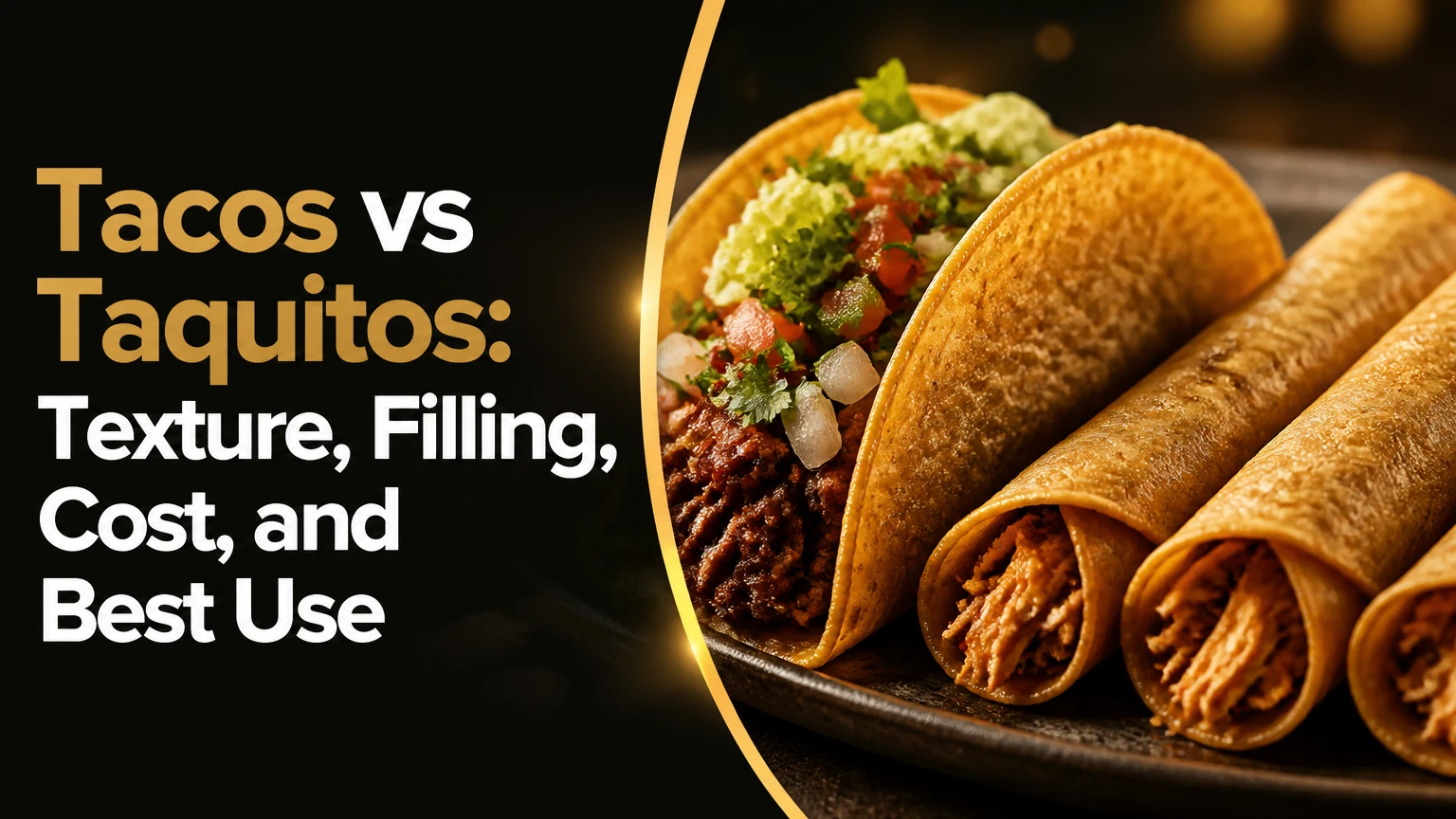
Tacos are folded tortillas filled and topped for immediate eating, while taquitos are small tortillas filled, rolled into cylinders, and usually cooked until crisp. Tacos emphasize fresh toppings, flexible tortillas, and juicy fillings; taquitos emphasize a rigid fried shell, concentrated filling, portability, and batch preparation.
Key Facts at a Glance
- A taco is defined primarily by its folded tortilla format, while a taquito is defined by its tightly rolled cylindrical shape.
- Traditional taquitos commonly use small corn tortillas and are fried, but baked and air-fried versions are also widely prepared.
- Tacos accommodate wetter fillings and fresh toppings more easily because the ingredients remain exposed rather than enclosed.
- Taquitos need a relatively dry, finely shredded filling because excess moisture can split the roll or soften the shell.
- A typical taco takes 5-10 minutes to assemble once ingredients are ready; a homemade taquito batch commonly takes 25-45 minutes.
- A taquito is not automatically smaller than every taco, and a flauta is not universally separate from a taquito because regional usage differs.
What Are Tacos and Taquitos?
A taco is a tortilla folded around a filling, usually with toppings added after cooking or immediately before serving. A taquito is a small filled tortilla rolled tightly into a tube, with the tortilla shape and cooking method creating a crisp, self-contained shell.
The word taquito means “little taco” in Spanish, but culinary usage is more specific than the literal translation suggests. A folded taco can be soft or crisp, open at the top or closed around the filling. A taquito must be rolled, and in many Mexican and Mexican-American menus the term also implies that the roll has been fried or otherwise crisped.
The distinction is structural rather than ingredient-based. Beef, chicken, beans, cheese, potatoes, and vegetables can appear in both dishes. The same seasoned chicken can become a soft taco with onion and salsa or a taquito with a compact filling and a fried corn tortilla.
Are Taquitos Simply Rolled Tacos?
Taquitos are rolled tacos in the broadest sense, but “rolled taco” is a wider menu term than “taquito.” Restaurants may use rolled taco, taquito, or taco dorado for similar fried corn-tortilla cylinders, while flauta often identifies a longer roll or a flour-tortilla version.
Terminology varies by region, restaurant, and family tradition. In parts of Mexico, tacos dorados refers to fried rolled tacos, whereas United States menus often reserve taquito for a shorter corn roll and flauta for a longer item. The tortilla type is a useful clue, not a universal legal definition.
Tacos vs Taquitos: What Is the Practical Difference?
The central difference between tacos and taquitos is how the tortilla manages filling, moisture, and heat. A taco remains open enough for fresh toppings and varied textures, while a taquito encloses a compact filling inside a crisp shell formed by frying, baking, or air frying.
| Feature | Taco | Taquito | Practical result |
|---|---|---|---|
| Basic shape | Folded half-moon | Rolled cylinder | Tacos expose toppings; taquitos contain filling |
| Common tortilla | 5-6 inch corn or flour | 4-6 inch corn, sometimes flour | Corn gives a firmer fried shell |
| Typical cooking | Griddle, comal, or no final frying | Deep-frying, baking, or air frying | Taquitos develop a crisp outer layer |
| Filling moisture | Juicy meat, salsa, vegetables | Drained shredded meat or mashed vegetables | Wet fillings suit tacos better |
| Toppings | Onion, cilantro, lettuce, cheese, salsa | Crema, guacamole, lettuce, cheese, salsa | Taquito toppings are usually added after cooking |
| Eating time | Best immediately | Holds for roughly 15-30 minutes when crisp | Taquitos fit platters and portable meals |
| Batch suitability | Individual assembly | 8-24 rolls per batch | Taquitos suit parties and freezer preparation |
Tacos are more adaptable at the moment of serving. A cook can add broth-rich meat, raw vegetables, fresh herbs, and several sauces without placing those ingredients inside a sealed fried tube. Taquitos reward tighter control because the filling must remain stable during rolling and cooking.
Why Does the Texture Differ?
Tacos stay soft or lightly crisp because the tortilla is warmed or griddled, not usually dehydrated through prolonged oil contact. Taquitos become crunchy because hot oil removes surface moisture from the tortilla while the rolled shape holds the shell against the filling.
A 175°C to 180°C, or 350°F to 355°F, oil temperature is a practical range for frying taquitos. Cooler oil can soak into the tortilla and produce a greasy shell. Hotter oil can brown the exterior before the filling warms, especially when the rolls are thick or frozen.
The texture also depends on tortilla handling. Corn tortillas crack when cold and dry, so warming them under a damp towel or briefly steaming them makes rolling possible. Flour tortillas bend more readily but often produce a different, lighter texture and may be labeled flautas rather than taquitos.
How Do Taco and Taquito Styles Compare?
Taco styles differ mainly by tortilla, protein, topping system, and regional tradition. Taquito styles differ mainly by tortilla size, filling texture, and whether the roll is fried, baked, or air fried.
| Style | Tortilla and size | Filling | Cooking and toppings |
|---|---|---|---|
| Street taco | 4-5 inch corn, often doubled | Carne asada, chicken, beans, or vegetables | Comal-warmed; onion, cilantro, salsa |
| Tex-Mex hard taco | 5-6 inch fried corn shell | Ground beef, beans, or seasoned vegetables | Lettuce, tomato, cheddar, sour cream |
| Birria taco | 5-6 inch corn tortilla | Braised beef or goat | Griddled in cooking fat; consomé on side |
| Fish taco | 5-6 inch corn or flour tortilla | Fried, grilled, or seared fish | Cabbage, crema, lime, salsa |
| Taco dorado | Corn tortilla folded and fried | Potato, chicken, or beans | Lettuce, cheese, crema, salsa |
| Soft flour taco | 6-8 inch flour tortilla | Beef, chicken, beans, or vegetables | Griddled; cheese, salsa, vegetables |
| Rolled dish | Typical tortilla | Filling texture | Final treatment |
|---|---|---|---|
| Classic taquito | 4-5 inch corn | Shredded chicken or beef | Deep-fried 2-3 minutes |
| Taco dorado rolled style | 4-6 inch corn | Potato, beans, or shredded meat | Fried until golden |
| Flauta | 6-10 inch corn or flour | Shredded meat or cheese | Fried or baked; longer roll |
| Potato taquito | 4-5 inch corn | Mashed seasoned potato | Fried or air fried |
| Cheese taquito | 4-5 inch corn | Cheese with beans or vegetables | Fried, baked, or air fried |
| Frozen commercial taquito | Usually corn, 4-6 inches | Processed meat, cheese, or beans | Oven or air fryer reheating |
The categories overlap. A menu should be read by its description rather than by the name alone, particularly when a restaurant uses flauta and taquito interchangeably.
Which Dish Handles Moist Fillings Better?
Tacos handle moist fillings better because the filling is supported by a folded tortilla rather than trapped inside a sealed fried shell. Salsa, braising liquid, guacamole, and fresh vegetables can be added at the table, whereas taquito fillings usually need draining before rolling.
A practical taquito filling should be cohesive but not wet. Shredded chicken mixed with a small amount of thick sauce works better than meat swimming in broth. Mashed potato, refried beans, and shredded cheese bind naturally; loose salsa belongs on top after cooking.
This difference explains why birria works exceptionally well as a taco. The tortilla can be dipped in seasoned cooking fat, griddled, filled with tender meat, and served beside consomé. The same juicy meat requires substantial draining before it can safely enter a taquito.
How Much Filling Should Go in a Taquito?
A typical 4-5 inch taquito uses 1-2 tablespoons of filling, usually 15-30 grams. A small taco commonly holds 30-60 grams, or about 1-2 ounces, because the open folded format does not require space for rolling.
Overfilling causes two problems. The tortilla cannot wrap tightly, and steam pressure can force the seam open during cooking. Underfilling produces a hollow, brittle roll that feels dry even when the exterior is properly crisp.
| Item | Typical filling quantity | Recommended filling texture | Main failure when exceeded |
|---|---|---|---|
| Street taco | 30-45 g | Juicy and finely chopped | Tortilla tears or spills |
| Hard-shell taco | 45-60 g | Ground or crumbled | Shell fractures under weight |
| Small taquito | 15-30 g | Drained and shredded | Seam opens during frying |
| Large flauta | 30-45 g | Shredded and cohesive | Center remains loose |
| Potato taquito | 20-30 g | Firm mashed potato | Roll becomes difficult to close |
Which Is Healthier, a Taco or a Taquito?
A taco is often the lower-fat choice when it uses a warmed tortilla, lean protein, beans, and vegetables, while a taquito usually gains additional fat from frying. No universal calorie result exists because tortilla diameter, cooking oil, cheese, sauces, and filling quantity can reverse the comparison.
The most useful comparison isolates preparation method. A grilled chicken taco with one corn tortilla and vegetable toppings differs substantially from a deep-fried beef taquito topped with cheese and crema. An air-fried bean taquito may contain less added fat than a large flour taco filled with cheese and sour cream.
The United States Department of Agriculture FoodData Central provides ingredient-level nutrition data rather than one official category value for “taco” or “taquito.” That limitation matters: restaurant portions and frozen products vary enough that package labels or recipe calculations are more reliable than generic online averages.
| Preparation | Typical portion | Added cooking fat | Nutrition pressure point |
|---|---|---|---|
| Griddled corn taco | 1 taco, 30-45 g filling | 0-2 g | Sodium in meat and salsa |
| Flour taco | 1 taco, 45-60 g filling | 0-3 g | Larger tortilla and cheese |
| Deep-fried taquito | 1 roll, 15-30 g filling | Variable, often absorbed | Frying oil and dense toppings |
| Air-fried taquito | 1 roll, 15-30 g filling | 0-2 g spray oil | Processed filling or sodium |
| Bean and vegetable taco | 1 taco, 30-45 g filling | 0-2 g | Sodium in canned beans |
| Potato taquito | 1 roll, 20-30 g filling | Low when baked | Refined tortilla and toppings |
For a lower-fat plate, choose soft corn tacos, grilled chicken or beans, cabbage, pico de gallo, and a measured amount of crema. For a crisp texture with less oil, brush taquitos lightly and air fry them, understanding that air frying changes browning and may require a longer cooking time.
How Do You Make Soft Tacos?
To make soft tacos, warm 4-6 inch corn tortillas for about 30 seconds per side, add 30-60 grams of cooked filling, and finish with toppings immediately. The main success factor is tortilla pliability: a dry tortilla cracks, while an overheated tortilla loses structure and becomes gummy.
- Warm the tortillas. Heat a dry comal or skillet over medium heat, then warm each corn tortilla for 20-30 seconds per side. Stack finished tortillas in a clean towel.
- Prepare the filling. Use 30-60 grams of seasoned meat, beans, fish, or vegetables per taco. Remove excess liquid so the tortilla remains foldable.
- Build the taco. Place the filling slightly off center rather than directly on the crease. Add onion, cilantro, cabbage, cheese, or other toppings in controlled quantities.
- Add acid and salsa. Use about 1 teaspoon of salsa and a small squeeze of lime per taco, adjusting for the filling’s salt and moisture.
- Fold and serve. Fold the tortilla once and serve within a few minutes. Double tortillas when the filling is juicy or the corn tortilla is thin.
The taco is ready when the tortilla bends without cracking and the filling stays centered after folding. A common mistake is adding salsa before the tortilla is warm, which allows liquid to soak into one spot and weaken the shell.
How Do You Make Crisp Taquitos?
To make crisp taquitos, soften corn tortillas, add 1-2 tablespoons of drained filling, roll tightly, secure the seam, and cook until golden. A batch of 12 typically takes 25-45 minutes, including filling preparation, rolling, and cooking.
- Drain and cool the filling. Remove visible broth or sauce and let the mixture cool enough to handle. Hot, wet filling creates steam inside the roll.
- Soften the tortillas. Wrap 8-12 tortillas in a damp towel and microwave for 30-45 seconds, or steam them briefly. Keep the stack covered while working.
- Fill lightly. Place 15-30 grams of filling in a narrow line near one edge. Leave at least 1 centimeter of clear tortilla at both ends.
- Roll firmly. Tuck the tortilla over the filling, then continue rolling into a compact cylinder. Avoid crushing the tortilla.
- Secure the seam. Place the roll seam-side down or use a toothpick that can be removed before serving. Do not rely on several toothpicks in hot oil.
- Cook completely. Fry at 175°C to 180°C for 2-3 minutes, or air fry at approximately 200°C, or 400°F, for 8-12 minutes, turning once.
- Drain and finish. Transfer fried rolls to a rack or paper towel. Add lettuce, crema, guacamole, cheese, or salsa immediately before serving.
A taquito is properly cooked when the exterior is evenly golden and rigid, with a warm center that does not release liquid when cut. The most common technical error is using a wet filling, not an inadequate amount of oil.
Do Tacos or Taquitos Cost Less?
Tacos usually cost less per individually assembled serving, while taquitos can be more economical for parties when prepared in large batches. Typical restaurant prices range from $2.50-$5 per taco and $8-$13 for a platter of three to five taquitos, though location and ingredients change the result.
Homemade tacos require fewer cooking steps and less oil. Taquitos use more tortillas per serving and may require frying oil, but batch preparation reduces labor per piece. Frozen taquitos generally cost about $6-$9 for a 20-count box, or roughly $0.30-$0.45 per roll before toppings.
| Purchase format | Typical quantity | Typical price | Approximate unit cost |
|---|---|---|---|
| Restaurant taco | 1 piece | $2.50-$5.00 | $2.50-$5.00 |
| Restaurant taquito platter | 3-5 rolls | $8.00-$13.00 | $1.60-$4.33 |
| Frozen taquitos | 20 rolls | $6.00-$9.00 | $0.30-$0.45 |
| Homemade tacos | 8 servings | $12-$25 ingredients | $1.50-$3.13 |
| Homemade taquitos | 12 rolls | $12-$24 ingredients | $1.00-$2.00 |
| Party taco bar | 12 servings | $30-$60 ingredients | $2.50-$5.00 |
These are typical planning ranges, not universal market prices. Restaurant labor, city, protein choice, and toppings have greater price impact than the dish name.
Which Is Better for Parties, Travel, and Leftovers?
Taquitos are usually better for parties and travel because their rigid shells can be cooked in batches and eaten with fewer spills. Tacos are better for immediate meals because fresh toppings, juicy fillings, and hot tortillas retain more quality when assembled and served at once.
| Situation | Better choice | Portion plan | Reason |
|---|---|---|---|
| Standing party | Taquitos | 2-4 rolls per guest | Compact, batch-cooked, easy to plate |
| Family dinner | Tacos | 2-4 tacos per guest | Each person customizes toppings |
| Packed lunch | Taquitos | 3-5 rolls per container | Less sauce leakage and better portability |
| Road trip | Taquitos | 2-3 rolls per person | Stable shape and minimal assembly |
| Juicy braised meat | Tacos | 2-3 tacos per person | Open format handles broth and salsa |
| Make-ahead freezer meal | Taquitos | 12-24 rolls per batch | Freeze individually before bagging |
| Quick weeknight meal | Tacos | 8-12 tacos in 10 minutes | Assembly is faster than rolling and frying |
Taquitos are not automatically better leftovers. Their shell softens when sealed beside steam or wet toppings. Store the rolls separately from salsa, lettuce, crema, and guacamole, then reheat them uncovered on a rack.
Can You Freeze Taquitos?
Taquitos freeze well for about 1-2 months when cooled, frozen in a single layer, and stored in an airtight container. Freeze cooked or uncooked rolls without wet toppings, then reheat from frozen in an oven or air fryer until the center is hot.
A practical method is to freeze uncooked assembled taquitos on a tray for 1-2 hours before transferring them to a bag. This prevents the rolls from sticking together. Air fry frozen taquitos at about 190°C to 200°C, or 375°F to 400°F, for approximately 10-16 minutes, turning halfway.
Tacos do not freeze as a complete assembled dish. Tortillas, meat, beans, and toppings should be stored separately because lettuce, salsa, and cream-based toppings lose texture after thawing.
What Are the Most Common Problems?
The most common taco problems are cracked tortillas, overloaded fillings, and soggy shells. The most common taquito problems are seam failure, greasy exteriors, dry centers, and moisture trapped inside the roll.
| Problem | Likely cause | Immediate fix | Prevention |
|---|---|---|---|
| Corn taco cracks | Cold or stale tortilla | Steam briefly and double the tortilla | Keep tortillas covered and warm |
| Taco spills | More than 60 g filling | Remove some filling and fold tightly | Use 30-45 g for small tacos |
| Taquito unrolls | Loose seam or overfilling | Place seam-down and hold 10 seconds | Use 15-30 g filling |
| Taquito bursts | Wet or hot filling | Stop frying and drain filling | Cool and reduce the filling |
| Taquito turns greasy | Oil below 175°C | Raise heat and cook smaller batches | Fry at 175°C-180°C |
| Outside burns, center stays cool | Oil above 185°C or frozen thick roll | Lower heat and extend cooking | Use smaller rolls and verify temperature |
| Shell softens | Steam or wet toppings | Reheat uncovered on a rack | Store toppings separately |
A useful practitioner rule is to judge the filling by how it behaves on a spoon. If liquid pools around the mixture within several seconds, the filling is too wet for a tightly rolled taquito. Drain it, reduce it in a pan, or add a cohesive ingredient such as mashed beans or potato.
Food safety also matters. The USDA recommends refrigerating perishable cooked food within two hours, or within one hour when ambient temperatures exceed 90°F. Reheat leftovers to 165°F, especially when taquitos contain cooked poultry or other prepared fillings.
Which Should You Choose?
Choose tacos for fresh toppings, juicy fillings, fast assembly, and individual customization. Choose taquitos for crunch, portability, freezer preparation, and party service. The best answer depends on the desired texture, filling moisture, cooking time, and whether the food will be eaten immediately.
Choose Tacos for Fresh, Juicy Meals
Tacos are the stronger choice for birria, grilled fish, chopped steak, beans with salsa, and meals where onion, cilantro, cabbage, or lime matters as much as the filling. A taco also works better when diners want different levels of heat or different sauces.
Tacos are less suitable when food must sit for a long time. Wet toppings can soften a hard shell, and a soft tortilla can become difficult to handle after prolonged contact with hot filling.
Choose Taquitos for Crunch and Portability
Taquitos are the stronger choice for lunch boxes, party platters, freezer cooking, and meals eaten while standing. The cylindrical shell protects the filling and limits the exposed surface area, so taquitos generally create fewer spills than heavily topped tacos.
Taquitos are less suitable for broth-heavy fillings and delicate fresh toppings. Adding salsa before storage turns the crisp shell soft, while adding too much filling creates a roll that breaks during cooking.
Choose Air-Fried Taquitos for Lower-Oil Crispness
Air-fried taquitos suit cooks who want a crisp exterior without submerging the tortillas in oil. Brush or spray the rolls lightly, leave space between them, and turn them halfway through cooking for more even browning.
Air frying does not reproduce deep-frying exactly. The shell may be drier and less blistered, and a very lean filling can become tough during the longer cooking period. A small amount of cheese, beans, or thick sauce helps retain moisture inside.
Frequently Asked Questions
Are tacos always soft?
No. Tacos can use soft corn or flour tortillas, fried corn shells, or tortillas that are briefly griddled until crisp. Street tacos are commonly soft and small, while many Tex-Mex tacos use rigid fried shells. The defining feature is the folded taco format, not one mandatory tortilla texture.
Can taquitos be baked instead of fried?
Yes. Arrange assembled taquitos seam-side down, brush them lightly with oil, and bake at about 425°F for 15-22 minutes, turning once. Baked taquitos usually have a drier, less blistered shell than fried taquitos, but they reduce the amount of cooking oil used.
What sauce goes with taquitos?
Salsa verde, roasted tomato salsa, guacamole, Mexican crema, and shredded lettuce are common choices. Add wet sauces after cooking rather than before frying, because liquid inside the roll can create steam, weaken the tortilla, and cause the seam to open.
How many tacos or taquitos should one person eat?
A typical adult serving is two to four small tacos or three to five taquitos, depending on filling size and side dishes. A 4-inch taquito with 15-30 grams of filling is smaller than a generously filled restaurant taco, so counting pieces alone can mislead.
Are flautas and taquitos the same food?
Flautas and taquitos are closely related rolled tortilla dishes, but the distinction changes by region. Flautas are often longer and may use flour tortillas, while taquitos are commonly shorter corn-tortilla rolls. Restaurant menus frequently overlap the terms, so the listed tortilla and size provide the better guide.
Which reheats better, tacos or taquitos?
Taquitos generally reheat better because their shells can regain crispness in an oven or air fryer. Tacos reheat best when tortillas and fillings are warmed separately and toppings are added afterward. Microwave reheating softens fried shells and can make corn tortillas tough or chewy.
The Bottom Line
Tacos are folded, customizable tortillas built around fresh toppings and fillings that may be juicy or delicate. Taquitos are compact rolled tortillas designed for a crisp shell, controlled moisture, and convenient batch service. Choose tacos for an immediate, topping-heavy meal; choose taquitos for crunch, portability, freezing, or parties. The decisive difference is not the filling. It is the tortilla’s shape and the way that shape is cooked.