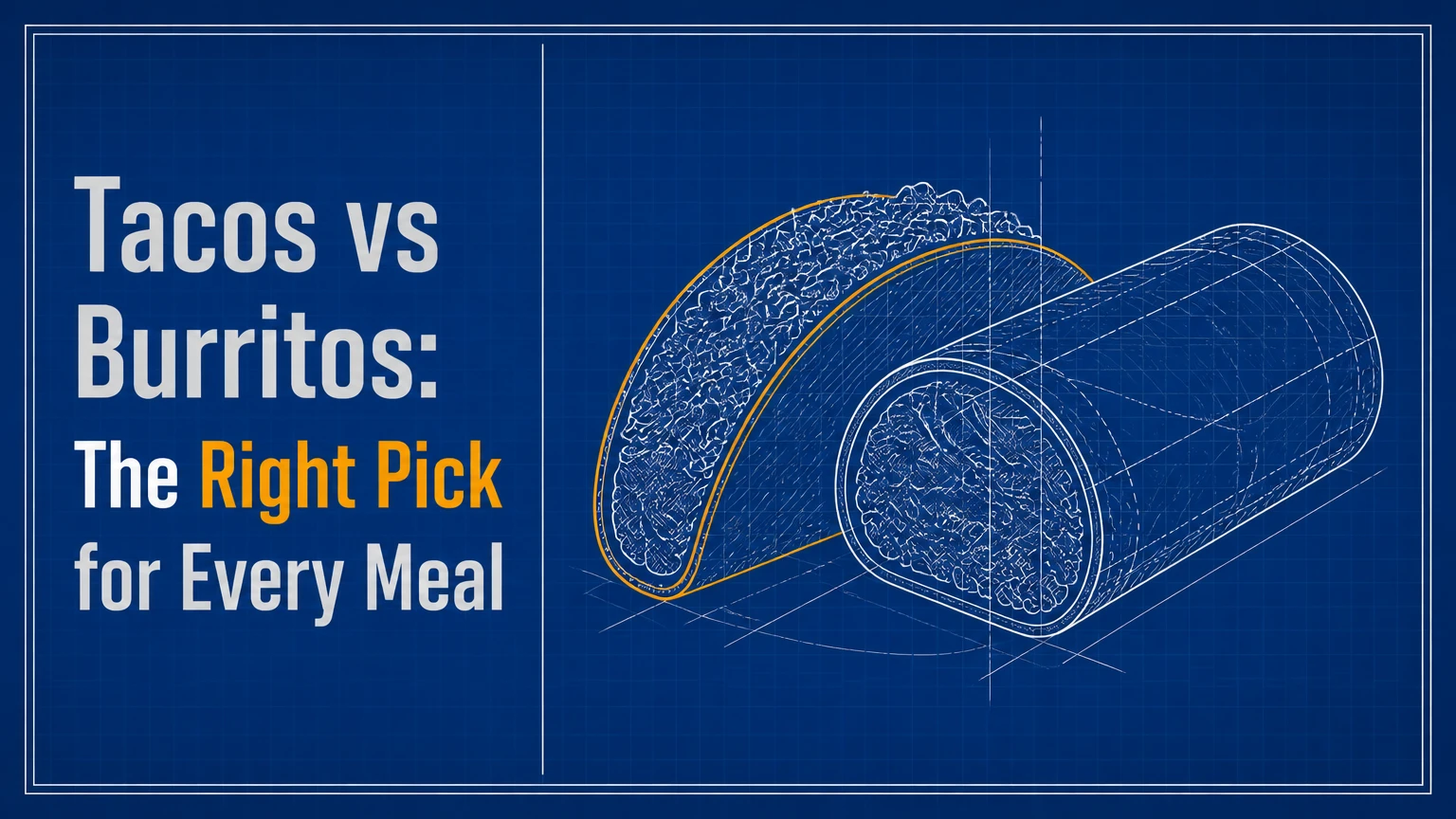
Tacos are better for variety, lighter portions, crisp textures, and sampling several fillings, while burritos are better for a complete, portable, filling meal. The decisive differences are tortilla size, whether the tortilla remains open or sealed, filling density, moisture management, eating method, and regional style rather than the ingredient list alone.
Key Facts at a Glance
- A taco usually uses a 5-7-inch tortilla and remains open at both ends after folding.
- A burrito usually uses a 10-14-inch flour tortilla that fully encloses its filling.
- A single burrito commonly weighs several times more than one taco, but restaurant portions vary widely.
- Tacos offer better mix-and-match variety because diners can order different fillings individually.
- Burritos travel more cleanly because the tortilla creates a sealed package around the filling.
- Neither format is automatically healthier; tortilla size, rice, cheese, creamy toppings, protein, and portion count determine the meal’s nutrition.
What Is the Difference Between Tacos and Burritos?
The defining difference between tacos and burritos is enclosure: a taco folds around its filling without fully sealing the package, while a burrito wraps the filling inside a closed tortilla. Tacos usually emphasize a tortilla, protein, fresh garnish, and salsa; burritos usually organize several ingredients into a dense, portable interior.
A taco can use corn or flour and can be soft or crisp. A burrito generally uses a large, flexible flour tortilla because flour tortillas stretch more reliably during rolling and resist cracking when warm. These are common patterns, not legal definitions. Small flour tacos and rice-free burritos both exist.
Eating method separates the formats further. A taco is held from the sides and eaten in a few bites, often over a plate. A burrito is held from one end, commonly with paper or foil around the lower half, and eaten as a self-contained meal.
| Attribute | Taco | Burrito | Practical consequence |
|---|---|---|---|
| Typical tortilla diameter | 5-7 inches | 10-14 inches | Burritos hold substantially more food |
| Closure | Folded, open-ended | Fully rolled and sealed | Burritos travel with less spill risk |
| Typical structure | Tortilla, filling, garnish | Tortilla, starch, protein, binder, sauce | Burritos create denser bites |
| Common eating setting | Counter, table, street stand | Commute, lunch desk, takeout | Tacos reward immediate eating |
| Typical order size | 2-4 units | 1 unit | Tacos increase flavor variety |
| Main structural risk | Side or bottom splitting | Seam or wet-bottom failure | Each format needs different handling |
Is a Soft Taco the Same as a Burrito?
A soft taco is not automatically a burrito because the distinction depends on size, enclosure, and construction rather than softness alone. A soft taco remains relatively small and open-ended, whereas a burrito uses a large tortilla and folds the sides inward before rolling the package closed.
A restaurant may call a large folded flour tortilla a “wrap,” “soft taco,” or burrito according to its menu convention. The name does not change the physical distinction. If the tortilla cannot enclose the filling with side folds and a sealed seam, the item behaves like a taco or wrap rather than a classic burrito.
How Do Taco and Burrito Structures Work?
Tacos rely on a flexible hinge and a low center of gravity, while burritos rely on tortilla tension, compact layering, and a closed seam. A taco’s open edges allow steam and liquid to escape; a burrito’s enclosure retains heat but makes excess moisture more dangerous.
For tacos, the filling should sit in a narrow line along the lower center of the tortilla. Tall piles increase the leverage exerted on the fold, so the tortilla splits more easily when lifted. A second corn tortilla creates redundancy when the filling is juicy or the first tortilla is thin.
Burritos need a controlled filling footprint. A practical home target is a 2-inch border around a filling rectangle no wider than one-third of the tortilla. Rice, beans, cheese, or another relatively cohesive ingredient can stabilize loose fillings, but rice is not structurally mandatory.
Why Do Tacos Fall Apart?
Tacos fall apart when filling weight, liquid, or folding force exceeds the tortilla’s strength. Thin corn tortillas are especially vulnerable after prolonged contact with salsa, broth, or juicy meat because moisture weakens the tortilla’s toasted structure.
Warm the tortilla for 15-30 seconds per side on a dry skillet or comal. Keep a single taco filling near 1.5-2.5 ounces, and use two tortillas when the filling is wet or the tortilla has visible cracks. Add salsa immediately before eating instead of allowing it to soak for several minutes.
Why Do Burritos Get Soggy?
Burritos get soggy when liquid ingredients collect against the lower tortilla faster than the tortilla can resist absorption. Undrained beans, watery salsa, and broth-heavy fillings create the greatest risk, particularly when a hot burrito is wrapped tightly and held for more than 15 minutes.
Drain beans and cooked fillings before assembly. Place a drier ingredient between wet fillings and the tortilla, then wrap the burrito in paper or foil with the seam underneath. For takeout, request wet sauce separately unless the restaurant’s wet-burrito format is meant to be eaten with utensils.
Which Tortilla Works Best for Each Format?
Corn tortillas suit traditional tacos because they provide toasted maize flavor and a firm, compact bite, while large flour tortillas suit burritos because their gluten-based structure stretches around a dense filling. Flour tacos and corn-based burrito variations exist, but the tortilla must match the intended load.
Corn tortillas typically measure 5-6 inches for street tacos and 6-8 inches for larger table tacos. Burrito tortillas commonly measure 10-14 inches, with 12 inches offering a useful balance between capacity and manageability. A tortilla diameter is not its edible weight, so label size alone cannot predict calories.
| Format or tortilla | Typical size | Best filling load | Main advantage |
|---|---|---|---|
| Street taco corn tortilla | 5-6 inches | 1-1.5 ounces | Strong toasted flavor and portion control |
| Soft flour taco tortilla | 6-8 inches | 1.5-2.5 ounces | Flexible fold and mild flavor |
| Burrito flour tortilla | 10-14 inches | 8-16 ounces | Stretch, enclosure, and portability |
| Extra-large flour tortilla | 14-16 inches | 14-24 ounces | Maximum capacity with higher split risk |
| Crispy taco shell | 5-6 inches | 1-2 ounces | Crunch and rigid shape |
| Whole-grain wrap-style tortilla | 10-12 inches | 8-14 ounces | Fiber-forward alternative with less elasticity |
What Are the Major Taco and Burrito Styles?
Taco styles differ mainly through tortilla treatment, cooking method, filling, and garnish, while burrito styles differ through regional assembly and whether the finished item remains dry, toasted, or covered in sauce. Names such as “street taco” and “Mission burrito” identify recognizable patterns, not one universal recipe.
| Style | Defining ingredients | Tortilla or finish | Best use |
|---|---|---|---|
| Street taco | Grilled meat, onion, cilantro, lime | Small corn tortilla, often doubled | Sampling several fillings |
| Taco de guisado | Stewed vegetables, beans, or braised filling | Soft corn tortilla | Moist, homestyle meal |
| Taco de asador | Grilled steak, chicken, or vegetables | Charred corn or flour tortilla | Smoky, direct flavors |
| Tex-Mex taco | Seasoned ground beef, lettuce, tomato, cheese | Crisp shell or flour tortilla | Familiar family-style meal |
| Mission burrito | Rice, beans, protein, salsa, cheese, optional creamy toppings | Large flour tortilla, tightly rolled | Portable, high-volume lunch |
| California burrito | Grilled steak, fries, cheese, guacamole, salsa | Large flour tortilla | Rich, starch-heavy regional specialty |
| Breakfast burrito | Egg, potato, cheese, and breakfast protein | Large flour tortilla | Morning meal and reheating |
| Wet burrito | Filled burrito, red or green sauce, melted cheese | Rolled, then plated | Fork-and-knife dining |
| Burrito dorado | Standard burrito with crisped exterior | Grilled after rolling | Firmer shell and melted interior |
A street taco is not simply a smaller restaurant taco. In many Mexican contexts, the combination of small corn tortillas, focused fillings, fresh onion, cilantro, and lime creates a distinct eating style. Tex-Mex tacos may use lettuce, tomato, shredded cheese, and a crisp shell, producing a different texture and seasoning profile.
Burrito terminology is similarly regional. The San Francisco Mission burrito is known for a large flour tortilla and a substantial filling matrix, while a California burrito typically uses fries in place of the rice-and-bean pattern found in many Mission versions. A wet burrito changes the eating method entirely because sauce and cheese turn a handheld item into a plated dish.
Which Is More Filling, Tacos or Burritos?
Burritos are usually more filling per item because a large tortilla encloses starch, protein, beans, cheese, and sauce in a compact meal. Tacos can provide equal or greater total food when ordered in multiples, but a two-taco order generally offers more flavor variation and less bulk than one large burrito.
The word “filling” has two meanings. A burrito creates more physical fullness through mass and starch, while tacos can deliver more protein or vegetables per calorie when the order emphasizes lean filling and limits cheese and creamy toppings. A meal of three small tacos may therefore be lighter than a restaurant burrito but more satisfying for a diner who values variety.
| Typical restaurant portion | Approximate weight | Typical calorie range | Common protein range |
|---|---|---|---|
| One street taco | 2.5-4 ounces | 150-250 calories | 7-15 grams |
| Three street tacos | 7.5-12 ounces | 450-750 calories | 21-45 grams |
| One soft Tex-Mex taco | 4-6 ounces | 250-400 calories | 10-20 grams |
| Standard bean-and-protein burrito | 12-20 ounces | 700-1,100 calories | 25-50 grams |
| California-style burrito | 16-28 ounces | 1,000-1,600 calories | 35-65 grams |
| Bowl with comparable filling | 12-24 ounces | 600-1,200 calories | 25-55 grams |
The ranges above are typical restaurant estimates, not universal nutrition facts. The United States Department of Agriculture FoodData Central lists individual ingredients separately, so an accurate total requires the restaurant’s actual tortilla weight, cooked filling quantity, oils, cheese, sauce, and toppings.
Are Tacos Healthier Than Burritos?
Tacos are often easier to portion, but tacos are not automatically healthier than burritos. Two fried-shell tacos with cheese and creamy sauce can exceed the calories of two grilled corn tacos, while a burrito made with beans, vegetables, lean protein, and modest cheese can provide a balanced meal.
For lower carbohydrate intake, choose corn tacos with a protein and vegetable garnish, or order a burrito bowl without a flour tortilla and rice. For higher protein, ask for an extra serving of grilled chicken, lean beef, beans, or both, then control cheese and creamy toppings rather than removing vegetables.
A large flour tortilla can contribute several hundred calories before fillings are added, but the exact amount depends on diameter, recipe, and brand. Restaurant nutrition panels are more reliable than generic online averages because preparation fats and serving sizes vary substantially.
Which Travels Better, Tacos or Burritos?
Burritos travel better because the sealed tortilla contains loose fillings and preserves heat during a short commute. Tacos are better for immediate service, especially when crisp shells, fresh herbs, or thin corn tortillas are part of the intended texture.
A burrito can remain reasonably intact for 20-30 minutes when wrapped seam-down and kept level. A soft taco should ideally be eaten within about 5-10 minutes after salsa is added, while a crisp taco should be separated from wet ingredients until serving.
| Situation | Better choice | Practical limit | Reason |
|---|---|---|---|
| Eating while walking | Burrito | 20-30 minutes wrapped | Closed seam reduces spills |
| Eating at a table | Tacos | Immediate service preferred | Open format preserves garnish |
| Long car journey | Burrito bowl or burrito | 30-45 minutes with sauce separate | Less shell collapse |
| Office lunch | Burrito | 15-25 minutes after pickup | Foil or paper retains heat |
| Children eating independently | Soft taco or small quesadilla | 1-2 units at a time | Smaller portions reduce overload |
| Crisp texture priority | Crisp taco | Under 10 minutes | Steam quickly softens shells |
No format is ideal for every commute. A wet burrito, heavily sauced burrito, or overfilled California-style burrito can be harder to manage than a restrained soft taco because the package becomes heavy and slippery.
How Should You Build Tacos and Burritos?
Tacos require immediate assembly around a small filling line, while burritos require measured layering and a deliberate rolling sequence. Warming the tortilla and controlling liquid are the two steps that prevent most home failures.
How to Build a Taco
- Warm the tortilla. Heat a corn or flour tortilla for 15-30 seconds per side until flexible, with light toast marks on a corn tortilla.
- Add the filling. Place 1.5-2 ounces of cooked protein, beans, mushrooms, or vegetables along the lower center.
- Add structural toppings. Use chopped onion, cilantro, cabbage, or a small amount of cheese to distribute texture without creating a tall mound.
- Add salsa last. Use 1-2 teaspoons immediately before serving, especially with corn tortillas.
- Fold and serve. Bring the sides upward without compressing the filling, then eat over a plate.
You will know the taco is correctly loaded when the tortilla closes without force and the filling remains below the top edge. The common mistake is treating a small taco like a bowl by adding too much filling; use a second tortilla instead of creating a high, unstable stack.
How to Wrap a Burrito
- Warm the tortilla. Steam or heat a 10-14-inch flour tortilla for 10-15 seconds until pliable.
- Create the filling zone. Place rice, beans, or another cohesive base in a rectangle, leaving about 2 inches at the bottom and sides.
- Add the center ingredients. Place protein, vegetables, cheese, and salsa in the middle third, keeping wet sauce modest.
- Fold the sides. Fold the left and right edges inward until they cover the ends of the filling.
- Tuck the bottom. Pull the lower edge over the filling and tighten it beneath the first fold.
- Roll under tension. Continue rolling forward while keeping the side folds tucked.
- Rest seam-down. Place the burrito seam-down for 30-60 seconds, or toast it seam-down on a dry skillet.
You will know the burrito is correctly wrapped when the seam stays closed after a gentle lift and no filling protrudes from either end. The common mistake is filling the center with a loose, wet mound; a flatter rectangle rolls more securely than a taller pile.
How Much Do Tacos and Burritos Cost?
Tacos commonly cost less per unit, but burritos often deliver more food per dollar because one purchase replaces several tacos. Price depends on city, restaurant type, protein, labor, and whether the item includes premium toppings or a side.
Typical United States restaurant ranges are approximately $2.50-$5.00 for one taco and $9.00-$16.00 for a standard burrito. Specialty tacos, large regional burritos, and delivery orders can exceed those ranges, while fast-casual promotions can fall below them.
| Purchase | Typical menu price | Typical food quantity | Value pattern |
|---|---|---|---|
| One street taco | $2.50-$4.00 | 2.5-4 ounces | Lowest entry cost |
| Three-taco plate | $9.00-$16.00 | 8-14 ounces | Highest variety |
| Standard burrito | $9.00-$16.00 | 12-20 ounces | Highest single-item fullness |
| Premium steak burrito | $13.00-$20.00 | 16-24 ounces | Higher protein and price |
| Burrito bowl | $10.00-$17.00 | 12-24 ounces | Flexible tortilla-free portion |
| Family taco order | $25.00-$50.00 | 10-20 tacos | Best for mixed preferences |
For budget planning, compare the price of a full meal rather than the unit price. Three inexpensive tacos may cost more than one burrito but allow diners to select different fillings and avoid paying for unwanted rice, cheese, or sauce.
Which Should You Choose?
Choose tacos for variety, immediate dining, smaller portions, crisp or fresh toppings, and a meal where each filling remains distinct. Choose a burrito for portability, maximum fullness, reheating, and a single compact order that combines starch, protein, vegetables, and sauce.
Choose Tacos for Variety and Portion Control
Tacos suit a diner who wants three different fillings, such as grilled chicken, braised beef, and roasted vegetables. The smaller format also makes it easier to limit starch, skip cheese, or order one additional taco only if hunger remains.
Tacos are less suitable for eating in a moving vehicle, carrying across a long distance, or preserving a crisp shell. Order salsa separately when the food must sit longer than 10 minutes.
Choose Burritos for Commuting and Full Meals
Burritos suit commuters, field workers, and diners who need a one-handed meal with minimal packaging. Rice and beans create a dependable base, while protein and vegetables make the interior more substantial than a snack-sized taco.
Burritos are less suitable when diners disagree about ingredients because the filling cannot be separated after rolling. A bowl may be better for shared customization or for anyone who dislikes a large flour tortilla.
Choose Tacos for Lower-Carbohydrate Meals
Two or three corn-tortilla tacos can offer tighter carbohydrate control than a large flour tortilla, especially when the filling emphasizes grilled protein and vegetables. Ask for cheese, creamy toppings, and rice separately when precise portion management matters.
Tacos do not guarantee a low-calorie meal. Fried shells, oily fillings, and large amounts of cheese can reverse the advantage quickly.
Choose a Burrito for High-Protein Meal Prep
A burrito can support meal preparation when the filling is cooled before wrapping and wet ingredients are added sparingly. Use beans, grilled chicken, lean beef, or tofu, then reheat the wrapped item until the center is hot.
Do not freeze a burrito with watery lettuce, fresh tomato, or large amounts of sour cream. Those ingredients release water during thawing and damage the tortilla’s texture.
What Are the Best Alternatives to Tacos and Burritos?
A bowl is the closest burrito alternative, while a tostada or quesadilla can replace a taco when diners want a different texture. Alternatives are useful when portability, gluten avoidance, crispness, or ingredient separation matters more than the handheld format.
| Alternative | Replaces | Typical structure | Best reason to choose it |
|---|---|---|---|
| Burrito bowl | Burrito | Rice, beans, protein, toppings in a bowl | Easier customization and lower tortilla load |
| Tostada | Crisp taco | Fried or toasted flat tortilla with toppings | Maximum crunch without a folded shell |
| Quesadilla | Soft taco | Folded tortilla with melted cheese and filling | Cohesive, kid-friendly texture |
| Enchilada | Wet burrito | Filled tortilla covered in sauce | Best for plated, saucy dining |
| Salad bowl | Taco or burrito | Greens, vegetables, protein, toppings | Higher vegetable volume |
| Lettuce wrap | Taco | Leaf-wrapped filling | Tortilla-free handheld option |
An alternative does not automatically solve nutrition or mess concerns. A cheese-heavy quesadilla can be denser than tacos, and a bowl can contain more rice than the burrito tortilla it replaces.
Common Problems and How Do You Fix Them?
Taco and burrito failures usually come from excessive filling, cold tortillas, uncontrolled liquid, or waiting too long before eating. Correct the physical cause rather than adding more tortilla after the package has already split.
| Failure | Likely cause | Immediate fix | Prevention |
|---|---|---|---|
| Taco splits at fold | Cold or overloaded tortilla | Transfer filling to a second warm tortilla | Keep filling under 2.5 ounces |
| Taco turns mushy | Salsa added too early | Drain excess salsa and eat immediately | Add salsa at the table |
| Burrito cracks while rolling | Cold, dry flour tortilla | Warm for 10-15 seconds | Steam before filling |
| Burrito leaks from ends | Filling placed too close to edges | Fold ends inward and press seam down | Keep a 2-inch border |
| Burrito has wet bottom | Undrained beans or sauce | Toast seam-down briefly | Drain wet ingredients |
| Filling clumps in one bite | Ingredients layered in separate piles | Reassemble in thin alternating layers | Distribute each component across the center |
A double tortilla is a structural repair, not a substitute for portion control. Two thin tortillas still fail when a wet filling sits untouched for 30 minutes.
An important practitioner rule is to place the most cohesive ingredients against the tortilla and the loosest ingredients toward the center. A second rule is to use salsa as a finishing condiment when texture matters, not as a marinade inside the package.
Frequently Asked Questions
Can You Make a Burrito With a Corn Tortilla?
A burrito can use a corn tortilla, but a large corn tortilla is less elastic and more likely to crack during side folds and rolling. Corn tortillas work better for smaller, tightly controlled burritos or rolled dishes served immediately, while large flour tortillas remain the more reliable choice for portable burritos.
Do Tacos or Burritos Have More Protein?
Burritos often contain more total protein because their larger format holds more filling, beans, and cheese. Tacos can provide a higher protein-to-calorie ratio when diners choose grilled protein, use two or three small corn tortillas, and limit cheese and creamy toppings.
Can Burritos Be Made Without Rice?
Burritos can be made without rice because rice is a common filling, not a defining requirement. Beans, vegetables, potatoes, cheese, and protein can replace rice, although the filling may need another cohesive ingredient to prevent loose components from shifting during rolling.
Why Are Some Burritos Wrapped in Foil?
Restaurants wrap burritos in foil to retain heat, support the lower half, and reduce leakage during transport. Foil does not improve a poorly rolled burrito, and diners should open one end gradually because trapped steam can soften the tortilla and loosen the seam.
Are Tacos Easier to Make at Home?
Tacos are usually easier to assemble because they require fewer structural steps and tolerate more variation in filling placement. Burritos require a warmed tortilla, measured borders, controlled moisture, and tension during rolling, but the technique becomes predictable after several practice attempts.
Which Is Better for a Group Meal?
Tacos are usually better for groups with different tastes because each person can select several fillings and toppings. Burritos work better when everyone wants a substantial, standardized meal, while a taco bar or burrito bowl station provides the greatest ingredient separation and customization.
The Bottom Line
Tacos vs burritos is ultimately a choice between open variety and sealed convenience. Choose tacos for fresh toppings, smaller portions, multiple fillings, and immediate table service; choose burritos for portability, caloric density, reheating, and a complete one-item meal. When neither format fits, order a bowl for control or a quesadilla for a cohesive, crisp-edged alternative.