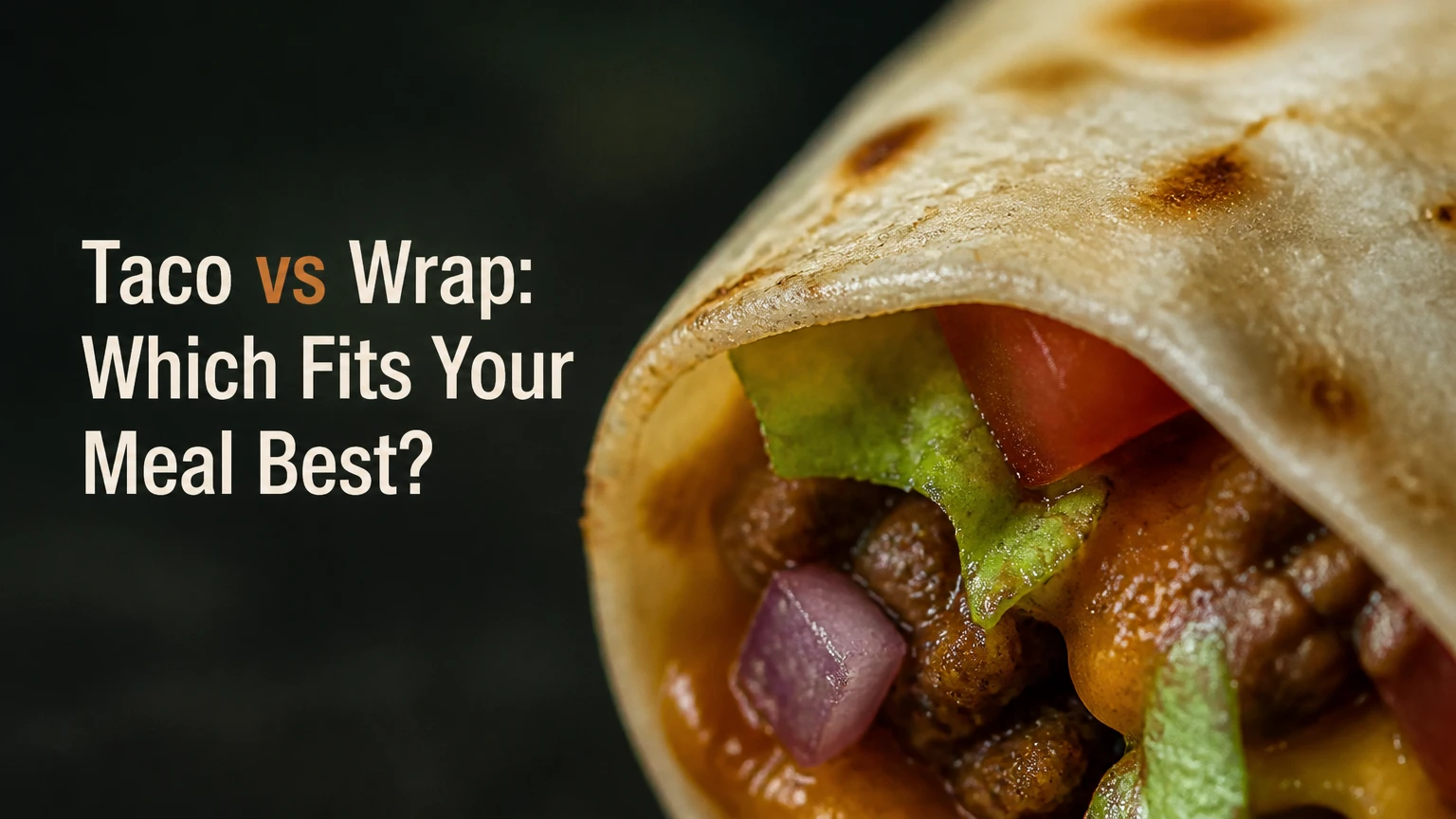
A taco uses a small tortilla folded around or beneath a filling, while a wrap uses a larger flatbread rolled around fillings with overlapping layers. Tacos usually prioritize concentrated flavor, portion variety, and immediate eating; wraps prioritize containment, portability, and a complete meal in one package.
Key Facts at a Glance
- A typical taco tortilla measures 4-6 inches, while a meal-sized wrap usually measures 10-14 inches.
- Tacos commonly hold 1.5-3 ounces of filling each; wraps commonly hold 8-16 ounces.
- A taco is defined by its folded or filled tortilla format, not by one mandatory ingredient or tortilla size.
- A wrap can use wheat tortilla, lavash, flatbread, lettuce, or another flexible outer layer.
- A sealed wrap usually travels better than an open or folded taco, but a double-layer taco resists leaks better than a single tortilla.
- Calorie totals depend more on filling, cheese, sauce, oil, and serving size than on the word taco or wrap.
Taco vs Wrap: The Core Difference
The main difference is the architecture: a taco folds a relatively small tortilla around a modest portion, whereas a wrap rolls a larger flexible bread around a larger portion and overlaps the outer layer. The taco exposes the filling along the top; the wrap normally encloses the filling along its sides and bottom.
Taco is a traditional Mexican food category with many regional forms. Soft tacos may use corn or wheat tortillas, and crisp tacos use fried or baked corn shells. A taco can be open, folded in half, doubled with two tortillas, or filled with a stew that requires careful handling.
Wrap is a broader modern menu category rather than one single traditional dish. Deli wraps, lavash rolls, shawarma, chicken wraps, and vegetable flatbread rolls share a rolling method, but their breads, seasonings, and cultural origins differ. A wrap does not require a specific filling.
The common shorthand has limits. A taco is not always designed for completely mess-free one-handed eating, and a wrap is not always sealed at both ends. A burrito is also more specific than the generic word wrap because it belongs to Mexican cuisine and follows established filling and folding traditions.
What Makes a Food a Taco?
A taco is a tortilla-based preparation in which the tortilla supports or surrounds a filling without requiring a full cylindrical roll. The filling may include seasoned meat, vegetables, beans, seafood, cheese, stews, herbs, or salsa, depending on the regional style.
| Taco style | Typical tortilla | Typical filling | Common serving format |
|---|---|---|---|
| Street taco | 4-5 inch corn tortilla | 1-2 ounces seasoned meat or vegetables | Single or doubled tortilla |
| Taco de guisado | 5-6 inch corn or wheat tortilla | 2-3 ounces stew or braised filling | Soft, folded taco |
| Crispy taco | 5-6 inch fried corn shell | Ground filling, beans, lettuce, cheese | Open-top U-shape |
| Fish or vegetable taco | 5-6 inch corn or wheat tortilla | 2-3 ounces fish, tofu, or vegetables | Soft, folded taco |
The tortilla often acts as both holder and eating surface. That design allows salsa, herbs, pickled vegetables, and garnishes to remain visible, which makes tacos especially suited to contrasting several fillings in one meal.
What Makes a Food a Wrap?
A wrap is a filling enclosed by rolling a flexible outer layer around it. The preparer places the ingredients in the lower or central third, folds the side edges inward, then rolls the bottom edge forward until the seam rests underneath.
| Wrap style | Outer layer | Typical diameter | Typical filling |
|---|---|---|---|
| Deli wrap | Wheat or flavored flour tortilla | 10-12 inches | Cold cuts, greens, tomato, spread |
| Lavash roll | Thin lavash flatbread | 10-14 inches | Grilled meat, vegetables, pickles |
| Shawarma wrap | Flatbread or pita-style bread | 8-12 inches | Sliced roasted meat, salad, sauce |
| Vegetable wrap | Flour tortilla or large collard leaf | 10-12 inches | Beans, grains, raw vegetables, dressing |
A wrap may be cut in half for serving, but cutting does not define it. The defining feature is the rolled, overlapping enclosure, which creates a longer path for fillings and liquid to escape.
Which Structure Holds Food Better?
Wraps generally hold more food and contain loose ingredients better because overlapping layers distribute pressure along the cylinder. Tacos provide less containment, but their smaller load makes them easier to balance when the tortilla is warm and the filling is restrained.
| Structural feature | Taco | Wrap | Practical consequence |
|---|---|---|---|
| Wrapper diameter | 4-6 inches typical | 10-14 inches typical | Wrap supports a larger meal |
| Main closure | One central fold | Side folds plus rolled seam | Wrap has more containment |
| Typical filling load | 1.5-3 ounces | 8-16 ounces | Taco needs smaller portions |
| Primary failure point | Top edge or tortilla sides | Bottom fold or seam | Each requires different handling |
| Moisture exposure | High at open top | Moderate until bread softens | Taco should be eaten sooner |
| Best eating position | Held upright or slightly tilted | Horizontal or angled forward | Wrap suits travel better |
The geometry changes how force reaches the wrapper. A taco concentrates weight at the bottom crease, while a wrap spreads weight across the folded base and rolled sidewalls. However, a wrap can rupture when dense fillings press against one point, especially if the tortilla is cold or the base fold is too shallow.
A practitioner rule is to fill a taco by height and a wrap by width. Keep taco filling below the upper edges, while keeping wrap filling in a compact strip no wider than roughly one-third of the tortilla.
Winner for containment: the wrap, especially when the seam is tucked underneath and the filling is dry enough to preserve the bread.
Which Holds More Food?
A standard wrap holds approximately three to five times the filling of one small taco, although serving sizes vary by restaurant and recipe. A wrap is usually one complete meal, while tacos are commonly served as two, three, or four separate units.
A 5-inch taco often carries 1.5-3 ounces of filling. A 12-inch wrap often carries 8-16 ounces, including protein, vegetables, grains, cheese, and sauce. The larger wrapper adds carbohydrate and calories, but the filling determines most of the meal’s protein, fat, fiber, and sodium.
| Meal format | Wrapper count | Typical filling mass | Typical meal pattern |
|---|---|---|---|
| Two street tacos | 2 tortillas | 3-6 ounces total | Light meal or snack |
| Three soft tacos | 3 tortillas | 4.5-9 ounces total | Standard restaurant meal |
| One deli wrap | 1 tortilla | 8-12 ounces | Portable lunch |
| One large burrito | 1 tortilla | 12-20 ounces | High-volume meal |
The wrap does not automatically provide better satiety. A small wrap filled mostly with refined starch and dressing may satisfy less than three tacos containing beans, vegetables, and a substantial protein portion. Food volume, protein, fiber, and total energy matter more than the wrapper label.
Winner for maximum capacity: the wrap. Winner for controlling each individual serving: the taco.
Which Has Better Nutrition?
Neither format is inherently healthier. Tacos often make portion control easier because each tortilla contains less food, while wraps can deliver more vegetables and protein in one meal but may also carry more calories, sodium, and refined carbohydrate.
The USDA FoodData Central database lists substantial variation among tortillas and prepared foods, so a fixed calorie claim for every taco or wrap would be misleading. A small corn tortilla may contribute about 50-70 calories, while a large flour tortilla may contribute about 200-350 calories before fillings are added.
| Component | Typical taco amount | Typical wrap amount | Main nutritional variable |
|---|---|---|---|
| Tortilla energy | 50-100 kcal | 180-350 kcal | Diameter and flour or corn recipe |
| Protein filling | 1.5-3 oz | 4-8 oz | Meat, beans, tofu, fish, or egg |
| Added sauce | 1-2 tbsp | 2-4 tbsp | Oil, sugar, cream, and sodium |
| Cheese | 0-0.75 oz | 0.5-2 oz | Portion and cheese type |
| Vegetables | 0.5-2 oz | 2-5 oz | Fresh, grilled, pickled, or fried |
Corn tortillas are often useful for gluten-free meals, but consumers should verify packaging and preparation surfaces when cross-contact matters. Flour tortillas contain wheat unless a certified alternative is used. Lettuce wraps reduce wrapper carbohydrate but change structural strength and cannot reliably replace a flour tortilla for wet or heavy fillings.
For a lower-calorie order, choose one or two soft corn tacos, lean protein, beans or vegetables, and a measured salsa. For a balanced wrap, use a 10-inch tortilla, 4 ounces of protein, at least 2 cups of vegetables, and sauce on the side.
Nutrition winner: tacos for portion control; wraps for building one larger, vegetable-heavy meal; neither wins by default.
Which Is Better for Portability?
A wrap is better for commuting, lunchboxes, and eating away from a table because the folded ends and bottom seam reduce ingredient loss. Tacos work better for immediate eating, especially when served in a tray, basket, or taco holder that keeps the tortilla upright.
Portability depends on filling moisture as much as shape. A dry grilled filling can travel acceptably in a taco for a short distance, while a wet wrap may become soggy within 30-60 minutes. A lettuce layer between the tortilla and juicy ingredients slows softening but does not stop it.
Best Formats for Common Situations
| Situation | Better choice | Recommended specification | Reason |
|---|---|---|---|
| Subway or car commute | Wrap | 10-12 inch, double-folded ends | Lower spill risk |
| Office lunch after 2 hours | Wrap | Sauce separately or inside greens | Controls sogginess |
| Restaurant tasting meal | Tacos | Three 4-5 inch tacos | Supports variety |
| Outdoor meal without utensils | Wrap | Dry fillings, seam underneath | Easier one-handed handling |
| Family dinner with shared toppings | Tacos | Warm tortillas in a covered cloth | Guests customize each serving |
A wrap still needs packaging. Foil preserves warmth and shape, while parchment allows steam to escape and reduces condensation. Plastic wrap around a hot wrap can trap steam, making the tortilla soft at the seam.
Winner for transport: the wrap, provided high-moisture sauces are controlled and the seam remains underneath.
What Do Tacos and Wraps Cost?
Typical restaurant tacos cost about $2-$5 each, while a complete wrap commonly costs $8-$15. The comparison changes when tacos are purchased in a three-item plate or when a wrap includes premium protein, a side, or a drink.
Restaurant pricing reflects serving format, labor, protein quantity, location, and side dishes. A taco priced at $3 may require three orders to equal the food volume of a $12 wrap, but tacos let diners mix inexpensive and premium fillings.
| Purchase | Typical price | Typical portion | Effective use |
|---|---|---|---|
| Single street taco | $2-$4 | 1.5-3 oz filling | Snack or sampler |
| Three-taco plate | $8-$16 | 5-9 oz filling | Full meal |
| Deli wrap | $8-$14 | 8-12 oz filling | Complete lunch |
| Large specialty wrap | $12-$18 | 10-16 oz filling | High-volume meal |
At home, tortillas, beans, rice, vegetables, and cooked protein usually produce a lower per-serving cost than restaurant meals. A practical home estimate is $1.50-$3.50 per taco meal and $2.50-$6 per wrap meal, excluding equipment and labor, with protein causing the largest variation.
Winner for flexible spending: tacos. Winner for predictable single-meal volume: wraps.
How Should You Assemble Each One?
A taco takes about 2-5 minutes to assemble when the filling is cooked, while a wrap takes about 3-7 minutes because heating and folding require more handling. Wrapper temperature determines success more than speed.
Building a Soft Taco
- Heat a 4-6 inch tortilla on a dry skillet for 15-30 seconds per side. Stop when it bends without cracking.
- Add 1.5-2.5 ounces of filling in a narrow line across the center.
- Add onion, herbs, vegetables, or cheese without raising the filling above the tortilla’s side edges.
- Spoon 1-2 teaspoons of salsa over the center rather than flooding the ends.
- Fold the tortilla gently and serve within 5-10 minutes.
You will know the taco is ready when the tortilla stays flexible after folding and the bottom crease supports the filling without splitting. The common mistake is adding cold tortillas to hot, wet ingredients, which creates immediate cracking and accelerated sogginess.
Rolling a Wrap
- Warm a 10-14 inch flour tortilla for 8-15 seconds in a microwave or 15 seconds per side in a skillet.
- Place 6-12 ounces of filling in the lower third, leaving at least 2 inches at both side edges.
- Put dry greens or a firm vegetable layer against the tortilla before adding wet ingredients.
- Fold both side edges inward by 2-3 inches.
- Fold the bottom edge over the filling, pull the contents toward you, and roll forward firmly.
- Rest the wrap seam-side down for 30-60 seconds before cutting.
The wrap is properly rolled when the filling cannot slide toward either open end during a gentle horizontal lift. The common mistake is distributing ingredients across the full tortilla, which prevents compression and leaves no material for a secure seam.
How Do Burritos and Other Flatbread Foods Compare?
A burrito is a specific Mexican preparation made with a flour tortilla that encloses a filling, while a generic wrap can use many breads, fillings, and culinary traditions. Quesadillas, tostadas, gyros, and sandwiches overlap with tacos or wraps in ingredients but use different structural methods.
| Food | Wrapper or base | Closure method | Defining feature |
|---|---|---|---|
| Taco | Small corn or wheat tortilla | Fold or partial enclosure | Filling remains exposed |
| Burrito | Large flour tortilla | Fully rolled and enclosed | Mexican filled tortilla |
| Quesadilla | Tortilla | Folded or layered, then cooked | Melted cheese and browned tortilla |
| Tostada | Fried flat tortilla | No fold or roll | Crisp flat base with toppings |
| Gyro-style roll | Pita or flatbread | Folded or rolled | Seasoned sliced filling with sauce |
Menu language can blur these categories. A restaurant may call a large rolled tortilla a wrap even when its ingredients resemble a burrito, but culinary naming usually depends on tradition, preparation, and expected serving style rather than geometry alone.
Winner for a recognizable Mexican category: the taco or burrito, depending on whether the tortilla remains open or fully enclosed.
Why Do Tacos and Wraps Fail?
Tacos usually fail because the tortilla is cold, overloaded, or weakened by liquid. Wraps usually fail because the filling is too wide, the bottom fold is shallow, or the seam is placed on top instead of underneath.
| Failure | Likely cause | Immediate fix | Prevention |
|---|---|---|---|
| Taco splits at the crease | Cold or overcooked tortilla | Replace and reheat gently | Warm tortillas before filling |
| Taco spills over the top | Filling exceeds side height | Remove 0.5-1 oz filling | Keep filling below edges |
| Wrap bursts at the bottom | Filling placed too low or too wet | Rewrap with a second tortilla | Leave a 2 inch lower margin |
| Wrap becomes soggy | Sauce contacts bread for too long | Add dry greens or drain filling | Pack sauce separately |
| Wrap unwinds | Loose roll or top-side seam | Re-roll and rest seam-down | Compress while rolling |
An expert rule of thumb is to drain cooked vegetables and beans before wrapping them. Steam and free liquid weaken a tortilla faster than the same ingredients do when their surfaces are relatively dry.
Another useful correction is to avoid excessive heat. A tortilla should become flexible, not brittle or toasted, before rolling. Overheating dries the wrapper and creates hairline cracks that expand under pressure.
Which Should You Choose?
Choose a taco for variety, smaller portions, visible toppings, and immediate eating. Choose a wrap for commuting, meal preparation, larger servings, and situations where one enclosed package matters more than sampling several fillings.
For the Commuter
Choose a wrap with 4-6 ounces of protein, 2 cups of greens or vegetables, and sauce placed between dry ingredients rather than directly against the tortilla. Wrap the package in parchment, then foil if heat retention matters.
A taco is a poor choice for a moving vehicle because its open top and loose garnishes require continuous visual control. A taco holder improves table stability but does not make the food reliably travel-proof.
For the Fitness-Focused Eater
Choose tacos when precise carbohydrate and calorie portions matter, especially with small corn tortillas and measured fillings. Choose a wrap when a single meal needs a defined protein serving, substantial vegetables, and enough carbohydrate for training or an active workday.
The wrapper alone cannot determine fitness value. Record the tortilla, filling, sauce, cheese, and cooking oil separately if accuracy matters.
For the Culinary Explorer
Choose tacos when the goal is to sample different proteins, stews, salsas, and tortilla styles in one sitting. Three tacos can provide more flavor variation than one large wrap because each unit can carry a different filling.
Tacos also expose texture contrasts more clearly. Crisp vegetables, fresh herbs, warm filling, and acidic salsa remain distinct instead of blending inside a larger roll.
For Meal Preparation
Choose wraps for one- to two-day preparation, but keep wet sauces, cut tomatoes, and heavily dressed greens separate when possible. Assemble tacos shortly before eating because soft tortillas absorb moisture quickly and crisp shells lose texture.
Neither format is ideal for several days of refrigeration after assembly. Store tortillas separately, cool fillings before packing, and reheat protein without overheating the wrapper.
FAQ
Is a burrito a taco or a wrap?
A burrito is closer to a wrap in physical construction because a large flour tortilla rolls completely around the filling. Culinary classification usually treats a burrito as its own Mexican dish, not as an ordinary deli wrap, because its tortilla, filling combinations, and preparation follow a distinct tradition.
Are wraps healthier than tacos?
Wraps are not automatically healthier than tacos. A large flour tortilla may contain two to five times the calories of a small corn tortilla, but a wrap can include more vegetables and protein. Compare the complete serving, including sauces, cheese, cooking oil, and filling quantity.
Can you make a gluten-free wrap?
Yes, gluten-free wraps can use certified corn tortillas, rice-based flatbreads, cassava tortillas, or large lettuce leaves. Corn tortillas are often the most practical option, but cross-contact can occur on shared griddles, cutting boards, and preparation surfaces. Certification matters for people with celiac disease.
How many tacos equal one wrap?
Two to four tacos usually approximate the food volume of one meal-sized wrap, depending on tortilla diameter and filling. Three 5-inch tacos may contain 5-9 ounces of filling, while a 10-12 inch wrap commonly contains 8-12 ounces. Calorie equivalence still depends on ingredients.
Can a taco be fully enclosed?
A taco can be partially enclosed or tightly folded, but a fully sealed cylindrical tortilla preparation is more commonly called a burrito or wrap. Food names vary by region and restaurant, so shape alone cannot settle every borderline case.
What is the best sauce for a wrap?
Thick sauces, hummus, mashed beans, and drained yogurt-based spreads usually work better than thin salsa because they move less during rolling. Use about 1-2 tablespoons for a 10-inch wrap and place wet ingredients between greens or protein rather than against the tortilla.
The Bottom Line
Taco vs wrap is primarily a choice between modular flavor and controlled containment. Tacos are smaller, easier to portion, and better for tasting several fillings, while wraps hold more food and travel with fewer spills. Choose tacos for immediate meals and variety; choose wraps for portability, meal prep, and one-package convenience.