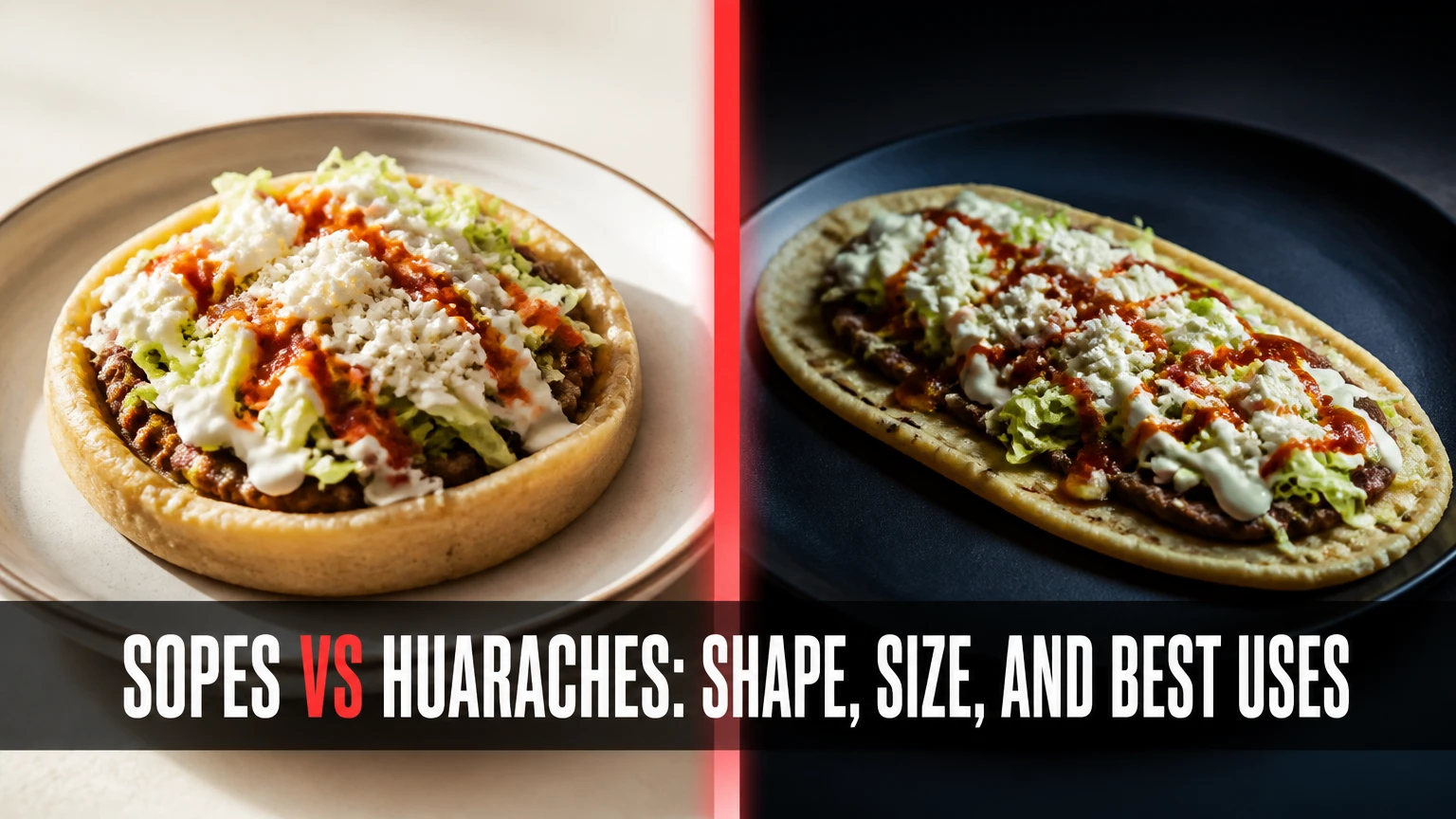
Sopes are small, thick masa rounds with pinched edges, while huaraches are larger, elongated masa bases that often contain beans inside the dough. Sopes work best for sampling several toppings or serving guests, whereas a huarache usually functions as one substantial meal. The decisive differences are structure, bean placement, portion size, and portability.
Key Facts at a Glance
- A typical sope measures 2.5-4 inches across and has a raised rim that contains beans, salsa, crema, and meat.
- A typical huarache measures 8-12 inches long and has an oval shape modeled after a sandal sole.
- Sopes usually receive beans on top; huaraches commonly have refried beans sealed inside the masa.
- Sopes are commonly ordered in pairs or trios, while one huarache often equals a full lunch or dinner.
- Both use corn masa, but neither dish requires a single universal topping or cooking method.
- Typical restaurant prices range from $3-$5 per sope and $8-$14 per huarache in many United States markets.
Sopes vs Huaraches: The Core Difference
The core difference between sopes and huaraches is structural: a sope is a small cup-like masa shell, while a huarache is a long, flat masa platform that may contain beans. That structure determines how much food each item carries, how it is eaten, and whether the order feels like a snack or a complete plate.
A sope’s raised perimeter creates a shallow boundary around wet ingredients. The thick center stays tender beneath refried beans, shredded meat, lettuce, cheese, crema, and salsa. A huarache distributes toppings across a much wider surface, so the base can carry steak strips, cactus, mushrooms, squash blossoms, or multiple garnishes without concentrating weight in one small area.
The comparison is not perfectly rigid across Mexico. Vendors may griddle rather than fry, serve beans on top rather than inside, or use smaller “huarache” portions for breakfast and appetizers. Shape and construction provide the most reliable identification, not a single topping list.
| Feature | Sope | Huarache |
|---|---|---|
| Typical shape | Round, 2.5-4 inches wide | Oval, 8-12 inches long |
| Typical dough thickness | 0.25-0.4 inch | 0.2-0.3 inch |
| Usual bean placement | Spread on top | Often sealed inside |
| Typical serving | 2-3 pieces | 1 piece |
| Typical eating style | Handheld or fork-assisted | Plate and fork |
| Typical United States price | $3-$5 each | $8-$14 each |
What Are Sopes and Huaraches?
Sopes and huaraches are Mexican antojitos built from corn masa, the pliable dough used for tortillas and other regional preparations. Sopes become identifiable through their thick round form and pinched edge, while huaraches become identifiable through their elongated sandal-like form, larger surface, and frequent internal bean layer.
Masa made from fresh ground nixtamal generally has a more pronounced corn aroma and flexible texture than dough mixed from masa harina. Nixtamalization cooks dried corn with an alkaline ingredient, then washes and grinds it; the process changes flavor, softens the kernel, and improves the dough’s handling qualities.
Neither dish depends on wheat gluten. The dough gains cohesion from hydrated corn particles, starch gelatinization, and proper kneading. A useful home-cooking test is a smooth ball that feels like modeling clay and does not crack when pressed.
Regional vocabulary can create confusion. A vendor’s “huarache” may be shorter and thicker than the common restaurant version, while a “sope” may be oval in some markets. Ask about the shape, filling, and size when ordering in an unfamiliar location.
Shape, Structure, and Portion
A sope uses vertical structure, while a huarache uses horizontal surface area. The sope’s rim helps contain loose salsa and juicy fillings, whereas the huarache’s broad base spreads heavier toppings across a larger eating surface.
The rim must be high enough to hold food but not so tall that the center becomes doughy. For most home batches, a 3-inch sope about 1/3 inch thick provides a workable balance between crisp edges and a soft interior. A huarache around 9 inches long offers enough room for a protein, beans, vegetables, cheese, and salsa without becoming difficult to lift.
Portion size changes the dining experience. Three small sopes can provide three different flavor combinations, while a single huarache usually gives one continuous composition. Sopes also cool faster because their individual centers are smaller.
| Measurement | Small sope | Standard sope | Small huarache | Large huarache |
|---|---|---|---|---|
| Dough weight | 35-45 g | 50-65 g | 90-110 g | 130-170 g |
| Finished width or length | 2-2.5 inches | 3-4 inches | 6-8 inches | 9-12 inches |
| Approximate thickness | 0.25 inch | 0.3-0.4 inch | 0.2-0.25 inch | 0.25-0.3 inch |
| Typical portion count | 3-5 per diner | 2-3 per diner | 1 per diner | 1 per diner |
| Best service format | Appetizer or tasting plate | Snack or light meal | Light meal | Full meal |
Where Do the Beans Go?
Sopes usually receive a layer of refried beans on the cooked surface, while huaraches often hide a thin layer of beans inside the masa. The distinction is common rather than absolute, because some cooks serve huaraches with beans on top and some stuffed sopes exist.
For a sope, beans act as both a topping and a moisture barrier. Spread 1-2 tablespoons over the center, leaving the raised rim visible. The beans should be thick enough to stay in place, but loose enough to spread without tearing the masa.
For a stuffed huarache, use reduced, cool refried beans. Excess water or steam inside the filling creates weak spots that burst during rolling. A thin 1-2 tablespoon layer is easier to seal than a generous filling, and the beans should remain at least 1/2 inch from the dough edges.
Bean placement changes texture. Top-layer beans produce a clearer contrast between crisp masa and creamy filling; internal beans distribute richness through the base and make every bite more consistent.
How Are Sopes and Huaraches Cooked?
Sopes and huaraches are commonly cooked on a dry comal or cast-iron surface, then finished according to the cook’s preference. A brief second fry can produce a crisper exterior, but griddling alone is also traditional and often gives a softer, less oily result.
Heat the comal to approximately 400-450°F, or until a small piece of dough begins to set promptly without scorching. Cook the shaped masa for about 1.5-2 minutes per side, turning when light brown spots appear and the surface releases cleanly.
Pinch a sope while the dough remains hot and flexible, usually within 15-30 seconds of removing it from the comal. A huarache does not need a raised rim, so it can return directly to the cooking surface after shaping.
If frying, use a shallow layer of oil or rendered cooking fat and cook for roughly 45-90 seconds per side. The target is a lightly crisp exterior with a tender center, not a brittle shell.
| Cooking stage | Sope | Huarache | Success signal |
|---|---|---|---|
| Comal temperature | 400-450°F | 400-450°F | Dough sets without dark scorching |
| First side | 1.5-2 minutes | 2-3 minutes | Brown spots appear |
| Second side | 1.5-2 minutes | 2-3 minutes | Surface feels dry, center remains flexible |
| Shaping window | 15-30 seconds after cooking | Before final cooking | Dough bends without cracking |
| Optional frying | 45-90 seconds per side | 45-90 seconds per side | Exterior crisps, center stays soft |
| Rest before topping | 1-2 minutes | 1-2 minutes | Surface firms enough to carry toppings |
A common misconception is that all sopes and huaraches must be fried. Many street vendors and home cooks finish them entirely on the comal, especially when the masa is properly hydrated and the toppings provide enough moisture.
What Toppings Work Best?
Sopes favor toppings that benefit from containment, while huaraches favor toppings that need room to spread. The distinction is practical: a loose stew fits securely inside a sope’s rim, while long steak slices or large cactus pieces sit more naturally on a huarache.
Common sope combinations include beans with shredded chicken, picadillo, diced potatoes, chorizo, cheese, lettuce, crema, and salsa. Seafood versions may use shrimp or fish mixtures, but watery ceviche should be drained before assembly.
Huaraches commonly carry grilled steak, cecina, chorizo, cactus, mushrooms, squash blossoms, huitlacoche, or mixed vegetables. Dense toppings should be sliced thinly so the base remains easy to cut.
| Topping style | Better match | Typical quantity | Preparation requirement |
|---|---|---|---|
| Picadillo | Sope | 1-2 tbsp per piece | Drain excess liquid |
| Shredded chicken | Sope | 20-30 g per piece | Season and keep moist |
| Grilled steak strips | Huarache | 75-110 g per piece | Slice across the grain |
| Grilled nopal | Huarache | 1 medium pad | Remove excess surface moisture |
| Chorizo and potatoes | Either | 30-45 g per sope or 90 g per huarache | Cook potatoes until tender |
| Shrimp mixture | Sope | 20-30 g per piece | Drain citrus liquid |
| Huitlacoche or squash blossoms | Huarache | 40-70 g per piece | Sauté before assembly |
| Salsa and crema | Either | 1-2 tsp each | Add immediately before serving |
Which Has Better Texture and Eating Experience?
Sopes provide a higher edge-to-center ratio, so each bite can include crisp rim, soft masa, creamy beans, and topping. Huaraches provide a flatter sequence of textures, with the internal bean layer softening the masa from within while the exposed underside develops a toasted crust.
Sopes are easier to customize at a gathering because each piece can receive a different combination. Their small size also helps diners compare green salsa, red salsa, pickled vegetables, and different proteins without committing to one large plate.
Huaraches feel more substantial but can become structurally awkward when overloaded. A fork and knife are practical for large portions, particularly when toppings extend beyond the edges. A huarache is not the best choice for walking, driving, or eating without a plate.
What Are the Main Types?
Sopes and huaraches do not have one fixed national recipe. Their names describe the masa form, while the toppings often reflect household preferences, regional ingredients, market availability, and the time of day.
| Style or example | Base | Common topping | Typical setting |
|---|---|---|---|
| Sope de picadillo | Round sope | Ground beef, potato, carrot | Home meal or fonda |
| Sope de chorizo y papas | Round sope | Chorizo and diced potato | Breakfast or street stall |
| Mini-sope | 1.5-2 inch sope | Beans, cheese, salsa | Party or catering |
| Seafood sope | Round sope | Shrimp or seasoned fish | Coastal menu |
| Huarache de asada | Bean-stuffed oval | Grilled steak and cheese | Lunch or dinner |
| Huarache de nopal | Bean-stuffed oval | Grilled cactus and vegetables | Vegetarian order |
| Huarache campechano | Large oval | Cecina, chorizo, and chicharrón | Hearty street meal |
| Huarache with huitlacoche | Large oval | Corn smut and squash blossoms | Seasonal or regional menu |
Names such as “campechano” can vary by vendor. One restaurant may use the term for a mixed-meat topping, while another may use it for a combination of different ingredients. The preparation should be confirmed before ordering if dietary restrictions matter.
Which Is Better for Nutrition and Dietary Needs?
Neither dish is automatically healthier because the nutritional result depends on dough weight, cooking fat, beans, protein, cheese, and portion size. A grilled sope with beans and vegetables may contain less energy than a large huarache covered with meat and cheese, but a lightly topped huarache can also be the more balanced plate.
For a lighter order, choose comal-cooked masa, a moderate bean layer, grilled vegetables, cactus, salsa, and a small amount of cheese or crema. For more protein, add chicken, steak, eggs, or beans while reducing the cheese and fried finishing fat.
Both dishes are naturally suitable for a wheat-free diet when the masa and toppings are uncontaminated. They are not automatically suitable for every vegetarian diet, because meat-based cooking fats, chorizo, or mixed fillings may be used. Ask whether the comal and utensils are shared with wheat products if strict avoidance is required.
The main counterintuitive point is portion density. A huarache may contain fewer separate pieces than a sope order but still provide substantially more masa and topping because its surface is several times larger.
How Do You Make Them at Home?
A home cook can prepare a basic batch of sopes in about 35-50 minutes or huaraches in about 45-65 minutes, depending on whether fresh masa or masa harina is used. Sopes are the easier starting point because they eliminate the stuffing, sealing, and rolling stage that causes most huarache failures.
Ingredients and Equipment
| Item | Sopes, 8 pieces | Huaraches, 4 pieces | Practical specification |
|---|---|---|---|
| Fresh masa or masa harina | 400 g | 500-600 g | Add water gradually |
| Warm water | 300-360 ml | 375-500 ml | Amount varies by flour |
| Salt | 4 g | 5-6 g | Fine salt disperses evenly |
| Refried beans | 250-350 g | 100-150 g for filling | Use thick, cool beans |
| Cooking oil, optional | 2-3 tbsp | 2-3 tbsp | Shallow frying only |
| Comal or skillet | 1 | 1 | 10-12 inch surface |
| Plastic or parchment | 8 sheets | 4 sheets | Prevents sticking |
Step 1: Mix and Rest the Masa
Combine masa with salt and most of the warm water. Knead for 2-4 minutes, adding water in teaspoons until the dough feels smooth and pliable, then cover it for 10 minutes so the moisture distributes.
You will know the dough is ready when a pressed edge remains mostly smooth rather than breaking into dry flakes. A cracked edge means the dough needs more water; sticky dough needs a small amount of masa harina.
Step 2: Shape the Sopes
Divide the dough into 8 portions of approximately 50 g. Press each portion between plastic sheets until it forms a round about 3-4 inches wide and 1/3 inch thick, then avoid flattening the center as thin as a tortilla.
Cook each round on a dry, hot comal for 1.5-2 minutes per side. Remove it, wait only long enough to handle the steam safely, then pinch the perimeter upward with damp fingers or a folded towel.
The successful rim should remain attached around the full circumference. Pinching after the dough cools is the fastest route to cracks.
Step 3: Shape and Fill the Huaraches
Divide 500-600 g of dough into 4 portions. Roll each into a short log, press a channel through the center, add 1-2 tablespoons of cold, thick refried beans, and seal the dough completely before elongating it.
Press or roll the filled log between plastic sheets into an oval approximately 8-10 inches long and 1/4 inch thick. Work gently from the center outward so the filling stays distributed rather than pushed through one end.
A properly sealed huarache has no visible bean seam. If the dough splits, patch it with a small piece of moist masa and reduce the filling.
Step 4: Cook and Finish
Cook the shaped pieces on a 400-450°F comal until brown spots appear and the surface releases. Turn the huarache carefully because its length makes one end easier to overcook.
Finish on the comal for a softer result or fry briefly in shallow oil for a crisper exterior. Add beans to the top of sopes, then arrange protein, vegetables, cheese, crema, and salsa immediately before serving.
What Does It Cost and How Long Does It Take?
Typical home costs are approximately $1-$2 per sope serving and $2-$4 per huarache serving before labor, depending on the protein and whether fresh masa is available. Restaurant prices commonly reach $3-$5 per sope and $8-$14 per huarache in United States cities, with regional and ingredient variation.
| Scenario | Sopes | Huaraches | Main cost driver |
|---|---|---|---|
| Home, beans and vegetables | $0.75-$1.50 each | $1.50-$2.50 each | Masa and produce |
| Home, chicken or steak | $1.25-$2.50 each | $3-$6 each | Protein quantity |
| Restaurant order | $6-$15 for 2-3 | $8-$14 for 1 | Location and protein |
| Active preparation | 25-35 minutes | 35-50 minutes | Shaping complexity |
| Total batch time | 35-50 minutes | 45-65 minutes | Comal capacity |
| Typical leftovers | 1 day refrigerated | 1 day refrigerated | Topping moisture |
These figures are typical planning ranges, not fixed prices. Fresh masa from a tortillería may cost less than packaged specialty flour, while steak, seafood, and imported cheese can change the final price considerably.
What Common Mistakes Ruin Them?
The most damaging mistakes are excessive moisture, insufficient dough thickness, and delayed shaping. Sopes tolerate more topping moisture because of their rim, but neither dish remains crisp when watery salsa sits on the masa for several minutes.
- Pinching cold sopes: The edge cracks instead of bending. Shape the rim within 15-30 seconds of removing each round.
- Pressing the dough too thin: A thin base becomes brittle during frying. Keep sopes near 1/3 inch and huaraches near 1/4 inch.
- Using warm or loose beans inside huaraches: Steam and liquid weaken the seal. Reduce the beans and cool them fully before filling.
- Overloading the center: Heavy toppings make a sope collapse and make a huarache difficult to cut. Use measured portions.
- Cooking on a cool comal: The masa dries before browning. Preheat until a test piece sets and develops spots within about two minutes.
- Adding salsa too early: Liquid migrates into the crust. Assemble within 1-2 minutes of serving.
A practitioner rule of thumb is to prepare toppings before shaping the masa. Masa waits reasonably well under a damp cloth, but cooked shells lose their best texture while toppings are being chopped.
Which Should You Choose?
Choose Sopes for Beginners
Sopes are the better beginner project because the round shape is forgiving and the bean layer does not need to be sealed inside the dough. Sopes also let a cook test hydration, thickness, and comal heat on small pieces before committing to a large filled base.
Choose Huaraches for a Full Meal
Huaraches are the stronger choice for a filling lunch or dinner because one large base combines masa, internal beans, protein, vegetables, and garnishes. Choose a comal-cooked version when you want a less oily crust and a grilled steak or nopal topping when the broad surface needs a substantial centerpiece.
Choose Mini-Sopes for Parties
Mini-sopes are easier to serve at gatherings because guests can take one or two pieces without cutting a large base. Prepare 1.5-2 inch shells, offer several measured toppings, and add salsa only after guests select their combinations.
Choose Either for Vegetarian Eating
Both formats work well with beans, nopal, mushrooms, squash blossoms, huitlacoche, roasted peppers, and fresh salsa. Huaraches provide more room for substantial vegetables, while sopes make it easier to offer several small vegetarian combinations.
Choose Sopes for Sampling
Sopes win when the purpose is variety. An order of three can pair a savory filling with green salsa, a second with a richer red sauce, and a third with vegetables or seafood, giving more flavor contrast than one large huarache.
Sopes and Huaraches Compared With Similar Foods
Sopes and huaraches differ from tlacoyos, gorditas, and tostadas in shape, filling strategy, and texture. The names overlap in casual restaurant usage, so visual construction remains more reliable than menu descriptions.
| Food | Shape | Internal filling | Typical texture | Typical use |
|---|---|---|---|---|
| Sope | Small round with rim | Usually none | Thick and tender | Snack or appetizer |
| Huarache | Long oval | Often beans | Broad, crisp-tender base | Full meal |
| Tlacoyo | Oval, pointed ends | Beans, fava, or cheese | Dense and rustic | Breakfast or street meal |
| Gordita | Round, thick pocket | Usually filled after cooking | Puffy and soft | Handheld meal |
| Tostada | Flat round shell | None | Fully crisp | Topped plate |
| Memela | Thin oval or round | Beans on surface | Soft with toasted edges | Breakfast or light meal |
A tlacoyo may resemble a small huarache because both can contain beans, but tlacoyos typically have pointed ends and a thicker, more compact body. A gordita is defined by its pocket-like interior, while a sope is defined by its open raised rim.
Frequently Asked Questions
Can You Make Sopes With Masa Harina?
Yes, masa harina works for sopes when mixed with enough warm water to create a smooth, flexible dough. Start with the package ratio, then adjust by teaspoons because humidity and flour age affect absorption. Rest the dough for 10 minutes before pressing, and keep unused portions covered so the edges do not dry.
Can You Make Huaraches Without Stuffing the Beans?
Yes, a huarache can be made from plain masa with beans spread on top after cooking. Stuffing is common because it gives the base an integrated bean flavor, but shape and size identify the preparation more reliably than internal filling. Plain dough is also easier for beginners to roll without leaks.
Are Sopes Gluten-Free?
Traditional sopes are made from corn masa and contain no wheat gluten, but restaurant cross-contact can occur on shared surfaces. Check masa ingredients, cooking surfaces, seasoning mixes, and toppings if you require strict avoidance. Flour tortillas, wheat-based sauces, and contaminated utensils can change an otherwise corn-based order.
Can You Reheat Sopes and Huaraches?
Reheat both dishes on a dry skillet or comal over medium heat for 2-4 minutes per side, adding toppings afterward. A microwave softens the masa and makes salsa soak in, so it works only as a quick convenience method. Refrigerate plain bases separately from wet toppings for the best result.
Which One Is Easier to Eat Without Utensils?
Sopes are easier to eat by hand because their smaller size and raised edge contain the toppings. Huaraches usually require a plate and fork, especially when topped with steak, cactus, crema, and salsa. A small, lightly topped huarache can be handheld, but that is not its most practical serving format.
The Bottom Line
Sopes are small, rimmed masa rounds designed for flexible toppings, quick sampling, and party service. Huaraches are larger oval masa bases, often bean-stuffed, designed to carry a substantial topping as one meal. For beginners and variety, choose sopes; for a filling plate with steak, nopal, or mixed vegetables, choose huaraches. Understanding the difference between sopes vs huaraches comes down to shape, bean placement, portion, and eating context.