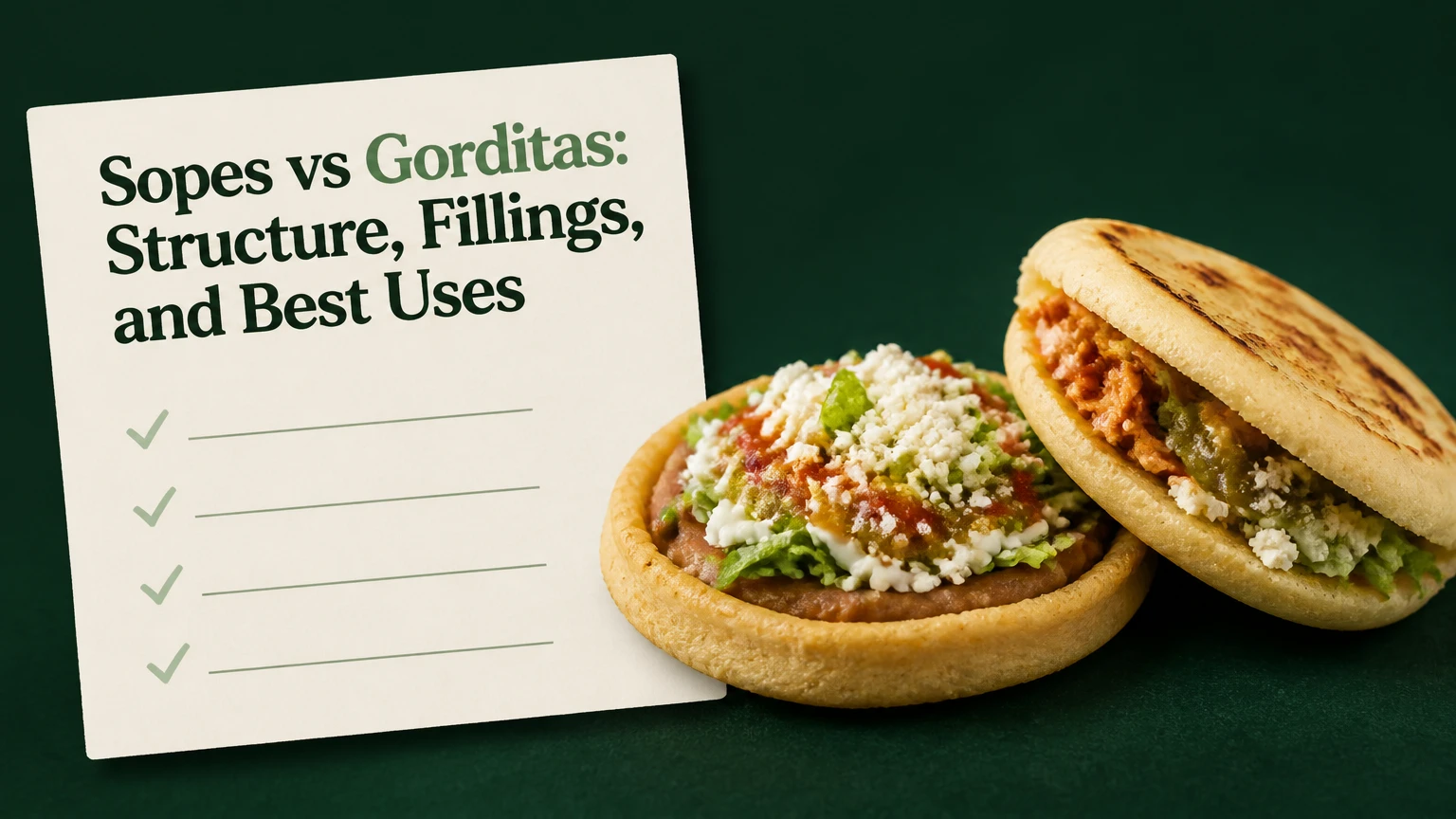
Sopes are thick corn masa bases with raised edges that hold open-face toppings, while gorditas are thicker masa cakes cooked to create a slit or pocket for enclosed fillings. Sopes favor layered beans, lettuce, cheese, and salsa; gorditas favor warm guisados, melted cheese, and fillings that benefit from insulation.
Key Facts at a Glance
A sope is an open masa base with a pinched rim, while a gordita is a stuffed masa cake.
Typical sopes measure 3-5 inches across and are about 1/3 inch thick before cooking.
Typical gorditas measure 3-5 inches across and are about 1/2 inch thick before cooking.
Sopes usually receive toppings after cooking; gorditas are sliced and filled after they puff.
Sopes are easier to shape consistently, while gorditas require even thickness and reliable steam expansion.
Regional names overlap, so a pellizcada, memela, or gordita may have different shapes in different parts of Mexico.
How Do Sopes vs Gorditas Differ?
The decisive difference is containment: a sope holds ingredients above a raised masa rim, whereas a gordita holds ingredients inside a split masa cake. That design changes the ideal fillings, eating method, cooking technique, texture, and portability of each food.
A sope begins as a relatively thick disc. A cook partially grills the disc, pinches its perimeter while the dough remains pliable, and then finishes it on a comal or in shallow oil. The raised edge creates a small edible tray. Refried beans often go down first because their thick consistency anchors other ingredients without immediately weakening the base.
A gordita begins thicker and keeps a rounded edge rather than a sharply raised rim. Heat firms the outside while moisture inside turns to steam. When the dough expands, the cooked walls can separate enough to create an interior cavity. The cook then makes a controlled side opening and adds a warm filling.
The distinction is functional rather than merely visual. Sopes expose each topping, so contrasting textures remain easy to notice. Gorditas conceal the filling, but the masa encloses heat and makes saucy food easier to carry.
Master Comparison: Which Food Fits Your Meal?
Sopes fit meals that prioritize visible toppings, crisp edges, and customization; gorditas fit meals that prioritize warm fillings, portability, and a contained bite. The table below compares typical home or street-stall portions, because individual recipes vary substantially by region.
| Criterion | Sopes | Gorditas |
|---|---|---|
| Typical diameter | 3-5 inches | 3-5 inches |
| Typical raw thickness | About 1/3 inch | About 1/2 inch |
| Main structure | Raised rim about 1/4 inch high | Interior cavity with a side opening |
| Cooking surface | Comal, then 30-60 seconds in oil | Comal for 5-8 minutes, frying optional |
| Typical serving | 2-4 pieces per meal | 1-3 pieces per meal |
| Ideal fillings | Beans, lettuce, cheese, salsa | Guisados, chicken, cheese, vegetables |
| Eating position | Plate or napkin, usually stationary | Handheld, usually wrapped in paper |
| Typical U.S. street price | $2-$4.50 each | $2.50-$6 each |
Structure and Texture
Sopes have a crisp perimeter and a tender center, while gorditas range from chewy and bread-like to crisp and flaky depending on whether the dough is griddled or fried. A properly made sope bends slightly without collapsing under beans. A properly made gordita has walls thick enough to hold filling but thin enough to bite through comfortably.
Texture depends on three variables: dough hydration, thickness, and heat. Dry masa produces cracks and a hard bite. Excess water creates weak walls that deform during lifting. Excessive heat browns the surface before the center cooks, while insufficient heat dries the cake before steam can expand.
A sope usually provides more textural contrast because its exterior can be crisped briefly while fresh toppings remain cool. A gordita provides a more unified bite because masa, filling, and retained heat meet inside the same enclosure.
Winner: Sopes win for crisp-to-soft contrast; gorditas win for a warm, cohesive stuffed bite.
Toppings, Fillings, and Moisture
Sopes handle layered toppings best because the raised edge contains moderate amounts of beans, salsa, crema, lettuce, and crumbled cheese. Gorditas handle dense or saucy fillings best because the masa pocket limits lateral movement and keeps the center warm.
A practical filling rule is to match moisture to structure. Put thick refried beans, shredded chicken, sautéed vegetables, or firm cheese into either food. Reserve very loose salsa or broth-heavy guisados for gorditas only when the pocket is fully cooked and the food will be eaten immediately.
| Filling type | Better match | Typical quantity per piece | Main reason |
|---|---|---|---|
| Refried beans with lettuce | Sope | 1-2 tablespoons beans | Beans anchor visible toppings |
| Shredded chicken with salsa | Gordita | 2-3 tablespoons | Pocket contains sauce and heat |
| Crumbled fresh cheese | Sope | 1-2 tablespoons | Cheese remains visible and cool |
| Sautéed mushrooms and squash | Either | 2-3 tablespoons | Moisture stays moderate after draining |
| Melted cheese with peppers | Gordita | 25-35 grams cheese | Enclosed masa retains melting heat |
| Potato and seasoned vegetables | Sope | 2 tablespoons | Firm filling stays above the rim |
Sopes are not poor choices for wet food, but their topping area has a limit. A base saturated with salsa for more than several minutes can soften and split, especially when the masa was thin or the oil temperature was low.
Gorditas are not automatically leak-proof. A slit cut too far around the edge, a cavity with undercooked walls, or a filling that is hotter than the masa can cause splitting. Let excess sauce drain from a stew before stuffing.
Winner: Gorditas win for saucy fillings; sopes win for fresh toppings and visible assembly.
Portability and Serving
Gorditas are more portable because the masa encloses the filling and reduces the number of exposed surfaces. Sopes work better on a plate, where a diner can manage toppings that shift when the base is lifted.
For transport, wrap each gordita in parchment or food paper after filling, but avoid sealing it in plastic while steaming hot. Trapped condensation softens the masa. Sopes should remain separate from salsa and wet garnishes until serving.
| Use case | Recommended food | Serving limit | Packaging detail |
|---|---|---|---|
| Walking commute | Gordita | 1-2 pieces | Paper wrap with open top |
| Buffet or party bar | Sope | 2-4 pieces | Bases separate from toppings |
| Family dinner | Either | 2-3 pieces per person | Serve salsa in a separate bowl |
| Lunchbox after 2 hours | Gordita | 1 filled piece | Cool before wrapping |
| Sauce tasting | Sope | 2 small pieces | Add salsa immediately before eating |
| Vehicle eating | Gordita | 1 piece | Use a napkin and shallow container |
The portability advantage has a trade-off. Gorditas can become steamy and soft inside their wrapping, while sopes preserve a better crust when toppings are added at the table.
Winner: Gorditas win for one-handed eating; sopes win for plated service and topping control.
How Are Sopes and Gorditas Made?
Sopes require partial cooking, edge pinching, and usually a short frying step, while gorditas require a thicker patty, even heat, puffing, and careful slicing. Both foods typically take 30-45 minutes from dough mixing to service when making 8-12 pieces at home.
Preparing the Masa
Use fresh nixtamalized masa when available, or combine masa harina with warm water according to the package directions. The finished dough should feel soft and cohesive, similar to modeling clay, without sticking heavily to clean hands.
For a typical batch of 8-10 pieces, start with about 500 grams of masa or masa harina dough. Add water in 15-30 milliliter increments because flour brands and humidity change absorption. Rest the dough for 10-15 minutes before shaping so moisture distributes evenly.
Keep the dough covered with a damp towel. Uncovered masa develops a dry skin quickly, and that skin becomes the source of rim cracks in sopes and steam leaks in gorditas.
Shaping and Cooking Sopes
- Divide and press: Form 45-55 gram balls and press each into a 3-4 inch disc about 1/3 inch thick.
- Set the surface: Cook on a dry comal over medium heat for about 60-90 seconds per side, until the surface looks matte and the disc holds its shape.
- Pinch the rim: While the disc is hot but safe to handle with damp fingers, pinch a continuous edge about 1/4 inch high.
- Finish the base: Return the sope to the comal for 1-2 minutes per side, or shallow-fry it in oil at about 350-375°F for 30-60 seconds total.
- Assemble: Spread 1-2 tablespoons of beans, then add the selected filling, garnish, cheese, and salsa.
You will know the sope is ready when the base feels firm underneath, the rim remains attached, and the center bends slightly without cracking. A hard, rigid base usually spent too long in oil.
A frequent mistake is pinching a cold disc. Cold masa has lost flexibility, so the edge fractures instead of rising. Another mistake is making the rim too tall, which creates a thick, doughy border that reduces the topping area.
Shaping and Cooking Gorditas
- Divide and flatten: Form 60-75 gram balls and press them into 4-5 inch cakes about 1/2 inch thick.
- Control the edges: Keep the center slightly thicker than the perimeter, but avoid a sharp ridge that blocks even expansion.
- Cook gradually: Use medium heat and turn the gordita every 60-90 seconds for 5-8 minutes.
- Encourage expansion: Press lightly near the center with a spatula after several turns if the surface has set but the interior has not expanded.
- Open and fill: Cut a slit along roughly one-third of the edge immediately after cooking, then add 2-3 tablespoons of warm, drained filling.
You will know a gordita has cooked properly when the surface is lightly browned, the cake feels inflated or hollow in the center, and the slit opens without tearing the opposite wall.
Deep frying is optional and changes the result. A brief fry after partial griddling creates a crisper shell, but a fully fried gordita can feel heavy if the dough is too thick or the oil temperature falls below about 350°F.
What Regional Variations Should You Know?
Regional terminology prevents false comparisons because the same name can describe different shapes, fillings, or cooking methods. Sopes, pellizcadas, memelas, garnachas, and gorditas overlap in some local food traditions, but they do not always refer to identical products.
| Regional style | Common location | Dough or shape | Typical preparation |
|---|---|---|---|
| Pellizcada | Central and southern Mexico | Pinched masa disc | Comal-cooked with a shallow center |
| Memela | Puebla and Oaxaca | Long or oval masa base | Beans and toppings added on top |
| Garnacha | Oaxaca and nearby areas | Small fried masa round | Meat, onions, or salsa added after frying |
| Gordita de harina | Northern Mexico | Wheat-flour thick cake | Griddled and split for stuffing |
| Gordita de horno | Several central regions | Baked corn masa cake | Wood-fired or conventional oven |
| Gordita de migas | Regional household style | Masa mixed with crisped pieces | Cooked as a filled or enriched cake |
A flour gordita is closer to a thick wheat pocket than a standard corn sope, so comparing the two only by shape can mislead. Baked gorditas also differ from griddled versions in crust, moisture loss, and holding time.
Terminology varies by vendor and state. Ask whether the item is corn or wheat based, open or split, griddled or fried, and topped or filled.
Which Fillings Work Best for Each Food?
Sopes perform best with toppings added in layers, while gorditas perform best with fillings that are warm, compact, and drained enough to protect the inner wall. The best pairing depends on moisture, temperature, and whether the food will be eaten immediately.
Strong Sope Pairings
Use refried beans as the first layer, followed by a modest portion of seasoned chicken, shredded beef, potatoes, mushrooms, or squash. Add lettuce, crema, fresh cheese, and salsa after the hot filling so the garnishes retain their texture.
Sopes are especially effective for tasting several toppings at once. A catering setup can offer 30-40 gram bases with separate bowls of beans, vegetables, chicken, cheese, lettuce, and salsa, allowing guests to assemble two or three combinations without making the base soggy.
Strong Gordita Pairings
Choose fillings with enough body to stay inside the pocket. Shredded chicken, seasoned beef, beans with cheese, potato mixtures, and thick vegetable stews work better than thin soups or watery sauces.
Fill the pocket shortly before eating. A typical 4-inch gordita holds about 2-3 tablespoons comfortably; forcing in more can split the seam and make the first bite spill.
What Do Sopes and Gorditas Cost to Make?
Typical homemade ingredient cost ranges from $0.40-$1.25 per piece, excluding labor and equipment, while restaurant or street-stall prices often range from $2-$6 per piece in the United States. Local Mexican prices vary by city, filling, portion size, and whether the item uses fresh masa.
| Cost factor | Typical home range | Typical service range | Main variable |
|---|---|---|---|
| Plain masa per piece | $0.10-$0.25 | $0.25-$0.75 | Fresh masa or packaged flour |
| Filling per piece | $0.20-$0.75 | $0.75-$2.50 | Cheese, chicken, vegetables, or stew |
| Oil and garnishes | $0.10-$0.25 | $0.25-$0.75 | Frying depth and garnish quantity |
| Total homemade piece | $0.40-$1.25 | Not applicable | Batch size and ingredient waste |
| Street or restaurant sope | Not applicable | $2-$4.50 | City and topping selection |
| Street or restaurant gordita | Not applicable | $2.50-$6 | Filling size and regional style |
Sopes can cost less per base because they use slightly less masa, but a generous garnish bar may raise the total ingredient cost. Gorditas can be more economical for a filling-heavy meal because one large piece often replaces two smaller open-face pieces.
Prices are typical planning ranges, not a universal menu standard. A vendor in Mexico, the United States, or Canada may price the same style very differently.
What Common Problems Occur?
Most failures come from incorrect moisture, uneven thickness, or heat that is too high or too low. Diagnosing the failure by texture is more reliable than adding more flour or turning up the burner.
| Failure | Likely cause | Recovery action | Prevention |
|---|---|---|---|
| Sope rim cracks | Dry dough or delayed pinching | Moisten hands and press cracks closed | Cover dough and pinch while warm |
| Sope becomes hard | Excess frying or thin dough | Add moist beans and serve immediately | Fry 30-60 seconds total |
| Gordita does not puff | Cold comal or steam leak | Cook longer over medium heat | Keep center thick and edges intact |
| Gordita tears during slicing | Cut after cooling | Rewarm briefly and cut one side | Open immediately after cooking |
| Pocket stays doughy | Excess thickness or low heat | Return to comal for 2-3 minutes | Use about 1/2 inch raw thickness |
| Filling leaks | Too much sauce or overstuffing | Drain filling and reduce portion | Use 2-3 tablespoons per piece |
Why Does a Gordita Fail to Puff?
A gordita fails to puff when steam cannot build pressure inside an evenly cooked dough shell. Common causes include a cold cooking surface, cracks at the perimeter, uneven thickness, or masa that is too dry to seal.
Do not press the gordita aggressively. Heavy pressure can flatten the internal space before the walls set. Turn it regularly, maintain medium heat, and test one piece before cooking the entire batch.
Why Does a Sope Fall Apart?
A sope falls apart when the masa is too wet, the base is too thin, the rim was pinched unevenly, or liquid toppings remain on the surface too long. The rim cannot compensate for a weak center.
Use thick beans as the foundation and drain sautéed fillings before assembly. If the base is already soft, serve it on a plate rather than attempting handheld eating.
How Should You Store and Reheat Them?
Sopes and gorditas keep for about 2-3 days in a refrigerator when cooled, wrapped, and stored separately from wet toppings. For longer storage, freeze plain cooked bases for up to 1 month, then reheat them directly on a comal or skillet.
| Item | Refrigerator time | Freezer time | Reheating method |
|---|---|---|---|
| Plain sope base | 2-3 days | Up to 1 month | Skillet, 2-3 minutes per side |
| Topped sope | Same day preferred | Not recommended | Reheat base before topping |
| Plain gordita | 2-3 days | Up to 1 month | Comal, 3-4 minutes total |
| Filled gordita | 1-2 days | Up to 2 weeks | Covered skillet, 4-6 minutes |
| Refried beans | 3-4 days | Up to 2 months | Saucepan, 5-8 minutes |
| Fresh garnishes | 1-2 days | Not recommended | Serve cold and drain well |
Microwaving softens the crust but works for a quick reheating cycle of 20-30 seconds. A dry skillet restores more surface texture and reduces condensation.
Do not store salsa, lettuce, or crema inside a refrigerated sope. Those ingredients accelerate softening and make reheating uneven.
Which Should You Choose?
Choose sopes for customization, crisp edges, visible garnishes, and plated meals; choose gorditas for portability, warm guisados, and a larger enclosed filling. The right decision depends on how the food will be eaten and which texture matters most.
For Home Cooking Beginners
Start with sopes if consistent results matter more than handheld convenience. A sope can still succeed when it does not puff, because the cook can form the rim after the surface sets and cover small imperfections with beans.
Gorditas reward careful dough control but expose uneven thickness immediately. Make them after practicing a few masa discs and learning how medium heat affects steam.
For Parties and Catering
Choose sopes for a self-serve station. Cook the bases ahead, keep beans warm, and provide toppings in shallow bowls so guests can assemble food within several minutes of service.
Gorditas work better when a cook fills each piece to order. Their enclosed structure is convenient for pre-portioned service, but filled pockets lose crispness when wrapped and held for too long.
For Commuters and Lunchboxes
Choose gorditas when the food must travel or be eaten without utensils. Use a thick filling, drain excess sauce, and wrap the item after it cools for one or two minutes.
Avoid overfilling. A smaller, stable gordita is easier to eat than a large pocket that splits at the first bite.
For Fresh Topping Fans
Choose sopes when lettuce, crema, fresh cheese, avocado, salsa, and contrasting garnishes are central to the meal. The open surface lets each ingredient keep its separate temperature and texture.
Sopes are less suitable when the meal must remain hot for an extended period. Enclosed gorditas retain heat more effectively.
For Gluten Avoidance
Traditional corn sopes and corn gorditas are naturally made without wheat, but cross-contact can occur in shared kitchens. Wheat-flour gorditas contain gluten, so confirm the flour base and preparation surface before ordering.
Corn masa itself does not guarantee a gluten-free kitchen. Fillings, sauces, and shared fryers can introduce other ingredients.
Expert Rules for Better Results
- Resting masa matters more than aggressive kneading. A 10-15 minute covered rest allows hydration to equalize, which reduces edge cracking without making the dough tough.
- A sope rim should contain food, not dominate the bite. About 1/4 inch is usually enough for a 3-5 inch base; taller edges waste surface area and remain doughy.
- Filling temperature changes structural strength. Very hot, watery filling softens the inner wall quickly, so drain stews and add loose salsa at the table.
- Test one gordita before committing the batch. Puffing behavior reveals whether the dough thickness, hydration, and comal temperature are correct.
- Fresh garnishes belong at the last moment. Lettuce and crema placed several minutes early can turn a crisp sope into a soft one.
FAQ
Are sopes and gorditas made from the same dough?
Sopes and corn gorditas commonly use nixtamalized corn masa, but their dough thickness and shaping differ. Gorditas de harina use wheat flour, and some baked gorditas include sugar or other ingredients. Fresh masa and masa harina can both work when the dough is hydrated until soft and cohesive.
Are gorditas healthier than sopes?
Neither food is automatically healthier because preparation changes the result. A griddled corn gordita with vegetables may use less oil than a fried sope, while a sope with beans and fresh garnishes may contain less filling than a cheese-heavy gordita. Portion size and cooking fat matter most.
Can you make sopes without frying them?
Yes. Cooked sopes can remain comal-griddled instead of being fried, producing a softer, drier exterior. Brush the comal lightly with oil only if the dough sticks. Comal-only sopes work especially well with beans, vegetables, and fresh garnishes that do not require a very crisp base.
Can a gordita be made with masa harina?
Yes. Mix masa harina with warm water according to the package ratio, then adjust with small additions of water until the dough feels pliable. Cover the dough for 10-15 minutes before shaping. A dry mixture is the most common reason masa harina gorditas crack or fail to expand.
Why are some Mexican foods called both sopes and gorditas?
Mexican food names vary by region, vendor, and family tradition. A thick pinched disc may be called a sope, pellizcada, memela, or another local term, while gordita can describe several filled or baked masa cakes. Shape, cooking method, and local usage provide better clues than the name alone.
Which is easier to reheat, a sope or a gordita?
A plain sope or plain gordita reheats well on a dry skillet, but a gordita usually protects its filling more effectively. Reheat the masa separately from lettuce, crema, and salsa whenever possible. A filled gordita takes about 4-6 minutes over low to medium heat, while toppings should be added afterward.
Conclusion
Sopes vs gorditas is fundamentally a comparison between an open masa base and an enclosed masa pocket. Choose sopes for crisp edges, visible toppings, customization, and plated service; choose gorditas for warm guisados, portability, and a filling that stays contained. Their regional names vary, but their structural differences make the practical choice clear.