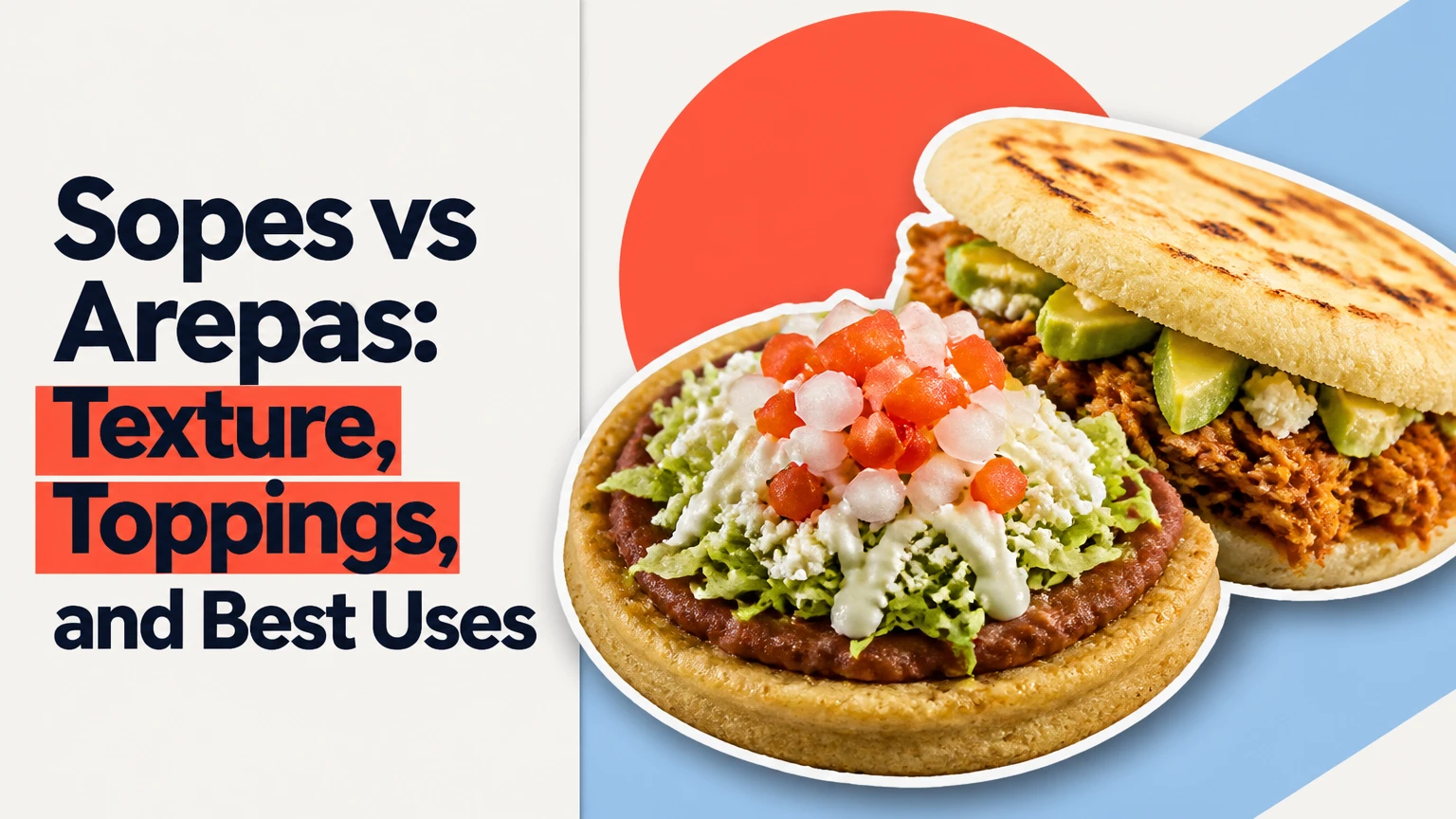
Sopes are Mexican nixtamalized-corn masa bases with pinched rims for holding toppings, while arepas are thicker Colombian and Venezuelan corn patties that are usually split and filled. Sopes deliver a crisp, fried or griddled shell with toppings on top; arepas provide a bread-like crust and tender interior around a contained filling.
Key Facts at a Glance
- Sopes use masa harina or fresh nixtamalized masa, while arepas typically use pre-cooked corn flour labeled harina de maíz precocida.
- Sopes are usually 6-8 mm thick and topped from above; stuffed arepas commonly measure 12-20 mm before slicing.
- A typical batch of sopes takes 30-45 minutes, while griddled arepas take about 20-30 minutes.
- Sopes need a raised edge, but arepas need enough thickness to form a pocket without breaking.
- Both foods can be gluten-free by ingredient, although fillings, shared cooking surfaces, and packaged products require label checks.
- Arepas are generally easier to freeze and reheat; sopes are better for a fresh, build-your-own topping spread.
What Is the Difference Between Sopes and Arepas?
The defining difference is structural: a sope is an edible shallow plate, whereas an arepa is an edible bun or pocket. Both are corn-based, round or oval, unleavened foods, but they developed in different culinary regions and use different dough traditions.
Sopes belong primarily to Mexican antojitos, with roots in the use of nixtamalized corn. Cooks shape a thick masa disk, cook it until firm enough to handle, then pinch the warm perimeter upward. The rim keeps beans, shredded meat, salsa, lettuce, cheese, or cream on the base.
Arepas are everyday staples across Colombia and Venezuela. Cooks mix water and salt with pre-cooked corn flour, shape a patty, and cook it on a griddle, budare, skillet, oven, or fryer. Thick arepas can be opened horizontally and filled, while thin Colombian styles may be served as a side with cheese, butter, or a hot drink.
| Attribute | Sopes | Arepas |
|---|---|---|
| Primary region | Mexico, including central and southern states | Colombia and Venezuela |
| Dough base | Nixtamalized masa or masa harina | Harina de maíz precocida |
| Typical shape | 6-8 mm disk with 3-6 mm rim | 12-20 mm disk or stuffed patty |
| Serving structure | Toppings remain above the base | Filling sits inside a sliced pocket |
| Main cooking pattern | Comal cooking followed by shallow frying | Griddle cooking, baking, steaming, or frying |
| Common meal role | Street snack, antojito, party food | Breakfast, lunch, dinner, or side bread |
How Do the Corn Doughs Work?
Nixtamalization changes corn chemically, while pre-cooking changes the flour physically through heat and drying. The difference explains why masa harina and arepa flour cannot normally replace each other in equal proportions.
During nixtamalization, dried corn is cooked and soaked in an alkaline solution, commonly calcium hydroxide, then washed and ground. The process loosens the hull, improves dough cohesion, and increases the availability of niacin. The Food and Agriculture Organization describes nixtamalization as a process that improves the nutritional and functional qualities of maize, although the exact nutrient outcome depends on washing, soaking, and processing conditions.
Masa harina sold for tortillas and sopes has already undergone that process. It needs water to become workable, not another lime treatment. Arepa flour, by contrast, is made from corn that has been cooked, dried, and ground into a quickly hydrating flour. The package should specifically say precooked corn flour.
The FDA defines foods labeled “gluten-free” as containing fewer than 20 parts per million of gluten under its 2013 rule. Plain corn flour can meet that standard, but a finished sope or arepa may not if its seasoning, filling, cheese, or shared fryer introduces wheat.
| Flour or grain | Suitable for sopes | Suitable for arepas | Expected result |
|---|---|---|---|
| Mexican masa harina | Yes, standard choice | Usually no | Cohesive tortilla-style dough, poor arepa structure |
| Harina de maíz precocida | Possible, with regional texture differences | Yes, standard choice | Smooth arepa dough, less traditional sope flavor |
| Fresh nixtamalized masa | Yes, highly traditional | No, unless a recipe is adapted | Moist, aromatic masa with shorter storage life |
| Yellow cornmeal | No, without a binder and adaptation | No, without extensive adaptation | Coarse, crumbly dough |
| Cornstarch | No | No | Sticky paste without corn structure |
| Fresh sweet corn purée | For specialized recipes | Yes, for arepa de choclo style | Moist, sweet, soft batter-like dough |
Which Has the Better Texture and Flavor?
Sopes have a thin, corn-forward base with a crisp underside and a chewy center, while arepas have a thicker crust surrounding a soft, steamy interior. Cooking temperature and thickness matter more than the flour label alone: a thick arepa cooked too quickly stays gummy, and a wetly topped sope loses its crispness.
Sopes gain flavor from browned masa and the fat used during the second cooking stage. Their toppings remain distinct, so each bite can combine creamy beans, seasoned protein, sharp salsa, fresh lettuce, and salty cheese. The raised edge adds chew and prevents runny ingredients from immediately escaping.
Arepas taste milder when made from white pre-cooked flour. That neutral profile makes them suitable for avocado and chicken, shredded beef, beans, eggs, cheese, or vegetables. A well-cooked arepa should have a dry, lightly crisp exterior and an interior that is moist but not wet or paste-like.
A practitioner rule of thumb is simple: choose a sope when the topping contrast matters most, and choose an arepa when the corn shell must carry a substantial filling during transport.
| Texture factor | Sopes | Arepas |
|---|---|---|
| Exterior | Crisp, especially after frying | Crisp or firm after griddling |
| Interior | Chewy, compact masa | Soft, dense, bread-like crumb |
| Moisture tolerance | Low after topping, often under 15 minutes | Moderate after filling, higher when wrapped |
| Best texture window | Immediately after assembly | Within 10-20 minutes of cooking |
| Main failure | Soggy base | Gummy or undercooked center |
How Are Sopes and Arepas Cooked?
Sopes are formed in two cooking stages, while arepas usually use one longer griddle stage followed by optional oven finishing. The decisive technique for sopes is pinching the rim while the base remains warm; for arepas, the decisive technique is controlling heat long enough to cook the center.
Sopes: Shape, Cook, and Top
- Mix 2 cups of masa harina with about 1 1/2 cups warm water and 1/2 teaspoon salt. Adjust with water until the dough feels smooth and leaves no dry cracks.
- Divide the dough into 8 portions of roughly 45-50 g each. Press each portion into a 6-8 mm disk.
- Cook the disks on a dry comal over medium-high heat for 60-90 seconds per side. The surface should gain light brown spots while remaining flexible.
- Pinch a 3-6 mm rim immediately after removing each disk. Use a folded towel because the dough retains significant heat.
- Shallow-fry the bases in 3-5 mm of oil or warmed fat at about 175 C for 60-120 seconds per side.
- Drain briefly, spread with 1-2 tablespoons refried beans, and add the selected toppings.
You will know the sope base is ready when the bottom is crisp but the center still bends slightly. A dry, cracked edge means the dough lacked water; a greasy base usually means the cooking fat was below about 175 C or the pan was overloaded.
Sopes do not universally require a second frying step. Many home cooks griddle them with a thin film of fat, and some regional preparations use fresh masa, sauce, or baking methods. The fried version is common because it creates a sturdy, crisp platform.
Arepas: Hydrate, Griddle, and Fill
- Combine 2 cups pre-cooked corn flour with 2 1/4-2 1/2 cups warm water and 1/2 teaspoon salt, following the package because brands absorb differently.
- Mix for 2 minutes, then rest the dough for 5 minutes. The flour should fully hydrate before shaping.
- Form 6 patties about 12-20 mm thick. Smooth the edges with wet fingers to prevent splits.
- Cook on a lightly oiled skillet or budare over medium-low to medium heat for 5-7 minutes per side.
- For thick Venezuelan-style arepas, finish in a 200 C oven for about 5 minutes if the crust is brown before the center is cooked.
- Slice three-quarters of the way through and fill while warm.
The arepa is done when the crust feels firm, the center has no wet paste, and a tapped shell sounds somewhat hollow. High heat is the common mistake: the surface browns before the interior has time to set.
Which Toppings and Fillings Work Best?
Sopes are better for layered toppings that benefit from separate textures, while arepas are better for cohesive fillings that can be held in a pocket. Neither dish has a single mandatory topping, and regional recipes often use local ingredients unavailable in the simplified restaurant versions.
| Dish or style | Region | Typical corn base | Representative topping or filling |
|---|---|---|---|
| Sopes with beans and chicken | Mexico | Nixtamalized masa | Refried beans, chicken, lettuce, queso fresco, salsa |
| Garnacha | Oaxaca and nearby regions | Small masa base | Shredded meat, pickled onion, chile salsa |
| Tlacoyo | Central Mexico | Oval stuffed masa | Beans or cheese inside the dough |
| Huarache | Mexico City and central Mexico | Long oval masa | Beans, meat, cheese, salsa |
| Reina pepiada arepa | Venezuela | Pre-cooked corn flour | Chicken, avocado, mayonnaise, lime |
| Arepa de pabellón | Venezuela | Pre-cooked corn flour | Shredded beef, black beans, plantain, white cheese |
| Arepa de choclo | Colombia | Fresh sweet corn | Melted queso blanco |
| Arepa de huevo | Caribbean Colombia | Corn dough | Egg inserted and fried inside |
| Arepa paisa | Antioquia, Colombia | Thin white corn patty | Butter, cheese, or a simple side serving |
The terms huarache and tlacoyo identify related Mexican masa foods, not interchangeable names for every sope. Garnacha is also used differently by region, so a menu description matters more than assuming that every garnacha has the same shape.
Sopes vs Arepas: Which Is Better for Your Situation?
Sopes are the stronger choice for fresh entertaining, varied toppings, and Mexican-style meals; arepas are the stronger choice for beginners, freezer storage, portable lunches, and substantial handheld fillings. The right decision depends on whether the meal prioritizes assembly flexibility or transportable structure.
| Situation | Better choice | Typical quantity | Reason |
|---|---|---|---|
| Beginner cooking project | Arepas | 2-3 per person | No rim pinching and forgiving dough |
| Topping bar for 8 people | Sopes | 2 per person | Bases can be cooked ahead and customized |
| Freezer breakfast | Arepas | 6-12 patties | Unfilled shells reheat effectively |
| Fresh street-food dinner | Sopes | 2-3 per person | Crisp bases support layered toppings |
| Packed lunch | Arepas | 1 large per person | Pocket contains filling with less leakage |
| Lower-fat preparation | Griddled arepas | 1-2 per person | No mandatory frying and minimal added oil |
| Sauce-heavy meal | Sopes | 2 per person | Rim contains beans and thicker salsa |
For Beginners
Choose arepas if dough handling is your main concern. The mixture can be corrected with small additions of water, and smooth edges are easier to repair than a cracked sope rim formed over hot masa.
Arepas are not automatically foolproof. Thick patties require moderate heat, and a beginner who uses a high flame may produce a browned exterior with a raw middle. Start with 12-15 mm patties until you learn how your pan transfers heat.
For Meal Prep
Choose arepas for meal prep because unfilled patties freeze better than assembled sopes. Cool cooked arepas completely, separate them with parchment, freeze them in a sealed container, and reheat in a toaster oven or skillet until the center is hot.
Freeze sope bases separately if needed, but add beans, salsa, lettuce, and dairy only after reheating. Wet toppings soften the masa and make the base less pleasant after storage.
For a Crowd
Choose sopes for a topping bar when guests have different preferences. Prepare 16 bases for eight people, then offer about 2 cups of beans, 3 cups of cooked protein, 2 cups of salsa, 2 cups of shredded lettuce, and 1 1/2 cups of cheese.
Arepas work for groups when every guest receives a filled portion. They require more assembly control because each shell must be sliced and filled, but they create less table mess once wrapped.
How Much Do They Cost and How Long Do They Take?
A typical home batch costs about $0.50-$1.50 per serving for the corn base and basic toppings, while restaurant prices commonly range from $3-$6 for a sope and $4-$9 for a filled arepa. The final price varies by city, protein, labor, and whether the food is sold as a snack or full meal.
| Cost or time factor | Sopes | Arepas |
|---|---|---|
| Home dough batch | $2-$5 for 8 bases | $2-$5 for 6-8 patties |
| Typical restaurant price | $3-$6 each | $4-$9 each |
| Active preparation | 20-30 minutes | 15-20 minutes |
| Total typical preparation | 30-45 minutes | 20-30 minutes |
| Cooking time per batch | 12-20 minutes | 15-25 minutes |
| Basic equipment | Comal, press, skillet | Bowl, skillet, optional oven |
Restaurant prices are useful decision ranges, not universal market data. A cheese-only arepa may cost less than one filled with chicken and avocado, while a sope platter may include several smaller pieces at a lower per-piece price.
Are Sopes or Arepas Healthier?
Griddled arepas often provide the easier lower-fat option because the shell can cook with little added oil, while many sopes are shallow-fried after griddling. Neither dish is inherently low-calorie: the energy and sodium load can rise sharply with cheese, creamy sauces, fatty fillings, or large portions.
Plain corn shells from suitable labeled ingredients are naturally free of wheat gluten, but diners with celiac disease should verify packaged flour, fillings, and cross-contact controls. The Celiac Disease Foundation recommends avoiding cross-contact, which includes shared griddles, fryers, utensils, and preparation surfaces.
Sopes may be the better nutritional choice when their smaller size makes portion control easier and toppings include beans, vegetables, and lean chicken. Arepas may be the better choice when a diner needs a filling, portable meal with measured ingredients and no frying.
A practical rule is to compare the complete plate, not the shell. Two small bean-and-vegetable sopes can differ nutritionally from one oversized arepa filled with cheese and a rich salad.
What Are Common Mistakes?
The most frequent sope failures are dry dough, late rim formation, and wet assembly; the most frequent arepa failures are wrong flour, excessive heat, and insufficient cooking time. Each problem has a specific correction, so replacing the entire recipe is rarely necessary.
| Failure mode | Likely cause | Immediate fix | Prevention |
|---|---|---|---|
| Sope edge cracks | Dough is too dry | Knead in water 1 tablespoon at a time | Cover dough while shaping |
| Rim collapses | Base cooled before pinching | Pinch immediately after cooking | Work in small batches |
| Sope turns oily | Oil below 175 C | Raise heat and avoid crowding | Test with a small dough piece |
| Sope becomes soggy | Wet toppings sit too long | Drain salsa and serve promptly | Assemble within 5-15 minutes |
| Arepa center stays gummy | Heat is too high | Finish slowly in a 200 C oven | Use medium-low heat |
| Arepa splits | Dough or edges are dry | Wet hands and smooth cracks | Rest dough 5 minutes |
| Arepa crumbles | Wrong flour or poor hydration | Add water and reshape | Use labeled precooked flour |
| Arepa dries out | Shell is exposed after cooking | Wrap in a towel or container | Reheat with gentle moisture |
One counterintuitive point matters: adding more oil does not reliably make a sope crispier. Correct oil temperature and a dry surface remove moisture faster, while low-temperature oil penetrates the masa.
A second practitioner rule concerns arepas: thinner is safer for a first attempt. A 12 mm patty cooks through more predictably than a 20 mm patty, and the thinner shell can still be stuffed after a careful horizontal cut.
Can You Substitute One Flour for the Other?
Masa harina and arepa flour are not direct substitutes because their processing creates different hydration and texture behavior. Arepa flour can produce a workable sope-like base after testing, but masa harina usually creates a fragile or overly dense arepa.
Use masa harina when the desired result is tortilla-like aroma, a flexible Mexican masa texture, and a pinched edge. Use pre-cooked arepa flour when the desired result is a thicker patty with a soft interior and a cuttable pocket.
| Substitution attempt | Practical result | Adjustment | Recommendation |
|---|---|---|---|
| Masa harina in arepas | Dense, cracked patty | Add water and reduce thickness | Use only for experimentation |
| Arepa flour in sopes | Smooth but less traditional base | Test hydration and pinch warm | Acceptable for a shortcut |
| Cornmeal in either dish | Grainy, weak dough | Requires binder and new formula | Avoid for first attempt |
| Fresh sweet corn in arepa dough | Soft, sweet shell | Use a choclo-style recipe | Suitable for a regional variation |
How Do Sopes Compare With Pupusas and Tortillas?
Sopes differ from pupusas because toppings remain on top of a sope, while a pupusa encloses cheese, beans, meat, or vegetables inside the masa. Tortillas are thinner and function primarily as wrappers or table bread, while sopes are thicker, rimmed bases.
| Food | Main region | Typical thickness | Filling position | Typical cooking |
|---|---|---|---|---|
| Sope | Mexico | 6-8 mm | Above the base | Comal plus optional frying |
| Arepa | Colombia, Venezuela | 12-20 mm | Inside or beside shell | Griddle, oven, fryer, or steam |
| Pupusa | El Salvador | 8-12 mm | Enclosed in masa | Dry griddle |
| Corn tortilla | Mexico and Central America | 1-2 mm | Wrapped inside | Dry comal |
| Gordita | Mexico | 8-15 mm | Inside or on top | Griddle or frying |
The closest comparison depends on the feature being evaluated. Pupusas and gorditas are closer to arepas in their ability to enclose filling, while tortillas are closer to sopes in their strong nixtamalized-corn identity.
Frequently Asked Questions
Are sopes and arepas made from the same corn flour?
No. Sopes normally use nixtamalized masa or masa harina, while arepas generally use pre-cooked corn flour. The two products hydrate differently because masa harina has undergone alkaline processing and arepa flour has undergone cooking, drying, and grinding.
Which is more filling, a sope or an arepa?
A thick stuffed arepa is usually more filling per piece because it contains a larger corn shell and a substantial interior portion. Two small sopes can provide a similar meal, particularly when topped with beans, chicken, vegetables, and cheese.
Can you bake sopes instead of frying them?
Yes. Bake shaped sopes at about 200 C until firm, then brush them lightly with oil if desired. Baked sopes will have a drier, less richly crisp surface than shallow-fried versions, and wet toppings should be added immediately before serving.
Can you make arepas without P.A.N. flour?
Yes, provided another brand is labeled harina de maíz precocida. P.A.N. is widely used, but Goya, Juana, and regional brands may also work. Ordinary cornmeal, cornstarch, and most masa harina do not provide the same dough structure.
Are arepas always Venezuelan?
No. Arepas are central to both Colombian and Venezuelan cuisines, with major differences in thickness, fillings, preparation, and serving customs. Colombian arepas include thin paisa styles and sweet choclo versions, while Venezuelan arepas are often thicker and stuffed.
Which should you choose, sopes or arepas?
Choose sopes for crisp Mexican masa, layered toppings, and a party topping bar. Choose arepas for faster dough preparation, portable fillings, freezer storage, or a griddled shell with less added fat. For a first attempt, arepas are usually simpler; for maximum topping contrast, sopes are stronger.
The Bottom Line
Sopes vs arepas is a choice between an open, crisp masa base and a thicker corn pocket. Sopes win for Mexican-style toppings, fresh serving, and customizable gatherings; arepas win for portability, freezer preparation, and substantial fillings. Choose the flour first, control heat carefully, and judge the complete meal rather than the corn shell alone.