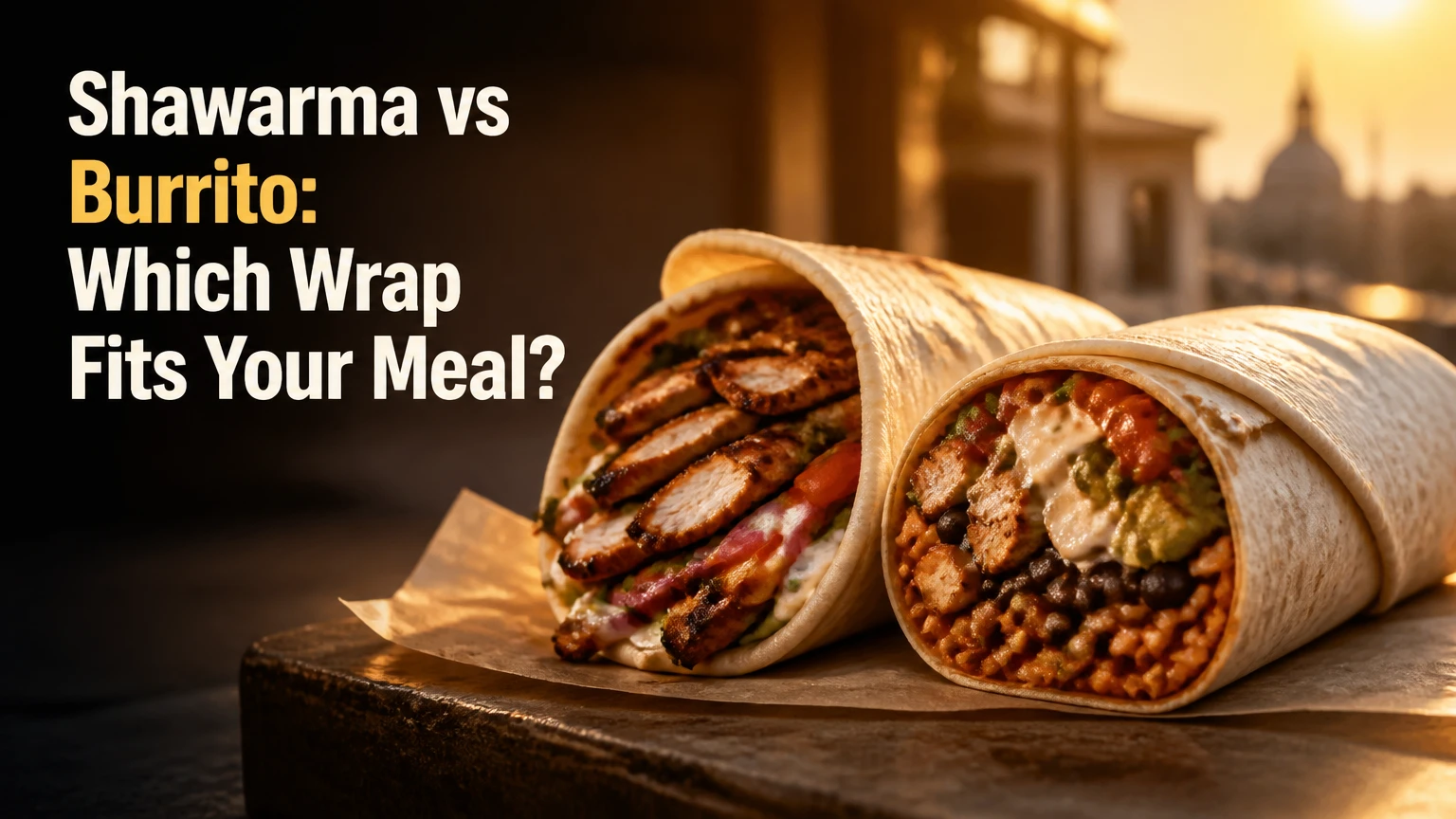
Shawarma is a Middle Eastern preparation of marinated meat roasted on a vertical spit, shaved into pita or another flatbread, and finished with sauces and pickles. A burrito is a Mexican or Mexican American tortilla format that encloses fillings such as beans, meat, rice, cheese, and salsa. The better choice depends on flavor, portion, diet, portability, and budget.
Key Facts at a Glance
- Shawarma centers on spit-roasted, thinly sliced meat; a burrito centers on a filled flour tortilla.
- Chicken shawarma commonly pairs with garlic sauce and pickled vegetables, while burritos often combine beans, rice, salsa, cheese, or avocado-based toppings.
- A typical shawarma wrap weighs about 200-350 grams; a large Mission-style burrito commonly weighs about 450-800 grams.
- Restaurant shawarma often contains about 500-700 calories, while a fully loaded burrito commonly reaches 900-1,300 calories, although recipes vary widely.
- Shawarma usually delivers sharper garlic, acidity, and spice; burritos usually offer more starch, creaminess, and ingredient variety.
- Choose shawarma for shaved roast-meat texture and a smaller meal; choose a burrito for customization, fullness, and a higher calorie-per-dollar return.
What Are Shawarma and Burritos?
Shawarma and burritos are both filled flatbread foods, but their culinary identities begin in different places. Shawarma is defined by the cooking method and seasoned meat, whereas a burrito is defined by the way a tortilla is folded around a filling.
The word shawarma derives from a term associated with turning or rotating, matching the vertical spit that slowly exposes stacked meat to heat. Common versions use chicken, beef, lamb, or a combination of meats with added fat. The outer layer cooks first, develops browned edges, and gets shaved before the next layer is exposed.
A burrito does not require one specific meat or cooking technique. A cook can fill a wheat flour tortilla with beans, rice, vegetables, eggs, cheese, or braised meat. The defining operation is enclosure: the tortilla is folded over the filling so the ends are closed and the cylinder can be eaten by hand.
| Attribute | Shawarma | Burrito |
|---|---|---|
| Culinary origin | Levant and wider Middle East | Mexico and Mexican American regions |
| Defining feature | Vertical spit-roasted meat | Folded flour tortilla |
| Common bread | Pita, laffa, saj, or yufka | Large wheat flour tortilla |
| Typical protein | Chicken, beef, lamb, or turkey | Beef, chicken, beans, eggs, or vegetables |
| Signature sauces | Toum, tahini, hummus, or amba | Salsa, sour cream, guacamole, or cheese |
| Typical structure | Thin, tightly rolled wrap | Larger enclosed cylinder |
| Common accompaniments | Pickles, onions, tomatoes, herbs | Rice, beans, lettuce, salsa, cheese |
The distinction matters when ordering. A restaurant can sell “shawarma” made with griddled meat rather than a working vertical spit, while a burrito can contain shawarma-style meat without becoming a traditional shawarma wrap. Names describe culinary systems, not only ingredient lists.
How Are Shawarma and Burritos Prepared?
Shawarma is prepared through continuous roasting and shaving, while a burrito is prepared through separate component cooking and controlled folding. The spit determines shawarma’s texture, whereas moisture management and tortilla flexibility determine whether a burrito holds together.
How does a shawarma spit work?
A shawarma spit cooks a layered cone of marinated meat beside a vertical heat source, usually gas or electric. The rotating stack exposes a narrow outer zone to intense heat, and the cook shaves the browned surface into thin strips as service continues.
Typical commercial preparation follows this sequence:
- Marinate sliced meat with acid, salt, fat, and spices.
- Stack the slices tightly on a vertical skewer.
- Add a fat layer or fat-rich slices near the top.
- Rotate the stack beside the heating element.
- Shave the browned exterior with a long knife or electric slicer.
- Reheat or toast the bread, then add meat, sauce, and vegetables.
- Roll the wrap and optionally press it briefly on a hot surface.
The fat cap helps baste lower layers, but it does not guarantee tender meat. A slow-selling spit can leave the exposed surface dry, especially when the operator shaves too infrequently or holds meat in a warm tray for too long.
How is a burrito folded?
A burrito is folded by placing a controlled amount of filling across the lower-middle portion of a warm flour tortilla, tucking in the sides, and rolling the bottom edge tightly over the filling. Warming increases flexibility because the tortilla becomes less prone to cracking.
A reliable assembly sequence is:
- Warm a 10- to 14-inch flour tortilla for roughly 10-20 seconds per side.
- Place rice or another dry base in a horizontal strip.
- Add beans and hot protein without exceeding the tortilla’s capacity.
- Add salsa, cheese, vegetables, and cold toppings in moderate quantities.
- Fold the side edges inward by about 4-6 centimeters.
- Pull the lower edge over the filling and tighten the first turn.
- Continue rolling until the seam rests underneath.
The practical limit is structural, not theoretical. A 14-inch tortilla may hold 500-700 grams when tightly wrapped, but excess salsa, large chunks, or unheated tortillas increase tearing and leakage.
Food safety applies to both foods. The United States Department of Agriculture Food Safety and Inspection Service states, “Use a food thermometer to ensure foods are cooked to a safe internal temperature.” A busy shawarma shop may shave continuously, but cooked meat still requires temperature control; a burrito counter must also keep hot fillings hot and chilled toppings cold.
What Goes Inside Each Wrap?
Shawarma usually has fewer core components and a stronger sauce-and-pickle identity, while burritos support a broader filling matrix built from starch, legumes, protein, dairy, vegetables, and salsa. Neither category has one universal recipe.
| Component | Chicken shawarma example | Beef or lamb shawarma example | Mission burrito example | Breakfast burrito example |
|---|---|---|---|---|
| Main protein | Marinated chicken | Spiced beef, lamb, or both | Carne asada, chicken, or braised beef | Eggs with beans or breakfast meat |
| Main starch | Pita or laffa | Pita, saj, or laffa | Flour tortilla, rice, and beans | Flour tortilla and potatoes |
| Sauce | Toum or tahini | Tahini, toum, or amba | Salsa, sour cream, or guacamole | Salsa or hot sauce |
| Acidic element | Pickled cucumber or turnip | Sumac onion or pickled vegetables | Salsa, jalapeño, or lime | Salsa or pickled chile |
| Fresh element | Tomato, parsley, or cucumber | Tomato, onion, or herbs | Lettuce, cilantro, or tomato | Onion, pepper, or avocado |
| Texture target | Crisp meat edges and crunchy pickles | Rich meat with sharp acidity | Soft rice, beans, and melted cheese | Soft egg, potato, and cheese |
Chicken shawarma is commonly seasoned with garlic, lemon, cumin, cardamom, paprika, turmeric, or yogurt-based marinades, though recipes differ by country and restaurant. Toum contributes a raw garlic intensity, while tahini brings sesame bitterness and a smoother finish.
Beef and lamb versions often bring warmer spice notes from allspice, cinnamon, cloves, coriander, or black pepper. Amba, a tangy mango condiment associated with Iraqi and Israeli food traditions, adds sourness and fenugreek-like savoriness.
Burrito fillings vary even more. A Mission-style burrito often combines meat, rice, beans, cheese, salsa, sour cream, and guacamole. A California burrito replaces rice and beans with french fries, carne asada, cheese, and guacamole. A northern Mexican burrito may be smaller and simpler, with beans, chile, and a meat filling.
Which Types Matter Most?
The most useful shawarma comparison is regional and structural, while the most useful burrito comparison is size, filling pattern, and local tradition. Restaurant labels overlap, so the ingredient list and preparation method matter more than the name alone.
| Style | Bread or shell | Typical filling pattern | Distinguishing feature |
|---|---|---|---|
| Levantine chicken shawarma | Pita or saj | Chicken, toum, pickles, vegetables | Garlic-forward and tangy |
| Beef or lamb shawarma | Pita or laffa | Meat, tahini, onion, pickles | Richer flavor and browned edges |
| Turkish-style döner sandwich | Pide-like bread or flatbread | Sliced spit-roasted meat and salad | Related spit-roasting tradition |
| Israeli-style shawarma | Laffa or pita | Often turkey, lamb fat, hummus, amba | Hummus and amba are common options |
| Mission burrito | Large flour tortilla | Meat, rice, beans, dairy, salsa | Large, foil-wrapped format |
| California burrito | Large flour tortilla | Carne asada, fries, cheese, guacamole | French fries replace rice and beans |
| Breakfast burrito | Flour tortilla | Eggs, potato, cheese, beans, salsa | Designed around morning ingredients |
| Northern Mexican burrito | Smaller flour tortilla | Beans, chile, meat, or vegetables | Thinner and less overloaded |
Döner, shawarma, and gyro share vertical or spit-roasting associations, but they are not interchangeable names. Gyro is Greek and often uses a different seasoning profile and service style; döner is Turkish; shawarma developed in the Arabic-speaking Middle East. The categories overlap historically while retaining distinct culinary traditions.
Shawarma vs Burrito: Which Is Better by Criterion?
Shawarma wins for concentrated roast-meat flavor, acidic toppings, and a moderate portion. Burritos win for ingredient range, meal size, and the ability to adjust protein, beans, rice, dairy, and vegetables independently.
| Decision criterion | Shawarma | Burrito | Practical winner |
|---|---|---|---|
| Meat texture | Thin shaved slices with crisp edges | Chopped, grilled, braised, or shredded filling | Shawarma for spit-roasted texture |
| Carbohydrate load | Usually one pita or flatbread | Tortilla plus rice, beans, and sometimes fries | Shawarma in the standard build |
| Customization | Sauce, pickles, bread, and protein changes | Extensive filling and portion changes | Burrito |
| Average mass | 200-350 grams typical | 450-800 grams for large formats | Shawarma for a smaller meal |
| Typical calorie range | 500-700 with chicken and sauce | 900-1,300 when fully loaded | Shawarma in standard portions |
| Sauce profile | Toum, tahini, hummus, amba | Salsa, dairy, avocado-based sauces | Tie, based on flavor preference |
| Portability | Tight, but sauces can drip | Strong when foil-wrapped correctly | Burrito for transport |
| Reheating | Bread can harden and vegetables wilt | Holds up better without cold toppings | Burrito |
Which has the stronger flavor?
Shawarma usually has the stronger immediate flavor because browned meat, garlic sauce, pickles, and spice reach the palate in concentrated layers. Burritos offer a wider sequence of flavors, but rice, beans, and cheese can soften the impact of salsa and grilled meat.
A shawarma wrap is often more aromatic and acidic. A burrito is often more savory, creamy, earthy, and filling. The comparison changes when the burrito uses a strongly seasoned protein and fresh salsa, or when shawarma contains bland meat and excessive sauce.
Winner: Shawarma for concentrated seasoning and contrast; burrito for layered variety.
Which is more filling?
A large burrito is usually more filling because it combines a 300-400 gram tortilla-and-filling base with rice, beans, cheese, or fries. Shawarma can be filling when served with extra meat, hummus, or side dishes, but a standard wrap usually has less total mass.
Satiety depends on protein, fiber, fat, and total calories rather than cuisine alone. A chicken shawarma plate with hummus and salad may satisfy longer than a small, sauce-heavy wrap, while a bean-and-rice burrito can provide substantial fiber without a large meat portion.
Winner: Burrito for maximum fullness in one handheld meal; shawarma for a lighter standard serving.
Which is easier to customize?
Burritos are easier to customize because each filling can be increased, removed, or substituted independently. Customers can request extra beans, no rice, double protein, dairy-free toppings, or a tortilla bowl without changing the basic cooking system.
Shawarma customization usually affects the final assembly rather than the spit itself. Customers can change bread, sauce, pickles, or protein, but the meat marinade and cooking method are usually fixed for the day.
Winner: Burrito for dietary control and ingredient-by-ingredient customization.
Are Shawarma and Burritos Healthy?
Neither shawarma nor burritos are automatically healthy or unhealthy. A chicken shawarma wrap with moderate garlic sauce may contain fewer calories than a cheese-and-sour-cream burrito, but a large shawarma with fatty meat and generous sauce can exceed a bean-and-vegetable burrito.
| Typical restaurant build | Estimated calories | Protein range | Main calorie drivers |
|---|---|---|---|
| Chicken shawarma in pita | 500-700 kcal | 25-40 g | Chicken, bread, toum |
| Beef or lamb shawarma in laffa | 650-950 kcal | 25-45 g | Meat fat, large bread, tahini |
| Bean and vegetable burrito | 600-900 kcal | 18-30 g | Tortilla, beans, rice, cheese |
| Chicken Mission burrito | 800-1,200 kcal | 35-60 g | Tortilla, rice, beans, cheese |
| California burrito | 900-1,400 kcal | 35-60 g | Fries, steak, cheese, guacamole |
| Breakfast burrito | 700-1,100 kcal | 25-45 g | Eggs, potato, cheese, tortilla |
These figures are typical restaurant ranges, not standardized nutrition data. Portion size, cooking fat, tortilla diameter, sauce quantity, and meat cut can shift the result by several hundred calories.
For a lower-calorie order, choose chicken shawarma, request sauce on the side, and add pickles or salad. For a burrito, choose beans, vegetables, a moderate rice portion, and one rich topping instead of automatically adding cheese, sour cream, and guacamole together.
Nutrition claims should remain specific. A shawarma wrap is not inherently low-carbohydrate because pita, laffa, sauces, and fries can create a substantial carbohydrate load. A burrito is not inherently nutritionally poor because beans, vegetables, lean protein, and salsa can form a balanced meal.
Which Costs More?
Burritos commonly cost more in large American restaurant markets because they use a larger tortilla and several separately prepared fillings. Typical quick-service prices range from $7-$13 for shawarma and $9-$16 for a large burrito, with location, labor, protein, and portion size driving the final price.
| Purchase factor | Shawarma | Burrito |
|---|---|---|
| Typical quick-service price | $7-$13 | $9-$16 |
| Typical serving weight | 200-350 g | 450-800 g |
| Typical service time | 60-120 seconds | 45-90 seconds |
| Typical cost per 100 g | About $2.00-$6.50 | About $1.10-$3.55 |
| Common premium add-on | Extra meat or hummus | Extra protein or guacamole |
| Best value strategy | Add a side only when hungry | Use beans and rice to increase volume |
The burrito may provide more food per dollar, but volume is not the same as value for every customer. Someone seeking a 600-calorie lunch may waste money on an oversized burrito, while someone replacing two meals may find the larger format economical.
Service speed also needs context. Burrito assembly can be faster during a well-organized rush, while shawarma service slows when meat must be shaved, weighed, toasted, and wrapped individually. A long line does not prove inferior preparation.
Which Should You Choose?
Choose shawarma when the priority is spit-roasted meat, sharp pickles, garlic sauce, and a smaller handheld portion. Choose a burrito when the priority is fullness, customization, transport stability, or a meal built around beans, rice, vegetables, and multiple toppings.
For a high-protein, moderate-size lunch
Select chicken shawarma in pita with sauce measured lightly and extra pickles or salad. Ask whether the meat is shaved from the active spit, because freshly exposed layers generally offer better texture than meat held in a tray.
A burrito can also work for this goal when ordered with double chicken, beans, vegetables, salsa, and a reduced rice portion. The burrito becomes less moderate when cheese, sour cream, guacamole, and fries are added together.
For the biggest meal per dollar
Select a bean-and-rice burrito with one protein portion and the toppings you will actually eat. Beans increase fiber and volume, while rice supplies inexpensive energy; adding every premium topping may raise the bill faster than it improves satiety.
Shawarma offers better value when the restaurant serves a generous meat portion or includes hummus, salad, and bread as a plate. A small wrap with heavy sauce is less economical for a very hungry customer.
For a commuter or traveler
Choose a tightly wrapped burrito when transport lasts more than 20-30 minutes. Foil contains the cylinder, and the dense rice-and-bean interior usually survives movement better than a thin pita with watery sauce.
Shawarma works well for immediate eating, especially when pressed after rolling. For travel, request thick bread, sauce on the side, and pickles separated if the restaurant can accommodate it.
For gluten avoidance
Neither standard category is automatically gluten-free. Flour tortillas contain wheat, and pita, laffa, and saj commonly contain wheat as well; cross-contact at shared grills and preparation surfaces can also matter.
A shawarma plate without bread may be easier to adapt, provided sauces and sides are verified. A burrito bowl removes the tortilla, but rice, beans, meat, and toppings still require ingredient and cross-contact checks.
For vegetarian or vegan eating
A burrito usually offers the broader vegetarian pathway because beans, rice, grilled vegetables, salsa, and avocado can provide a complete filling without imitation meat. Cheese and sour cream can be removed for a vegan order.
Vegetarian shawarma menus vary. Falafel wraps are a related Middle Eastern handheld option, but falafel is not shawarma because it is fried or baked ground-legume mixture rather than spit-roasted meat.
What Are the Common Problems and Fixes?
The main shawarma failures are dry meat, excessive sauce, and bread breakdown; the main burrito failures are overfilling, cold centers, and wet tortillas. Most problems come from holding time, moisture placement, or portion control rather than the cuisine itself.
| Failure | Likely cause | Immediate fix | Prevention |
|---|---|---|---|
| Dry shawarma meat | Low spit turnover or long hot holding | Add fresh sauce and request newly shaved meat | Choose a busy shop with active service |
| Soggy shawarma bread | Watery vegetables or excess sauce | Eat immediately or request sauce separately | Use thicker bread and drain pickles |
| Burrito tears during rolling | Cold tortilla or excessive filling | Transfer contents to a second tortilla | Warm tortilla and reduce volume |
| Burrito leaks at the seam | Loose first fold or wet filling | Rewrap in foil and keep seam down | Tighten the first turn |
| Cold burrito center | Chilled toppings added in a dense core | Reheat without lettuce or sour cream | Use hot rice and protein; add cold toppings later |
| Bland shawarma | Weak marinade or sauce imbalance | Add pickles, lemon, or stronger sauce | Sample the meat before adding extras |
A common practitioner rule is to judge a shawarma shop by turnover and shaving rhythm, not by the height of its meat cone alone. A tall cone can look impressive while moving too slowly to maintain fresh outer layers.
Another useful rule is to treat sauces as structural ingredients. Toum, tahini, salsa, sour cream, and guacamole alter moisture, lubrication, and weight distribution, so placing large wet portions in one area can damage an otherwise sound wrap.
The most counterintuitive burrito mistake is adding more tortilla warming time without monitoring dryness. A brief warm-up improves flexibility, but prolonged direct heat dehydrates the surface and makes cracking more likely during the final fold.
How Do You Make Each at Home?
Home cooks can make burritos with a skillet and prepared fillings, while shawarma requires either a vertical rotisserie or a hot pan method that imitates browned shaved edges. A practical home shawarma meal takes about 45-90 minutes for marination and cooking, whereas a burrito can be assembled in 20-40 minutes when components are ready.
| Home method | Equipment | Typical active time | Best result |
|---|---|---|---|
| Shawarma spit | Vertical rotisserie, knife, heat source | 2-4 hours including cooking | Layered shaved meat |
| Shawarma pan method | Heavy skillet, tongs, thermometer | 35-60 minutes | Thin browned strips |
| Burrito skillet assembly | Skillet, spatula, cutting board | 20-40 minutes | Fast custom filling |
| Burrito batch cooking | Rice pot, bean pan, skillet | 60-90 minutes | Several meals with consistent portions |
For home shawarma, slice boneless chicken thinly, marinate it with lemon, garlic, yogurt or oil, salt, and spices, then cook it in small batches over high heat. Crowding the pan steams the meat and prevents the browned edges that define the style.
For a home burrito, prepare the filling components separately, warm the tortilla, keep wet toppings moderate, and roll with the seam underneath. A burrito bowl is the simpler option when tortilla size or folding technique is limiting.
Home cooks should use a food thermometer for poultry and other meat. Surface browning cannot verify the center’s safety, and reheating a wrap does not reliably correct unsafe storage.
FAQ
Is shawarma basically a burrito?
Shawarma resembles a burrito because both can be handheld wraps, but shawarma is defined by seasoned meat cooked on a vertical spit and commonly served with Middle Eastern bread, sauces, and pickles. A burrito is defined by a folded tortilla containing a broad range of fillings, including vegetarian combinations.
Is shawarma healthier than a burrito?
Shawarma is often lower in calories than a fully loaded burrito because a standard wrap usually contains less total food, rice, cheese, and beans. The result changes with meat fat, bread size, sauce quantity, and fries. A bean-and-vegetable burrito can be nutritionally stronger than a sauce-heavy shawarma.
Can a burrito contain shawarma meat?
A burrito can contain shawarma-style meat, but the finished food is best described as a fusion burrito rather than traditional shawarma. The tortilla, folding method, and fillings identify the burrito format, while the spit-roasted meat supplies a shawarma-inspired component.
What is the difference between shawarma and gyro?
Shawarma is a Middle Eastern spit-roasted meat preparation with seasonings and accompaniments that vary across the Levant and neighboring regions. Gyro is a Greek dish with its own seasoning, bread, sauces, and serving conventions. Both use rotating meat, but shared equipment does not make them the same dish.
Can you freeze shawarma or burritos?
Burritos freeze more successfully when they contain rice, beans, and cooked protein without lettuce, sour cream, or watery salsa. Shawarma meat freezes reasonably well by itself, but assembled wraps often suffer from tough bread and limp vegetables. Store fillings separately when possible and reassemble after reheating.
Which is easier to eat neatly?
A tightly wrapped burrito is usually easier to carry because its large flour tortilla and foil support contain the filling. Shawarma is easier to eat immediately when freshly pressed, but thin bread, pickles, and generous sauce can cause dripping near the bottom seam.
The Bottom Line
Shawarma vs burrito is a choice between two different food systems, not a contest between identical wraps. Choose shawarma for freshly shaved, heavily seasoned meat, garlic or tahini sauce, pickles, and a smaller portion. Choose a burrito for maximum filling capacity, customization, fiber from beans, transport stability, and value by volume. The best decision follows the meal you need, the portion you want, and the preparation quality available at the counter.