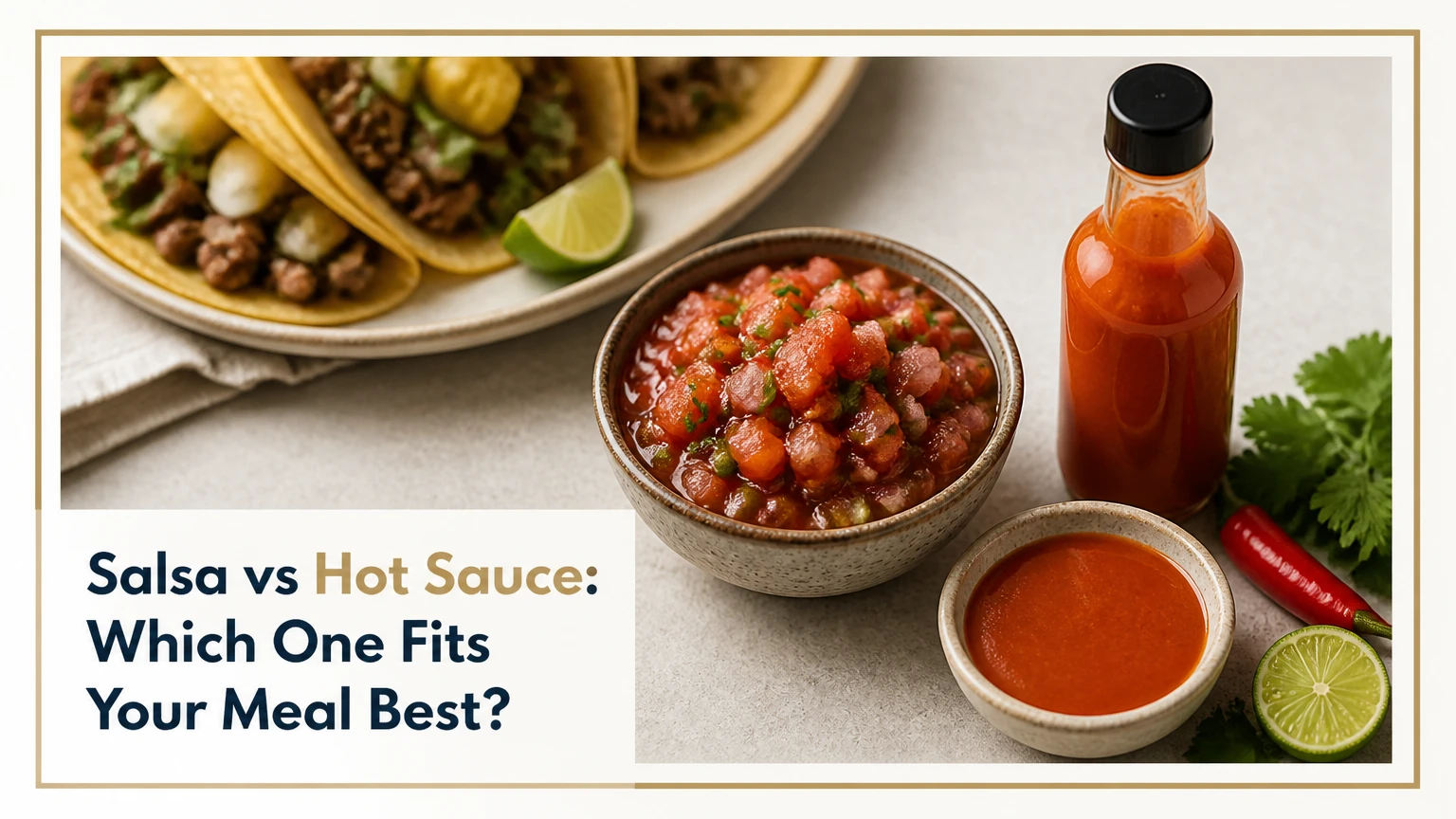
Salsa is a textured vegetable condiment designed to contribute moisture, acidity, flavor, and often bite, while hot sauce is a concentrated liquid seasoning designed to distribute chili heat and acidity in small amounts. Salsa usually works as a dip or topping; hot sauce usually works as a finishing ingredient or heat adjustment.
Key Facts at a Glance
- Salsa commonly contains tomatoes or tomatillos, onion, chili peppers, herbs, citrus, and salt.
- Hot sauce concentrates chili peppers in a pourable base that may include vinegar, water, fruit, garlic, salt, or sugar.
- Salsa is usually consumed by the forkful or spoonful, while hot sauce is commonly measured in teaspoons or dashes.
- Fresh salsa typically requires refrigeration and lasts about 3-7 days when handled correctly.
- A commercial hot sauce can last months or years, but shelf life depends on acidity, formulation, processing, packaging, and storage.
- Neither category has a fixed heat level: a mild salsa can be hotter than a mild hot sauce, and a superhot sauce can exceed 1,000,000 Scoville heat units.
What Is the Difference Between Salsa and Hot Sauce?
The main difference is culinary function: salsa adds a substantial, textured mixture to food, whereas hot sauce adds concentrated heat, acidity, and flavor with minimal volume. The categories overlap because blended salsa can be pourable and thick hot sauce can resemble a puree, but serving behavior remains the most useful distinction.
Salsa often preserves some identity of its ingredients. A diced tomato, a tomatillo puree, a roasted onion, or a cilantro leaf remains perceptible through texture and aroma. Hot sauce usually processes ingredients more aggressively through blending, cooking, fermentation, straining, or homogenization.
The difference affects recipe balance. Two tablespoons of salsa can add several grams of water and vegetable solids to a taco, while one teaspoon of vinegar-based hot sauce may add sharp acidity without materially changing the dish’s texture.
| Attribute | Salsa | Hot sauce | Practical consequence |
|---|---|---|---|
| Typical serving | 2-4 tablespoons | 1 teaspoon to 1 tablespoon | Salsa changes volume more |
| Texture | Chopped, pulpy, or pureed | Thin, smooth, or thick-pourable | Hot sauce spreads farther |
| Main job | Topping, dip, side condiment | Heat and acid adjustment | They solve different problems |
| Common acid | Lime juice or mild vinegar | Distilled or cider vinegar | Hot sauce often tastes sharper |
| Moisture contribution | Moderate to high | Low to moderate | Salsa can soften crisp foods |
| Storage pattern | Fresh versions need refrigeration | Commercial bottles may be shelf-stable | Labels and formulation matter |
How Do Heat and Texture Work?
Capsaicin creates chili heat by activating TRPV1 receptors, nerve channels that normally respond to high temperature; the brain interprets that signal as burning even though capsaicin is not physically heating the mouth. Concentration, serving size, pepper variety, and the surrounding ingredients determine the final sensation.
Salsa can contain capsaicin, but vegetables, fruit, water, seeds, acids, and serving volume dilute its delivery. Hot sauce places more pepper extract or pepper puree into a smaller serving, so the same chili may feel more intense when blended into a concentrated liquid.
Dairy fat can reduce the sensation temporarily because capsaicin dissolves more readily in fat than in water. Sugar, starch, and the physical removal of pepper solids can also change perception, although none reliably eliminates capsaicin.
Texture follows a different mechanism. Salsa retains insoluble vegetable fibers and cell fragments, while hot sauce may be blended at high speed, strained through fine mesh, cooked until soft, or stabilized with a small amount of xanthan gum.
A useful practitioner rule is simple: heat measures intensity, but texture determines distribution. A thin sauce reaches every part of a bowl of soup quickly. A chunky salsa delivers hot pepper in localized bites.
Which One Is Hotter?
Hot sauce is often hotter per teaspoon, but salsa has no guaranteed heat ceiling or floor. A salsa containing serrano or habanero peppers can exceed a mild jalapeño sauce, while a Louisiana-style sauce made with aged cayenne may taste gentler because vinegar and salt dominate the first impression.
The Scoville scale estimates capsaicinoid heat, but a pepper’s published rating does not equal the heat of the finished condiment. Dilution, fermentation, cooking, sugar, oil, vinegar, and serving size all alter the result.
| Pepper or style | Typical pepper range | Common finished use | Heat expectation |
|---|---|---|---|
| Bell pepper | 0 SHU | Mild salsa base | No capsaicin burn |
| Jalapeño | 2,500-8,000 SHU | Pico de gallo or green sauce | Mild to medium |
| Serrano | 10,000-25,000 SHU | Fresh salsa or blended sauce | Medium to hot |
| Habanero | 100,000-350,000 SHU | Fruit-forward hot sauce | Very hot |
| Carolina Reaper | Often above 1,000,000 SHU | Superhot sauce | Extreme |
A label that says “habanero” does not automatically identify a sauce as extreme. A small amount of habanero blended with mango, carrot, vinegar, and water may be less intense than a dense pepper mash.
How Do the Main Types Differ?
Salsa categories differ mainly by base ingredient, cooking method, and texture. Hot sauce categories differ mainly by pepper concentration, acid system, fermentation, sweetness, and viscosity.
| Type | Defining ingredients | Typical texture | Best application |
|---|---|---|---|
| Pico de gallo | Raw tomato, onion, chili, lime, cilantro | Dry-chopped | Tacos, grilled foods, beans |
| Salsa roja | Red tomato, dried or fresh chili, onion, garlic | Coarse puree or smooth sauce | Enchiladas, eggs, rice |
| Salsa verde | Tomatillo, green chili, onion, herbs | Chunky or blended | Chicken, roasted vegetables |
| Salsa negra | Dried fried chili, garlic, oil, dark seasonings | Dark, oily puree | Tacos, grilled meats, noodles |
| Louisiana-style hot sauce | Cayenne, vinegar, salt | Thin liquid | Eggs, fried foods, soups |
| Mexican-style hot sauce | Dried chili, vinegar, spices | Thin to medium | Tacos, snacks, beans |
| Sriracha-style sauce | Red jalapeño, garlic, sugar, vinegar | Thick puree | Noodles, sandwiches, rice |
| Caribbean-style hot sauce | Habanero, fruit or vegetables, vinegar | Thin to medium | Seafood, rice, roasted foods |
Regional labels are useful but not absolute. “Mexican-style” can describe many formulations, and salsa in Mexico includes a much wider family of fresh, cooked, roasted, ground, and seed-based preparations than the tomato dip commonly sold in North American supermarkets.
How Do Nutrition and Sodium Compare?
Salsa usually contributes more calories, fiber, and micronutrients per serving because people eat a larger quantity of vegetables. Hot sauce often contributes fewer calories per teaspoon, but its sodium concentration can be significant when consumers add repeated dashes.
Nutrition varies sharply by brand and recipe. A fresh tomato salsa with little salt differs from a cheese-based dip labeled salsa, while a sweet chili sauce differs nutritionally from a vinegar-and-pepper sauce.
| Typical serving | Calories | Sodium | Main nutritional variable |
|---|---|---|---|
| Fresh salsa, 2 tablespoons | About 5-15 | About 100-250 mg | Added salt and tomato content |
| Fresh salsa, 1/2 cup | About 20-60 | About 300-800 mg | Serving size and draining |
| Vinegar hot sauce, 1 teaspoon | About 0-5 | About ฉ50-150 mg | Salt and pepper concentration |
| Thick sweet hot sauce, 1 tablespoon | About 15-45 | About 150-400 mg | Sugar and sodium |
| Homemade unsalted salsa, 1/2 cup | About 20-50 | Under 50 mg naturally | Salt added at the end |
Check the Nutrition Facts panel rather than assuming “hot” means low-calorie or “fresh” means low-sodium. The United States Food and Drug Administration identifies 2,300 milligrams of sodium per day as the Daily Value for adults and children ages four and older, so frequent condiment use can matter even when each serving appears small.
How Long Do They Last?
Fresh salsa typically lasts 3-7 days in a refrigerator at 40°F or below, while unopened commercial hot sauce may remain usable for many months or longer when the manufacturer’s storage instructions are followed. Opened hot sauce loses quality sooner than it becomes unsafe, especially when fresh produce, fruit, or low-acid ingredients are present.
Fresh pico de gallo has a shorter practical life than cooked salsa because raw tomatoes release water, herbs wilt, and cut vegetables support faster quality decline. Use clean utensils, refrigerate promptly, and discard salsa with mold, fermentation odors, gas production, or an unusual slimy texture.
Commercial hot sauce requires label-based judgment. Vinegar, salt, low pH, heat processing, and preservatives can support extended storage, but a sauce with fresh fruit puree or limited acidification may require refrigeration after opening.
| Product | Typical unopened storage | Typical opened storage | Main quality warning |
|---|---|---|---|
| Homemade pico de gallo | Refrigerated immediately | 3-4 days | Watery texture and sour odor |
| Homemade cooked salsa | Refrigerated unless validated for canning | 5-7 days | Mold, gas, or off odor |
| Commercial refrigerated salsa | Refrigerated | 5-14 days after opening | Mold around lid or surface |
| Vinegar-based hot sauce | Pantry if label permits | 6-24 months typical | Darkening or flavor loss |
| Fruit-forward hot sauce | Pantry or refrigerator per label | 1-6 months typical | Swelling, mold, or separation |
Home cooks should not infer shelf stability from a low pH guess. The National Center for Home Food Preservation recommends tested recipes and approved processing methods for canned salsa; an untested mixture with insufficient acid can create a serious food-safety risk.
As USDA Food Safety and Inspection Service guidance puts it, “When in doubt, throw it out.” That rule is especially appropriate for homemade fermented or canned products with uncertain acidity.
How Do You Make Fresh Salsa?
Fresh salsa takes about 15-25 minutes and requires tomatoes, onion, chili, lime juice, cilantro, salt, a knife, a bowl, and a colander. The most important success factor is water control, because salted tomatoes can release enough liquid to turn a crisp mixture into a thin dip.
Step 1: Prepare the vegetables
For about 2 cups, dice 450 grams of firm tomatoes, 60 grams of white onion, and one jalapeño or serrano. Remove the tomato cores and watery seed pulp if the tomatoes are especially juicy.
Success checkpoint: The pieces should be similar in size, approximately 5-7 millimeters, so each bite contains balanced ingredients.
Common mistake: Crushing tomatoes with a dull knife creates excess liquid and bruised flavor.
Step 2: Salt and drain the tomatoes
Toss the tomatoes with approximately 3 grams of salt and place them in a colander for 10 minutes. Reserve the drained liquid for soup or a cooked sauce if desired.
Success checkpoint: The tomatoes remain moist but no longer pool heavily in the bowl.
Common mistake: Salting the entire mixture at once can draw water from onion and herbs before serving.
Step 3: Combine and acidify
Mix the drained tomatoes with onion, chili, 15-30 milliliters of lime juice, and 10 grams of chopped cilantro. Add salt gradually because the tomatoes were already seasoned.
Success checkpoint: The salsa tastes bright, lightly salty, and fresh rather than dominated by lime.
Common mistake: Adding too much lime to compensate for bland tomatoes produces sourness without adding depth.
Step 4: Rest and adjust
Rest the salsa for 15 minutes, then taste again. Add a small amount of chili for heat, onion for sharpness, or lime for acidity.
Success checkpoint: The salsa holds its shape on a chip or spoon for several seconds.
Common mistake: Serving immediately can make the onion taste harsh because the flavors have not blended.
For longer storage, cook the salsa or use a tested preservation recipe. Refrigeration slows spoilage but does not make an untested canned salsa safe for pantry storage.
How Is Fermented Hot Sauce Made?
Fermented hot sauce generally takes 1-4 weeks before blending and acid adjustment, although fermentation length depends on temperature, salt percentage, pepper variety, and desired acidity. Safe fermentation requires a measured salt concentration, clean equipment, submerged solids, and a reliable way to verify the finished product.
Step 1: Weigh the ingredients
A typical pepper mash uses 2-3% salt by total ingredient weight. For 1,000 grams of peppers and aromatics, 20-30 grams of non-iodized salt is a typical starting range.
Success checkpoint: The salt is measured by weight, not guessed with spoons.
Common mistake: Changing the salt percentage substantially can encourage spoilage or suppress the desired lactic-acid bacteria.
Step 2: Pack and exclude air
Blend or crush the peppers, pack them into a fermentation jar, and keep all solids below the brine or mash surface. Use a fermentation weight and leave headspace for gas.
Success checkpoint: Bubbles appear during active fermentation and pepper solids remain submerged.
Common mistake: Exposed solids can develop surface mold, which means the batch should not be casually scraped and used.
Step 3: Monitor the ferment
Keep the jar at a stable room temperature, commonly around 18-22°C, for one to four weeks. Open the vessel carefully if the system is not fitted with an airlock because pressure can build.
Success checkpoint: The mash develops a clean sour aroma and measurable acidity rather than a rotten or solvent-like odor.
Common mistake: Treating bubbling alone as proof of safety is unreliable because different microorganisms can produce gas.
Step 4: Blend, strain, and acidify
Blend the fermented mash with vinegar or another approved acidic ingredient, then strain if a smooth sauce is wanted. Measure pH with a calibrated meter rather than relying on taste; commercially shelf-stable products require validated formulation and processing.
Success checkpoint: The sauce has the intended texture, stable acidity, and no abnormal odor or visible growth.
Common mistake: Bottling a fermented sauce and storing it at room temperature without confirming acidity and process controls.
Fermentation adds lactic acidity and savory complexity, but it does not automatically make a product shelf-stable. Refrigerate homemade sauce unless a qualified preservation method establishes safe storage.
Can You Substitute One for the Other?
Salsa can replace hot sauce when a recipe benefits from moisture, vegetable texture, and a milder heat release. Hot sauce can replace salsa only when the missing tomato or vegetable bulk does not affect the recipe, because a teaspoon of liquid seasoning cannot reproduce several tablespoons of chopped produce.
| Intended result | Recommended substitute | Starting amount | Adjustment |
|---|---|---|---|
| Add heat to eggs | Hot sauce | 1 teaspoon per serving | Add salt only after tasting |
| Add topping to tacos | Salsa | 2-3 tablespoons per serving | Drain watery salsa first |
| Add acid to soup | Hot sauce | 1/2 teaspoon at a time | Reduce other vinegar or lime |
| Replace salsa in a dip | Salsa plus diced vegetables | 1:1 volume | Hot sauce alone is too thin |
| Replace hot sauce in marinade | Blended salsa | 2 tablespoons per 500 grams food | Add measured vinegar for acidity |
| Add moisture to rice or beans | Salsa | 1/4 cup per serving | Reduce cooking liquid slightly |
A practical substitution formula is to replace one tablespoon of hot sauce with three to four tablespoons of salsa, then reduce another acidic ingredient if the salsa contains lime or vinegar. Reverse substitution requires adding water, tomato, onion, or broth to prevent a dish from becoming too sharp and concentrated.
Which One Should You Choose?
Choose salsa for texture, fresh vegetable flavor, and a substantial topping; choose hot sauce for concentrated heat, controlled acidity, portability, and long storage. The right choice depends on the food’s moisture level, cooking stage, desired heat distribution, and whether the condiment must remain stable for several weeks.
Choose salsa for tacos and bowls
Salsa is the stronger choice for tacos, grain bowls, beans, and grilled vegetables because its solids add contrast to soft ingredients. Pico de gallo works best when the food is rich or soft and needs freshness, while a cooked roja suits dishes that need deeper roasted flavor.
Salsa is less suitable when crispness must remain intact for hours. Juicy tomato salsa can soften chips, fried shells, and toasted bread within minutes.
Choose hot sauce for eggs and soups
Hot sauce performs well in eggs, soups, noodles, rice, and sauces because a small quantity distributes quickly. Vinegar-forward sauce cuts richness, while garlic-heavy or fruit-forward sauce adds more recognizable flavor.
Add hot sauce near the end of cooking when its fresh acidity matters. Add it earlier when the goal is to integrate heat into a stew or pan sauce.
Choose a cooked salsa for meal preparation
Cooked salsa is usually more stable in a container than fresh pico de gallo because heat softens vegetables and reduces some free water. It still requires refrigeration unless the product uses a tested canning process.
For weekday meal preparation, portion salsa separately from crisp foods. Store 60-120 grams in a sealed container and add it immediately before eating.
Choose fermented hot sauce for layered heat
Fermented hot sauce suits people who want acidity and savory depth alongside heat. A fermented habanero sauce may complement beans or roasted vegetables, while a mild fermented jalapeño sauce can work as an everyday table condiment.
Fermented sauce is not automatically better. Fermentation can produce flavors that clash with delicate fish, lightly seasoned vegetables, or desserts.
What Ingredients Need Extra Attention?
Salsa and hot sauce can contain high sodium, alliums, citrus, mustard, fruit, or commercial thickeners, so ingredient labels matter for allergies and dietary restrictions. The pepper itself is rarely the only relevant ingredient.
Check for these items:
- Sodium: Compare milligrams per labeled serving, especially when using sauce repeatedly.
- Alliums: Onion and garlic can matter for people following low-FODMAP plans.
- Mustard: Some Caribbean-style and yellow hot sauces use mustard as a major ingredient.
- Fruit: Mango, peach, pineapple, and other fruit may affect allergy planning and sugar intake.
- Thickeners: Xanthan gum is common in smooth sauces and is generally used at roughly 0.1-0.2% in small-batch formulations.
- Cross-contact: Shared production equipment can expose a product to sesame, dairy, or other allergens.
Ingredient order also reveals formulation. A sauce listing vinegar before peppers will usually taste more acidic than a pepper-first sauce, while sugar appearing near the beginning predicts a sweeter profile.
What Problems Should You Watch For?
The most common salsa problem is excess water, while the most common hot sauce problem is imbalance between heat, acid, salt, and texture. Correct the underlying ratio rather than masking the symptom with large amounts of sugar or salt.
| Problem | Likely cause | Practical fix | Prevention |
|---|---|---|---|
| Watery salsa | Juicy tomatoes or early salting | Drain through a colander | Salt tomatoes separately |
| Bitter salsa | Excess raw onion, char, or herb stems | Add fresh tomato and modest lime | Remove burned skins |
| Sauce separates | Low viscosity or incomplete blending | Blend again or use a measured stabilizer | Homogenize before bottling |
| Excessive vinegar | Acid added too quickly | Dilute with pepper puree or cooked vegetables | Add acid in stages |
| Fermentation mold | Solids exposed to air | Discard uncertain batches | Keep mash submerged |
| Excessive heat | Superhot pepper concentration | Dilute with acid-compatible puree | Add peppers by weight |
A counterintuitive correction is that more lime does not reliably fix bland salsa. Lime increases acidity, but it cannot replace salt, ripe tomato flavor, roasted aromatics, or enough resting time.
Another practitioner rule is to evaluate a condiment at serving temperature. Cold salsa tastes less aromatic and may seem less salty, while room-temperature hot sauce releases more volatile pepper and vinegar aromas.
The Bottom Line
Salsa vs hot sauce is not a contest with one universal winner. Salsa is the better choice when a dish needs fresh produce, moisture, texture, and a spoonable topping; hot sauce is better when a dish needs concentrated heat, acid, portability, or precise dosing.
Use salsa on tacos, beans, eggs, bowls, and grilled vegetables when ingredient texture matters. Use hot sauce in soups, noodles, marinades, cooked sauces, and finished dishes when a teaspoon should change flavor without adding bulk. For the widest range of meals, keep one fresh or cooked salsa and one mild vinegar-based hot sauce, then add specialty sauces only when their pepper or flavor profile fills a specific role.
Frequently Asked Questions
Is salsa healthier than hot sauce?
Salsa often provides more vegetable material and may contribute modest fiber and vitamin content, while vinegar-based hot sauce usually contains fewer calories per teaspoon. Neither is automatically healthier because sodium, sugar, serving size, and recipe composition vary. Compare nutrition labels and measure portions if sodium or sugar intake matters.
Does salsa always contain tomatoes?
Salsa does not always contain tomatoes. Salsa verde commonly uses tomatillos, while some roasted, fruit-based, avocado-based, chile-based, and seed-based salsas use little or no tomato. The defining feature is a seasoned sauce or mixture, not a mandatory red tomato base.
Can hot sauce be used for cooking?
Hot sauce can be used during cooking, but timing changes its flavor. Early addition integrates heat and reduces fresh vinegar aroma, while late addition preserves brightness and pepper fragrance. Add small amounts to soups, beans, marinades, braises, and pan sauces, then taste before adding more salt.
Why does restaurant salsa taste fresher?
Restaurant salsa often tastes fresher because it may be prepared shortly before service, use ripe produce, and combine raw ingredients with measured salt and acid. Restaurants also control cutting size and serving temperature. Commercial salsa can taste less fresh when heat processing, long storage, or excess liquid softens the vegetables.
Can children eat hot sauce or salsa?
Children can eat mild salsa or hot sauce when the ingredients and heat level suit them, but tolerance varies widely. Start with a tiny amount, avoid forcing spicy food, and check labels for sodium, allergens, and added sugar. Superhot pepper products are inappropriate for casual tasting because the physical discomfort can be severe.
Should hot sauce be refrigerated after opening?
Follow the manufacturer’s label first. Vinegar-forward commercial hot sauce may remain safe in a cool pantry after opening, although refrigeration helps preserve color and flavor; sauces containing fresh fruit, low acid, or limited preservatives more often require refrigeration. Homemade hot sauce should remain refrigerated unless a validated preservation process confirms shelf stability.