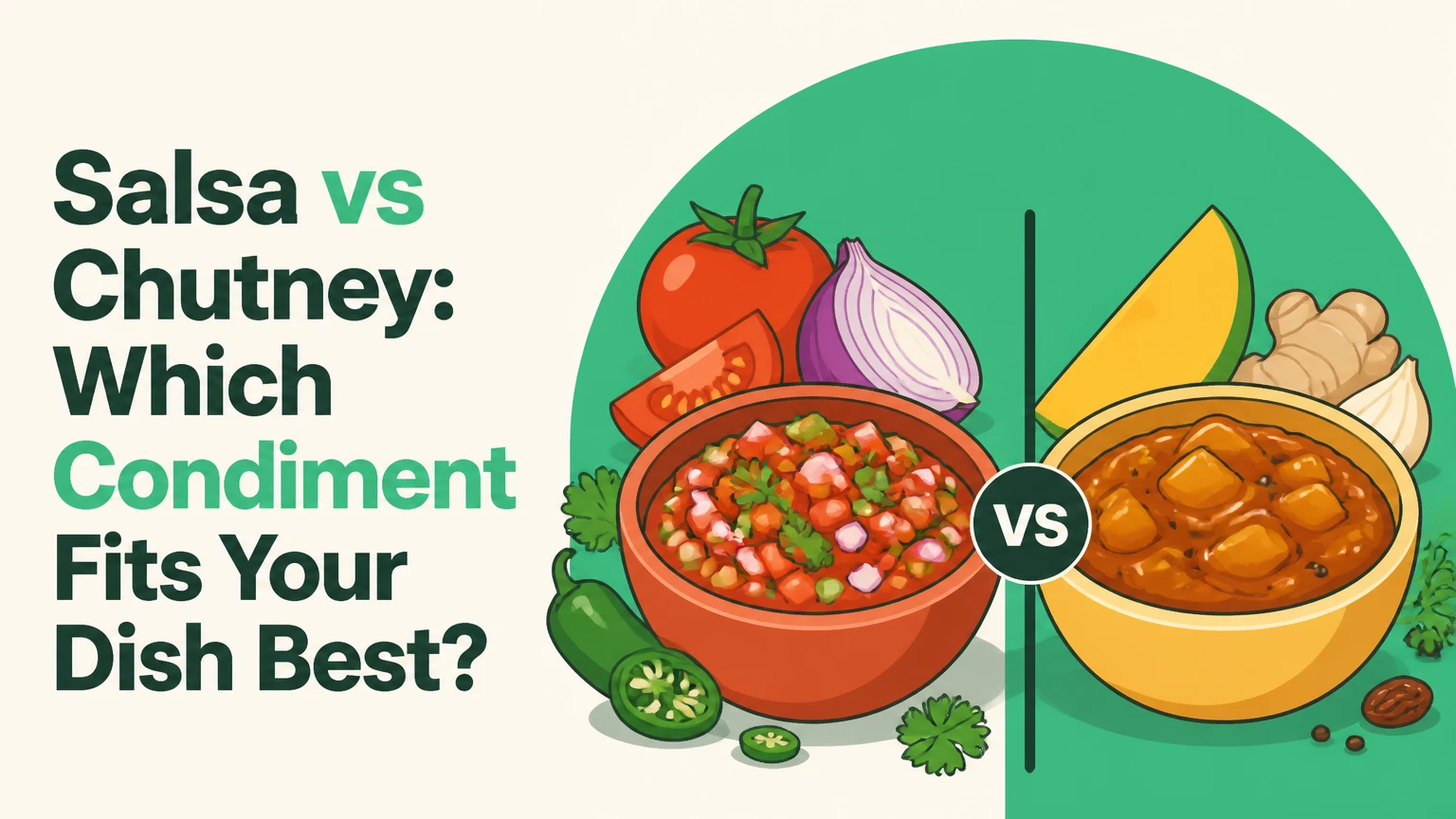
Salsa is usually a fresh or lightly cooked, acid-forward condiment built around vegetables, chiles, and herbs, while chutney is a broader South Asian condiment category that may be fresh, ground, or slowly cooked with fruit, vegetables, acid, sugar, and spices. Choose salsa for sharp freshness and chutney for layered sweet-sour depth, unless the chutney is a fresh green style.
Key Facts at a Glance
- Salsa usually tastes acidic, fresh, savory, and chile-forward; cooked salsa develops roasted or smoky flavors.
- Chutney may be raw or cooked, so “chutney” does not automatically mean sweet, jam-like, or shelf-stable.
- Pico de gallo is typically chunky and fresh, while mango chutney is usually soft, concentrated, sweet-sour, and spiced.
- Refrigerated fresh salsa commonly keeps for 3-5 days, while opened cooked chutney commonly keeps for several weeks when handled cleanly.
- A pH below 4.6 is important for controlling botulinal growth, but pH alone does not validate a home-canning recipe.
- Salsa generally fits tacos, eggs, grilled dishes, and chips; chutney generally fits rice dishes, savory pastries, curries, sandwiches, and cheese.
Salsa vs Chutney: What Is the Core Difference?
Salsa is generally a Mexican and broader Latin American condiment family in which fresh vegetables, chiles, herbs, and acid remain recognizable. Chutney is a South Asian condiment family that includes fresh herb pastes, ground coconut mixtures, tamarind sauces, and cooked fruit reductions.
The difference is therefore cultural and structural, not simply a choice between tomato and mango. Salsa can be cooked, blended, smoky, or fruit-based. Chutney can be raw, green, savory, creamy, fiery, or sweet. A fresh mango salsa and a mango chutney may share fruit, lime, and chile, yet their texture, spice treatment, sweetness, and intended uses differ substantially.
Master comparison
| Criterion | Salsa | Chutney |
|---|---|---|
| Common culinary roots | Mexico, Central America, Latin America | India and South Asia |
| Typical base | Tomato, tomatillo, onion, chile | Fruit, herbs, coconut, tamarind, vegetables, lentils |
| Common preparation | Raw chopping, roasting, boiling, blending | Grinding, tempering, simmering, reducing |
| Dominant balance | Acid, salt, chile heat, freshness | Sweet-sour, spice, pungency, savory depth |
| Texture | Crisp chunks, coarse puree, thin sauce | Paste, pulp, relish-like reduction, creamy blend |
| Best serving temperature | Cool or room temperature | Room temperature, warm, or chilled |
| Typical fresh storage | 3-5 refrigerated days | 2-5 refrigerated days for fresh versions |
| Typical cooked storage | 5-7 refrigerated days | 3-8 weeks refrigerated after opening, depending on recipe |
Salsa is the stronger choice when a dish needs immediate freshness and moisture. Chutney is the stronger choice when a dish needs concentrated sweetness, spice, acidity, or a thick spreadable texture.
How Do Salsa and Chutney Work Differently?
Salsa creates impact through cutting, crushing, roasting, and acidification. Chopping breaks plant tissue, releases aromatic compounds, and distributes lime juice, vinegar, salt, and chile across the mixture. Roasting adds browned, smoky notes, but a raw salsa keeps more crispness and raw herbal character.
Chutney develops flavor through grinding, oil tempering, fermentation in some traditions, or simmering. Heating softens plant tissue and evaporates water, which concentrates sugar, acid, salt, and spice. Oil also carries fat-soluble aromas from ingredients such as mustard seed, cumin, fenugreek, curry leaves, and dried chiles.
A practical rule follows from these mechanics: use salsa to add volume and freshness, and use chutney to add concentration. The rule is not absolute because green chutney and coconut chutney are often uncooked or briefly tempered, while salsa roja may be fully roasted and blended.
How Do Flavor and Texture Differ?
Salsa usually delivers a short, sharp flavor sequence: acid first, chile and salt next, followed by tomato, onion, herb, or roasted notes. Chutney usually delivers a longer sequence because sweetness, sourness, spice, and cooked fruit or herb aromas appear at different points.
Texture affects pairing as much as flavor. Crisp pico de gallo can cut through a soft taco filling, whereas smooth tamarind chutney can coat a fried snack without falling apart. Mango chutney adds a dense, sticky layer to a sandwich, while green chutney supplies moisture without the same sugar concentration.
| Sensory attribute | Fresh salsa | Cooked salsa | Fresh chutney | Cooked chutney |
|---|---|---|---|---|
| Moisture | High, 70-90% typical | Medium, 55-80% typical | Medium, 50-75% typical | Low, 30-65% typical |
| Texture | Crisp, juicy, chunky | Soft, blended, or pulpy | Paste, puree, or coarse grind | Thick pulp or spread |
| Sweetness | 0-5% added sugar typical | 0-8% added sugar typical | 0-15% added sugar typical | 15-45% added sugar typical |
| Acid source | Lime, lemon, tomato, vinegar | Tomato, tomatillo, vinegar, lime | Lemon, tamarind, yogurt, vinegar | Vinegar, tamarind, citrus |
| Heat expression | Fresh chile aroma and bite | Roasted or dried-chile depth | Fresh chile and herb heat | Dried spice and chile warmth |
| Best contrast | Rich, soft, fried, or grilled foods | Charred meats and roasted vegetables | Rice, snacks, legumes, sandwiches | Aged cheese, curry, roast vegetables |
Added sugar percentages in the table are typical recipe ranges, not universal composition data. A coconut chutney may contain no added sugar, while a commercial fruit chutney may contain substantially more.
What Are the Main Types of Salsa?
The main salsa styles differ by chile, cooking method, color, and texture rather than by name alone. Pico de gallo is raw and chunky, salsa verde often uses tomatillos, salsa roja commonly uses red tomatoes and dried chiles, and salsa negra is darker, oil-rich, and smoky.
| Salsa type | Core ingredients | Preparation | Typical texture | Best uses |
|---|---|---|---|---|
| Pico de gallo | Tomato, onion, jalapeño, cilantro, lime | Raw chop, 10-15 minutes | Chunky and juicy | Tacos, chips, eggs |
| Salsa verde | Tomatillo, green chile, onion, cilantro | Raw, boiled, or roasted | Coarse puree or sauce | Enchiladas, grilled chicken, beans |
| Salsa roja | Tomato, dried chile, garlic, onion | Roast or simmer, then blend | Smooth or pulpy | Tacos, rice, grilled foods |
| Salsa negra | Dried chiles, garlic, oil, vinegar | Fry and blend carefully | Dense, dark paste | Marinades, meats, noodle dishes |
| Salsa de molcajete | Charred tomato, chile, onion, garlic | Crush in a mortar | Rough, rustic puree | Tortillas, grilled vegetables |
| Fruit salsa | Mango, pineapple, peach, chile, lime | Raw dice or brief cook | Juicy chunks | Fish, poultry, salads |
Pico de gallo should not be judged by the standards of a smooth bottled sauce. Its appeal depends on distinct pieces, controlled liquid, and a fresh aroma. Salsa negra requires more caution because fried chiles can turn bitter quickly at high heat.
What Are the Main Types of Chutney?
Chutney includes several distinct preparations, so the word describes a family rather than a single texture or flavor. Mango chutney is a cooked fruit reduction, hari chutney is a fresh herb and chile blend, tamarind chutney is sweet-sour and smooth, and coconut chutney is a fresh, creamy accompaniment.
| Chutney type | Core ingredients | Cooking level | Typical flavor | Common pairings |
|---|---|---|---|---|
| Mango chutney | Mango, vinegar, sugar, ginger, spices | 30-60 minute simmer | Sweet, sour, warm-spiced | Rice, sandwiches, cheese |
| Hari chutney | Cilantro, mint, green chile, lemon | Raw blend, 5-10 minutes | Herbal, sharp, hot | Snacks, grilled foods, wraps |
| Tamarind chutney | Tamarind, jaggery, cumin, chile | Simmer and strain, 20-35 minutes | Sweet-sour, earthy | Chaat, fritters, savory pastries |
| Coconut chutney | Coconut, chile, ginger, lentil, curry leaf | Raw grind plus tempering | Creamy, fresh, savory | Dosa, idli, rice cakes |
| Peanut chutney | Roasted peanut, chile, garlic, tamarind | Toast and grind, 15-25 minutes | Nutty, savory, sour | Breakfast breads, rice |
| Tomato chutney | Tomato, onion, chile, spices | Cook and reduce, 25-40 minutes | Savory, tangy, concentrated | Flatbreads, lentils, eggs |
Hari, coconut, and peanut chutneys often have short storage lives because they contain fresh herbs, coconut, nuts, or water without the preservation effect of a long reduction. They should not be treated like sealed commercial mango chutney.
Which Condiment Fits Each Dish?
Salsa fits foods that benefit from acidity, crunch, and loose moisture. Chutney fits foods that benefit from a concentrated smear, sweet-sour contrast, aromatic spice, or a thick coating.
| Dish or situation | Better first choice | Serving amount | Why it fits | Useful alternative |
|---|---|---|---|---|
| Corn or flour tacos | Pico de gallo | 30-45 g per taco | Acid and crunch balance rich filling | Green chutney for an herb-hot profile |
| Tortilla chips | Chunky salsa | 60-90 g per serving | Scoops cleanly and supplies moisture | Tamarind chutney for sweet-sour contrast |
| Grilled vegetables | Salsa verde | 30-60 g per portion | Tomatillo acid cuts charred flavors | Hari chutney for fresh herbs |
| Rice and lentil dishes | Mango or tamarind chutney | 15-30 g per serving | Concentrated flavor seasons plain grains | Roasted salsa roja |
| Fried savory snacks | Tamarind chutney | 15-25 g per piece | Sweetness and acid offset frying | Green chutney |
| Aged or firm cheese | Mango chutney | 10-20 g per bite | Fruit and spice counter salt | Fruit salsa |
| Eggs or breakfast breads | Salsa roja | 30-60 g per serving | Tomato and chile add savory acidity | Tomato chutney |
| Sandwiches and wraps | Thick chutney | 15-25 g per serving | Spreadable texture stays in the bread | Drained salsa fresca |
The best pairing depends on intensity. Mild food can support a strongly spiced chutney, while a delicate dish may need a restrained salsa with low chile heat and moderate acidity.
Can One Replace the Other?
Salsa can replace chutney when the dish needs acidity, herbs, or moisture, but the substitution will usually reduce sweetness and spice depth. Chutney can replace salsa when a dish tolerates concentrated sugar and a thicker texture, but the result may feel heavy or overly sweet.
For a practical substitution, use one-third to one-half as much cooked fruit chutney as the salsa quantity, then add fresh lime, chopped herbs, or finely diced onion. For replacing chutney with salsa, drain excess liquid and add a small amount of date syrup, brown sugar, or fruit preserves only when the dish needs sweetness.
Avoid direct substitution in recipes where texture controls the result. Pico de gallo cannot fully replace tamarind chutney on a fried snack, and mango chutney cannot reproduce the cool crunch of tomato salsa inside a taco.
How Is Salsa Made, and How Is Chutney Cooked?
Fresh salsa takes 10-15 minutes and needs controlled moisture more than extended cooking. A basic batch uses 450 g diced tomatoes, 60 g onion, 15-30 g fresh chile, 15 g cilantro, 30 ml lime juice, and 4-5 g salt.
- Dice the tomatoes into 6-10 mm pieces.
- Drain them for 15-20 minutes if they release visible liquid.
- Rinse or lime-macerate the onion for 5-10 minutes.
- Mix the ingredients and rest the salsa for 10 minutes.
- Adjust salt and lime after the vegetables release more juice.
You will know fresh salsa worked when the pieces remain distinct and the bowl has no large pool of liquid. The common mistake is adding lime and salt before controlling watery tomatoes.
A cooked chutney typically begins with 500 g prepared fruit or vegetables, 100-200 g sugar, 100-150 ml vinegar, 10-20 g aromatics, and 3-6 g dried spices. Toast whole spices briefly in oil, add the produce and liquids, then simmer uncovered until a spoon leaves a temporary path across the pan.
The common mistake is using high heat during the final reduction. Sugar concentrates as water leaves, so scorching can occur within minutes.
Time, Cost, and Batch Planning
Typical home batches show the main economic difference: salsa is fast but perishable, while cooked chutney uses more fuel and ingredients but provides more servings over time. Costs vary by region, season, imported spices, and whether fresh fruit is purchased prepared.
| Preparation | Batch size | Active time | Total time | Typical ingredient cost |
|---|---|---|---|---|
| Pico de gallo | 550-650 g | 10-15 minutes | 20-30 minutes | $4-$8 |
| Roasted salsa roja | 500-700 ml | 20-30 minutes | 40-55 minutes | $5-$10 |
| Hari chutney | 250-350 g | 5-10 minutes | 10-15 minutes | $3-$7 |
| Tamarind chutney | 400-500 ml | 15-25 minutes | 30-45 minutes | $4-$9 |
| Mango chutney | 600-750 ml | 30-45 minutes | 45-70 minutes | $6-$12 |
| Coconut chutney | 300-400 g | 10-15 minutes | 15-20 minutes | $4-$9 |
These are typical household ranges in United States grocery pricing. A local seasonal mango crop can reduce chutney cost, while imported tamarind, coconut, or specialty chiles can increase it.
How Should You Store Them?
Fresh salsa should be refrigerated promptly in a covered container and used within 3-5 days for best quality. Fresh herb or coconut chutney usually has a similar or shorter practical window, often 2-5 days, because herbs, nuts, and coconut lose quality quickly.
Cooked chutney commonly lasts 3-8 weeks refrigerated after opening when the jar is clean and the product remains acidic. A sealed commercial jar may last until its printed date, but a home-cooked chutney does not automatically have the same validated shelf life.
| Product | Refrigerator target | Freezer guidance | Quality warning |
|---|---|---|---|
| Pico de gallo | 3-5 days at 4°C or below | 1-2 months, texture softens | Watery liquid and dull herbs |
| Cooked salsa | 5-7 days after opening | 2-3 months | Fermented smell or gas |
| Hari chutney | 2-4 days | 1 month, color darkens | Browning and sour odor |
| Coconut chutney | 2-3 days | Not ideal, separates | Rancid or sour nut aroma |
| Mango chutney | 3-8 weeks after opening | 3-6 months | Mold, bubbling, swollen lid |
| Tamarind chutney | 3-8 weeks after opening | 3-6 months | Fermentation or off odor |
Do not rely on sugar and vinegar as automatic guarantees of safety. The National Center for Home Food Preservation identifies pH 4.6 as an important boundary for botulinal growth control, but safe canning also depends on tested ingredient proportions, heat penetration, jar size, processing time, and sealing conditions.
For home canning, use a tested recipe from the National Center for Home Food Preservation or a university extension service. Refrigeration is the safer choice for an improvised chutney recipe.
What Does Acidity Mean for Safety?
Acidity improves preservation, but a target pH number does not make every salsa or chutney safe for room-temperature storage. Tomatoes can vary in acidity, vegetables can dilute vinegar, and thick mixtures can heat unevenly inside a jar.
The National Center for Home Food Preservation recommends tested preservation procedures rather than relying on taste, ingredient ratios, or a handheld pH reading alone. A salsa recipe designed for fresh eating should not be converted casually into a canning recipe.
A practical home rule is simple: refrigerate fresh salsa, fresh green chutney, coconut chutney, and any untested cooked mixture. Use clean utensils, avoid double dipping, cool cooked batches quickly, and discard products with mold, gas production, a swollen lid, or a strong fermented odor.
Common Problems and How Do You Fix Them?
Salsa and chutney fail for different reasons because one usually contains fresh, water-rich pieces while the other often contains concentrated sugars and reduced liquids.
| Problem | Likely cause | Immediate fix | Prevention |
|---|---|---|---|
| Watery salsa | Salty tomatoes release liquid | Drain 10-15 minutes | Drain tomatoes before mixing |
| Harsh raw onion | Sulfur compounds remain intense | Rinse or lime-macerate 5-10 minutes | Use a finer dice |
| Bitter salsa | Chiles or garlic scorched | Dilute with tomato and acid | Roast at moderate heat |
| Thin chutney | Insufficient evaporation | Simmer uncovered 10-20 minutes | Use a wide pan |
| Burnt chutney base | High heat and concentrated sugar | Transfer unburnt top to a clean pan | Use low heat and stir |
| Overly sweet chutney | Too much sugar or fruit | Add vinegar in 5 ml increments | Add sugar gradually |
| Flat green chutney | Weak acid or stale herbs | Add lemon and fresh herbs | Blend immediately after washing |
An expert kitchen rule is to correct concentration before seasoning: reduce a thin chutney first, then adjust acid and salt. Adding sugar to a watery mixture often creates a larger scorching risk without fixing the underlying texture.
A second rule concerns onion. Rinsing chopped onion removes some sharp surface compounds, but soaking it for too long can make the onion watery and muted. Five to ten minutes is usually enough.
What Are the Important Edge Cases?
Is a fruit salsa the same as fruit chutney?
Fruit salsa and fruit chutney are related but not interchangeable. Fruit salsa usually preserves diced fruit structure and emphasizes lime, chile, herbs, and a fresh finish, while fruit chutney usually softens or reduces fruit and emphasizes vinegar, sugar, and warm spices.
A pineapple salsa may contain raw pineapple, red onion, cilantro, and lime. Pineapple chutney may contain cooked pineapple, ginger, vinegar, sugar, mustard seed, and dried chile. The ingredient overlap does not erase the process difference.
Is fresh chutney still chutney?
Fresh chutney is still chutney when it follows a regional chutney tradition and functions as a condiment, even without cooking. Hari chutney, coconut chutney, and peanut chutney can be ground fresh and served immediately, sometimes with a brief spice tempering.
This distinction matters because fresh chutney has a shorter storage life than a reduced fruit chutney. Recipe name alone cannot predict preservation.
Is salsa the same as relish?
Salsa and relish overlap, but relish usually emphasizes finely chopped or minced preserved vegetables, vinegar, and a more uniform texture. Salsa more often retains identifiable fresh ingredients and chile or herb character.
A cucumber relish served with a sandwich and pico de gallo served with tacos can both be spooned condiments, yet their culinary traditions, texture, and seasoning goals differ.
Which Should You Choose?
Choose salsa for fresh contrast
Choose salsa when the plate contains rich, fried, grilled, or soft foods that need acidity and crunch. Pico de gallo works with tacos and eggs, salsa verde suits grilled vegetables and poultry, and salsa roja adds roasted depth to rice or tortillas.
Salsa is also the better choice when preparation time is under 15 minutes and the condiment will be eaten within several days. Salsa is not ideal when you need a sweet spread, a dense glaze, or a condiment that remains stable for weeks after opening.
Choose chutney for concentrated sweet-sour depth
Choose chutney when the dish needs a thick, aromatic condiment with sweetness, tamarind acidity, fruit, toasted spice, or herb paste. Mango chutney suits rice dishes, sandwiches, and firm cheese, while tamarind chutney suits fried snacks and savory pastries.
Chutney is not automatically the better meal-prep option. Fresh green, coconut, and peanut chutneys spoil nearly as quickly as fresh salsa, while cooked fruit chutney lasts longer because reduction, acid, sugar, and refrigeration slow deterioration.
Choose a fresh hybrid for fruit and grilled foods
Choose fruit salsa when you want visible pieces, a cool texture, and lime-led acidity. Choose fruit chutney when you want a soft, spreadable condiment with vinegar, sugar, ginger, and spice.
For a middle ground, make a quick fruit relish by dicing 450 g mango or pineapple, adding 30 ml lime juice, 15 g minced onion, 5 g grated ginger, 2 g chile, and 2-3 g salt, then resting it for 15 minutes. The mixture remains fresh but develops more layered seasoning than plain fruit salsa.
FAQ
Is salsa healthier than chutney?
Neither category is automatically healthier because recipes vary widely. Fresh salsa often contains fewer added sugars and less concentrated energy, while cooked chutney may contain substantial sugar, oil, nuts, or coconut. Compare the nutrition label or recipe quantities, especially added sugar and sodium, rather than judging by the condiment name.
Can you eat chutney with tacos?
You can eat chutney with tacos when its sweetness and texture suit the filling. Use a small amount of tamarind or green chutney with grilled vegetables, beans, or spiced fillings, but use only 10-15 g of sweet mango chutney per taco to avoid overpowering the tortilla and filling.
Which has more sugar, salsa or chutney?
Cooked fruit chutney usually has more added sugar than salsa. A typical mango chutney recipe may use 100-200 g sugar per 500 g fruit, whereas fresh salsa commonly uses no added sugar or up to 5-10 g for balancing acidity. Commercial labels provide the definitive product comparison.
Can salsa and chutney be frozen?
Salsa and chutney can both be frozen, but quality changes differ. Fresh tomato salsa becomes softer and releases liquid after thawing, while cooked chutney usually retains its texture more effectively. Freeze in 125-250 ml portions, leave headspace, thaw under refrigeration, and stir before serving.
Does cooking make salsa a chutney?
Cooking does not automatically turn salsa into chutney. Salsa remains a salsa when its culinary identity, seasoning, and use follow a salsa style, even if tomatoes and chiles are roasted or simmered. Chutney is defined by its own regional traditions and preparation patterns, not by cooking alone.
What is the best choice for meal preparation?
Cooked mango or tamarind chutney is usually the better meal-preparation choice because a refrigerated batch can remain usable for several weeks after opening. Fresh salsa is better for short planning cycles of three to five days, while coconut and herb chutneys should be prepared in smaller batches.
The Bottom Line
Salsa vs chutney is primarily a choice between fresh, loose, acid-forward contrast and concentrated, often sweet-sour spice depth. Choose salsa for tacos, chips, eggs, grilled foods, and meals that need crunch within 15 minutes. Choose chutney for rice, savory snacks, sandwiches, cheese, and dishes that benefit from a thick, layered condiment. Always check the specific style, because fresh green chutney and cooked mango chutney behave very differently.