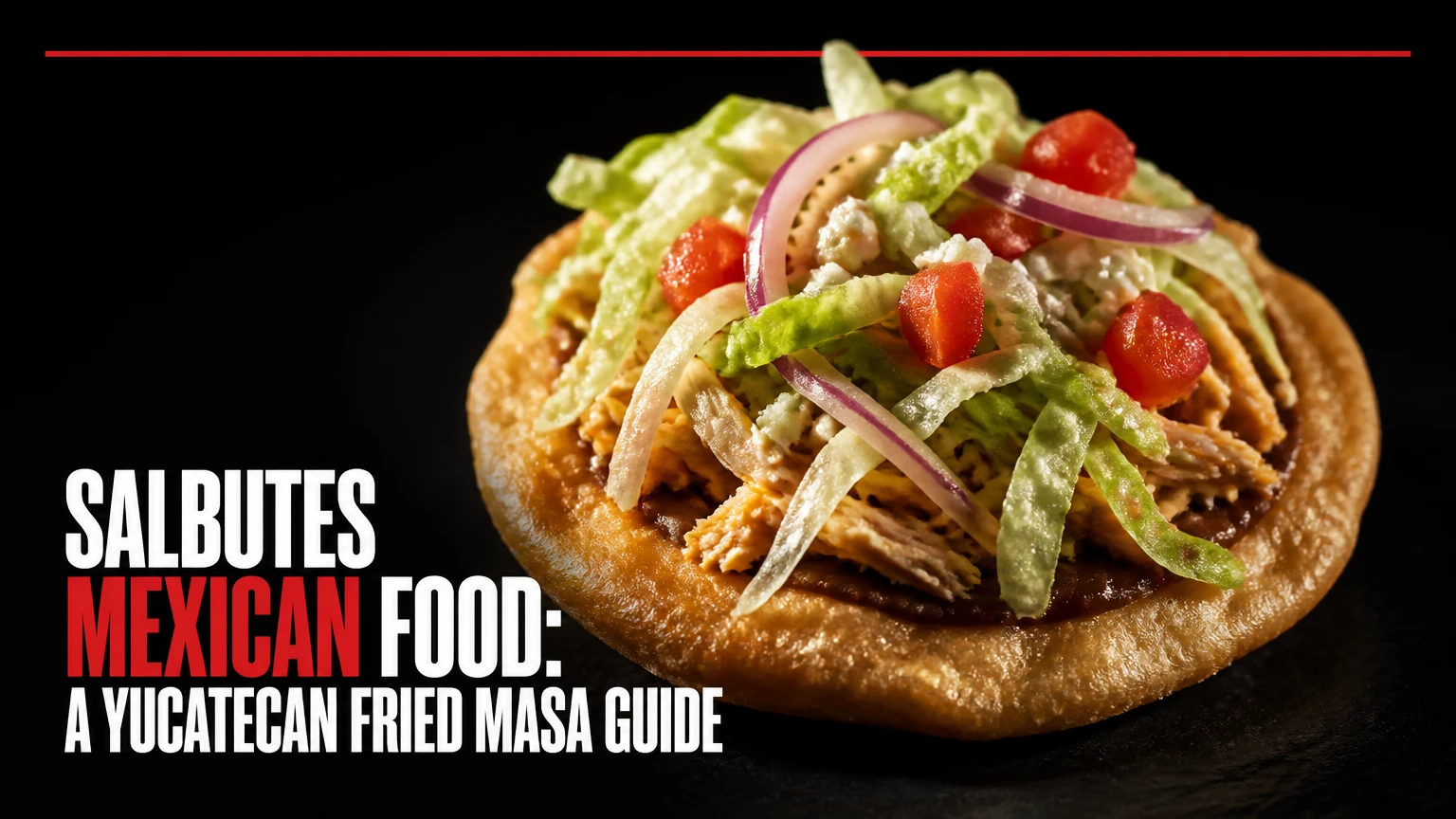
Salbutes are Yucatecan Mexican street food made from raw corn masa that puffs briefly in hot oil, creating a soft, airy, slightly chewy base. The warm masa disc is commonly topped with shredded turkey or chicken, lettuce, tomato, avocado, pickled red onions, and habanero salsa, then eaten immediately.
Key Facts About Salbutes Mexican Food
- Salbutes originated in the Yucatán Peninsula, especially the food traditions of Yucatán, Campeche, and Quintana Roo.
- A salbute uses raw, hydrated corn masa and is fried briefly so it puffs without becoming a hard tostada.
- Traditional toppings include shredded poultry, lettuce or cabbage, tomato, avocado, pickled red onion, and chile salsa.
- Salbutes are usually softer and thicker than tostadas, while panuchos contain a layer of refried black beans inside the tortilla.
- A practical home batch takes about 40-50 minutes when the protein and onions are prepared in advance.
- The most reliable frying range is typically 175-190°C, with the exact time determined by thickness, oil depth, and moisture.
What Are Salbutes?
Salbutes are lightly puffed, fried corn-masa bases from the Yucatán Peninsula. Cooks press raw masa into small discs, fry each disc for a short time, and finish it with seasoned meat, vegetables, pickled onions, and salsa. The result resembles a soft tostada, but its interior remains tender rather than brittle.
The Spanish name is commonly written salbut in the singular and salbutes in the plural. English-language menus often use “salbute” for one piece. Yucatecan cooks may serve them as a snack, breakfast, late-night food, or a small meal built around two or more pieces.
Salbutes are associated with Mérida and other Yucatecan communities, although versions appear across the peninsula. Their identity comes from the fresh fried masa and topping combination, not from one universally fixed meat or spice mixture.
Why Do Salbutes Puff?
A salbute puffs when water in the hydrated masa rapidly becomes steam inside a hot, flexible shell. The outer surface sets before all the moisture escapes, so pressure lifts part of the disc and creates a hollow or layered center.
Raw masa matters because it still contains enough moisture to generate steam. A fully cooked tortilla has already lost much of that expansion potential, which is why frying a regular tortilla produces a tostada rather than a classic salbute.
Flour appears in some home and commercial recipes, and small amounts can alter elasticity and browning. It is not a universal requirement, however. Traditional formulas vary by cook, town, available masa, and desired thickness. A well-hydrated corn masa can puff without wheat flour.
What Does a Salbute Taste Like?
A salbute tastes of fresh corn, hot frying fat, seasoned poultry, sharp pickled onion, creamy avocado, and bright chile salsa. Its base is softer and more yielding than a tostada, with a lightly crisp surface that gives way to a tender center.
The toppings create most of the contrast. Pickled red onions contribute acidity, lettuce adds cool crunch, tomato brings moisture, and habanero salsa supplies intense heat. Turkey gives a deeper, more traditional flavor, while chicken is milder and easier to prepare.
Salbutes are designed for immediate service. As the topping juices soak into the masa, the base becomes softer and eventually difficult to hold. That short serving window is part of the dish’s appeal, but it makes salbutes a poor candidate for long buffet service.
How Are Salbutes Made at Home?
Home cooks can make salbutes in about 45 minutes by preparing the toppings first, mixing hydrated masa, pressing small discs, and frying each one at approximately 175-190°C. Oil temperature and masa hydration determine success more reliably than the addition of flour or a fixed frying time.
Ingredients and Equipment
The following quantities make approximately 12 small salbutes, enough for four moderate servings.
| Component | Quantity | Typical preparation time | Practical detail |
|---|---|---|---|
| Instant corn masa flour | 2 cups, about 240 g | 5 minutes | Use nixtamalized masa harina |
| Warm water | 1 1/2-1 3/4 cups | 3 minutes | Add gradually until soft and pliable |
| All-purpose flour, optional | 2 tablespoons | 1 minute | Use only if your chosen recipe calls for it |
| Salt | 1 teaspoon | 1 minute | Mix into the dry ingredients |
| Frying oil or lard | 1-1 1/2 liters | 10 minutes to heat | Use a deep, stable pan |
| Cooked shredded chicken or turkey | 500 g | 20-30 minutes | Thigh meat stays moister than breast |
| Lettuce or cabbage | 3 cups shredded | 5 minutes | Dry thoroughly before assembly |
| Pickled red onions | 1 cup | 20 minutes | Prepare while the protein cooks |
You also need a tortilla press, two plastic sheets, a thermometer, a slotted spatula, a draining rack or paper towels, and a wide pan. A thermometer is more useful than judging oil readiness by a tiny piece of dough.
Step 1: Prepare the Masa
Combine the masa harina and salt. Add warm water gradually while mixing, then knead for 2-3 minutes. The finished dough should feel like soft modeling clay and should not crack when you press its edge.
Rest the dough for 10 minutes under a damp towel. This allows the masa particles to hydrate evenly. If the surface cracks, add water one teaspoon at a time. If the dough feels sticky, knead in a small amount of masa harina rather than a large quantity of flour.
Success checkpoint: A pressed test disc has a smooth edge and lifts from the plastic without tearing.
Common mistake: Dry masa produces dense, flat salbutes because the dough lacks enough moisture for steam expansion.
Step 2: Press Thin Discs
Divide the dough into 12 portions of approximately 35-40 g each. Roll each portion into a ball, place it between plastic sheets, and press it into a disc about 2.5-3.5 mm thick.
Slightly thicker discs hold wet toppings better, while thinner discs puff more easily but can tear. Keep the pressed pieces covered so their surfaces do not dry before frying.
Success checkpoint: Each disc has an even thickness and a diameter of approximately 10-12 cm.
Common mistake: Uneven edges create weak spots that split in the oil. Re-form and press any disc with visible cracks.
Step 3: Heat the Frying Fat
Heat enough oil to give each salbute room to float without touching the pan base. Aim for 175-185°C for the first test piece, then adjust according to color and puffing.
Some recipes specify approximately 190°C, but a home pan can lose heat rapidly when a cold disc enters. A slightly lower starting point gives the cook more control and reduces surface scorching. Lard adds savory depth; neutral vegetable oil gives a cleaner flavor.
Success checkpoint: The test salbute begins to bubble immediately and turns pale golden without darkening.
Common mistake: Oil below 170°C encourages absorption and heaviness. Oil above 190°C can color the outside before the center cooks.
Step 4: Fry Each Masa Disc
Lower one raw disc into the oil. Spoon hot oil over its surface for several seconds, then turn it with a slotted spatula. Total frying commonly takes 20-40 seconds at home, although a thin disc in fully recovered oil can finish sooner.
The frequently cited 5-15 second window is possible in very hot, shallow commercial frying, but it is too narrow as a universal home instruction. Thickness, oil volume, pan shape, and starting temperature change the result.
Success checkpoint: The salbute is lightly puffed, flexible when lifted, and pale cream to light golden.
Common mistake: Leaving the disc in the oil until it becomes rigid creates a tostada-like shell instead of a salbute.
Step 5: Drain and Shape
Remove the fried disc immediately and drain it vertically or on a rack. If the center has puffed into a large bubble, gently press the middle while the base remains warm to create a shallow well for toppings.
Do not compress the entire surface. The soft interior is the texture that separates a salbute from a crisp tortilla chip.
Success checkpoint: The base bends slightly without cracking and supports a tablespoon of filling.
Common mistake: Stacking hot salbutes tightly traps steam and makes the lower pieces wet. Drain them in a single layer.
Step 6: Assemble and Serve
Build each salbute close to service time. A practical order is lettuce or cabbage, shredded poultry, tomato, avocado, pickled red onion, and salsa on the side.
Traditional households do not all use the same order, and some add salsa before the protein. The important rule is moisture control: keep acidic liquids and salsa off the masa until the final minute.
Which Toppings Belong on Salbutes?
The most recognizable salbute toppings are shredded poultry, lettuce, tomato, avocado, pickled red onions, and chile salsa. Yucatecan variations may replace the poultry, add regional stews, or use cabbage in place of lettuce.
| Topping or filling | Typical quantity per salbute | Flavor contribution | Suitable preparation |
|---|---|---|---|
| Shredded chicken | 35-45 g | Mild, savory protein | Simmer with onion, garlic, and oregano |
| Shredded turkey | 35-45 g | Traditional, fuller poultry flavor | Cook in seasoned broth or recado |
| Lettuce or cabbage | 15-20 g | Freshness and crunch | Shred finely and dry well |
| Tomato | 15-25 g | Juicy acidity and sweetness | Use thin slices or small dice |
| Avocado | 20-30 g | Fatty, creamy contrast | Add immediately before serving |
| Pickled red onion | 10-15 g | Vinegar brightness and color | Drain before placing on masa |
| Habanero salsa | 1-2 teaspoons | Heat and roasted chile flavor | Serve separately for control |
The key condiment is cebollas encurtidas, or Yucatecan pickled red onions. A fast version uses thinly sliced red onion, citrus juice or vinegar, salt, and oregano. The onions become usable after about 20 minutes, although an overnight rest produces a more rounded flavor.
What Types of Salbutes Are Common?
Salbutes vary mainly by protein and regional stew, while the fried masa base remains similar. Turkey is historically associated with traditional Yucatecan preparations, but chicken is now common because it is inexpensive, accessible, and quick to shred.
| Style | Main filling | Regional or culinary association | Typical flavor profile |
|---|---|---|---|
| Salbutes de pavo | Shredded turkey | Yucatán home cooking | Brothy, aromatic, savory |
| Salbutes de pollo | Shredded chicken | Everyday restaurants and stalls | Mild, moist, lightly seasoned |
| Salbutes de cazón | Flaked dogfish | Coastal Campeche and peninsula towns | Briny, firm, herbaceous |
| Salbutes de pescado | Flaked local fish | Coastal markets | Light, savory, citrus-friendly |
| Salbutes de carne molida | Yucatecan ground-beef picadillo | Home and restaurant variations | Savory, spiced, occasionally sweet |
| Salbutes de relleno negro | Turkey or chicken in dark recado | Yucatecan festive cooking | Smoky, earthy, chile-rich |
Relleno negro requires particular care because the dark recado comes from heavily toasted chiles and spices. The color should be deep and nearly black, but burnt ingredients can create harsh bitterness. This style is better for cooks who already understand chile-toasting temperatures.
Vegetarian salbutes can use seasoned black beans, mushrooms, squash, or shredded jackfruit. Such versions are adaptations rather than the standard Yucatecan form, but they preserve the central contrast between fried masa, crisp vegetables, acidity, and chile.
Salbutes, Panuchos, or Tostadas: Which Is Different?
Salbutes are the softest option, panuchos contain a concealed bean layer, and tostadas are intentionally crisp throughout. Choose salbutes for a tender, freshly fried base, panuchos for black-bean flavor and a firmer bite, and tostadas when storage or maximum crunch matters.
| Feature | Salbute | Panucho | Tostada |
|---|---|---|---|
| Starting base | Raw hydrated masa disc | Cooked corn tortilla | Cooked corn tortilla |
| Internal filling | Usually none | Refried black beans | None |
| Frying result | Puffy, flexible, tender | Crisp exterior, soft bean center | Dry, flat, brittle |
| Typical thickness | 2.5-3.5 mm raw | 1.5-2.5 mm tortilla | 1-2 mm tortilla |
| Best serving time | Within 5-10 minutes | Within 10-20 minutes | Within 30 minutes or longer |
| Common toppings | Poultry, greens, onion, avocado | Turkey, chicken, pickled onion | Seafood, beans, cheese, lettuce |
| Main drawback | Soggies quickly | Requires stuffing and sealing | Breaks under wet toppings |
Are Salbutes the Same as Tostadas?
Salbutes are not the same as tostadas because salbutes remain soft and slightly inflated, whereas tostadas are dried or fried until rigid. A tostada is built for crunch and can tolerate more moisture before losing its structure; a salbute is built for immediate eating.
Are Salbutes the Same as Panuchos?
Salbutes differ from panuchos because panuchos receive a layer of refried black beans inside the tortilla. Panuchos are generally made from a cooked tortilla that is opened, filled, and fried again, while salbutes are fried directly from raw masa.
How Much Do Salbutes Cost?
A typical salbute in Mexico costs approximately 15-35 Mexican pesos per piece, while restaurants outside Mexico may charge about 4-7 US dollars per piece. Prices vary with city, protein, portion size, venue, and whether the dish is sold as street food or as a plated starter.
| Setting | Typical price per piece | Typical serving size | Main price driver |
|---|---|---|---|
| Yucatecan street stall | 15-25 MXN | 2-4 pieces | Chicken, turkey, or local demand |
| Casual restaurant in Mérida | 25-45 MXN | 2-3 pieces | Service and larger toppings |
| Coastal seafood restaurant | 30-60 MXN | 2-3 pieces | Cazón, fish, or seafood supply |
| United States restaurant | $4-$7 USD | 2-3 pieces | Labor, imported ingredients, rent |
| Home-cooked batch | $1.25-$2.50 USD each | 3 pieces | Protein and frying oil cost |
These are typical planning ranges, not a universal menu standard. Street prices can change significantly by neighborhood and season, while international prices often include labor and table service that do not apply to a market stall.
What Causes Salbutes to Fail?
Most salbute failures come from dry masa, weak oil heat, excessive thickness, or over-frying. The fastest diagnosis is to inspect the dough edge, measure the oil temperature, and test one disc before cooking the full batch.
| Problem | Likely cause | Corrective action | Expected result |
|---|---|---|---|
| Disc stays flat | Oil below 170°C or dry masa | Add water, heat oil to 175-185°C | Immediate bubbling and partial puff |
| Base turns hard | Frying longer than 45 seconds | Remove at pale golden color | Flexible, tender center |
| Salbute feels greasy | Crowded pan or low recovery heat | Fry one at a time, wait 20-30 seconds | Drier surface and lighter bite |
| Edge cracks before frying | Dough lacks hydration | Add water by teaspoons and knead | Smooth, sealed perimeter |
| Disc tears in oil | Uneven pressing or weak edge | Re-press to 2.5-3.5 mm | Intact base with even puff |
| Toppings slide off | Excess liquid or no center well | Drain onions and press a shallow well | More stable assembly |
A counterintuitive rule is that hotter oil does not always produce a better puff. Excessive heat sets the outer surface too quickly, while the center remains dense or the exterior darkens before the masa expands.
Another professional rule is to fry one test piece before seasoning the entire dough batch. The test reveals whether the discs are too thick, whether the masa needs more water, and whether the oil loses too much heat when the disc enters.
Can Salbutes Be Stored or Reheated?
Salbute bases can be held briefly, but assembled salbutes should be eaten immediately. Store cooled bases in a sealed container for up to one day, then rewarm them in a dry skillet or oven; do not microwave them with wet toppings.
For best texture, press the raw discs in advance and refrigerate them between plastic sheets for up to several hours. Keep them covered so the exposed masa does not form a dry skin. Fry only when service begins.
Freezing is possible but changes the texture. Separate raw discs with parchment, freeze them flat, and fry from thawed or partially thawed condition after checking for surface cracks. Frozen dough can require a longer frying time and may puff less evenly.
Salbutes are poor choices for packed lunches, long-distance transport, or large self-service buffets. Panuchos and tostadas tolerate holding better, especially when toppings are packed separately.
Can You Bake Salbutes Instead of Frying Them?
Baking does not reproduce the classic salbute because the masa surface receives slower, drier heat and usually loses moisture before it inflates. A hot oven can produce a cooked masa base, but the result is closer to a thick baked tortilla than a traditional salbute.
Air frying has the same limitation. It may brown a lightly oiled disc, but it rarely creates the soft, hollow texture produced by direct contact with hot oil. Use an air fryer only when reducing oil is more important than preserving traditional texture.
For a lower-oil alternative, cook the raw discs on a hot comal, then brush them lightly with oil and finish them briefly in a skillet. The base will be flexible and flavorful, but it should be described as a comal-cooked masa tostada rather than an authentic fried salbute.
What Should a Beginner Serve With Salbutes?
Beginners should serve salbutes with shredded chicken, pickled red onions, shredded lettuce, avocado, and a separate habanero salsa. This combination requires few specialized ingredients and makes the texture, acidity, richness, and heat easy to balance.
Prepare the protein and onions first. Fry the masa last, then assemble in under five minutes. Keep salsa, tomato juices, and drained onion liquid away from the bases until the final moment.
A complete meal can include a light broth, citrus-dressed cabbage, or a simple bean side. Heavy, wet sides can make the meal feel greasy because the salbute already contributes fried masa and rich toppings.
Frequently Asked Questions
Are salbutes gluten-free?
Salbutes made only with nixtamalized corn masa, salt, water, and gluten-free frying fat are naturally gluten-free. Some recipes add wheat flour, which changes that status. Check the masa harina label, shared fryer practices, and prepared seasonings when cooking for someone with celiac disease.
What meat is traditional in salbutes?
Turkey is the most traditionally associated meat in Yucatecan salbutes, especially when simmered in a seasoned broth or regional recado. Chicken is now more common in everyday cooking because it costs less and cooks faster. Fish and dogfish versions occur in coastal communities.
How many salbutes make a meal?
Two to three medium salbutes generally make a light meal, while four may suit a larger appetite. A typical piece contains about 35-45 g of shredded protein, so serving size depends on the meat quantity, toppings, and side dishes.
What salsa goes with salbutes?
Roasted habanero salsa is a classic pairing because its heat cuts through fried masa and rich poultry. Mild tomato-based chile sauces work for guests who prefer less heat. Serve salsa separately because liquid softens the salbute within minutes.
Why are my salbutes greasy?
Greasy salbutes usually indicate oil below approximately 170°C, an overcrowded pan, or insufficient draining. Fry one disc at a time, allow the oil to recover for 20-30 seconds, and drain each piece vertically or on a rack instead of stacking it.
Where can you find salbutes in Mexico?
Salbutes are especially associated with the Yucatán Peninsula, including Mérida and towns across Yucatán, Campeche, and Quintana Roo. Look for them at evening antojito stalls, local markets, fondas, and restaurants specializing in Yucatecan cooking.
The Bottom Line
Salbutes Mexican food is a Yucatecan specialty built around raw corn masa fried into a soft, lightly puffed disc. Turkey or chicken, pickled red onion, greens, avocado, tomato, and habanero salsa provide the traditional balance. For the best result, hydrate the masa well, fry one disc at a time, and serve each salbute within minutes.