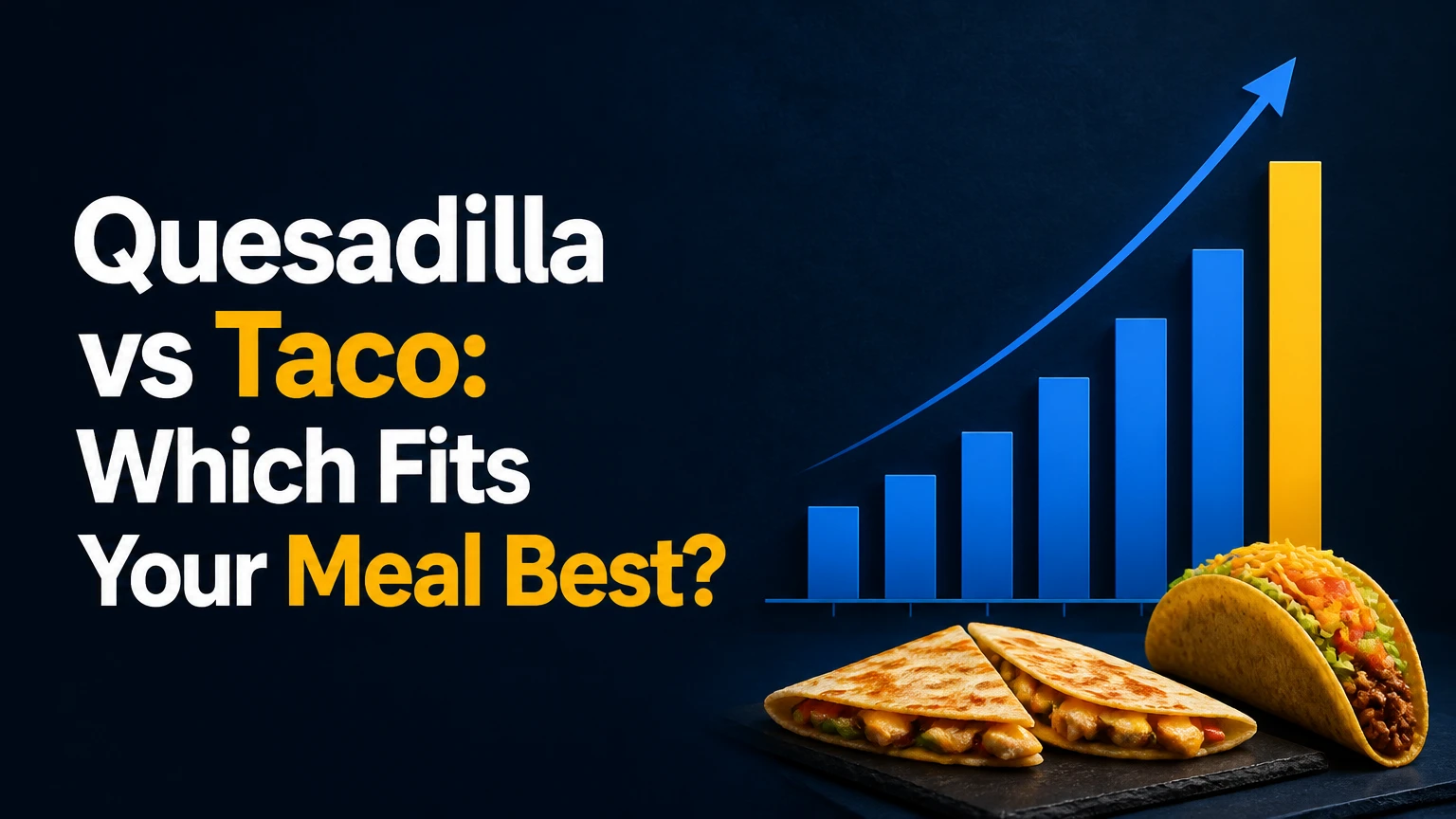
A taco is a tortilla folded around a filling, while a quesadilla is a tortilla cooked with cheese and fillings until the interior binds together. Choose tacos for variety, fresh garnishes, and easier portion control; choose quesadillas for a hotter, denser, more portable meal that holds together during transport.
Key Facts at a Glance
Tacos usually use 10-15 cm corn tortillas, while restaurant quesadillas commonly use 20-30 cm flour tortillas.
Melted cheese gives a quesadilla internal cohesion; a taco depends on tortilla flexibility and careful filling placement.
A typical taco contains about 150-300 calories, while a full cheese quesadilla commonly contains 500-1,000 calories.
Tacos usually take 1-3 minutes to assemble after fillings are ready; quesadillas generally take 4-7 minutes to melt and brown.
Corn tortillas are naturally gluten-free when made without cross-contact; flour tortillas contain wheat gluten.
Neither dish is automatically more traditional: preparation, ingredients, region, and restaurant style determine that.
What Is the Difference Between a Quesadilla and a Taco?
The defining difference is structural. A taco presents a filling inside a soft or crisp tortilla that remains open along one edge, whereas a quesadilla cooks a tortilla and cheese together so the cheese helps join the two sides or binds the filling inside one folded layer.
Tacos are designed around contrast. A warm filling may meet raw onion, cilantro, acidic salsa, lime, cabbage, or radish at the moment of eating. Quesadillas concentrate heat, fat, and texture inside a browned tortilla, so the cheese and cooking surface influence the result more heavily.
The Spanish word quesadilla is associated with queso, or cheese, but Mexican usage is regional rather than uniform. In parts of Mexico City, a quesadilla can be ordered with or without cheese, a point documented in discussions of Mexican food terminology by Mexico News Daily and culinary reference sources. Outside that context, most diners expect cheese.
Structural Comparison
| Attribute | Taco | Quesadilla |
|---|---|---|
| Basic shape | Folded half-moon or open vessel | Folded half-moon or two-layer round |
| Binding force | Tortilla flexibility and filling balance | Melted cheese plus tortilla contact |
| Typical tortilla | 10-15 cm corn | 20-30 cm flour or corn |
| Main texture | Soft, crisp, or lightly griddled | Crisp exterior with melted interior |
| Best serving window | Immediate, within 5-10 minutes | Immediate, within 10-15 minutes |
| Common garnish | Onion, cilantro, salsa, lime | Salsa, crema, avocado, pickled vegetables |
A taco is easier to customize one at a time. A quesadilla is easier to transport as a single portion. Those opposing strengths explain why menus often place both dishes beside each other even when they use similar chicken, beef, vegetables, or salsa.
How Are Tacos and Quesadillas Built?
Tacos use a vessel-first design: warm the tortilla, add a controlled amount of filling, then finish with toppings. Quesadillas use a bonding-first design: distribute cheese across the tortilla, add relatively dry fillings, fold or cover, and cook until the cheese melts without burning the exterior.
Taco Construction
A street-style taco commonly uses one or two warmed corn tortillas. The filling goes near the center rather than against the edge, because excess liquid and weight make the tortilla tear. A practical starting quantity is 45-75 grams of cooked filling per taco, followed by 1-2 tablespoons of toppings.
Taco quality depends on moisture control. A spoonful of thick stew can work, but watery sauce should be drained briefly before assembly. Salsa belongs on the taco immediately before eating, not 20 minutes earlier, because acid and water weaken the tortilla.
Quesadilla Construction
A folded quesadilla works best when cheese covers most of the tortilla but stops about 1-2 cm from the edge. Use roughly 60-100 grams of shredded cheese for a 25 cm flour tortilla, then add 60-100 grams of cooked filling. Excess volume prevents even contact and causes cheese to escape into the pan.
Medium or medium-low heat is more reliable than high heat. The tortilla needs time to brown while the center reaches a fluid, cohesive texture. A lid can shorten melting time, but trapped steam may soften the exterior, so uncover the pan for the final 30-60 seconds.
How Do Price, Calories, Size, and Time Compare?
Typical restaurant tacos cost less per unit and contain fewer calories, but a full meal may require two to four tacos. A quesadilla costs more as a single menu item and usually delivers more grams of food, cheese, and tortilla in one portion.
The figures below are practical ranges, not universal nutrition labels. Restaurant recipes vary substantially with tortilla diameter, oil, cheese quantity, protein, and garnish.
| Measure | Taco, typical | Quesadilla, typical | Main variable |
|---|---|---|---|
| Tortilla diameter | 10-15 cm | 20-30 cm | Corn or flour format |
| Finished weight | 60-110 g | 220-450 g | Cheese and filling load |
| Calories per item | 150-300 kcal | 500-1,000 kcal | Oil, cheese, tortilla size |
| Assembly or cooking time | 1-3 minutes | 4-7 minutes | Whether fillings are pre-cooked |
| Street or food-truck price | $2.50-$5 | $7-$14 | City and protein |
| Casual restaurant price | $3.50-$8 | $10-$18 | Portion and side dishes |
A large quesadilla can equal the calories of two to four tacos, but the comparison changes when a taco order includes several tortillas, rich meat, cheese, or creamy toppings. The correct unit for diet decisions is the complete meal, not the menu label.
Which Is More Filling?
A quesadilla is usually more filling per menu item because it combines a large tortilla with cheese and a concentrated filling. Tacos can match or exceed that satiety when ordered in multiples and paired with beans, grilled vegetables, or a high-protein filling.
| Meal configuration | Typical portions | Approximate energy | Satiety factors |
|---|---|---|---|
| Two chicken tacos | 2 tortillas, 90-140 g filling | 350-650 kcal | Protein, salsa, moderate tortilla |
| Three beef tacos | 3 tortillas, 135-225 g filling | 550-950 kcal | Protein, fat, multiple garnishes |
| Cheese quesadilla | 1 tortilla, 80-120 g cheese | 500-850 kcal | Fat, starch, melted cheese |
| Chicken quesadilla | 1 tortilla, 60-100 g chicken, 60-100 g cheese | 650-1,000 kcal | Protein, cheese, large tortilla |
| Vegetable quesadilla | 1 tortilla, 60-100 g cheese, 100-160 g vegetables | 500-850 kcal | Fiber, starch, fat |
For a lower-calorie order, two corn-tortilla tacos with grilled chicken or fish, salsa, onion, and cilantro are usually easier to manage than a large flour quesadilla. For a physically demanding day, the quesadilla’s concentrated carbohydrate and fat can be useful, although it is less suitable for anyone who wants a light meal.
Which Styles Will You See on Menus?
Taco categories often describe the cooking method or filling, while quesadilla categories describe the tortilla format, cheese arrangement, or regional convention. Menu names are not perfectly standardized, so the ingredient line matters more than the category alone.
| Style | Tortilla or format | Typical filling | Usual finish |
|---|---|---|---|
| Tacos de asador | Small corn tortillas | Grilled beef or chicken | Onion, cilantro, salsa |
| Tacos de guisado | Thick or soft corn tortillas | Braised chicken, vegetables, bean stew | Stew sauce and fresh garnish |
| Tacos al pastor | Small corn tortillas | Chile-marinated spit-cooked meat | Onion, cilantro, pineapple |
| Baja fish tacos | Corn tortillas | Battered or grilled white fish | Cabbage, crema, lime |
| Shrimp tacos | Corn or flour tortillas | Grilled or sautéed shrimp | Cabbage, salsa, avocado |
| Tex-Mex hard-shell taco | Fried U-shaped corn shell | Seasoned ground beef, chicken, or beans | Lettuce, tomato, cheese |
| Mexican corn quesadilla | Corn masa or corn tortilla | Cheese, squash blossom, mushroom, or epazote | Griddled or fried |
| Flour quesadilla | Large flour tortilla | Cheese, chicken, beef, or vegetables | Folded and sliced |
| Sincronizada | Two flour tortillas | Ham-style sliced meat and cheese | Flat toasted sandwich |
| Gringa | Flour tortillas | Al pastor-style meat and cheese | Griddled and cut |
Is a Mexican Quesadilla Always Made With Cheese?
A Mexican quesadilla is not defined identically in every region. In much of Mexico, cheese is expected, but in Mexico City, diners may need to specify whether they want cheese, an ordering convention that differs from the cheese-centered American restaurant version.
Traditional Mexican quesadillas can use fresh corn masa pressed around fillings such as squash blossoms, mushrooms, huitlacoche, or epazote. They may be cooked on a comal or fried, and the result can be very different from a large flour tortilla filled with shredded cheese.
The word “authentic” therefore needs a location attached to it. A flour quesadilla with Monterey Jack may be conventional in a United States Tex-Mex restaurant, while a corn-masa quesadilla with squash blossom is a more regionally specific Mexican preparation.
How Do You Cook Each One at Home?
Tacos require about 10-15 minutes when the filling is already cooked, while quesadillas require about 8-12 minutes for assembly and pan cooking. The main success factor for tacos is tortilla flexibility; for quesadillas, it is moderate heat combined with dry fillings.
A Reliable Taco Method
- Warm the tortillas. Heat corn tortillas on a dry skillet for 20-30 seconds per side, or wrap them in a damp towel and heat them until pliable.
- Prepare the filling. Use 45-75 grams of cooked meat, beans, mushrooms, or vegetables per taco. Drain excess liquid.
- Build the base. Place the filling in the center of one tortilla, or use two tortillas for a wet or heavy filling.
- Add fresh elements. Use 1-2 tablespoons of onion, cilantro, cabbage, salsa, or another garnish.
- Finish at the table. Add lime immediately before eating so the acid stays bright and does not soften the tortilla in advance.
You will know the taco is ready when the tortilla bends without cracking and the filling remains centered after one gentle fold. The common mistake is adding too much sauce before serving.
A Reliable Quesadilla Method
- Heat the pan. Set a skillet to medium-low or medium, approximately 160-175°C if measured with an infrared thermometer.
- Add the tortilla. Use one 20-30 cm tortilla for a folded quesadilla.
- Distribute cheese. Spread 60-100 grams across most of the surface, leaving 1-2 cm clear at the edge.
- Add dry filling. Place 60-100 grams of cooked chicken, beef, mushrooms, peppers, or beans over one half.
- Fold and cook. Fold the tortilla and cook for 2-3 minutes per side.
- Rest and slice. Wait 30-60 seconds before cutting into wedges so the melted center firms slightly.
You will know the quesadilla is ready when both surfaces are golden and the cheese pulls together the filling without leaking heavily. The common mistake is using high heat, which browns the tortilla before the center melts.
Which Dish Is Better for Nutrition and Dietary Restrictions?
Tacos usually offer easier portion control and more vegetable-based customization, while quesadillas provide more concentrated energy and often more saturated fat from cheese. Ingredient selection matters more than the dish name.
For gluten-free eating, choose verified corn tortillas and confirm that the kitchen avoids shared griddles, fryers, and flour dust. Corn itself contains no gluten, but restaurant cross-contact can make a nominally corn-based taco unsuitable for someone with celiac disease.
For dairy-free eating, order tacos without cheese, crema, or queso-based sauces. A standard quesadilla requires a dairy-free cheese alternative or a different format, because removing the binding cheese changes the dish’s structure.
| Dietary goal | More practical choice | Specific order | Modification |
|---|---|---|---|
| Lower calories | Tacos | Two corn tacos with grilled chicken | Skip cheese and crema |
| Higher protein | Either | Three chicken tacos or chicken quesadilla | Request 90-120 g cooked protein |
| Gluten-free | Corn-tortilla tacos | Fish, chicken, beef, or beans | Confirm cross-contact controls |
| Dairy-free | Tacos | Salsa, onion, cilantro, lime | Remove cheese and crema |
| Vegetarian | Either | Bean and vegetable tacos or mushroom quesadilla | Check broth and cooking fat |
| More fiber | Tacos | Bean tacos with cabbage and salsa | Add beans or vegetables |
| Child-friendly portability | Quesadilla | Mild cheese and chicken filling | Cut into small wedges |
A quesadilla is not automatically unhealthy, and a taco is not automatically light. Fried shells, oily fillings, large portions, and creamy toppings can reverse the expected comparison.
Why Do Tacos and Quesadillas Fail?
Tacos fail when the tortilla is cold, overloaded, or exposed to watery filling for too long. Quesadillas fail when the pan is too hot, the filling is wet, or the cheese quantity is large enough to escape before the tortilla browns.
| Problem | Likely cause | Immediate fix | Prevention |
|---|---|---|---|
| Corn tortilla cracks | Tortilla below serving temperature | Reheat and replace | Keep tortillas wrapped |
| Taco becomes soggy | Watery salsa or stew | Drain and rebuild | Add salsa at serving |
| Quesadilla leaks | Cheese or filling reaches edge | Reduce filling and reseal | Leave 1-2 cm border |
| Exterior burns | Pan above medium heat | Lower heat and cover briefly | Cook 2-3 minutes per side |
| Center stays cold | Thick, cold filling | Chop and preheat filling | Use room-temperature cooked food |
| Quesadilla turns greasy | Excess oil or cheese | Rest on a rack or paper | Use 1 teaspoon oil or less |
| Taco falls apart | Filling placed too close to fold | Rebalance the center | Use 45-75 g filling |
A counterintuitive kitchen rule is that a little less cheese often produces a better quesadilla. Cheese must melt into a thin adhesive layer; a thick layer releases fat and insulates the center, creating a greasy exterior with unevenly heated filling.
Another practical rule is to treat salsa as a finishing ingredient rather than a cooking ingredient for tacos. The same salsa that improves a fresh taco can destroy its structure after 10-15 minutes.
Can You Reheat Them?
Tacos reheat best when tortillas and fillings are warmed separately, while quesadillas reheat best in a skillet, toaster oven, or air fryer that restores surface crispness. Microwaves heat cheese quickly but soften tortillas and can produce unevenly hot fillings.
For tacos, reheat the filling to 74°C when using leftovers, then warm fresh tortillas separately. For quesadillas, use a skillet over medium-low heat for 2-3 minutes per side or an air fryer at approximately 175°C for 3-5 minutes, checking the center.
Do not leave either dish at room temperature for extended periods. The United States Department of Agriculture recommends refrigerating perishable leftovers within two hours, or within one hour when ambient temperatures exceed 32°C.
What Similar Dishes Are Not the Same?
A taco is not a burrito, tostada, enchilada, or sincronizada simply because the dishes share tortillas and fillings. Shape, cooking method, and sauce treatment distinguish these related foods.
| Dish | Tortilla arrangement | Sauce treatment | Typical eating format |
|---|---|---|---|
| Taco | Folded around filling | Added at serving | Handheld |
| Quesadilla | Folded or layered with cheese | Usually served alongside | Handheld wedges |
| Burrito | Fully rolled and enclosed | Usually dry outside | Handheld cylinder |
| Tostada | Flat and fried | Toppings layered on top | Handheld or plated |
| Enchilada | Rolled tortilla | Covered with chile sauce | Fork and plate |
| Sincronizada | Two tortillas with filling between | Usually no poured sauce | Sliced sandwich |
The closest practical alternative to a quesadilla is a sincronizada, especially when two tortillas are toasted around cheese and a sliced filling. The closest alternative to a taco is a tostada, but the flat fried base changes the texture, toppings, and handling.
Which Should You Choose?
Choose tacos for variety, fresh toppings, portion control, and regional exploration. Choose a quesadilla for a compact meal, melted cheese, longer heat retention, or a cleaner handheld format during a commute.
| Diner or situation | Recommended choice | Order specification | Reason |
|---|---|---|---|
| Calorie-conscious diner | Two corn tacos | Grilled chicken, salsa, no crema | Smaller adjustable portions |
| Culinary explorer | Mixed tacos | Four fillings, one taco each | Wider flavor comparison |
| Commuter | Folded quesadilla | Dry chicken and cheese, wrapped after resting | Fewer loose toppings |
| Comfort-food seeker | Flour quesadilla | Cheese, chicken, peppers, salsa | Dense, hot, rich texture |
| Dairy-free diner | Corn tacos | Beans, fish, or vegetables without crema | No structural dependence on cheese |
| Gluten-free diner | Verified corn tacos | Separate preparation surface | Avoids wheat tortilla |
| Family sharing a meal | Both | Mild quesadilla plus individual tacos | Different textures and portion sizes |
Choose Tacos for Variety and Freshness
Tacos are the better choice when you want to compare fillings or control each portion separately. An order containing one grilled beef taco, one fish taco, and one bean taco gives more sensory range than a single quesadilla with one dominant cheese profile.
Tacos also handle fresh garnishes better. Onion, cilantro, cabbage, lime, and salsa remain distinct because they are added after cooking rather than steamed inside the tortilla.
Tacos are not ideal for long transport when heavily sauced. For delivery, request salsa separately and keep the tortillas warm but ventilated so condensation does not soften them.
Choose Quesadillas for Portability and Heat
Quesadillas are the better choice when containment matters more than ingredient contrast. The folded tortilla keeps most fillings inside, and melted cheese helps the portion remain cohesive while walking, commuting, or serving children.
Quesadillas are less effective for delicate fillings that need freshness, such as crisp herbs or finely dressed cabbage. Heat and cheese can overwhelm those ingredients, especially when the quesadilla is thick.
A quesadilla also has a narrower quality window. It is best within 10-15 minutes, while a taco can be rebuilt from separately stored tortillas, filling, and salsa.
FAQ
Are quesadillas healthier than tacos?
Tacos are usually lighter per unit, but a complete taco meal can exceed a small quesadilla when the order contains several rich fillings. Corn tortillas, lean protein, beans, vegetables, salsa, and limited cheese create the most favorable balance. Compare the entire portion rather than the dish label.
Do tacos or quesadillas contain more protein?
A quesadilla can contain more protein when it includes 60-100 grams of chicken, beef, or beans in addition to cheese. Three tacos may provide equal or greater protein because their total filling weight is higher. Ask for the protein quantity when nutrition precision matters.
Can a quesadilla be made without cheese?
A cheese-free folded tortilla can be cooked with vegetables, beans, or meat, but it will not bind in the same way because melted cheese provides the adhesive structure. Use a smaller filling quantity, press the fold during cooking, and describe the result as a filled griddled tortilla.
Are hard-shell tacos healthier than soft tacos?
Hard-shell tacos are not automatically healthier. Frying adds fat and calories, while a soft corn tortilla generally offers a simpler, less brittle base. The filling, cheese, sour cream, portion size, and cooking fat determine the meal’s nutrition more than shell shape.
Which stays crisp longer?
A quesadilla usually keeps its exterior crisp longer than a taco if it is vented after cooking, but steam eventually softens both dishes. Tacos stay more appealing when tortillas, fillings, and salsa remain separate until serving. Quesadillas should rest on a rack rather than a sealed plate.
What is the simplest choice for a first visit to a Mexican restaurant?
Choose tacos when you want to understand the restaurant’s fillings, salsas, and regional style. Choose a quesadilla when you prefer a familiar, mild, cheese-centered meal. Ordering one of each is useful when the menu lists unfamiliar fillings but provides no detailed descriptions.
The Bottom Line
The best answer to quesadilla vs taco depends on the meal’s job. Tacos win for variety, fresh garnishes, adjustable portions, and regional comparison; quesadillas win for portability, heat retention, cohesion, and a rich cheese-centered texture. Choose the tortilla, filling, cooking method, and toppings together, because those details determine the result more than the dish name alone.