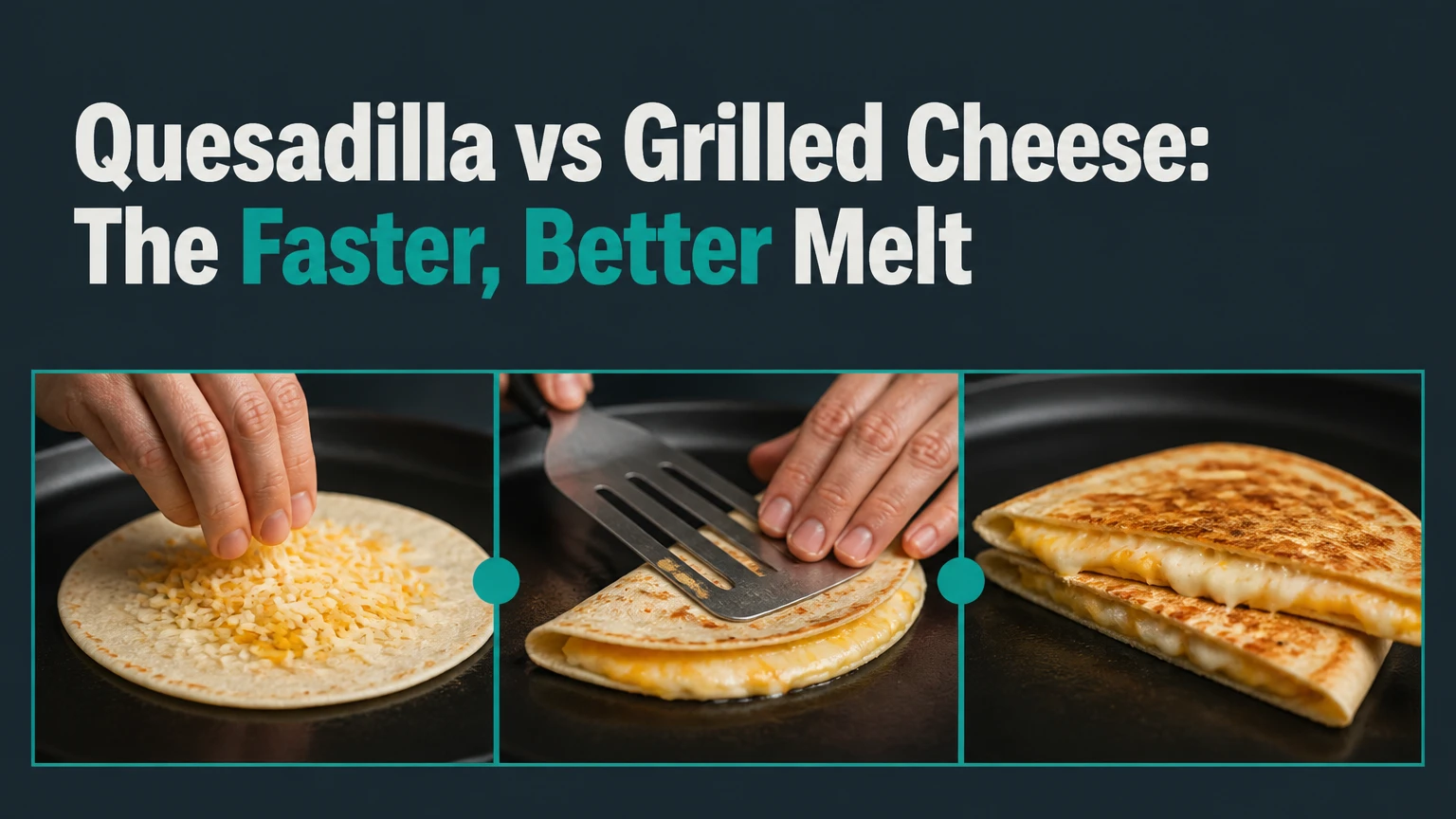
A quesadilla usually wins for speed, filling capacity, and crispness, while grilled cheese wins for buttery bread texture and soup dipping. A quesadilla uses a folded corn or flour tortilla around melted cheese; grilled cheese uses sliced bread, exterior fat, and cheese cooked between the slices. The better choice depends on texture, fillings, and serving context.
Key Facts at a Glance
A quesadilla uses a tortilla shell, while grilled cheese uses two slices of bread.
A cheese-only quesadilla typically cooks in 4-6 minutes; grilled cheese usually takes 6-10 minutes over medium-low heat.
Quesadillas tolerate cooked chicken, beans, vegetables, and salsa better than grilled cheese.
Grilled cheese provides thicker, richer browning because butter or mayonnaise fries the porous bread surface.
Neither food is automatically healthier; tortilla size, bread type, cheese quantity, and fillings determine the result.
A low, steady cooking temperature melts the center before either exterior burns.
What Separates a Quesadilla From Grilled Cheese?
A quesadilla is a tortilla-based filled preparation, and grilled cheese is a bread-based cheese sandwich. The quesadilla’s defining structure is a tortilla folded around cheese, although two tortillas can also be used; grilled cheese requires separate bread slices enclosing cheese and is browned with fat on the outside.
The distinction is structural rather than simply geographic. Both foods combine a starch exterior with a meltable cheese interior, but the starch changes the eating experience. A thin tortilla creates a compact, crackly shell. Bread contains more air and absorbs more fat, creating a thicker crust with a softer crumb.
The word quesadilla is associated with Mexican cuisine, where versions may use corn or flour tortillas and regional cheeses. The modern American grilled cheese developed from earlier open-faced cheese toast preparations, commonly called cheese dreams in accounts of early 20th-century American cooking. The exact origin story is less tidy than a single invention date.
Is a grilled cheese sandwich a quesadilla?
A grilled cheese sandwich is not normally classified as a quesadilla because bread slices and tortillas belong to different culinary formats. The foods share a cooking principle, melted cheese enclosed by a browned starch, but classification depends on the wrapper, preparation tradition, and typical accompaniments.
A tortilla folded around cheese remains a quesadilla even when it includes chicken or vegetables. A bread sandwich with Tex-Mex seasoning remains grilled cheese unless the bread is replaced with tortillas. Borderline creations can be delicious without needing a strict label.
Quesadilla vs Grilled Cheese: Which Features Matter Most?
The most important differences are wrapper, browning method, filling capacity, moisture tolerance, and serving style. Quesadillas favor thin, crisp, adaptable meals, whereas grilled cheese favors buttery crust, soft interior bread, and dipping.
| Criterion | Quesadilla | Grilled cheese |
|---|---|---|
| Main wrapper | 8-10 inch corn or flour tortilla | 2 slices, 25-35 g each |
| Typical cheese amount | 45-75 g shredded cheese | 40-60 g sliced or shredded cheese |
| Typical cook time | 4-6 minutes | 6-10 minutes |
| Exterior fat | 0-5 g, often dry-cooked | 5-14 g butter or mayonnaise |
| Best added filling | 60-120 g cooked chicken or vegetables | 15-40 g onion, tomato, or apple |
| Best accompaniment | Salsa, pico de gallo, beans | Tomato soup, pickle, salad |
| Main texture | Crisp tortilla with stretchy center | Fried crust with tender crumb |
| Main failure risk | Soggy filling or broken fold | Burned bread and unmelted cheese |
Which cooks faster?
A cheese quesadilla generally cooks faster, usually 4-6 minutes, because the tortilla is thin and the cheese layer is exposed to heat across a broad surface. Grilled cheese commonly needs 6-10 minutes because the bread insulates the cheese and must brown gradually without scorching.
Thickness changes the result more than the food’s name. A large, heavily filled quesadilla can take longer than a thin grilled cheese, especially when refrigerated chicken or dense vegetables are added. For either preparation, a preheated pan and room-temperature cheese reduce the time required to melt the center.
Which has the stronger structure?
A folded quesadilla usually contains fillings more effectively, provided the fillings are dry and limited to one thin layer. Grilled cheese has stronger bread-to-bread cohesion but offers less protection against slippery fillings, so wet tomatoes or loose vegetables can force the sandwich apart.
The folded edge gives the quesadilla a useful mechanical advantage. Cheese seals portions of the tortilla as it melts, while the fold acts as a hinge. That design makes a quesadilla practical for sliced chicken, refried beans, roasted peppers, or leftover vegetables.
How Do Cooking Mechanics Change the Result?
Quesadillas brown through direct contact with a hot pan and lose moisture quickly, while grilled cheese browns through fat absorbed into bread pores. In both foods, the cook must balance surface browning against the slower movement of heat toward the cheese center.
Cheese does not melt at one universal temperature. Many semihard cheeses soften within roughly 55-65°C, or 130-150°F, but the exact behavior depends on moisture, fat, acidity, age, and emulsifying salts. American cheese melts smoothly because its formulation helps keep fat and water together; aged cheddar can become oily or grainy when overheated.
The Maillard reaction creates browned flavor on bread and tortillas, but browning is not the same as melting. A dark exterior can appear while the center remains cool. Medium-low heat for grilled cheese and medium heat for a thin quesadilla give the interior more time to warm before the starch surface becomes bitter.
What changes the cheese melt?
Cheese choice, shred size, starting temperature, and moisture determine melt quality. Finely shredded Monterey Jack melts quickly in a quesadilla, while American cheese melts most predictably in grilled cheese because emulsifying salts limit oil separation.
| Cheese | Typical melt behavior | Best use | Main limitation |
|---|---|---|---|
| Oaxaca | Elastic, smooth, stringy | Corn or flour quesadilla | Can be difficult to find |
| Monterey Jack | Fast, creamy, mild | Filled quesadilla | Mild flavor needs seasoning |
| Low-moisture mozzarella | Stretchy, moderate speed | Quesadilla or sandwich blend | Limited browning flavor |
| American | Very smooth, fast | Classic grilled cheese | Mild, processed flavor |
| Young cheddar | Flavorful, fairly smooth | Grilled cheese blend | Can release oil when overheated |
| Gruyère | Smooth, nutty, moderate speed | Artisan grilled cheese | Higher typical cost |
| Pepper Jack | Creamy with chili flavor | Spiced quesadilla | Heat level varies by brand |
| Vegan melt-style slices | Formulation-dependent | Dairy-free versions | Texture differs substantially |
A practical rule is to pair a flavorful cheese with a reliable melting cheese. Sharp cheddar plus Monterey Jack supplies more flavor and smoother texture than sharp cheddar alone. For a quesadilla, Oaxaca and Chihuahua cheeses are traditional options where available, while Monterey Jack is a dependable supermarket substitute.
How Should You Cook Each One?
A reliable cheese quesadilla needs one large tortilla, 45-60 g cheese, and a dry skillet heated over medium. A reliable grilled cheese needs two bread slices, 40-60 g cheese, 5-7 g softened butter or mayonnaise, and a medium-low skillet. The most important factor is even heat, not excessive fat.
How to make a crisp, filled quesadilla
- Heat the skillet. Place a cast-iron, carbon-steel, or nonstick skillet over medium heat for 2 minutes. A dry pan is sufficient for most flour tortillas.
- Add the tortilla. Lay one 8-10 inch tortilla flat and warm it for 20-30 seconds so it becomes flexible.
- Distribute the cheese. Spread 45-60 g shredded cheese over half the tortilla, leaving a 1.5 cm border.
- Add cooked fillings. Use 60-120 g cooked chicken, beans, or vegetables. Drain wet ingredients first.
- Fold and cook. Fold the bare half over the filling and cook for 2-3 minutes, pressing lightly with a spatula.
- Flip once. Turn the quesadilla when the underside has brown spots and the cheese begins to soften. Cook another 1-2 minutes.
- Rest and slice. Rest for 1 minute, then cut into 3 or 4 wedges.
You will know the quesadilla is ready when the tortilla has crisp brown spots, the folded edge holds together, and the cheese flows slightly when pressed. A common mistake is adding cold, wet filling directly from the refrigerator, which cools the center and creates steam inside the tortilla.
How to make a well-melted grilled cheese
- Soften the exterior fat. Spread 5-7 g softened butter or mayonnaise on one side of each bread slice.
- Build the sandwich. Place 40-60 g cheese between the uncoated sides. Keep the cheese 5 mm from the edge to reduce leakage.
- Start over medium-low heat. Put the sandwich into a skillet and cook for 3-4 minutes.
- Cover briefly. Place a lid over the skillet for 45-90 seconds if the bread is browning before the cheese softens.
- Flip carefully. Turn the sandwich once the first side is evenly golden, then cook for 3-4 minutes.
- Check the center. Remove the sandwich when the bread is browned and the cheese has softened throughout. Rest for 1 minute.
Mayonnaise spreads easily and can brown evenly, while butter provides a more traditional dairy aroma. Neither choice fixes high heat. If bread darkens within 2 minutes, lower the burner before flipping.
| Cooking variable | Quesadilla target | Grilled cheese target | Why it matters |
|---|---|---|---|
| Pan temperature | Medium, about 175-190°C surface | Medium-low, about 150-175°C surface | Prevents exterior scorching |
| First side | 2-3 minutes | 3-4 minutes | Allows browning before flipping |
| Second side | 1-2 minutes | 3-4 minutes | Bread needs longer browning |
| Resting time | 1 minute | 1 minute | Redistributes molten cheese |
| Lid use | Usually unnecessary | 45-90 seconds | Traps heat around thick bread |
| Flip count | 1 flip | 1 flip | Reduces filling movement |
Which Filling and Topping Combinations Work Best?
Quesadilla fillings should be cooked, relatively dry, and cut into small pieces, while grilled cheese additions should be thin and restrained. Moisture is the main dividing line: tortillas tolerate more variety than bread, but neither format handles watery ingredients well.
| Combination | Quantity per serving | Recommended wrapper | Practical note |
|---|---|---|---|
| Chicken, Monterey Jack, scallion | 90 g chicken, 50 g cheese | Flour tortilla | Drain chicken juices before assembly |
| Black bean, Pepper Jack, corn | 70 g beans, 40 g corn, 50 g cheese | Corn tortilla | Mash beans slightly for stability |
| Roasted mushroom, Gruyère | 60 g mushroom, 45 g cheese | Sourdough bread | Cook mushrooms until dry first |
| Caramelized onion, cheddar | 30 g onion, 50 g cheese | Wheat or sourdough bread | Cool onions before assembling |
| Tomato, mozzarella, basil | 2 thin tomato slices, 50 g cheese | Bread or tortilla | Pat tomato dry to reduce steam |
| Apple, cheddar, mustard | 30 g apple, 45 g cheese | Seeded bread | Use thin apple slices only |
Salsa belongs on the side of a quesadilla rather than inside a thin cheese-only version because liquid salsa steams the tortilla. Tomato soup is a natural grilled cheese partner because the sandwich’s crisp crust and fat-rich crumb contrast with a smooth, acidic dip.
Can leftovers go into a quesadilla?
Cooked leftovers are usually better suited to a quesadilla than grilled cheese because the tortilla can enclose chopped meat, beans, rice, or vegetables without requiring a stable sandwich crumb. Reheat leftovers first, remove excess liquid, and keep the total filling below about 120 g for an 8-10 inch tortilla.
Leftover roasted vegetables work especially well after a brief skillet reheat. Watery stews, loose sauces, and cold refrigerated fillings are poor choices unless drained and reduced first. The goal is warm, concentrated filling rather than a second source of steam.
Which Is Healthier?
Neither quesadillas nor grilled cheese is inherently healthier; the nutritional outcome depends on portion size, cheese quantity, wrapper, added fat, and fillings. A vegetable quesadilla with 45 g cheese can be lighter than a large buttered grilled cheese, while a cheese-only flour quesadilla can exceed a small sandwich in calories.
The United States Department of Agriculture FoodData Central lists nutrition values by specific branded or generic food, not by broad dish category. That distinction matters because an 8-inch flour tortilla, a 12-inch restaurant tortilla, white sandwich bread, and sourdough have materially different energy and sodium values.
| Typical home serving | Main starch amount | Cheese amount | Added fat | Approximate calorie pattern* |
|---|---|---|---|---|
| Small corn quesadilla | 2 corn tortillas, 50-60 g total | 40 g | 0-2 g | About 250-350 kcal |
| 10-inch flour quesadilla | 1 tortilla, 55-70 g | 50 g | 0-5 g | About 400-550 kcal |
| White-bread grilled cheese | 2 slices, 60 g total | 45 g | 10 g | About 400-550 kcal |
| Sourdough grilled cheese | 2 slices, 80 g total | 50 g | 10-14 g | About 500-700 kcal |
| Chicken quesadilla | 1 flour tortilla, 60 g | 45 g plus 90 g chicken | 0-5 g | About 550-700 kcal |
*Typical kitchen estimates, not laboratory measurements. Brand, size, cheese, and cooking fat can change the total substantially.
For more protein and fiber, add beans or chicken and use less cheese rather than simply choosing one dish by name. For lower saturated fat, reduce cheese and butter, then add vegetables. For gluten avoidance, corn tortillas and certified gluten-free bread can work, although cross-contact depends on the kitchen.
Why Do Quesadillas Become Soggy?
Quesadillas become soggy when wet fillings release steam faster than the tortilla can evaporate it. Common causes include undrained beans, raw tomato, excess salsa, refrigerated meat, overfilling, or stacking cooked quesadillas while trapped steam is still escaping.
Use the following recovery sequence:
- Open the quesadilla and remove visible wet filling.
- Return the tortilla to a dry skillet over medium heat.
- Cook it open for 30-60 seconds per side.
- Reassemble with less filling and a fresh layer of cheese.
- Rest on a wire rack rather than a flat plate.
Pre-shredded cheese is not automatically unusable, but anti-caking ingredients can make the melt less smooth. Block cheese shredded shortly before cooking usually produces better cohesion. The kitchen rule is simple: control water before increasing heat.
Why Does Grilled Cheese Burn Before the Cheese Melts?
Grilled cheese burns before melting when the pan temperature rises faster than heat can travel through the bread and cheese. High heat rapidly browns butter and bread surfaces, while a thick cheese layer remains comparatively cool in the center.
Use thinner cheese slices or a coarse shred, cook over medium-low heat, and cover the skillet briefly. A 45-60 g cheese layer melts more evenly than a packed stack of thick slices. Bread taken directly from the freezer also increases the center-melting time.
If the first side is already dark, lower the heat and cover the pan after flipping. If the bread is pale after 4 minutes, increase the heat only slightly. The aim is a golden surface, not maximum burner power.
How Much Do They Cost and How Long Do They Take?
At home, a basic cheese quesadilla typically costs about $1.00-$2.50 per serving, while a basic grilled cheese typically costs about $1.25-$3.00. Restaurant prices vary by country, portion, labor, and fillings, so quoted restaurant ranges should be treated as local examples rather than universal prices.
| Version | Typical prep | Typical cook | Typical home cost | Serving assumption |
|---|---|---|---|---|
| Cheese quesadilla | 2 minutes | 4-6 minutes | $1.00-$2.00 | 1 flour tortilla, 50 g cheese |
| Filled quesadilla | 5-8 minutes | 5-7 minutes | $2.00-$4.50 | 90 g cooked filling |
| Classic grilled cheese | 2-3 minutes | 6-10 minutes | $1.25-$2.50 | 2 bread slices, 45 g cheese |
| Artisan grilled cheese | 4-6 minutes | 8-12 minutes | $3.00-$6.00 | Sourdough, specialty cheese |
| Restaurant quesadilla | 5-10 minutes | Kitchen-dependent | $6.00-$14.00 | Often includes side or garnish |
| Restaurant grilled cheese | 5-10 minutes | Kitchen-dependent | $5.00-$15.00 | Often includes soup or fries |
Quesadillas are usually the better leftover meal because one tortilla can use small quantities of several ingredients. Grilled cheese is more predictable when the pantry contains only bread, cheese, and a cooking fat.
Which Should You Choose?
Choose a quesadilla for speed, fillings, lower crumb production, and salsa-based meals. Choose grilled cheese for buttery browning, a soft bread interior, and dipping into tomato soup or another smooth accompaniment. The best answer changes with the meal rather than with a universal ranking.
Choose a quesadilla for a fast filled lunch
A quesadilla is the stronger choice when lunch must include leftover chicken, beans, roasted vegetables, or a small amount of cheese. The folded tortilla contains irregular ingredients better, and a dry skillet can finish a cheese-only version in about 5 minutes.
Choose grilled cheese for soup or maximum crust
Grilled cheese is the better choice beside tomato soup because bread creates a thicker, fat-browned surface that remains substantial during dipping. Sourdough supplies structure, while American cheese or a cheddar-Jack blend melts more evenly than aged cheddar alone.
Choose a quesadilla for children or selective eaters
A plain flour quesadilla offers a familiar shape and can hide a thin layer of mashed beans or finely chopped cooked vegetables. Keep the cheese mild, cut the wedges after a one-minute rest, and cool the center before serving.
Choose grilled cheese for a minimalist pantry meal
Grilled cheese wins when the available ingredients are sliced bread, cheese, butter, or mayonnaise. The recipe requires no filling preparation, but the cook must accept a longer low-temperature cooking period and more surface fat.
Choose a corn quesadilla for gluten-free cooking
A corn quesadilla can be the simpler gluten-free option, provided the tortillas are labeled appropriately and the cooking surface is free of cross-contact. Corn tortillas are less flexible than flour tortillas, so warming them before folding reduces cracking.
How Do You Reheat Them Without Losing Crispness?
Reheat a quesadilla or grilled cheese in a dry skillet over low to medium-low heat for 2-4 minutes per side, rather than in a microwave alone. A microwave softens the wrapper through steam, while direct dry heat restores surface crispness.
For a quesadilla, use a skillet or air fryer at approximately 175°C for 3-5 minutes, turning once if needed. For grilled cheese, use a skillet with no additional fat for 2-3 minutes per side. An oven at 190°C can reheat several pieces at once in roughly 6-10 minutes.
Let both foods vent on a rack after reheating. A sealed container or covered plate traps moisture and reverses the crisping work.
FAQ
Is a quesadilla easier to customize than grilled cheese?
Yes, a quesadilla is generally easier to customize because its tortilla can hold cooked meat, beans, vegetables, herbs, and regional sauces without requiring the crumb structure of bread. Grilled cheese accepts additions too, but wet or bulky fillings can make the sandwich slide apart and brown unevenly.
Can you make a quesadilla without oil?
Yes, most nonstick skillets can cook a flour or corn quesadilla without oil because the tortilla contains enough surface fat for moderate browning. A small amount of oil improves color and reduces sticking in stainless steel or cast-iron pans, but excess oil can make the tortilla greasy.
Can you make grilled cheese with mayonnaise instead of butter?
Yes, mayonnaise can replace butter on the bread’s exterior and spreads more easily when cold. The sandwich still needs medium-low heat because mayonnaise browns the bread efficiently, and high heat can darken the surface before the cheese melts.
Which one is better for meal prep?
A quesadilla is usually better for meal prep when fillings are cooked and relatively dry, because it reheats quickly and accommodates planned leftovers. Assemble close to cooking time when possible. A preassembled grilled cheese can become damp if bread contacts moist cheese or vegetables for several hours.
Is a cheese-only quesadilla vegetarian?
A cheese-only quesadilla is vegetarian when the tortilla and cheese contain no animal-derived ingredients outside dairy, but cheese-making methods vary. Some cheeses use microbial enzymes, while others use animal rennet, so strict vegetarians should check the product label or manufacturer information.
Can you freeze quesadillas or grilled cheese?
Quesadillas freeze more successfully than finished grilled cheese because tortillas resist structural collapse better than bread. Cool the quesadilla completely, separate portions with parchment, freeze airtight, and reheat directly in a skillet or oven so condensation does not soften the surface.
The Bottom Line
For the keyword quesadilla vs grilled cheese, choose a quesadilla when speed, fillings, crispness, or leftovers matter most. Choose grilled cheese when buttery bread, a thicker crust, and soup dipping define the meal. Both depend on controlled heat and a moderate cheese layer, but the wrapper determines the central experience: tortilla snap and flexibility versus bread crunch and tenderness.