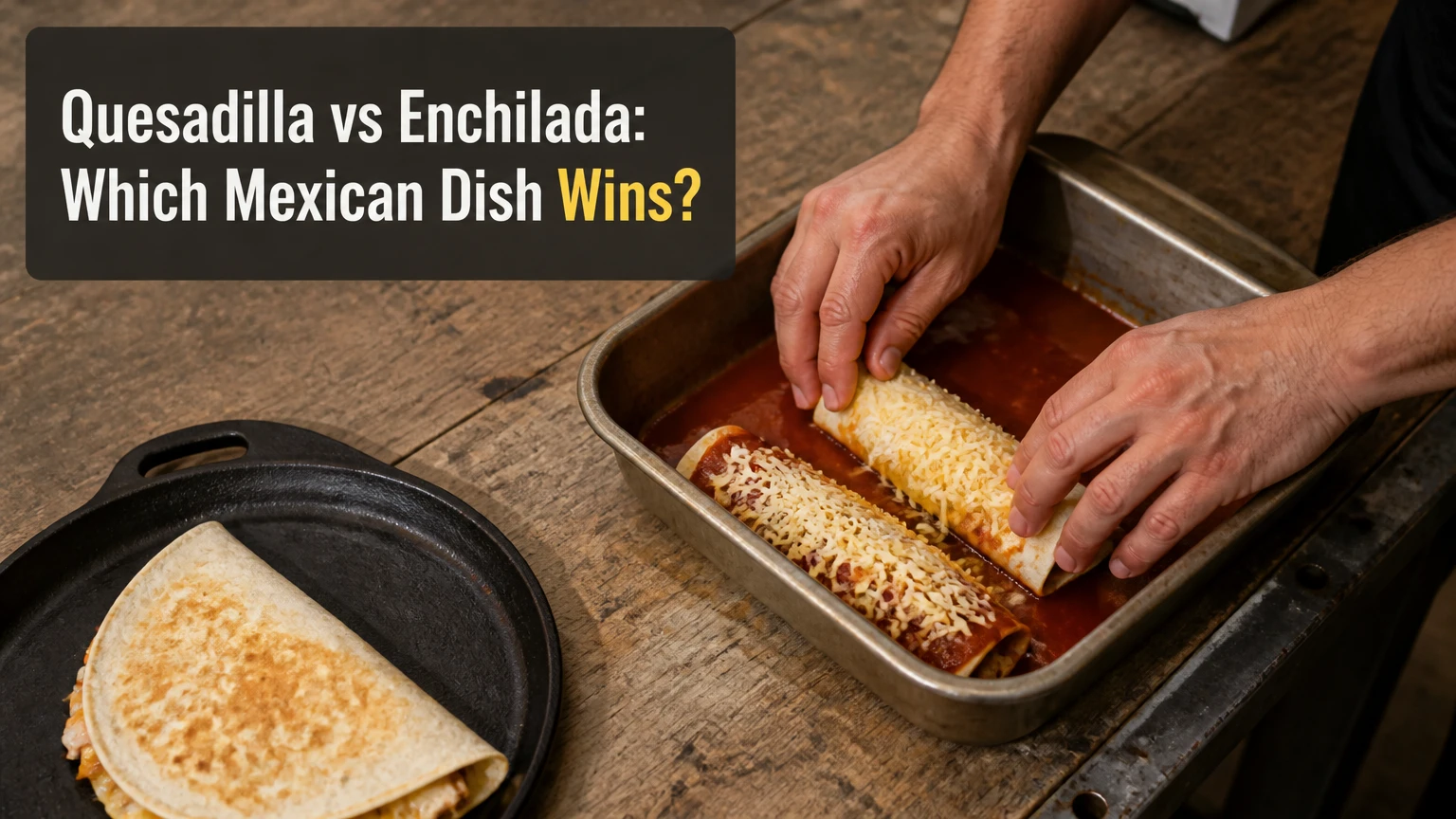
A quesadilla is a folded tortilla cooked on a griddle with cheese and optional fillings, while an enchilada is a rolled tortilla filled, coated in chile sauce, and usually baked or heated in that sauce. Choose a quesadilla for speed, crisp texture, and portability; choose an enchilada for saucy flavor, batch cooking, and a plated meal.
Key Facts at a Glance
- A quesadilla normally takes 5-10 minutes and cooks in one skillet or on a comal.
- An enchilada typically takes 30-45 minutes because the sauce, filling, assembly, and heating happen separately.
- Quesadillas are commonly folded and griddled; enchiladas are commonly rolled, sauced, and baked.
- Corn tortillas are the traditional foundation for enchiladas, while quesadillas use corn or flour depending on region and style.
- A quesadilla usually delivers a crisp or toasted exterior; an enchilada becomes soft, tender, and sauce-saturated.
- Typical restaurant quesadillas cost less than enchilada plates, but portion size and local pricing vary widely.
What Is the Difference Between a Quesadilla and an Enchilada?
The main difference is the cooking structure: a quesadilla encloses filling between folded tortilla surfaces and melts the interior on a hot cooking surface, whereas an enchilada rolls a tortilla around filling and lets chile sauce soften the tortilla during heating. The dishes can share cheese, beans, chicken, vegetables, and garnishes, but their textures and serving formats remain distinct.
A quesadilla is often a single half-moon cut into wedges. The tortilla may be corn or flour, and cheese may be central, optional, or absent in some regional Mexican preparations. In Mexico City, for example, fresh masa quesadillas can contain squash blossoms, huitlacoche, or chicharrón, with cheese depending on the order and vendor.
An enchilada is defined more by the sauced tortilla than by one fixed filling. Red sauces may use dried ancho or guajillo chiles, green sauces often use tomatillos and fresh chiles, and creamy versions modify the sauce with dairy. Enchiladas may be rolled, stacked, or arranged in a casserole, although the rolled form is the most recognizable.
| Attribute | Quesadilla | Enchilada | Practical consequence |
|---|---|---|---|
| Basic shape | Folded half-moon | Rolled cylinder or stack | Quesadilla is handheld; enchilada needs a plate |
| Main cooking medium | Dry comal or skillet | Chile sauce plus oven or skillet | Quesadilla browns; enchilada absorbs moisture |
| Typical tortilla | Corn or flour | Mostly corn | Flour is common in northern and American quesadillas |
| Defining component | Melted or enclosed filling | Sauce coating the tortilla | Sauce is optional for a quesadilla, defining for an enchilada |
| Typical serving | 1 large or 2 small pieces | 2-3 rolled enchiladas | Enchiladas suit a composed dinner plate |
| Eating texture | Crisp, chewy, stretchy | Soft, tender, saucy | The better choice depends on texture preference |
Which Tortilla Is Traditional?
Corn tortillas are the traditional choice for enchiladas, while quesadillas legitimately use either corn or flour according to regional style. Flour tortillas dominate many northern Mexican and United States versions of quesadillas, but central and southern Mexican quesadillas frequently use fresh corn masa or prepared corn tortillas.
Corn provides a toasted maize flavor and a firm structure when lightly fried before saucing. Flour tortillas bend easily and brown evenly, which makes them convenient for large skillet quesadillas, but they are less characteristic of classic rolled enchiladas.
The distinction is not absolute. Northern Mexican cooking includes flour-tortilla traditions, and restaurants may use flour tortillas for enchiladas because they are flexible. That substitution changes the dish’s flavor and texture, but it does not automatically make the result invalid.
Mexican and Tex-Mex Conventions
Mexican quesadillas often emphasize the tortilla and a modest filling, while Tex-Mex quesadillas commonly use a large flour tortilla, abundant cheese, grilled meat, and wedge-shaped portions. The American restaurant format is recognizable and satisfying, but it should not be treated as the only definition of a quesadilla.
| Style | Tortilla | Common filling | Cooking format |
|---|---|---|---|
| Mexico City masa quesadilla | Fresh corn masa | Squash blossom, huitlacoche, cheese | Griddled or fried, 4-8 minutes |
| Northern Mexican quesadilla | Flour, 20-25 cm | Cheese, beef, vegetables | Comal or skillet, 5-8 minutes |
| Tex-Mex restaurant quesadilla | Flour, 25-30 cm | Jack cheese, chicken, beef, peppers | Flat griddle, 6-10 minutes |
| Classic rolled enchilada | Corn, 15-18 cm | Cheese, beans, chicken | Sauced and baked, 25-40 minutes |
| Enchiladas potosinas | Chile-seasoned corn masa | Cheese or beans | Fried or griddled, 10-20 minutes |
How Does Cooking Method Change Texture?
A quesadilla develops crispness through direct contact with a hot pan, while an enchilada becomes tender because sauce penetrates the tortilla during heating. The difference comes from moisture: dry surface heat promotes browning, whereas chile sauce hydrates starch and reduces the tortilla’s resistance to a fork.
For a quesadilla, medium heat gives the cheese time to melt before the tortilla burns. A 20-25 cm tortilla usually needs 2-3 minutes per side, depending on thickness, pan material, and filling temperature. Excess moisture from wet vegetables or un-drained beans can steam the interior and prevent a crisp exterior.
For an enchilada, the tortilla should be flexible before rolling. A brief pass through oil, steam, or warm sauce reduces cracking. The sauce should cover the tortilla but not leave the rolls submerged, because too much liquid weakens the corn structure and produces a mushy casserole.
The textural contrast explains much of the preference divide. Quesadillas reward immediate eating. Enchiladas reward sauce development, resting time, and fork-ready service.
Which Dish Is Faster and Easier?
A quesadilla is usually faster and easier for one or two servings, with a typical total time of 5-10 minutes and one pan to clean. Enchiladas require more coordination, but a batch of 8-12 can be assembled in roughly 25 minutes and heated together, making them more efficient for families or guests.
The hidden labor is different. Quesadillas require active attention at the stove because each one cooks separately. Enchiladas require more preparation before heating, including sauce, filling, tortilla handling, and baking-dish assembly.
| Task | Quesadilla, 2 servings | Enchiladas, 8 servings | Typical difference |
|---|---|---|---|
| Ingredient preparation | 3-5 minutes | 12-20 minutes | Enchiladas require 9-15 extra minutes |
| Active cooking | 4-6 minutes | 10-15 minutes | Quesadillas finish sooner for small portions |
| Total elapsed time | 5-10 minutes | 30-45 minutes | Enchiladas take 3-6 times longer |
| Main equipment | 1 skillet or comal | Saucepan, skillet, baking dish | Enchiladas create 2-4 more dirty items |
| Batch capacity | 1-2 at once | 8-12 per dish | Enchiladas scale better |
| Best service window | Immediate | 10-20 minutes after baking | Enchiladas tolerate delayed serving |
Which Dish Costs Less?
A homemade quesadilla generally costs about $1.50-$4 per serving, while a homemade enchilada plate often costs $2.50-$6 per serving because sauce, several tortillas, toppings, and more filling are used. Restaurant pricing is less predictable, but quesadilla orders commonly cost less than a full enchilada plate.
Ingredient choices create the largest cost difference. A cheese-only quesadilla needs one tortilla and 40-60 grams of cheese, while a three-enchilada plate may use three tortillas, 90-150 grams of filling, 180-250 milliliters of sauce, cheese, crema, and side dishes.
The cheapest enchiladas are not necessarily inferior. A bean filling and homemade chile sauce can feed four people economically. The cost rises when the recipe includes prepared sauces, specialty cheese, chicken, several garnishes, or separate rice and bean sides.
| Serving context | Quesadilla typical cost | Enchilada typical cost | Main cost driver |
|---|---|---|---|
| Homemade cheese version | $1.50-$2.50 | $2.50-$4.00 | Cheese and tortilla quantity |
| Homemade meat version | $2.50-$4.00 | $4.00-$6.00 | Cooked meat and sauce |
| Casual restaurant | $7-$14 | $10-$20 | Portion, location, side dishes |
| Group of four at home | $6-$16 total | $10-$24 total | Batch filling and garnish |
| Premium restaurant | $14-$24 | $18-$32 | Specialty cheese, protein, plating |
Which Is Healthier, a Quesadilla or an Enchilada?
Neither dish is automatically healthier because calories depend on tortilla size, cheese, filling, sauce, oil, and side dishes. A small bean enchilada with chile-tomato sauce can contain fewer calories than a large cheese-and-chicken quesadilla cooked with oil, while a vegetable quesadilla can be the lighter choice.
Typical homemade estimates place a moderate quesadilla around 350-600 calories and a two- or three-enchilada serving around 450-800 calories. These are ingredient-based ranges, not universal nutrition facts. Restaurant portions can exceed them when tortillas are large, cheese is heavy, and rice, beans, sour cream, or chips accompany the meal.
Enchiladas can provide more sauce-based flavor with less cheese per bite, especially when beans or shredded vegetables provide the filling. Quesadillas can provide better portion control because one folded tortilla creates a clearly bounded serving.
| Version | Tortilla amount | Cheese amount | Typical calories | Protein range |
|---|---|---|---|---|
| Cheese quesadilla | 1 flour tortilla | 50-70 g | 350-550 kcal | 14-22 g |
| Chicken quesadilla | 1 flour tortilla | 40-60 g | 450-700 kcal | 25-38 g |
| Bean enchiladas | 2-3 corn tortillas | 30-60 g | 400-650 kcal | 15-25 g |
| Chicken enchiladas | 2-3 corn tortillas | 45-75 g | 500-800 kcal | 28-45 g |
| Vegetable enchiladas | 2-3 corn tortillas | 30-60 g | 350-600 kcal | 10-20 g |
For dietary planning, check the entire plate rather than the dish name. Corn tortillas are naturally gluten-free when produced without cross-contact, while flour tortillas contain wheat. Dairy-free fillings and cheese substitutes also change melting behavior and total nutrition.
How to Make a Quesadilla That Stays Crisp
A reliable quesadilla uses one tortilla, 40-70 grams of freshly shredded melting cheese, 60-90 grams of cooked filling, and medium heat for about 2-3 minutes per side. The most important rule is to keep the filling thin and dry enough that cheese melts before steam softens the tortilla.
- Heat a skillet or comal to medium. A surface temperature around 175-190°C is typical, although home cooks can judge readiness when a tortilla warms without smoking oil.
- Warm the tortilla for 15-20 seconds. This prevents cracking when folded and improves contact with the pan.
- Add cheese to one half. Leave a 1.5 cm border so melted cheese does not leak immediately.
- Add a thin layer of filling. Use chopped cooked chicken, drained beans, roasted vegetables, or mushrooms. Keep the total filling below 90 grams for a 20-25 cm tortilla.
- Fold and cook. Press lightly with a spatula, then cook 2-3 minutes until the underside is golden.
- Flip once. Cook another 2-3 minutes, then rest for 60 seconds before slicing.
The quesadilla is ready when the tortilla has brown spots, the cheese flows toward the edge, and the fold holds together when lifted. A wire rack preserves crispness better than a flat plate because trapped steam softens the underside.
Freshly shredded Oaxaca, Chihuahua, Monterey Jack, or low-moisture mozzarella usually melts more smoothly than heavily coated pre-shredded cheese. However, pre-shredded cheese is not unusable; lower heat and a lid can compensate for slower melting, though the exterior may soften.
How to Make Enchiladas Without Soggy Tortillas
A dependable enchilada batch uses 8-12 corn tortillas, 500-750 grams of filling, about 500-750 milliliters of sauce, and 15-20 minutes in a 190°C oven. Tortilla flexibility, moderate sauce coverage, and a short resting period determine whether the rolls remain intact.
- Prepare the filling and sauce first. The filling should be hot or warm, and the sauce should be warm enough to coat without forming a skin.
- Soften each tortilla. Flash-fry for 5-10 seconds per side, steam for 20-30 seconds, or warm briefly on a dry comal. Oil creates the most durable barrier against rapid sauce absorption.
- Coat the tortilla. Dip it completely or brush both sides with sauce, then move quickly before it cools.
- Fill with 60-90 grams. Place filling in a line slightly below the center, which makes the first fold easier.
- Roll tightly and arrange seam-side down. Coat the baking dish first so the bottom tortillas do not stick.
- Cover and heat. Add enough sauce to cover exposed tortilla, sprinkle cheese, and bake at 190°C for 15-20 minutes.
- Rest for 5 minutes. Garnish with crema, cilantro, sliced onion, or cotija before serving.
A tortilla is properly prepared when it bends around the filling without splitting and retains a visible surface after saucing. The most common failure is treating the tortilla like dry bread. Corn tortillas need heat and flexibility before they meet acidic or watery sauce.
Stovetop and Make-Ahead Options
Enchiladas do not always require an oven. A covered skillet can heat assembled enchiladas over low heat for 8-12 minutes, while stacked enchiladas can be prepared on a comal and served immediately. The oven mainly provides even batch heating and melted cheese across a casserole.
For make-ahead cooking, assemble the dish up to 24 hours in advance, cover tightly, refrigerate, and add approximately 5-10 minutes to the heating time. Cold tortillas absorb sauce longer, so avoid excessive liquid during assembly.
What Usually Goes Wrong?
Quesadillas fail when heat, moisture, or filling quantity prevents the tortilla and cheese from finishing together. Enchiladas fail when tortillas are dry, sauce is unbalanced, or the dish remains in the oven long enough for the corn structure to collapse.
- Burned quesadilla, unmelted cheese: Lower the skillet to medium-low and cover for 30-60 seconds. High heat browns the tortilla before the cheese reaches a fluid texture.
- Soggy quesadilla: Drain beans, pat vegetables dry, and reduce filling by 25-30%. Wet ingredients release steam inside the fold.
- Quesadilla splitting: Warm the tortilla before filling and leave a clean border around the edge.
- Cracked enchilada tortilla: Steam or flash-fry it before dipping. Cold corn tortillas have less flexibility and split along dry seams.
- Mushy enchiladas: Reduce sauce by 15-20% and avoid prolonged holding after baking. Sauce continues migrating into the tortilla while the dish rests.
- Dry enchilada edges: Spread sauce across the bottom and cover exposed tortilla completely before baking.
- Greasy surface: Use only enough oil to soften the tortilla, then drain briefly on a rack or paper towel.
One practitioner rule matters more than most recipe variations: cook wet fillings until their surface moisture is gone before enclosing them. Cheese can lubricate a quesadilla, but it cannot compensate for watery mushrooms, salsa, or un-drained beans.
Which Styles Should You Know?
Quesadilla and enchilada names describe families of preparations rather than two rigid recipes. Regional Mexican dishes and United States restaurant versions may use different tortillas, sauces, fillings, and cooking methods while retaining the core structure.
Quesadilla Styles
Mexico City masa quesadillas are made from fresh corn dough and may be fried or cooked on a comal. Cheese is common in many places but is not a universal requirement. Northern versions often use flour tortillas, while American Tex-Mex versions usually use large flour tortillas and abundant shredded cheese.
A sincronizada is related but structurally different: two flour tortillas are stacked with ham and cheese, grilled, and cut into wedges. It resembles a flat sandwich more than a folded single-tortilla quesadilla.
Enchilada Styles
Enchiladas rojas use a red chile sauce, often built from dried chiles, garlic, spices, and broth. Enchiladas verdes use tomatillos and fresh green chiles, creating a tangier sauce. Enchiladas suizas add dairy and melted cheese, producing a creamy finish.
Enchiladas potosinas begin with chile-seasoned masa rather than a plain tortilla dipped in sauce. Stacked enchiladas, sometimes called enchiladas montadas, layer tortillas and fillings instead of rolling every tortilla. These forms demonstrate why “baked versus fried” is useful shorthand, not a complete definition.
Which Dish Fits Your Situation?
A quesadilla is the better choice for a quick individual meal, portable lunch, or crisp-texture preference. An enchilada is the better choice for a family dinner, planned leftovers, or a meal where sauce and layered flavor matter more than speed.
| Situation | Recommended dish | Quantity | Typical time | Reason |
|---|---|---|---|---|
| One-person lunch | Quesadilla | 1 large | 5-10 minutes | One pan and immediate service |
| Children’s meal | Quesadilla | 1 small | 5-8 minutes | Mild filling and handheld wedges |
| Dinner for six | Enchiladas | 12 rolls | 35-50 minutes | Batch assembly and oven heating |
| Portable meal | Quesadilla | 1 folded tortilla | 8-12 minutes | Sauce-free and easy to wrap |
| Meal prep for two days | Enchiladas | 8-10 rolls | 45 minutes | Sauce protects filling during reheating |
| Gluten-free requirement | Corn quesadilla or enchilada | 1-3 tortillas | 10-40 minutes | Verify tortilla ingredients and cross-contact |
| Crispness priority | Quesadilla | 1 serving | 5-10 minutes | Direct pan contact preserves browning |
| Sauce-focused dinner | Enchilada | 2-3 rolls | 30-45 minutes | Chile sauce carries the main flavor |
Choose a Quesadilla for Speed
Busy weeknight cooks should choose a quesadilla when dinner must reach the table in under 10 minutes. A single skillet handles the tortilla, cheese, and cooked filling, and the dish can be adjusted individually for different eaters.
Quesadillas are less suitable when eight people need to eat simultaneously. Cooking several separately creates a service bottleneck, and holding them in a covered container sacrifices the crisp exterior that defines the format.
Choose Enchiladas for Groups
Hosts and meal preppers should choose enchiladas because a full baking dish can contain 8-12 portions and remain warm during a short serving delay. Assembly takes longer, but the batch workflow is more efficient than cooking individual quesadillas.
Enchiladas are less suitable when the sauce has not been prepared and no time exists for tortilla handling. A rushed version made with cold, brittle tortillas often breaks before it reaches the baking dish.
Choose by Texture and Flavor
Crisp-edge enthusiasts should choose quesadillas, especially with a dry skillet and freshly shredded cheese. Diners who prioritize chile depth, acidity, and tender tortillas should choose enchiladas, where the sauce contributes more flavor than the filling alone.
Neither dish is inherently more authentic because authenticity depends on the regional preparation being discussed. A fried masa quesadilla and a carefully sauced corn enchilada can both be traditional, while a large restaurant version may represent a different culinary lineage.
How Do Leftovers and Reheating Compare?
Quesadillas are best eaten immediately and usually lose crispness after 15-30 minutes, while enchiladas remain usable for 2-3 days when refrigerated and reheat more evenly. The difference comes from their intended moisture profile: steam damages a quesadilla’s crust but is already integrated into an enchilada.
Reheat a quesadilla in a dry skillet over medium-low heat for 2-4 minutes per side, or use an oven at 190°C for 6-10 minutes. Avoid the microwave when crispness matters, because trapped steam softens the tortilla.
Reheat enchiladas covered at 175-190°C for 15-25 minutes, depending on portion size and starting temperature. A microwave works for individual portions in 2-4 minutes, but the sauce may heat unevenly and the cheese surface will not brown.
| Leftover factor | Quesadilla | Enchilada | Best practice |
|---|---|---|---|
| Refrigerator life | 1-2 days | 2-3 days | Store below 4°C in a sealed container |
| Microwave time | 60-120 seconds | 2-4 minutes | Cover enchiladas to retain moisture |
| Oven reheating | 190°C, 6-10 minutes | 175-190°C, 15-25 minutes | Use a rack for quesadillas |
| Texture after reheating | Softer exterior | Usually still tender | Add fresh garnish after heating |
| Freezer suitability | 1 month, quality declines | 2-3 months | Freeze enchiladas before final bake |
The Bottom Line
Quesadilla vs enchilada is ultimately a choice between fast griddled crispness and slower sauced tenderness. Choose the quesadilla for a 5-10 minute meal, portable serving, or immediate cheese-and-tortilla texture. Choose the enchilada for a 30-45 minute batch dinner, complex chile sauce, and leftovers that reheat well.
A quesadilla is not automatically less substantial, and an enchilada is not automatically heavier. Tortilla size, cheese quantity, filling, oil, sauce, and side dishes determine the final cost and nutrition more reliably than the dish name.
Frequently Asked Questions
Can a quesadilla be made without cheese?
Yes, a quesadilla can contain beans, vegetables, mushrooms, or cooked meat without cheese, particularly in regional Mexican preparations. Cheese remains common because it binds the filling and provides the familiar melted texture. Without cheese, use a smaller filling quantity and press the folded tortilla gently so ingredients stay enclosed.
Are enchiladas always spicy?
No, enchiladas are not always spicy. Chile sauces can be mild, especially when made with ancho chiles, roasted tomatillos, or reduced fresh chile quantities. Heat level depends on the chile variety, seed removal, sauce ratio, and preparation method rather than the word enchilada itself.
Can I use flour tortillas for enchiladas?
You can use flour tortillas for enchiladas, but corn tortillas provide the more traditional flavor and sauce behavior. Flour tortillas are flexible and less likely to crack, yet they can become gummy when heavily sauced. Warm them briefly, use moderate sauce, and avoid overbaking if flour is your only option.
Which dish is better for breakfast?
A quesadilla is usually better for breakfast because it cooks quickly and works with eggs, beans, cheese, mushrooms, or vegetables in one skillet. An enchilada suits a planned brunch when sauce and batch preparation are useful. For either dish, precooked fillings reduce morning preparation substantially.
Can I make either dish vegetarian?
Both dishes can be vegetarian. Quesadillas work well with cheese, beans, squash, mushrooms, spinach, or roasted peppers, while enchiladas can use beans, sweet potato, vegetables, or cheese. Drain wet fillings carefully, because excess moisture affects quesadilla crispness and can weaken enchilada tortillas.
Which dish should I order at a restaurant?
Order a quesadilla when you want a quick, handheld meal with toasted tortilla and melted cheese. Order enchiladas when you want a plated meal with chile sauce, several rolls, and side dishes. Ask whether the restaurant uses corn or flour tortillas and whether the filling is cooked to order, since both details affect texture.