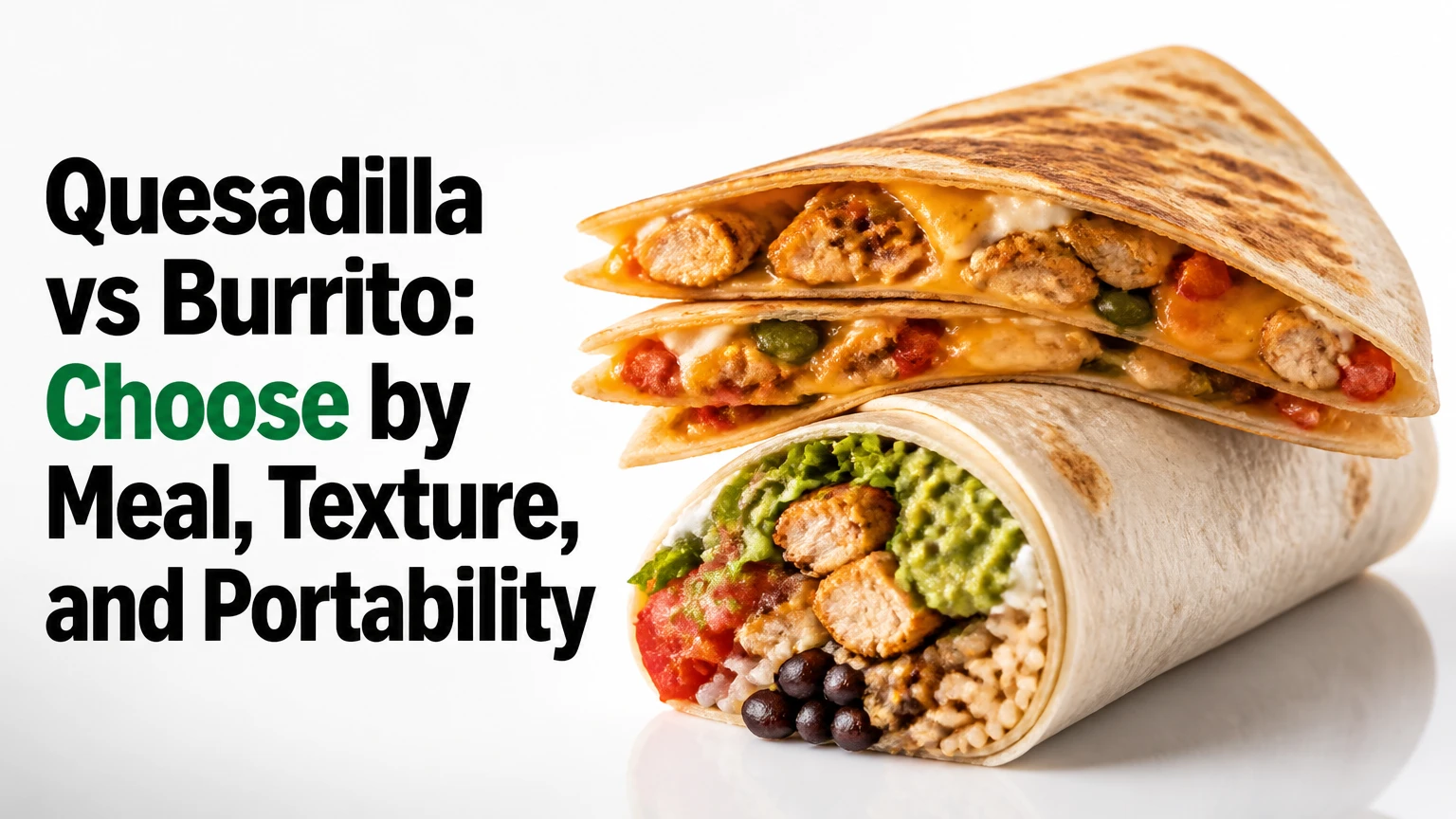
A quesadilla is a folded or layered tortilla cooked until cheese melts and the exterior browns, while a burrito is a fully enclosed tortilla package rolled around a larger mixture of fillings. Choose a quesadilla for crisp texture, speed, and sharing; choose a burrito for capacity, portability, and a complete meal in one wrap.
Key Facts at a Glance
A quesadilla is usually flat, folded, cheese-bound, and griddled on both sides.
A burrito is cylindrical, tucked at both ends, and held together by tortilla tension.
Typical quesadilla preparation takes 5-10 minutes; a filled burrito takes 10-15 minutes.
A burrito generally holds more rice, beans, protein, and toppings than a quesadilla.
Quesadillas are easier to cook correctly, but burritos usually travel better.
Typical restaurant prices range from $7-$12 for a quesadilla and $9-$16 for a burrito.
What Is the Difference Between a Quesadilla and a Burrito?
The defining difference is the package structure: a quesadilla is an open, flat tortilla preparation folded around cheese, whereas a burrito is a sealed, rolled tortilla preparation built around a dense filling. Cheese provides much of a quesadilla’s internal cohesion; folding and tortilla elasticity provide a burrito’s cohesion.
The Merriam-Webster definition describes a quesadilla as “a tortilla filled with cheese and often a savory mixture,” which captures its cheese-centered identity without limiting it to one filling. Burritos vary more widely because rice, beans, meat or plant protein, salsa, vegetables, and dairy toppings can all occupy separate layers.
| Feature | Quesadilla | Burrito | Practical consequence |
|---|---|---|---|
| Basic shape | Half-moon or two-layer disk | Sealed cylinder | Quesadilla exposes more crisp surface |
| Main binder | Melted cheese | Tucked tortilla | Burrito depends on rolling technique |
| Typical tortilla | 8-10 inches | 10-12 inches | Burrito needs more flexibility |
| Cooking method | Griddle or skillet | Fill, roll, then serve or toast | Quesadilla develops stronger browning |
| Eating style | Handheld wedges or whole | Handheld sealed meal | Burrito contains loose ingredients better |
The names also cover regional preparations rather than rigid international standards. A Mexico City quesadilla may use fresh corn dough and may be served without cheese, while many United States restaurants use a flour tortilla and melted cheese as the central feature.
Why Do They Have Different Textures?
Quesadillas become crisp because a thin tortilla contacts a hot cooking surface while melted cheese lubricates and binds the interior. Burritos remain softer because multiple moist ingredients sit inside a thick tortilla cylinder, and steam has fewer direct paths to escape.
A practical griddle temperature for a flour quesadilla is approximately 350-400°F, or medium heat on many stovetops. At that range, a room-temperature tortilla can brown in about 2-3 minutes per side while preheated fillings give the cheese time to liquefy.
Burrito texture depends on moisture distribution. Dry rice, drained beans, and modest salsa protect the tortilla; watery beans, excess sour cream, and fresh tomatoes placed directly against the wrapper increase leakage and softening.
How Do You Assemble Each Dish?
Quesadilla assembly requires fewer structural decisions: warm the tortilla, distribute cheese, add a modest amount of cooked filling, fold, and toast. Burrito assembly requires portion control, moisture management, edge placement, and a tight final roll.
| Stage | Quesadilla method | Burrito method | Typical amount or time |
|---|---|---|---|
| Tortilla preparation | Warm flat in skillet | Steam or heat until flexible | 10-20 seconds |
| Base layer | 1/2-3/4 cup shredded cheese | 1/3 cup rice plus 1/3 cup beans | Per tortilla |
| Main filling | 1/3-1/2 cup cooked protein or vegetables | 1/2 cup protein or plant filling | Fully cooked |
| Moist toppings | 1-2 tablespoons salsa | 1-2 tablespoons salsa or crema | Drain excess liquid |
| Closure | Fold in half | Tuck sides, fold bottom, roll forward | 10-20 seconds |
| Final heat | Toast 2-3 minutes per side | Optional toast, 1-2 minutes per side | Until sealed or browned |
For a quesadilla, place cheese across the tortilla but keep a 1-inch border. Add filling to one half, fold the empty half over it, and turn the quesadilla once the underside is golden and the cheese has begun to flow.
For a burrito, place the filling in a horizontal band below the center. Fold the side edges inward first, pull the lower tortilla flap over the filling, compress the ingredients gently, and roll forward until the seam rests underneath.
Expert rule of thumb: a burrito should look underfilled before rolling. A 12-inch tortilla carrying roughly 1.5-2 cups of filling is easier to close than one carrying 2.5 cups, even when both portions fit on paper.
Which Holds More Food?
A burrito holds more food because its cylindrical cavity encloses ingredients on all sides, while a quesadilla needs a thin layer so it can fold, brown, and flip without spilling. A typical burrito provides 1.5-2.5 cups of filling; a quesadilla commonly carries 0.75-1.5 cups.
| Dish format | Tortilla diameter | Typical filling volume | Typical finished weight |
|---|---|---|---|
| Small quesadilla | 8 inches | 3/4-1 cup | 6-10 ounces |
| Large quesadilla | 10 inches | 1-1.5 cups | 10-16 ounces |
| Standard burrito | 10 inches | 1.25-2 cups | 14-22 ounces |
| Large burrito | 12 inches | 1.75-2.5 cups | 20-32 ounces |
The capacity advantage matters when the meal must include a grain, legume, protein, vegetables, and toppings. The flatter format works better when cheese, roasted vegetables, or one main filling should remain prominent in every bite.
A larger burrito is not automatically more satisfying. Rice, beans, cheese, sauces, and tortilla contribute different amounts of energy and protein, so two burritos with the same diameter can differ substantially in nutrition.
Which Is Better for Calories and Nutrition?
Neither dish is inherently healthier because calories depend on tortilla size, cheese, rice, beans, protein, cooking fat, and sauces. A vegetable quesadilla with moderate cheese can be lighter than a large burrito, while a bean-and-vegetable burrito can provide more fiber and protein than a cheese-heavy quesadilla.
Typical restaurant ranges show the portion effect:
| Order | Typical calories | Protein range | Main calorie drivers |
|---|---|---|---|
| Cheese quesadilla | 450-750 kcal | 15-30 g | Tortilla, cheese, cooking oil |
| Chicken quesadilla | 600-950 kcal | 30-50 g | Cheese plus chicken portion |
| Bean and vegetable burrito | 650-1,000 kcal | 20-35 g | Rice, beans, tortilla, sauces |
| Meat burrito with dairy toppings | 850-1,500+ kcal | 35-65 g | Large tortilla, rice, cheese, crema |
The USDA’s FoodData Central database lists individual ingredients rather than assigning universal values to named dishes, which is the correct approach because restaurant portions vary widely. A practical estimate starts with the tortilla, then adds measured cheese, starch, protein, and sauce.
For a lighter quesadilla, use 1/2 cup cheese, 3 ounces of protein, and a nonstick pan. For a lighter burrito, use 1/3 cup rice, 1/3 cup beans, 3-4 ounces of protein, and salsa instead of a large creamy topping.
Which Is Faster and Less Expensive?
A quesadilla is usually faster and cheaper because it uses fewer components and needs only one short cooking stage. A burrito costs more when it includes rice, beans, protein, several toppings, and a larger tortilla, although batch-cooked ingredients can narrow the difference.
| Situation | Quesadilla time | Burrito time | Typical food cost per serving |
|---|---|---|---|
| Simple home meal | 5-8 minutes | 10-15 minutes | $2-$5 |
| Protein-based home meal | 8-12 minutes | 12-20 minutes | $4-$8 |
| Fast-casual restaurant | 5-8 minutes | 7-12 minutes | $7-$16 |
| Batch preparation | 6-10 minutes each | 3-6 minutes each | $3-$9 |
Restaurant prices vary by city, protein, portion, and brand. The supplied overview’s $7-$11 quesadilla and $9-$15 burrito ranges are reasonable typical United States fast-casual figures, but premium fillings and delivery fees can push either order higher.
Quesadilla wins for a quick weeknight meal. Burrito wins when one assembled package replaces separate grain, bean, protein, and topping dishes.
How Do Regional Styles Differ?
Regional styles change the ingredients and cooking method, so “quesadilla” and “burrito” do not identify one universal recipe. The most useful distinction is whether the style remains flat and griddled or becomes a sealed rolled package.
| Style | Category | Characteristic ingredients | Service format |
|---|---|---|---|
| Traditional flour quesadilla | Quesadilla | Cheese, chicken, mushrooms, or vegetables | Folded and griddled |
| Sincronizada | Quesadilla family | Two tortillas, ham-style filling, Chihuahua cheese | Stacked and toasted |
| Mexico City quesadilla | Regional quesadilla | Corn masa, cheese optional by local practice | Cooked on a comal or fried |
| Gringa | Quesadilla family | Flour tortilla, seasoned spit-roasted meat, cheese | Folded and griddled |
| Mission-style burrito | Burrito | Rice, beans, protein, salsa, guacamole | Large and often foil-wrapped |
| California burrito | Burrito | Grilled steak, fries, cheese, guacamole | Large handheld package |
| Wet burrito | Burrito | Rolled filling, red or green sauce, melted cheese | Plated and covered |
| Breakfast burrito | Burrito | Egg, potato, cheese, seasoned protein | Handheld morning meal |
The term “Mission burrito” refers to a San Francisco-associated style known for a large flour tortilla and a broad filling combination. Food historian Jeffrey M. Pilcher has documented the burrito’s development as a Mexican and Mexican American food with shifting regional identities, which is why restaurant menus should be read as local expressions rather than fixed standards.
A wet burrito loses some portability because sauce is added after rolling. A breakfast burrito often uses fewer fresh toppings because eggs and potatoes perform better when wrapped hot.
Which Is Better for Takeout and Reheating?
A burrito is generally better for takeout because the sealed wrapper contains loose fillings and retains heat, while a quesadilla loses its crisp surface quickly inside packaging. A quesadilla reheats better in a dry skillet or air fryer; a burrito reheats best after being wrapped loosely and warmed gradually.
| Use case | Better choice | Recommended packaging | Reheating method |
|---|---|---|---|
| 20-minute commute | Burrito | Foil or vented paper | Skillet or oven |
| Immediate sharing | Quesadilla | Ventilated box | Serve within 5 minutes |
| Packed lunch | Burrito | Foil, sauce on side | Microwave, then dry pan |
| Crisp leftovers | Quesadilla | Paper towel, loose container | Air fryer at 350°F |
| Sauce-heavy order | Wet burrito | Lidded meal container | Oven-safe dish if available |
Packaging creates a counterintuitive result: foil preserves burrito warmth but can trap steam against a quesadilla’s browned surface. Venting helps the quesadilla, while tight wrapping helps the burrito maintain its shape.
Neither format is ideal for long storage with fresh salsa inside. Refrigerate leftovers within two hours, keep chilled food at 40°F or below, and reheat dense leftovers to 165°F, consistent with USDA food-safety guidance.
Which Fits Different Diets?
A burrito usually offers more room for balanced customization, while a quesadilla makes portion control simpler. The best choice depends on whether the priority is protein, fiber, lower carbohydrate content, dairy reduction, or gluten avoidance.
| Dietary priority | Easier format | Practical build | Main limitation |
|---|---|---|---|
| Higher protein | Burrito | 4-6 ounces chicken or beans | Large total calories |
| Higher fiber | Burrito | Beans, vegetables, whole-grain tortilla | More moisture and bulk |
| Lower carbohydrate | Quesadilla | Smaller tortilla, cheese, vegetables | Less fiber unless vegetables increase |
| Dairy-free | Burrito | Beans, rice, protein, salsa, avocado | Needs careful kitchen handling |
| Gluten-free | Corn quesadilla or certified tortilla | Corn tortilla, cheese, vegetables | Cross-contact risk |
| Lower sodium | Either format | Unsalted beans, fresh vegetables, limited sauce | Restaurant toppings vary |
A quesadilla does not have to be cheese-only. A smaller amount of cheese can bind roasted peppers, mushrooms, spinach, or chicken without making the dish overwhelmingly rich.
A burrito can be nutritionally dense in the literal sense, meaning it contains many ingredients, but large portions of rice, cheese, and creamy toppings can raise total calories rapidly. Ask for sauces separately when ordering.
What Common Problems Occur?
Most quesadilla failures come from excessive filling or insufficient heat, while most burrito failures come from excess moisture, a cold tortilla, or poor ingredient placement. Each problem has a predictable mechanical cause and a straightforward correction.
- Quesadilla spills during flipping. Use less filling, press the folded edge briefly with a spatula, and flip with a wide turner.
- Quesadilla browns before the cheese melts. Lower the heat to medium and preheat meat or vegetables before assembly.
- Quesadilla becomes greasy. Reduce added oil because cheese already supplies fat for browning.
- Burrito tears during rolling. Steam the tortilla for 10-15 seconds and avoid placing wet ingredients against the center of the wrapper.
- Burrito opens after rolling. Keep fillings below the tortilla’s midpoint, tuck both sides firmly, and rest the seam underneath for one minute.
- Burrito becomes mushy. Drain beans, reduce salsa to 1-2 tablespoons, and separate cold watery toppings from the tortilla.
Expert preparation insight: temperature equalization matters more than cooking speed. Cold filling inside a quesadilla forces the tortilla to overbrown before the center warms, while a warm tortilla gives a burrito enough elasticity to close without splitting.
Second practitioner rule: cheese should touch the tortilla in a quesadilla. Cheese placed only between cold fillings melts slowly and cannot create the thin adhesive layer that stabilizes the fold.
What Are the Closest Alternatives?
Tacos, wraps, and enchiladas are the nearest alternatives, but each changes the balance between openness, portability, and sauce. A taco exposes its filling, a wrap often uses a non-Mexican filling structure, and an enchilada is usually plated with sauce rather than carried dry.
| Dish | Closure | Typical tortilla | Sauce position | Best use |
|---|---|---|---|---|
| Taco | Open or lightly folded | 4-6-inch corn or flour | Added on top | Small portions and variety |
| Quesadilla | Folded or layered | 8-10-inch flour or corn | Side or interior | Crisp cheese-centered meal |
| Burrito | Fully sealed | 10-12-inch flour | Interior or exterior | Portable complete meal |
| Enchilada | Rolled, not sealed | 6-8-inch corn | Over the top | Plated saucy dinner |
Choose tacos when you want several fillings in separate units. Choose an enchilada when sauce and a seated meal matter more than portability. Choose a wrap when the ingredients are better suited to a cold or lightly heated lunch format.
Which Should You Choose?
Choose a quesadilla for speed, crispness, a smaller portion, or a meal built around melted cheese. Choose a burrito for maximum filling capacity, a longer commute, varied ingredients, or a meal that combines several food groups in one package.
Choose a Quesadilla If You Want Crisp Texture
The quesadilla is the better choice for diners who value browned tortilla edges and a melted interior. Its 5-10 minute preparation time suits a quick dinner, and cutting it into wedges makes it easier to share.
The limitation is moisture. Salsa, guacamole, and sour cream belong on the side when crispness matters, because wet toppings soften the tortilla within minutes.
Choose a Burrito If You Need Portability
The burrito is the better choice for commuters, packed lunches, and meals eaten without a plate. The sealed cylinder protects rice, beans, protein, and toppings more effectively than an open quesadilla.
The limitation is structural density. A large burrito can become difficult to eat, especially when the filling exceeds 2 cups or when watery ingredients create pressure inside the wrapper.
Choose a Quesadilla If You Want Simple Portion Control
A quesadilla gives the cook a visible boundary around the meal. A 10-inch tortilla with 1/2-3/4 cup cheese and 1/2 cup filling creates a predictable serving that is easier to estimate than a restaurant burrito.
Choose a Burrito If You Want Maximum Customization
A burrito accommodates separate portions of rice, beans, protein, vegetables, salsa, avocado, and dairy toppings. That flexibility makes it easier to increase protein or fiber without changing the entire preparation method.
Choose Neither If You Want a Saucy Plated Meal
Select an enchilada when the meal should be covered in sauce and eaten with utensils. A wet burrito can provide a similar experience, but it sacrifices much of the portability that makes a standard burrito useful.
FAQ
Can a quesadilla have no cheese?
A preparation called a quesadilla traditionally centers on cheese, but regional practice differs. Mexico City quesadillas may be made from corn masa and ordered with cheese as an added ingredient rather than an automatic one. In common United States restaurant usage, removing cheese makes the dish closer to a folded filled tortilla.
Is a burrito always made with a flour tortilla?
A burrito is most commonly made with a large flour tortilla because flour tortillas provide the flexibility and size needed for a sealed roll. Smaller regional or specialty preparations may use other wrappers, but a rigid corn tortilla is more likely to crack when asked to contain a large, moist filling.
Can you make a burrito with only beans and cheese?
Yes. A bean-and-cheese burrito can be structurally sound when the beans are thick and drained, the cheese is distributed evenly, and the tortilla is warmed before rolling. Use about 1/2 cup beans and 1/3 cup cheese for a 10-inch tortilla to preserve closure.
Which dish is easier for beginners?
A quesadilla is easier for beginners because the cook manages one fold instead of a multi-stage sealed roll. The main beginner risks are overfilling and excessive heat. Burritos become easier after the tortilla is warmed and the filling is measured rather than added by eye.
Can you freeze quesadillas and burritos?
Both can be frozen, but burritos usually freeze more successfully when they contain low-moisture fillings and no fresh lettuce, watery tomato, or sour cream. Wrap each item tightly, label the date, thaw safely, and reheat until the center reaches 165°F.
What is the final choice between a quesadilla and burrito?
Choose a quesadilla when crispness, speed, cheese, and portion control lead the decision. Choose a burrito when portability, ingredient capacity, customization, and meal completeness matter more. The best answer to quesadilla vs burrito depends primarily on texture versus containment, not on one format being universally superior.
The Bottom Line
Quesadilla vs burrito is a choice between a crisp folded tortilla and a densely filled sealed wrap. Quesadillas take less time, emphasize melted cheese and browning, and work well for smaller meals or sharing. Burritos hold more ingredients, travel better, and offer broader customization, but they require warmer tortillas and stricter moisture control.