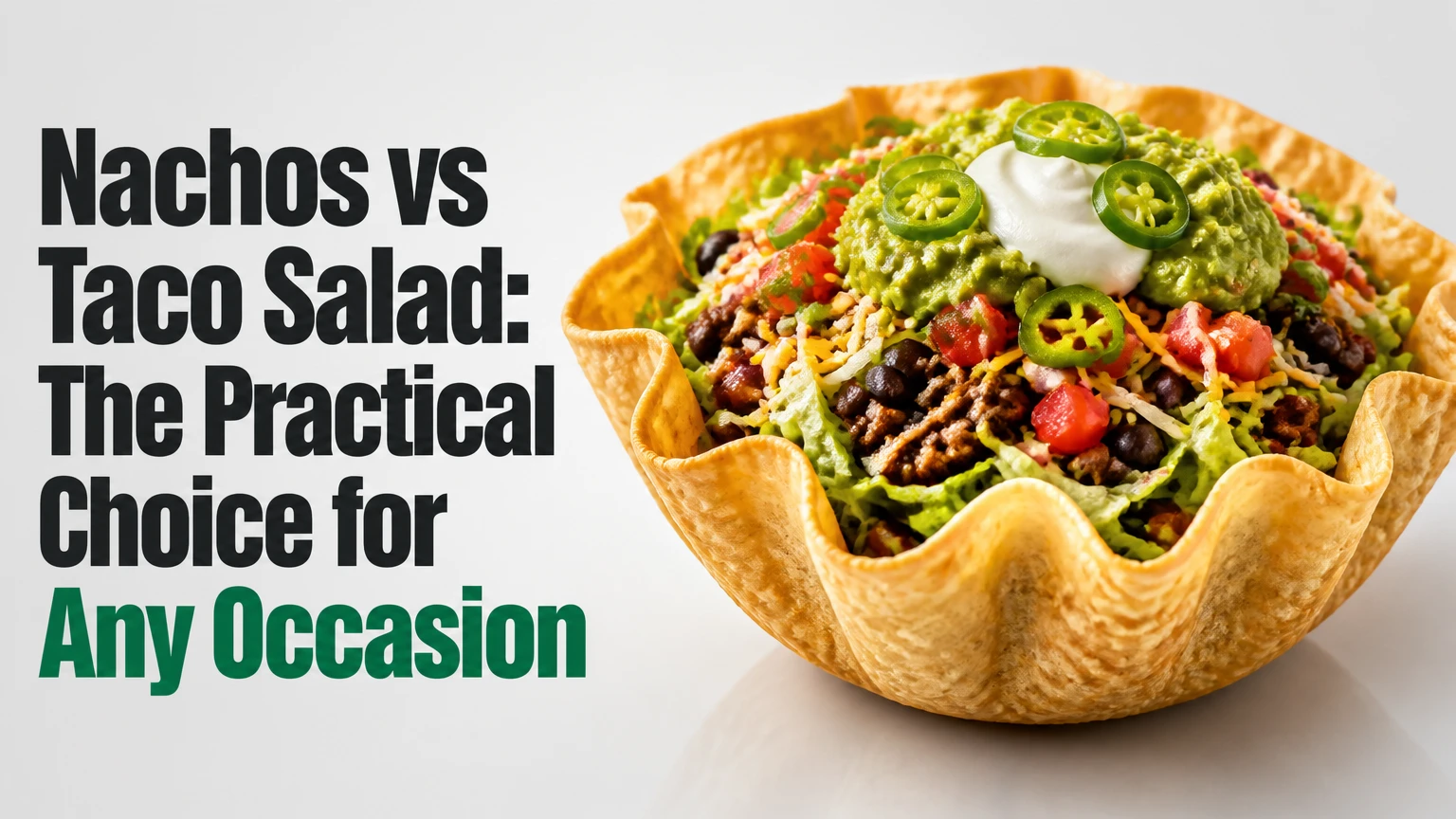
Nachos are a warm, shareable dish built on tortilla chips, melted cheese, and hot or fresh toppings, while taco salad is an individual fork-eaten meal centered on lettuce, taco-seasoned fillings, and a dressing or salsa. Choose nachos for communal snacking and maximum cheese-to-crunch impact; choose taco salad for a plated meal with more greens and adjustable portions.
Key Facts at a Glance
- Nachos use tortilla chips as the primary structural base; taco salad uses lettuce, a tortilla shell, grains, or a combination.
- A typical nacho platter serves 2-4 people, while a taco salad normally serves one person.
- Nachos are assembled before heating, but taco salad is usually assembled after cooking its meat and shell.
- A fried tortilla bowl is optional, not essential, to the definition of taco salad.
- Lettuce does not automatically make taco salad lower in calories because fried shells, cheese, creamy dressing, and large portions can dominate the meal.
- Typical home preparation takes 10-15 minutes for nachos and 15-25 minutes for taco salad with a fried shell.
What Is the Difference Between Nachos and Taco Salad?
Nachos are an open, layered snack or meal in which tortilla chips carry melted cheese and toppings. Taco salad is a composed salad that combines taco-style ingredients with a substantial lettuce base, then adds dressing, salsa, cheese, beans, and a protein. The central difference is structural: nachos optimize chip coverage, while taco salad optimizes forkful balance.
The dishes overlap because both may include seasoned beef, chicken, beans, cheddar, jalapeños, tomatoes, guacamole, and sour cream. Their eating mechanics remain different. A nacho should deliver a stable chip, topping, and cheese combination in one bite; a taco salad should combine greens, protein, dressing, and crunch across a bowl.
Nachos trace their commonly cited origin to Ignacio “Nacho” Anaya, who prepared a simple version in 1943 in Piedras Negras, Mexico. The early form used individual tortilla chips, cheese, and sliced pickled jalapeño. Modern loaded nachos are much more elaborate, but the individual chip remains the defining unit.
Taco salad has no single universally accepted canonical recipe. In North American restaurants, the recognizable format usually includes lettuce, taco-seasoned meat or beans, cheese, tomatoes, and either a fried flour tortilla bowl or a crunchy topping.
How Do the Two Dishes Work Structurally?
Nachos depend on load-bearing chips and even ingredient distribution, whereas taco salad depends on separating crisp greens from moisture until serving. Cheese can slow direct moisture contact on a chip, but it is not a waterproof barrier, so drained beans and post-baking salsa remain important.
A reliable nacho platter uses wide, shallow layers rather than a deep pile. Thick restaurant-style corn chips support more filling than thin snack chips, and freshly shredded cheese generally melts more smoothly than heavily coated pre-shredded cheese. A two-layer arrangement reduces the familiar problem of dry chips underneath and overloaded chips on top.
Taco salad has a different failure point. Hot meat, wet dressing, and acidic tomatoes gradually soften lettuce and fried shells. The most dependable assembly places the shell or bowl below, lettuce above it, and dressing at the last moment. Warm meat can be included, but it should be drained and rested briefly rather than transferred straight from a steaming skillet.
Master Comparison Table
| Criterion | Nachos | Taco salad |
|---|---|---|
| Primary base | 100-150 g corn tortilla chips | 75-120 g lettuce, shell optional |
| Normal serving | 2-4 people per platter | 1 person per bowl |
| Core utensil | Fingers, plate, napkins | Fork, bowl, optional knife |
| Serving temperature | Warm chips and cheese, cold garnish | Cool greens, warm or room-temperature filling |
| Typical preparation | 10-15 minutes | 15-25 minutes with fried shell |
| Typical home cost | $2.50-$5.00 per serving | $3.50-$8.00 per serving |
| Best setting | Game day, casual group snack | Lunch, weeknight dinner, individual meal |
| Main texture goal | Crisp chip with molten cheese | Crisp lettuce with controlled crunch |
Which Dish Makes the Better Meal?
Taco salad usually makes the more complete individual meal because lettuce, beans, protein, and vegetables create more volume and ingredient variety per bowl. Nachos can also become a meal when they include a measured protein, beans, vegetables, and enough food for the person eating them, but their chip-and-cheese foundation remains more energy dense.
The distinction is portion architecture, not a moral difference between “healthy” and “unhealthy” foods. A small sheet pan of lightly topped nachos may contain less food per person than a large taco salad with a fried shell, cheese, creamy dressing, and a full serving of meat.
Typical Nutrition and Portion Ranges
| Serving format | Energy range | Protein range | Fiber range | Main calorie drivers |
|---|---|---|---|---|
| Nachos, shared platter divided by 4 | 350-650 kcal | 15-28 g | 4-8 g | Chips, cheese, meat |
| Nachos, single large portion | 800-1,400 kcal | 30-55 g | 7-14 g | Chips, cheese, beans, toppings |
| Taco salad, fried flour shell | 700-1,200 kcal | 25-45 g | 8-16 g | Fried shell, meat, cheese, dressing |
| Taco salad, greens and lean chicken | 400-700 kcal | 30-50 g | 9-17 g | Chicken, beans, avocado, dressing |
| Taco bowl with rice and beans | 550-900 kcal | 20-40 g | 8-15 g | Rice, beans, cheese, sauce |
These are typical recipe-planning ranges, not laboratory measurements. The USDA FoodData Central database lists ingredients separately rather than assigning one universal value to “nachos” or “taco salad,” so actual totals depend on chip weight, cheese quantity, meat fat level, shell size, and dressing.
For a lower-energy version, the highest-impact changes are measurable: use 30-45 g of cheese per serving instead of 60-90 g, replace a fried shell with 2 cups of romaine, and serve 1-2 tablespoons of dressing instead of pouring freely. Removing lettuce would be a mistake because lettuce supplies volume for very few calories.
Which Base and Toppings Should You Use?
Corn chips give nachos a rigid, salty, roasted foundation, while lettuce gives taco salad a cool, watery, high-volume base. Fried flour shells add crackle and visual appeal but also introduce a separate fried component that can outweigh the calorie difference created by the greens.
Common Bases and Variations
| Version | Base quantity | Cooking method | Best use | Main limitation |
|---|---|---|---|---|
| Classic sheet-pan nachos | 100-150 g corn chips | Bake at 200°C for 5-7 minutes | Sharing for 2-4 | Softens after 15-20 minutes |
| Stadium nachos | 90-130 g thin chips | Warm cheese sauce | Fast serving | Sauce can pool and soften chips |
| Totchos | 300-400 g potato tots | Bake or fry 20-30 minutes | Hearty party food | Heavier and less crisp over time |
| Fried-shell taco salad | 1 large flour tortilla | Fry at 190°C for about 2 minutes | Restaurant-style presentation | Shell adds fat and breaks easily |
| Greens-only taco salad | 75-120 g romaine or iceberg | No shell frying | Lighter weekday meal | Less standalone crunch |
| Southwestern grain bowl | 120-180 g cooked rice or quinoa | Simmer or reheat grain | Meal prep | Becomes a bowl rather than a classic salad |
Nacho toppings should be relatively dry before baking. Use drained beans, browned meat with excess fat removed, and shredded cheese. Add pico de gallo, guacamole, crema, cilantro, and lime after heating, because fresh ingredients lose texture when exposed to oven heat.
Taco salad toppings benefit from contrast and restraint. Romaine supplies a firmer bite than delicate leaf lettuce, black beans add fiber and body, tomatoes add acidity, and crushed chips supply concentrated crunch. A creamy salsa dressing clings to lettuce more effectively than a thin liquid, but portion control still matters.
How Do You Make Crisp, Evenly Topped Nachos?
Build nachos in two shallow layers, use about 100-150 g of sturdy chips and 120-180 g of shredded cheese for a platter serving 2-4, then bake at 200°C for 5-7 minutes. The success checkpoint is bubbling cheese with firm chip edges; the common mistake is adding watery toppings before heating.
- Spread the first chip layer. Cover a wide sheet pan with roughly half the chips, allowing slight overlap but avoiding a deep mound. A 30-by-40-centimeter pan gives toppings room to distribute.
- Add the first cheese and filling layer. Use half the cheese, 100-150 g cooked meat, and 100 g drained black or pinto beans. Scatter ingredients across the center and edges.
- Repeat the layers. Add the remaining chips, cheese, meat, and beans. Two shallow tiers create more consistently loaded bites than one thick top layer.
- Bake until the cheese melts. Use a preheated oven at 200°C for 5-7 minutes. Broil for the final 30-60 seconds only if you can watch continuously.
- Finish after baking. Add 100-150 g pico de gallo, 60-80 g guacamole, pickled jalapeños, cilantro, and 60-90 g sour cream or crema.
You will know the nachos worked when the cheese joins adjacent chips without turning oily, the lower layer still bends rather than collapses, and every section of the pan contains a topping. Serve immediately or within 10 minutes for the best texture.
How Do You Assemble Taco Salad Without Making It Soggy?
Assemble taco salad with completely dry lettuce, drained fillings, and dressing added immediately before eating. Cool the cooked meat for 5-10 minutes, or place it beneath the greens as a separate warm layer, because steaming-hot filling accelerates wilting and softens a fried shell.
- Prepare the shell or alternative base. For a fried bowl, shape one large flour tortilla over a heat-safe mold and fry at about 190°C until golden, commonly 2-3 minutes depending on thickness. Drain fully.
- Dry and cut the greens. Use 75-120 g chopped romaine or iceberg. Spin or towel-dry the leaves; surface water is a larger sogginess risk than most cooks expect.
- Cook the filling. Brown 120-170 g ground beef, turkey, chicken, or a vegetarian protein with 1-2 teaspoons of taco seasoning. Drain excess liquid and rest for 5-10 minutes.
- Layer the bowl. Add lettuce, 80-120 g protein, 80-100 g beans, 60-80 g tomatoes, and 30-45 g shredded cheese.
- Dress at the table. Use 30-45 ml salsa, lime dressing, or avocado-based dressing. Add tortilla strips or crushed chips last.
The finished salad should have crisp lettuce, warm rather than steaming meat, and a shell that remains rigid through the first several forkfuls. Tossing everything 20 minutes early is the most reliable way to lose that contrast.
What Do Nachos and Taco Salad Typically Cost and Require?
At home, nachos usually cost $2.50-$5.00 per serving when a platter is divided among four people, while taco salad costs about $3.50-$8.00 per serving depending on shell, protein, and avocado. Nachos need an oven and sheet pan; taco salad needs a skillet, and a fried shell adds oil, a mold, and cleanup.
Practical Time and Cost Comparison
| Dish and scale | Active time | Heat time | Typical total cost | Equipment |
|---|---|---|---|---|
| Nachos for 2 | 10 minutes | 5-7 minutes | $6-$12 | Sheet pan, oven |
| Nachos for 4 | 12-15 minutes | 5-7 minutes | $10-$20 | Large sheet pan, oven |
| Taco salad, no shell | 15 minutes | 10-15 minutes | $7-$14 | Skillet, knife, bowls |
| Taco salad, fried shell | 20 minutes | 12-18 minutes | $10-$22 | Skillet, fryer or deep pot |
| Meal-prep taco bowls, 4 | 35-45 minutes | 20-30 minutes | $18-$32 | Pot, skillet, containers |
Restaurant pricing varies by region, portion, service model, and protein. Typical menu ranges are $10-$16 for a standard nacho platter and $12-$18 for a taco salad with a fried shell, but these figures should be treated as budgeting estimates rather than fixed market prices.
Which Is Better for Different Situations?
Nachos are better for a group, while taco salad is better for an individual meal, especially when diners need separate toppings or a fork-friendly format. A greens-based taco salad is the more practical choice for a lighter meal, but sheet-pan nachos are faster when the oven is already available and several people are eating together.
Choose Nachos When
- Four or fewer people will share immediately.
- The occasion is a game, casual gathering, or snack-centered meal.
- Guests want different toppings on different sections.
- You can serve the platter within 10-15 minutes of baking.
- Crunch and melted cheese matter more than a large vegetable base.
Choose Taco Salad When
- Each person needs an individual portion.
- Diners want control over dressing, beans, protein, or heat.
- The meal must be eaten with a fork at a desk or table.
- Leftovers need to be stored in separate components.
- You want to use romaine, lean protein, beans, and salsa as the main structure.
Persona Decision Table
| Diner or occasion | Recommended dish | Specific build | Reason |
|---|---|---|---|
| Game-day host, 4 guests | Sheet-pan nachos | 2 pans, 200°C, 6 minutes each | Fast communal service |
| Solo weekday lunch | Taco salad | 90 g romaine, 130 g chicken, 30 ml salsa | Individual and portable |
| Lower-calorie dinner | Greens-based taco salad | No shell, 30 g cheese, 15 ml dressing | Removes a major fried component |
| Family with mixed preferences | Nachos | Separate half-pan topping zones | Customizable by section |
| Gluten-avoidant diner | Corn-chip nachos or shell-free salad | Verify seasoning and chip labels | Flour shell is avoided |
| Meal-prep household | Taco bowl | Rice, beans, protein, greens packed separately | Better component storage |
What Are the Most Common Failure Modes?
The most common nacho failure is moisture reaching chips before or after baking, while the most common taco salad failure is uncontrolled contact among hot filling, wet dressing, greens, and a fried shell. Both problems come from treating layered dishes as piles rather than timed structures.
Troubleshooting Table
| Failure | Likely cause | Immediate fix | Prevention |
|---|---|---|---|
| Dry lower nacho layer | One layer only | Add salsa and crema at serving | Build two shallow layers |
| Soggy nachos | Wet beans or early salsa | Move fresh toppings to side dishes | Drain beans for 5 minutes |
| Oily cheese | Excess fat or overheated cheese | Blot surface gently | Shred block cheese; bake briefly |
| Wilted taco lettuce | Meat added while steaming | Separate meat and greens | Rest filling 5-10 minutes |
| Broken tortilla bowl | Over-frying or thin tortilla | Transfer to a regular bowl | Fry until golden, not brittle |
| Watery salad bottom | Thin dressing used heavily | Drain excess and add dry greens | Limit dressing to 30-45 ml |
| Bland taco salad | No acid or seasoning contrast | Add lime, salsa, or pickled chile | Season protein and beans separately |
A useful practitioner rule is to measure wet toppings by volume. About 30 ml of salsa per individual salad provides flavor without flooding the base; 90 ml can turn the bottom into a liquid layer before the meal is finished.
Another rule applies to cheese. For nachos, 120-180 g of cheese per 100-150 g of chips gives broad coverage, but more cheese does not guarantee better nachos. Excess cheese traps steam and grease, especially when the chips are thin.
The health halo also deserves correction. A taco salad with a 120 g fried shell, 90 g cheese, 180 g fatty ground meat, and 60 ml creamy dressing can exceed the energy of a modest nacho portion divided among several people.
Can You Make Either Dish Healthier?
Both dishes can be adjusted, but taco salad offers the easier path to a lower-energy, higher-volume meal because its primary base can be greens rather than fried flour or corn chips. Nachos become more balanced when the chip quantity is fixed and beans, vegetables, and lean protein occupy more surface area.
For healthier nachos, use 100 g baked corn chips, 120 g black beans, 100 g lean chicken, 90-120 g cheese, and fresh salsa added after cooking. Serve the platter with shredded lettuce or a bean-and-tomato side rather than treating extra cheese and sour cream as the only toppings.
For healthier taco salad, omit the fried bowl, use 90-120 g romaine, add 100-130 g grilled chicken or beans, use 30-45 g cheese, and measure 15-30 ml dressing. Avocado can remain in the recipe, but a 30-50 g portion supplies creaminess without turning the entire bowl into a rich sauce.
These changes alter the dish’s identity only slightly. Removing the shell creates a shell-free taco salad; replacing lettuce with rice creates a taco bowl, so menus and recipes should name the result accurately.
How Should You Store Leftovers?
Store nacho components separately because assembled chips usually lose their crispness within 15-20 minutes when exposed to salsa, beans, and crema. Store taco salad greens, protein, shell, cheese, and dressing in separate containers, then assemble within 5 minutes of eating.
Refrigerate cooked meat and beans in shallow containers within 2 hours, following U.S. Food and Drug Administration food-safety guidance for perishable foods. Reheat protein until steaming hot, then allow it to cool briefly before adding it to greens. Do not refrigerate a fried shell with moist salad inside; it will soften and may become difficult to handle.
Nachos are poor candidates for next-day reheating after assembly. Reheat dry chips and cheese separately at 180-200°C for several minutes, then add fresh toppings, though the result will not match a freshly built platter.
FAQ
Are nachos healthier than taco salad?
Neither dish is automatically healthier. A small nacho serving divided among four people can be lighter than a taco salad with a fried flour shell, fatty meat, cheese, and creamy dressing. A greens-based taco salad with lean protein, beans, salsa, and measured cheese is usually the easier option for reducing energy density.
Can taco salad use tortilla chips instead of a fried bowl?
Yes. Crushed corn tortilla chips or baked tortilla strips can replace the fried flour bowl and provide crunch with less equipment and easier portion control. Add 15-30 g per serving immediately before eating, because chips mixed into dressed lettuce soften quickly.
Are nachos suitable as a full dinner?
Nachos can function as dinner when the platter includes a defined protein, beans, vegetables, and a reasonable chip portion. A useful home target is 100-150 g chips for two people, 200-250 g cooked protein or beans combined, and at least 150 g fresh toppings.
Which dish is easier to make vegetarian?
Both are straightforward, but taco salad provides more room for beans, lentils, roasted vegetables, corn, and greens without losing meal volume. Vegetarian nachos work well with black beans, refried beans, mushrooms, and peppers, although wet fillings must be drained before they reach the chips.
Can I prepare either dish ahead of time?
Prepare components ahead, not the completed dish. Cook meat and beans up to three days in advance, wash and dry greens, shred cheese, and refrigerate wet toppings separately. Assemble nachos immediately before baking and taco salad immediately before dressing.
Which dish is better for a party?
Nachos are better for a party when guests eat at roughly the same time because one sheet pan provides a shared centerpiece. Taco salad works better as a build-your-own station, where lettuce, protein, beans, cheese, shell pieces, salsa, and dressing remain separate for individual assembly.
The Bottom Line
Nachos vs taco salad is fundamentally a choice between a warm, shared chip structure and a cool, individual greens structure. Choose nachos for immediate communal eating, melted cheese, and customizable portions across a platter. Choose taco salad for a fork-eaten meal, more vegetable volume, easier component storage, and a shell-free route to lower energy density. Both dishes work best when moisture, heat, and serving time are controlled.