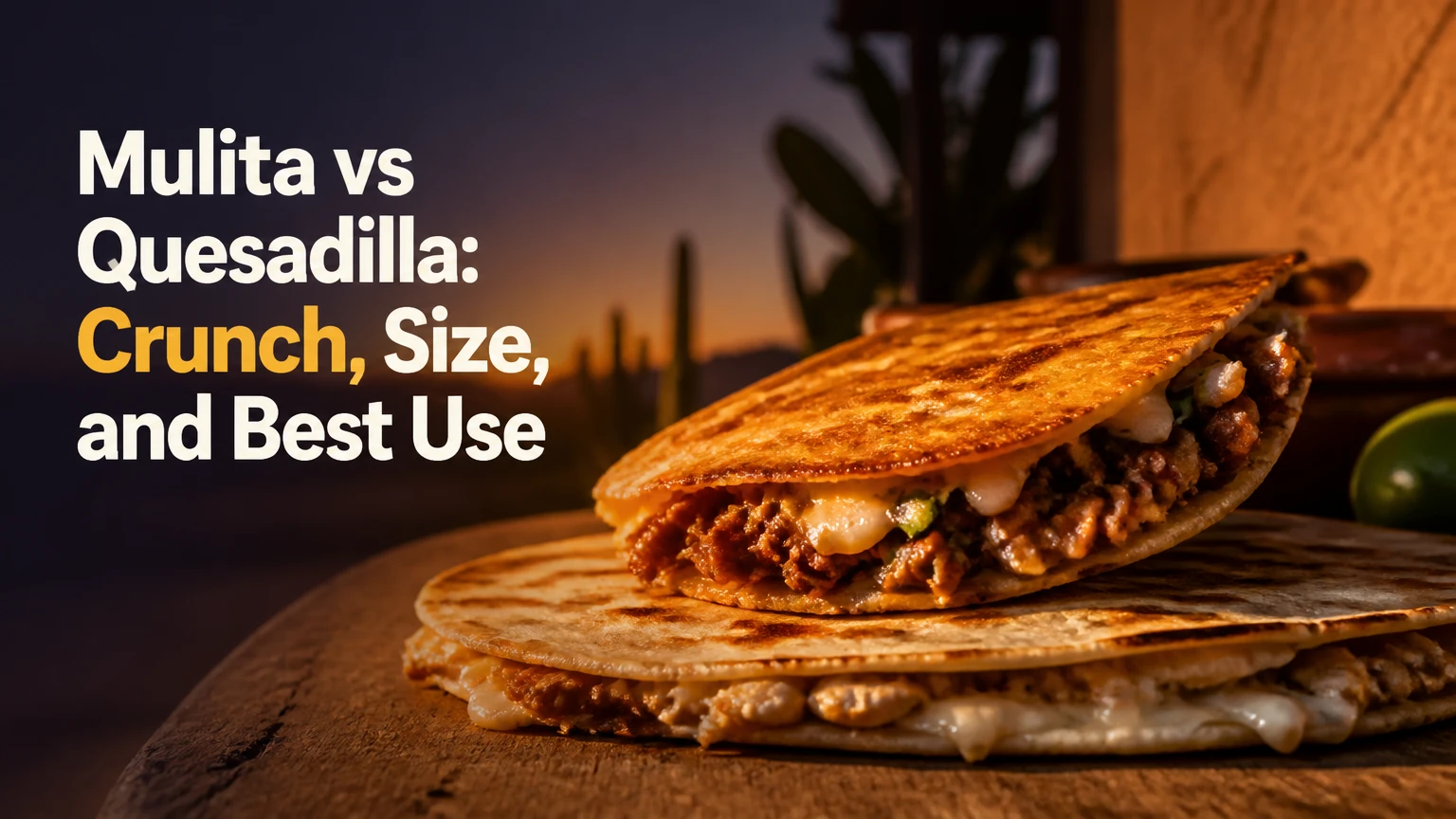
A mulita uses two tortillas stacked around melted cheese and usually chopped meat, creating a crisp Mexican street-food sandwich. A quesadilla uses one tortilla folded over cheese and optional fillings, producing a half-moon or sealed pocket. Choose a mulita for crunchy, meat-forward bites; choose a quesadilla for flexibility, larger portions, or a softer comal-cooked texture.
Key Facts at a Glance
- A mulita usually has two separate corn tortillas, while a folded quesadilla usually has one tortilla.
- A mulita is generally smaller, denser, and more structurally rigid than a quesadilla.
- A quesadilla may use corn or flour tortillas, depending on region, restaurant, and cooking style.
- Cheese is central to both dishes, but meat is more consistently prominent in a taco-shop mulita.
- A mulita usually delivers more crisp edges because both tortilla surfaces contact the griddle.
- A Mexico City quesadilla may be ordered without cheese unless the customer specifically requests it.
What Is the Structural Difference?
The defining difference is tortilla geometry: a mulita is a two-tortilla stack, while a conventional quesadilla is one tortilla folded around its filling. The mulita resembles a compact sandwich, and the quesadilla resembles a filled half-moon.
A typical mulita starts with one tortilla, cheese, chopped meat, and a second tortilla. The cook grills or fries the stack until the cheese bonds the layers. A quesadilla starts with a single tortilla, places filling on one side or across the whole surface, and folds or seals it before toasting.
The distinction matters when eating. A mulita distributes pressure across two rigid tortilla layers, so it holds dense meat and cheese without collapsing quickly. A quesadilla has a hinge or sealed edge, which makes it easier to open, fill, and customize but more vulnerable to tearing when overloaded.
Master Comparison Table
| Criterion | Mulita | Quesadilla | Practical consequence |
|---|---|---|---|
| Tortilla count | 2 separate tortillas | 1 folded tortilla, or 2 large tortillas in some restaurant styles | Mulita has a thicker outer shell |
| Common tortilla | 12-13 cm corn tortilla | 15-30 cm corn or flour tortilla | Quesadilla usually offers more surface area |
| Core filling | Cheese plus chopped meat | Cheese plus optional vegetables, meat, or beans | Quesadilla accommodates more combinations |
| Shape | Round, stacked sandwich | Half-moon, sealed pocket, or full round | Quesadilla is easier to portion into wedges |
| Typical cook time | 3-5 minutes | 2-4 minutes | Mulita needs more time for the center to heat |
| Texture | Crisp, firm, greasy when heavily oiled | Soft to crisp, depending on tortilla and fat | Quesadilla has a broader texture range |
| Typical street price | About $3.50-$6.00 each | About $4.00-$12.00 each | Size and fillings create greater quesadilla variation |
| Best use | Meat-forward taco stand order | Custom meal or adaptable home cooking | Choice depends on appetite and setting |
What Is a Mulita?
A mulita is a small, grilled or fried tortilla sandwich built from two tortillas, melted cheese, and commonly a chopped filling such as grilled beef, spit-roasted seasoned meat, or stewed beef. The name is commonly translated as “little mule,” although the food’s culinary identity comes from its taco-shop construction rather than from a single standardized recipe.
In Mexican street-food usage, mulitas are strongly associated with corn tortillas. The tortillas may be cooked with meat drippings, oil, or a lightly greased plancha, which creates crisp edges and a toasted corn aroma. Cheese melts between the layers and acts as both flavor and adhesive.
A mulita is not simply a quesadilla with extra filling. The second tortilla changes the ratio of starch, filling, and surface area, producing a denser bite and a more stable package. Taco stands often pair mulitas with salsa, onion, cilantro, lime, and sometimes a dipping broth.
What Is a Quesadilla?
A quesadilla is a tortilla filled with melted cheese and optional ingredients, then folded, sealed, or cooked as a full round. Corn and flour versions both exist, and the dish can range from a lightly toasted comal snack to a filled masa pocket that is fried.
The word refers to a broad family of preparations rather than one rigid shape. In many regions, a quesadilla means a folded tortilla with cheese. In parts of Mexico City, however, a quesadilla can contain ingredients such as squash blossom, mushrooms, or seasoned meat without cheese unless “con queso” is requested.
A flour quesadilla is typically larger and more pliable. A corn quesadilla has stronger toasted-maize flavor and can become crisp without much oil. A quesadilla frita uses raw or freshly prepared corn masa, seals the filling inside, and fries the finished pocket, making it materially different from a griddled folded tortilla.
Which Has the Better Texture?
The mulita is usually crispier and more rigid, while the quesadilla can range from soft and flexible to deeply crisp. Mulita texture comes from two tortilla surfaces and often added cooking fat; quesadilla texture depends more heavily on tortilla type, heat, thickness, and whether the dish is griddled or fried.
A mulita develops a crunchy exterior when its tortillas are warmed before assembly and pressed briefly against a moderately hot plancha. Cheese that escapes onto the cooking surface can form crisp browned edges, sometimes called a costra when the cheese itself becomes the browned crust.
A flour quesadilla stays supple because flour tortillas contain more fat and remain flexible after heating. A corn quesadilla becomes brittle faster, especially when cooked dry. Deep-fried quesadillas have the strongest crunch but also absorb more fat and can conceal very hot filling.
Texture verdict: Choose a mulita for layered crunch; choose a quesadilla when you want control over softness, toastiness, or frying.
Which Has More Filling and Meat?
A mulita usually has a higher meat-to-tortilla identity, while a large quesadilla can hold more total filling by weight. The result depends on tortilla diameter, but taco-shop mulitas generally contain about 45-75 grams of chopped filling, whereas a large quesadilla may contain 60-120 grams.
Mulita fillings are commonly chopped finely so the sandwich closes cleanly. Carne asada, al pastor, birria, cheese, onions, and cilantro fit well because small pieces distribute pressure evenly. Bulky lettuce, wet salsa, and large vegetable chunks tend to make the stack unstable.
Quesadillas accept larger pieces and a wider range of ingredients. Cooked mushrooms, squash blossom, shredded chicken, beans, roasted peppers, and potato can fill a 20-30 cm tortilla, although watery ingredients must be drained first.
Filling verdict: Choose a quesadilla for maximum volume and customization; choose a mulita for a concentrated meat-and-cheese bite.
Which Cheese Works Best?
Oaxaca cheese is the most useful all-purpose choice for either dish because it melts smoothly and stretches without releasing excessive water. Asadero, Chihuahua, and low-moisture mozzarella also work, while aged crumbly cheeses are better as accents than as the main melting layer.
| Cheese | Melt behavior | Stretch | Best application |
|---|---|---|---|
| Oaxaca | Smooth at 65-75°C | High | Mulita and corn quesadilla |
| Asadero | Soft, cohesive, mild | Medium-high | Griddle cooking |
| Chihuahua | Even melt, moderate salt | Medium | Flour quesadilla |
| Low-moisture mozzarella | Reliable, mild | High | Home substitute |
| Monterey Jack | Fast melt, rich texture | Medium | Large flour quesadilla |
| Cotija | Minimal melt, salty | Low | Finishing sprinkle, not structural glue |
Use about 35-50 grams of shredded cheese for a small mulita and 50-80 grams for a 20-25 cm quesadilla. Cheese should touch the tortilla directly, because it forms a barrier that limits moisture transfer from meat and vegetables.
Cheese verdict: Oaxaca gives both dishes the most balanced melt, while Chihuahua or Monterey Jack suits a larger flour quesadilla.
How Are Mulitas and Quesadillas Cooked?
Both dishes need moderate direct heat, usually around 175-205°C on a griddle, so the tortilla browns while the cheese melts. The main difference is assembly: a mulita is stacked and flipped as one unit, while a quesadilla is folded or sealed after its filling is placed.
Mulita Method
- Warm two 12-13 cm corn tortillas for 20-30 seconds per side. Flexible tortillas resist cracking during the flip.
- Place the first tortilla on a lightly greased plancha.
- Add 35-50 grams of melting cheese across the center.
- Add 45-75 grams of finely chopped cooked meat.
- Add onions or cilantro in a restrained layer, keeping wet salsa off the interior.
- Cap the filling with the second tortilla.
- Cook for 90-120 seconds, flip carefully, and cook another 90-120 seconds.
- Press lightly for 10-15 seconds, then serve immediately.
You will know the mulita is ready when both tortillas show browned spots and the cheese holds the layers together. The common mistake is using a cold, rigid tortilla, which splits when the sandwich is turned.
Quesadilla Method
- Heat one 15-30 cm corn or flour tortilla on a dry or lightly greased pan.
- Place 50-80 grams of cheese over half the tortilla.
- Add 60-120 grams of dry, cooked filling.
- Fold the empty half over the filling.
- Cook for 60-90 seconds per side, pressing the top gently.
- Rest for 30-60 seconds before cutting, so the cheese thickens slightly.
A quesadilla is ready when the tortilla has toasted spots and the folded edge stays closed without force. Overfilling is the main failure: a 25 cm tortilla should remain below roughly 2.5 cm of filling height.
Preparation Comparison
| Preparation detail | Mulita | Folded quesadilla | Why it matters |
|---|---|---|---|
| Tortilla size | 12-13 cm | 15-30 cm | Smaller size improves mulita stability |
| Cheese quantity | 35-50 g | 50-80 g | Larger quesadillas need more adhesive |
| Filling quantity | 45-75 g | 60-120 g | Quesadilla has greater capacity |
| First cook | 90-120 seconds | 60-90 seconds | Stacked mulita heats more slowly |
| Flip method | Turn the complete stack | Turn the folded half-moon | Mulita needs flexible tortillas |
| Rest time | 15-30 seconds | 30-60 seconds | Larger cheese mass needs more setting time |
How Do Regional Styles Change the Answer?
Regional practice changes the definition of a quesadilla more dramatically than the definition of a mulita. Mulitas are widely recognized as two tortillas with cheese and a filling, especially in taco-shop contexts, while quesadillas vary in tortilla, shape, cheese requirement, and cooking method.
In Mexico City, vendors may sell quesadillas with fillings such as huitlacoche, squash blossom, mushrooms, or chicharrón and ask customers whether they want cheese. In other parts of Mexico and in many restaurants outside Mexico, cheese is assumed by the word quesadilla.
The term “quesadilla” also covers fried masa pockets. A quesadilla frita is made from raw corn dough, filled, sealed, and submerged in hot oil. That preparation should not be compared directly with a lightly toasted flour quesadilla because the shell, cooking medium, and moisture level differ.
| Style | Region or setting | Tortilla base | Typical filling | Cooking method |
|---|---|---|---|---|
| Mulita de asada | Taco stands in northern and western Mexico, plus Mexican restaurants abroad | 2 corn tortillas | Chopped grilled beef and Oaxaca cheese | Greased plancha |
| Mulita de al pastor | Taco shops | 2 corn tortillas | Spit-roasted seasoned meat, onion, cilantro | Griddle |
| Mulita de birria | Birria-focused stands | 2 corn tortillas | Stewed beef and melted cheese | Broth-tinted griddle |
| Quesadilla de comal | Home kitchens and markets | Corn or flour tortilla | Cheese, vegetables, or meat | Dry or lightly greased comal |
| Quesadilla frita | Central Mexican market stalls | Fresh corn masa | Cheese, potato, mushrooms, or meat | Deep-fried |
| Sincronizada | Mexican home cooking and restaurants | 2 flour tortillas | Ham-style sliced filling and cheese | Griddled and cut into wedges |
Is a Mulita a Taco or a Quesadilla?
A mulita is closer to a taco sandwich than to a standard folded quesadilla, but the categories overlap because both use tortillas, cheese, and cooked fillings. A taco normally uses one folded tortilla without a second tortilla enclosing the filling, while a mulita uses two tortillas as a closed stack.
A quesadilla can resemble a mulita when two large flour tortillas are layered with cheese and cut into wedges. That preparation is often called a sincronizada when it includes a sliced filling between the tortillas. Shape alone therefore cannot settle every menu dispute.
The most reliable test is construction. Two small tortillas stacked around cheese and taco filling indicate a mulita. One tortilla folded around cheese indicates a conventional quesadilla. Two large tortillas used as top and bottom layers indicate a quesadilla-style sandwich or sincronizada, depending on local terminology.
Category verdict: Order by the vendor’s stated name, but use tortilla count and tortilla size to identify the actual preparation.
How Much Do They Usually Cost?
A typical mulita costs about $3.50-$6.00 per piece, while a quesadilla costs about $4.00-$12.00 because quesadillas vary from small market snacks to large restaurant meals. Prices change with city, meat, cheese, portion size, and whether the dish includes sides.
A meat-heavy mulita may cost more than a plain cheese quesadilla even when the mulita is smaller. Birria versions often sit at the upper end because the meat requires a long braise and may include consomé for dipping.
Quesadillas with vegetables or beans usually cost less than versions with grilled beef or birria. Restaurant menus may also price a large quesadilla as an entrée, adding salad, rice, or beans that are not part of the core dish.
| Item | Typical portion | Typical price | Typical cook time | Main price driver |
|---|---|---|---|---|
| Cheese mulita | 1 small sandwich | $2.50-$4.00 | 3-4 minutes | Cheese and tortilla |
| Mulita de asada | 1 small sandwich | $3.50-$6.00 | 3-5 minutes | Grilled beef |
| Mulita de birria | 1 sandwich plus broth | $5.00-$8.00 | 4-6 minutes | Stewed meat and consomé |
| Small corn quesadilla | 1 folded tortilla | $2.50-$5.00 | 2-3 minutes | Cheese or vegetable filling |
| Large flour quesadilla | 1 20-30 cm tortilla | $6.00-$12.00 | 3-5 minutes | Size and meat |
| Quesadilla frita | 1 fried masa pocket | $3.00-$7.00 | 5-8 minutes | Filling and frying oil |
Which Is Lighter?
A corn quesadilla cooked on a dry comal with vegetables is usually the lighter option, but no dish has a fixed calorie count. A small meat mulita commonly lands around 350-500 calories, while a large flour quesadilla can reach 450-750 calories before toppings or sides.
The largest variables are tortilla diameter, cheese mass, meat fat, and added cooking oil. Two small corn tortillas do not automatically make a mulita heavier than one large flour tortilla, because a 30 cm flour tortilla can contain substantially more starch and fat.
Typical nutrition estimates should be treated as meal-planning ranges, not laboratory measurements. Restaurant portions vary enough that weighing tortillas and cheese gives a more useful home estimate than relying on the dish name.
Lighter-choice verdict: Choose a dry-cooked corn quesadilla with mushrooms, squash blossom, or shredded chicken when reducing fat and portion size matters most.
Which Should You Choose?
The mulita is the better choice for crispness, compact meat portions, and taco-stand eating. The quesadilla is better for larger servings, flexible fillings, flour tortillas, and home preparation.
For the Crunch Seeker
Choose a mulita de asada or mulita de birria. Two tortillas create more browned surface, and the compact shape lets melted cheese contact the plancha without exposing a large wet interior.
For a Flexible Home Meal
Choose a quesadilla. One tortilla, 50-80 grams of cheese, and a measured filling can be assembled in under five minutes, and the format accepts leftovers more easily than a small mulita.
For a Larger Appetite
Choose a large quesadilla with 80-120 grams of filling, or order multiple mulitas. A quesadilla offers more total capacity, but a pair of mulitas can provide better portion control and more crisp edges.
For a Soft, Toasted Texture
Choose a flour quesadilla cooked over medium heat. Flour tortillas bend without cracking and remain softer after cooling than thin corn tortillas.
For a Birria Order
Choose a mulita when the goal is a crisp tortilla with a rich meat filling and dipping broth. Keep the consomé on the side until eating, because soaking the sandwich beforehand removes the texture that defines it.
What Are the Main Failure Modes?
Wet ingredients, excessive heat, and overloaded tortillas cause most mulita and quesadilla problems. Cheese placement, moisture control, and medium heat solve nearly every common failure without requiring special equipment.
- Soggy bottom: Drain meat, mushrooms, and salsa before assembly. Add pico de gallo, lime, and watery salsa after cooking.
- Burned tortilla with unmelted cheese: Reduce the pan to medium heat, cover for 30-60 seconds, and use finer cheese shreds.
- Cracked mulita tortillas: Warm corn tortillas for 20-30 seconds per side before stacking.
- Quesadilla opening during the flip: Reduce filling by 20-30 grams and leave a 1.5 cm clean border around the edge.
- Rubbery flour tortilla: Avoid prolonged low heat after the cheese melts. Serve within two minutes.
- Greasy fried quesadilla: Maintain oil near 175-185°C and drain the finished pocket vertically on a rack.
A practitioner rule of thumb is to fix moisture before adding more heat. Extra heat browns the exterior faster, but it does not remove water trapped inside cheese and filling.
Can You Store or Reheat Them?
Mulitas and quesadillas are best immediately after cooking, but both can be refrigerated for up to three days in a sealed container. Reheat them on a dry skillet or toaster oven rather than in a microwave if crispness matters.
Cool the food uncovered for 10-15 minutes before sealing it. Closing a steaming tortilla in a container traps condensation, which softens the exterior and can make corn tortillas tear during reheating.
Reheat at approximately 175°C for 5-8 minutes in a toaster oven, or over medium-low heat for 2-3 minutes per side in a skillet. Add fresh salsa, onion, cilantro, and lime only after reheating.
What Should You Say When Ordering?
Ordering language varies by region, but a precise request reduces confusion. Ask for the dish name, filling, cheese preference, and salsa separately.
Useful phrases include:
- Una mulita de asada, por favor: One steak mulita, please.
- Una quesadilla de flor de calabaza con queso: A squash-blossom quesadilla with cheese.
- El queso aparte: The cheese on the side.
- La salsa aparte: The salsa on the side.
- Con consomé: With dipping broth.
- Sin cebolla: Without onion.
At a Mexico City stand, specify con queso if cheese is important. At many restaurants outside Mexico, the default quesadilla already includes cheese, but confirming the filling and tortilla type remains useful.
FAQ
Is a mulita always made with corn tortillas?
A traditional taco-shop mulita usually uses two small corn tortillas, particularly in Mexican street-food settings. Some restaurants use flour tortillas or larger tortillas for local preference, so corn is a strong convention rather than an absolute rule. Tortilla count and stacked construction identify the dish more reliably than corn alone.
Can a quesadilla have no cheese?
Yes. In parts of Mexico City, vendors may call a filled tortilla a quesadilla even when it contains no cheese, so customers often specify “con queso.” In many other regions and in international restaurants, cheese is assumed. The local menu convention determines the default.
Which one is easier for beginners?
A flour quesadilla is easier for beginners because the tortilla remains flexible, the filling is visible before folding, and the dish does not require flipping two separate layers as one small sandwich. A mulita becomes straightforward after tortillas are warmed and the filling is kept finely chopped and relatively dry.
Are birria tacos and birria mulitas the same?
Birria tacos usually use one tortilla folded around stewed meat, while a birria mulita uses two tortillas, melted cheese, and the same type of seasoned meat. Both may be dipped in broth before grilling, but the mulita has a thicker sandwich structure and more cheese surface.
What is a sincronizada?
A sincronizada is generally made with two flour tortillas layered with cheese and a sliced filling, often a ham-style ingredient, then griddled and cut into wedges. It resembles a large quesadilla but differs from a small corn mulita in tortilla size, filling style, and presentation.
Which dish stays crisp longer?
A mulita usually stays structurally crisp longer because its two tortillas create a thicker outer barrier, although added broth or wet salsa quickly softens it. A quesadilla loses crispness faster when oversized, heavily filled, or sealed in a container while still steaming.
The Bottom Line
Mulita vs quesadilla is primarily a choice between a compact, two-tortilla meat sandwich and a flexible, folded tortilla meal. Choose a mulita for crisp corn tortillas, melted cheese, chopped meat, and street-food texture. Choose a quesadilla for larger portions, flour or corn options, vegetable fillings, easier home cooking, and control over softness or crunch.