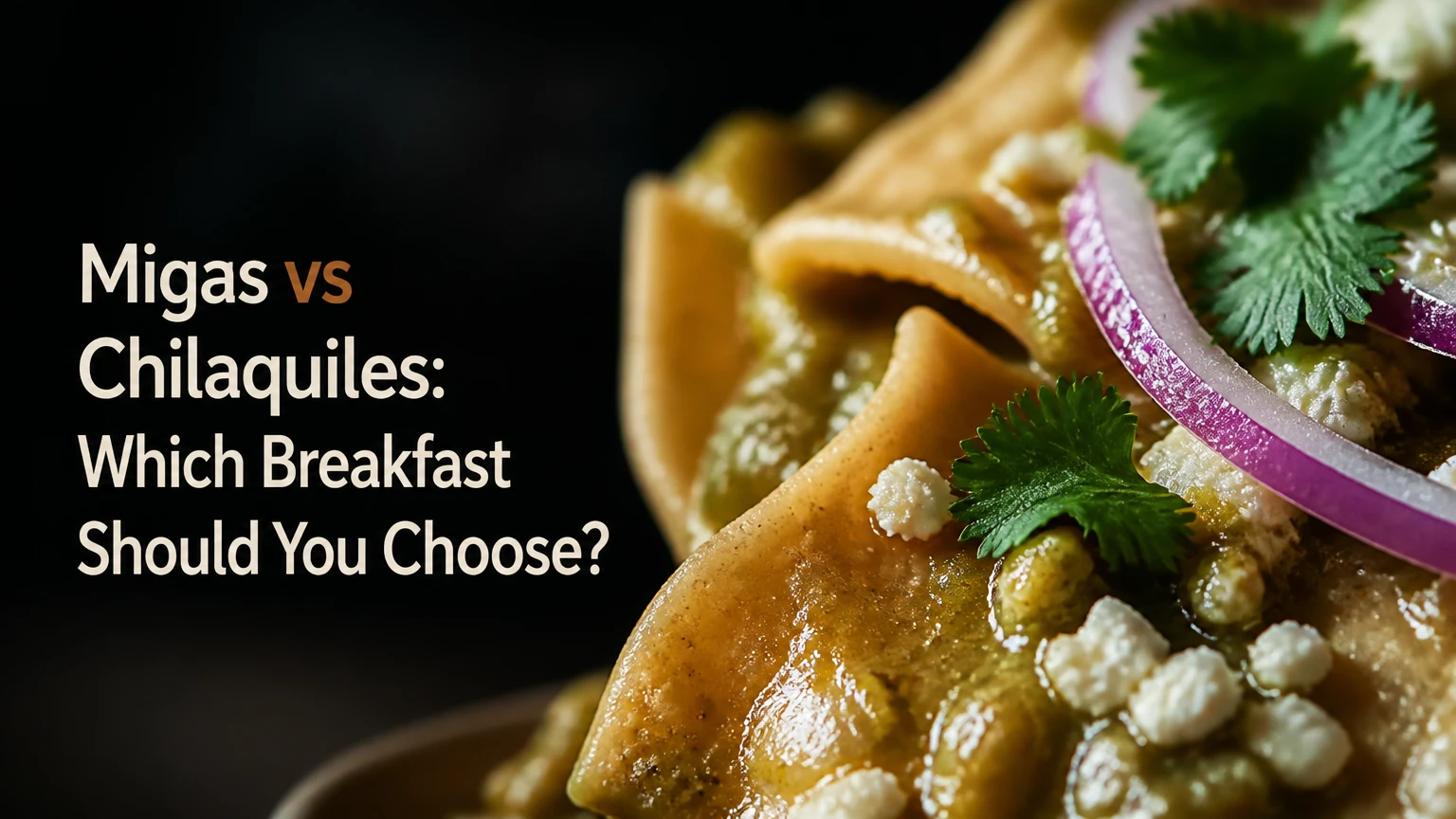
Migas and chilaquiles both use corn tortillas, but they are built differently. Chilaquiles are crisp tortilla chips softened in salsa, while Tex-Mex migas are scrambled eggs folded with fried tortilla pieces and vegetables. Choose chilaquiles for saucy, layered texture; choose migas for a faster, protein-forward skillet breakfast.
Key Facts at a Glance
- Chilaquiles combine fried corn tortilla chips with warm salsa, then receive toppings such as crema, queso fresco, onion, and eggs.
- Tex-Mex migas combine crisp tortilla strips or pieces with scrambled eggs, onion, tomato, chile, and often melted cheese.
- Chilaquiles are sauce-forward and have a short serving window before the chips become soft.
- Tex-Mex migas usually take about 15 minutes, while scratch-made chilaquiles commonly take 25-45 minutes.
- Spanish migas are a separate regional dish made from moistened stale wheat bread, garlic, olive oil or cooking fat, cured sausage, and paprika.
- Neither dish has one universal recipe, so the local meaning of “migas” should be confirmed before ordering.
Migas vs Chilaquiles: The Core Difference
The defining difference is where moisture enters the dish. Chilaquiles expose fried tortilla chips to salsa, allowing the chips to absorb liquid and become tender with a slight chew. Tex-Mex migas add tortilla pieces to eggs during scrambling, so coagulating egg binds the pieces while leaving some crisp or chewy pockets.
That construction changes the entire eating experience. Chilaquiles resemble a composed plate of sauced totopos, with acidity and chile leading the flavor. Migas resemble a skillet scramble, with egg, vegetables, and cheese providing the main body.
The comparison becomes confusing because “migas” has several regional meanings. In Texas and parts of northern Mexico, the word commonly refers to the egg-and-tortilla breakfast. In Spain, migas generally refers to seasoned fried breadcrumbs, often made with stale wheat bread. The Spanish dish is related by thrift and technique, not by its final ingredients or presentation.
| Attribute | Chilaquiles | Tex-Mex migas | Spanish migas |
|---|---|---|---|
| Main starch | Fried corn tortilla chips | Fried corn tortilla strips or pieces | Stale wheat bread crumbs |
| Binding component | Warm salsa | Scrambled eggs | Oil or cooking fat |
| Typical cooking time | 25-45 minutes | About 15 minutes | About 35-45 minutes |
| Primary texture | Soft, chewy, partly crisp | Tender egg with crisp-chewy pieces | Crisp outside, tender inside |
| Usual serving style | Plated and topped | Served directly from a skillet | Rustic plate or shared pan |
| Common flavor base | Tomatillo or chile-tomato salsa | Onion, tomato, fresh chile | Garlic, paprika, cured sausage |
| Typical accompaniments | Crema, queso fresco, onion, cilantro | Beans, cheese, avocado, flour tortillas | Grapes, fried egg, peppers |
How Are the Dishes Constructed?
Chilaquiles are starch-forward, while Tex-Mex migas are protein-forward. The distinction is practical: chilaquiles depend on controlling liquid contact, whereas migas depend on controlling egg heat and curd formation.
Chilaquiles Use Controlled Absorption
A chilaquiles cook fries or bakes corn tortilla wedges until they are rigid, then coats them with hot salsa for roughly 30-60 seconds. Surface starch absorbs the sauce first; a thick chip preserves more structure than a thin commercial chip because its center takes longer to soften.
Sauce temperature matters. Warm salsa coats evenly without requiring prolonged simmering, while boiling chips in sauce for several minutes produces a paste-like texture. Many cooks pour salsa over chips immediately before serving rather than tossing everything in a deep pan.
Migas Use Egg Coagulation
Tex-Mex migas begin with tortilla pieces that are fried or crisped separately. Aromatics cook before the eggs are added, and the heat drops to medium-low so the eggs form soft curds instead of dry fragments.
Egg proteins set around 145-160°F, although the skillet continues cooking after removal from the burner. Pulling the pan while the eggs still look slightly glossy prevents rubbery curds and preserves the tortilla’s contrast.
Which Regional Variations Matter?
Chilaquiles vary mainly through salsa and toppings. Migas vary more radically because the same name can describe an egg breakfast in Texas or a bread dish in Spain.
| Variation | Base ingredients | Sauce or seasoning | Typical toppings or sides | Best description |
|---|---|---|---|---|
| Chilaquiles verdes | Corn chips, eggs or chicken | Tomatillo, jalapeño, garlic | Crema, queso fresco, cilantro | Tart and herbal |
| Chilaquiles rojos | Corn chips, eggs or meat | Tomato, guajillo, ancho chile | Onion, cotija, avocado | Earthy and chile-rich |
| Chilaquiles divorciados | Corn chips, divided portions | Red salsa and green salsa | Egg, crema, queso | Two sauces on one plate |
| Tex-Mex migas | Tortilla pieces and eggs | Tomato, onion, serrano or jalapeño | Cheddar, Monterey Jack, beans | Savory and skillet-oriented |
| Migas poblanas | Tortilla pieces and eggs | Poblano cream sauce | Rajas, panela cheese | Mild, creamy, smoky |
| Spanish migas | Moistened stale wheat bread | Garlic, paprika, olive oil | Cured sausage, grapes, fried egg | Rustic and bread-forward |
Chilaquiles verdes are usually the sharper choice because tomatillo supplies acidity that cuts through crema and fried chips. Chilaquiles rojos deliver a deeper chile profile, especially when dried ancho or guajillo peppers are toasted before blending.
Divorciados are a presentation format rather than a third sauce family. A plate receives red salsa on one side and green salsa on the other, allowing the diner to compare acidity, heat, and chile flavor in one serving.
How Does Texture and Sauce Differ?
Chilaquiles deliver the stronger sauce experience, while migas deliver the more consistent egg-and-tortilla bite. Chilaquiles can contain crisp, chewy, and soft chips on one plate; migas distribute tortilla pieces through egg curds and usually remain less wet.
| Texture and flavor factor | Chilaquiles | Tex-Mex migas | Practical consequence |
|---|---|---|---|
| Sauce quantity | About 1-1.5 cups per 4 ounces of chips | Usually 0-3 tablespoons of cooking liquid | Chilaquiles taste wetter |
| Crispness window | Roughly 1-5 minutes after saucing | About 5-10 minutes after cooking | Chilaquiles need faster service |
| Acid level | Medium-high with tomatillo or tomato chile salsa | Low-medium unless hot sauce is added | Chilaquiles taste brighter |
| Egg role | Optional topping or added protein | Structural part of the dish | Migas are naturally egg-centered |
| Cheese role | Cool garnish, often queso fresco | Melting finish, often Jack or Cheddar | Cheese changes the dish differently |
| Bite distribution | Separate chips with uneven softening | Small tortilla pieces inside egg curds | Migas provide more uniform spoonfuls |
A useful practitioner rule is to sauce only the amount of chilaquiles that will be eaten immediately. Holding sauced chips in a warm oven does not preserve crunch; it accelerates softening because heat keeps moisture moving into the tortilla.
Which Ingredients and Substitutions Work?
Thick day-old corn tortillas produce the best chilaquiles and migas texture, but sturdy store-bought totopos can work when frying is impractical. The substitution changes the cooking time, not the identity of the dish.
Choosing the Tortilla
Use tortillas about 1.5-2 millimeters thick when possible. Cut six-inch tortillas into six or eight wedges for chilaquiles, or into 1/2-inch strips and small squares for migas.
Packaged chips should be added later than homemade chips because thin chips absorb salsa quickly. If using them for chilaquiles, warm the salsa separately and fold for no more than 20-30 seconds.
Choosing the Salsa
Tomatillo salsa gives chilaquiles verdes a tart, grassy flavor. Tomato and dried-chile salsa creates chilaquiles rojos with a darker, rounder profile. A smooth salsa coats chips more evenly, while a coarse salsa leaves pockets of concentrated flavor.
Migas do not require a separate salsa. Diced tomato, onion, and fresh chile provide moisture and aroma, while a spoonful of red or green salsa can be added at the table without changing the egg structure.
| Ingredient decision | Recommended amount for two servings | Useful substitute | Resulting change |
|---|---|---|---|
| Corn tortillas | 6-8 six-inch tortillas | 4 ounces thick totopos | Faster, less control over thickness |
| Eggs for migas | 4 large eggs | 3 eggs plus 1/2 cup beans | Lower egg richness, more fiber |
| Chilaquiles salsa | 1.5-2 cups | Prepared salsa of the same color | Shorter cooking time |
| Fresh chile | 1 serrano or 1/2 jalapeño | 1/4 teaspoon ground chile | Less fresh aroma |
| Crema | 3-4 tablespoons | Plain unsweetened yogurt | Tangier, thinner garnish |
| Queso fresco | 2-3 ounces | Feta or mild farmer cheese | Saltier or creamier finish |
| Corn tortillas for gluten-free meals | 6-8 certified corn tortillas | None if contamination matters | Check package labeling |
For dairy-free plates, omit crema and cheese, then finish with avocado, onion, cilantro, or toasted pumpkin seeds. For vegetarian migas, use oil and beans instead of meat-based additions. For gluten-free diners, verify that tortillas, chips, seasonings, and prepared salsa share no wheat contamination.
How Much Time and Money Do They Require?
Tex-Mex migas typically cost $2-$5 per home serving and take about 15 minutes. Chilaquiles usually cost $3-$8 per home serving and take 25 minutes with prepared salsa or 40-45 minutes with homemade salsa and fried tortillas.
These are typical home-cooking ranges in the United States, not fixed prices. Restaurant prices vary by city, portion size, egg quality, meat additions, and whether the plate includes beans or specialty toppings.
| Dish and setting | Typical time | Typical home cost per serving | Typical restaurant price | Equipment |
|---|---|---|---|---|
| Tex-Mex migas at home | 15 minutes | $2-$5 | Not applicable | One skillet |
| Chilaquiles with prepared salsa | 25 minutes | $3-$6 | Not applicable | Skillet and blender optional |
| Chilaquiles from scratch | 40-45 minutes | $4-$8 | Not applicable | Pan, skillet, blender |
| Spanish migas at home | 35-45 minutes | $4-$9 | Not applicable | Heavy skillet |
| Casual taqueria plate | 20-30 minutes service time | Not applicable | $9-$13 | Commercial griddle |
| Brunch restaurant plate | 20-35 minutes service time | Not applicable | $14-$19 | Commercial kitchen |
Chilaquiles cost more when the recipe includes frying oil, fresh tomatillos, several chiles, crema, cheese, and a separate protein. Migas remain economical because eggs, tortillas, onion, and tomato cover most of the dish.
How Do Nutrition and Dietary Needs Compare?
Migas usually provide more directly integrated protein because eggs form the main structure. Chilaquiles can match or exceed that protein when topped with two eggs, beans, chicken, or another substantial ingredient, but plain chilaquiles are primarily a tortilla-and-salsa meal.
A typical two-egg serving of migas contains roughly 12-14 grams of egg protein before cheese or beans. Two eggs on chilaquiles provide a similar amount, while 1/2 cup of cooked beans adds approximately 7-8 grams of protein. These are ingredient-based estimates, not laboratory nutrition values.
| Nutrition driver | Chilaquiles example | Migas example | Main variable |
|---|---|---|---|
| Egg protein | 0-2 eggs, 0-14 grams | 2 eggs, about 12-14 grams | Number of eggs |
| Tortilla load | 4 ounces chips or 6-8 tortillas | 3-4 tortillas for two servings | Portion size |
| Added fat | Frying oil plus crema or cheese | Cooking oil plus cheese | Frying method |
| Fiber | Salsa, onion, beans, avocado | Tomato, onion, beans, avocado | Side dishes |
| Dairy | Optional crema and cheese | Often cheese, optional cream | Toppings |
| Wheat exposure | Usually none with corn tortillas | Flour tortillas may accompany the plate | Side selection |
Neither dish automatically qualifies as light. A large fried-chip portion with cheese and crema can contain more energy than a modest serving of migas, while migas can become equally rich when cooked in substantial fat and covered with cheese.
Which Dish Stores and Reheats Better?
Migas are the better leftover choice, although freshly cooked eggs still provide the best texture. Chilaquiles should be stored as separate chips and salsa whenever possible because combined leftovers lose crispness and become soft during refrigeration.
For migas, cool leftovers within two hours, refrigerate them in a sealed container, and use them within three to four days. Reheat gently in a covered skillet with one teaspoon of water per serving, stopping when the eggs are hot rather than dry.
| Storage question | Chilaquiles | Tex-Mex migas | Best practice |
|---|---|---|---|
| Refrigerated quality | Poor once chips meet salsa | Fair for 1-3 days | Store components separately |
| Reheating method | Skillet for salsa, fresh chips added later | Low skillet heat or microwave | Avoid high heat |
| Freezing | Not recommended | Not recommended | Egg and tortilla texture suffer |
| Best packed lunch format | Chips, salsa, toppings separate | Migas with beans separate | Reassemble after reheating |
| Maximum quality window | Same meal, ideally 1 hour | Same day, acceptable by day 2 | Cook smaller portions |
This is one area where the dishes reverse expectations. Chilaquiles often taste more complex as the salsa rests, but the chips cannot retain their intended texture after prolonged contact with that sauce.
How Can You Avoid Common Failures?
Chilaquiles fail when the chips absorb too much liquid or when the salsa lacks enough concentration to coat them. Migas fail when the tortilla pieces are not crisped first or when eggs are cooked aggressively.
| Failure | Likely cause | Immediate fix | Prevention |
|---|---|---|---|
| Chilaquiles turn to paste | Thin chips or long simmering | Add fresh chips and serve immediately | Use thick chips and 30-60 seconds of contact |
| Chips remain dry | Salsa too thick or too little | Add 1-2 tablespoons warm salsa | Measure sauce before combining |
| Salsa tastes flat | Insufficient salt or acidity | Add lime juice or salt gradually | Taste after blending and simmering |
| Migas become watery | Wet vegetables or excess liquid | Cook uncovered until moisture reduces | Drain tomatoes and avoid milk-heavy eggs |
| Migas become rubbery | High heat or overcooking | Remove pan and fold gently | Stop while eggs remain glossy |
| Tortilla pieces disappear | Pieces were too thin or soft | Add freshly crisped pieces | Fry thicker strips before eggs |
One counterintuitive rule matters: adding more salsa does not rescue dry chilaquiles indefinitely. Excess liquid changes the starch structure, so the correct fix is often better chip thickness and shorter contact time rather than a larger sauce quantity.
Another expert rule concerns salt. Salt the chips immediately after frying, then season the salsa separately; salting only the finished plate leaves the chips underseasoned while the toppings become overly salty.
When Should You Serve Each Dish?
Serve chilaquiles when sauce, contrast, and presentation matter more than speed. Serve migas when the meal must be hot, filling, adaptable, and ready from one skillet.
Choose Chilaquiles for a Brunch Plate
Chilaquiles work well for a weekend breakfast because the salsa can be made in advance and the final assembly takes less than five minutes. Fried eggs, shredded chicken, beans, crema, queso fresco, and avocado turn the base into a composed meal.
Chilaquiles are less suitable for buffet service unless chips and salsa remain separate. A serving line exposes every portion to additional holding time, so the first plate may retain chew while the last plate becomes soft.
Choose Migas for a Fast Family Breakfast
Migas are more forgiving when diners arrive at different times. The cook can prepare vegetables and tortilla pieces first, then scramble eggs in batches, although the eggs should not sit on a hot burner after reaching their final texture.
Migas also accept substitutions easily. Use leftover roasted vegetables, beans, cooked greens, or a small amount of prepared salsa, provided the pan does not become wet enough to steam the tortilla pieces.
Which Dish Should You Choose?
The better dish depends on the desired texture, available time, and serving format. Chilaquiles win for saucy complexity and visual presentation, while Tex-Mex migas win for speed, integrated protein, and one-pan flexibility.
Choose Chilaquiles If You Want Salsa
Chilaquiles are the stronger choice for diners who prioritize tomatillo acidity, chile depth, crema, and a changing chip texture. Choose them when you can serve the plate immediately and have at least 25 minutes for preparation.
Chilaquiles are also the better choice for comparing sauces. A red-and-green divorciados plate provides two flavor profiles without requiring two separate breakfasts.
Choose Migas If You Have 15 Minutes
Tex-Mex migas are the practical winner for a rushed morning. Four eggs, three or four tortillas, onion, tomato, and fresh chile can produce two servings in one skillet with minimal cleanup.
Migas are also preferable when protein must be part of every bite. Eggs bind the tortilla pieces rather than appearing as a separate topping, and beans or cheese can increase satiety without requiring a separate sauce.
Choose Spanish Migas for a Bread-Based Dish
Spanish migas are the right choice when the intended dish is rustic fried breadcrumbs rather than Mexican tortilla breakfast. Stale wheat bread, garlic, paprika, cooking fat, and regional additions create a different category of comfort food.
Spanish migas are not an alternative preparation method for chilaquiles. They share a leftover-starch origin, but wheat bread, seasoning, cooking fat, and serving customs give them a separate culinary identity.
Choose Neither Dish for Advance Meal Prep
Neither dish is ideal for a five-day meal-prep schedule. Chilaquiles lose chip structure, and migas lose egg tenderness; overnight storage is acceptable, but quality declines with each reheating cycle.
For advance preparation, store salsa, fried tortilla pieces, cooked beans, and raw egg mixture separately. Assemble chilaquiles at service, or cook a fresh small batch of migas in under 10 minutes.
| Situation | Recommended dish | Why | What to avoid |
|---|---|---|---|
| Breakfast before work | Tex-Mex migas | About 15 minutes and one skillet | Large wet salsa additions |
| Weekend brunch | Chilaquiles verdes | Sauce and topping presentation | Holding sauced chips |
| High-protein plate | Migas with beans | Eggs bind every portion | Overcooking the curds |
| Sauce comparison | Chilaquiles divorciados | Red and green salsa together | Using thin chips |
| Leftover use | Migas | Reheats more reliably | Freezing the eggs |
| Spanish regional meal | Spanish migas | Bread, garlic, paprika profile | Substituting corn chips |
| Gluten-free breakfast | Corn-based chilaquiles or migas | Corn tortillas avoid wheat | Flour tortilla sides |
| Crowd buffet | Component-style chilaquiles | Guests assemble portions | Mixing all chips early |
The Bottom Line
Migas and chilaquiles are not interchangeable tortilla breakfasts. Chilaquiles use salsa to transform fried chips into a saucy, chewy plate, while Tex-Mex migas use eggs to bind crisp tortilla pieces into a fast skillet meal. Choose chilaquiles for sauce and immediate service, or migas for speed, protein, and flexibility.
Frequently Asked Questions
Are chilaquiles always made with eggs?
Chilaquiles do not require eggs. Eggs are a common topping, usually fried or scrambled, but the base dish consists of fried corn tortilla chips and salsa with garnishes such as crema, cheese, onion, and cilantro. Beans, chicken, or avocado can provide additional substance without adding eggs.
Can I make chilaquiles with store-bought tortilla chips?
Store-bought chips work when they are thick and sturdy, but thin chips soften rapidly. Use about 4 ounces of heavy tortilla chips with 1-1.5 cups of warm salsa, fold for 20-30 seconds, and plate immediately. Homemade fried tortillas offer better control over thickness and salt.
Do migas need cheese?
Migas do not need cheese. Tex-Mex versions often use Monterey Jack, Cheddar, or another melting cheese, but eggs, crisp tortilla pieces, onion, tomato, and chile create a complete dish without it. Beans, avocado, cilantro, or a spoonful of salsa can replace the richness of cheese.
Are migas and tortilla española the same?
Migas and tortilla española are different dishes. Migas use fried tortilla pieces with scrambled eggs in the Tex-Mex tradition, while tortilla española is a set egg dish built around sliced potato and onion. The shared egg component does not make their techniques or textures equivalent.
Which dish is spicier, migas or chilaquiles?
Chilaquiles are often spicier because the salsa concentrates roasted chiles, tomatillos, or dried peppers across the entire plate. Migas usually receive fresh jalapeño or serrano in smaller quantities, although either dish can be mild or hot depending on the cook.
Can chilaquiles and migas use the same tortillas?
Both dishes can use the same day-old corn tortillas, but the cut and timing differ. Chilaquiles need larger wedges that resist salsa, while migas benefit from smaller strips or squares that distribute through egg curds. Fry or crisp both formats before adding moisture.