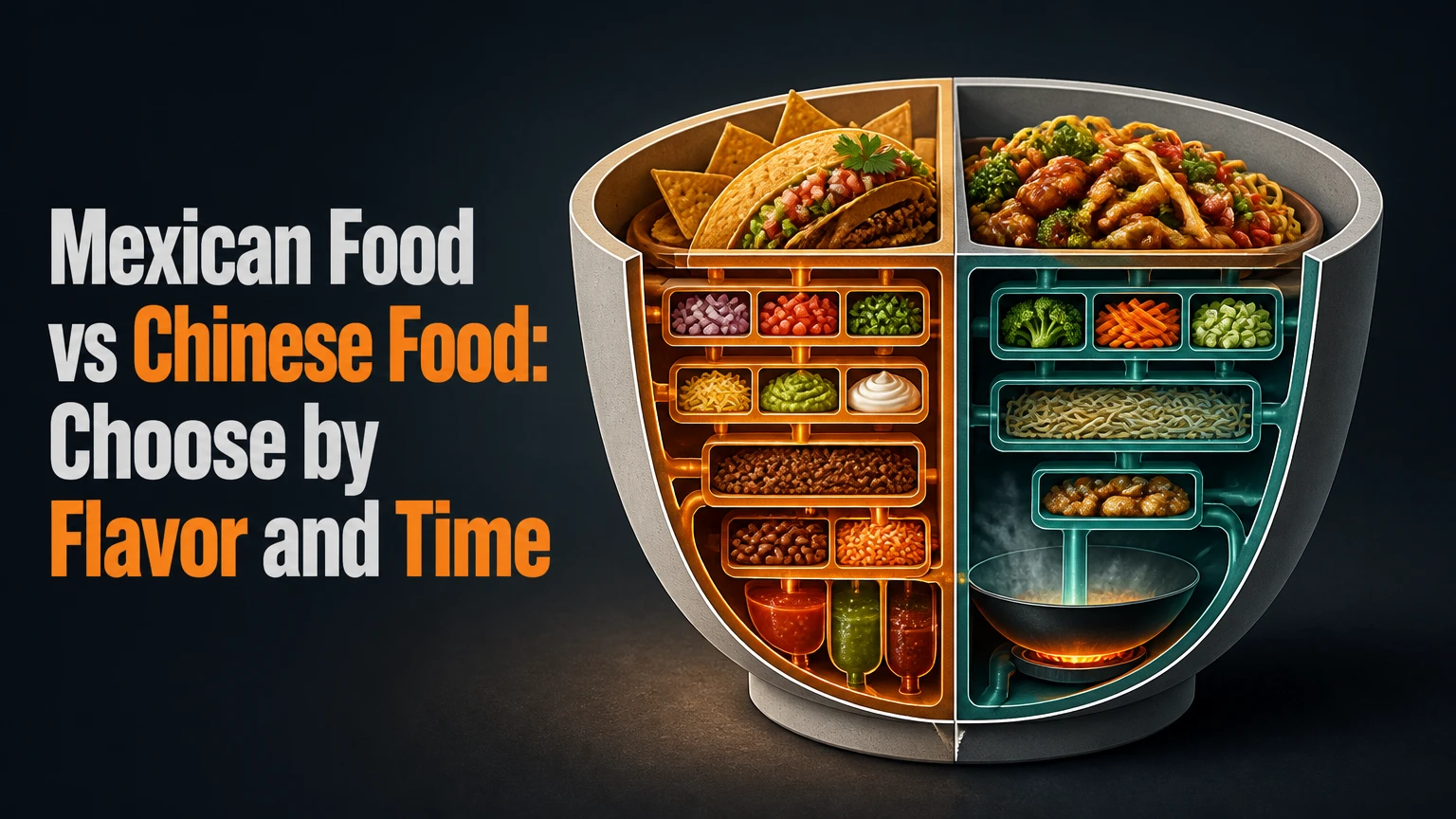
Mexican food and Chinese food differ most in their flavor architecture, staple ingredients, and cooking tempo. Mexican cuisine builds meals around corn masa, beans, chilies, herbs, acids, and slow-cooked or grilled foods, while Chinese cuisine spans eight major regional traditions that emphasize rice, wheat, aromatics, fermented seasonings, steaming, braising, and high-heat cooking.
Key Facts at a Glance
Mexican cuisine commonly centers on corn, beans, squash, chilies, tomatoes, herbs, and regional proteins.
Chinese cuisine includes eight major culinary traditions, including Sichuan, Cantonese, Shandong, Jiangsu, Fujian, Zhejiang, Hunan, and Anhui.
Mexican cooking often develops flavor through roasting, grinding, braising, grilling, and fresh finishing acids.
Chinese cooking often develops flavor through knife preparation, aromatic frying, steaming, braising, and rapid wok cooking.
Typical home stir-fries take 15-30 minutes from preparation to serving, while Mexican braises commonly take 2-5 hours.
Corn tortillas are usually easier to adapt to gluten-free meals, while soy sauce, wheat noodles, and wrappers make many Chinese dishes unsuitable without substitutions.
What Is the Difference Between Mexican Food and Chinese Food?
Mexican food is a regional cuisine rooted in Mesoamerican foodways and shaped by Indigenous, Spanish, African, Caribbean, and later global influences. Chinese food is an umbrella term for numerous regional cuisines across China, each with its own ingredients, seasoning patterns, preferred textures, and cooking equipment.
The comparison becomes misleading when it treats tacos and takeout chow mein as complete representatives. A Yucatecan achiote preparation differs sharply from northern grilled foods, just as Cantonese steamed fish differs from a Sichuan chile-and-peppercorn dish.
UNESCO inscribed traditional Mexican cuisine on its Representative List of the Intangible Cultural Heritage of Humanity in 2010. The recognition describes a cultural system involving farming, preparation, communal practices, and ingredients rather than a single list of dishes. Chinese cuisine has no equivalent single cuisine profile because its regional traditions developed across a large geographic and cultural area.
Master Comparison Table
| Criterion | Mexican food | Chinese food | Practical result |
|---|---|---|---|
| Main starch | Corn masa, rice, wheat flour | Rice, wheat noodles, wheat wrappers | Mexican meals often use tortillas; Chinese meals often use rice or noodles |
| Core aromatics | Onion, garlic, cilantro, dried chilies | Ginger, garlic, scallions, dried chilies | Mexican aromatics often finish dishes fresh; Chinese aromatics frequently fry in oil |
| Signature acid | Lime, vinegar, sour orange, tomatillo | Black vinegar, rice vinegar, pickled vegetables | Mexican acidity is often added at serving; Chinese acidity is commonly built into sauces |
| Typical heat style | Roasted chile heat with herbal freshness | Chile heat, peppercorn numbness, or mild aromatic warmth | Sichuan food can numb; many Cantonese dishes are mild |
| Common techniques | Comal cooking, roasting, grinding, braising, grilling | Stir-frying, steaming, braising, deep-frying, boiling | Mexican food often layers stages; Chinese food often controls heat and timing |
| Typical active preparation | 30-90 minutes for a home meal | 20-45 minutes, including chopping | Chinese cooking is fast at the stove but demanding before cooking |
| Typical casual price in North America | $3-$15 for tacos, tamales, or plates | $6-$18 for noodles, rice dishes, or dumplings | Prices vary by city, restaurant type, and portion size |
| Gluten-free adaptability | Usually high with corn tortillas and rice | Variable because of soy sauce, noodles, and wrappers | Ingredient labels and shared cooking surfaces still matter |
How Do Mexican and Chinese Flavor Systems Work?
Mexican cuisine usually creates contrast among toasted, earthy, hot, fresh, acidic, and creamy elements. A dish may combine a roasted chile sauce, slow-cooked meat or vegetables, corn masa, raw onion, cilantro, and lime, so the final flavor changes between the first bite and the finish.
Chinese cuisines more often organize a dish around aromatic foundations, texture, savory depth, and a controlled balance of sweet, salty, sour, bitter, and pungent notes. The five-flavor model is useful, but it does not mean every Chinese dish contains equal amounts of all five flavors.
The most important practical distinction is when flavor is added. Mexican cooks may roast or toast ingredients early, grind them into a sauce, then add fresh herbs and acid late. Chinese cooks may prepare every ingredient before heating the wok, fry aromatics briefly, and combine the ingredients with a sauce during a narrow cooking window.
Ingredient Architecture
| Flavor role | Mexican examples | Chinese examples | Function |
|---|---|---|---|
| Foundation | Corn, beans, tomatoes, squash | Rice, wheat, soybeans, leafy greens | Provides starch, protein, bulk, or body |
| Heat | Jalapeño, ancho, guajillo, habanero | Dried red chile, chile bean paste, Sichuan peppercorn | Adds heat, aroma, or numbing sensation |
| Savory depth | Toasted chilies, browned meat, beans, epazote | Soy sauce, fermented bean products, dried seafood, mushrooms | Builds umami and persistence |
| Fresh finish | Lime, cilantro, onion, radish | Scallions, cilantro, sesame, pickled vegetables | Adds aroma, acidity, crunch, or lift |
| Texture | Tortilla, toasted corn, creamy avocado, crisp chicharrón-style toppings | Silken tofu, chewy noodles, crisp vegetables, dumpling wrappers | Creates contrast within the meal |
| Fermentation | Masa fermentation in selected regional foods, pickled vegetables | Soybean pastes, black vinegar, fermented vegetables | Adds acidity, salt, complexity, or umami |
Which Cuisine Uses More Chilies and More Heat?
Mexican food uses a wider everyday range of fresh and dried Capsicum chilies, but Chinese food can deliver greater perceived heat in certain regional styles. Sichuan dishes combine chile heat with Sichuan peppercorn, while Hunan food often uses direct, aromatic chile intensity without the same numbing effect.
Chili variety matters more than a simple heat ranking. Ancho and pasilla chilies contribute dried-fruit and earthy notes, guajillo contributes red-fruit aroma, and habanero provides sharp heat. Chinese dried chilies can add fragrance and crisp heat, while fermented chile pastes contribute salt and savory depth.
Restaurant menus distort the comparison. A mild Cantonese soup and a Sichuan dry-pot dish represent very different heat levels, just as a bean-and-cheese enchilada and a habanero salsa do within Mexican cooking.
Winner by heat: Chinese food for numbing, high-impact regional heat; Mexican food for broader everyday chile variety and layered roasted-chile flavor.
What Ingredients Define Mexican Food and Chinese Food?
Corn, beans, squash, chilies, tomatoes, onions, herbs, and regional fruits form the most recognizable Mexican ingredient network. Rice, wheat, soybeans, ginger, garlic, scallions, leafy vegetables, mushrooms, fermented seasonings, and tea-related aromatics occupy a comparable foundational role in Chinese cooking.
Mexican food is not automatically corn-based. Northern Mexico uses wheat flour tortillas extensively, and rice appears in soups, side dishes, and festive meals. Chinese food is not automatically soy-heavy either: some Cantonese, Fujian, and Zhejiang dishes depend more on seafood, broth, freshness, and restrained seasoning.
Mexican Regional Styles
| Region | Defining ingredients | Representative foods | Typical technique |
|---|---|---|---|
| Oaxaca | Maize, black beans, avocado leaves, dried chilies | Mole, tlayuda, memelas | Grinding, roasting, comal cooking |
| Puebla | Chilies, nuts, seeds, spices, maize | Mole poblano, chiles en nogada | Sauce preparation and stuffing |
| Yucatán | Achiote, sour orange, habanero, banana leaves | Cochinita-style dishes, papadzules | Marinating, wrapping, slow cooking |
| Northern Mexico | Wheat flour, beef, dried meats, flour tortillas | Carne asada, burritos, machaca | Grilling, searing, drying |
| Veracruz and Gulf coast | Tomatoes, olives, capers, seafood, chilies | Veracruz-style fish, seafood stews | Braising and simmering |
| Mexico City and central Mexico | Corn tortillas, herbs, adobo, vegetables | Tacos al pastor, tlacoyos, soups | Grilling, roasting, street-food assembly |
Chinese Regional Styles
| Tradition | Flavor and texture profile | Representative foods | Common techniques |
|---|---|---|---|
| Sichuan | Chile heat, peppercorn numbness, fermented savoriness | Mapo tofu, dan dan noodles | Stir-frying, braising, dry-frying |
| Cantonese | Fresh, delicate, lightly sweet, broth-centered | Dim sum, steamed fish, char siu-style foods | Steaming, roasting, quick sautéing |
| Shandong | Seafood, wheat foods, scallions, clear savory flavors | Seafood dishes, stuffed dumplings | Boiling, braising, knife work |
| Jiangsu | Tender textures, balanced sweetness, refined presentation | Lion’s head meatballs, Huaiyang dishes | Braising, steaming, careful slicing |
| Hunan | Direct chile heat, garlic, smoked and sour notes | Chairman Mao-style dishes, chopped-chile fish | Stir-frying, steaming, smoking |
| Fujian | Seafood, soups, delicate broths, umami | Buddha jumps over the wall, fish-ball soups | Simmering, steaming, braising |
| Zhejiang | Fresh seafood, bamboo shoots, mild sweetness | West Lake fish, Dongpo-style dishes | Steaming, braising, quick cooking |
| Anhui | Mountain herbs, fungi, rustic braises | Stinky tofu, mountain vegetable dishes | Stewing, smoking, braising |
The frequently repeated “four great traditions” label describes an older classification of Shandong, Sichuan, Cantonese, and Jiangsu cuisines. Contemporary Chinese food education commonly uses the eight major traditions listed above, although regional classifications vary by source.
How Does Mexican Nixtamalization Compare With Chinese Wok Cooking?
Nixtamalization transforms dried maize with an alkaline solution, while wok cooking transfers intense heat rapidly through a prepared sequence of ingredients. These processes solve different culinary problems: nixtamalization changes the grain’s chemistry and usability, whereas wok cooking controls surface browning, texture, and timing.
Mexican Nixtamalization
- Dried maize is simmered in water containing calcium hydroxide, commonly called cal.
- The kernels rest in the alkaline liquid, often for 8-18 hours depending on the maize and desired texture.
- The loosened outer skin is washed away.
- The softened nixtamal is ground into masa.
- Masa is shaped into tortillas, tamales, tlacoyos, or other foods.
The process improves the dough’s handling properties and increases the bioavailability of niacin. The Food and Agriculture Organization has documented nixtamalization’s importance for maize nutrition and food processing. Home cooks should use food-grade calcium hydroxide, not an unidentified lime product.
A workable tortilla dough feels supple rather than wet. If the edge cracks during pressing, add water in small increments; if the dough sticks heavily, reduce hydration or rest it briefly before changing the formula.
Chinese Wok Cooking
- Cut every ingredient before heating the wok.
- Heat the wok until a water droplet evaporates rapidly.
- Add oil, then aromatics for several seconds.
- Cook proteins and dense vegetables in batches.
- Return ingredients to the wok and add sauce around the hot sides.
- Toss briefly until the sauce clings without pooling.
Wok hei is not simply “food cooked above 200°C.” The term refers to a combination of smoky aroma, seared flavor, and rapid cooking associated with a hot wok and skilled tossing. A crowded home wok often produces steamed food because moisture lowers the cooking surface temperature.
The professional rule is simple: preparation precedes heat. Once the wok is hot, there is little time to measure, chop, or search for ingredients.
Which Cuisine Is Faster to Cook?
Chinese food is usually faster from heat to plate, while Mexican food can require more advance preparation. A vegetable stir-fry may cook in 4-8 minutes after chopping, but a pot of beans, birria-style beef, or a complex mole can require several hours.
The comparison changes when total labor is counted. Chinese food transfers the work into precise cutting and mise en place, while Mexican food often transfers work into soaking, roasting, grinding, marinating, or braising.
| Dish or preparation | Active work | Cooking time | Typical total time |
|---|---|---|---|
| Chinese vegetable stir-fry | 15-25 minutes | 4-8 minutes | 20-35 minutes |
| Chinese steamed dumplings | 35-60 minutes | 8-15 minutes | 45-75 minutes |
| Mexican fresh salsa and tacos | 20-35 minutes | 5-15 minutes | 25-50 minutes |
| Mexican tamales | 90-150 minutes | 60-90 minutes | 3-4 hours |
| Mexican bean pot | 20-35 minutes | 90-180 minutes | 2-4 hours |
| Mexican mole-style sauce | 90-150 minutes | 45-90 minutes | 2.5-4 hours |
Winner for weeknight speed: Chinese food, provided ingredients are chopped before cooking.
Which Cuisine Is Cheaper?
Mexican food is often cheaper for individual portions because corn tortillas, beans, rice, and salsa stretch a meal efficiently. Chinese food can be similarly economical when built around rice, cabbage, tofu, eggs, or seasonal vegetables, but restaurant portions and specialty ingredients create wider price variation.
The following are typical 2025 North American casual-dining ranges, not universal prices. Urban rent, delivery fees, seafood, portion size, and restaurant service can move the final bill substantially.
| Purchase scenario | Mexican food, typical range | Chinese food, typical range | Main cost driver |
|---|---|---|---|
| Street-style individual meal | $4-$12 | $6-$15 | Protein portion and city |
| Casual restaurant entrée | $12-$25 | $14-$30 | Portion, service, and seafood |
| Sit-down meal per person | $20-$45 | $25-$60 | Shared dishes and beverages |
| Home meal for four | $12-$30 | $15-$35 | Protein, specialty sauces, and leftovers |
| Specialty regional dish | $18-$40 | $20-$50 | Long preparation and imported ingredients |
| Vegetarian home meal | $8-$20 | $10-$25 | Beans, tofu, mushrooms, and produce |
Winner for the lowest food budget: Mexican food for bean-and-maize meals; Chinese food becomes equally competitive with rice, tofu, cabbage, and homemade sauce.
Is Mexican or Chinese Food Healthier?
Neither cuisine is inherently healthier because nutrition depends on the dish, portion, cooking method, and restaurant recipe. Mexican food can provide fiber through beans, maize, squash, and vegetables, while Chinese food can provide vegetables, tofu, seafood, and broth-based dishes, but either cuisine can become high in sodium, refined starch, or added fat.
The USDA Dietary Guidelines for Americans emphasize dietary patterns, vegetables, legumes, whole grains, and sodium awareness rather than assigning health status to national cuisines. A steamed fish dish with greens is nutritionally different from a battered, sweetened entrée, just as a bean-and-vegetable taco plate differs from a heavily fried combination meal.
Dietary Comparison
| Dietary concern | Mexican food | Chinese food | Best practical choice |
|---|---|---|---|
| Gluten avoidance | Corn tortillas and rice are useful; flour tortillas contain wheat | Rice is suitable; soy sauce, noodles, and wrappers often contain wheat | Mexican food with verified corn preparation |
| Vegetarian eating | Beans, nopales, squash, mushrooms, and rice offer many options | Tofu, vegetables, mushrooms, rice, and noodles offer broad options | Tie, with broth and sauce verification |
| Sodium control | Salsa, cheese, cured ingredients, and restaurant sauces may be salty | Soy sauce, fermented pastes, stock, and MSG-containing seasoning may be salty | Either cuisine cooked from scratch |
| Higher fiber | Beans, maize, vegetables, and seeds can provide substantial fiber | Brown rice, vegetables, mushrooms, and legumes can increase fiber | Dish-dependent |
| Lower added fat | Grilled vegetables, beans, salsa, and broth-based soups | Steamed fish, greens, tofu, and clear soups | Cantonese-style or grilled Mexican dishes |
| Common hidden ingredient | Lard, cheese, cream, or shared griddles | Wheat-based soy sauce, stock, and shared fryers | Ask targeted preparation questions |
People with celiac disease need more than a corn or rice label. Shared griddles, fryers, ladles, and sauces can create cross-contact in either cuisine.
Winner for gluten-free flexibility: Mexican food, when the kitchen uses verified corn masa and separate preparation equipment.
What Should a Beginner Cook First?
A beginner should start with a Mexican bean-and-vegetable taco plate or a Chinese vegetable stir-fry, depending on available equipment. The taco plate tolerates timing mistakes, while the stir-fry rewards preparation and teaches heat control quickly.
For Mexican food, begin with store-bought masa harina, canned or pre-cooked beans, one roasted salsa, and sautéed vegetables. For Chinese food, begin with rice, sliced cabbage, tofu or egg, ginger, garlic, scallions, and a measured sauce.
Beginner Difficulty Table
| First dish | Equipment | Skill focus | Failure risk |
|---|---|---|---|
| Bean tacos with roasted salsa | Skillet, blender, tortilla press optional | Toasting, seasoning, assembly | Low |
| Chicken or tofu stir-fry | Wok or wide skillet | Cutting, batch cooking, sauce timing | Medium |
| Fresh masa tortillas | Comal or skillet, press | Hydration, pressing, heat control | Medium |
| Steamed dumplings | Steamer, tray, pot | Folding, sealing, steam timing | High |
| Mole-style sauce | Heavy pot, blender, comal | Toasting, grinding, reduction | High |
The practitioner rule is to learn one variable at a time. Do not attempt homemade tortillas, a multi-chile sauce, and a large dinner simultaneously; use prepared components until the cooking sequence feels automatic.
Which Cuisine Is Better for Meal Prep and Leftovers?
Mexican food is usually better for batch cooking because beans, rice, braised fillings, roasted vegetables, and sauces hold well for two to four days and often reheat without losing their structure. Chinese stir-fries are best fresh because vegetables soften and sauces can separate after refrigeration.
Meal-prep quality depends on storing components separately. Keep salsa, herbs, pickled onions, tortillas, rice, fillings, and sauces in separate containers, then assemble portions shortly before eating.
| Meal-prep component | Refrigerator life, typical | Freezer performance | Best reheating method |
|---|---|---|---|
| Cooked beans | 3-4 days | Excellent, 2-3 months | Covered saucepan |
| Braised Mexican filling | 3-4 days | Good, 2-3 months | Low covered heat |
| Corn tortillas | 3-5 days | Good, 1-2 months | Dry skillet |
| Chinese fried rice | 3-4 days | Fair to good | Very hot skillet |
| Chinese stir-fried greens | 2-3 days | Poor | Brief skillet reheating |
| Dumplings | 3-4 days cooked | Excellent uncooked | Steam or pan-steam |
Cool cooked rice quickly and refrigerate it promptly. The United States Department of Agriculture advises refrigerating perishable leftovers within two hours, or within one hour when ambient temperatures exceed 90°F.
Winner for batch cooking: Mexican food, especially beans, rice, braised fillings, and sauces stored as separate components.
What Are the Biggest Cooking Mistakes?
The most damaging Mexican cooking mistake is treating chilies as interchangeable, while the most damaging Chinese cooking mistake is crowding the wok. Both errors erase the intended flavor and texture before seasoning can correct the dish.
Mexican Troubleshooting
- Bland salsa: Roast tomatoes, onions, garlic, or chilies on a dry comal until softened and marked, then blend with salt and acid.
- Bitter chile sauce: Remove blackened skins and seeds, toast dried chilies briefly, and avoid prolonged high heat.
- Cracked tortilla edges: Add warm water one teaspoon at a time and knead until the dough feels like soft modeling clay.
- Rubbery masa: Increase hydration, allow a 15-minute rest, and avoid overcooking the tortilla.
- Heavy stew: Add acid and fresh herbs at the end instead of adding more salt or fat.
- Weak bean flavor: Salt the cooking liquid and add aromatics early, then reduce the broth near the end.
Chinese Troubleshooting
- Steamed rather than seared food: Cook half the ingredients at a time and let the wok recover heat between batches.
- Burned garlic or ginger: Add aromatics to moderately hot oil and fry them for 5-15 seconds before adding wetter ingredients.
- Watery sauce: Mix starch with cool liquid, add a small amount, and keep the wok hot during the final toss.
- Tough protein: Slice across the grain, marinate briefly, and remove it as soon as it becomes opaque.
- Soggy fried rice: Use chilled, separated rice and avoid adding wet sauce before the grains are hot.
- Uneven vegetables: Cut dense vegetables smaller than leafy vegetables so they finish together.
A counterintuitive truth is that a hotter wok cannot rescue poor ingredient order. Moisture, batch size, and cut dimensions determine whether high heat produces browning or steaming.
Which Should You Choose?
Choose Mexican food when you want roasted chile complexity, corn-based staples, flexible toppings, substantial beans, or food that improves after resting. Choose Chinese food when you want rapid cooking, varied textures, precise vegetable preparation, steamed dishes, or a meal designed for sharing.
Choose Mexican Food If You Need Batch-Friendly Meals
Mexican food fits households that cook once and assemble meals repeatedly. A pot of beans, rice, roasted vegetables, salsa, and a braised filling can create tacos, bowls, tostadas, or plates across several meals without tasting identical.
Mexican food is also a strong choice for diners who need corn-based or naturally gluten-free options. Verify the kitchen, because flour tortillas and shared surfaces can still introduce wheat.
Choose Chinese Food If You Need a Fast Dinner
Chinese food fits weeknights when ingredients can be chopped in advance and a wide skillet is available. A stir-fry can move from raw ingredients to the table in under 15 minutes of cooking, although total preparation commonly reaches 25-40 minutes.
Chinese food is less forgiving when the cook multitasks. The short cooking window means burnt aromatics, overcooked protein, or a watery sauce can appear within seconds.
Choose Mexican Food for Fresh Heat and Chinese Food for Numbing Heat
Mexican food offers more ways to control heat through salsa choice, chile type, seed removal, and serving quantity. Chinese regional food offers a distinctive sensory range from mild Cantonese broths to Sichuan mala, where chile heat combines with the tingling effect of Sichuan peppercorn.
Choose Either Cuisine for Vegetarian Meals
Both cuisines support vegetarian cooking, but the flavor-building strategy differs. Mexican vegetarian meals can rely on beans, roasted chilies, squash, mushrooms, masa, and avocado, while Chinese vegetarian meals often depend on tofu, mushrooms, greens, fermented bean products, and carefully balanced sauces.
Ask whether stocks, sauces, cooking fats, or shared equipment contain animal ingredients. Restaurant labels rarely provide enough detail for strict dietary requirements.
Mexican Food vs Chinese Food: The Bottom Line
Mexican food vs Chinese food is not a contest with one universal winner. Mexican cuisine is usually the better choice for corn-based meals, layered roasted-chile flavor, gluten-free flexibility, and leftovers, while Chinese cuisine is usually better for rapid cooking, vegetable variety, textural contrast, and shared meals.
The best decision follows the meal’s constraint. Select Mexican food for batch preparation and fresh salsa-driven contrast; select Chinese food for a fast wok meal or steamed, broth-based, and regionally varied dishes.
FAQ
Which Cuisine Has More Variety, Mexican or Chinese?
Chinese cuisine has greater documented regional breadth because its major traditions cover a large geographic area with distinct ingredients and techniques. Mexican cuisine also has substantial regional variety, including Oaxacan, Yucatecan, northern, Gulf, and central traditions. Variety depends on the restaurant’s regional range rather than the country name alone.
Is Mexican Food Usually More Filling Than Chinese Food?
Mexican food often feels more filling when a meal combines beans, corn tortillas, rice, cheese, and a substantial filling. Chinese food can be equally filling when it includes rice, noodles, dumplings, tofu, or several shared dishes. Portion size, fiber, protein, and fat determine satiety more reliably than cuisine category.
Which Cuisine Is Better for Children?
Mexican food can be easier for children because tortillas, beans, rice, grilled vegetables, and mild fillings can be served separately. Chinese food also works well when families order steamed rice, dumplings, mild noodles, tofu, and vegetables without strong sauces. Serving components separately gives children more control over heat and texture.
Can Mexican and Chinese Ingredients Be Used Together?
Mexican and Chinese ingredients can work together when one flavor system remains dominant. Corn tortillas with ginger-scallion vegetables, chile oil with beans, or citrus-marinated tofu can be coherent combinations, but adding soy sauce, lime, chilies, and fermented paste without adjusting salt and acidity can produce a muddy result.
Which Cuisine Is Better for a Small Kitchen?
Mexican food is often easier in a small kitchen because a skillet, pot, blender, and basic knife can produce many dishes. Chinese food remains practical with a wide skillet instead of a wok, but ventilation and counter space matter because high-heat cooking creates smoke and requires ingredients within arm’s reach.
Which Cuisine Is More Authentic in North American Restaurants?
Authenticity cannot be assigned to an entire restaurant category. North American Mexican and Chinese restaurants may preserve regional techniques, adapt ingredients, or create local styles for their customers. Ask about the region, staple preparation, sauce ingredients, and cooking method rather than judging authenticity by spice level or menu familiarity.