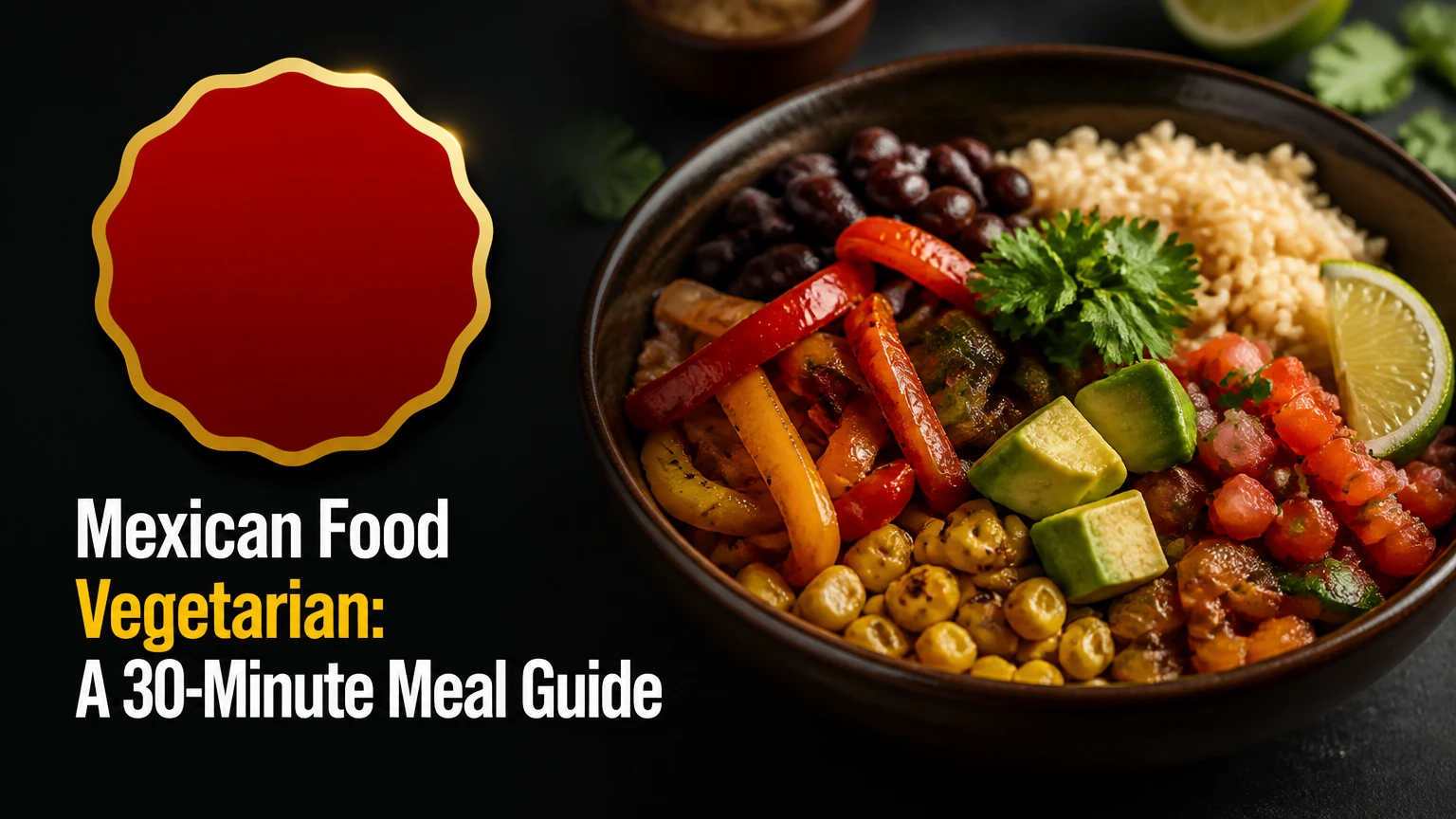
Mexican food vegetarian means Mexican cooking prepared without meat, poultry, or seafood, using corn, beans, vegetables, chiles, herbs, eggs, and dairy according to the diner’s diet. The tradition is broader than cheese-based substitutions: its strongest dishes build flavor from toasted chiles, roasted produce, nixtamalized corn, legumes, smoke, herbs, and lime.
Key Facts at a Glance
Vegetarian Mexican food can be fully vegan when cooks omit dairy, eggs, lard, and animal-based broth.
Corn tortillas, beans, squash, chiles, tomatoes, onions, and herbs form the cuisine’s core ingredient network.
A typical weeknight meal takes 20-35 minutes, while tamales and chile rellenos commonly require 60-120 minutes.
Restaurant beans, rice, tortillas, and sauces require ingredient checks because lard and chicken broth are frequent hidden additions.
The most reliable complete meal pairs a legume with corn or another grain, vegetables, fruit or lime, and a moderate fat source.
Roasting, charring, blooming spices, and adding acid create depth without requiring large amounts of cheese.
What Is Mexican Food Vegetarian?
Mexican food vegetarian is a culinary category, not a single standardized diet or menu. In Mexico, meat-free cooking includes everyday bean stews, vegetable soups, masa dishes, egg preparations, regional specialties, street snacks, and elaborate meals built around ingredients such as huitlacoche, squash blossoms, nopales, and dried chiles.
The category has deep roots in Indigenous foodways. Corn, beans, squash, amaranth, tomatoes, tomatillos, chiles, cacao, herbs, and cactus were important foods in Mesoamerica before modern restaurant classifications existed. Modern vegetarian cooking also includes ingredients introduced later, including rice, wheat flour, dairy, and some globally available meat alternatives.
“Vegetarian” usually permits eggs and dairy. “Vegan” excludes both, as well as lard, gelatin, and animal-derived broth. That distinction matters because a bean taco may be vegetarian but not vegan if the beans were cooked with lard.
How do the Three Sisters support a meal?
The Three Sisters are corn, beans, and squash, an Indigenous agricultural grouping in which climbing beans use corn stalks for support and squash helps shade the soil. On the plate, corn and beans complement each other nutritionally, while squash contributes moisture, fiber, carotenoids, and sweetness.
The phrase “complete protein” needs precision. A meal containing corn and beans supplies all essential amino acids in useful proportions, but the body does not require every individual food to be complete. Total protein, energy intake, and dietary variety matter more than treating the Three Sisters as a formula.
What makes the flavor taste distinctly Mexican?
The most recognizable flavor pattern combines chile aroma, toasted or roasted ingredients, fresh herbs, salt, and acid. A salsa may use charred tomatillos, garlic, onion, serrano chile, and cilantro, while an adobo may use rehydrated dried chiles, spices, vinegar, and roasted aromatics.
A useful cooking sequence is:
- Toast dried chiles briefly until fragrant, usually 15-30 seconds per side.
- Soak softened chiles in hot water for 15-20 minutes.
- Roast tomatoes, tomatillos, onion, or vegetables until browned at the edges.
- Blend with garlic, spices, and enough liquid for a pourable texture.
- Fry or simmer the sauce briefly to integrate flavor.
- Finish with lime juice, vinegar, fresh herbs, or pickled onion.
Blackened dried chiles taste bitter rather than smoky. Remove them from the pan as soon as their aroma opens.
Which Vegetarian Mexican Dishes Are Worth Choosing?
The best dish depends on the desired combination of protein, preparation time, richness, and regional character. Bean tacos offer the lowest-cost starting point, mushroom tacos provide a meaty texture without imitation products, and chile rellenos deliver the most elaborate traditional presentation.
| Dish | Main filling or base | Typical time | Typical home cost per serving |
|---|---|---|---|
| Bean tacos | Pinto or black beans, corn tortillas | 15-20 minutes | $1.50-$3 |
| Mushroom tacos | Cremini, oyster, or portobello mushrooms | 20-25 minutes | $3-$6 |
| Nopal tacos | Grilled cactus pads, onion, salsa | 25-35 minutes | $2.50-$5 |
| Vegetable fajitas | Peppers, onions, zucchini, mushrooms | 25-30 minutes | $3-$6 |
| Chilaquiles | Tortilla chips, salsa, beans, optional eggs | 20-30 minutes | $2.50-$5 |
| Enchiladas | Corn tortillas, chile sauce, beans or vegetables | 45-60 minutes | $4-$8 |
| Chile relleno | Roasted poblano, cheese or beans, egg batter | 60-90 minutes | $5-$10 |
| Tamales | Masa, bean, rajas, or vegetable filling | 90-150 minutes | $3-$7 |
| Papadzules | Egg-filled tortillas with pumpkin-seed sauce | 45-60 minutes | $4-$8 |
| Esquites | Corn kernels, epazote, chile, lime | 20-25 minutes | $2-$5 |
What are the best vegetarian taco fillings?
Bean, mushroom, nopal, squash blossom, huitlacoche, potato, sweet potato, and hibiscus-flower fillings all work well, but they need different treatments. Beans need seasoning and texture; mushrooms need high heat; nopales need moisture control; hibiscus flowers need thorough rinsing and a savory marinade after brewing.
Mushrooms are best seared in a single layer so their water evaporates before seasoning. Nopales benefit from grilling or sautéing until their slippery texture decreases. Hibiscus flowers, often called jamaica, become chewy and pleasantly tangy after simmering, then pair well with onion and chile.
How do enchiladas, chilaquiles, and quesadillas differ?
Enchiladas are rolled or folded corn tortillas softened in chile sauce and filled before baking or plating. Chilaquiles use fried or baked tortilla pieces simmered briefly in red or green salsa, while quesadillas cook a filling inside a folded tortilla.
| Dish | Texture target | Typical sauce | Strong vegetarian filling | Vegan adaptation |
|---|---|---|---|---|
| Enchiladas | Soft, saucy tortilla | Guajillo red or tomatillo green | Beans, spinach, squash | Cashew crema or avocado |
| Chilaquiles | Crisp centers, softened edges | Salsa verde or roja | Beans, eggs, mushrooms | Beans, tofu scramble |
| Quesadillas | Crisp exterior, melted center | Salsa for dipping | Cheese, mushrooms, squash blossoms | Plant-based cheese or mashed beans |
| Tostadas | Rigid, crunchy base | Salsa and crema | Refried beans, lettuce, avocado | Omit dairy crema |
| Sopes | Thick masa with raised rim | Salsa and toppings | Beans, nopales, potato | Beans, avocado, cabbage |
Timing determines texture. Add salsa to chilaquiles immediately before serving if you want crunch, or simmer for several minutes when a softer texture is preferred.
Which regional specialties are naturally vegetarian?
Papadzules from the Yucatán use tortillas filled with cooked egg and covered with pumpkin-seed sauce. Central Mexican cooking includes rajas con crema, squash blossoms, huitlacoche quesadillas, and many bean or vegetable antojitos. Nopales appear widely, especially in central Mexico, while tamales vary by region and filling.
Chile relleno traditionally features a roasted poblano stuffed with cheese, coated in egg batter, and fried, although bean-filled and vegetable-filled versions also exist. Tamales can contain beans, rajas with cheese, vegetables, or sweet corn. Regional preparation changes the dish’s ingredients, sauce, and texture, so “authentic” does not mean one fixed recipe.
How Do You Build a Balanced Vegetarian Mexican Plate?
A balanced vegetarian Mexican plate combines a legume, a corn or grain food, at least two vegetables, a modest fat source, and an acidic or fresh garnish. This structure improves protein density and satiety while preventing cheese, fried tortillas, or sour cream from carrying the entire meal.
| Meal component | Practical portion | Examples | Primary contribution |
|---|---|---|---|
| Legume | 1/2-1 cup cooked | Black beans, lentils, refried pinto beans | Protein and fiber |
| Corn or grain | 2-4 corn tortillas or 1/2-1 cup rice | Tortillas, arroz rojo, quinoa | Energy and texture |
| Vegetables | 1-2 cups | Nopales, squash, peppers, cabbage | Fiber, color, volume |
| Fat source | 1-2 tablespoons | Avocado, pumpkin seeds, olive oil | Flavor and satiety |
| Acid and herbs | 1-3 tablespoons | Lime, vinegar, cilantro, pickled onion | Balance and freshness |
The United States Department of Agriculture FoodData Central lists cooked beans as meaningful sources of protein, fiber, iron, potassium, and folate, although values vary by bean type and preparation. Beans are therefore more than a filler. They anchor a meal nutritionally and economically.
Corn masa has another important property. Nixtamalization, the alkaline treatment used to make traditional masa, changes the grain’s texture and improves the availability of niacin. The Food and Agriculture Organization has documented nixtamalization’s nutritional importance, especially in diets where maize supplies a large share of calories.
Is vegetarian Mexican food healthy?
Vegetarian Mexican food can be nutrient-dense when beans, vegetables, whole corn tortillas, seeds, and fresh salsas carry most of the meal. A plate dominated by fried chips, large quantities of cheese, creamy toppings, and salty packaged sauces can still be high in calories, sodium, and saturated fat.
Nutrition depends on preparation rather than cuisine label. Choose whole beans more often than heavily salted refried beans, use avocado or pumpkin seeds in measured portions, and add cabbage, nopales, tomatoes, squash, or leafy greens for volume.
A useful practitioner rule is to make one ingredient creamy, not four. If the beans are rich, keep the cheese light; if avocado supplies fat, use a sharp salsa rather than a heavy cream topping.
What are the strongest vegetarian protein options?
Beans, lentils, eggs, dairy, tofu, tempeh, pumpkin seeds, and textured vegetable protein can all fit Mexican flavor systems. For a conventional pantry, beans and lentils provide the lowest cost per serving, while eggs and Greek yogurt add concentrated protein with short preparation times.
| Protein option | Typical serving protein | Cooking time | Best use |
|---|---|---|---|
| Cooked black beans, 1 cup | About 15 grams | 10-20 minutes if canned | Tacos, bowls, soup |
| Cooked lentils, 1 cup | About 18 grams | 25-35 minutes | Picadillo, tostadas |
| Eggs, 2 large | About 12 grams | 5-10 minutes | Chilaquiles, papadzules |
| Firm tofu, 150 grams | About 18-22 grams | 15-25 minutes | Tacos, adobo bowls |
| Pumpkin seeds, 30 grams | About 8-9 grams | 3-5 minutes toasted | Salads, sauces, garnish |
| Plain Greek yogurt, 1/2 cup | About 10 grams | No cooking | Crema substitute |
Protein numbers are typical estimates from USDA FoodData Central entries and vary by brand, moisture, and serving size. Athletes and people with higher requirements should increase the legume or tofu portion rather than relying on extra cheese.
How Can You Make a 30-Minute Weeknight Meal?
A 30-minute vegetarian Mexican meal is easiest when one component is ready-made and the remaining ingredients cook at high heat. A practical formula uses canned beans, corn tortillas, one quick-cooking vegetable, a raw salsa, and avocado or seeds, with the main success factor being moisture control.
Step 1: Choose the meal architecture
Select tacos, bowls, fajitas, or tostadas before heating the pan. For two people, plan 1 can of beans, 8-10 corn tortillas, 3 cups vegetables, 1 cup salsa, and 1 avocado or 1/4 cup seeds.
You will know the plan works when every component has a defined job: beans supply substance, vegetables provide texture, tortillas carry the meal, and salsa supplies acidity.
Step 2: Prepare the salsa
Blend or chop 2 tomatoes, 1/4 onion, 1 small chile, 1 tablespoon lime juice, and 2 tablespoons cilantro. Add salt gradually because canned beans and cheese may already contain sodium.
For deeper flavor, char the tomatoes, onion, and chile in a dry skillet for 6-10 minutes before blending. Keep raw salsa cold and roasted salsa warm, but avoid combining both until the final assembly.
Step 3: Cook the filling
Heat 1 tablespoon oil in a wide skillet. Cook 3 cups sliced mushrooms, peppers, zucchini, or nopales for 7-12 minutes, stirring only after browning develops. Add 1 teaspoon ground cumin, 1/2 teaspoon Mexican oregano, 1 minced garlic clove, and 1 tablespoon lime juice near the end.
The filling is ready when vegetables show browned edges and the skillet contains no pool of liquid. Crowding creates steaming, especially with mushrooms and zucchini.
Step 4: Season and warm the beans
Heat 1 can of rinsed beans with 1/4 cup water, 1/4 onion, 1 minced garlic clove, and 1/2 teaspoon ground cumin for 8-10 minutes. Mash one-quarter of the beans against the pan to thicken the mixture.
The beans should hold together in a tortilla without running. If they taste flat, add salt first, then lime or a spoonful of salsa. Extra spice cannot repair under-seasoning by itself.
Step 5: Warm the tortillas
Heat corn tortillas in a dry skillet for 20-30 seconds per side, then stack them in a towel or covered container. Eight to ten tortillas serve two people when each person eats four or five tacos.
A flexible tortilla bends without cracking. Cold tortillas split, leak filling, and make a properly seasoned meal seem dry.
Step 6: Assemble and finish
Layer beans, vegetables, salsa, cabbage, avocado, cilantro, and lime. Add cheese only after tasting the assembled taco, because cheese can mute chile aroma and increase salt quickly.
A 30-minute meal is complete when it contains contrasting temperatures, at least one crisp element, and enough acid to balance the cooked filling.
What Is the Cost and Time Trade-Off?
Home-prepared vegetarian Mexican meals typically cost $2-$8 per serving, depending on produce, specialty chiles, and whether dried beans are cooked from scratch. Restaurant prices commonly range from $10-$20 for a vegetarian entrée in the United States, with major metropolitan areas often higher.
| Meal format | Active time | Total time | Typical home cost | Main trade-off |
|---|---|---|---|---|
| Bean tacos | 10-15 minutes | 15-20 minutes | $1.50-$3 | Lowest cost, simpler texture |
| Vegetable bowl | 20-25 minutes | 25-35 minutes | $3-$6 | Flexible, fewer tortillas |
| Enchiladas | 30-40 minutes | 45-60 minutes | $4-$8 | Better presentation, more cleanup |
| Chile rellenos | 45-60 minutes | 60-90 minutes | $5-$10 | Traditional technique, frying required |
| Tamales | 60-90 minutes | 90-150 minutes | $3-$7 | Efficient in batches, labor intensive |
| Restaurant burrito | 0 minutes | 10-25 minutes waiting | $10-$20 | Convenient, hidden ingredients possible |
Dry beans reduce food cost but require planning. A batch of 1 pound dried beans typically yields about 5-6 cups cooked, enough for several meals, while canned beans trade a higher per-serving cost for immediate use.
Specialty ingredients do not always improve the result. A good local mushroom, cabbage, lime, and canned bean can produce a more balanced dinner than expensive dried chiles used without correct soaking or seasoning.
How Do Vegetarian and Vegan Versions Compare?
Vegetarian Mexican food permits eggs and dairy, while vegan Mexican food replaces them with beans, tofu, avocado, pumpkin-seed sauces, cashew crema, or blended white beans. Neither category is automatically healthier because frying, sodium, portion size, and added fat still determine the final profile.
| Feature | Vegetarian version | Vegan version | Practical consequence |
|---|---|---|---|
| Quesadilla filling | Oaxaca-style cheese or queso fresco | Beans, tofu, or plant-based cheese | Vegan versions vary in melt |
| Chilaquiles topping | Eggs and crema | Tofu scramble and avocado | Similar richness, different texture |
| Chile relleno | Cheese and egg batter | Bean filling, egg-free batter | More difficult to crisp evenly |
| Refried beans | May contain lard | Oil or water based | Ask about cooking fat |
| Enchilada garnish | Sour cream and cheese | Avocado, seeds, cabbage | Lower dairy, added plant fat |
| Broth | May use chicken stock | Vegetable or bean broth | Confirm with the kitchen |
Vegetarian food is often easier to order in traditional restaurants because eggs and cheese are common fillings. Vegan diners need to ask about cooking fat, broth, crema, cheese, and tortilla preparation separately.
What Should You Ask at a Mexican Restaurant?
Ask whether beans and rice contain lard or chicken broth, whether tortillas are cooked on a shared surface, and whether sauces contain dairy. The clearest Spanish requests are “sin manteca,” meaning without lard, “sin caldo de pollo,” meaning without chicken broth, and “sin queso,” meaning without cheese.
Use this ordering sequence:
- State “soy vegetariano” or “soy vegetariana,” depending on the speaker.
- Specify whether eggs and dairy are acceptable.
- Ask about beans, rice, tortillas, and sauces individually.
- Request grilled vegetables, beans, nopales, mushrooms, or squash blossoms.
- Confirm that the final plate contains no meat garnish or shared filling.
Naturally vegan choices often include guacamole, salsa, plain corn tortillas, nopales, grilled vegetables, and beans cooked without lard. Restaurant practices differ, so a menu label alone is not a guarantee.
Are corn tortillas gluten-free?
Traditional corn tortillas made from masa harina and water are naturally gluten-free, but packaged products and restaurant preparation can introduce cross-contact. Flour tortillas, shared griddles, seasoning blends, and fillings thickened with wheat require separate checks.
People with celiac disease should ask whether the kitchen uses dedicated cookware and preparation surfaces. “Corn tortilla” identifies the base ingredient, not the entire preparation environment.
What Common Mistakes Ruin Vegetarian Mexican Food?
The most common failures are poor moisture control, scorched chiles, under-seasoned beans, and excessive reliance on cheese. Vegetarian dishes need deliberate browning and acidity because vegetables release water and legumes require seasoning throughout cooking.
| Mistake | Observable symptom | Likely cause | Corrective action |
|---|---|---|---|
| Cold tortillas | Cracks and rigid edges | No reheating or dry storage | Heat 20-30 seconds per side |
| Burned dried chiles | Harsh, bitter sauce | Toasting beyond fragrance | Discard and start again |
| Watery mushrooms | Gray, soft filling | Crowded pan | Cook in batches over high heat |
| Bland beans | Flat flavor despite salt | No aromatics or acid | Add onion, garlic, cumin, lime |
| Greasy quesadillas | Oil pooling on plate | Excess fat and cheese | Use moderate heat and less filling |
| Grainy salsa | Rough chile particles | Inadequate soaking or blending | Soak 15-20 minutes and strain |
| Soggy chilaquiles | No crisp texture | Salsa added too early | Toss immediately before serving |
A counterintuitive rule is that more chile does not necessarily create more flavor. Toasting a smaller amount correctly, then balancing it with acid and salt, produces a cleaner sauce than adding several poorly handled chiles.
Another practitioner rule concerns beans: mash only a portion. Fully puréed beans can become dense and pasty, while partially mashed beans create adhesion for tacos and retain recognizable texture.
Which Dishes Fit Different Diners?
Beginners should start with bean tacos or vegetable fajitas because both tolerate substitutions and finish in under 35 minutes. Vegan diners should choose beans, nopales, mushrooms, guacamole, and corn tortillas after verifying cooking fat and broth.
| Diner or goal | Best choice | Why it fits | Avoid or modify |
|---|---|---|---|
| Beginner cook | Bean tacos | 15-20 minutes, five core ingredients | Avoid multi-stage sauces |
| Vegan diner | Nopal and bean bowl | Naturally adaptable, high fiber | Check lard and dairy |
| High-protein meal | Lentil picadillo tacos | About 18 grams protein per cup of lentils | Limit cheese as the main protein |
| Budget household | Bean and squash tostadas | $2-$4 per serving, batch friendly | Use cabbage instead of costly greens |
| Traditionalist | Chile relleno or papadzules | Regional technique and distinctive sauces | Allow 45-90 minutes |
| Gluten-free diner | Enchiladas with corn tortillas | Masa-based and easy to verify | Check shared cooking surfaces |
| Family meal | Vegetable fajitas | Separate toppings suit preferences | Keep chile heat moderate |
| Batch cook | Bean-rice casserole | 4-6 portions, reheats well | Add fresh salsa after reheating |
Vegetarian Mexican food is less suitable when the goal is a very low-sodium meal unless beans, sauces, and tortillas are prepared at home. It is also a poor fit for diners who dislike chiles, although many dishes can use roasted peppers, herbs, and lime without significant heat.
Frequently Asked Questions
Is Mexican food traditionally vegetarian?
Traditional Mexican cuisine includes substantial vegetarian dishes, although many regional meals also use animal ingredients. Corn, beans, squash, nopales, mushrooms, chiles, tomatoes, and seeds support a large meat-free repertoire that predates modern vegetarian labels. Restaurant menus may still cook those ingredients with lard or animal broth.
What Mexican food is naturally vegan?
Plain corn tortillas, guacamole, many salsas, nopales, grilled vegetables, some bean dishes, and certain rice preparations can be vegan. Verify that beans contain no lard, rice contains no chicken broth, and toppings contain no cheese, sour cream, or crema. Preparation varies by restaurant and household.
What can replace meat in Mexican recipes?
Beans replace meat most economically, while mushrooms provide browned, savory texture. Lentils work in picadillo, tofu absorbs adobo, jackfruit suits saucy fillings, and chopped hibiscus flowers provide a chewy taco filling. Choose the substitute according to texture rather than treating every replacement as interchangeable.
Are vegetarian Mexican meals high in carbohydrates?
Many Mexican meals include corn tortillas, rice, masa, or potatoes, so carbohydrate content can be substantial. A balanced plate controls the grain portion and adds beans, vegetables, seeds, or tofu. Two to four tortillas with 1/2-1 cup beans and 1-2 cups vegetables is a practical starting range.
How long do cooked vegetarian Mexican dishes keep?
Cooked beans, rice, and vegetable fillings generally keep three to four days in a refrigerator at 40°F or below when cooled promptly in shallow containers. Store salsa separately to preserve texture. Reheat fillings thoroughly, then add fresh lime, herbs, cabbage, or avocado after heating.
What is the easiest authentic vegetarian Mexican dinner?
Bean tacos with freshly warmed corn tortillas, roasted tomato salsa, cabbage, lime, and avocado are the easiest authentic-style dinner. The meal takes about 20 minutes, costs roughly $2-$4 per serving, and demonstrates the core technique of combining seasoned legumes, masa, roasted produce, acid, and fresh garnish.
The Bottom Line
Mexican food vegetarian is a broad, historically grounded cuisine built from corn, beans, vegetables, chiles, herbs, seeds, eggs, and dairy rather than a narrow collection of meat substitutes. For a fast meal, choose bean tacos, mushroom tacos, or vegetable fajitas; for regional technique, make papadzules, tamales, or chile rellenos. The best results come from browned vegetables, properly seasoned beans, warmed tortillas, controlled chile heat, and a fresh acidic finish. Vegan diners should verify lard, broth, dairy, and shared cooking surfaces before ordering. With those checks, vegetarian Mexican food can be affordable, filling, adaptable, and nutritionally balanced.