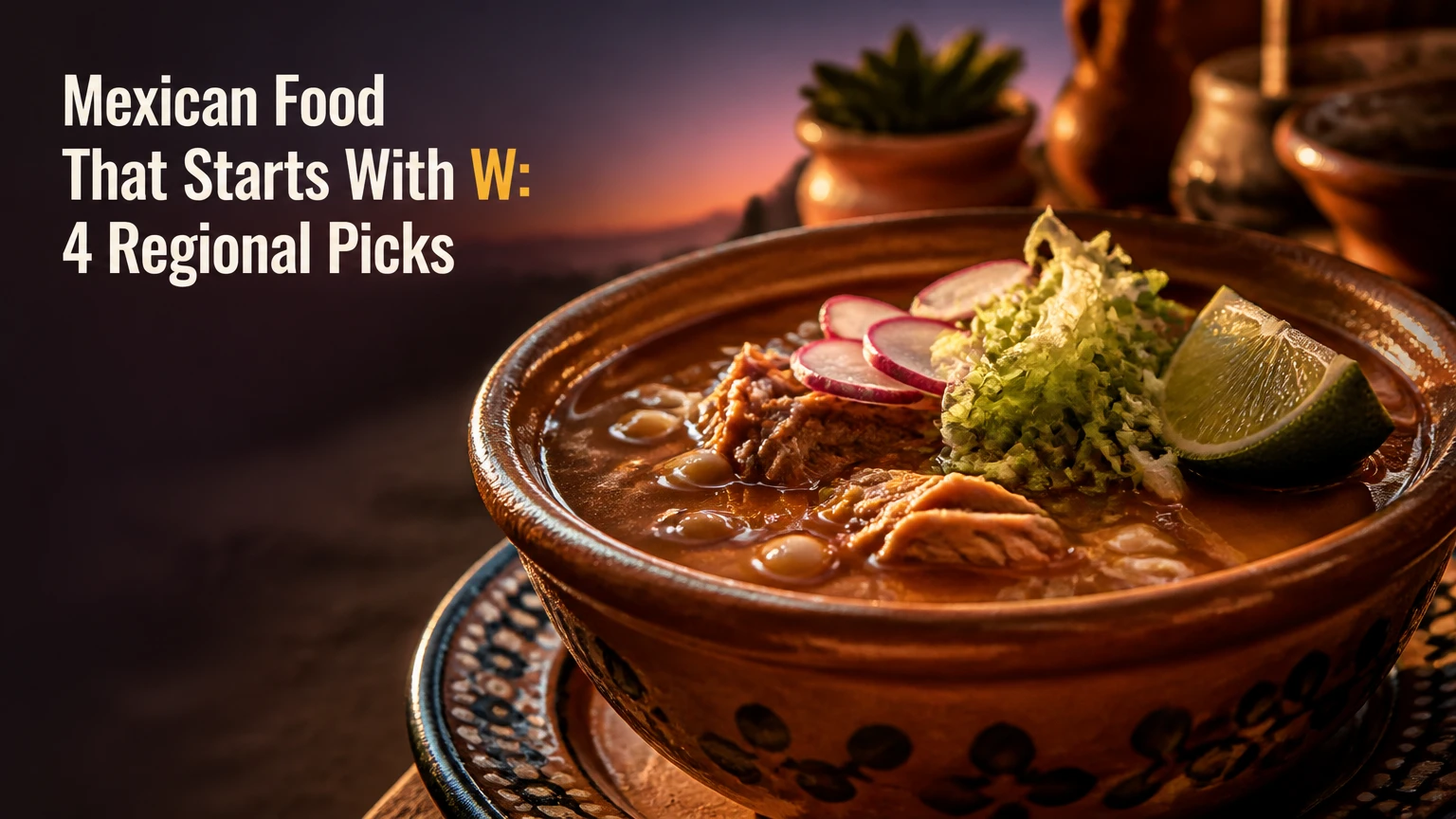
The most accurate answer to “mexican food that starts with w” is that Mexican cuisine has few standard Spanish food names beginning with W. The commonly listed choices are huachinango, often misspelled “wachinango,” wheat tortillas, watermelon agua fresca, and white corn quesadillas, with the last three being English descriptions rather than original Spanish names.
Key Facts at a Glance
Huachinango a la Veracruzana is the authentic Spanish name for Veracruz-style red snapper; “wachinango” is a phonetic misspelling.
Tortillas de harina are wheat-flour tortillas strongly associated with northern Mexico, especially Sonora and Chihuahua.
Agua de sandía is the Spanish name for watermelon agua fresca, usually made with watermelon, water, lime, and sugar.
Quesadillas de maíz blanco use white-corn masa, but the English phrase “white corn quesadillas” is a descriptive menu label.
A typical homemade serving costs about $1-$8, depending on fish, cheese, and local ingredient prices.
Corn-based options are naturally gluten-free when prepared with uncontaminated masa and fillings.
Are There Authentic Mexican Foods That Start With W?
Standard Mexican Spanish contains almost no traditional food names beginning with W because Spanish normally uses gu, hu, or another established spelling for many sounds that English speakers associate with W. The letter appears mainly in foreign words, brand names, Indigenous-language terms, and modern transliterations.
The most important correction is huachinango, not “wachinango.” Huachinango means red snapper and appears in the established dish huachinango a la Veracruzana. English listicles sometimes replace “Hu” with “W” to satisfy an alphabetical food challenge, but Mexican menus and Spanish-language recipes generally retain huachinango.
The other W entries work differently. “Wheat tortillas,” “watermelon agua fresca,” and “white corn quesadillas” translate or describe foods whose Spanish names are tortillas de harina, agua de sandía, and quesadillas de maíz blanco. They are useful search terms, but they should not be presented as four native Spanish dish names.
UNESCO’s 2010 description of Mexican cuisine calls it “a comprehensive cultural model comprising farming, ritual practices, age-old skills, culinary techniques and ancestral community customs and manners.” That definition matters here because ingredients, regional practice, and Spanish naming carry more cultural meaning than an English alphabetical label.
What Is the Best Choice for Most Searchers?
Huachinango a la Veracruzana is the strongest traditional answer, while agua de sandía is the fastest and easiest preparation. Wheat tortillas offer the clearest regional identity, and white corn quesadillas are the most practical meat-free snack.
| Choice | Standard Spanish name | Typical time | Best use |
|---|---|---|---|
| Huachinango | Huachinango a la Veracruzana | 45-60 minutes | Formal seafood dinner |
| Wheat tortillas | Tortillas de harina | 40-60 minutes | Tacos, burritos, breakfast |
| Watermelon drink | Agua de sandía | 5-10 minutes | Hot-weather meal pairing |
| White corn quesadillas | Quesadillas de maíz blanco | 15-25 minutes | Quick snack or light meal |
Which Mexican Food Beginning With W Should You Choose?
Choose huachinango for authenticity, wheat tortillas for a regional staple, watermelon agua fresca for speed, and white corn quesadillas for a low-cost corn-based meal. No single option wins every situation because the items belong to different categories: entrée, bread, beverage, and snack.
| User situation | Best choice | Reason | Typical serving cost |
|---|---|---|---|
| Beginner cook | Agua de sandía | No dough handling or frying | $1-$3 |
| Seafood dinner | Huachinango a la Veracruzana | Complete plated entrée | $8-$25 |
| Gluten-free meal | White corn quesadillas | Corn masa contains no wheat | $2-$6 |
| Large family meal | Tortillas de harina | Batch cooking and flexible fillings | $0.30-$1 each |
| Summer gathering | Agua de sandía | Makes a 2-liter pitcher quickly | $3-$8 |
| Northern Mexican theme | Tortillas de harina | Regional wheat tradition | $2-$6 per dozen |
Which Option Is Most Traditional?
Huachinango a la Veracruzana has the strongest claim as a named Mexican dish, although the word begins with H rather than W. The fish preparation comes from Veracruz and combines red snapper with tomatoes, onion, garlic, olives, capers, chiles, herbs, and citrus.
Tortillas de harina also have a clear Mexican regional history. Wheat arrived after the Spanish conquest, then became especially important in northern regions where wheat agriculture and ranching shaped local foodways. The result is not an imitation of a corn tortilla. It is a separate regional tortilla tradition.
The two English phrases are broader descriptions. Mexican cooks certainly prepare quesadillas with white-corn masa and serve watermelon agua fresca, but the English W wording is not the conventional cultural name.
Which Choice Costs the Least?
Agua de sandía and white corn quesadillas usually cost the least at home, with typical ingredient costs of $1-$3 and $2-$6 per batch. Huachinango costs more because red snapper is a premium fresh fish and the recipe normally feeds fewer people.
| Food | Main cost driver | Typical home batch | Typical restaurant price |
|---|---|---|---|
| Huachinango | Red snapper, olives, capers | $18-$35 | $25-$45 |
| Wheat tortillas | Flour, shortening, cooking fuel | $3-$8 per dozen | $2-$6 per dozen |
| Agua de sandía | Watermelon and seasonal pricing | $3-$8 per 2 liters | $3-$7 per large glass |
| White corn quesadillas | Oaxaca or Chihuahua cheese | $5-$12 for 4-6 | $2-$8 each |
Restaurant prices vary by city, seafood supply, portion size, and service level. The ranges above are typical consumer estimates, not fixed national prices.
What Is Huachinango a la Veracruzana?
Huachinango a la Veracruzana is a Veracruz-style red snapper dish baked or simmered in a tomato sauce with onion, garlic, olives, capers, herbs, and chile. The dish reflects coastal Mexican cooking shaped by local seafood and ingredients introduced through Spanish and Mediterranean contact.
A traditional presentation uses a whole cleaned fish, although fillets are more practical for home kitchens. Whole fish gives the sauce a more dramatic presentation, while fillets reduce bones and shorten cooking time. Either format requires careful attention because lean snapper dries quickly when overcooked.
The sauce is acidic, savory, and aromatic rather than heavily spicy. Tomatoes and lime supply brightness, capers and olives add salt, and jalapeño or another green chile contributes moderate heat. Nutmeg and bay leaf appear in some versions, but recipes vary by household and region.
How Do You Prepare Veracruz-Style Red Snapper?
Prepare huachinango by marinating cleaned snapper, building a tomato sauce, then baking the fish at 190°C or 375°F until the thickest section flakes and reaches a safe internal temperature. A typical whole fish takes 25-30 minutes after preparation.
- Rub one cleaned 1.5-2 kilogram snapper with lime juice, minced garlic, salt, black pepper, and optional nutmeg.
- Rest the fish for 15-20 minutes while heating olive oil in a broad pan.
- Cook one sliced onion, two garlic cloves, three chopped tomatoes, and one jalapeño for 8-10 minutes.
- Add 60 grams of sliced green olives, 30 grams of capers, bay leaf, and herbs.
- Place the fish in a baking dish, spoon the sauce over it, and bake at 190°C.
- Check the thickest flesh with a thermometer. Fish should reach 63°C or 145°F, then rest for 5 minutes.
A common mistake is treating lime juice as a long marinade. Acid changes the surface texture, but it does not replace heat for cooking or food safety. Refrigerate the fish during marination and avoid leaving seafood at room temperature for extended periods.
| Preparation format | Fish quantity | Cooking time | Practical result |
|---|---|---|---|
| Whole snapper | 1.5-2 kg | 25-30 minutes | Dramatic presentation, more bones |
| Large fillets | 180-250 g each | 12-18 minutes | Easier serving, faster cooking |
| Small fillets | 120-160 g each | 8-12 minutes | Suitable for individual portions |
| Covered baking dish | 1.5 kg total | 20-25 minutes | Moist texture, softer sauce surface |
What Are Wheat Tortillas in Mexican Cuisine?
Wheat tortillas, called tortillas de harina, are soft unleavened flatbreads made from wheat flour, fat, salt, and water; many home recipes include a small amount of baking powder. They are especially associated with northern Mexico and are widely used for tacos, burritos, quesadillas, and breakfast dishes.
Wheat gluten gives the dough elasticity, allowing a thin tortilla to stretch without tearing. Fat tenderizes the crumb, while a rest of about 20-30 minutes relaxes the gluten so the dough rolls easily. A properly cooked tortilla develops brown spots and may inflate briefly on a hot comal.
Sonoran sobaqueras can reach roughly 30-40 centimeters, or 12-16 inches, and are large enough for substantial burritos. Smaller six-inch tortillas suit tacos and breakfast portions. The size changes cooking time and handling, not the basic dough method.
How Do You Make Soft Flour Tortillas?
Make soft flour tortillas by mixing flour, salt, fat, and warm water, resting the dough, rolling each portion thin, and cooking it briefly on a hot comal. A 12-tortilla batch typically takes 40-60 minutes, including the resting period.
- Combine 360 grams flour, 7 grams salt, 5 grams baking powder, and 60 grams lard or vegetable shortening.
- Rub the fat into the flour until the mixture resembles coarse crumbs.
- Add 220-240 milliliters warm water gradually and knead for 5-7 minutes.
- Divide the dough into 12 balls, cover them, and rest for 20-30 minutes.
- Roll each ball to about 1-2 millimeters thick.
- Cook on a 230°C or 450°F comal for 30-45 seconds per side.
- Stack cooked tortillas inside a towel or covered container to retain steam.
The practitioner rule is simple: high heat and short cooking produce softness. Low heat forces the tortilla to remain on the surface longer, causing moisture loss and a brittle texture.
| Variable | Recommended value | Failure sign | Correction |
|---|---|---|---|
| Dough hydration | 220-240 ml water per 360 g flour | Cracked edges | Add water 5 ml at a time |
| Resting time | 20-30 minutes | Dough springs back | Rest another 10 minutes |
| Cooking surface | 230°C or 450°F | Pale, dry tortilla | Increase heat |
| Cooking time | 30-45 seconds per side | Hard or cracker-like | Remove sooner and cover |
| Finished thickness | 1-2 mm | Raw center | Roll more evenly |
Wheat tortillas are not suitable for people avoiding gluten unless a certified gluten-free flour blend is used. Corn tortillas provide the more reliable alternative.
What Is Watermelon Agua Fresca?
Watermelon agua fresca, or agua de sandía, is a lightly diluted fruit drink made from watermelon, water, lime, and a small amount of sugar or another sweetener. The drink is commonly served cold with street food, tacos, grilled dishes, and spicy meals.
The best texture depends on the fruit’s water content. Very ripe watermelon may need little added water, while firm or less sweet fruit benefits from a larger dilution and extra lime. Straining removes some pulp, but many households serve the drink unstrained for a fuller texture.
A practical two-liter formula uses 1.5 kilograms watermelon, 500 milliliters cold water, 30-45 milliliters lime juice, and 30-60 grams sugar. Blend in batches, taste before adding all the sweetener, and serve over ice rather than blending large quantities of ice into the drink.
How Long Does Agua de Sandía Keep?
Agua de sandía keeps for about 24 hours in a covered refrigerator, although separation begins within minutes because fruit solids settle. Stir the pitcher before serving, and discard the drink if it develops an off smell, fermentation, or unusual surface bubbles.
| Batch size | Watermelon | Added water | Lime juice | Typical yield |
|---|---|---|---|---|
| One glass | 300 g | 100 ml | 5 ml | 400 ml |
| Small pitcher | 750 g | 250 ml | 15 ml | 1 liter |
| Family pitcher | 1.5 kg | 500 ml | 30-45 ml | 2 liters |
| Event batch | 3 kg | 1 liter | 60-90 ml | 4 liters |
A tiny pinch of salt can sharpen sweetness without making the drink taste salty. Too much ice inside the blender creates a thin beverage; chilled ingredients and serving ice work better.
What Are White Corn Quesadillas?
White corn quesadillas are folded tortillas made from white-corn masa and filled with melting cheese, then cooked on a comal or fried in oil. The standard Spanish description is quesadillas de maíz blanco, although local menus may simply list quesadillas and identify the tortilla color separately.
White-corn masa provides a mild earthy flavor and a flexible structure when properly hydrated. Oaxaca cheese, Chihuahua cheese, quesillo, and mild mozzarella-style cheeses melt more smoothly than aged, low-moisture cheese. Fillings can include mushrooms, squash blossoms, huitlacoche, beans, or cooked vegetables.
Quesadilla terminology varies across Mexico. Some regions use cheese as the defining filling, while Mexico City street vendors may offer quesadillas with optional cheese, depending on the stand and local custom. The tortilla color does not determine the entire regional identity.
How Do You Stop Corn Quesadillas From Splitting?
Prevent corn quesadillas from splitting by keeping the masa moist, limiting wet fillings, and allowing the tortilla to partially set before folding. Cooked fillings should be drained, and the raw tortilla should be about 3-4 millimeters thick for reliable handling.
- Knead white masa with warm water until smooth and pliable.
- Press a 45-50 gram ball into a 12-14 centimeter tortilla.
- Cook the tortilla for about 30 seconds on the first side.
- Add 25-35 grams cheese to one half, leaving a 1-centimeter border.
- Fold carefully and cook 1-2 minutes per side.
- Remove when the surface has brown spots and the cheese is soft.
If the edge cracks, wet your fingers and press the seam together. If the tortilla tears across the center, the masa is probably too dry or the filling is too wet. Deep-frying produces a crisp shell but requires more oil, careful temperature control, and a splatter-safe pan.
| Quesadilla style | Tortilla | Filling amount | Cooking method |
|---|---|---|---|
| Comal street style | 12-14 cm white corn | 25-35 g cheese | 1-2 minutes per side |
| Fried marketplace style | 12-14 cm white corn | 30-45 g filling | 175-180°C oil |
| Vegetable version | 14-16 cm white corn | 40-60 g vegetables | Comal, 3-5 minutes |
| Large home version | 16-18 cm white corn | 50-70 g cheese | Covered skillet, 4-6 minutes |
How Do the Four W Options Compare?
The four options differ more by category than by flavor. Huachinango is a complete seafood entrée, wheat tortillas are a bread and meal component, agua de sandía is a beverage, and white corn quesadillas are a filled snack or light meal.
| Food | Texture | Dominant flavor | Skill level | Gluten status |
|---|---|---|---|---|
| Huachinango | Flaky fish, soft sauce | Tomato, olive, citrus | Medium-high | Naturally gluten-free |
| Wheat tortillas | Soft, elastic, flexible | Mild wheat and fat | Medium | Contains gluten |
| Agua de sandía | Thin, pulpy liquid | Sweet, tart watermelon | Low | Naturally gluten-free |
| White corn quesadillas | Crisp outside, melting center | Corn, cheese, chile | Low-medium | Usually gluten-free |
Huachinango demands the most attention because fish thickness and freshness control the result. Wheat tortillas reward practice, especially with hydration and heat. Agua de sandía has the lowest failure rate, while quesadillas are forgiving if the masa and filling stay balanced.
Which Food Is Best for a Gluten-Free Table?
Huachinango, agua de sandía, and white corn quesadillas are the suitable choices, provided the kitchen avoids wheat cross-contact and uses pure corn masa. Wheat tortillas are not appropriate for a gluten-free table unless a separately certified dough is used.
Check packaged cheese, spice blends, bouillon, and prepared sauces because hidden wheat ingredients can enter otherwise corn-based dishes. At restaurants, ask whether the comal and fryer are shared with flour tortillas.
Common Mistakes With These Foods
The most frequent mistakes are using the misspelled name as though it were standard Spanish, overcooking lean fish, skipping dough rest, adding excessive water to fruit drinks, and overfilling corn tortillas. Each problem has a practical correction.
- Calling the fish “wachinango”: Use huachinango when ordering or researching Spanish-language recipes.
- Drying the snapper: Check the thickest part before the suggested cooking time ends, because ovens and fish shapes vary.
- Making stiff wheat tortillas: Increase comal heat, shorten cooking, and keep the stack covered immediately.
- Making watery agua fresca: Add water gradually and taste the blended fruit before diluting further.
- Splitting quesadillas: Rehydrate the masa and drain vegetables, mushrooms, or beans before filling.
- Using unsuitable cheese: Choose a moist melting cheese rather than a dry aged cheese that releases fat without forming a smooth interior.
A counterintuitive kitchen rule is that more kneading does not always improve flour tortillas. Kneading develops structure, but an extended rest often contributes more to rollability than additional mechanical work.
What Can You Substitute?
Use firm white-fleshed fish when red snapper is unavailable, corn tortillas when wheat must be avoided, seasonal melon when watermelon quality is poor, and Oaxaca-style cheese when quesillo is unavailable. Substitutions should preserve the cooking behavior, not merely the color or name.
| Original ingredient | Practical substitute | Ratio or amount | Expected change |
|---|---|---|---|
| Red snapper | Sea bass or firm white fish | 1:1 by weight | Similar flaky texture |
| Lard | Vegetable shortening | 1:1 | Slightly cleaner flavor |
| Oaxaca cheese | Chihuahua cheese | 1:1 | Similar melting behavior |
| Watermelon | Cantaloupe or honeydew | 1:1 by weight | Less water, more dilution needed |
| White-corn tortilla | Yellow-corn tortilla | 1:1 | Deeper corn flavor |
| Jalapeño | Serrano chile | Use 50-75% amount | Sharper heat |
Substitution cannot make a dish regionally identical. A fish replacement may change moisture, while a different melon changes sweetness and water content. Adjust cooking by texture and taste rather than following the original timing blindly.
Frequently Asked Questions
Does Mexican Spanish Use the Letter W?
Mexican Spanish uses W mainly in foreign terms, personal names, brands, and some transliterations of Indigenous-language words. Traditional food names rarely begin with W in standard Spanish, which is why English alphabetical lists often use translations such as wheat tortillas or watermelon agua fresca.
How Do You Pronounce Huachinango?
Huachinango is commonly pronounced approximately wah-chee-NAHN-goh, with the stress on the third syllable. The initial hua creates a sound similar to “wa,” but the established written form begins with H and contains no W.
Is Huachinango the Same as Red Snapper?
Huachinango commonly refers to red snapper, especially Lutjanus campechanus in many Mexican seafood contexts. Fish names can vary by region and market, so buyers should confirm the species, freshness, and whether the fish is whole or filleted.
Are Wheat Tortillas More Authentic Than Corn Tortillas?
Wheat tortillas are authentic Mexican food, especially in northern states such as Sonora and Chihuahua, but they do not replace corn tortillas across the country. Corn has a deeper history throughout Mesoamerican foodways, while wheat tortillas represent a distinct northern regional tradition.
Can Agua de Sandía Be Made Without Added Sugar?
Agua de sandía can be made without added sugar when the watermelon is ripe and naturally sweet. Lime and a small pinch of salt can improve perceived sweetness, while excessive water will make an unsweetened batch taste flat.
What Should I Ask for at a Mexican Restaurant?
Ask for huachinango a la Veracruzana rather than “wachinango” when seeking the Veracruz-style fish dish. For the other options, ask for tortillas de harina, agua de sandía, or quesadillas de maíz blanco, then confirm fillings, cheese, cooking method, and possible wheat cross-contact.
The Bottom Line
The clearest answer to mexican food that starts with w is a language-qualified list, not a claim that Mexico has four standard Spanish W-named dishes. Huachinango a la Veracruzana is the most authentic named dish associated with the search, while tortillas de harina, agua de sandía, and quesadillas de maíz blanco are accurate Mexican foods described with English W labels. Choose huachinango for a regional seafood centerpiece, wheat tortillas for northern Mexican cooking, watermelon agua fresca for a five-minute drink, and white corn quesadillas for an inexpensive corn-based meal.