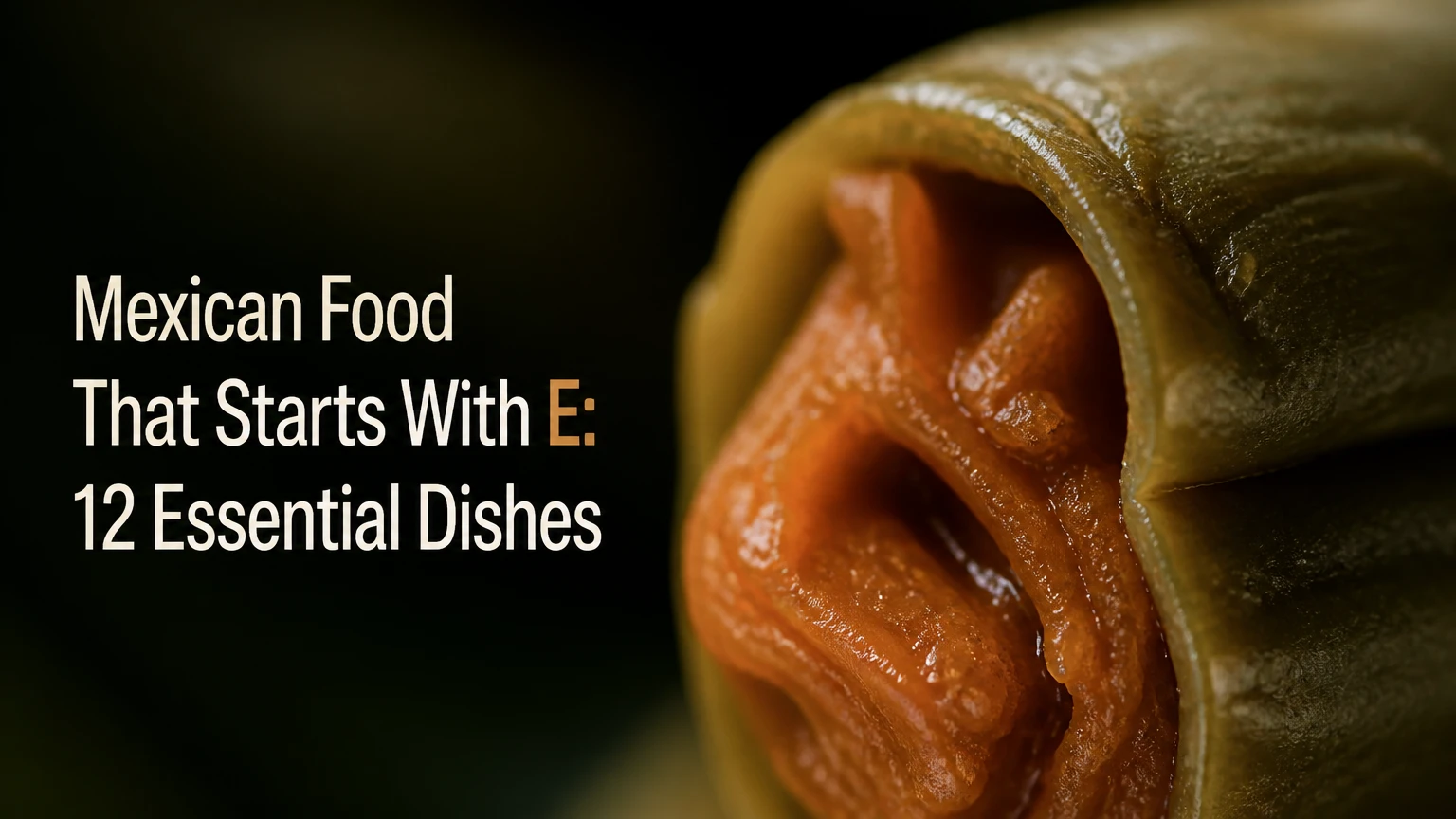
Mexican food that starts with e includes enchiladas, elote, empanadas, enmoladas, esquites, enfrijoladas, entomatadas, enchiladas potosinas, huevos rancheros, huevos a la mexicana, escamoles, and estofado. The most widely recognized choices are enchiladas, elote, empanadas, and enmoladas, while the other dishes add regional, breakfast, street-food, and culinary context.
Key Facts at a Glance
- Enchiladas are corn tortillas filled, rolled, and covered with chile sauce.
- Elote is whole corn on the cob with toppings such as mayonnaise, cotija, chile, and lime.
- Empanadas are sealed turnovers made with wheat flour or corn masa and filled with savory or sweet mixtures.
- Enmoladas are enchiladas covered with mole rather than a standard red or green sauce.
- Esquites contain corn kernels served in a cup, while elote is served on the cob.
- Enfrijoladas use a bean sauce, and entomatadas use a tomato-based sauce instead of chile sauce.
What Mexican Food That Starts With E Should You Try First?
The best first choice is elote for a quick snack, enchiladas for a complete meal, empanadas for portable food, and enmoladas for a rich regional specialty. Elote takes about 15 minutes, enchiladas usually take 45-60 minutes, empanadas require roughly 60 minutes, and scratch-made enmoladas can take 1-2 hours.
The letter E produces a useful mix of Mexican foods rather than a single dish category. Corn appears in elote, esquites, tortillas, and masa, while beans, tomato, mole, eggs, and pastry broaden the list beyond street food.
Some names are common across Mexico and Mexican restaurants abroad. Others, such as escamoles, are strongly associated with particular regions or ingredients and may be difficult to find outside Mexico.
Which Mexican Dishes Begin With E?
The main E foods range from everyday staples to regional specialties. The following table separates the dishes by base, service style, and typical eating occasion.
| Dish | Main base | Typical serving | Common occasion |
|---|---|---|---|
| Enchiladas | Corn tortilla and chile sauce | Three rolled tortillas | Lunch or dinner |
| Elote | Whole sweet corn | One cob with toppings | Street snack or barbecue |
| Empanadas | Wheat flour or corn masa | One sealed turnover | Snack, bakery item, or dessert |
| Enmoladas | Corn tortilla and mole | Two to three rolled tortillas | Family meal or celebration |
| Esquites | Loose corn kernels | One cup with toppings | Street snack |
| Enfrijoladas | Corn tortilla and beans | Two to four folded tortillas | Breakfast or lunch |
| Entomatadas | Corn tortilla and tomato sauce | Two to three folded tortillas | Breakfast or dinner |
| Huevos rancheros | Eggs, tomato, chile, and tortilla | Two eggs with tortillas | Breakfast |
| Huevos a la mexicana | Eggs, tomato, onion, and chile | Scrambled eggs | Breakfast |
| Escamoles | Ant larvae | Small seasoned portion | Regional specialty |
| Estofado | Meat or vegetables in a simmered sauce | Bowl or plated entrée | Lunch or dinner |
| Enchiladas potosinas | Chile-seasoned masa | Folded masa filled with cheese | Regional meal or snack |
The four most useful answers for a general search are enchiladas, elote, empanadas, and enmoladas. Esquites, enfrijoladas, and entomatadas are valuable additions because they explain how Mexican cuisine changes the tortilla, sauce, or serving format while retaining related techniques.
How Are Enchiladas Made?
Enchiladas are made by lightly frying corn tortillas, coating them in warm chile sauce, filling them, rolling or folding them, and finishing them with more sauce and toppings. A typical batch of 12 enchiladas takes 45-60 minutes and uses about 12 tortillas, 500-700 grams of filling, and 500-750 milliliters of sauce.
The tortilla treatment determines the final texture. Flash-frying each tortilla for approximately 3-5 seconds per side softens it while creating a thin oil barrier, which reduces tearing when the tortilla meets the sauce.
A reliable enchilada method
- Prepare the sauce. Toast dried guajillo, ancho, or pasilla chiles for 30-60 seconds, remove stems and seeds, soak them, then blend them with garlic, onion, spices, and broth.
- Simmer the sauce. Cook the blended sauce for 10-20 minutes until it coats a spoon. Strain it if the chile skins remain coarse.
- Condition the tortillas. Fry corn tortillas briefly in oil. Drain them on paper or a rack.
- Fill and roll. Dip one tortilla in warm sauce, add 2-3 tablespoons of chicken, cheese, beans, or vegetables, then roll it seam-side down.
- Finish the pan. Add sauce over the tortillas and bake at 175°C or 350°F for 10-15 minutes if melted cheese is desired.
- Garnish. Use onion, crema, queso fresco, cotija, cilantro, lettuce, radish, or avocado according to the regional style.
The most common mistake is treating the tortilla as a disposable wrapper. A dry tortilla cracks, while an unconditioned tortilla often dissolves under the sauce. Flour tortillas can work in some restaurant adaptations, but corn tortillas provide the expected flavor and structure.
What are the main enchilada varieties?
Enchilada varieties differ mainly by sauce, filling, tortilla treatment, and regional origin. Enchiladas rojas use dried red chiles, enchiladas verdes use tomatillos and fresh green chiles, and enchiladas suizas add dairy and melted cheese to a usually green sauce.
| Variety | Sauce or dough | Typical filling | Regional association |
|---|---|---|---|
| Enchiladas rojas | Guajillo, ancho, or pasilla sauce | Chicken, beef, potato, or cheese | Found throughout Mexico |
| Enchiladas verdes | Tomatillo, serrano, garlic, and cilantro | Chicken, cheese, or vegetables | Central and northern Mexico |
| Enchiladas suizas | Cream-enriched green sauce | Chicken | Mexico City |
| Enchiladas potosinas | Chile paste mixed into masa | Cheese and onion | San Luis Potosí |
| Enchiladas queretanas | Red chile sauce with fried vegetables | Cheese and onion | Querétaro |
| Enchiladas mineras | Guajillo-style sauce with potato and carrot | Cheese, chicken, or vegetables | Guanajuato |
| Enchiladas de mole | Mole sauce | Chicken or turkey | Puebla, Oaxaca, and central Mexico |
Enchiladas potosinas are structurally different from ordinary rolled enchiladas. The chile paste enters the masa before pressing, and the filled tortilla is folded and cooked, so the sauce is part of the tortilla itself rather than only an exterior coating.
Why Is Elote a Mexican Food Beginning With E?
Elote is grilled, boiled, or roasted corn on the cob served with a coating of mayonnaise or crema, salty cheese, chile seasoning, and lime. A typical preparation takes 15 minutes, costs about $1-$3 at home per cob depending on toppings, and requires only a grill, skillet, or stovetop burner.
Whole corn is usually charred until several kernels develop brown spots without drying out. The creamy coating adheres best when the cob is warm and relatively dry, and finely grated cheese clings more effectively than large crumbles.
How do you prepare elote at home?
- Grill four corn cobs over medium-high heat for 10-12 minutes, turning every 2-3 minutes.
- Mix 120 grams of mayonnaise with 60 grams of Mexican crema, if using both.
- Brush the warm corn with the mixture.
- Roll the corn in 75-100 grams of finely grated cotija or queso fresco.
- Add chile powder or Tajín and squeeze lime over each cob.
- Serve immediately with napkins because the coating remains loose on the kernels.
An indoor version works well under a broiler or in a heavy skillet. Rotate the corn until the kernels show scattered char marks, then apply the toppings away from direct heat so the dairy does not separate.
What is the difference between elote and esquites?
Elote is corn served on the cob, while esquites are corn kernels removed from the cob and served in a cup. Both can use chile, lime, cheese, mayonnaise, and crema, but esquites are commonly cooked with butter, onion, and epazote before serving.
| Feature | Elote | Esquites |
|---|---|---|
| Corn format | Whole cob | Loose kernels |
| Eating tool | Hands or skewer | Spoon |
| Cooking time | 10-12 minutes | 12-20 minutes |
| Typical seasoning | Mayo, cheese, chile, lime | Butter, onion, epazote, mayo, cheese |
| Main advantage | Strong grilled flavor | Easier, cleaner eating |
| Best setting | Outdoor snack or barbecue | Indoor snack or party service |
Esquites are the better choice for children, office lunches, or anyone avoiding the mess of a coated cob. Elote offers a more direct grilled-corn experience, especially when the kernels receive light charcoal contact.
Are Mexican Empanadas Sweet or Savory?
Mexican empanadas can be savory or sweet, and their dough varies by region. Savory versions may contain picadillo, chicken, beans, or cheese, while sweet empanadas commonly contain pumpkin, fruit paste, or cajeta. Preparation usually takes about 60 minutes, followed by 3-5 minutes of frying or 15-20 minutes of baking.
Mexican empanadas are not a single standardized national recipe. Northern areas more often use wheat flour dough, while southern and southeastern traditions may use corn masa or locally adapted doughs. The filling must be cool before sealing, because hot filling creates steam that weakens the edge.
Common Mexican empanada fillings
| Style | Filling | Dough | Cooking method |
|---|---|---|---|
| Empanadas de carne | Ground beef picadillo | Wheat flour | Fried or baked |
| Empanadas de pollo | Shredded chicken and chile | Wheat flour or masa | Fried |
| Empanadas de calabaza | Spiced pumpkin | Wheat flour | Baked |
| Empanadas de cajeta | Thick goat-milk caramel | Wheat flour | Baked |
| Empanadas de queso | Fresh cheese and onion | Masa or wheat flour | Fried |
| Empanadas de fruta | Guava, pineapple, or fruit paste | Wheat flour | Baked or fried |
A fork-crimped edge is functional rather than decorative. It compresses the dough layers and gives steam a less direct route to the seal. Frying at approximately 175-180°C, or 350-356°F, produces a crisp shell, while baking at 200°C, or 400°F, reduces oil but creates a drier crust.
What Are Enmoladas?
Enmoladas are corn tortillas filled and covered with mole, usually a dark sauce made from dried chiles, spices, seeds, nuts, aromatics, and sometimes unsweetened chocolate. Enmoladas follow the enchilada format, but mole replaces the ordinary red, green, or tomato-based sauce.
Mole is dense and intensely seasoned, so the filling should remain simple. Shredded chicken, turkey, queso fresco, or onion allows the sauce to remain the dominant flavor without making the dish heavy in every component.
| Enmolada choice | Typical quantity | Flavor effect | Best use |
|---|---|---|---|
| Chicken filling | 60-90 g per tortilla | Mild, savory balance | Main meal |
| Queso fresco | 30-45 g per tortilla | Light, salty contrast | Vegetarian plate |
| Mole paste | 100-150 g per four servings | Concentrated chile and spice | Fast preparation |
| Finished mole sauce | 500-750 ml per 12 tortillas | Ready-to-use coverage | Weeknight cooking |
| Sesame garnish | 1-2 teaspoons per serving | Toasted aroma | Traditional finish |
| Sliced onion | 20-30 g per serving | Sharp freshness | Rich sauces |
Scratch mole can require an hour or more because ingredients are toasted, blended, strained, and simmered. Prepared mole paste reduces the active cooking time to approximately 15-25 minutes, although the final flavor depends heavily on the brand and how much broth or seasoning is added.
What Other Mexican Foods Start With E?
Several additional Mexican foods begin with E, including enfrijoladas, entomatadas, huevos rancheros, huevos a la mexicana, escamoles, estofado, and enchiladas potosinas. These foods expand the answer beyond the four internationally familiar names and reveal how Mexican cooking uses beans, tomatoes, eggs, masa, and regional ingredients.
Enfrijoladas
Enfrijoladas are tortillas dipped in a bean sauce, folded, and filled or topped with cheese, onion, chicken, or avocado. The sauce commonly uses blended black or pinto beans with onion, garlic, broth, or chile.
Enfrijoladas are often easier than enchiladas because the sauce requires fewer ingredients and no dried-chile preparation. They are especially practical for breakfast because leftover beans can become the sauce.
Entomatadas
Entomatadas are tortillas coated in a cooked tomato sauce rather than a chile-forward enchilada sauce. They can contain cheese, chicken, vegetables, or beans and are usually milder than enchiladas rojas or verdes.
The distinction is based on the sauce, not merely the heat level. A tomato sauce may contain chile, while an enchilada sauce may be mild despite using dried chiles.
Huevos rancheros and huevos a la mexicana
Huevos rancheros usually pair fried eggs with tortillas and a cooked tomato-chile sauce. Huevos a la mexicana are scrambled eggs cooked with tomato, onion, and green chile, creating a faster skillet dish.
| Breakfast dish | Egg preparation | Sauce or mixture | Typical serving time |
|---|---|---|---|
| Huevos rancheros | Fried eggs | Tomato and chile sauce | 15-20 minutes |
| Huevos a la mexicana | Scrambled eggs | Tomato, onion, green chile | 10-15 minutes |
| Enfrijoladas with eggs | Fried or scrambled eggs | Bean sauce | 20-30 minutes |
| Entomatadas with eggs | Fried or scrambled eggs | Tomato sauce | 20-30 minutes |
Escamoles
Escamoles are edible ant larvae traditionally harvested in parts of Mexico, especially central regions. They are cooked with ingredients such as butter, onion, epazote, or chile and are regarded as a regional delicacy rather than an everyday restaurant staple.
Availability, harvesting practices, and personal dietary choices vary. Escamoles should be purchased only from reputable suppliers, because wild collection can create food-safety and ecological concerns.
Estofado
Estofado is a Mexican-style stew or braise made with meat, vegetables, aromatics, and a seasoned liquid. Recipes vary significantly by state and household, so the word identifies a cooking method and dish family rather than one fixed ingredient list.
Which E Dish Is Easiest, Cheapest, or Most Filling?
Elote is usually the easiest and fastest E dish, enfrijoladas are among the cheapest complete meals, and enchiladas provide the most dependable combination of filling, sauce, and batch cooking. Empanadas win for portability, while enmoladas offer the deepest sauce complexity at the highest time and ingredient cost.
| Goal | Best choice | Typical time | Typical home cost |
|---|---|---|---|
| Fastest snack | Elote | 15 minutes | $1-$3 per serving |
| Lowest-cost meal | Enfrijoladas | 20-30 minutes | $1.50-$3 per serving |
| Best batch dinner | Enchiladas | 45-60 minutes | $2-$5 per serving |
| Most portable | Empanadas | 60 minutes | $1-$3 each |
| Richest sauce | Enmoladas | 25 minutes with paste | $3-$7 per serving |
| No grill required | Entomatadas | 25-35 minutes | $2-$4 per serving |
| Quick breakfast | Huevos a la mexicana | 10-15 minutes | $1.50-$3 per serving |
These are typical home-cooking ranges in the United States, not fixed national prices. Corn quality, cheese choice, prepared-sauce brands, local labor costs, and access to specialty ingredients can change the final amount substantially.
How Do You Choose Among These Mexican Foods?
Choose by eating situation first, then by sauce tolerance, equipment, and dietary needs. Elote fits a snack, enchiladas fit a family meal, empanadas travel well, and enfrijoladas or entomatadas are better when you need a simpler sauce than mole.
For a beginner
Choose elote or esquites. The technique has only one major checkpoint: cook the corn until tender with a few charred kernels, then apply toppings while the surface remains warm but dry.
For a weeknight dinner
Choose enfrijoladas, entomatadas, or enchiladas made with prepared sauce. Enfrijoladas generally require the fewest specialized ingredients, while enchiladas offer more filling and freezer flexibility.
For a vegetarian meal
Choose cheese or bean enchiladas, enfrijoladas, entomatadas, esquites, or cheese empanadas. Check cheese labels if strict vegetarian practice matters, because some traditional cheeses may use animal-derived rennet.
For a dairy-free meal
Use elote with a lime-chile paste, esquites with olive oil, bean enchiladas, or tomato-based entomatadas. Replace crema with unsweetened plant-based yogurt only when its flavor is neutral and its texture is thick enough to cling.
For a portable meal
Choose baked empanadas. Enchiladas and enmoladas lose structural quality during transport because their sauces soften the tortillas, while elote requires toppings and cleanup at serving time.
What Are the Main Preparation Problems?
The most common problems are torn tortillas, watery toppings, leaking empanadas, bitter chile sauce, and overly heavy mole. Each failure has a specific cause, so adjusting one variable usually works better than adding more seasoning.
| Problem | Likely cause | Practical fix | Prevention |
|---|---|---|---|
| Enchilada breaks | Tortilla is dry or cold | Warm and briefly fry it | Condition every tortilla |
| Red sauce tastes bitter | Chiles were burned | Dilute with broth and rebalance | Toast 30-60 seconds only |
| Elote topping slides | Corn is wet or sauce is thin | Pat corn dry and thicken coating | Apply toppings while warm |
| Empanada opens | Filling was hot or edge was weak | Press, crimp, and chill briefly | Cool filling before assembly |
| Mole tastes heavy | Sauce is too concentrated | Add warm broth gradually | Taste after each dilution |
| Esquites taste flat | Missing acid or salt | Add lime and cheese incrementally | Season after cooking |
A practitioner rule of thumb is to fix texture before flavor. A falling tortilla cannot be rescued by extra cheese, and a leaking empanada cannot be repaired reliably after frying.
Another counterintuitive point concerns chile heat. Removing seeds may reduce some bitterness and bulk, but most perceived heat comes from the chile flesh and inner membranes, so a seeded sauce can still be hot.
Elote also does not require mayonnaise. Mayonnaise provides adhesion and richness, but a thick crema, mashed avocado, or lime-seasoned bean spread can perform the same structural role for different dietary needs.
How Much Time and Equipment Do These Foods Need?
Most E dishes require ordinary kitchen equipment, although elote benefits from a grill and empanadas benefit from a thermometer. Typical preparation ranges from 10 minutes for huevos a la mexicana to more than 90 minutes for mole made from individual ingredients.
| Dish | Active preparation | Cooking time | Useful equipment |
|---|---|---|---|
| Elote | 5 minutes | 10-12 minutes | Grill, skillet, or broiler |
| Enfrijoladas | 10-15 minutes | 10-15 minutes | Blender and skillet |
| Entomatadas | 15-20 minutes | 10-15 minutes | Blender and saucepan |
| Enchiladas | 25-35 minutes | 10-15 minutes | Frying pan and baking dish |
| Empanadas | 35-45 minutes | 5-20 minutes | Rolling tool and fryer or oven |
| Enmoladas | 20 minutes with paste | 15-25 minutes | Blender and saucepan |
| Huevos a la mexicana | 5 minutes | 5-10 minutes | Skillet |
| Escamoles | 10-15 minutes | 5-10 minutes | Frying pan |
Batch cooking changes the economics. A 12-enchilada pan may feed four people, while one empanada generally functions as a snack or light meal unless served with beans, salad, or soup.
Can You Store or Freeze These Dishes?
Enchiladas and empanadas freeze most successfully, while elote, esquites, and finished enmoladas are best eaten shortly after cooking. Store cooked dishes in airtight containers, cool them promptly, and refrigerate them at 4°C or below.
| Dish | Refrigerator guidance | Freezer guidance | Reheating method |
|---|---|---|---|
| Enchiladas | 3-4 days | Freeze assembled without final cheese | Covered oven at 175°C |
| Empanadas | 3-4 days | Freeze before or after baking | Oven or air fryer |
| Enmoladas | 2-3 days | Freeze sauce separately | Warm sauce, then assemble |
| Esquites | 3-4 days | Texture softens after freezing | Skillet with a splash of water |
| Elote | Best same day | Not recommended fully topped | Reheat corn, add toppings fresh |
| Enfrijoladas | 2-3 days | Freeze beans separately | Warm sauce and tortillas separately |
For meal preparation, freeze the sauce and filling separately from tortillas whenever possible. This preserves texture better than freezing a fully sauced tortilla dish for several weeks.
Frequently Asked Questions
Is elote healthy?
Elote provides corn, carbohydrates, and some fiber, but mayonnaise, crema, and cheese increase its fat and sodium content. A lighter serving uses one tablespoon of sauce, 15-20 grams of cheese, lime, and chile. The nutritional profile depends more on the topping quantity than on the corn itself.
Are enchiladas always spicy?
Enchiladas are not always spicy. Heat depends on the chile variety, quantity, and whether the cook removes seeds and membranes. Tomato-based entomatadas, cheese enchiladas, and mild ancho or guajillo sauces can deliver chile flavor with limited heat.
Can Mexican empanadas be made without frying?
Mexican empanadas can be baked at approximately 200°C, or 400°F, for 15-20 minutes. Brushing the surface with beaten egg or oil improves browning, while a well-sealed edge prevents filling from escaping during baking.
What cheese can replace cotija in elote?
Queso fresco, feta, Parmesan, or finely crumbled aged cheese can replace cotija. Queso fresco gives a mild Mexican profile, feta provides stronger saltiness, and Parmesan creates a drier, nuttier coating. Reduce added salt when using feta or Parmesan.
Are enfrijoladas the same as enchiladas?
Enfrijoladas use bean sauce instead of the chile-based sauce associated with enchiladas. Both dishes use softened corn tortillas, but enfrijoladas usually have a milder, creamier flavor and often require fewer ingredients.
Which E dish is best for children?
Esquites, mild cheese empanadas, enfrijoladas, and huevos a la mexicana are usually easier for children than heavily spiced enmoladas. Serve chile, lime, and strong cheese separately so each portion can be adjusted without changing the main dish.
The Bottom Line
The strongest answers to mexican food that starts with e are enchiladas, elote, empanadas, and enmoladas. Choose elote for a fast street-food snack, enchiladas for a flexible family dinner, empanadas for portability, and enmoladas for a mole-centered meal. Esquites, enfrijoladas, entomatadas, huevos rancheros, and other regional dishes complete the wider Mexican E-food list.