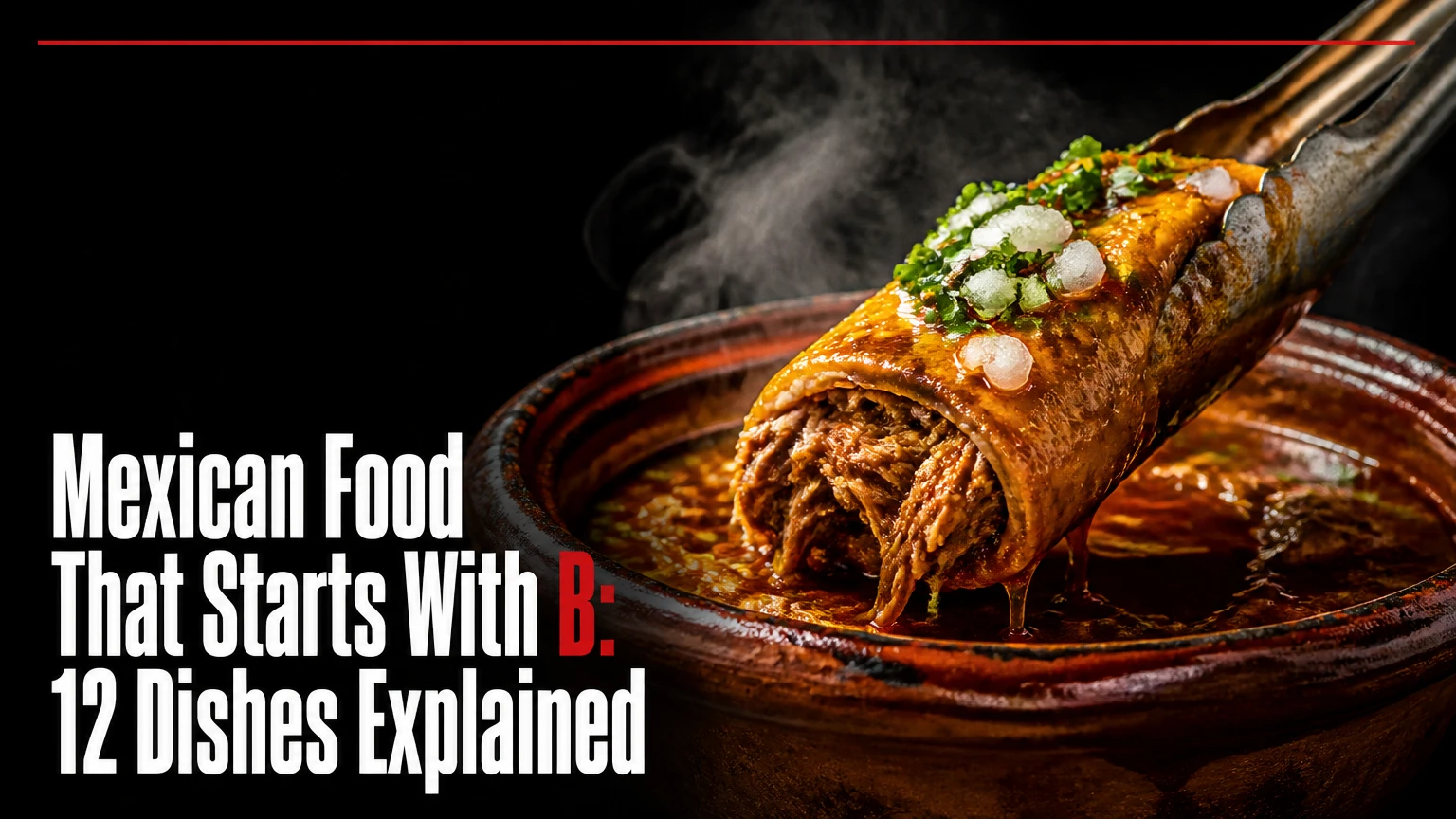
Mexican food that starts with B includes birria, burritos, barbacoa, biónicos, bolillos, buñuelos, bocoles, and bistec a la mexicana. The best-known dishes range from Jalisco’s chile-seasoned stew and northern Mexico’s flour-tortilla burritos to Guadalajara’s fruit dessert and crisp fried pastries, so the letter B covers meals, breads, snacks, and sweets.
Key Facts at a Glance
- Birria is a chile-marinated meat preparation from western Mexico, commonly made with goat or beef and served with consomé.
- Barbacoa describes slow, moist cooking, traditionally in an earth oven, rather than one fixed recipe or meat.
- Mexican burritos developed primarily in northern regions and traditionally use a flour tortilla with a relatively restrained filling.
- Biónicos are fruit cups from Guadalajara covered with a sweet crema-based dressing and toppings.
- Bolillos are crusty oval wheat rolls used for tortas, while buñuelos are fried or baked sweets finished with sugar or syrup.
- Typical restaurant portions cost about $4-$20 in the United States, depending on the dish, location, and serving size.
What Mexican Food That Starts With B Includes
Mexican foods beginning with B fall into four useful groups: braised meat dishes, tortilla-based meals, breads and pastries, and prepared fruit or vegetable dishes. Birria, barbacoa, burritos, and biónicos are the four dishes most often returned for this query, but they are not the complete list.
The spelling matters. Biónico carries an accent on the first vowel in Spanish, although English-language menus frequently write “bionico.” Buñuelo uses the letter ñ and refers to several regional fried pastries rather than one standardized shape. Barbacoa identifies both a cooking tradition and the food produced through that method.
The table below separates the core dishes by culinary role.
| Food | Category | Main serving format | Common region or association |
|---|---|---|---|
| Birria | Braised meat | Bowl, taco, quesataco | Jalisco and western Mexico |
| Burrito | Tortilla meal | Rolled flour tortilla | Northern Mexico |
| Barbacoa | Slow-cooked meat | Tacos, consomé, platter | Hidalgo, central Mexico |
| Biónico | Fruit dessert | Chilled cup or bowl | Guadalajara, Jalisco |
| Bolillo | Wheat bread | Roll or torta base | Mexico City and nationwide |
| Buñuelo | Fried pastry | Flat disc, strips, or rounds | Multiple Mexican regions |
What Are the Four Best-Known B Foods?
The four most recognizable Mexican foods beginning with B are birria, burritos, barbacoa, and biónicos. Birria and barbacoa are savory slow-cooked meat preparations, burritos are filled flour tortillas, and biónicos are chilled fruit desserts with a sweet dairy topping.
Birria
Birria is a heavily seasoned meat dish associated with Jalisco. Traditional versions often use goat, while beef birria has become especially common in restaurants outside Mexico. Dried chiles such as guajillo and ancho provide color and depth; garlic, cumin, cloves, oregano, vinegar, and bay leaf build the seasoning profile.
Birria is usually braised until the meat separates easily. The cooking liquid becomes a concentrated broth called consomé, which may be served alongside the meat or used to moisten tacos. Quesabirria adds melted cheese and griddles a tortilla in the reddish seasoned fat collected from the broth.
Burritos
A burrito is a flour tortilla wrapped around a filling, usually with one primary guisado, beans, or meat. Northern Mexican burritos are often smaller and simpler than the large American restaurant style associated with the Mission district of San Francisco.
A Mexican burrito may contain chile colorado, beans, machaca, shredded beef, or another prepared filling. Rice, sour cream, lettuce, and multiple sauces are more characteristic of many United States interpretations, although restaurant styles overlap.
Barbacoa
Barbacoa is a slow-steaming or slow-roasting method traditionally associated with meat cooked in a covered pit. Maguey leaves help retain moisture and add an earthy aroma, while overnight cooking softens cuts that would otherwise be difficult to chew.
Regional recipes differ significantly. Hidalgo is strongly associated with sheep barbacoa, while beef cheek and beef head are common in many taco shops. Modern home versions use a covered pot, slow cooker, or pressure cooker, but those methods reproduce tenderness more reliably than the exact smoky aroma of an earth oven.
Biónicos
A biónico is a Mexican fruit dessert linked with Guadalajara street-food culture. Chopped fruit, commonly banana, strawberry, papaya, apple, and melon, is coated in a sweet mixture containing condensed milk, evaporated milk, and Mexican crema or sour cream.
Granola, raisins, shredded coconut, and chopped nuts add texture. A yogurt-based dressing reduces richness but changes the traditional flavor and mouthfeel. Biónicos are best assembled shortly before serving because cut fruit releases liquid and softens the toppings.
How Do Birria and Barbacoa Differ?
Birria is defined by its chile-based seasoning and broth, while barbacoa is defined primarily by its slow, moist cooking method. A dish can be tender and richly seasoned without being birria, and beef cooked in a barbacoa style is not automatically birria.
| Attribute | Birria | Barbacoa | Practical consequence |
|---|---|---|---|
| Defining feature | Chile marinade and consomé | Slow steaming or roasting | Flavor versus cooking method |
| Traditional meat | Goat or mutton | Sheep, goat, or beef head | Regional choice changes texture |
| Liquid | Broth is intentionally served | Cooking juices may be less prominent | Birria suits dipping |
| Typical seasoning | Guajillo, ancho, garlic, cumin | Salt, herbs, chiles, regional spices | Barbacoa can taste more meat-forward |
| Common service | Tacos with consomé | Tacos, plates, consommé | Both work for group meals |
| Home method | Covered braise, 3.5-5 hours | Slow cooker, 6-10 hours | Barbacoa often needs longer cooking |
Birria usually wins for diners who want a pronounced chile flavor and a dip-able broth. Barbacoa usually wins when the goal is tender meat with a cleaner, less sauce-dominant profile.
How Do Mexican Burritos Differ by Region?
Mexican burritos vary according to tortilla size, filling density, and local food culture. Northern Mexican versions often keep the filling narrow enough to produce a compact roll, whereas the large Mission-style burrito can include rice, beans, cheese, salsa, and several additional garnishes.
| Burrito style | Typical tortilla | Typical filling | Approximate size |
|---|---|---|---|
| Northern Mexican | Flour, 20-25 cm | One guisado or beans | 150-300 g |
| Burrito de machaca | Flour, 20-25 cm | Dried shredded beef, egg, onion | 200-350 g |
| Burrito ahogado | Flour, 25-30 cm | Filled burrito covered in sauce | 300-500 g |
| Mission-style | Flour, 30-35 cm | Rice, beans, meat, cheese, salsa | 500-900 g |
A flour tortilla must be warm and flexible before filling. About 100-180 g of filling is a manageable range for a compact burrito; heavier portions increase the risk of tearing unless the tortilla is unusually large.
The Mission style is convenient when one wrapped meal must include several components. The northern style is preferable when the flavor of a single guisado should remain dominant.
What Is a Biónico Made Of?
A traditional biónico combines chopped fresh fruit with a sweet crema mixture, then adds granola, raisins, coconut, or nuts. A typical two-person batch uses 500-700 g of fruit, 120 ml of crema or sour cream, 60 ml of evaporated milk, and 60-90 ml of condensed milk.
Banana contributes softness and sweetness, strawberry adds acidity, and papaya provides a mellow tropical note. Apple and melon add firmer texture, but watery melon should be drained before assembly.
Biónicos are not designed for long storage. Refrigerate covered portions for up to 24 hours, and add granola only at serving time. For a less sweet version, use plain yogurt, reduce the condensed milk to 30 ml, and add toasted oats instead of sweetened cereal.
What Other Mexican Foods Begin With B?
Other Mexican foods beginning with B include bolillo, buñuelos, bocoles, bistec a la mexicana, and beans prepared in regional styles. These foods matter because a search limited to four famous dishes misses important bread, pastry, masa, and home-cooking traditions.
| Food | What it is | Typical ingredients or service |
|---|---|---|
| Bolillo | Crusty oval wheat roll | Flour, yeast, salt, water; used for tortas |
| Buñuelo | Fried or baked sweet pastry | Wheat dough, sugar, cinnamon, syrup |
| Bocol | Thick Huastecan masa cake | Corn masa, fat, beans, cheese, or meat |
| Bistec a la mexicana | Beef with tomato, onion, and green chile | Thin beef strips served with tortillas |
| Bocolito | Small filled masa cake | Masa, beans, cheese, or regional stew |
| Frijoles | Beans prepared as a staple food | Pinto, black, or bayo beans with aromatics |
Bolillo
A bolillo is a crusty wheat roll with a compact oval shape and a firm exterior. It is the standard bread for many tortas, where its interior must hold fillings without collapsing under beans, meat, cheese, or salsa.
Bolillos are usually best on the day of purchase. If the crust softens, reheat the roll at about 180°C for 5-8 minutes, then cool it briefly before slicing.
Buñuelos
Mexican buñuelos are crisp pastries that may be shaped as thin rounds, strips, or small pieces. Recipes differ by region, but common finishes include cinnamon sugar, piloncillo syrup, or a light sugar coating.
Commercial and family recipes should not be treated as interchangeable. Some doughs include baking powder, while others rely on thin rolling and frying for their texture.
Bocoles
Bocoles are thick, round masa cakes associated with the Huasteca region. The masa may be mixed with fat and filled or topped with beans, cheese, herbs, or a prepared savory mixture.
Bocoles are denser than tortillas and smaller than many gorditas. Their defining feature is the thick masa base, not a specific topping.
How Do You Make Beef Birria at Home?
Beef birria typically takes 4.5-6 hours including marination and produces tender meat plus consomé for tacos or bowls. The most important success factor is gentle covered cooking, because aggressive boiling toughens the meat and leaves the broth cloudy.
Before You Start
| Requirement | Typical specification | Quantity or range |
|---|---|---|
| Beef | Chuck roast, short rib, or shank | 1.5 kg |
| Dried chiles | Guajillo and ancho | 4 and 2 |
| Braising liquid | Unsalted beef stock or water | 1-1.2 liters |
| Marination | Covered refrigeration | 4-12 hours |
| Cooking vessel | Dutch oven or slow cooker | 5-6 liters |
| Total active time | Blending and serving | 35-50 minutes |
Step 1: Toast and Soften the Chiles
Remove stems and most seeds from four guajillo chiles and two ancho chiles. Toast them in a dry pan for 15-30 seconds per side, then soak them in hot water for 15 minutes.
You will know the chiles are ready when they bend easily and smell fruity rather than burnt. Burnt chiles create bitterness that sugar or extra broth cannot remove.
Step 2: Blend and Strain the Adobo
Blend the softened chiles with five garlic cloves, 1 teaspoon cumin, 1 teaspoon Mexican oregano, two cloves, 2 tablespoons vinegar, 240 ml soaking liquid, and 1 teaspoon salt. Strain the mixture through a fine sieve.
A smooth adobo coats the meat evenly and produces a cleaner consomé. Do not skip straining if the chiles have tough skins or many seeds.
Step 3: Marinate the Beef
Coat 1.5 kg of beef chuck, short rib, or shank with the adobo. Refrigerate the covered meat for at least 4 hours, although an overnight marinade gives the surface more time to absorb flavor.
Keep raw beef below 4°C during marination. A shallow container cools more safely than a deep stockpot.
Step 4: Braise the Meat
Place the marinated beef in a covered Dutch oven with the adobo, 1 liter of stock, one quartered onion, and two bay leaves. Bring the liquid to a gentle simmer, then cook at low heat for 3.5-4.5 hours.
The meat is ready when a fork enters with little resistance and the fibers separate without pressure. If the liquid boils rapidly, lower the heat and add 120-240 ml of water or stock.
Step 5: Separate the Fat and Serve
Remove the meat and shred it. Rest the broth for 5-10 minutes, then skim the orange fat from the surface into a separate bowl.
Use the seasoned fat to coat corn tortillas before griddling them. Fill each tortilla with approximately 45-60 g meat and cheese if desired, then serve two or three tacos with 180-240 ml consomé.
How Much Time and Money Do B Foods Require?
Typical preparation time ranges from 5 minutes for assembling a biónico to 10-12 hours for traditional barbacoa. United States restaurant prices commonly range from about $4 for a bolillo-based snack to $20 for a birria or barbacoa plate, but metropolitan pricing can be higher.
| Food | Home preparation time | Typical US restaurant price | Typical portion |
|---|---|---|---|
| Birria tacos with consomé | 4.5-6 hours | $12-$20 | 3 tacos plus 180-240 ml broth |
| Burrito | 15-30 minutes | $8-$18 | 250-900 g |
| Barbacoa tacos | 6-12 hours | $12-$22 | 3-4 tacos |
| Biónico | 5-10 minutes | $6-$12 | 350-500 g |
| Bolillo | 2-4 hours from dough | $1-$3 | 1 roll |
| Buñuelos | 35-60 minutes | $3-$8 | 2-4 pieces |
Restaurant menus rarely distinguish traditional and adapted versions consistently. Ask whether birria uses goat or beef, whether barbacoa is cheek or another cut, and whether a burrito includes rice before comparing prices.
Which B Food Should You Choose?
Choose birria for intense chile flavor, barbacoa for tender meat with a simpler profile, a burrito for portability, and a biónico for a chilled sweet dish. Bolillos and buñuelos are better choices when the search is specifically about Mexican breads or pastries beginning with B.
| Situation | Best choice | Why it fits | Main limitation |
|---|---|---|---|
| First Mexican B dish | Birria | Clear signature flavor and consomé | Long cooking time |
| Portable lunch | Northern burrito | Compact flour-tortilla format | Can be dry if under-sauced |
| Group taco meal | Barbacoa | Tender meat scales well | Traditional preparation is lengthy |
| Chilled dessert | Biónico | No cooking required | Fruit softens quickly |
| Breakfast or torta | Bolillo | Holds substantial fillings | Bread loses crust overnight |
| Holiday-style sweet | Buñuelo | Crisp texture and cinnamon finish | Frying requires temperature control |
A vegetarian diner can choose biónicos, bean-filled bocoles, bolillo tortas with vegetable fillings, or seasoned beans. A dairy-free diner should confirm that biónico dressing does not contain crema or condensed milk and that bocoles are cooked without added dairy.
What Common Problems Affect These Foods?
The most common problems are oily birria broth, torn burrito tortillas, dry barbacoa, watery biónicos, and greasy buñuelos. Each problem has a specific cause, so changing ingredients without correcting the technique usually produces inconsistent results.
| Problem | Likely cause | Practical correction |
|---|---|---|
| Birria tastes bitter | Chiles were scorched | Toast briefly and discard blackened chiles |
| Birria seems too oily | Fat was not skimmed | Rest broth 5-10 minutes and remove surface fat |
| Burrito tears | Cold tortilla or excess filling | Warm tortilla and use 100-180 g filling |
| Barbacoa is dry | Heat escaped during cooking | Seal vessel and maintain a covered braise |
| Biónico becomes watery | Fruit was cut too early | Drain fruit and assemble within 30 minutes |
| Buñuelos absorb oil | Frying temperature is too low | Maintain approximately 175-185°C |
A counterintuitive birria rule is that the orange fat is useful rather than waste. Skimming it separately lets you control richness while preserving a concentrated cooking oil for tortillas.
A second practitioner rule is to judge barbacoa by resistance, not by the clock. Beef cheek may need 8 hours, while smaller chuck pieces can soften sooner; a fork test is more reliable than copying a fixed cooking time.
A third rule applies to burritos: filling temperature matters less than tortilla flexibility. A hot tortilla stretches around a moderate filling, while a cold tortilla tears even when the portion is correctly measured.
Are These Foods Traditionally Mexican or Adapted?
Birria, barbacoa, burritos, biónicos, bolillos, buñuelos, bocoles, and bistec a la mexicana are all connected with Mexican foodways, but recipes change by state, family, restaurant, and diaspora community. “Traditional” does not mean one national formula.
Barbacoa has especially strong regional variation. A Hidalgo-style preparation and a beef-cheek taco-shop preparation may share a name while using different animals, spices, equipment, and serving customs.
Burritos also need careful labeling. Northern Mexican burritos are not simply smaller versions of Mission burritos; they developed within different regional food systems and often emphasize one filling rather than a layered combination.
The same caution applies to quesabirria. The dish uses birria as its meat foundation, but the cheese-filled taco format became particularly prominent through contemporary restaurant and street-food culture. It should be described as a birria variation, not as the only or oldest form of birria.
Frequently Asked Questions
What is the easiest Mexican food beginning with B to make?
Biónicos are usually the easiest because preparation involves chopping fruit, mixing the dressing, and adding toppings. A basic serving can be assembled in 5-10 minutes without a stove. A bean-filled bolillo is another quick option, while birria and barbacoa require several hours of cooking.
Which Mexican B food is best for breakfast?
A burrito filled with beans, egg, or machaca is the most practical breakfast choice. Northern Mexican breakfast burritos often remain compact and portable, while a bolillo can hold eggs, beans, cheese, or vegetables in a torta-style sandwich.
Can birria and barbacoa use the same cut of beef?
Birria and barbacoa can use overlapping cuts such as chuck, shank, or cheek, but the preparation remains different. Birria depends on a chile adobo and broth, whereas barbacoa depends on slow moist cooking. The same beef cut does not make the dishes equivalent.
Are biónicos healthy?
Biónicos provide fruit, but traditional dressing can add substantial sugar through condensed milk and toppings. A lower-sugar version uses plain yogurt, limits condensed milk to 30 ml per serving, and replaces sweet granola with oats or unsalted nuts.
What is the difference between a bolillo and a baguette?
A bolillo is a Mexican oval wheat roll with a crisp crust and compact crumb, while a baguette is a longer French-style loaf with a different shape and production tradition. Bolillos are especially associated with tortas because their size and structure suit filled sandwiches.
How should leftover birria be stored?
Refrigerate shredded birria and consomé in separate covered containers within two hours of cooking. Use the leftovers within 3-4 days, or freeze them for about 2-3 months. Reheat the meat in broth so it remains moist, then skim excess fat before serving.
The Bottom Line
Mexican food that starts with B spans far more than birria, burritos, barbacoa, and biónicos. Choose birria for chile-seasoned meat and consomé, barbacoa for slow-cooked tenderness, burritos for portable meals, biónicos for fruit dessert, bolillos for tortas, and buñuelos for crisp sweets. Regional context determines what each name means in practice.