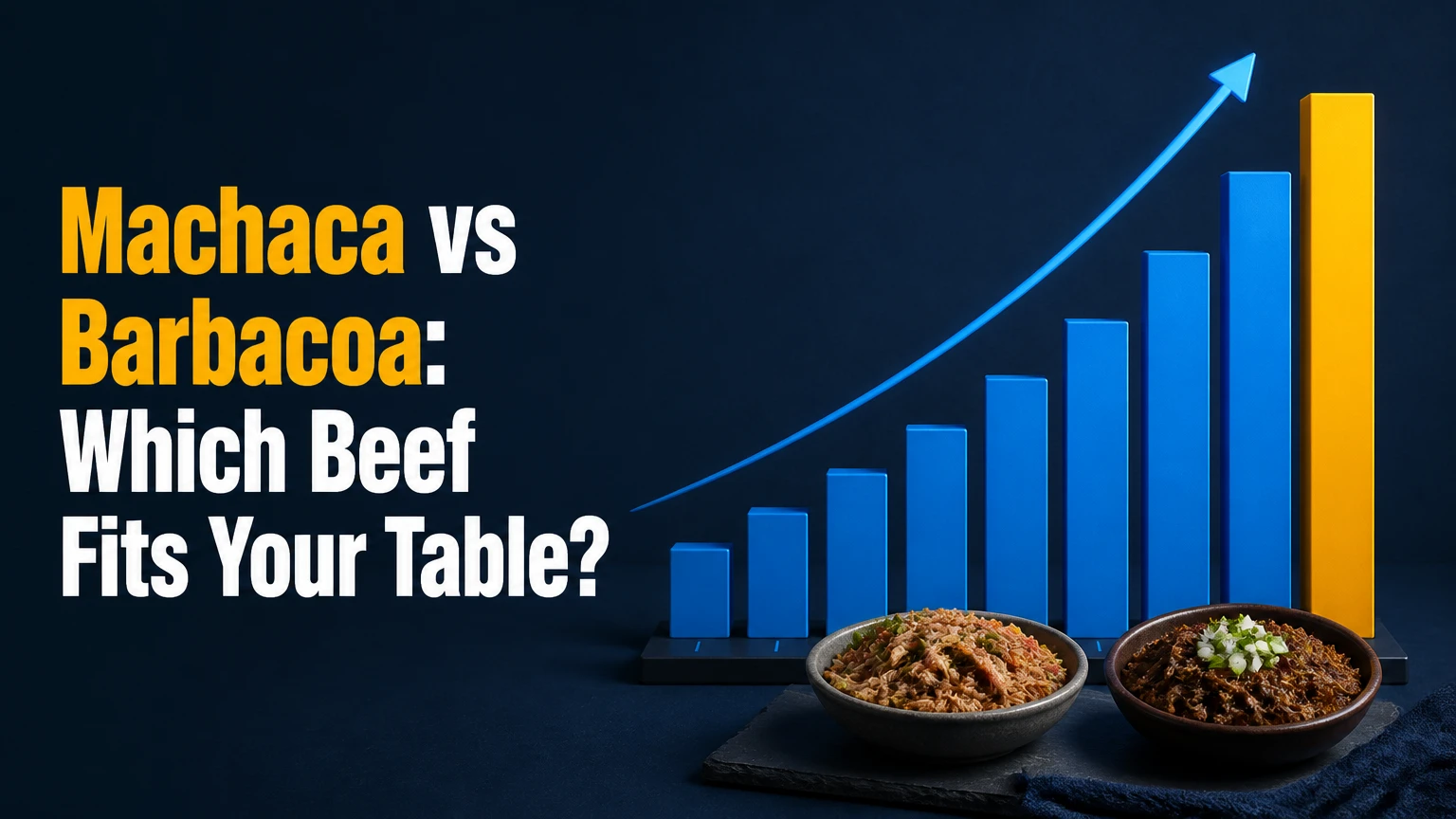
Machaca is salted, dried, shredded beef that is later fried or simmered with vegetables, while barbacoa is fresh meat cooked slowly with moist heat until collagen becomes gelatin and the fibers pull apart. Choose machaca for concentrated flavor, speed, portability, and breakfast dishes; choose barbacoa for juicy tenderness, tacos, broth, and feeding a group.
Key Facts at a Glance
- Machaca begins as preserved meat, so its defining traits are concentrated flavor, low moisture, and variable saltiness.
- Barbacoa begins as fresh meat, so its defining traits are long cooking, gelatin-rich juices, and tender shreds.
- Traditional barbacoa uses an underground pit, but modern barbacoa commonly uses an oven, pressure cooker, or slow cooker.
- Machaca usually takes 5-15 minutes to finish once dried meat is available; traditional drying adds 1-3 days.
- Beef cheek, chuck, brisket, sheep, and goat can all produce barbacoa, depending on regional tradition.
- Machaca and barbacoa are not interchangeable at equal weights because machaca is dry and barbacoa contains substantial moisture.
What Is the Difference Between Machaca and Barbacoa?
Machaca is a preservation method and an ingredient, whereas barbacoa is primarily a cooking method and a finished dish. Machaca is salted, dried, pounded, and rehydrated in a skillet; barbacoa is fresh meat braised or steamed for hours until connective tissue dissolves.
The distinction matters because the two preparations behave differently in recipes. Machaca needs added moisture, fat, or eggs to become tender. Barbacoa already carries cooking juices and can be served in tortillas with consommé, onions, cilantro, and salsa.
The Google overview correctly identifies machaca as traditionally dried beef and barbacoa as traditionally pit-cooked meat. Two qualifications improve that summary: machaca is not always made from one fixed cut, and barbacoa does not require a pit in modern kitchens or follow one national recipe.
| Attribute | Machaca | Barbacoa |
|---|---|---|
| Primary identity | Dried, shredded meat | Slow-cooked fresh meat |
| Typical beef forms | Flank, round, brisket, skirt | Cheek, chuck, brisket |
| Traditional regions | Sonora, Chihuahua, Sinaloa | Hidalgo, State of Mexico, Jalisco |
| Moisture at serving | Low to moderate | High |
| Texture | Fine, fibrous, slightly chewy | Soft, yielding, gelatinous |
| Main meal use | Breakfast, burritos, flour tortillas | Tacos, plates, consommé |
| Active finishing time | 5-15 minutes | 20-40 minutes to shred and serve |
| Total traditional timeline | 1-3 days drying plus cooking | 8-14 hours cooking |
How Are the Two Preparations Made?
Machaca is made by salting and drying thin beef, then softening, shredding, and cooking it with aromatics. Barbacoa is made by seasoning fresh meat and holding it in a humid, low-temperature environment until collagen converts into gelatin.
The Traditional Machaca Process
Traditional Northern Mexican machaca generally follows this sequence:
- Slice lean beef into thin sheets.
- Salt the slices thoroughly.
- Dry the meat in sun or moving dry air for roughly 1-3 days, depending on thickness, humidity, and temperature.
- Toast or soften the dried sheets briefly.
- Pound or shred the meat into fine strands.
- Fry the strands with oil or lard, onion, tomato, chile, and garlic.
- Add eggs, broth, or additional vegetables when a softer breakfast preparation is wanted.
Home drying requires food-safety control. A dehydrator with a verified temperature setting is more predictable than outdoor drying, because insects, humidity, and uneven drying can leave unsafe pockets. Commercial machaca is the simpler option for most kitchens.
The Traditional Barbacoa Process
Traditional barbacoa uses seasoned meat over or around a covered vessel, often inside an underground oven lined with heated stones. Agave leaves may wrap the meat or line the pit, and the collected liquid becomes a seasoned broth in some regional preparations.
Modern cooks reproduce the same mechanism with a covered Dutch oven, slow cooker, or pressure cooker. The essential variables are a collagen-rich cut, sufficient moisture, a sealed cooking environment, and enough time for the meat to reach shredding tenderness.
| Production stage | Machaca | Barbacoa |
|---|---|---|
| Starting meat | Thin lean slices | Large fresh cuts or bone-in portions |
| Preservation or cooking method | Salt and dehydration | Braising, steaming, or pit roasting |
| Typical temperature | Dehydrator often 145-160°F for meat protocols | Oven commonly 275-325°F |
| Main transformation | Moisture removal, then rehydration | Collagen conversion into gelatin |
| Typical total time | 1-3 days traditional drying | 8-14 hours pit or slow-cooker cooking |
| Final liquid | Added tomato, broth, eggs, or vegetables | Natural juices and cooking broth |
| Finishing action | Fry, simmer, or scramble | Rest, shred, defat, and serve |
Which Meat, Texture, and Flavor Should You Expect?
Machaca tastes concentrated, salty, and intensely beefy, with strands that retain more resistance than braised meat. Barbacoa tastes savory and aromatic, with a moist, yielding texture created by gelatin, rendered fat, and prolonged cooking.
Machaca’s texture depends heavily on the finished dish. Dry strands fried until crisp may resemble fine beef jerky, while machaca con huevo becomes soft because egg and tomato provide moisture. Barbacoa remains tender when the meat contains enough collagen and the cooking vessel prevents evaporation.
Flavor also varies by region. Sonoran machaca may use tomato, onion, green chile, or egg, while Hidalgo-style barbacoa often centers on sheep, aromatic leaves, broth, and handmade tortillas. “Machaca” and “barbacoa” identify broad traditions, not one fixed seasoning formula.
| Sensory factor | Machaca | Barbacoa |
|---|---|---|
| First flavor impression | Salt, dried beef, toasted meat | Braised meat, chile, aromatics |
| Texture at its driest | Fine, firm, slightly chewy | Not applicable |
| Texture when properly finished | Tender strands with some bite | Soft strands that separate easily |
| Fat level | Usually low in the dried ingredient | Moderate to high, depending on cut |
| Salt risk | High if the product is heavily cured | Moderate, added during seasoning |
| Best moisture partners | Eggs, tomato, broth, salsa | Consommé, salsa, tortilla |
| Best serving temperature | Hot from skillet | Hot after resting and shredding |
Which Preparation Is Faster and More Portable?
Machaca is faster in the kitchen and more portable because commercial dried machaca can remain shelf-stable until opened, while barbacoa requires refrigerated fresh meat and long cooking. Barbacoa offers greater serving volume but demands advance planning.
A skillet of machaca with eggs can reach the table in about 10 minutes. A batch of barbacoa may need 15 minutes of active preparation plus 8-14 hours in a covered cooker, although most of that time requires little attention.
Storage claims need care. Commercial machaca should follow its package instructions, and homemade dried meat should not be treated as automatically shelf-stable unless the drying and packaging process has been validated. Cooked barbacoa belongs in the refrigerator within two hours, or within one hour when the surrounding temperature exceeds 90°F.
| Planning factor | Machaca | Barbacoa |
|---|---|---|
| Active preparation | 10-25 minutes | 25-45 minutes |
| Waiting time | 0 minutes with packaged machaca | 6-14 hours |
| Refrigeration before cooking | Usually unnecessary for unopened commercial product | Required |
| Typical batch size | 4-8 ounces dry meat | 3-6 pounds raw meat |
| Servings per batch | 2-4 breakfast portions | 8-16 taco portions |
| Best portable format | Sealed dry meat and tortillas | Chilled cooked meat in a cooler |
| Main planning risk | Excess salt or inadequate rehydration | Undercooked connective tissue |
Which One Costs More?
Machaca commonly costs more per pound as purchased because drying removes water and concentrates labor, while barbacoa costs more in energy and preparation time. Retail prices vary by region, cut, brand, and whether the comparison uses dry machaca or cooked barbacoa.
Typical United States retail ranges are approximately $20-$40 per pound for packaged dry machaca and $12-$25 per pound for prepared beef barbacoa. Those figures are comparison guides, not fixed market prices. A restaurant taco plate and a packaged ingredient measure different portions and overhead.
Dry-weight comparisons can mislead. One pound of dried machaca may represent several pounds of fresh beef before moisture loss, while one pound of cooked barbacoa still includes substantial water and gelatin. Compare cost per serving instead.
| Cost measure | Machaca | Barbacoa |
|---|---|---|
| Typical retail ingredient price | $20-$40 per dry pound | $8-$18 per raw pound for chuck or cheek |
| Typical prepared food price | $10-$18 per serving | $12-$25 per taco plate |
| Typical home batch cost | $8-$20 for 4 servings | $35-$75 for 8-12 servings |
| Main hidden cost | Drying labor and weight loss | Cooking energy and refrigeration |
| Budget substitution | Commercial dried beef in small bags | Chuck instead of cheek |
| Best value condition | Small, fast meals | Large group meals |
Is Machaca or Barbacoa Healthier?
Neither preparation is automatically healthier; machaca is often leaner but can be much higher in sodium, while barbacoa can contain more fat but less concentrated salt per bite. Portion size, cut, preparation liquid, and the rest of the meal determine the practical difference.
Dried meat loses water, so its protein and sodium become concentrated by weight. A product label is more useful than a generic estimate because brands differ widely in salt content. Rinsing machaca may reduce surface salt, but it also removes flavor and does not guarantee a specific sodium reduction.
Barbacoa made from cheek or fatty lamb can produce a rich, high-energy serving. Trimming visible fat, chilling the broth, and removing the hardened fat layer can reduce greasiness without stripping away gelatin. The most reliable nutrition comparison uses the package label or a measured recipe, not the dish name alone.
Can You Substitute Machaca for Barbacoa?
Machaca can replace barbacoa only in fillings where a dry, salty, fibrous texture is acceptable, and the recipe must add moisture. Use roughly one-quarter to one-third as much dry machaca as cooked barbacoa by weight, then add tomato, broth, eggs, or sauce gradually.
The substitution works in breakfast burritos, skillet fillings, and compact camping meals. It fails when the dish depends on juicy strands, collagen-rich broth, or large pieces of tender meat, such as classic barbacoa tacos with consommé.
To adapt machaca for tacos, sauté onion and chile, add hydrated machaca, and finish with enough broth to soften the fibers without turning them mushy. Keep salt out of the first stage because the dried beef may already provide the seasoning.
Can Barbacoa Replace Machaca?
Barbacoa can replace machaca in a moist tortilla filling, but it cannot reproduce machaca’s preserved flavor, dry storage, or rapid skillet preparation. Drain and finely chop the barbacoa before frying it with eggs or vegetables if a closer texture is needed.
Barbacoa is the better substitute when tenderness matters more than portability. It is a poor substitute for emergency pantry meals because cooked meat needs cold storage and reheating, and its moisture makes it unsuitable for a dry snack format.
A useful rule is simple: replace machaca with barbacoa by adding moisture to the recipe only if the original recipe expects a juicy filling. Replace barbacoa with machaca only after reducing the dry meat quantity and restoring liquid.
Where Do Regional Traditions Differ?
Northern Mexican machaca is associated with arid regions where drying and salting historically extended meat’s usable life. Central Mexican barbacoa is strongly associated with pit-cooked sheep, while beef barbacoa is especially common in northern Mexico and border-region restaurants.
Regional labels are useful but not absolute. Machaca may use beef, fish, manta ray, or other local ingredients in coastal areas. Barbacoa may use sheep, goat, beef cheek, chuck, brisket, or other meat depending on local supply and tradition.
Mixiote is related but distinct. Mixiote refers to meat steamed in a thin agave-leaf membrane or a modern substitute, often in individual portions; it should not be treated as a universal synonym for barbacoa.
| Regional preparation | Common protein | Cooking or preservation method | Typical serving |
|---|---|---|---|
| Sonoran machaca | Lean beef | Salting, drying, shredding | Eggs and flour tortillas |
| Chihuahua-style machaca | Beef | Dried meat with tomato and chile | Burritos or skillet meals |
| Hidalgo barbacoa | Sheep | Covered pit steaming | Tacos and consommé |
| Jalisco goat barbacoa | Goat | Slow braising or pit cooking | Tacos with salsa |
| Northern beef barbacoa | Beef cheek or chuck | Covered braise or steam | Tacos, bowls, broth |
| Coastal machaca variants | Fish or manta ray | Drying and shredding | Stews, tacos, or breakfast |
What Are the Most Common Cooking Mistakes?
The most common machaca mistake is adding salt before tasting, while the most common barbacoa mistake is stopping the cook when the meat is technically done but collagen has not fully softened. Both dishes improve when cooks manage moisture deliberately.
Machaca Mistakes
- Over-salting: Cook the vegetables first, add machaca, and season only after tasting.
- Leathery strands: Fry briefly, then add tomato, broth, or egg and cover for 2-4 minutes.
- Burnt fibers: Use medium heat because thin dried strands toast quickly.
- Mushy texture: Add liquid in tablespoons rather than pouring in a full cup.
- Uneven rehydration: Break large clumps apart before they enter the skillet.
Barbacoa Mistakes
- Dry shreds: Use cheek, chuck, brisket, or another collagen-rich cut, and keep the pot sealed.
- Greasy broth: Chill the cooking liquid and lift off the solidified fat before reheating.
- Tough meat after hours: Continue cooking until a fork slides through the center; time alone is not the doneness test.
- Weak flavor: Salt the meat adequately and season the cooking liquid, not only the surface.
- Unsafe cooling: Divide a large batch into shallow containers so it chills quickly.
A practitioner rule matters here: barbacoa tenderness is governed by collagen conversion, not by the clock. An extra 60-90 minutes can rescue a tough batch, whereas adding more seasoning cannot.
Which Should You Choose?
Choose machaca for quick breakfasts, travel, pantry storage, leaner fillings, and cooks who enjoy a distinct chew. Choose barbacoa for soft tacos, weekend meals, broth, large gatherings, and anyone who prioritizes juicy tenderness.
Choose Machaca If You Need Speed
Machaca is the practical choice when dinner must be ready in under 20 minutes. It also works well for camping or emergency meal planning when unopened commercial packaging is available and cooking equipment is limited to a skillet.
Machaca is not ideal for diners who dislike salty, fibrous textures. It also requires label reading because two products with the same name can differ substantially in salt, shred size, and fat content.
Choose Barbacoa for Tacos and Groups
Barbacoa is the stronger choice for a taco gathering because a 4-pound batch of raw beef can provide roughly 8-12 servings, depending on tortilla size and toppings. The cooking liquid can become a separate broth, increasing the meal’s usefulness.
Barbacoa is not ideal for an immediate weekday breakfast. The long cook, refrigeration requirement, and fat management make it less convenient than machaca.
Choose According to Texture
Texture-sensitive diners usually prefer barbacoa because properly cooked collagen-rich meat produces soft, moist shreds. Diners who want a concentrated beef flavor with a firmer bite may prefer machaca.
Choose According to Nutrition Goals
Athletes seeking a lean, compact protein ingredient may find machaca more practical, but sodium must be checked first. Diners limiting rich foods may prefer trimmed beef barbacoa with defatted broth, while those needing lower sodium should compare labels and recipes rather than assume one winner.
| User situation | Better choice | Reason | Adjustment |
|---|---|---|---|
| 10-minute breakfast | Machaca | Fast skillet finishing | Add tomato or egg |
| Weekend taco meal | Barbacoa | Tender, high-yield batch | Defat broth |
| Backpack or road meal | Commercial machaca | Low weight and no pre-cook refrigeration | Follow package storage |
| Soft-texture preference | Barbacoa | Gelatin-rich, yielding strands | Use cheek or chuck |
| Lower-fat meal | Lean machaca or trimmed beef barbacoa | Depends on sodium and cut | Read labels, trim fat |
| Lowest sodium priority | Unsalted homemade barbacoa | Machaca is commonly cured | Control seasoning |
| Small pantry meal | Machaca | Little ingredient waste | Buy a small package |
| Consommé service | Barbacoa | Cooking liquid is integral | Strain and chill broth |
How Should You Buy and Store Each One?
Buy machaca by checking sodium, ingredients, shred size, package date, and storage instructions; buy barbacoa by selecting a collagen-rich cut with enough connective tissue and planning safe refrigeration. Product labels and butcher guidance matter more than the name alone.
For machaca, choose a package with clearly stated ingredients and avoid assuming that “dry” means shelf-stable after opening. Seal opened product tightly and follow the manufacturer’s refrigeration guidance. Homemade dried meat requires validated drying and packaging practices for long storage.
For barbacoa, beef cheek gives the richest gelatin, chuck offers easier sourcing, and brisket provides a balance of beef flavor and structure. Cooked meat should be refrigerated promptly, used within the refrigerator window recommended by food-safety authorities, or frozen for longer storage.
The Bottom Line
Machaca vs barbacoa is a choice between preserved, concentrated beef and fresh, slow-cooked meat. Machaca wins for speed, portability, breakfast, and compact portions; barbacoa wins for tenderness, tacos, broth, and group meals. The most important practical distinction is moisture: machaca needs liquid added, while barbacoa creates and retains liquid during cooking.
Neither dish is universally superior. A salty breakfast skillet needs machaca, while a soft taco with consommé needs barbacoa. Choose the preparation that matches the texture, timeline, storage conditions, and serving format you actually have.
Frequently Asked Questions
Is machaca the same as dried beef?
Machaca is a Mexican style of salted, dried, and shredded meat, usually beef, but ordinary dried beef is a broader category. Machaca is commonly cooked again with onion, tomato, chile, eggs, or broth, so the finished dish is softer and more seasoned than a simple dried-meat snack.
Is barbacoa always cooked underground?
Traditional barbacoa is associated with an underground pit or covered earth oven, but barbacoa is not always cooked underground today. A sealed Dutch oven, slow cooker, or pressure cooker can reproduce the moist, collagen-softening environment, although the flavor and aroma will differ from leaf-wrapped pit cooking.
What cut is best for beef barbacoa?
Beef cheek is the most gelatin-rich common choice, while chuck is easier to find and more forgiving for home cooks. Brisket also works when it contains adequate connective tissue. Lean round is a poor choice because prolonged cooking can produce dry, stringy shreds rather than succulent meat.
Can I make machaca without drying beef at home?
Yes. Commercial machaca is usually the safest and most convenient shortcut because it has already been processed. Fresh beef can be cooked, shredded, and seasoned for a similar skillet dish, but that result is shredded beef rather than traditional dried machaca because it lacks the preservation stage.
Why is my machaca too salty?
Machaca may be too salty because the meat was heavily cured before cooking. Avoid adding salt to the vegetables or eggs, and balance the dish with unsalted tomato, onion, egg, potato, or broth. Rinsing a small portion can reduce surface salt, but it also removes some characteristic flavor.
Why is my barbacoa still tough?
Barbacoa remains tough when collagen has not converted fully, when the cut is too lean, or when moisture escaped during cooking. Keep the vessel covered, add a small amount of broth if needed, and continue cooking until a fork penetrates the thickest section with little resistance.