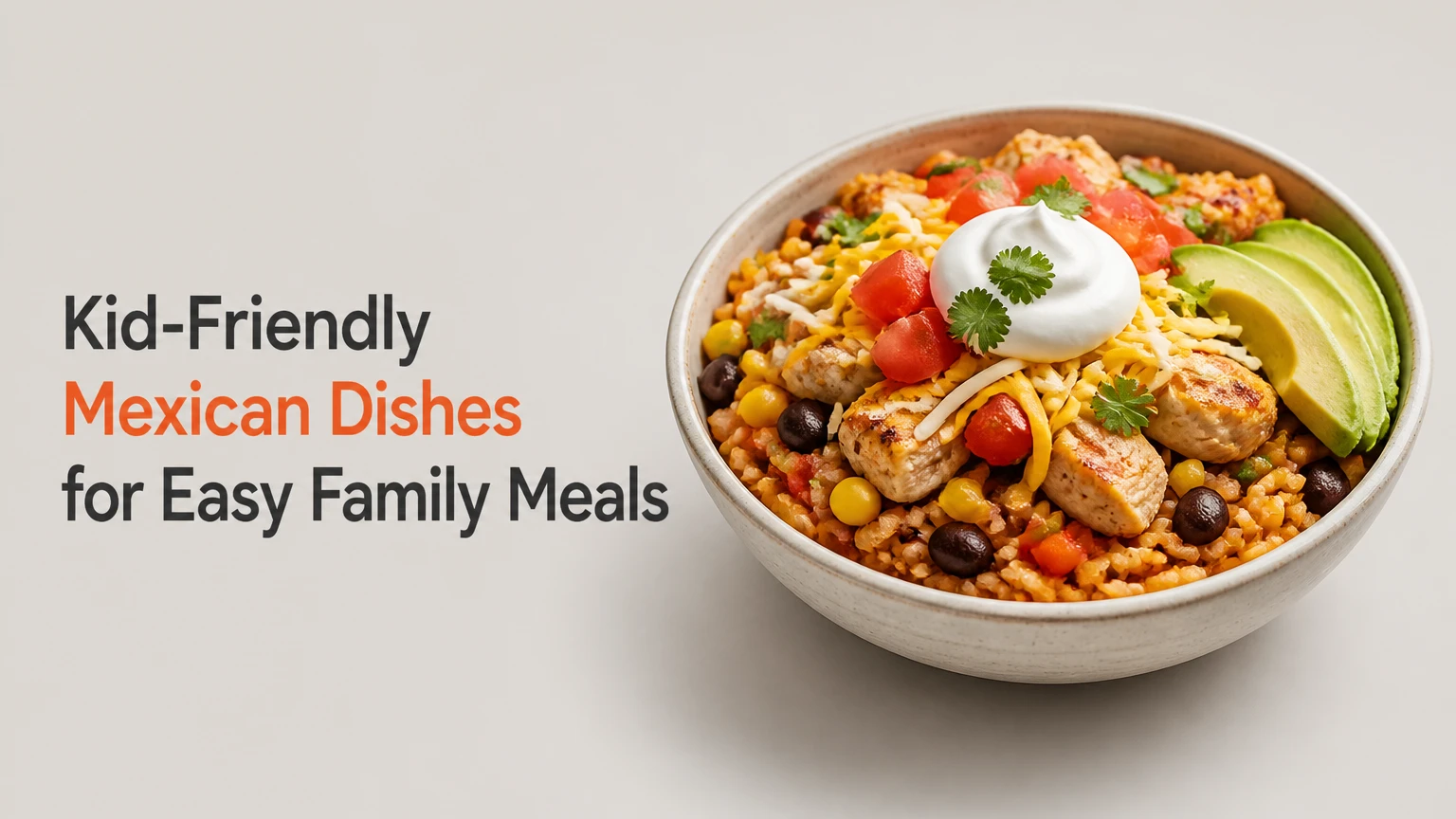
Kid-friendly Mexican dishes are mild, customizable meals built from familiar foods such as cheese, chicken, beans, rice, corn, avocado, and tortillas. The most reliable choices keep spicy toppings separate, use soft or manageable textures, and let children assemble small portions themselves, making quesadillas, tacos, bowls, tostadas, and enchiladas adaptable for different ages.
Key Facts at a Glance
Cheese quesadillas typically take 10-15 minutes and require four basic ingredients.
A child-friendly taco base can contain zero hot pepper while adults add salsa or jalapeño separately.
Deconstructed burrito bowls reduce texture conflict because rice, beans, protein, and toppings remain separate.
For children under 4, cut firm foods into age-appropriate pieces and supervise eating at the table.
Typical home cost for four servings ranges from $12-$25 in the United States, depending on protein and toppings.
Cook ground meat to 160°F and poultry to 165°F, following USDA Food Safety and Inspection Service guidance.
What Makes Kid-Friendly Mexican Dishes Work?
Kid-friendly Mexican dishes work when parents control heat, texture, visibility, and portion size without removing the meal’s recognizable Mexican-inspired ingredients. A mild base can use cumin, garlic, onion powder, lime, tomato, and cilantro, while hot peppers and spicy sauces remain optional table additions.
“Clean, Separate, Cook, and Chill” is the FDA’s concise food-safety message, and the same sequence matters when preparing family taco fillings. Raw meat should remain separate from ready-to-eat toppings, cooked food should reach a safe internal temperature, and leftovers should be refrigerated promptly.
The phrase “kid-friendly” describes an adaptation for children, not a single traditional Mexican category. Mexican cuisine includes regional foods with varied chilies, herbs, cheeses, grains, and cooking methods. A flour-tortilla quesadilla may be especially approachable for a cautious eater, while a child familiar with corn tortillas may prefer a bean taco or simple rice and chicken plate.
The Four-Part Design Framework
| Principle | Practical method | Child benefit | Adult adjustment |
|---|---|---|---|
| Mild base | Omit hot pepper from meat and beans | Prevents unexpected heat | Add salsa at the table |
| Deconstruction | Serve ingredients in separate sections | Reduces food-touching anxiety | Combine portions on one plate |
| Component control | Offer two tortillas and small toppings | Gives children choice | Set a balanced portion |
| Visual appeal | Use colorful corn, cheese, avocado, and tomato | Makes ingredients identifiable | Rotate vegetables weekly |
Flavor should not disappear when heat is removed. Lime juice, roasted garlic, mild tomato sauce, toasted cumin, and a small amount of salt provide distinction without relying on capsaicin.
Which Kid-Friendly Mexican Dishes Are Best?
The best kid-friendly Mexican dishes depend on the child’s texture preferences, age, and willingness to combine ingredients. Quesadillas are the safest first choice, burrito bowls suit children who dislike mixed foods, tacos offer the most interaction, and enchiladas work best for children who already accept soft casseroles.
| Rank | Dish | Typical time | Best fit | Main limitation |
|---|---|---|---|---|
| 1 | Cheese quesadilla | 10-15 minutes | First exposure, toddlers with safe textures | Limited vegetables unless served alongside |
| 2 | Deconstructed burrito bowl | 15-25 minutes | Children who dislike mixed foods | Requires several prepared components |
| 3 | Soft or baked tacos | 20-25 minutes | Hands-on family dinners | Can become messy or structurally unstable |
| 4 | Mild chicken enchiladas | 35-45 minutes | Soft-food eaters and batch cooking | Wet texture may be rejected |
| 5 | Bean and cheese tostadas | 15-20 minutes | Vegetarian meals and crunchy-food fans | Hard shells require careful age suitability |
The table uses practical suitability ratings rather than unsupported “success rates.” Acceptance varies substantially by age, previous exposure, appetite, and the child’s tolerance for visible ingredients.
1. Cheese Quesadillas: Best First Choice
Cheese quesadillas are the most dependable entry point because melted cheese and a warm tortilla resemble familiar grilled sandwiches. Use one 8-inch flour tortilla, ½ cup mild Monterey Jack or mild cheddar, and optional ¼ cup finely shredded chicken or mashed beans per serving.
Heat a skillet over medium-low heat, place the tortilla flat, add cheese to one half, fold, and cook for 2-3 minutes per side. The exterior should show light golden spots, while the cheese should be fully melted. Let the quesadilla rest for two minutes before cutting so the filling does not slide out.
For toddlers, cut the quesadilla into narrow strips rather than triangles. For older children, wedges support dipping into plain yogurt, mild guacamole, or a smooth tomato dip. Avoid large uncut rounds because they are difficult for small hands to manage.
Choose a quesadilla when time and predictability matter most. Skip it as the only meal component when the child needs a complete dinner, since cheese and tortilla alone provide less variety than a bowl with beans, fruit, or vegetables.
2. Soft or Baked Tacos: Best Interactive Option
Soft tacos are usually easier for younger children because flexible tortillas do not shatter, while baked tacos give older children a sturdier shell for self-assembly. A useful serving starts with one small tortilla, 2 tablespoons of filling, 1 tablespoon of cheese, and one optional topping.
Use mild ground beef, turkey, shredded chicken, mashed beans, or lentils. Season with garlic powder, onion powder, cumin, and tomato rather than a commercial seasoning packet whose heat level and sodium content vary by brand. Adults can add hot sauce after serving.
Stand-up shells help children build tacos without holding the tortilla open. If shells break, spread the pieces over a plate and turn the meal into taco nachos, keeping toppings in separate sections.
Tacos suit family meals where children enjoy choosing ingredients. They are less suitable for a very young child who cannot manage hard shells or for a child who rejects food that touches.
3. Bean and Cheese Tostadas: Best Vegetarian Alternative
Bean and cheese tostadas use a crisp tortilla base, a thin layer of mashed beans, mild cheese, and optional toppings such as avocado or finely chopped tomato. The combination provides a meat-free meal with a familiar flavor profile and a defined visual structure.
Spread ¼ cup warm refried beans over one tostada, add 2 tablespoons of shredded cheese, and finish with a small amount of avocado or plain yogurt. Warm assembled tostadas at 375°F for 4-6 minutes if melted cheese improves acceptance.
Choose baked tostadas for an older child who likes crunch and can handle firm foods safely. Skip them for toddlers or children who struggle with hard textures, and serve the same beans and cheese over soft rice instead.
4. Deconstructed Burrito Bowls: Best for Selective Eaters
Deconstructed burrito bowls keep rice, beans, protein, corn, avocado, cheese, and tortilla chips in separate portions, allowing a child to select familiar foods without committing to a mixed burrito. The bowl format also makes it easy to provide a plain fallback beside one new ingredient.
For four servings, prepare about 3 cups cooked rice, 2 cups beans, 2 cups cooked chicken or another protein, and 1½ cups total toppings. Place each component in a separate bowl or muffin-tin compartment. Offer a tortilla chip as an optional scoop, but do not require children to combine the ingredients.
Cilantro and lime should be optional because both have strong flavors that some children interpret as unpleasant. Plain rice, mild beans, shredded cheese, and corn form a neutral base; adults can add salsa, pickled vegetables, or extra lime to their own bowls.
Choose a bowl when food separation matters more than speed. Skip it when several separate pans would make the meal harder to prepare than a quesadilla or taco.
5. Mild Chicken Enchiladas: Best Soft Family Bake
Mild chicken enchiladas combine shredded poultry, tortillas, tomato sauce, and melted cheese in a soft baked dish. Use a mild red sauce or a plain yogurt and tomato mixture, and taste the sauce before adding it to the pan because packaged sauces differ widely in heat and acidity.
For four servings, fill eight small tortillas with 2 tablespoons chicken each, arrange them seam-side down, cover with 1½ cups sauce, and top with 1 cup cheese. Bake at 375°F for 15-20 minutes, until the center is hot and the cheese melts.
An enchilada casserole is easier when rolling frustrates children. Layer tortilla pieces, chicken, sauce, and cheese in a baking dish, then bake until bubbling at the edges. This method increases softness, so reserve it for children who accept moist foods.
Choose enchiladas for batch cooking and fork-friendly meals. Skip them when the child strongly prefers dry, separate textures.
How Do You Build a Balanced Plate?
A balanced child’s Mexican-inspired plate combines one protein, one grain or tortilla, one produce item, and an optional dairy or fat component in small, recognizable portions. A practical starting plate contains 2-3 tablespoons of each unfamiliar item, with more of accepted foods available without pressure.
| Meal base | Protein option | Produce option | Mild finishing ingredient |
|---|---|---|---|
| Quesadilla | Mashed black beans | Orange segments | Plain yogurt |
| Soft taco | Shredded chicken | Corn kernels | Avocado |
| Rice bowl | Pinto beans | Diced tomato | Mild cheese |
| Tostada | Refried beans | Finely chopped lettuce | Lime wedge |
| Enchilada | Shredded chicken | Blended tomato sauce | Monterey Jack |
Blending vegetables into sauce can increase exposure but should not be used to deceive a child or make vegetables the only acceptable route. Visible corn, avocado, cucumber, or fruit gives children a chance to identify and control what they eat.
For a lower-sodium meal, choose no-salt-added beans, rinse canned beans, and season the filling yourself. For a vegetarian plate, pair beans and cheese, beans and rice, or lentils and tortillas. For a gluten-free plate, use certified gluten-free corn tortillas and verify that packaged seasonings and sauces carry appropriate labeling.
How Should Portions Change by Age?
Children’s portions should begin small and expand according to appetite, while texture and supervision matter more than making a dish visually miniature. Toddlers need soft, manageable pieces, preschoolers benefit from two or three controlled choices, and school-age children can assemble fuller portions.
| Age group | Tortilla or grain | Protein starting portion | Safer serving approach |
|---|---|---|---|
| 1-3 years | ¼-½ small tortilla | 1-2 tablespoons | Soft strips, mashed beans, close supervision |
| 4-6 years | ½-1 small tortilla | 2-3 tablespoons | Small taco, separated toppings |
| 7-10 years | 1 small tortilla | ¼ cup | Build-your-own plate |
| 11+ years | 1-2 tortillas | ⅓-½ cup | Regular family portions adjusted to appetite |
Cut round foods such as grapes or cherry tomatoes into smaller pieces, shred firm meat, and remove hard or chewy fragments. The CDC identifies whole grapes, chunks of meat, and hard raw vegetables among foods that can present choking hazards for young children, so age-appropriate preparation remains necessary even when the recipe itself is mild.
20-Minute Mild Beef Tacos: A Reliable Method
Mild baked beef tacos take approximately 20-25 minutes, use one skillet and one baking dish, and work best when the filling stays moist and the toppings remain separate. The method below makes eight small tacos, or four modest adult servings.
Before You Start
| Requirement | Typical specification |
|---|---|
| Active time | 15 minutes |
| Total time | 20-25 minutes |
| Difficulty | Beginner |
| Protein | 1 pound lean ground beef or turkey |
| Tortillas or shells | 8 small flour tortillas or stand-up shells |
| Cheese | 1 cup shredded mild cheese |
| Seasoning | 1 teaspoon cumin, ½ teaspoon garlic powder, ½ teaspoon onion powder |
| Equipment | 10-inch skillet, spoon, baking dish, thermometer |
Step 1: Brown the Protein
Cook 1 pound ground meat in a 10-inch skillet over medium heat for 6-8 minutes, breaking it into pieces until no pink remains. Drain excess fat if needed, then return the skillet to the burner.
You will know this step worked when the meat is evenly browned and loose rather than compressed into large chunks. The common mistake is using high heat, which browns the outside quickly while leaving large pieces undercooked.
Step 2: Add Mild Seasoning and Moisture
Stir in 1 teaspoon cumin, ½ teaspoon garlic powder, ½ teaspoon onion powder, ¼ teaspoon salt, and ⅓ cup water or unsalted broth. Simmer for 3-4 minutes until the liquid lightly coats the meat.
The filling should look moist but should not release liquid when spooned. If the child dislikes cumin’s earthy flavor, reduce it to ½ teaspoon and add 2 tablespoons plain tomato puree instead.
Step 3: Warm and Fill the Shells
Place eight shells close together in a baking dish, or warm eight tortillas in a covered skillet for 30 seconds. Add 2 tablespoons meat to each shell, leaving room for toppings and reducing spillover.
You will know the portion is manageable when the shell remains upright and the filling sits below its rim. Overfilling is the common mistake; it makes hard shells collapse and soft tacos difficult for small hands to hold.
Step 4: Melt the Cheese
Add about 2 tablespoons shredded Monterey Jack, mild cheddar, or a mild Mexican-style blend to each taco. Bake shells at 375°F for 5-7 minutes, or place soft tacos in a covered skillet for 1-2 minutes.
The cheese should melt without browning heavily. A food thermometer should read 160°F in the cooked ground meat, according to USDA guidance.
Step 5: Serve the Toppings Separately
Set out shredded lettuce, diced tomato, corn, avocado, plain yogurt, and mild guacamole in separate bowls. Offer one topping at a time to a cautious eater and allow adults to add hotter salsa to their own tacos.
The successful checkpoint is a child choosing at least one component independently, even if the first plate contains only tortilla and cheese. Pressure to combine foods often creates a stronger refusal than the ingredient itself.
Cost, Time, and Equipment
Typical United States grocery costs for four servings range from $12-$25 at home. Cheese quesadillas usually cost the least, while meals with fresh avocado, prepared chicken, and several toppings cost more; restaurant pricing varies by city, service fees, and portion size.
| Dish | Grocery cost for four | Active time | Equipment |
|---|---|---|---|
| Cheese quesadillas | $8-$14 | 10-15 minutes | Skillet |
| Bean tostadas | $10-$16 | 15-20 minutes | Sheet pan |
| Mild beef tacos | $14-$22 | 15-20 minutes | Skillet, baking dish |
| Burrito bowls | $12-$20 | 15-25 minutes | Saucepan, bowls |
| Chicken enchiladas | $18-$25 | 20-30 minutes | Baking dish, skillet |
A practitioner rule of thumb is to prepare one shared hot component and two cold toppings. That limit keeps a weeknight meal manageable while still giving a selective eater meaningful control.
Which Dish Fits Your Family?
| Family situation | Best choice | Reason | Adjustment |
|---|---|---|---|
| Toddler, soft-texture preference | Quesadilla strips | Soft, grippable pieces | Use mashed beans or finely shredded chicken |
| Picky eater, foods must remain separate | Burrito bowl | Components stay visible | Serve rice and cheese first |
| Busy parent, under 25 minutes | Mild tacos | One skillet and quick assembly | Use pre-cooked rice or chicken |
| Vegetarian household | Bean tostadas | Beans provide the main protein | Use soft rice for younger children |
| Batch-cooking household | Enchilada casserole | Reheats in one dish | Reserve toppings until serving |
A child who avoids mixed foods will usually do better with a divided plate than with a carefully hidden ingredient. A child who prefers crunch may reject enchiladas but accept a tostada. These are texture decisions, not evidence that the child dislikes Mexican flavors generally.
How Do You Store and Reheat Leftovers?
Store cooked fillings and toppings separately in shallow, covered containers within two hours of cooking. Refrigerated leftovers are typically best used within 3-4 days under USDA guidance, while tortillas and shells should remain sealed to prevent moisture transfer.
Reheat meat, beans, rice, and enchiladas until steaming hot throughout. Warm taco filling in a skillet with 1 tablespoon water, heat rice covered with a splash of water, and add lettuce, avocado, and yogurt only after reheating.
| Leftover | Refrigerator storage | Best reheating method | Texture protection |
|---|---|---|---|
| Cooked taco meat | 3-4 days | Skillet, 3-5 minutes | Add 1 tablespoon water |
| Cooked rice | 3-4 days | Covered microwave or saucepan | Add 1-2 teaspoons water |
| Enchiladas | 3-4 days | Oven at 350°F, 15-20 minutes | Cover with foil |
| Cut avocado | 1 day | Do not reheat | Add lime and cover tightly |
| Shredded lettuce | 1-2 days | Serve cold | Store with a dry paper towel |
Do not bake assembled tacos for later storage. Shells soften as filling releases moisture, so store the components apart and assemble them after reheating.
Troubleshooting Common Failures
The Filling Tastes Spicy Without Hot Peppers
Cumin, raw onion, black pepper, acidity, and excessive heat can feel intense even when no chili is present. Reduce cumin by half, replace raw onion with onion powder, and serve the food warm rather than very hot.
The Meat Is Dry
Dry meat usually results from overcooking or insufficient liquid. Add 2-4 tablespoons unsalted broth or tomato puree, simmer briefly, and stop cooking as soon as the mixture becomes spoonable.
Soft Tacos Tear
A cold or overloaded tortilla tears under pressure. Warm each tortilla for 20-30 seconds, use 2 tablespoons filling, and fold it only once. Smaller tortillas often succeed better than large ones because children exert less squeezing force.
Enchiladas Become Soggy
Excess sauce and prolonged storage create a wet tortilla. Use 1½ cups sauce for eight small enchiladas, warm tortillas before filling, and add cheese or fresh toppings after reheating.
The Shells Collapse
Hard shells collapse when they contain too much wet filling. Choose stand-up shells, keep beans and meat thick, or convert broken shells into taco nachos served on a flat plate.
The Child Rejects Every Topping
Offer one familiar food with one optional new food, rather than presenting six unfamiliar choices. A child may need repeated, low-pressure exposure before accepting a new texture, so keep the rejected ingredient separate and avoid making the meal conditional on tasting it.
Frequently Asked Questions
Are mild Mexican dishes healthy for children?
Mild Mexican dishes can form a balanced family meal when beans, poultry, cheese, rice, tortillas, fruit, or vegetables appear in sensible portions. Healthfulness depends on the full plate and preparation method, not on whether the dish is called a taco, quesadilla, or enchilada.
What Mexican food can a child eat without cheese?
Bean tacos, chicken tacos, rice bowls, avocado tostadas, and mild rice with corn work without cheese. Use mashed beans, shredded chicken, avocado, or plain rice as the familiar component, then add vegetables separately so the child can control the combination.
How can I make Mexican food dairy-free?
Replace cheese with mashed avocado, dairy-free plain yogurt, or a small amount of mild dairy-free shreds. Check tortillas, beans, sauces, and prepared proteins for milk ingredients because packaged products may contain them even when the main recipe appears dairy-free.
Can children eat salsa?
Children can eat salsa when the ingredients, texture, and heat level suit their age and preferences. Start with a mild tomato salsa containing no hot pepper, remove large raw pieces for younger children, and serve it separately so the child can decide whether to use it.
What is the easiest Mexican lunch for school?
A bean-and-cheese quesadilla, plain chicken tortilla roll-up, or deconstructed rice bowl is usually easier to pack than a fully dressed taco. Cool cooked food before packing, use an insulated lunch bag when needed, and keep wet toppings separate to prevent soggy tortillas.
How do I introduce stronger Mexican flavors?
Introduce one stronger flavor at a time, such as lime, cilantro, cumin, or roasted tomato, beside familiar rice, cheese, beans, or tortilla. Keep the amount small and optional; familiarity grows more reliably through repeated exposure than through hiding a large quantity in a preferred meal.
The Bottom Line
Kid-friendly Mexican dishes succeed when children can recognize the ingredients, control the assembly, and avoid unexpected heat or difficult textures. Start with quesadilla strips for predictability, choose deconstructed burrito bowls for food separation, use tacos for interactive meals, and reserve enchiladas for children who prefer soft baked foods. The best kid-friendly Mexican dishes are flexible family meals, not separate food made without flavor.