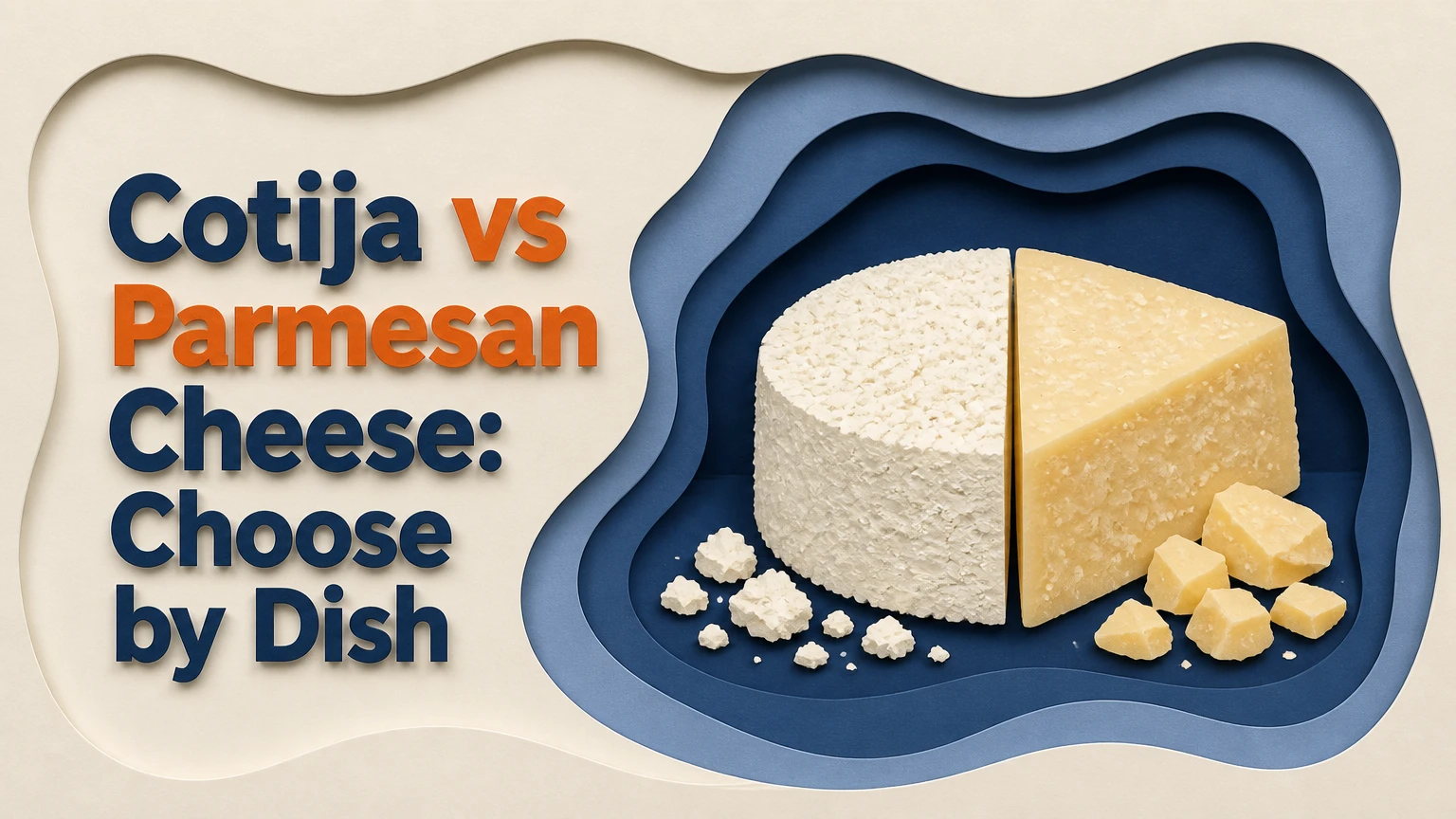
Cotija and Parmesan are both firm, savory cow’s milk cheeses, but they are not interchangeable in every recipe. Cotija is sharper, saltier, and more crumbly, making it ideal for elote, beans, tacos, and salads; Parmesan is nuttier and more umami-rich, with better browning and sauce potential for pasta, risotto, soups, and gratins.
Key Facts at a Glance
- Cotija usually tastes saltier and more acidic than Parmesan at the same weight.
- Aged Cotija crumbles readily and softens under heat, but usually does not melt into a smooth sauce.
- Parmigiano Reggiano must mature for at least 12 months under its protected designation rules.
- Generic Parmesan can be younger, softer, and less complex than certified Parmigiano Reggiano.
- Cotija is the better finishing cheese for Mexican dishes; Parmesan is the better choice for Italian-style pasta and crisp cheese applications.
- When substituting Cotija for Parmesan, reduce added salt by about 25-50 percent and expect a sharper finish.
What Is the Difference Between Cotija and Parmesan?
Cotija is a Mexican cow’s milk cheese associated with Cotija de la Paz in Michoacán, while Parmesan is a broad commercial name that may describe several hard grating cheeses. Parmigiano Reggiano is the specific Italian PDO cheese made in designated provinces under regulated production and aging requirements.
Cotija is sold in forms that range from relatively moist and crumbly to dry and grateable. Retail labels do not apply “fresh” and “aged” consistently, so texture is a more reliable buying signal than the name alone. A moist block behaves more like a firm crumbly table cheese; a dry wedge behaves more like a grating cheese.
The term Parmesan has a wider meaning in North American stores. Certified Parmigiano Reggiano carries the familiar dotted rind markings and a production code, whereas domestic Parmesan may use different milk sources, cultures, aging periods, and processing methods. The Consorzio del Formaggio Parmigiano Reggiano describes its protected cheese as a “hard, granular cheese,” a useful distinction from softer supermarket Parmesan products.
Master Comparison Table
| Criterion | Cotija | Domestic Parmesan | Parmigiano Reggiano |
|---|---|---|---|
| Country or region | Mexico, especially Michoacán | United States, Argentina, and other producers | Northern Italy, regulated PDO area |
| Typical texture | Crumbly, dry, sometimes moist | Firm, sliceable, grateable | Granular, brittle, crystalline |
| Flavor | Salty, tangy, lactic, pungent | Savory, mild to nutty | Nutty, fruity, brothy, umami-rich |
| Typical aging | Several weeks to about 12 months | Commonly 6-18 months | Minimum 12 months, often 24-36 months |
| Heat behavior | Softens and holds visible crumbs | Melts unevenly or browns when dry | Browns, crisps, or forms a granular sauce |
| Typical U.S. retail price | About $7-$14 per pound | About $7-$15 per pound | About $18-$30 per pound |
| Best signature use | Elote, tacos, beans, salads | Pasta, casseroles, soups | Pasta, risotto, finishing, cheese crisps |
Which Cheese Has the Better Flavor?
Cotija has the stronger salty-acidic impact, while Parmesan has greater nutty, fruity, and broth-like complexity. Choose Cotija when the dish contains lime, chile, crema, avocado, or charred corn; choose Parmesan when the recipe depends on butter, stock, olive oil, or a mild cream sauce.
Aged Cotija delivers immediate intensity. Small crumbs spread across a dish, so the cheese can season every bite without a large quantity. That strength becomes a drawback in delicate preparations, where Cotija can dominate eggs, mild vegetables, or lightly seasoned rice.
Parmesan develops more layered flavors during aging. Parmigiano Reggiano commonly includes toasted-nut notes, dried fruit, browned butter, and savory stock impressions, with crunchy amino-acid crystals in longer-aged wheels. Younger domestic Parmesan is generally less granular and less aromatic, but it can be more economical for everyday cooking.
Flavor and Texture by Amount
| Use level | Cotija result | Parmesan result | Practical adjustment |
|---|---|---|---|
| 1 teaspoon per serving | Noticeable salt and tang | Mild savory lift | Use Cotija when the dish needs contrast |
| 1 tablespoon per serving | Dominant crumbly topping | Clear nutty or savory flavor | Reduce other salt with Cotija |
| 2 tablespoons per serving | Very salty for mild dishes | Rich finishing flavor | Pair Cotija with lime or chile |
| 30 grams in sauce | Grainy, limited integration | Possible smooth emulsion with heat control | Use Parmesan for emulsified pasta |
| 30 grams baked dry | Softened salty crust | Crisp browned layer | Choose Parmesan for frico or gratins |
Flavor verdict: Cotija wins for sharp Mexican-style contrast; Parmesan wins for layered savory complexity.
Which Cheese Melts Better?
Parmesan melts more usefully than Cotija, but neither cheese behaves like mozzarella. Parmesan can disperse into a controlled sauce when finely grated and added below boiling temperature, while Cotija generally softens, clumps, or remains visibly granular.
Cheese melting depends on moisture, acidity, salt, fat, protein structure, and heat exposure. Long-aged cheeses contain less free water, so their proteins and fat do not form the stretchy, fluid network associated with young melting cheeses. Parmesan’s fine particles can still disperse into a butter, pasta-water, or cream emulsion under controlled conditions.
Cotija’s typical role is visual and textural. Heat softens the crumbs on corn, beans, enchiladas, and roasted vegetables, but the cheese usually retains a noticeable grain. The result is desirable on elote and undesirable in a sauce that should coat noodles evenly.
Overheating either cheese can cause oil separation. Parmesan is especially prone to graininess when added to boiling liquid, while Cotija can become rubbery or hard at high oven temperatures.
Heat verdict: Parmesan wins for sauces and browning; Cotija wins when the topping should remain crumbly and visible.
How Are Cotija and Parmesan Made?
Cotija and Parmesan both begin with coagulated cow’s milk, but their formats, salting systems, moisture levels, and aging controls differ. Parmigiano Reggiano production is tightly regulated, while Cotija production varies considerably among Mexican producers and export products.
Parmigiano Reggiano uses milk from the defined production area, natural whey cultures, calf rennet, copper vats, pressing, and brine salting. The European Commission specification requires a minimum maturation period of 12 months, and the consortium evaluates wheels before they receive the full designation.
Cotija production commonly involves cultured cow’s milk, rennet or another coagulant, curd cutting, pressing, salting, and aging. Traditional and industrial methods are not identical. Some commercial Cotija is aged for months, while other products sold under the name are younger and more moist than a hard grating wedge.
Production Differences
| Production stage | Cotija | Parmigiano Reggiano |
|---|---|---|
| Milk | Cow’s milk, producer-dependent | Cow’s milk from regulated area |
| Curd formation | Cultured and coagulated curd | Natural whey culture and calf rennet |
| Shape | Blocks, rounds, or smaller wheels | Large wheels weighing about 35-40 kilograms |
| Salting | Dry salt or brine, producer-dependent | Brine salting for roughly 18-20 days |
| Aging control | Variable commercial periods | Minimum 12 months, often 24-36 months |
| Quality marking | Brand and regional labeling | Dotted rind, marks, and PDO identification |
The often-repeated claim that all Cotija ages for three months to one year is too rigid. Product specifications differ by producer and market, so check the package for an aging statement instead of treating one timeline as universal.
What Types Should You Buy?
Buy dry aged Cotija when you need a grateable Mexican finishing cheese, and buy Parmigiano Reggiano when you need predictable grating, complex flavor, or better performance in an Italian-style sauce. Domestic Parmesan remains a practical middle option for cooking where the cheese is mixed with other strong ingredients.
Cotija Buying Guide
| Product label or style | Typical moisture | Texture at purchase | Best use |
|---|---|---|---|
| Moist Cotija | About 35-45% | Crumbly, slightly yielding | Tacos, corn, beans |
| Dry aged Cotija | About 30-40% | Hard, brittle, grateable | Salads, tostadas, roasted vegetables |
| Small retail wedge | 25-150 grams | Varies by producer | Finishing two to six servings |
| Pre-crumbled Cotija | Varies | Loose, dry surface | Fast toppings, not sauces |
“Cotija añejo” generally signals a drier, more intensely flavored product, but the label is not a universal technical guarantee. Press the package gently when possible. A firm, dry wedge is more useful as a Parmesan substitute than a moist, feta-like piece.
Parmesan Buying Guide
| Product | Typical aging | Texture | Best use |
|---|---|---|---|
| Pre-grated canister Parmesan | About 6-12 months | Dry, fine, anti-caking treated | Table sprinkling |
| Domestic block Parmesan | About 6-18 months | Firm, grateable | Weeknight sauces and casseroles |
| Parmigiano Reggiano | 12-36+ months | Granular, crystalline | Finishing and pasta |
| 24-month Parmigiano Reggiano | About 24 months | Dry with crystals | Eating, grating, and risotto |
For sauces, choose a solid wedge and grate it immediately. Cellulose, starch, and other anti-caking ingredients in packaged grated cheese can reduce smooth incorporation, although the cheese’s age and the cooking temperature remain larger variables.
How Much Do Cotija and Parmesan Cost?
Typical U.S. retail prices range from $7-$15 per pound for Cotija or domestic Parmesan and from $18-$30 per pound for Parmigiano Reggiano. Actual prices change with region, import costs, package size, retailer, and aging period.
Price per pound does not equal cost per serving. A tablespoon of intensely flavored aged cheese weighs roughly 5-7 grams, so a $24-per-pound wedge costs approximately 8-11 cents for that portion before local tax. Cotija may cost less per pound, but its higher salt content can limit how much a recipe uses.
Typical Retail Value
| Cheese type | Typical price per pound | Approximate cost of 1 ounce | Common package |
|---|---|---|---|
| Moist Cotija | $7-$12 | $0.44-$0.75 | 8-16 ounces |
| Dry aged Cotija | $9-$15 | $0.56-$0.94 | 6-12 ounces |
| Domestic Parmesan | $7-$15 | $0.44-$0.94 | 6-16 ounces |
| Parmigiano Reggiano | $18-$30 | $1.13-$1.88 | 4-12 ounces |
Value verdict: Domestic Parmesan is usually the most versatile budget purchase, Cotija offers the best value for Mexican dishes, and Parmigiano Reggiano earns its premium when its distinctive flavor and granular texture matter.
Can Cotija Replace Parmesan?
Cotija can replace Parmesan as a dry topping, but it cannot fully replace Parmesan in an emulsified sauce or a recipe that depends on smooth melting. Use equal volume for a finishing sprinkle, then reduce added salt and add Cotija after cooking whenever possible.
A useful starting ratio is 1 tablespoon of dry Cotija for 1 tablespoon of Parmesan on salads, roasted vegetables, or baked dishes. Taste before salting because Cotija may contribute more immediate sodium. For pasta sauce, use Cotija only as a finishing crumb and replace the sauce’s Parmesan component with a melting cheese or a small amount of cream if smoothness matters.
Parmesan can replace Cotija on corn, beans, and tacos when necessary, but the dish will lose Cotija’s sharp lactic contrast. Add lime juice, chile, or a little extra salt separately rather than expecting Parmesan to reproduce the same flavor.
Substitution Ratios by Dish
| Dish | Original cheese | Substitute | Starting quantity and adjustment |
|---|---|---|---|
| Elote | Cotija | Parmesan | 1:1 volume, add lime and chile |
| Pasta sauce | Parmesan | Dry Cotija | Use 1/2 quantity as topping, not in sauce |
| Bean tostadas | Cotija | Parmesan | 1:1 volume, add salt only after tasting |
| Caesar-style salad | Parmesan | Dry Cotija | Use 3/4 quantity, add extra acidity carefully |
| Potato gratin | Parmesan | Dry Cotija | Use 1/2-3/4 quantity, expect less browning |
| Roasted vegetables | Parmesan | Cotija | 1:1 volume, add after roasting |
Which Cheese Should You Choose for Your Dish?
Cotija is the better choice for elote, tacos, tostadas, beans, avocado, and grilled vegetables, while Parmesan is better for pasta, risotto, soups, gratins, breadcrumbs, and crisp baked cheese. The deciding factor is whether the recipe needs acidic contrast, smooth dispersion, or controlled browning.
Choose Cotija for Mexican and Southwestern Dishes
Cotija works especially well when a dish already contains fat, acidity, or heat. On corn with crema and lime, Cotija cuts richness and remains visible after contact with the hot surface. On beans and tacos, its salt concentrates in small crumbs instead of disappearing into the filling.
Cotija is not a good choice for a delicate cream sauce, cacio-style pasta, or any preparation where the cheese must disappear into a smooth emulsion. Its sharpness can overwhelm subtle stock, butter, or vegetable flavors.
Choose Parmesan for Italian-Style Cooking
Parmesan belongs in preparations that reward nutty umami and controlled dispersion. Finely grated Parmesan can thicken pasta water and fat into a coating when the pan is removed from direct heat, and dry grated Parmesan browns effectively on casseroles and vegetables.
Parmesan is also useful as a rind in soups and bean dishes. Remove the rind before serving because it softens and releases flavor but does not become fully tender.
Choose by Cooking Function
| Desired result | Recommended cheese | Reason |
|---|---|---|
| Visible salty crumble | Cotija | Retains granules after heating |
| Smooth pasta coating | Parmesan | Disperses in a controlled emulsion |
| Golden cheese crisp | Parmesan | Browns and dehydrates effectively |
| Lime and chile contrast | Cotija | Tangy salt balances strong seasoning |
| Deep broth-like umami | Parmigiano Reggiano | Long aging creates complex savory notes |
| Mild casserole topping | Domestic Parmesan | Lower cost and predictable browning |
How Do You Prevent Cheese Sauce Clumps?
Prevent Parmesan sauce clumps by removing the pan from direct heat, cooling the liquid briefly, grating the cheese finely, and adding it in small handfuls while whisking. Cotija should usually remain a topping because its low moisture and crumbly structure make smooth emulsification unreliable.
For pasta, reserve about 120 milliliters of starchy cooking water per serving. Combine the hot pasta with butter or another fat, wait until vigorous bubbling stops, then add finely grated Parmesan gradually while tossing. The working liquid should be hot but not boiling, typically below about 85°C.
The common mistake is adding cheese while the sauce is actively boiling. High heat tightens milk proteins and drives fat out, producing strings, grains, or an oily surface. Pre-shredded cheese makes the result less predictable because surface additives interfere with hydration.
Practitioner rule: Grate Parmesan more finely than seems necessary for sauce work. A microplane creates particles that hydrate quickly; thick box-grater shreds need more time and are more likely to form lumps.
How Should You Store Opened Cheese?
Wrap a wedge of Cotija or Parmesan in parchment or cheese paper, place it in a loosely closed bag or container, and refrigerate it at 1-4°C. Solid wedges retain quality longer than grated cheese because less surface area is exposed to air and moisture loss.
Use opened moist Cotija within about 1-2 weeks for best texture, while a dry aged Cotija wedge commonly remains usable for 3-4 weeks when wrapped correctly. A hard Parmesan wedge often keeps 4-8 weeks, although exact storage life depends on moisture, handling, and refrigerator conditions.
Discard cheese with widespread fuzzy mold, strong ammonia odor, sliminess, or unexplained pink, orange, or black discoloration. Hard, low-moisture cheese with a small isolated surface mold spot can sometimes be trimmed generously, but a moist Cotija product should be discarded rather than salvaged when mold spreads.
What Are the Best Alternatives?
The best Cotija alternative is queso añejo for a similarly salty Mexican profile, while the best Parmesan alternative is Grana Padano for a related Italian grating function. Pecorino Romano is saltier and sharper than Parmesan, so it requires a smaller quantity.
| Alternative | Closest match | Flavor difference | Best application |
|---|---|---|---|
| Queso añejo | Cotija | Salty, firm, less region-specific | Tacos and corn |
| Feta | Moist Cotija | More briny, softer, less dry | Salads and vegetables |
| Grana Padano | Parmesan | Milder and less intensely aged | Pasta and risotto |
| Pecorino Romano | Parmesan | Sharper, saltier, sheep’s milk | Pasta and gratins |
| Dry queso fresco | Cotija | Milder and less aged | Toppings and beans |
Queso fresco is not a direct substitute for aged Cotija or Parmesan. Queso fresco contains more moisture, tastes milder, and breaks rather than grates into a dry savory finish.
Common Mistakes and Better Fixes
- Adding Cotija to a boiling sauce: Use Cotija as a finishing crumble, or switch to finely grated Parmesan for emulsification.
- Salting before tasting: Add only half the planned salt when using Cotija, then adjust after the cheese is incorporated.
- Using moist Cotija as a Parmesan wedge: Choose a dry aged product when the recipe requires grating or browning.
- Assuming every Parmesan is Parmigiano Reggiano: Check for the PDO name and dotted rind when origin and aging matter.
- Buying a large pre-grated package for delicate sauce: Purchase a small solid wedge and grate it immediately.
- Expecting either cheese to stretch: Use a young, higher-moisture melting cheese when stretch is the intended result.
The Bottom Line
Cotija vs Parmesan cheese is primarily a choice between sharp salty contrast and layered nutty umami. Choose Cotija for elote, tacos, beans, salads, and roasted vegetables where the cheese should remain visible; choose Parmesan for pasta, risotto, soups, gratins, and cheese crisps where grating, browning, or controlled dispersion matters.
Aged Cotija is the closer substitute when a recipe needs a dry Mexican finishing cheese, but it is not a chemical or flavor equivalent to Parmigiano Reggiano. For the broadest refrigerator utility, buy a solid domestic Parmesan and a small Cotija wedge when your menu includes Mexican-style dishes.
Frequently Asked Questions
Is Cotija stronger than Parmesan?
Cotija usually tastes more immediately salty and acidic than Parmesan, especially in moist or moderately aged forms. Parmesan generally has greater aromatic complexity, with nutty, fruity, buttery, and savory notes that develop during longer aging. Use less added salt with Cotija, but do not assume it has more total flavor in every preparation.
Does Cotija contain less lactose than Parmesan?
Long-aged Cotija and Parmesan generally contain less lactose than fresh milk because cultures consume much of the milk sugar during fermentation and whey drainage removes additional lactose. Amounts vary by producer and age, so people with diagnosed lactose intolerance should check labels and follow medical guidance rather than rely on cheese type alone.
Are Cotija and Parmesan vegetarian?
Neither name guarantees vegetarian suitability because some producers use animal-derived rennet. Parmigiano Reggiano traditionally uses calf rennet, and Cotija products may use animal or microbial coagulants. Vegetarians should look for a microbial-rennet statement or contact the manufacturer before purchasing.
Can I freeze Cotija or Parmesan?
Freezing is possible, but texture usually suffers after thawing because ice crystals disrupt the cheese structure. Freeze grated Parmesan for cooking within about 1-2 months, but keep wedges refrigerated when you want clean shavings or a firm crumbly texture.
Which cheese has more sodium?
Cotija commonly tastes saltier and may contain more sodium per serving than Parmesan, but nutrition varies substantially by brand and moisture level. Compare the Nutrition Facts panels for the exact package, then reduce added salt in the recipe before changing the cheese quantity.