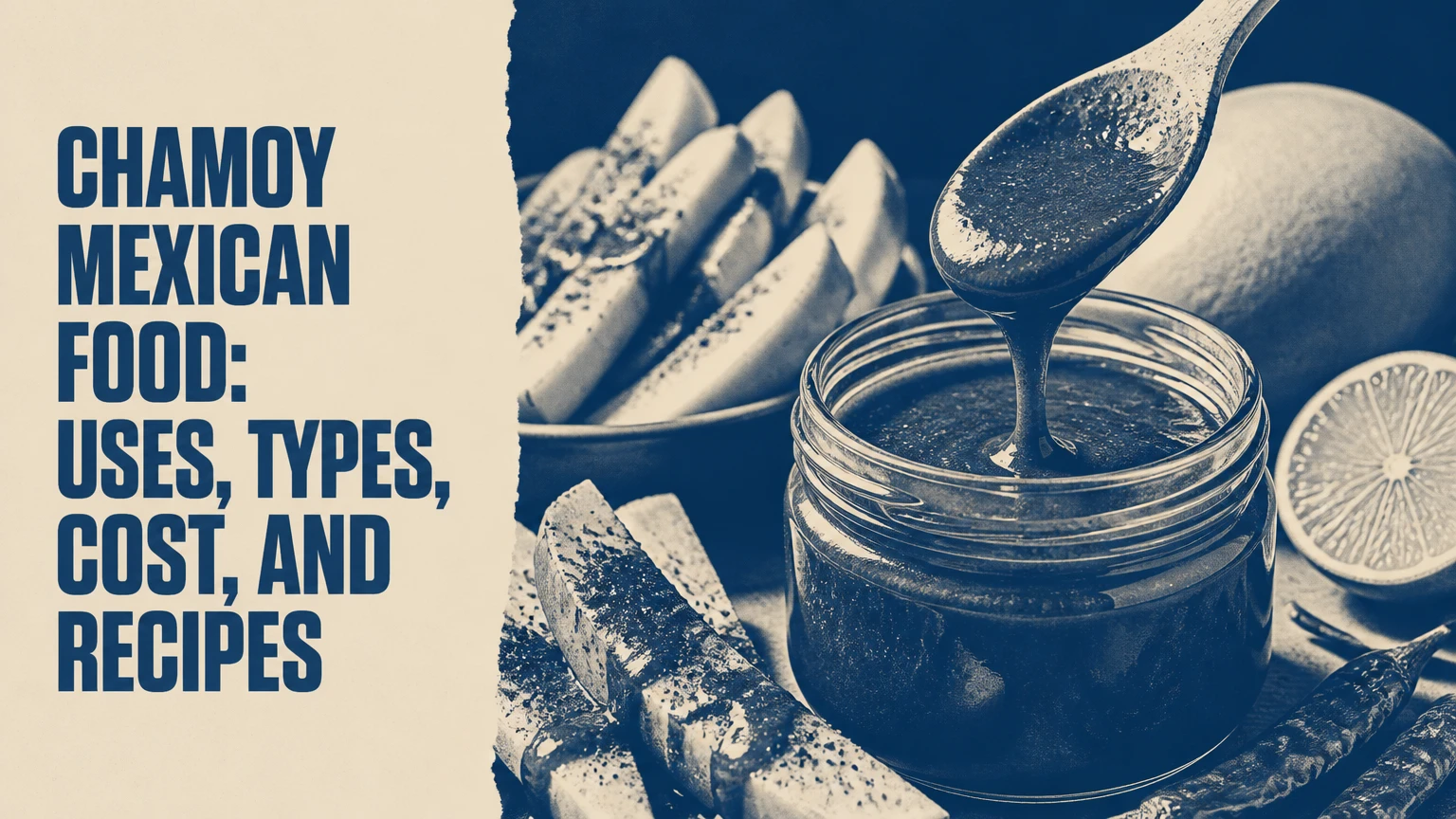
Chamoy Mexican food refers to the sweet, sour, salty, spicy condiment used on fruit, candy, chips, snacks, and cold drinks. Chamoy is usually made from pickled or dried fruit, chili, salt, and an acidic ingredient such as lime juice or citric acid, producing a layered flavor rather than simple sweetness or heat.
Key Facts About Chamoy
- Chamoy is a Mexican condiment with sweet, sour, salty, fruity, and chili flavors.
- Common bases include apricot, plum, mango, tamarind, hibiscus, or combinations of these ingredients.
- Liquid chamoy drizzles over fruit and snacks, while thicker paste adheres to candy and cup rims.
- Commercial chamoy often contains sugar or corn syrup, citric acid, chili, salt, preservatives, and coloring.
- A typical commercial bottle costs about $2-$5, while small-batch versions commonly cost $7-$15.
- Homemade chamoy generally requires refrigeration and is best used within about 2-4 weeks unless a tested preservation process is used.
What Is Chamoy?
Chamoy is a Mexican fruit-and-chile condiment that combines acidity, sweetness, saltiness, and capsaicin in one sauce. The condiment can be thin and pourable, thick enough to coat candy, or dried into a powder, and its exact flavor changes according to the fruit, chile, sweetener, and preservation method.
Chamoy developed from the Mexican adaptation of salted, preserved fruit traditions associated with East and Southeast Asian condiments such as umeboshi and sour plum preparations. The modern Mexican product is its own culinary category, shaped by local chiles, fruit, lime, sugar, and street-snack culture.
Chamoy is not one fixed recipe. A dark, fruit-heavy artisanal sauce may taste like tart apricot and dried chile, whereas a bright commercial sauce may emphasize citric acid, salt, sugar, and a clean red color. Both can be recognizable chamoy.
Andrew Zimmern described chamoy as “a salty-sweet, mildly spiced Mexican condiment that is superb drizzled on” snacks and fruit. That description captures its practical identity: chamoy is a finishing condiment, not usually the primary cooking sauce for a meal.
What Does Chamoy Taste Like?
Chamoy tastes fruity first in some recipes, sharply sour first in others, and salty or spicy at the finish. The balance depends on acidity, sugar, sodium, chile variety, and viscosity, so two bottles can taste noticeably different even when both are labeled chamoy.
The flavor structure works through contrast. Fruit or sweetener rounds the acidity, salt intensifies fruit perception, lime or citric acid creates brightness, and capsaicin extends the finish with heat. Thick sauces usually taste more concentrated because less water separates the ingredients on the tongue.
Chamoy does not necessarily taste hot. Mild products may deliver more sourness and salt than chile heat, while habanero versions can make heat the dominant feature. Read the ingredient list and heat description rather than assuming every red bottle has the same intensity.
What Is Chamoy Made From?
Chamoy is commonly made from fruit, chili, salt, sugar, and acid, but commercial formulas may replace much of the fruit with water, citric acid, sweeteners, flavorings, and stabilizers. The ingredient order on the label indicates which components make up the largest proportion by weight.
| Ingredient | Common examples | Function in chamoy | Effect on flavor or texture |
|---|---|---|---|
| Fruit | Apricot, plum, mango, tamarind | Provides body and natural acidity | Fruity, dense, sometimes fibrous |
| Chile | Ancho, árbol, piquín, habanero | Adds aroma and capsaicin | Earthy, sharp, smoky, or hot |
| Acid | Lime juice, citric acid, vinegar | Lowers pH and adds tartness | Bright, sour finish and longer keeping quality |
| Sweetener | Sugar, agave, corn syrup, allulose | Balances acid and chile | Softer heat, thicker mouthfeel |
| Salt | Sea salt, table salt | Amplifies flavor and preserves | Salty, savory, more intense fruit |
| Liquid base | Water, hibiscus tea, fruit juice | Rehydrates and controls flow | Pourable sauce or concentrated paste |
| Stabilizer | Xanthan gum, pectin | Prevents separation | Smooth, clingy consistency |
| Coloring | Hibiscus, chile, permitted food dye | Creates visual identity | Deep brown-red to bright red |
A fruit-forward label should name fruit near the beginning of the ingredient list. If water, corn syrup, or citric acid appears before fruit, the product may still taste good, but it is an acid-sweetened commercial sauce rather than a predominantly fruit-based preparation.
Chamoy is often vegan because its conventional ingredients come from plants or minerals. Check the label for brand-specific additives, especially when a product contains flavor blends, confectionery ingredients, or processing aids.
Which Types of Chamoy Are Available?
The main chamoy types are commercial liquid sauce, fruit-based artisanal sauce, candy paste, powder, extra-hot sauce, and reduced-sugar formulas. The best type depends on whether the condiment must pour, cling, sprinkle, or provide intense heat without adding much liquid.
| Chamoy type | Typical texture | Best use | Typical price |
|---|---|---|---|
| Commercial liquid | Thin, smooth, pourable | Watermelon, chips, snack plates | $2-$5 per bottle |
| Fruit-based artisanal | Medium-thick, sometimes pulpy | Fresh fruit, sauces, tasting | $7-$15 per 10-12 oz jar |
| Candy paste | Thick, sticky, concentrated | Gummies, dried fruit, candy coating | $6-$14 per jar |
| Chamoy powder | Dry, fine, sprinkleable | Popcorn, chips, nuts, dry snacks | $3-$10 per pouch |
| Extra-hot formula | Liquid or paste | Chile-focused snack mixes | $4-$12 per bottle |
| Reduced-sugar formula | Thin to medium-thick | Lower-sugar portions and drink rims | $6-$15 per bottle |
Chamoy powder is not always simply dehydrated liquid chamoy. Some products are seasoning blends built from salt, chili, sugar, acid, and flavoring, so the label may show no meaningful fruit content.
Candy paste often contains additional sugar, syrup, pectin, or gums. That formulation improves adhesion, but it can taste sweeter and heavier than a sauce intended for fruit.
How Is Chamoy Used in Mexican Food?
Chamoy is used as a finishing condiment on fresh fruit, dried fruit, candy, chips, shaved ice, snack mixes, and cold beverages. The strongest pairings combine chamoy with a relatively mild or sweet base, allowing its acidity and chile to remain distinct instead of becoming muddy.
| Food or beverage | Suggested starting amount | Why the pairing works | Practical note |
|---|---|---|---|
| Mango slices | 1-2 teaspoons per cup | Sweet flesh absorbs sour chile flavor | Pat mango dry first |
| Watermelon | 1 teaspoon per cup | Neutral sweetness offsets salt and acid | Add immediately before serving |
| Cucumber | 1 teaspoon per cup | Crisp water content softens heat | Use a thicker sauce |
| Dried mango | 1 teaspoon per 3 oz | Concentrated fruit matches concentrated sauce | Dust with chile powder |
| Gummy candy | 1 teaspoon per 4 oz | Sticky coating supports sweet-sour contrast | Toss in a dry seasoning afterward |
| Corn chips | 1-2 teaspoons per 2 oz | Salt and crunch carry the sauce | Drizzle lightly to prevent sogginess |
| Popcorn | 1 teaspoon per 4 cups | Acid cuts buttery or plain flavors | Mix quickly while popcorn is warm |
| Agua fresca | 1-2 teaspoons per 12 oz | Tartness adds a snack-style finish | Stir before drinking |
Chamoy is also used around the rim of cups. Thick paste works better than ordinary liquid sauce because the paste creates a continuous adhesive layer for salt or chile seasoning.
Tajín and chamoy are complementary, not identical. Tajín is primarily a dry chile-lime-salt seasoning, while chamoy is a wet fruit-acid condiment. A common snack combination uses chamoy for adhesion and Tajín for dry heat and texture.
How Do You Make Chamoy at Home?
A basic homemade chamoy takes about 35-50 minutes and produces roughly 2 cups. The most reliable method softens dried fruit, blends it with hibiscus liquid, adds acid and chile, then reduces the mixture gently until the sauce coats a spoon.
Before You Start
| Requirement | Typical specification |
|---|---|
| Total time | 35-50 minutes |
| Yield | About 2 cups |
| Difficulty | Moderate |
| Main equipment | 2-quart saucepan, blender, fine strainer |
| Main ingredients | 1 cup dried apricots, 1/2 cup prunes, 2 cups water |
| Flavor additions | 1/2 cup strong hibiscus tea, 2 tablespoons lime juice, 1-2 teaspoons chile |
| Storage | Refrigerate in a clean sealed jar |
Step 1: Soften the Fruit
Combine 1 cup dried apricots, 1/2 cup pitted prunes, and 2 cups water in a saucepan. Simmer over low heat for 15-20 minutes, until the fruit crushes easily with a spoon.
You will know the fruit is ready when no firm center remains. Boiling aggressively can make the liquid evaporate before the fruit hydrates, so keep the surface at a gentle simmer.
Step 2: Blend the Base
Transfer the softened fruit to a blender with 1/2 cup strong hibiscus tea and enough cooking liquid to create a smooth puree. Blend for 45-60 seconds, then add liquid one tablespoon at a time if the blades struggle.
Strain the puree if you want a smooth sauce for a cup rim. Leave it unstrained when a rustic, fruit-fiber texture is desirable.
Step 3: Balance the Seasoning
Stir in 2 tablespoons lime juice, 1 teaspoon salt, 1 teaspoon mild chile powder, and 1-2 tablespoons sugar or agave. Taste only after the mixture cools slightly, because hot puree can make acidity and chile seem less balanced.
The target flavor should be tart and savory before the final adjustment. Add chile gradually, since heat becomes more noticeable after the sauce rests.
Step 4: Reduce the Sauce
Return the puree to the saucepan and simmer uncovered over low heat for 10-15 minutes, stirring every 2-3 minutes. Stop when the sauce falls from a spoon in a slow ribbon rather than a watery stream.
Do not scorch the fruit sugars. A burnt bottom cannot be corrected by adding more lime, salt, or sweetener.
Step 5: Cool and Store
Cool the chamoy to room temperature, transfer it to a clean jar, and refrigerate it promptly. Label the jar with the preparation date and use a clean spoon each time.
A home kitchen cannot guarantee the shelf life of an untested recipe. For conservative storage, use homemade chamoy within 2-4 weeks, and discard it if mold, fermentation bubbles, gas pressure, or an abnormal odor appears.
Commercial or Artisanal Chamoy: Which Is Better?
Commercial chamoy is usually the better choice for large parties, consistent pouring, and lower cost, while artisanal chamoy is better for fruit-forward flavor and shorter ingredient lists. Neither category is automatically healthier or more authentic; the ingredient panel and intended use matter more than the label style.
| Criterion | Commercial sauce | Artisanal fruit sauce | Practical winner |
|---|---|---|---|
| Typical cost | $2-$5 per bottle | $7-$15 per 10-12 oz jar | Commercial for volume |
| Texture | Uniform and pourable | Medium-thick or pulpy | Commercial for drizzling |
| Fruit intensity | Low to moderate | Moderate to high | Artisanal for fruit |
| Color | Often bright red | Usually dark red-brown | Depends on preference |
| Storage | Often 1-3 years unopened | Often 1-6 months refrigerated | Commercial for pantry storage |
| Ingredient control | Brand formula | Smaller-batch formula | Artisanal for transparency |
| Large-group use | 16-33 oz bottles common | Smaller jars common | Commercial for parties |
| Rim adhesion | Usually weak to moderate | Often moderate to strong | Thick artisanal paste |
Bright red color does not prove artificial dye, and dark color does not prove superior quality. Hibiscus, concentrated chile, oxidation, and fruit type can all change appearance.
Commercial sauce may be the more practical product for a school snack table or large gathering because its cost per ounce is lower and its flow remains predictable. Artisanal sauce earns its higher price when the fruit flavor matters, the serving size is small, and refrigeration is convenient.
How Much Chamoy Should You Use?
Start with 1 teaspoon of chamoy per cup of fruit or snack, then increase to 2 teaspoons when the food is dry, bland, or highly sweet. A tablespoon can overwhelm a single serving and may add substantial sodium or sugar, depending on the brand.
| Serving situation | Starting portion | Maximum practical range | Adjustment |
|---|---|---|---|
| One cup fresh fruit | 1 teaspoon | 2 teaspoons | Pat fruit dry |
| Two ounces chips | 1 teaspoon | 2 teaspoons | Toss instead of soaking |
| Four ounces candy | 1 teaspoon | 2 tablespoons | Add paste gradually |
| Twelve-ounce cold drink | 1 teaspoon | 2 teaspoons | Stir with ice |
| One cup shaved ice | 2 teaspoons | 1 tablespoon | Use a thicker sauce |
| Cup rim | 1/2-1 teaspoon | 2 teaspoons | Apply in a narrow band |
Serving size matters because sodium and sugar vary dramatically across brands. A package label provides the authoritative nutrition figures; general online claims about all chamoy products cannot substitute for the specific bottle.
People limiting sodium, added sugar, or very spicy foods should compare serving sizes, choose a milder formula, and use chamoy as a measured garnish rather than a free-poured sauce. Sugar-free products may still contain salt, acids, sweeteners, and significant heat.
How Should You Store Chamoy?
Unopened commercial chamoy should follow the package date and storage instructions, while opened bottles generally benefit from refrigeration and clean handling. Homemade chamoy should be refrigerated because its tested acidity, preservation, and water activity are usually unknown.
| Product | Unopened storage | After opening | Discard indicators |
|---|---|---|---|
| Commercial liquid | Cool pantry until date | Refrigerate if label advises | Mold, gas, off odor |
| Commercial paste | Cool pantry until date | Refrigerate for texture | Separation with spoilage signs |
| Commercial powder | Dry pantry, sealed | Keep moisture out | Clumps, insects, stale odor |
| Artisanal sauce | Refrigerate if labeled | Refrigerate consistently | Mold or fermentation |
| Homemade sauce | Not shelf-stable | Refrigerate immediately | Bubbling, mold, sour off odor |
| Fruit-coated candy | Room temperature briefly | Use the same day | Weeping, slimy coating |
Always use a dry, clean utensil. Introducing water, crumbs, or fruit juice into the bottle can shorten quality life and create a spoilage risk.
What Are Chamoy’s Main Problems and Fixes?
The most common chamoy failures are excessive thinness, poor adhesion, overpowering salt, excessive sourness, and snack sogginess. Each problem has a different cause, so adding more sugar is not a universal solution.
| Problem | Likely cause | Corrective action | Prevention |
|---|---|---|---|
| Sauce runs off fruit | Wet surface or thin formula | Pat fruit dry; reduce sauce | Dress immediately before serving |
| Rim coating drips | Liquid sauce lacks viscosity | Use paste or reduce briefly | Apply a narrow layer |
| Sauce is too salty | High-sodium commercial formula | Dilute with unsalted fruit puree | Measure portions |
| Sauce is too sour | Excess citric acid or lime | Add fruit puree or small sweetener | Add acid gradually |
| Sauce is too thin | Excess water | Simmer uncovered 5-10 minutes | Measure liquid accurately |
| Candy turns wet | Too much liquid sauce | Use paste and dry seasoning | Coat small batches |
| Powder clumps | Humidity or wet spoon | Break clumps and reseal dry | Store with moisture control |
A small amount of xanthan gum can thicken a sauce, but it must be dispersed carefully. For 2 cups of chamoy, begin with about 1/16 teaspoon, blend thoroughly, and wait several minutes before adding more; excess gum creates a slick texture.
The most useful practitioner rule is to fix viscosity before seasoning. Reducing a salty sauce concentrates salt, so correct a thin, salty batch with unsalted fruit puree rather than prolonged simmering.
What Should You Look for When Buying Chamoy?
Choose chamoy by intended use, fruit content, heat level, texture, serving size, and storage requirements. A pourable commercial bottle suits fruit and snack plates, while a thick paste or reduced sauce performs better on candy and cup rims.
Buying Checklist
- Read the first five ingredients. Fruit near the beginning indicates a fruit-led formula; water, syrup, and citric acid indicate a more industrial profile.
- Check the serving size. Compare sodium and added sugar per tablespoon or per 15-gram serving.
- Match viscosity to the food. Thin sauce spreads over fruit; paste stays on candy.
- Treat heat labels as brand-specific. Mild, medium, and hot are not standardized ratings.
- Inspect the package size. A 33-ounce bottle usually offers better value than a 10-ounce jar for parties.
- Confirm storage instructions. Refrigeration requirements differ between brands and formulas.
- Check dietary claims. Vegan, sugar-free, and dye-free claims require label verification rather than assumption.
For a first purchase, a medium-heat liquid with moderate acidity is the most versatile. Extremely hot paste and heavily salted formulas are harder to repurpose when the initial flavor does not suit the household.
What Are the Best Alternatives to Chamoy?
Tajín, chili-lime seasoning, tamarind sauce, salsas, and lime with salt can replace chamoy, but each alternative changes the texture or flavor balance. Tajín is the closest dry substitute, while tamarind sauce is the closest fruit-acid substitute.
| Alternative | Texture | Main flavor | Best replacement use | Main limitation |
|---|---|---|---|---|
| Tajín seasoning | Dry powder | Chile, lime, salt | Fruit and chips | No syrupy fruit body |
| Lime and salt | Liquid drops | Sharp acid, salt | Cucumber and watermelon | No chile depth |
| Tamarind sauce | Thick liquid | Sweet-sour fruit | Candy and fruit | Usually less chile aroma |
| Chili-lime powder | Dry powder | Chile and acid | Popcorn and snack mixes | Limited sweetness |
| Mild salsa | Spoonable | Tomato, chile, aromatics | Savory chips | Not a candy coating |
| Plum or apricot puree | Thick puree | Fruity sweetness | Homemade sauce base | Needs acid and salt |
Chamoy should not replace a cooking sauce in every recipe. Its salt, acid, and sugar can dominate delicate foods, and its texture may separate when exposed to prolonged high heat.
Frequently Asked Questions
Is chamoy the same as Tajín?
Chamoy and Tajín are different products. Chamoy is a wet fruit-and-chile sauce or paste, while Tajín is a dry seasoning made primarily from chile, lime, and salt. They are often used together because chamoy supplies adhesion and moisture, while Tajín supplies dry seasoning and texture.
Is chamoy spicy?
Chamoy can be mild, medium, or very hot. Many commercial formulas emphasize sourness and salt instead of intense chile heat, but habanero versions can be substantially hotter. Start with 1 teaspoon, taste the finished food, and check the product’s stated heat level before serving it to children.
Is chamoy gluten-free?
Many chamoy products are gluten-free because fruit, chile, salt, sugar, and lime do not naturally contain gluten. The claim depends on the manufacturer’s ingredients and facility controls, so people with celiac disease or serious sensitivity should verify the package or contact the brand.
Can you put chamoy on ice cream?
Chamoy can work on vanilla, mango, lime, or fruit-based ice cream when used in a small amount. Begin with 1/2 teaspoon per scoop, then add dry chile-lime seasoning if desired. Very salty or acidic formulas can overpower dairy, so fruit-forward chamoy usually performs better.
Why does chamoy separate in the bottle?
Chamoy separates when fruit solids, water, oil, acid, and stabilizers are not fully suspended. Shake a commercial bottle if the label permits, or stir homemade sauce before serving. Separation with mold, gas, pressure, or an abnormal odor indicates spoilage rather than normal settling.
How long does homemade chamoy last?
Homemade chamoy is best refrigerated and used within about 2-4 weeks unless the recipe has been professionally tested for preservation. Clean preparation, a sealed container, and consistent refrigeration improve quality, but they do not establish a guaranteed shelf life.
The Bottom Line
Chamoy Mexican food is best understood as a flexible Mexican fruit-and-chile condiment rather than one standardized sauce. Choose a thin commercial bottle for affordable fruit and snack use, a thick paste for candy or cup rims, and a fruit-based artisanal formula when flavor complexity matters most. Start with measured portions, keep homemade chamoy refrigerated, and use Tajín when you want a dry chile-lime finish instead of a wet sauce.