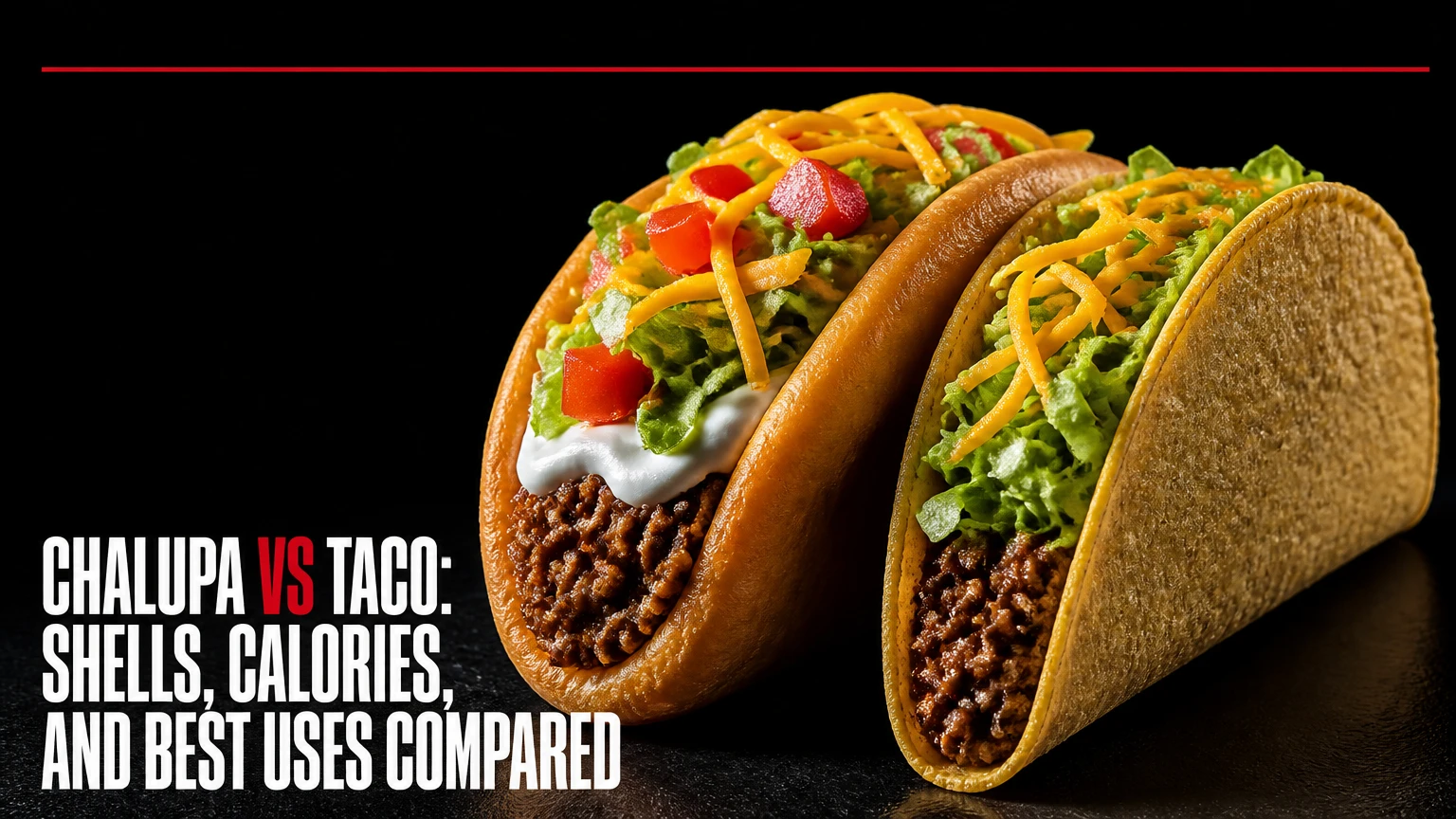
A taco is a folded tortilla filled and eaten by hand, while a chalupa is usually a thicker fried masa base or shell with a crisp exterior and a more substantial chew. The key difference is construction: tacos center on a flexible wrapper, whereas chalupas center on a fried corn-masa structure, although restaurant versions vary widely by region and brand.
Key Facts at a Glance
- A soft taco uses a pliable corn or flour tortilla; a chalupa normally uses fried masa or a fried flatbread.
- Mexican chalupas are regional foods, especially associated with Puebla, and do not all have the same boat shape.
- A Tex-Mex chalupa is generally thicker, more heavily topped, and more fried than a standard street taco.
- A taco can be soft, crisp, grilled, fried, folded, or doubled; “taco” describes a broad food family rather than one shell.
- A typical restaurant chalupa contains more shell fat and carbohydrates than a single corn-tortilla taco.
- Toppings often determine the final nutrition more than the name on the menu.
Chalupa vs Taco: What Is the Core Difference?
The core difference between a chalupa and a taco is the role of the wrapper. A taco uses a tortilla as a flexible container for filling, while a chalupa uses fried masa or another fried base as a crisp, thicker platform. That distinction affects texture, portability, topping capacity, oil content, and regional identity.
A taco tortilla may be made from nixtamalized corn masa or wheat flour. It is pressed thin and cooked on a comal, griddle, or industrial line, so the finished tortilla bends without shattering. A crisp taco shell is a different branch of the taco family: a tortilla is fried into a U shape or molded shell.
A chalupa generally begins with a thicker masa piece, disc, or shaped shell that is fried until the outside firms. Some versions remain slightly tender inside. Others become fully crisp. The name therefore identifies a preparation tradition, not a single globally standardized recipe.
| Criterion | Soft corn taco | Crisp taco | Mexican-style chalupa | Fast-food chalupa |
|---|---|---|---|---|
| Main wrapper | Corn tortilla | Fried corn shell | Fried masa disc or shell | Fried thick shell or flatbread |
| Typical thickness | 1.5-2.5 mm | 1.5-2.5 mm before frying | 3-6 mm | 4-8 mm |
| Primary texture | Flexible and tender | Brittle and crunchy | Crisp edge, chewy center | Crisp outside, soft filling |
| Typical filling load | 40-90 g | 40-80 g | 50-110 g | 80-150 g |
| Best eating method | Fold and bite | Hold upright | Support from underneath | Hold with both hands |
How Are Taco and Chalupa Shells Made?
Taco tortillas are usually pressed thin and cooked with dry heat, while chalupa shells or bases are fried in oil. A soft taco needs pliability, so the tortilla receives enough heat and moisture to remain bendable; a chalupa needs surface dehydration and browning, so frying creates a firmer, more porous structure.
Taco Preparation
A typical corn tortilla uses masa harina or freshly ground nixtamalized corn, water, and sometimes salt. A 25-30 gram dough ball is pressed to approximately 1.5-2.5 millimeters, then cooked on a hot comal for roughly 45-75 seconds total.
Fresh tortillas often puff because steam separates internal layers. The puff is useful, but a perfect puff is not required for a taco. The tortilla should feel cooked and flexible, with light brown spots rather than a dry, cracker-like surface.
Flour tortillas use wheat flour, water, fat, salt, and a leavening agent in many recipes. Flour creates more stretch than corn, so flour tacos are useful when fillings are wet or bulky.
Chalupa Preparation
A chalupa masa piece is thicker than a standard tortilla and is fried at a temperature commonly around 175-190°C, or 350-375°F. The cook shapes the masa before or during frying, depending on the regional method and the intended form.
The supplied overview describes a universal boat shape, repeated ladling, and sauce added directly to dough in the oil. Those details should not be treated as standard rules. Puebla chalupas can be small fried masa bases topped after cooking, while commercial versions may use a molded shell, a fried flatbread, or a proprietary production method.
| Preparation factor | Soft taco | Crisp taco | Fried masa chalupa | Commercial chalupa |
|---|---|---|---|---|
| Heat method | Comal or griddle | Frying or baking | Shallow or deep frying | Industrial frying or baking |
| Working dough thickness | 1.5-2.5 mm | 1.5-2.5 mm | 3-6 mm | 4-8 mm |
| Typical cooking time | 45-75 seconds | 30-90 seconds | 45-120 seconds | 60-180 seconds |
| Oil contact | None for tortilla | High | Moderate to high | Moderate to high |
| Main quality test | Bends without cracking | Crunches without collapsing | Crisp outside, tender center | Holds toppings without splitting |
Why Do the Textures Differ?
Tacos feel flexible or brittle because thin tortillas contain less structural mass, while chalupas feel thicker and chewier because frying dehydrates the surface around a larger masa structure. Oil temperature matters: low heat increases oil uptake, while excessive heat can harden the exterior before the inside cooks.
A tortilla’s thin cross-section loses moisture quickly, but its layered structure remains easy to fold when freshly heated. A chalupa’s thicker masa retains more interior moisture after the outer layer browns. That produces the characteristic contrast between a crisp surface and a dense or tender center.
A fried taco shell prioritizes audible crunch. A chalupa prioritizes load-bearing capacity and contrast. The difference resembles a thin crisp compared with a thicker fried bread, not merely two shapes made from identical dough.
Expert rule of thumb: a taco shell should support the filling while staying secondary to it. A chalupa shell is part of the main eating experience, so shell thickness and freshness deserve equal attention to the filling.
Which Regional Styles Matter?
Mexican chalupas and United States fast-food chalupas are related by name but can differ in shape, toppings, and cooking method. Mexican regional versions often use a small fried masa base with a restrained topping pattern, whereas United States versions commonly use a larger shell with seasoned filling, dairy toppings, and shredded vegetables.
Puebla is a major reference point for chalupa history and preparation. Puebla-style chalupas are often associated with small fried masa pieces topped with ingredients such as shredded meat, onion, and salsa. Exact recipes vary among cooks and restaurants.
Mexican tacos also have extensive regional variation. Tacos al pastor, tacos de asador, tacos de cazo, tacos dorados, fish tacos, and tacos de canasta differ in protein, cooking method, tortilla treatment, and service style.
| Named style | Wrapper or base | Typical topping pattern | Texture | Common context |
|---|---|---|---|---|
| Puebla chalupa | Small fried masa base | Salsa, onion, shredded filling | Crisp and tender | Regional Mexican cooking |
| Tacos al pastor | Soft corn tortillas | Marinated spit-cooked filling, onion, herbs | Soft, juicy, lightly toasted | Taquerias |
| Tacos de asador | Corn or flour tortillas | Grilled filling, salsa, onion | Flexible, lightly charred | Grilled-meat counters |
| Tacos dorados | Rolled fried tortillas | Fresh toppings and sauce | Fully crisp | Mexican home and street food |
| Tex-Mex hard taco | Molded fried corn shell | Seasoned filling, lettuce, cheese | Brittle and crunchy | United States Tex-Mex |
| Fast-food chalupa | Thick fried shell or flatbread | Filling, cheese, cream, lettuce | Crisp outside, soft inside | Chain restaurants |
Calling one version “the authentic chalupa” without naming its region creates confusion. The better question is whether a menu is presenting a Puebla-style chalupa, a broad Mexican interpretation, or a commercial United States product.
Which Has More Calories and Fat?
A chalupa usually has more calories and fat than a single soft corn taco because its thicker base is fried and its standard topping package is larger. A taco can still exceed a chalupa when it contains a large flour tortilla, fried filling, abundant cheese, cream, or two tortillas.
The figures below are typical restaurant ranges, not universal nutritional facts. Restaurant recipes, serving size, cooking oil, and toppings can shift the result substantially. The United States Food and Drug Administration requires chain restaurants to provide standardized calorie information, but independent taquerias may not publish comparable data.
| Item | Typical calories | Typical fat | Typical carbohydrates | Typical serving basis |
|---|---|---|---|---|
| Small corn street taco | 120-220 kcal | 4-10 g | 15-25 g | 1 taco, 40-90 g filling |
| Flour taco | 180-350 kcal | 6-16 g | 25-40 g | 1 taco, 50-100 g filling |
| Crisp hard taco | 170-320 kcal | 8-18 g | 18-32 g | 1 shell with filling |
| Puebla-style chalupa | 180-350 kcal | 8-18 g | 20-35 g | 1 small base |
| Fast-food chalupa | 300-550 kcal | 15-30 g | 30-50 g | 1 large assembled item |
| Cheese-heavy taco | 250-500 kcal | 14-32 g | 20-42 g | 1 taco with dairy toppings |
For a lower-calorie order, choose a small corn taco with grilled filling, salsa, onion, and herbs, then control the number of tortillas. For a chalupa, reducing cheese, cream, and fried add-ons often matters more than removing a small amount of filling.
Counterintuitive truth: a three-taco meal is not automatically lighter than one chalupa. Three tortillas and a larger total filling portion can outweigh the chalupa’s single fried base.
What Do They Cost?
A soft taco commonly costs less per unit than a chalupa, but a complete meal may require several tacos. Typical United States restaurant prices range from $2-$5 for a taco and $4-$9 for a chalupa, with metropolitan locations and specialty fillings reaching higher prices.
Home cost depends primarily on the filling and whether the cook buys prepared tortillas or makes masa from scratch. A tortilla press, comal, and frying thermometer add equipment cost, but those tools become economical when preparing repeated batches.
| Purchase or preparation | Typical unit cost | Active time | Equipment | Typical yield |
|---|---|---|---|---|
| Home soft corn taco | $0.80-$2.00 | 15-25 minutes | Comal or skillet | 8-12 tacos |
| Home flour taco | $0.60-$1.80 | 25-40 minutes | Skillet | 8-12 tacos |
| Home fried chalupa | $1.00-$2.75 | 30-50 minutes | Fry pan, thermometer | 6-10 chalupas |
| Taqueria street taco | $2-$5 | 5-15 minutes waiting | None | 1 taco |
| Fast-food chalupa | $4-$9 | 5-15 minutes waiting | None | 1 item |
| Catered taco service | $12-$30 | 30-90 minutes service | Catering setup | 3-5 tacos per guest |
Prices are typical planning ranges for the United States and can vary by city, restaurant type, ingredient, and portion size. Mexican regional restaurants may price a small chalupa closer to a taco, while chain products often cost more because they include larger shells and packaged toppings.
Which Is Easier to Make at Home?
Soft tacos are easier to make at home because they require reheating or cooking tortillas and assembling fillings, while chalupas add dough shaping, oil-temperature control, and hot-fat handling. A beginner can produce serviceable tacos in 20-30 minutes, whereas fried chalupas usually take 35-60 minutes.
The simplest home taco workflow is:
- Warm 8-12 tortillas on a dry skillet for 30-45 seconds per side.
- Cook 450-600 grams of filling until the center reaches a safe cooked temperature appropriate to the ingredient.
- Hold tortillas in a covered towel so steam preserves flexibility.
- Add 40-75 grams of filling per taco.
- Finish with salsa, onion, herbs, and an acidic garnish.
For chalupas, keep the masa hydrated but firm, shape pieces evenly, and fry in small batches. A thermometer is more reliable than visual judgment because oil that falls below approximately 170°C can leave the shell greasy, while excessively hot oil can brown the outside before the interior sets.
Practitioner rule: prepare toppings before frying chalupa shells. Fried masa loses its best texture quickly, so the filling station should be ready before the first shell leaves the oil.
How Do You Choose by Eating Situation?
Choose tacos for portability, variety, and fast individual customization; choose chalupas for crunch, heavier toppings, and a meal that emphasizes the fried base. The better option depends on whether the priority is freshness, structural strength, calorie control, or regional accuracy.
For a Quick Lunch
A soft corn taco is usually the better choice because it is lighter, faster to eat, and easy to order in multiple varieties. Two or three small tacos allow different fillings without committing to a large fried shell.
For Maximum Crunch
Choose a fresh chalupa or crisp taco. A chalupa provides more chew and interior density, while a crisp taco delivers a thinner, louder crunch. Neither holds its best texture after prolonged contact with wet salsa.
For Heavy Toppings
Choose a chalupa or a double-layer taco. The thicker fried base resists collapse better, but excessive cream, salsa, or juicy filling can still soften it within minutes.
For Parties and Buffets
Soft tacos are more practical for group service because tortillas can remain warm and fillings can be offered separately. Chalupas require closer timing, since assembled fried shells become tough or soggy as they sit.
For Regional Accuracy
Ask the restaurant what it means by chalupa. A menu that names Puebla, a small masa base, salsa, and onion is describing a different food from a chain menu offering a large filled shell with dairy toppings.
How Do Menus Use the Word Chalupa?
Restaurant menus use “chalupa” inconsistently, so the listed shell, size, toppings, and cooking method matter more than the name. A menu description mentioning a fried masa base points toward a Mexican-style preparation; a large filled shell with seasoned filling and dairy toppings usually indicates a United States commercial interpretation.
Use these questions when ordering:
- Is the base corn masa, a corn tortilla, or wheat flour?
- Is the shell fried to order?
- Is the chalupa flat, boat-shaped, rolled, or folded?
- Which toppings are standard?
- Can the kitchen reduce cheese or cream?
- Is the salsa added before service or served separately?
A menu’s use of “chalupa” does not guarantee a Puebla recipe. It also does not make the item a taco. Names communicate culinary lineage imperfectly, so the construction description is the reliable evidence.
What Commonly Goes Wrong?
Taco and chalupa failures usually come from moisture, temperature, or an overloaded shell. Soft tortillas tear when cold or under-hydrated, while fried masa becomes greasy at low oil temperature and hard when overcooked.
| Problem | Likely cause | Immediate fix | Prevention |
|---|---|---|---|
| Corn tortilla tears | Cold, dry tortilla | Reheat with light steam | Warm before filling |
| Taco becomes soggy | Wet salsa added too early | Drain filling and serve salsa separately | Assemble immediately |
| Crisp shell breaks | Shell is stale or overloaded | Use a second shell or smaller portion | Limit filling to 40-80 g |
| Chalupa feels greasy | Oil below 170°C | Let oil recover between batches | Fry smaller batches |
| Chalupa becomes leathery | Over-frying or cooling uncovered | Serve immediately | Remove when center remains tender |
| Masa cracks during shaping | Dough lacks water | Add water gradually, 5 ml at a time | Rest dough for 10 minutes |
A double tortilla is useful for wet or heavy taco fillings, but it is not a mandatory feature of every taco. The second tortilla improves strength at the cost of additional carbohydrates and a heavier bite.
Freshness is the main quality variable after cooking. A well-made chalupa served immediately can outperform a thinner shell on texture, while a cooled chalupa can become harder and less pleasant than a simple reheated taco tortilla.
Which Should You Choose?
Choose a Taco for Lower Shell Fat
Select a small corn taco with grilled filling, salsa, onion, and herbs when you want portion control. The taco remains the better default for a lighter meal, provided the order does not add large amounts of cheese, cream, or fried filling.
Choose a Chalupa for Texture
Select a chalupa when crisp edges, a chewy interior, and a stronger base matter more than minimal oil. Order it close to serving time and keep wet salsa moderate so the shell remains crisp.
Choose a Taco for Variety
Tacos are better when you want several fillings in one meal. Their small format supports different preparations, including grilled, slow-cooked, seafood, vegetable, and breakfast fillings.
Choose a Chalupa for Dense Toppings
A chalupa handles a larger topping load than a single thin tortilla. The advantage disappears when the shell is preassembled long before eating, because trapped moisture softens the fried surface.
Choose Neither by Name Alone
A flour taco with a fried filling can be heavier than a small masa chalupa. Compare shell size, frying, filling weight, cheese, cream, and salsa rather than assuming the category name determines nutrition.
Frequently Asked Questions
Is a chalupa a taco?
A chalupa is not simply another name for a taco. A taco is defined broadly by its filled tortilla format, while a chalupa usually emphasizes a fried masa base or shell. Some commercial chalupas resemble thick tacos, but regional Mexican chalupas may be small fried bases served with toppings rather than folded shells.
Are chalupas always made from corn?
Chalupas are traditionally associated with corn masa, but commercial versions can use wheat flour, a flour-based flatbread, or a proprietary shell. Ask about the wrapper when ingredients matter. A menu description that says “fried masa” is a stronger indicator of a corn-based preparation than the word chalupa alone.
Which stays crunchy longer, a taco or a chalupa?
A freshly fried chalupa often stays structurally firm longer than a thin crisp taco because its thicker base contains more material. Wet fillings can soften either shell quickly, and a chalupa may become dense or leathery after cooling. Serving time, oil quality, and moisture control matter more than shape alone.
Can you make a chalupa without deep-frying?
You can make a lower-oil chalupa-style base by pan-frying or baking thick masa, but the result will differ from a traditionally fried shell. Baking reduces surface oil but may produce a drier, less blistered crust. Pan-frying offers better browning, although it requires careful turning and even thickness.
Is a taco or chalupa better for children?
A soft taco is usually easier for children because the flexible tortilla produces fewer sharp fragments and allows smaller portions. A chalupa can work when served fresh with moderate filling, but its rigid edges and heavier toppings create more mess. Cut large items into manageable pieces and serve wet sauces separately.
The Bottom Line
The best choice in chalupa vs taco depends on the desired structure: choose a taco for flexibility, variety, portability, and easier portion control; choose a chalupa for fried masa texture, heavier toppings, and a crisp-chewy bite. Compare the actual shell and toppings, because regional recipes and restaurant menus use both names broadly.