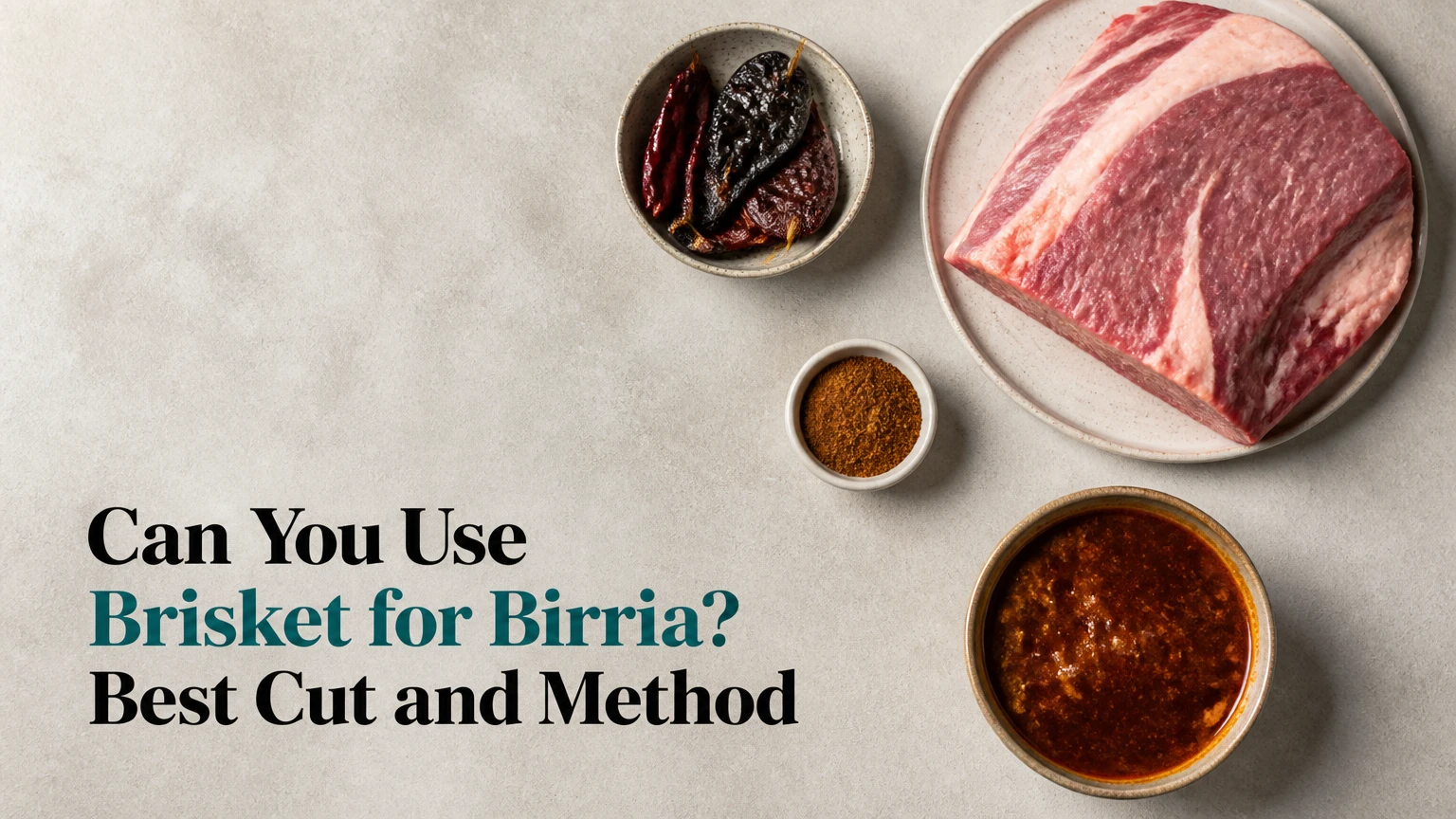
Yes, you can use brisket for birria, and brisket produces tender shredded beef with a rich consommé when braised gently until fully tender. Brisket point or a whole packer usually gives better results than a very lean flat, while adding beef shank supplies the marrow and gelatin that brisket alone lacks.
Key Facts at a Glance
- Brisket works well in birria because its connective tissue breaks down during a long, moist braise.
- The brisket point is more forgiving than the flat because it contains more internal fat.
- A typical brisket birria braise takes 4-5 hours in a 300°F oven or 8-10 hours in a slow cooker.
- Beef brisket commonly loses about 30-40% of its raw weight through rendering and moisture loss.
- Meat is usually ready to shred around 203-208°F, but probe tenderness is a better test than temperature alone.
- Brisket gives high meat yield; beef shank, neck, and oxtail give more bone-derived body and marrow flavor.
Is Brisket Good for Birria?
Brisket is good for birria when the cut is cooked low and slow in a chile-based braising liquid. The breast muscle contains collagen-rich connective tissue because it supports much of the cow’s body weight; extended moist heat converts that collagen into gelatin, softening the meat and thickening the consommé.
Brisket also brings more rendered fat than many lean stew cuts. That fat carries chile and spice aromas, creates the red-orange grasa used to fry tortillas, and keeps shredded meat succulent when the cooking liquid is properly balanced.
The trade-off is structural. Brisket has no large marrow bones, so brisket-only birria can taste beefy and rich without the mineral depth associated with shank, neck, or oxtail. For tacos, brisket’s high edible yield is a major advantage. For a broth-first birria, a mixed batch is usually stronger.
Why Does Brisket Become Tender?
Brisket becomes tender when collagen dissolves into gelatin during sustained heat and moisture exposure. The transformation takes time because brisket muscle fibers can feel firm at temperatures that are already safe to eat, yet still lack the soft texture required for shredding.
The USDA states that whole cuts of beef should reach a minimum internal temperature of 145°F with a three-minute rest for safety. That safety threshold does not indicate birria tenderness. A brisket piece may be safe at 145°F but still require several more hours before its connective tissue softens.
A practical tenderness range is 203-208°F, measured in the thickest piece. Treat that figure as a starting point, not a finish line. A probe or fork should enter with little resistance, and the meat should separate easily when pressed.
Which Brisket Cut Is Best?
The brisket point is the best single brisket cut for birria because its heavier marbling protects the meat during a long braise. A whole packer is the best choice for large batches, while the flat works when trimmed carefully and surrounded by enough liquid and fat.
| Brisket option | Typical raw weight | Fat level | Best use | Main risk |
|---|---|---|---|---|
| Point | 3-6 lb | High, often 20-30% visible fat | Juicy tacos and quesabirria | Greasy consommé |
| Flat | 4-8 lb | Moderate, often 10-20% visible fat | Leaner servings and uniform shreds | Dry edges |
| Whole packer | 10-16 lb | Mixed point and flat | Large gatherings and batch cooking | Uneven doneness |
| Brisket trimmings | 1-4 lb | Very high, often over 30% fat | Adding flavor to lean beef | Low usable meat yield |
Brisket Point
Choose brisket point when tenderness and moisture matter more than uniform slices. The point contains shorter, more irregular muscle fibers and more intramuscular fat, so it generally shreds easily after braising.
Trim away hard, waxy exterior fat and leave roughly 1/4 inch of softer fat where practical. Cut the point into 2.5-3 inch pieces. Smaller pieces cook faster, but pieces under 2 inches can lose texture and become difficult to separate cleanly from the rendered fat.
Brisket Flat
Choose brisket flat when you want less fat in the finished meat or already have a rich consommé base. The flat has a more consistent shape, but its lower marbling makes it less tolerant of an uncovered pot, insufficient liquid, or an aggressive boil.
Keep the flat in larger 3 inch pieces and avoid cutting away every visible fat seam. If using only flat, add 1-2 pounds of beef shank or another collagen-rich cut for each 4 pounds of brisket when broth texture matters.
Whole Packer Brisket
A whole packer combines the leaner flat and fattier point, making it practical for parties. Separate the two muscles if necessary, remove thick hard fat, and cut each section into similarly sized chunks so the lean flat does not overcook while the point finishes.
A whole packer is often too large for a standard 6-quart cooker. A 10-12 pound raw brisket may need to be divided between batches or reduced to the quantity that fits below the cooker’s maximum fill line.
How Much Brisket Do You Need?
Plan on 8 ounces of raw brisket per adult for tacos, or 10-12 ounces when birria is the main dish with few side dishes. Because brisket typically loses 30-40% of its raw weight, 4 pounds of raw meat usually provides approximately 2.4-2.8 pounds of cooked meat.
| Raw brisket | Typical cooked yield | Taco portions at 4 oz | Taco portions at 3 oz |
|---|---|---|---|
| 2 lb | 1.2-1.4 lb | 4-5 | 6-7 |
| 4 lb | 2.4-2.8 lb | 9-11 | 12-14 |
| 6 lb | 3.6-4.2 lb | 14-16 | 19-22 |
| 10 lb | 6-7 lb | 24-28 | 32-37 |
These figures are typical planning ranges, not fixed yields. A heavily trimmed flat loses less fat but may lose more moisture, while a fatty point can produce a smaller meat yield after rendering. Weigh the shredded meat after cooking if you need precise catering portions.
For a four-pound batch, use approximately 4 pounds brisket, 2 dried guajillo chiles, 2 dried ancho chiles, 1-3 dried arbol chiles, 2 medium tomatoes, 1 medium onion, 6 garlic cloves, 2 tablespoons vinegar, 1 teaspoon cumin, 1 teaspoon Mexican oregano, 2 cloves, 1/2 teaspoon allspice, 1 small cinnamon piece, and 4-5 cups unsalted beef stock.
Brisket Versus Traditional Birria Cuts
Brisket replaces traditional beef cuts successfully, but it does not reproduce every flavor or texture characteristic. Shank, neck, and oxtail contain more bone, marrow, and cartilage, whereas brisket gives more boneless meat per pound.
| Cut | Cooked meat yield | Gelatin contribution | Marrow flavor | Typical raw price range |
|---|---|---|---|---|
| Brisket point | 60-70% | Medium-high | Low | $5-$9 per lb |
| Brisket flat | 60-75% | Medium | Low | $7-$12 per lb |
| Beef shank | 45-60% | High | Medium-high | $6-$10 per lb |
| Beef neck | 45-60% | High | Medium | $5-$9 per lb |
| Oxtail | 35-50% | High | High | $9-$16 per lb |
Prices are typical United States retail ranges and vary by region, trimming, grade, and season. Brisket can be economical when the goal is a high volume of shredded meat, but oxtail may cost more while yielding fewer tacos.
Should You Mix Brisket With Beef Shank?
Mix brisket with beef shank when you want both abundant shredded meat and a thicker, more marrow-rich consommé. A useful starting ratio is 70% brisket to 30% bone-in shank by raw weight, such as 3 pounds brisket with 1.25 pounds shank.
The ratio is flexible. Use more shank for a broth-centered serving, or use brisket alone when taco filling and meat yield matter most. Remove the shank bones after braising, then pick the meat from the connective tissue and return the edible pieces to the main batch.
How Do You Make Brisket Birria?
Make brisket birria by searing seasoned chunks, blending a strained dried-chile adobo, and braising the meat covered until a probe slides into the center easily. A four-pound batch typically takes 4-5 hours in a 300°F oven, plus about 30 minutes for preparation and resting.
Before You Start
| Item | Typical requirement |
|---|---|
| Main meat | 4 lb brisket, preferably point or mixed point and flat |
| Cooking vessel | 6-8 quart Dutch oven with tight lid |
| Total active time | 45-60 minutes |
| Total oven time | 4-5 hours at 300°F |
| Broth | 4-5 cups unsalted beef stock |
| Dried chiles | 2 guajillo, 2 ancho, 1-3 arbol |
| Fat for searing | 1-2 tablespoons neutral oil or rendered beef fat |
| Target texture | Fork tender at approximately 203-208°F |
Step 1: Trim and Cut the Brisket
Remove silver skin and hard exterior fat, leaving about 1/4 inch of soft fat where possible. Cut the brisket into 2.5-3 inch chunks, then season all sides with approximately 1 tablespoon kosher salt and 1 teaspoon black pepper per 4 pounds of meat.
Large pieces retain moisture better than small cubes. The pieces should be large enough to shred after cooking but small enough to become surrounded by adobo.
You will know this step worked when the chunks have exposed muscle on several sides and no thick, rubbery fat plates remain. A common mistake is trimming the brisket completely lean, which reduces both flavor and the rendered grasa available for tortillas.
Step 2: Sear the Brisket
Heat 1-2 tablespoons oil or beef fat in the Dutch oven over medium-high heat. Sear the brisket in batches for 2-3 minutes per broad side, then transfer the browned pieces to a plate.
Do not crowd the pot. Overcrowding lowers the surface temperature and causes the meat to steam instead of developing browned fond. The browned bits left on the bottom dissolve into the adobo and add roasted beef flavor.
The sear is complete when each major surface has a dark brown crust rather than pale gray patches. Avoid blackening the fond because burned residue can make the consommé bitter.
Step 3: Build and Strain the Adobo
Remove stems and most seeds from the dried chiles. Toast the guajillo, ancho, and arbol chiles in a dry skillet for about 15-30 seconds per side, then soak them in just-boiled water for 15-20 minutes.
Blend the softened chiles with tomatoes, onion, garlic, vinegar, cumin, Mexican oregano, cloves, allspice, cinnamon, and 1-2 cups soaking liquid. Strain the mixture through a fine sieve before adding it to the pot.
Dried chiles burn quickly, so the color should deepen without turning black. The finished puree should be smooth enough to coat a spoon. A coarse, unstrained adobo leaves tough chile skin fragments in the consommé and can make the broth feel gritty.
Step 4: Braise the Brisket
Return the seared brisket to the pot and pour in the strained adobo. Add 4-5 cups beef stock, stopping when the liquid reaches roughly three-quarters of the meat’s height rather than automatically drowning every piece.
Bring the liquid just to a simmer, cover the pot, and place it in a 300°F oven for 4-5 hours. Check after 3.5 hours, then continue cooking until the thickest piece reaches approximately 203-208°F and a fork enters with little resistance.
A vigorous boil is a mistake because high agitation can tighten the outer muscle fibers while the interior remains firm. Gentle bubbling should occur around the edges, with no rolling boil across the surface.
Step 5: Rest, Shred, and Adjust
Remove the brisket when tender and rest it for 15-20 minutes. Shred the meat with forks or gloved hands, discarding large pieces of rendered fat and any tough connective tissue that has not softened.
Strain the braising liquid again if necessary. Skim some of the red fat from the surface and reserve it for frying tortillas, but keep enough fat to preserve the birria’s characteristic aroma and mouthfeel.
The meat is ready when it separates into moist strands without needing a knife. If it crumbles into dry threads, the batch likely cooked uncovered, used an overly lean flat, or stayed at an aggressive temperature.
Which Cooking Method Fits Your Schedule?
The oven gives the most even heat for brisket birria, while a pressure cooker reduces the clock time but needs a full natural release. Slow cookers work well for convenience, and stovetop braising requires the closest monitoring.
| Method | Typical meat quantity | Cooking time | Liquid level | Best control |
|---|---|---|---|---|
| Dutch oven, oven | 3-6 lb | 4-5 hours at 300°F | Three-quarters height | Even heat |
| Stovetop pot | 3-5 lb | 3.5-4.5 hours | Half to three-quarters height | Fast adjustment |
| Slow cooker | 2-5 lb | 8-10 hours on low | Half height | Hands-off cooking |
| Pressure cooker | 2-4 lb | 70-80 minutes high pressure | 1.5-2 cups minimum | Fastest method |
Pressure Cooker Variation
For an electric pressure cooker, cut brisket into 2-3 inch pieces and use at least the manufacturer’s minimum liquid requirement, usually 1.5-2 cups. Cook at high pressure for 70 minutes, then allow a full natural release before opening the lid.
A quick release can force hot liquid through the meat fibers and leave the exterior less succulent. If the brisket does not shred easily, reseal the cooker and add 10-15 minutes under pressure rather than serving it prematurely.
Slow Cooker Variation
Use the slow cooker on low for 8-10 hours, with the adobo and stock reaching approximately halfway up the meat. Sear the brisket first in a separate pan because most slow cookers cannot generate enough heat for a strong crust.
Slow cookers vary widely. Begin checking at eight hours, and continue until the meat passes the fork test. Holding brisket on low for several extra hours after it is tender can cause the flat to dry even when liquid remains.
How Do You Use the Consommé and Grasa?
Use the consommé as a dipping broth or bowl of soup, and use the orange-red grasa to coat tortillas before frying. Separate excess fat only after the liquid has rested briefly, because the fat naturally rises and becomes easier to collect.
For quesabirria, dip one side of each corn tortilla into the reserved grasa, place that side on a hot skillet, add Oaxaca cheese or another melting cheese, then add shredded brisket and fold. Cook until the tortilla is crisp and the cheese melts.
For a bowl, dilute an overly concentrated consommé with hot unsalted stock. Correct a thin broth by simmering it uncovered after removing the meat, but skim excess fat first so reduction does not intensify greasiness.
How Do You Control Excess Fat?
Control brisket fat by removing hard exterior fat before cooking, chilling the broth after cooking, and skimming only the amount that exceeds your preferred richness. Refrigeration solidifies the fat into a removable layer within several hours.
| Fat condition | Likely cause | Best correction |
|---|---|---|
| Thin orange sheen | Normal brisket rendering | Keep for tortilla frying |
| Thick surface layer | Fatty point or trimmings | Skim and reserve separately |
| Greasy mouthfeel | Too much rendered fat in broth | Chill, lift fat, reheat |
| Flat flavor after skimming | Nearly all grasa removed | Stir back 1-2 tablespoons |
The red fat is useful, but more is not automatically better. A consommé should taste beefy, chile-forward, and savory rather than coating the palate with plain fat.
What Mistakes Make Brisket Birria Tough?
The most common causes of tough brisket birria are insufficient cooking time, an aggressive boil, undersized pieces, and a lean flat cooked without enough moisture. Toughness usually means the collagen has not finished dissolving, not that the brisket is ruined.
Use these recovery steps:
- Meat resists shredding: Cover the pot and braise for another 30-45 minutes, then test again.
- Flat feels dry: Return it to hot consommé, cover tightly, and heat gently for 20-30 minutes.
- Broth tastes bitter: Burned chiles are the usual cause; dilute with unsalted stock and add a small amount of vinegar.
- Consommé is gritty: Strain it through a fine sieve, then reheat gently.
- Broth is too salty: Add unsalted stock or water, then restore chile and acid balance.
- Meat is greasy: Chill the broth, remove the hardened fat, and add back only what the tacos need.
Never compensate for undercooked brisket by raising the heat sharply. More time at a gentle simmer fixes collagen; a hard boil can damage the outer texture before the center becomes tender.
Can You Make Brisket Birria Ahead?
Brisket birria improves after an overnight rest because the meat absorbs seasoned liquid and the fat becomes easy to remove. Cool the meat and consommé in shallow containers, refrigerate them promptly, and reheat the broth and meat separately.
The USDA recommends refrigerating perishable leftovers within two hours, or within one hour when the surrounding temperature exceeds 90°F. Reheat leftovers to 165°F, using a thermometer for the broth and meat rather than relying on steam alone.
Store cooked birria for 3-4 days in a refrigerator at 40°F or below. Freeze the shredded meat with enough consommé to cover it, and use airtight containers for up to 2-3 months for best quality.
When Is Brisket the Wrong Choice?
Brisket is the wrong choice when you want a very lean birria, a bone-dominant consommé, or a quick meal without pressure cooking. A brisket flat can also disappoint when the batch is cooked uncovered or when the meat is cut into small pieces before braising.
Choose beef shank or neck when broth body and collagen matter more than meat yield. Choose oxtail when marrow flavor and gelatin are the priority. Choose chuck roast when brisket is unavailable and you want a smaller, more forgiving boneless braise.
Brisket is especially suitable for quesabirria, meal prep, and large gatherings. It produces clean shreds that distribute evenly across tortillas, while bone-in cuts often produce a more complex broth but require more picking and portion planning.
Frequently Asked Questions
Can You Use Smoked Brisket for Birria?
You can use already smoked brisket for birria, but the texture and flavor differ from raw-braised brisket. Add sliced or cubed smoked brisket to the adobo during the final 45-90 minutes, using enough consommé to rehydrate the meat without washing away its smoke character.
Can You Use Corned Brisket for Birria?
Corned brisket is a poor choice for traditional-tasting birria because curing salt and its seasoning blend can dominate the chile adobo. If you use it, rinse it thoroughly, avoid adding extra salt, and expect a distinctly cured flavor rather than a neutral beef profile.
Does Brisket Birria Need Beef Bones?
Brisket birria does not require beef bones, but bones improve consommé body and marrow depth. Add 1-2 pounds of bone-in shank for every 4-5 pounds of brisket when you want a fuller broth without reducing the amount of shredded meat.
Can You Use Brisket Trimmings in Birria?
Brisket trimmings can flavor birria, but they should not replace the main meat because their fat content is too high. Add up to 1 pound of trimmings to a 4-pound meat batch, then chill and skim the broth before serving.
What Should You Serve With Brisket Birria?
Serve brisket birria with corn tortillas, diced white onion, chopped cilantro, lime, and the strained consommé. For quesabirria, add a melting cheese and fry the tortillas in a measured amount of reserved grasa rather than pouring all surface fat into the pan.
The Bottom Line
Can you use brisket for birria? Yes. Choose brisket point or a whole packer for the juiciest shredded beef, leave a modest fat layer, braise covered at a gentle temperature, and cook until the meat is genuinely probe-tender around 203-208°F. Add beef shank when a deeper, gelatin-rich consommé matters more than maximum meat yield.