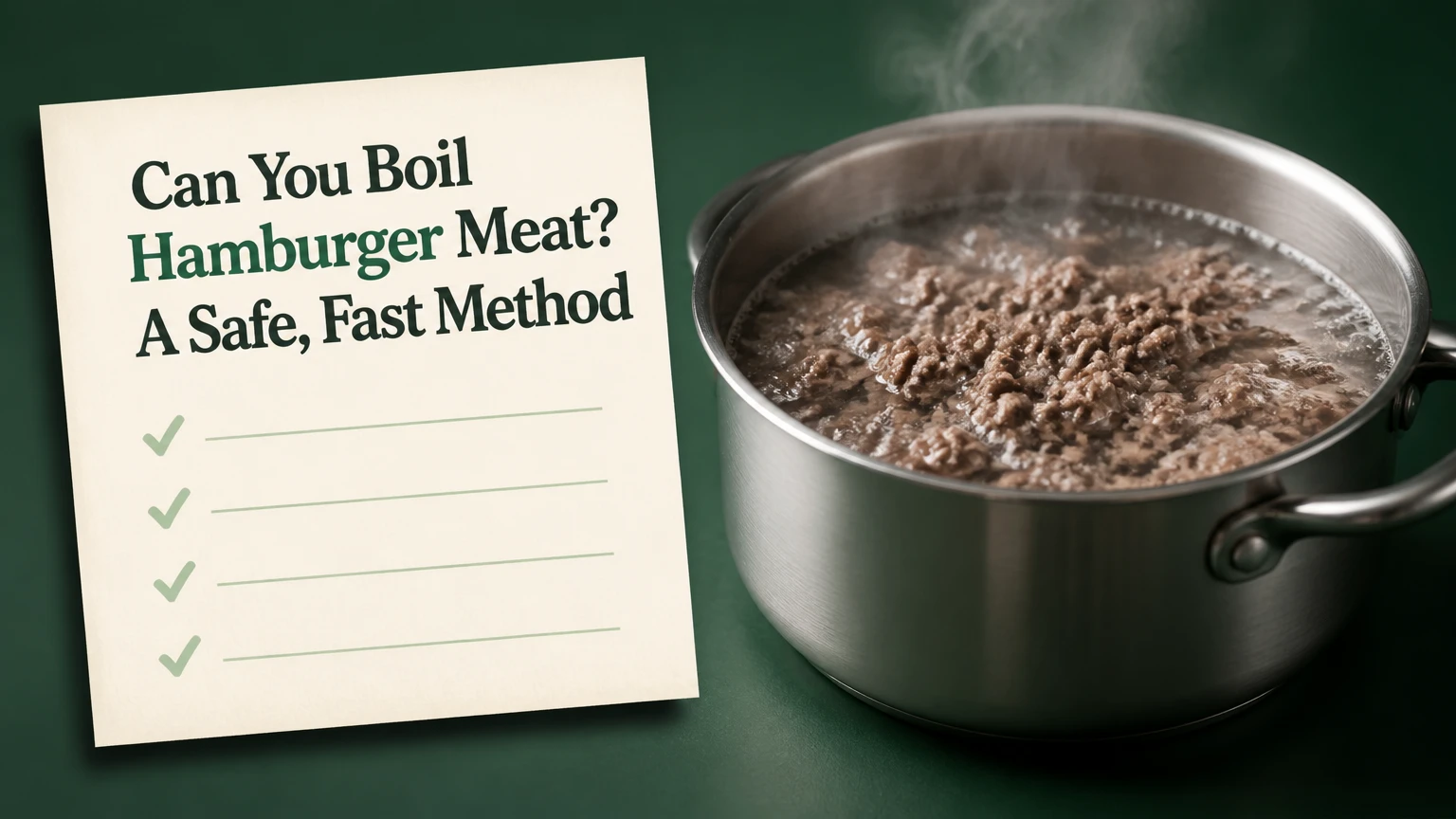
Yes, you can boil hamburger meat, although a gentle simmer usually produces better results than a hard boil. Break the raw ground beef into small crumbles in water, broth, or sauce, cook until the center reaches 160°F (71°C), then drain it thoroughly. Boiled ground beef is soft and leaner, but it will not develop the browned flavor of pan-fried beef.
Key Facts at a Glance
- Ground beef is safe when the thickest pieces reach 160°F (71°C), according to USDA Food Safety and Inspection Service guidance.
- One pound of ground beef usually needs 1-2 cups of liquid in a deep skillet or saucepan.
- Fresh crumbled beef commonly cooks in 8-12 minutes from cold liquid, while the active simmer may last about 5-8 minutes.
- A gentle simmer creates finer, softer crumbles; a violent boil can make lean beef firmer and more fragmented.
- Water removes some rendered fat, but the amount varies with the beef’s fat percentage, particle size, and draining time.
- Boiling is practical for soups, pet-food portions approved by a veterinarian, casseroles, and meal prep, not for crisp burger patties.
What Does Boiling Hamburger Meat Mean?
Boiling hamburger meat means cooking loose ground beef in a water-based liquid rather than directly against a hot, greased pan. In everyday cooking, the more controlled technique is poaching or simmering, because the liquid stays near 185-205°F instead of churning continuously at its boiling point.
The method produces gray or brown-gray crumbles with a uniform, tender-to-soft texture. Water transfers heat efficiently around each piece, while the liquid carries away some melted fat and soluble flavor compounds. The result works particularly well when the beef will be mixed into chili, soup, pasta sauce, rice, or a casserole.
Boiled ground beef is not the same as a boiled burger patty. A patty can cook through in liquid, but its exterior will remain soft and its shape may break apart. For a recognizable hamburger with a browned crust, use a skillet, grill, or oven instead.
Is Boiling Ground Beef Safe?
Boiling ground beef is safe when the meat reaches 160°F (71°C) throughout, measured with a food thermometer. The USDA Food Safety and Inspection Service identifies 160°F as the safe minimum internal temperature for ground beef because grinding can distribute surface bacteria through the batch.
Color is an unreliable endpoint. Fully cooked beef can retain a little pink color, while overcooked beef can look gray before every part has reached the same temperature. Check several crumbles, especially when cooking a dense frozen block or a large batch.
How Do You Boil Hamburger Meat?
To boil hamburger meat, combine one pound of raw ground beef with 1-2 cups of water or broth, break the meat apart as it heats, maintain a gentle simmer, and cook until the center reaches 160°F. Drain the beef through a heat-safe strainer, then season or add sauce while the crumbles remain warm.
Before You Start
| Item | Typical amount or setting | Practical specification |
|---|---|---|
| Ground beef | 1 lb, 454 g | 80/20 for flavor, 90/10 or 93/7 for less grease |
| Cooking liquid | 1-2 cups | Use 2 cups for a deep pot or frozen block |
| Pan | 10-12 inch skillet | Use a 3-quart saucepan for larger liquid volume |
| Cooking time | 8-12 minutes fresh | Use a thermometer, not time alone |
| Equipment | 1 spoon, 1 thermometer, 1 strainer | Use a potato masher for very fine crumbles |
| Typical cost | About $4-$9 per pound | Varies by region, package size, and fat ratio |
Step 1: Heat the Liquid
Pour 1-2 cups of water, unsalted broth, or sauce into a deep skillet. Heat it over medium-high until it reaches a boil, then reduce the burner slightly before adding the beef so the liquid remains hot without excessive splashing.
You will know the liquid is ready when steady bubbles rise across the surface. The common mistake is using a shallow pan with too little liquid, which leaves the top of the meat exposed and encourages uneven cooking.
Step 2: Add and Break Up the Beef
Place the raw ground beef into the hot liquid and immediately divide it with a wooden spoon, stiff spatula, potato masher, or heat-safe whisk. Work from the outside toward the center for 30-60 seconds, creating crumbles no larger than a walnut.
Small pieces cook more evenly and release fat more consistently than a single compact mass. You will know this step worked when no large cold core remains and the liquid can circulate between separate pieces. The common mistake is leaving the meat untouched for several minutes, which creates dense chunks that require longer cooking.
Step 3: Simmer Until 160°F
Reduce the heat to medium-low and maintain a gentle simmer for about 5-8 minutes after the beef is broken apart. Stir every minute, and insert an instant-read thermometer into several of the largest crumbles, avoiding contact with the pan.
USDA FSIS guidance specifies 160°F for ground beef. Cooking time changes with the meat’s starting temperature, crumble size, liquid volume, and batch depth, so a thermometer is more reliable than a fixed three-minute rule.
You will know the step is complete when multiple pieces reach 160°F and no raw, cool center remains. The common mistake is treating “no pink” as the only safety test or leaving the beef boiling long after it has reached the target temperature.
Step 4: Drain Without Damaging the Plumbing
Set a fine-mesh strainer over a heat-safe bowl and pour the beef and liquid through it. Press gently with a spoon if you want a drier filling, but avoid rinsing unless a specific medical or veterinary plan requires it because rinsing removes additional flavor.
Never pour grease or fatty cooking liquid down a sink. Let the collected liquid cool, refrigerate it if necessary, lift the solidified fat into the trash, and discard the remaining liquid according to local waste rules. You will know the beef is ready for use when it is drained but still moist enough to accept seasoning.
Step 5: Season and Use Immediately
Season the warm crumbles after draining with salt, black pepper, onion powder, paprika, cumin, or a prepared sauce suited to the dish. Warm meat absorbs dry seasoning more readily than chilled meat, but salt added after cooking cannot penetrate as deeply as salt added to the liquid.
For tacos, add salsa or taco sauce. For pasta, stir the beef into marinara. For soup, return the drained crumbles to the broth. Boiling is a texture-producing method, so a strong finishing sauce supplies the browning-related flavor that the liquid cannot create.
Which Liquid Should You Use?
Broth is the best general choice when boiled ground beef will be served as a filling, while plain water is appropriate when you need a neutral or low-seasoning result. Thin sauce can combine cooking and seasoning, but thick sauce may scorch before the meat cooks evenly.
| Liquid | Amount per 1 lb beef | Flavor result | Best application |
|---|---|---|---|
| Water | 1-2 cups | Neutral, mild | Pet portions approved by a veterinarian or bland meals |
| Low-sodium beef broth | 1-2 cups | Savory, beef-forward | Chili, rice bowls, casseroles |
| Chicken or vegetable broth | 1-2 cups | Mild, adaptable | Soup, pasta, mixed vegetables |
| Thin tomato sauce | 2 cups | Tomato-seasoned | Pasta sauce, stuffed peppers |
| Water with seasonings | 1-2 cups | Lightly seasoned | Meal prep when sodium must be controlled |
Plain water does not “seal in” juices, and broth does not guarantee deep flavor. Liquid enters the spaces between crumbles, while the absence of browning still limits roasted and toasted notes.
How Does Boiling Change Texture and Flavor?
Boiling ground beef creates soft, evenly cooked crumbles because liquid surrounds the meat and prevents direct high-heat crust formation. Pan-frying reaches temperatures high enough for browning on dry surfaces, while simmering liquid remains near the water boiling point and limits the Maillard reaction.
| Cooking method | Typical active time | Texture | Flavor development | Best use |
|---|---|---|---|---|
| Simmer in water | 5-8 minutes | Soft, fine crumbles | Mild, little browning | Soup, bland meals |
| Simmer in broth | 5-8 minutes | Soft, moist crumbles | Savory but not browned | Chili, casserole |
| Pan-fry crumbles | 8-12 minutes | Firm, varied pieces | Browned, roasted notes | Tacos, burgers, fillings |
| Poach in thin sauce | 10-15 minutes | Soft, sauce-coated | Integrated tomato or curry flavor | Pasta, saucy dishes |
The trade-off is direct. Boiling improves uniformity and reduces stovetop splatter, but it cannot reproduce the crust of beef cooked on a hot metal surface. Ground chuck with substantial fat loses some of the qualities that make it attractive when the cooking liquid and grease are discarded.
Does Boiling Make Ground Beef Healthier?
Boiling can lower the fat remaining in a serving when rendered fat separates and the cooking liquid is discarded, but no universal 30-50% reduction should be promised. The result depends on whether the beef is 73/27, 80/20, 90/10, or 93/7, how finely it is crumbled, and how thoroughly it drains.
| Beef label | Raw fat ratio | Expected grease handling | Practical choice |
|---|---|---|---|
| 73/27 | 27% fat | Highest visible fat and liquid | Use when cost and richness matter |
| 80/20 | 20% fat | Moderate to high grease | Good for chili or sauce |
| 85/15 | 15% fat | Moderate grease | Balanced for general cooking |
| 90/10 | 10% fat | Lower visible grease | Meal prep and lean fillings |
| 93/7 | 7% fat | Low grease, can dry faster | Low-fat meals and small portions |
Boiling does not turn ground beef into a low-calorie food automatically. Lean meat may lose little fat, and the cooking liquid can retain water-soluble nutrients and flavor compounds. If nutrition is the goal, compare the final drained serving with the package nutrition label and control the portion.
Nutrition research commonly finds that heat and water can reduce some water-soluble nutrients, including certain B vitamins, but the amount varies with cooking time and whether the liquid is consumed. If the beef cooks in soup, discarding the liquid removes nutrients that would otherwise remain in the meal.
Can You Boil Frozen Ground Beef?
You can boil frozen ground beef, but the safest and most even approach is to soften the exterior in hot liquid, scrape away cooked layers, and continue until the entire batch reaches 160°F. A frozen block should not be judged by a short three-to-five-minute timing estimate.
Place the frozen beef in 2 cups of simmering liquid in a deep saucepan. After 3-5 minutes, use tongs or a spoon to remove softened portions from the outside, break them apart, and return them to the pan. Continue scraping and stirring until no solid center remains.
| Starting condition | Typical total time | Required check |
|---|---|---|
| Fresh, already crumbled | 8-12 minutes | Several pieces at 160°F |
| Fresh, compact 1 lb block | 12-18 minutes | Break apart as the exterior softens |
| Frozen 1 lb block | 18-30 minutes | Check the former center carefully |
| Frozen 2 lb block | 25-40 minutes | Use a deep pan and test multiple locations |
Timing is a planning range, not a safety guarantee. A thick block can remain cold inside while the outer meat becomes overcooked, which is why thawing in the refrigerator produces a more consistent result when you have time.
Is Boiling Better Than Pan-Frying?
Boiling is better for soft, uniform, lower-grease crumbles and minimal splatter; pan-frying is better for browned flavor, firmer texture, and dishes where beef is the main attraction. Neither method is universally superior because the desired final texture determines the correct choice.
| Decision factor | Boiling or simmering | Pan-frying |
|---|---|---|
| Fresh beef time | 8-12 minutes | 8-12 minutes |
| Liquid required | 1-2 cups per pound | None, or 1 teaspoon oil |
| Browning | Minimal to none | Strong when pan is hot and uncrowded |
| Cleanup | Strainer and pot | Greasy skillet and spatula |
| Final texture | Soft, fine crumbles | Firm, browned crumbles |
| Grease control | Drain liquid and fat | Drain rendered fat separately |
| Best dish | Soup, casserole, bland filling | Tacos, burgers, browned sauces |
A useful practitioner rule is to choose boiling when the beef is a supporting ingredient and pan-frying when the beef supplies the main savory identity. Combining methods is also effective: simmer the beef until safe, drain it, then briefly brown the crumbles in a hot skillet before adding sauce.
When Should You Avoid Boiling Hamburger Meat?
Avoid boiling hamburger meat when you need a crisp crust, concentrated beef flavor, or a shaped patty that holds together. Boiling also wastes the flavor advantage of expensive, highly marbled beef because much of its rendered fat enters the discarded liquid.
Boiling is also a poor choice for very large batches in a small pan. Crowding lowers the liquid temperature, extends the cooking time, and produces a mixture of overcooked outer crumbles and underheated center pieces. For more than 2 pounds, use a large pot or cook in separate batches.
Can Dogs Eat Boiled Hamburger?
Dogs can sometimes eat fully cooked, plain ground beef, but a veterinarian should determine whether it fits the animal’s age, condition, calorie needs, and complete-diet requirements. Never add onion, garlic, heavy salt, or seasoning blends, and cool the meat before serving.
Plain boiled beef is not a nutritionally complete long-term diet for dogs or cats. A bland serving may be appropriate in a short-term feeding plan only when a veterinary professional recommends it. Remove excess grease, keep portions small, and stop feeding if vomiting, diarrhea, lethargy, or other symptoms worsen.
How Do You Fix Bland, Rubbery, or Gray Beef?
Bland boiled beef needs concentrated seasoning or sauce, while rubbery beef usually needs less cooking time and a gentler simmer during the next batch. Gray color is normal because the meat did not develop a browned surface, not evidence that the beef is spoiled.
| Problem | Likely cause | Immediate recovery | Next-batch correction |
|---|---|---|---|
| Bland flavor | Water carried away soluble flavor | Add broth concentrate, sauce, or spices | Use low-sodium broth |
| Rubbery chunks | Large pieces or vigorous boiling | Chop and mix into sauce | Break apart during the first minute |
| Dry crumbles | Lean beef or prolonged cooking | Add 2-4 tablespoons sauce | Stop at 160°F |
| Gray appearance | No Maillard browning | Add tomato or chile sauce | Brown drained beef briefly |
| Greasy result | High-fat beef or incomplete draining | Refrigerate and remove surface fat | Use 90/10 or drain longer |
Do not keep boiling to change gray color. Heat cannot create browning while the meat surface remains wet. Drain the beef, dry it briefly, and finish it in a hot skillet if appearance and flavor matter.
How Should You Cool, Store, and Reheat It?
Refrigerate cooked ground beef within two hours, or within one hour when the surrounding temperature exceeds 90°F, and use a shallow container so the center cools quickly. Keep the refrigerator at 40°F or below and use the beef within 3-4 days, consistent with USDA food-safety guidance.
| Storage format | Container | Typical refrigerator time | Reheating method |
|---|---|---|---|
| Drained crumbles | Shallow sealed container | 3-4 days | Skillet with 1-2 tablespoons liquid |
| Beef in sauce | Covered glass or plastic container | 3-4 days | Saucepan over medium-low |
| Frozen portions | Airtight freezer bag | 2-3 months for quality | Thaw overnight, then heat |
| Meal-prep bowl | Separate beef and grains | 3-4 days | Microwave until steaming hot |
Reheat only the portion you plan to eat. Add a spoonful of broth or sauce to prevent dry crumbles, and stir halfway through microwave heating so cold pockets do not remain.
What Are the Main Expert Rules?
Three rules prevent most failures: use a thermometer, control the simmer, and decide whether the dish needs browning before choosing the method. Boiling is reliable when the final dish supplies moisture and seasoning, but it is a poor substitute for browning.
- Do not use time as the only safety test. The same one-pound package can require different times when frozen, compacted, or divided into small crumbles.
- Do not equate drained grease with a fixed health result. The starting fat ratio and the amount retained in the meat determine the final serving.
- Do not season only the water and expect restaurant-level flavor. Add a concentrated finishing ingredient after draining because much of the cooking liquid will be discarded.
- Use the cooking liquid when the dish allows it. Returning the broth to soup preserves flavor and some dissolved nutrients.
- Choose a wide pan for fresh beef and a deep saucepan for frozen beef. Pan geometry affects circulation, splashing, and the speed at which the center warms.
Frequently Asked Questions
Can you boil hamburger meat before frying it?
Yes, but the two-stage method is usually unnecessary for fresh ground beef. Simmering first cooks the meat and removes some grease, while a final skillet step can restore browning. Use it when you need very fine, fully cooked crumbles with less surface splatter, not when you want a juicy burger patty.
How much water do you need to boil one pound of ground beef?
Use 1-2 cups of water for one pound of ground beef in a deep skillet. Choose closer to 2 cups for a compact or frozen block, because additional liquid improves circulation while the meat separates. Drain the excess after the crumbles reach 160°F.
Can you boil hamburger meat in tomato sauce?
Yes, ground beef can simmer directly in thin tomato sauce. Use about 2 cups of sauce per pound, stir frequently, and keep the heat low enough to prevent scorching. The sauce seasons the beef and hides its gray color, but it will not create the roasted flavor of browned meat.
Why does boiled ground beef turn gray?
Boiled ground beef turns gray because its wet surface stays near the liquid’s cooking temperature and does not develop the dry, high-heat browning associated with the Maillard reaction. Gray cooked beef is normal when the meat reaches 160°F and has been handled safely.
Is boiled hamburger meat good for tacos?
Boiled hamburger meat is usable for tacos, but pan-fried beef generally tastes better because browning adds deeper savory notes. If you boil it, drain thoroughly, add a concentrated taco seasoning mixture and salsa, or brown the drained crumbles for 2-4 minutes before assembling the tacos.
Should you rinse boiled ground beef?
Usually, no. Rinsing removes some grease, seasoning, and flavor, while draining through a strainer already removes most free liquid. Rinsing may be appropriate only under a specific medical or veterinary instruction, and the meat should still be handled, cooled, and stored safely.
The Bottom Line
Can you boil hamburger meat? Yes. Simmer fresh ground beef in 1-2 cups of water, broth, or thin sauce, break it into small crumbles, and cook until several pieces reach 160°F. Drain grease into a heat-safe container rather than the sink. Choose boiling for soft, uniform, low-mess fillings, and choose pan-frying when browned flavor and firm texture matter.