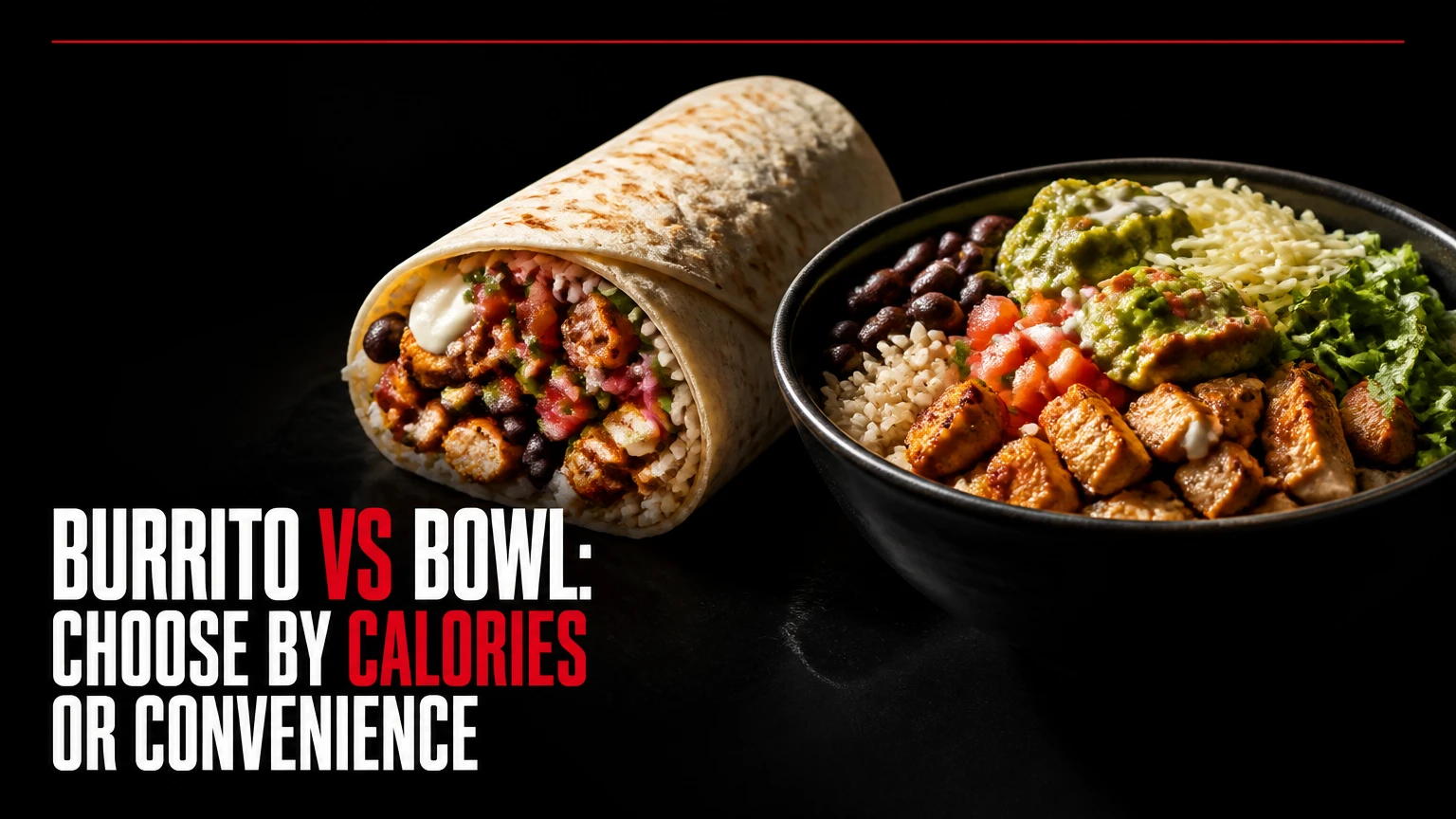
A burrito wraps rice, beans, protein, cheese, and toppings inside a flour tortilla, while a burrito bowl serves comparable ingredients openly over rice, greens, or beans. Choose a burrito for portability and compressed bites; choose a bowl for easier portion control, cleaner storage, and flexible low-carbohydrate customization.
Key Facts at a Glance
- A large 10- to 12-inch flour tortilla typically contributes about 220-320 calories and 35-50 grams of carbohydrate.
- A bowl is not automatically lower in calories because extra rice, cheese, guacamole, or creamy toppings can replace the tortilla.
- A burrito usually takes 45 seconds to 2 minutes to assemble in a fast-casual service line.
- A bowl generally travels better for meal prep because ingredients remain accessible and can be stored in separate layers.
- A burrito is the better choice for eating while walking, commuting, or avoiding utensils.
- A bowl with a tortilla served separately can combine portion flexibility with a hand-held option.
What Is the Difference Between a Burrito and a Bowl?
A burrito is an enclosed cylindrical meal made with a flour tortilla, while a burrito bowl is an open, deconstructed version served in a container. Both formats commonly include a grain or vegetable base, beans, a protein, salsa, cheese, guacamole, and other toppings.
The distinction is structural rather than purely ingredient-based. A burrito compresses the ingredients into a sequence of bites, and the tortilla adds starch, fat, elasticity, and chew. A bowl separates the components, so diners can mix them, remove ingredients, or eat different proportions in each forkful.
Traditional Mexican burritos vary by region and may contain fewer ingredients than the heavily customized versions sold by many fast-casual chains. The large, fully loaded format associated with chain restaurants is mainly a Mexican-American and Tex-Mex development, so calling every bowl a direct traditional equivalent oversimplifies the food’s history.
| Attribute | Burrito | Burrito bowl |
|---|---|---|
| Outer structure | 10- to 12-inch flour tortilla | Paper, plastic, or ceramic bowl |
| Eating method | Hands, napkin often useful | Fork or spoon |
| Base | Rice, beans, or both inside tortilla | Rice, greens, beans, or mixed base |
| Moisture tolerance | Limited by tortilla seams | Higher before serving, lower during storage |
| Portability | High for 15-30 minutes | Moderate, container required |
| Customization after serving | Low | High |
| Typical texture | Chewy tortilla plus compressed filling | Distinct layers and separate textures |
How Does Assembly Change the Meal?
Burrito assembly prioritizes structural strength, while bowl assembly prioritizes access and portion separation. A warm tortilla is filled with the base first, followed by beans and protein, then cheese and restrained amounts of wet toppings before the sides are folded and the package is rolled.
A bowl usually places rice, lettuce, or another foundation at the bottom. Beans and hot protein follow, allowing heat to soften cheese, while salsa, sour cream, guacamole, corn, cotija, or shredded lettuce finish the top. The open format makes moisture easier to manage because diners can keep some toppings separate.
Burrito assembly sequence
- Warm or steam a 10- to 12-inch flour tortilla for 10-20 seconds.
- Add 3/4-1 cup rice and 1/2 cup beans near the lower center.
- Add 3-5 ounces of protein, vegetables, and cheese.
- Limit wet toppings to approximately 2-4 tablespoons total.
- Fold the side edges inward, then roll from the bottom while tightening the filling.
- Rest the seam underneath for 30-60 seconds before cutting or eating.
The success checkpoint is a package that stays closed when lifted from the center. The common mistake is placing watery salsa directly against the tortilla, which softens the wrapper before the first bite.
Bowl assembly sequence
- Add 1-1 1/2 cups of rice, greens, or a combination.
- Add 1/2 cup beans and 3-5 ounces of warm protein.
- Add cheese while the protein remains hot.
- Place salsa, vegetables, and creamy toppings in separate areas.
- Mix only the portion being eaten immediately.
A bowl’s main advantage is reversibility. Diners can remove lettuce before reheating, add salsa after warming, or divide the contents into multiple meals without destroying the container’s structure.
Which Has Fewer Calories?
A burrito usually has more calories when the bowl contains the same fillings because the tortilla adds approximately 220-320 calories. The final calorie difference can disappear when a bowl receives extra rice, cheese, guacamole, or creamy toppings that would not fit inside a standard tortilla.
The United States Department of Agriculture’s FoodData Central database lists large flour tortillas with substantial energy and carbohydrate variation by brand and serving size, so a package label is more reliable than a universal tortilla estimate. Restaurant portions create another source of variation: a bowl may contain 1 1/2 cups of rice, while a burrito may contain closer to 3/4 cup to preserve rollability.
| Component | Typical portion | Typical calorie range | Main variable |
|---|---|---|---|
| Large flour tortilla | 1 tortilla, 10-12 inches | 220-320 | Diameter, oil, brand |
| Cooked white or brown rice | 3/4-1 1/2 cups | 155-310 | Scoop size and added oil |
| Black or pinto beans | 1/2-1 cup | 110-240 | Cooking fat and serving size |
| Chicken or lean beef | 3-5 ounces | 180-350 | Cut, marinade, cooking fat |
| Guacamole | 2-4 ounces | 100-220 | Avocado quantity |
| Cheese | 1-2 ounces | 110-230 | Type and handful size |
| Sour cream or queso | 2-4 tablespoons | 60-180 | Recipe and portion |
A lettuce-based bowl with one protein, beans, salsa, and no cheese or creamy topping can be substantially lighter than a fully loaded burrito. A rice-heavy bowl with double protein, guacamole, cheese, and queso can exceed the calories of a moderate burrito.
Winner for calorie control: the bowl, when the diner controls the base and toppings rather than treating the bowl as permission for larger scoops.
Which Has More Protein and Carbohydrate?
Protein depends more on the selected filling than on the format. A burrito and bowl with the same 4-ounce chicken portion contain nearly the same protein, while the bowl often makes double protein easier to request and easier to eat without structural failure.
Carbohydrate is usually lower in a bowl because the flour tortilla is absent. The difference becomes smaller when a bowl includes a large rice serving, beans, corn salsa, and a side tortilla. Beans contribute carbohydrate as well as fiber and plant protein, so removing the tortilla does not create a carbohydrate-free meal.
| Order configuration | Typical protein | Typical carbohydrate | Practical interpretation |
|---|---|---|---|
| Chicken burrito, rice, beans, salsa | 35-55 g | 85-125 g | High-energy portable meal |
| Chicken bowl, rice, beans, salsa | 35-55 g | 55-95 g | Similar protein, less wrapper starch |
| Double-chicken lettuce bowl | 55-75 g | 20-45 g | High-protein, lower-starch configuration |
| Bean and vegetable burrito | 15-30 g | 80-120 g | Fiber-rich, tortilla-heavy meal |
| Bean and vegetable bowl with rice | 15-30 g | 55-95 g | Easier to increase beans or vegetables |
| Bowl with side tortilla | 25-50 g | 80-125 g | Flexible format with wrapper available |
For strength training or a high-protein target, select the bowl, double the protein if needed, retain beans if tolerated, and ask for the rice portion that matches the meal’s training demands. For endurance activity, the burrito’s rice and tortilla can provide convenient carbohydrate without requiring a separate side.
Winner for protein flexibility: the bowl.
Winner for portable carbohydrate: the burrito.
Which Option Is Better for Weight Loss?
A bowl is usually easier to adapt for weight loss because diners can reduce rice, retain beans, add vegetables, and control calorie-dense toppings independently. The format alone does not cause weight loss, and a large bowl can remain energy-dense when it contains multiple starches and fats.
A practical order is 1/2 serving rice, beans, lean protein, fajita vegetables, salsa, and either cheese or guacamole. That configuration preserves protein, fiber, acidity, and texture while removing the tortilla and limiting the most concentrated additions.
The bowl is not ideal for every person pursuing weight loss. Some diners find a hand-held burrito more satisfying because the tortilla slows eating and creates a defined portion. Hunger, meal timing, and total daily intake matter more than whether the ingredients arrive in a wrapper.
Which Travels Better?
A burrito travels better for immediate eating because it can be carried and eaten without utensils. A bowl travels better for controlled transport and later eating because the container prevents compression, accommodates separate toppings, and supports refrigeration.
A sealed burrito generally retains acceptable texture for about 20-30 minutes, although steam can soften the tortilla sooner when the filling contains hot rice and wet salsa. A refrigerated bowl keeps for roughly 3-4 days when prepared and chilled promptly, but lettuce, sour cream, and guacamole should remain separate for best quality.
| Situation | Better format | Usable time window | Packing instruction |
|---|---|---|---|
| Walking commute | Burrito | 15-30 minutes | Wrap tightly in foil |
| Car travel | Burrito only when parked | 15-30 minutes | Do not eat while driving |
| Office lunch, same day | Bowl | 4-8 hours chilled | Pack wet toppings separately |
| Meal prep | Bowl | 3-4 refrigerated days | Reheat grains and protein alone |
| Air travel | Burrito | 1-3 hours with cooling | Use a sealed food container |
| Delivery | Bowl | 30-60 minutes | Request sauces separately |
A burrito is a poor choice for a lunch that will be reheated. Lettuce and sour cream become watery, while the tortilla may turn tough or tear. A bowl is a poor choice when the diner has no stable surface, utensil, or time to sit.
How Much Do Burritos and Bowls Cost?
At a typical fast-casual restaurant, a standard chicken or vegetable burrito or bowl costs about $9.50-$13.50 before regional taxes and delivery fees. Steak, guacamole, queso, premium beverages, and delivery commonly add $1.50-$3.50 per upgrade or order.
The base price is often identical because restaurants charge for the protein and assembly rather than the tortilla. Some locations charge a small amount for a side tortilla, while others include it, so the bowl-plus-tortilla strategy depends on the restaurant’s policy.
| Purchase pattern | Typical price | Portion outcome | Value note |
|---|---|---|---|
| Standard vegetable burrito | $8-$12 | 1 handheld meal | Lowest assembly complexity |
| Standard chicken bowl | $10-$14 | 1 large plated meal | Best customization |
| Steak burrito | $12-$17 | 1 dense handheld meal | Premium protein surcharge |
| Bowl with guacamole | $12-$17 | 1 meal plus fat-rich topping | Check upgrade price |
| Bowl plus side tortilla | $10-$15 | Flexible bowl or wrap | Strong value when tortilla is low-cost |
| Homemade chicken bowl | $3-$6 per serving | 2-4 servings per batch | Lowest cost for planned meals |
The bowl plus side tortilla is often the strongest value when the restaurant permits a tortilla at no charge or for approximately $0.50-$1.00. The diner can eat part of the filling as a bowl and wrap the remainder, although the total amount may exceed one conventional burrito.
What Goes in Each Option?
Both formats use modular ingredients, but the base determines the meal’s texture and nutritional profile. White rice gives softness and quick energy, brown rice adds firmer texture, romaine and field greens reduce starch, and beans add fiber, moisture, and plant protein.
Common proteins include grilled chicken, steak, braised beef, and tofu-based sofritas. Typical flavor systems include citrus, garlic, cumin, chile, onion, and herbs. Common salsas range from pico de gallo and roasted green chile to red chile and hotter pepper blends.
| Ingredient group | Common choices | Texture effect | Ordering adjustment |
|---|---|---|---|
| Grain base | White rice, brown rice | Soft, dense, chewy | Half portion for lower calories |
| Green base | Romaine, field greens | Crisp, light, watery | Add dressing or salsa carefully |
| Legumes | Black beans, pinto beans | Creamy, earthy | Keep for fiber and satiety |
| Protein | Chicken, steak, braised beef, tofu | Meaty, firm, or tender | Double only when protein is the priority |
| Fresh toppings | Pico, corn, fajita vegetables | Acidic, crisp, sweet | Use for flavor without heavy sauces |
| Rich toppings | Guacamole, cheese, cotija | Fatty, creamy, salty | Choose one or use half portions |
| Sauces | Sour cream, queso, red or green salsa | Creamy, liquid, spicy | Separate for storage |
Burritos benefit from ingredients with moderate moisture and small cuts. Bowls can accommodate larger vegetable pieces, extra greens, and toppings that would puncture or loosen a tortilla.
Which Should You Choose?
The right choice depends on the dominant constraint: portability favors a burrito, while portion control, customization, and storage favor a bowl. A side tortilla can reduce the trade-off when a restaurant offers one cheaply.
Choose a burrito for commuting
Order a burrito when you need a complete hand-held meal within 30 minutes. Request a warm, well-pressed tortilla, moderate rice, beans, protein, cheese, and a thicker salsa such as pico de gallo. Avoid several watery toppings because liquid migrates toward the seam.
Choose a bowl for fitness goals
Order a bowl with a lettuce or half-rice base, beans, double chicken or tofu, fajita vegetables, and salsa. Select either cheese or guacamole, not both by default, when calories are limited. This approach keeps protein adjustable and makes the carbohydrate source visible.
Choose a bowl for meal prep
Use a bowl for three- to four-day meal preparation. Store rice, beans, protein, and cooked vegetables together, then keep lettuce, salsa, sour cream, and guacamole in separate containers. Reheat the warm components before adding the cold toppings.
Choose a bowl plus tortilla for value
Order a bowl plus a side tortilla when the meal must cover two eating occasions. Eat the first portion as a bowl and use the remaining filling in the tortilla later, provided the food is refrigerated within two hours.
Choose a burrito for a defined portion
A burrito can help diners who prefer one visually defined meal rather than a large open container. The limitation is reduced visibility: extra rice, cheese, and sauce are hidden inside, so portion instructions should be given before assembly.
Common Problems and How to Fix Them
Why does a burrito break?
A burrito breaks when the tortilla is cold, the filling is overfilled, or liquid collects near the seam. Use a warm 10- to 12-inch tortilla, keep wet toppings below 4 tablespoons, and leave at least 2 inches of free tortilla at the lower edge.
If the package already tears, transfer the filling to a bowl rather than attempting another roll. A second tortilla adds structure but also adds approximately 220-320 calories, so double-wrapping is a structural fix, not a nutritional improvement.
Why does a bowl become watery?
A bowl becomes watery when hot ingredients contact cold lettuce, salt draws water from vegetables, or several liquid toppings pool at the bottom. Keep lettuce, salsa, sour cream, and guacamole separate until serving, particularly for meals stored overnight.
Use thicker pico de gallo instead of a large quantity of thin salsa when transport matters. Drain excess liquid from canned beans and corn before assembly.
How should leftovers be reheated?
Reheat rice, beans, protein, and cooked vegetables to 165°F, the reheating temperature recommended by the USDA for leftovers, then add cold toppings afterward. A microwave typically needs 1-3 minutes for one refrigerated serving, with stirring halfway through.
Do not microwave lettuce, sour cream, or guacamole. Remove those ingredients before heating, or request them on the side when ordering.
What is the soup-bowl mistake?
The soup-bowl mistake combines queso, sour cream, thin salsa, and watery vegetables in quantities that overwhelm the rice and greens. Choose one creamy or liquid topping, then balance it with a drier ingredient such as pico, cheese, or chopped vegetables.
What is the safest storage limit?
Refrigerate perishable leftovers within two hours, or within one hour when ambient temperatures exceed 90°F, following USDA food-safety guidance. Store leftovers at 40°F or below and use them within 3-4 days.
A sealed burrito should not sit in a warm vehicle for several hours. A bowl remains easier to inspect, divide, and chill, but its open structure does not make unsafe room-temperature storage acceptable.
How Can You Build the Better Version at Home?
A home bowl usually costs about $3-$6 per serving and takes 30-45 minutes when rice and protein are cooked from scratch. A burrito takes approximately 5-8 minutes to assemble per serving after the fillings are prepared, with tortilla warming and rolling determining success.
For four servings, prepare 4 cups cooked rice, 2 cups beans, 1 1/2-2 pounds cooked protein or tofu, 2 cups cooked vegetables, 1 cup salsa, 1 cup shredded lettuce, and 4-8 ounces of cheese or guacamole. Divide the warm components into containers and add cold toppings at serving.
| Home component | Four-serving quantity | Preparation time | Storage guidance |
|---|---|---|---|
| Cooked rice | 4 cups | 20-30 minutes | Chill in shallow containers |
| Beans | 2 cups | 10-20 minutes | Store with limited liquid |
| Protein or tofu | 1 1/2-2 pounds | 15-25 minutes | Chill within two hours |
| Cooked vegetables | 2 cups | 8-12 minutes | Keep separate from greens |
| Salsa | 1 cup | 5-10 minutes | Use a sealed cold container |
| Tortillas | 4-8 large tortillas | 1 minute per batch | Warm immediately before rolling |
For home burritos, cool fillings slightly before rolling. Extremely hot rice creates steam inside the tortilla, while excess moisture weakens the wrapper. For bowls, prioritize separate textures and assemble only the portion being eaten.
FAQ
Are burrito bowls healthier than burritos?
Burrito bowls are often healthier for calorie or carbohydrate control because they omit the flour tortilla, but the result depends on portions. A bowl with double rice, cheese, guacamole, queso, and creamy sauce can contain more calories than a moderate burrito with one protein and restrained toppings.
Can a burrito bowl include a tortilla?
A burrito bowl can include a tortilla on the side when the restaurant allows that option. The side tortilla lets diners eat part of the meal openly and wrap the remainder, but it adds approximately 220-320 calories for a large flour tortilla.
Is a burrito or bowl better for diabetes?
Neither format is automatically appropriate for diabetes management because rice, beans, tortilla size, sauces, and total carbohydrate determine the meal. A bowl makes carbohydrate portions easier to see and adjust, while a burrito hides the rice and tortilla together. Individual targets should follow a clinician’s advice.
Can you freeze a burrito or bowl?
A burrito freezes better than a fully assembled bowl when it contains rice, beans, and protein without lettuce, sour cream, fresh salsa, or guacamole. Freeze it wrapped and labeled, thaw safely, then reheat thoroughly. Freeze bowl components separately for better texture.
Which format is easier for children?
A bowl is easier to customize for children who prefer ingredients separated, while a burrito is easier for children who dislike utensils or want a portable meal. Serve small portions of rice, beans, protein, cheese, and mild salsa separately when texture preferences are uncertain.
Does a bowl contain more food than a burrito?
A bowl may contain more food because open containers can accept larger scoops without the structural limits of a tortilla, but restaurants do not use a universal bowl-to-burrito portion standard. Ask for measured rice, beans, and protein portions when comparing value or calories.
The Bottom Line
Burrito vs bowl is primarily a decision between portability and control. Select a burrito for a hand-held meal with compressed flavor and a defined package; select a bowl for adjustable portions, lower-starch customization, cleaner leftovers, and meal prep. When price permits, a bowl with a side tortilla offers the broadest flexibility.