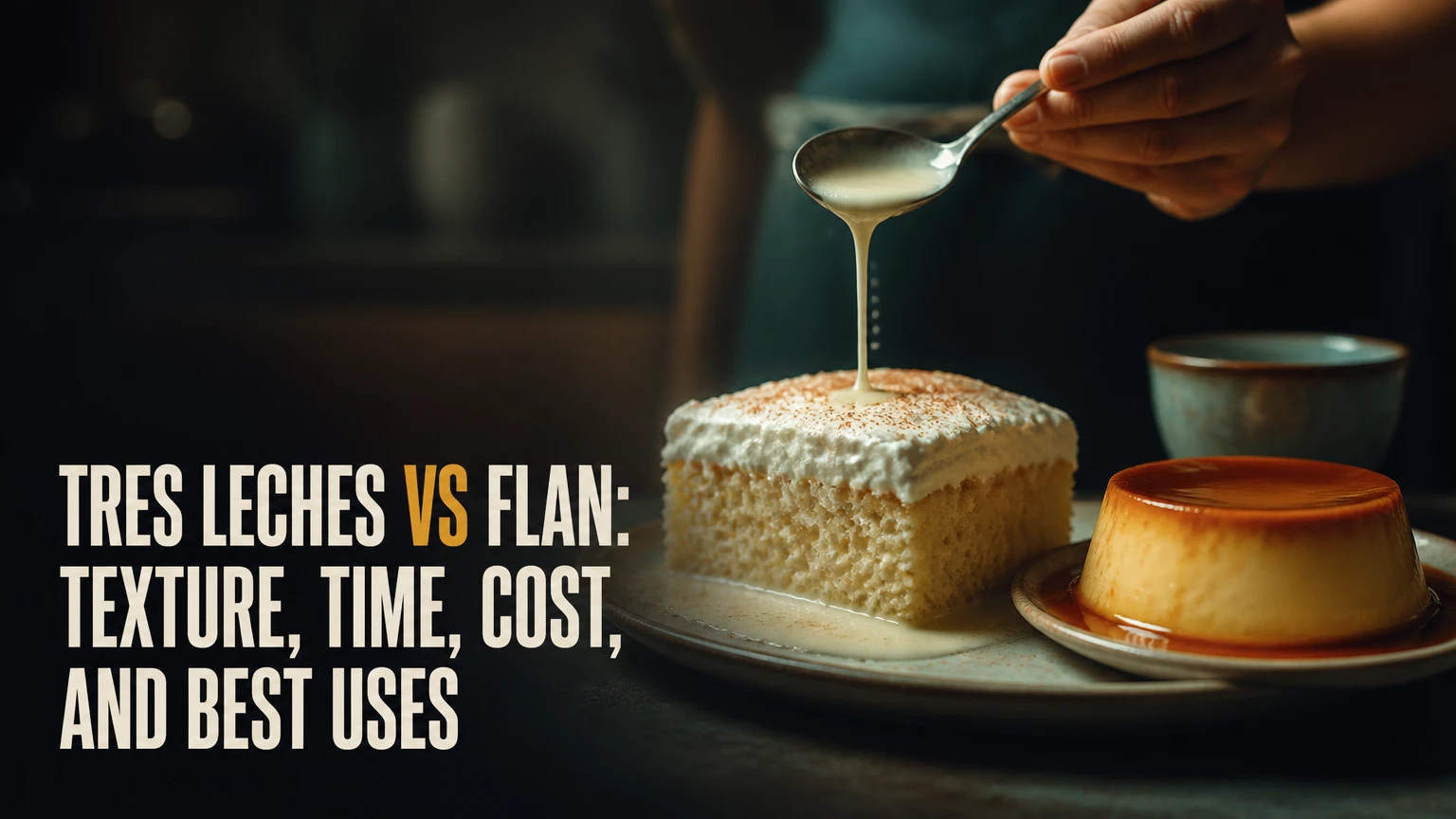
Tres leches is the better choice for a moist, cake-based dessert that feeds a crowd, while flan is better for a silky, gluten-free custard with dramatic caramel presentation. Tres leches absorbs a three-milk mixture into an airy sponge; flan sets eggs and dairy into a sliceable custard beneath liquid caramel.
Tres Leches vs Flan at a Glance
- Tres leches is a sponge cake soaked with evaporated milk, sweetened condensed milk, and cream or whole milk.
- Flan is a baked egg custard topped with caramel sauce released during inversion.
- Tres leches typically takes 5-13 hours because the cake needs extended chilling after soaking.
- Flan typically takes 5-8 hours, including baking and chilling, although overnight chilling improves unmolding.
- Tres leches usually contains wheat flour; traditional flan is naturally gluten-free.
- Tres leches is usually easier to portion for 10-16 people, while a 9-inch flan commonly yields 8-10 servings.
What Is the Difference Between Tres Leches and Flan?
The main difference is structural: tres leches is porous cake saturated with liquid, whereas flan is a solidified egg-and-milk custard covered with caramel. Tres leches eats like a cold, creamy cake with a soft crumb. Flan cuts like a tender gel and carries a concentrated caramel flavor.
Tres leches commonly uses a fat-light sponge made from eggs, sugar, flour, and baking powder. The finished cake receives a mixture of dairy products after baking, then absorbs that mixture through holes in the crumb.
Flan begins with sugar caramelized in a mold. Eggs, milk, condensed milk, and vanilla form the custard base, which cooks gently in a water bath. The caramel remains liquid enough to coat the inverted dessert after refrigeration.
| Attribute | Tres Leches | Flan |
|---|---|---|
| Dessert category | Soaked sponge cake | Baked egg custard |
| Primary structure | Open cake crumb | Coagulated egg protein network |
| Signature topping | Whipped cream, cinnamon, fruit | Liquid caramel glaze |
| Typical serving form | Rectangular cake squares | Round molded slices |
| Common flour status | Contains wheat flour | Naturally flour-free |
| Dominant sensation | Moist, milky, airy | Silky, dense, creamy |
The names also signal different identities. “Tres leches” refers to the three-milk soak, while “flan” refers to the custard dessert family found across Spain, Latin America, the Philippines, and other regions. Recipes vary by country, so no single ingredient list defines every traditional version.
Which Dessert Is Creamier and Which Has More Texture?
Flan is creamier and denser; tres leches has more textural contrast because its sponge retains a soft, porous crumb beneath the dairy soak. The choice depends on whether creaminess means a uniform custard or a moist cake that still offers gentle resistance when bitten.
Flan’s smoothness comes from controlled egg coagulation. Heat causes egg proteins to link into a gel that traps water and milk fat. Sugar delays coagulation, while the water bath limits harsh temperature swings.
Tres leches depends on capillary absorption. A low-fat sponge contains air cells that draw in the milk mixture, but the cake must retain enough crumb strength to hold the liquid. A butter-heavy cake often absorbs poorly and collapses into a paste.
A useful practitioner rule is to judge tres leches by the crumb’s recovery. Press the cooled sponge lightly before soaking. If the surface springs back, the cake has enough structure for liquid. If the indentation remains, the cake may become excessively compact after soaking.
How Do the Flavors Compare?
Tres leches tastes primarily of sweet dairy, vanilla, and sponge cake, while flan concentrates caramel, egg, vanilla, and cooked milk flavors. Cinnamon, berries, citrus zest, coffee, coconut, and chocolate can shift either dessert toward a different flavor profile.
Flan usually tastes less sweet in each bite because caramelized sugar contributes bitterness as well as sweetness. Tres leches can taste sweeter because condensed milk remains distributed throughout the cake rather than appearing mainly as a topping.
How Are Tres Leches and Flan Made?
Tres leches is baked first, soaked second, and chilled third; flan is caramelized, blended, water-bath baked, chilled, and inverted. Tres leches depends on absorption, while flan depends on gentle heat and accurate timing.
Tres Leches Production Sequence
- Bake the sponge. Whip egg whites to soft or stiff peaks, depending on the formula, and fold them into yolks, sugar, flour, and baking powder. A typical 9-by-13-inch cake bakes at 350°F for 25-30 minutes.
- Cool completely. Let the sponge reach room temperature before adding liquid. A hot cake can absorb unevenly and produce a dense, wet base.
- Create channels. Pierce the cake every 1/2-1 inch with a skewer or fork, reaching close to the bottom without shredding the crumb.
- Add the soak. Combine approximately 12 ounces evaporated milk, 14 ounces sweetened condensed milk, and 1-1 1/2 cups cream or whole milk for a standard large pan.
- Refrigerate. Chill for at least 4 hours. Overnight soaking gives the most even distribution.
- Finish and cut. Add stabilized whipped cream, then cut with a thin knife wiped clean between portions.
The success checkpoint is an evenly moist slice with no large puddle beneath it. The most common mistake is pouring the liquid rapidly into a few areas, which leaves dry sections and a saturated bottom.
Flan Production Sequence
- Caramelize the sugar. Cook 3/4-1 cup granulated sugar until amber, usually around 340-355°F. Pour it immediately into a 9-inch round mold.
- Mix the custard gently. Combine eggs, condensed milk, evaporated milk, vanilla, and salt without whipping excessive air into the mixture.
- Strain the base. A fine-mesh sieve removes chalaza strands, foam, and partially blended egg.
- Bake in a water bath. Set the mold in hot water reaching halfway up its sides. Bake at 325°F until the perimeter is firm and the center jiggles as one mass.
- Cool and refrigerate. Cool at room temperature, then chill for at least 4 hours.
- Invert carefully. Loosen the edge, warm the mold base briefly if necessary, and flip onto a rimmed plate.
The success checkpoint is a custard that holds its shape but trembles slightly in the center. The common mistake is baking until the center looks completely rigid, because residual heat continues cooking the eggs and can create a rubbery texture.
For food safety, the United States Department of Agriculture recommends cooking dishes containing eggs to 160°F. A thermometer reading near the center is more reliable than judging doneness by time alone, especially when mold depth and oven calibration differ.
Which Dessert Takes Less Time and Costs Less?
Flan usually requires less active preparation, while tres leches often provides more servings per batch. Typical homemade ingredient costs overlap, but flan can cost less when made with basic milk and eggs, whereas cream, fruit, and decorative toppings raise the price of tres leches.
| Planning metric | Tres Leches | Flan |
|---|---|---|
| Active preparation | 30-45 minutes | 20-35 minutes |
| Baking time | 25-30 minutes | 50-70 minutes |
| Minimum chilling | 4 hours | 4 hours |
| Best chilling window | 8-12 hours | 8-24 hours |
| Typical yield | 12-16 pieces | 8-10 slices |
| Typical homemade cost | $14-$28 | $9-$20 |
| Typical bakery price per serving | $5-$8 | $4-$7 |
Ingredient prices vary by city, brand, and decoration. A tres leches cake becomes more expensive when it includes berries, mascarpone, dulce de leche, or specialty cream. Flan’s major cost variables are eggs, dairy, vanilla, and the mold size.
The apparent time advantage of flan can be misleading. Flan has a longer oven stage and needs careful cooling before inversion, while tres leches has a shorter bake but cannot be served properly until the sponge has absorbed the soak.
Which Is Easier for a Beginner?
Flan is usually easier for a beginner because a blender or whisk can combine the custard without flour handling or egg-white folding. Tres leches is more forgiving after baking, but its sponge requires better technique before the soaking stage.
Flan still demands temperature control. Sugar can burn within seconds after reaching amber, and overbaked custard becomes grainy or springy. A sieve, water bath, and thermometer reduce those risks substantially.
Tres leches has a more forgiving presentation because whipped cream hides small surface flaws and the cake remains in its pan. However, under-whipped egg whites, overmixed batter, or insufficient holes can produce dry patches or a collapsed center.
| Beginner factor | Tres Leches | Flan |
|---|---|---|
| Flour technique | Folding required | None |
| Egg technique | Separate and whip eggs | Blend or whisk whole eggs |
| Main precision point | Sponge volume | Custard temperature |
| Special equipment | Mixer recommended | Water bath and fine sieve |
| Serving risk | Low, cut in pan | Moderate, invert intact |
| Best first-batch format | 9-by-13-inch pan | 8-inch loaf or 9-inch round mold |
A practitioner rule of thumb: choose flan if you prefer measuring temperature, and choose tres leches if you prefer managing batter structure. Neither dessert is technically difficult, but they fail for different reasons.
Which Dessert Travels and Feeds a Crowd Better?
Tres leches is better for large gatherings because a rectangular pan can hold 12-16 portions and the cake can be cut at the serving location. Flan is better for a smaller dinner where the dessert can remain chilled and be inverted shortly before service.
Transport tres leches in its original covered pan. Keep the pan level because excess soak can collect along one edge. Add whipped cream shortly before serving if the journey exceeds several hours.
Transport flan in its mold whenever possible. An inverted flan can slide or crack if the plate shifts, while a chilled molded custard has more support. Use an insulated carrier and keep both desserts below 40°F during transport.
| Occasion | Better choice | Practical reason | Recommended format |
|---|---|---|---|
| Office gathering, 12 people | Tres leches | Pan cuts quickly | 9-by-13-inch rectangle |
| Formal dinner, 6-8 people | Flan | Whole dessert plates elegantly | 8-inch round |
| Outdoor event | Tres leches | No inversion at venue | Covered chilled pan |
| Potluck with uncertain timing | Tres leches | Flexible portioning | Chilled squares |
| Small tasting menu | Flan | Dense portions work well | Individual ramekins |
| Long car journey | Either in mold | Structural support matters | Covered container |
Tres leches is not ideal for repeated transfers once fully soaked. Flan is not ideal for buffet service in a warm room because the custard softens and its caramel can spread across the plate.
Are Tres Leches and Flan Gluten-Free or Dairy-Free?
Traditional flan is gluten-free because its structure comes from eggs and dairy rather than flour, while standard tres leches contains wheat flour. Both desserts can be made dairy-free, but substitutions change sweetness, fat level, and setting behavior.
For dairy-free tres leches, use a reliable gluten-free or wheat-based sponge as appropriate, then replace the dairy soak with evaporated coconut milk, sweetened condensed coconut milk, and unsweetened oat or soy cream. Coconut flavors become prominent.
For dairy-free flan, use full-fat coconut milk and condensed coconut milk, then test the formula in a small mold because coconut products differ in water and fat content. Almond beverages alone are usually too thin for a rich custard.
| Dietary requirement | Tres Leches adaptation | Flan adaptation | Main risk |
|---|---|---|---|
| Gluten-free | Use certified gluten-free flour | Traditional recipe already fits | Cross-contact from tools |
| Dairy-free | Coconut condensed milk plus coconut cream | Full-fat coconut milk plus coconut condensed milk | Altered sweetness |
| Egg-free | Use a formulated cake soak dessert | Custard identity cannot be retained easily | Weak structure |
| Lower sweetness | Reduce topping and use unsweetened cream | Use less caramel, not less egg | Thin caramel layer |
| Nut-free | Use dairy or oat products | Use dairy or coconut products | Label cross-contact |
Do not assume every bakery flan is gluten-free. Some commercial kitchens add cookie crumbs, cake layers, or thickening mixes, and shared equipment can create cross-contact.
What Variations Are Worth Choosing?
Cuatro leches and coconut tres leches add richness to the cake format, while flan de queso, coffee flan, and coconut flan alter the custard without removing its defining caramel layer. The best variation preserves the original structure instead of adding so much flavoring that the dessert becomes heavy.
| Variation | Base dessert | Added ingredient | Texture effect | Best pairing |
|---|---|---|---|---|
| Cuatro leches | Tres leches | Dulce de leche | Heavier, denser soak | Cinnamon |
| Coconut tres leches | Tres leches | Coconut milk | Creamier, tropical crumb | Toasted coconut |
| Coffee tres leches | Tres leches | Espresso concentrate | Moist, bitter-sweet profile | Cocoa |
| Flan de queso | Flan | Cream cheese | Dense, cheesecake-like set | Berry garnish |
| Flan de café | Flan | Strong brewed coffee | Firm, aromatic custard | Unsweetened cream |
| Flan de coco | Flan | Coconut milk and flakes | Rich, slightly chewy | Lime zest |
The extra milk in cuatro leches should replace part of the original soak rather than simply being poured on top of a full quantity. Otherwise, the cake can become too wet to cut cleanly.
Tocino de cielo is related to flan but is not an ordinary milk custard. The Spanish dessert relies heavily on egg yolks and syrup, producing a much denser and more intensely sweet result.
How Should You Store Each Dessert?
Store both desserts covered in a refrigerator at 40°F or below, and use clean utensils for serving. Tres leches is typically best within 3-4 days, while flan often keeps its texture for 4-5 days when protected from odors and surface drying.
Whipped cream on tres leches may deflate or release liquid before the cake itself deteriorates. Stabilized cream, a tightly sealed container, and delayed decoration improve appearance.
Flan should remain in its mold until close to serving if presentation matters. Once inverted, caramel can thin across the plate, particularly after prolonged refrigeration or exposure to warm air.
| Storage issue | Tres Leches | Flan |
|---|---|---|
| Best refrigerator temperature | 34-40°F | 34-40°F |
| Preferred container | Covered baking pan | Mold or sealed plate |
| Best quality window | 24-48 hours | 24-72 hours |
| Typical usable window | 3-4 days | 4-5 days |
| Main deterioration | Soggy crumb, weeping cream | Watery caramel, drying surface |
| Freezer suitability | Cake texture may suffer | Custard may turn grainy |
Neither dessert should remain at room temperature for a full afternoon. Dairy and egg components require chilled handling, especially in warm kitchens or outdoor service.
What Common Problems Should You Fix?
Tres leches usually fails because the sponge lacks structure or the liquid is distributed unevenly; flan usually fails because the custard receives too much heat or the caramel hardens against the mold. Identifying the symptom first prevents an unnecessary remake.
| Symptom | Likely cause | Recovery | Prevention |
|---|---|---|---|
| Tres leches turns mushy | Fat-heavy cake or excessive soak | Chill longer, serve with a spoon | Use a porous sponge and measured liquid |
| Dry spots remain | Too few holes or rapid pouring | Add small amounts of reserved soak | Pierce in a regular grid |
| Liquid pools underneath | Cake was hot or pan was uneven | Drain some liquid, chill uncovered briefly | Cool cake and pour slowly |
| Flan has bubbles | Batter was over-whisked | Skim foam before baking | Blend gently and strain |
| Flan is rubbery | Oven too hot or overbaked | Serve sliced with fruit sauce | Remove at a slight center jiggle |
| Caramel stays stuck | Mold was not warmed | Dip base in hot water for 15-30 seconds | Loosen edge and invert promptly |
One counterintuitive point matters: more holes do not automatically improve tres leches. A shredded surface creates weak channels where liquid collects, so evenly spaced medium-depth holes outperform aggressive stabbing.
Another practitioner rule concerns flan water baths. Hot water is useful, but violently boiling water is not. A simmering oven environment can produce bubbles and curdled edges even when the average oven temperature appears correct.
If a flan cracks during inversion, keep the pieces cold and plate them with caramel, fruit, or cream. The dessert may lose its formal appearance but remain safe and flavorful if it was cooked and stored correctly.
Which Should You Choose?
Choose tres leches for a crowd, cake lovers, flexible decoration, or pan-based service; choose flan for gluten-free needs, smaller portions, smooth custard texture, and a formal plated finish. The right decision comes from serving conditions rather than prestige or recipe length.
Choose Tres Leches If You Are Hosting
Tres leches is the practical winner for 10 or more guests. A 9-by-13-inch pan offers predictable portions, travels well while covered, and allows fruit, cinnamon, or whipped cream to accommodate different preferences.
Tres leches is also the better option when the dessert must be prepared the day before. The overnight rest improves absorption and reduces last-minute assembly.
Choose Flan If Presentation Matters Most
Flan is the presentation winner for a dinner party or restaurant-style course. Its inverted shape creates a caramel pool and clean edge, provided the custard was chilled thoroughly and released without force.
Flan is also the stronger choice for gluten-free guests when the kitchen can prevent cross-contact. Its ingredient list is short, but the water bath and unmolding stage deserve careful attention.
Choose Either for Dietary Adaptation
Choose traditional flan for a simple gluten-free dessert, or choose coconut versions of either dessert for dairy-free service. Confirm the condensed milk, flavor extracts, toppings, and shared utensils before labeling a dessert suitable for a dietary restriction.
FAQ
Can You Make Tres Leches and Flan in the Same Dessert?
Yes, a tres leches flan cake can combine a cake layer with custard, but the preparation is more demanding than either dessert alone. The flan must set firmly before the cake and soak are added, and excess liquid can destabilize the layers during unmolding.
Is Flan Healthier Than Tres Leches?
Neither dessert is automatically healthier because both commonly contain concentrated sugar and dairy. Flan usually has fewer carbohydrates per serving when served as a small slice, while tres leches often provides a larger portion with cake, soak, and whipped topping.
Can You Use Box Cake for Tres Leches?
You can use a box cake, but a standard butter-heavy cake may absorb unevenly and become dense. A light white or sponge-style mix usually performs better, especially when baked slightly firm and cooled completely before the milk mixture is added.
Why Is My Flan Watery After Chilling?
Watery flan usually results from undercooking, excess liquid, or separation caused by overheating. Check the center temperature, confirm the egg-to-liquid ratio, and bake in a controlled water bath until the custard moves as one gentle mass.
Can Flan Be Made Without a Water Bath?
Flan can be baked without a water bath, but the edges are more likely to overcook before the center sets. Use a low oven, a tightly covered mold, and frequent checking if a water bath is impossible, although the texture may be less uniform.
Which Dessert Is Better the Next Day?
Both improve after overnight chilling, but the answer differs by goal. Tres leches usually gains better milk distribution by the next day, while flan gains firmer structure and easier release, making both strong make-ahead desserts.
The Bottom Line
Tres leches vs flan is a choice between soaked sponge cake and caramel custard, not between two versions of the same dessert. Select tres leches for generous portions, soft cake texture, and easy pan service. Select flan for gluten-free simplicity, dense creaminess, controlled portions, and an elegant caramel finish.