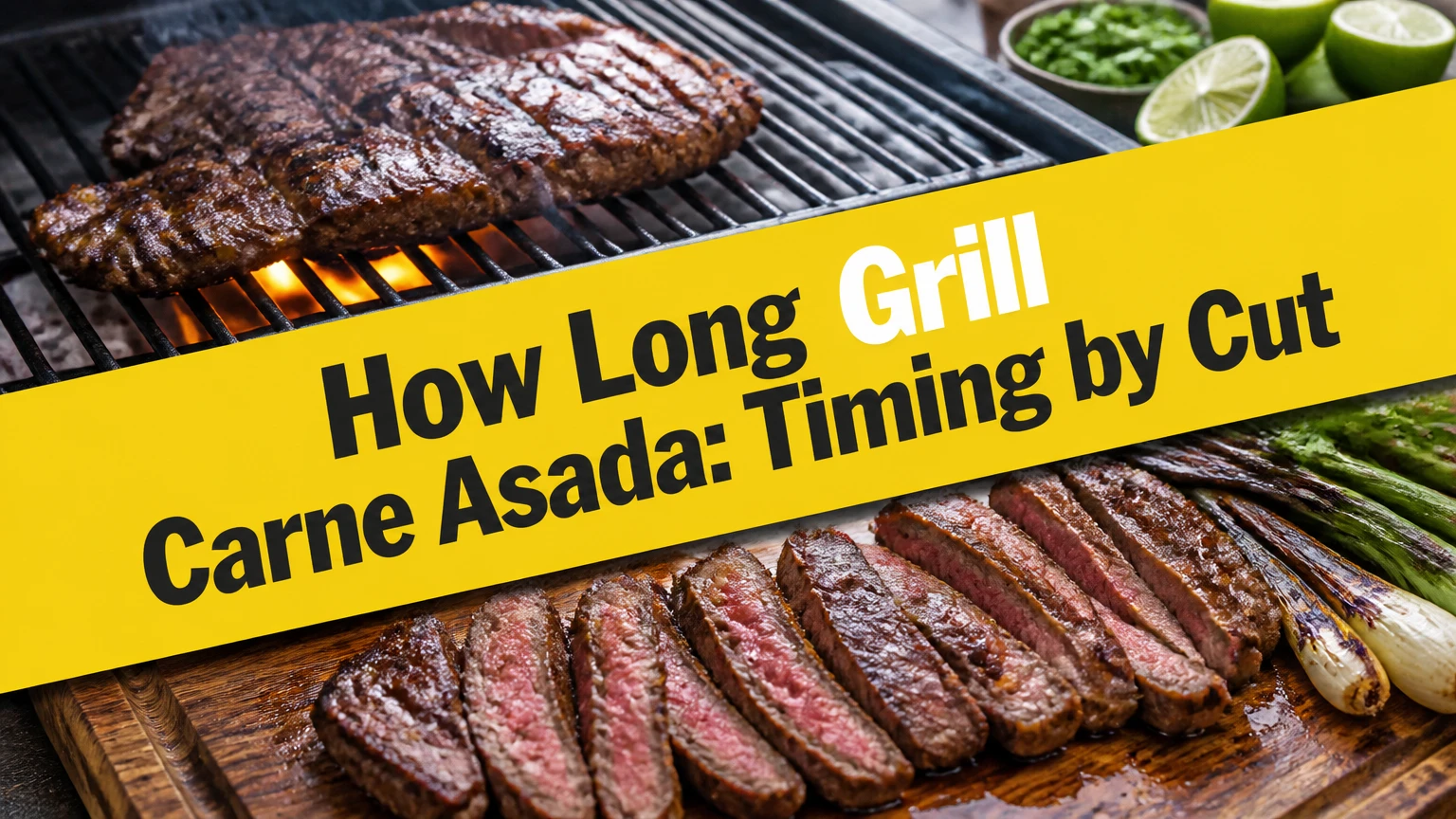
Carne asada usually takes 4-8 minutes total on a hot grill at 450-500°F, with skirt steak cooking fastest and flank steak taking longer. Grill over direct heat, turn the steak once, and use an instant-read thermometer rather than time alone: remove it at 125-135°F for medium-rare preference, or cook beef to the USDA-recommended 145°F with a 3-minute rest for food safety.
Key Facts at a Glance
- Skirt steak generally grills for 4-6 minutes total, or 2-3 minutes per side, over direct high heat.
- Flank steak generally grills for 6-8 minutes total, or 3-4 minutes per side, because it is usually thicker and leaner.
- Sirloin flap meat commonly takes 5-8 minutes total, but irregular thickness makes temperature checking especially important.
- A practical medium-rare target is 125-135°F, depending on whether the steak is removed before or after reaching the desired center temperature.
- USDA guidance for whole beef steaks is 145°F internally followed by a 3-minute rest.
- Rest carne asada for 5 minutes before slicing, then cut thinly across the grain.
How Long Should You Grill Carne Asada?
Carne asada should grill for 4-8 minutes total, but the correct time depends more on cut thickness than on the dish name. A thin inside skirt steak may reach medium-rare in four minutes, while a one-inch flank steak may need eight minutes under the same heat.
The most reliable method is to preheat the grill to 450-500°F and cook the steak over direct heat. Start checking the internal temperature after two minutes for skirt steak and after five minutes for flank steak. Time controls the cooking process, but temperature confirms the result.
Timing by Cut and Thickness
The following figures are typical practitioner ranges for a well-preheated grill. They assume the meat begins cold from refrigeration, the grate is clean, and the steak is not crowded with other food.
| Cut and typical thickness | Total time at 450-500°F | Approximate side time | Best temperature check |
|---|---|---|---|
| Skirt steak, 1/4-1/2 inch | 4-6 minutes | 2-3 minutes | Begin at 3 minutes |
| Flap meat, 1/2-3/4 inch | 5-8 minutes | 2.5-4 minutes | Begin at 5 minutes |
| Flank steak, 3/4-1 inch | 6-8 minutes | 3-4 minutes | Begin at 5 minutes |
| Thick flank steak, 1-1.25 inches | 8-12 minutes | 4-6 minutes | Begin at 7 minutes |
| Thin sliced carne asada, 1/8-1/4 inch | 2-4 minutes | 1-2 minutes | Visual check is usually sufficient |
A steak’s thickness can vary across its length, so one end may finish before the center. Fold or separate unusually thin sections before grilling, or move thinner portions to a cooler zone once they develop enough browning.
Why Does Carne Asada Cook So Quickly?
Carne asada cooks quickly because skirt, flank, and flap steaks are relatively thin cuts exposed to intense direct heat. Heat reaches the center within minutes, while the dry surface develops browning through the Maillard reaction, a set of chemical reactions between amino acids and reducing sugars.
The Maillard reaction becomes more effective after surface moisture evaporates. A wet marinade initially cools the meat, so excess liquid can delay browning and produce steaming instead of crust formation. Patting the steak dry, scraping off loose herbs, and leaving space between pieces all improve surface heat.
The Three Heat Effects That Matter
- Surface drying: Water on the exterior must evaporate before deep browning develops.
- Direct conduction: Hot grates transfer heat rapidly into the thin steak.
- Carryover cooking: The center can continue rising in temperature after the steak leaves the grill.
A useful practitioner rule is to prioritize a dry surface and a hot grate over a long marinade. Extra marinade time cannot compensate for a grill that is too cool or a steak placed on wet grates.
Which Cut Is Best for Carne Asada?
Skirt steak is the traditional high-flavor choice, flank steak is the easiest uniform cut for beginners, and flap meat offers a coarse, beefy texture at a commonly lower price. The best cut depends on whether the priority is speed, tenderness, availability, or cost.
Inside skirt and outside skirt are both associated with arrachera, although names vary by butcher and region. Flank steak has a more obvious grain and less internal fat, while flap meat has a loose texture that accepts seasoning well but often varies in thickness.
| Cut | Typical retail price per pound | Texture and fat | Typical grill time | Best use |
|---|---|---|---|---|
| Inside skirt | $10-$18 | Loose grain, moderate fat | 4-6 minutes | Charred tacos and fajitas |
| Outside skirt | $14-$25 | More tender, well marbled | 4-6 minutes | Special-occasion carne asada |
| Flank steak | $9-$16 | Lean, firm grain | 6-8 minutes | Beginner-friendly slicing |
| Sirloin flap | $8-$15 | Coarse grain, moderate fat | 5-8 minutes | Large taco gatherings |
Prices are typical United States grocery ranges and vary by region, grade, trimming, and season. A less expensive flap steak can outperform a premium flank steak when the flap is cooked quickly and sliced correctly.
Skirt Steak
Skirt steak produces the strongest beef flavor and the fastest cooking time. Its loose muscle structure takes on marinade readily, but its narrow window between medium-rare and overcooked makes an instant-read thermometer useful.
Trim only thick, hard pieces of surface fat. Thin soft fat can render over the fire and add flavor, while large flaps of fat can cause flare-ups. Cut very long skirt steaks into grillable sections before cooking.
Flank Steak
Flank steak is leaner and thicker than skirt steak, so it usually needs two to four additional minutes. Flank steak also has a pronounced grain that can appear to change direction near the tapered end, requiring careful inspection before slicing.
Flank steak is a practical beginner option because its broad, even surface makes temperature readings easier. It is less forgiving when cooked beyond medium because the lean muscle loses moisture quickly.
Flap Meat
Flap meat, also called sirloin flap, has a coarse grain and uneven shape. Its irregular thickness means a single total-time estimate is less dependable than a visual check followed by temperature readings in both thick and thin sections.
Flap meat works particularly well for tacos because the coarse fibers hold onto char and chopped toppings. Slice it across the grain after resting, and separate thick and thin sections before serving if their doneness differs.
What Grill Temperature Should Carne Asada Reach?
Carne asada grills best over 450-500°F direct heat, measured at the cooking grate rather than inferred from the lid thermometer. A gas-grill hood gauge can read substantially differently from the grate surface, so preheating for 10-15 minutes and testing a small area helps establish the real cooking zone.
Charcoal should have a strong, even bed of glowing coals before the steak goes down. Gas burners should be set high enough to recover quickly after the cold meat touches the grates. A two-zone fire gives you a hot searing area and a cooler recovery area for thin edges or flare-ups.
| Grill setup | Preheat target | Lid position | Main advantage | Main limitation |
|---|---|---|---|---|
| Gas grill, two burners | 450-500°F | Closed during preheat, open briefly to turn | Precise heat adjustment | Less smoke flavor |
| Charcoal kettle | 450-550°F at grate | Open for direct searing | Strong char and smoke | Heat varies by coal placement |
| Two-zone charcoal | 450-500°F hot side | Open while searing | Flare-up control | Requires more setup |
| Cast-iron grill pan | Medium-high, pan fully heated | No lid | Indoor alternative | More smoke and less live-fire flavor |
The grate should be clean and lightly oiled with a high-smoke-point oil such as avocado or refined canola oil. Oil the grate, not a dripping wet steak, because loose oil on the meat can intensify flames.
How Should You Prepare Carne Asada Before Grilling?
Prepare carne asada by trimming hard fat, marinating for 2-8 hours, draining excess liquid, and patting the surface dry before grilling. A citrus-heavy marinade often works best for a few hours rather than overnight because prolonged acid exposure can make the outer layer soft or chalky.
Marinade timing is not a universal eight-hour maximum. A low-acid mixture containing oil, salt, garlic, herbs, and spices can tolerate a longer period than a mixture dominated by lime juice. Keep raw beef refrigerated during marination, and discard used marinade or boil it before serving.
A Practical Marinade Balance
| Marinade component | Typical amount per 2 pounds beef | Function | Handling note |
|---|---|---|---|
| Lime or orange juice | 1/4-1/2 cup | Acidity and aroma | Shorter marination works best |
| Neutral oil | 2-4 tablespoons | Fat-soluble flavor and release | Prevent excess dripping |
| Salt | 1-1.5 teaspoons | Seasoning and moisture movement | Reduce if using salty sauce |
| Garlic, chile, herbs | 2-5 tablespoons combined | Aroma and heat | Remove loose pieces before grilling |
Do not rely on room-temperature resting to make a cold steak cook evenly. The USDA advises keeping perishable food out of the temperature danger zone, and 15-20 minutes on the counter is not required for a successful sear. Drying the surface and preheating the grill matter more.
What Is the Exact Grilling Process?
The most consistent process is direct high-heat grilling, one turn, temperature checking, and a short rest. The procedure takes about 20 minutes of active and waiting time, excluding marination, and the main success factor is preventing the thin steak from passing its target temperature.
Step 1: Preheat the Grill
Heat the grill to 450-500°F for 10-15 minutes, then clean the grates and lightly oil them. Create a hot direct zone and, if possible, a cooler zone for moving meat away from flames.
You will know the grill is ready when the grates are fully heated and a small drop of water evaporates immediately. Do not use water as a precise temperature test. A grate thermometer gives better information.
Common mistake: Starting while the grill is still warming. The steak then releases moisture before browning.
Step 2: Dry and Place the Steak
Remove the steak from the marinade, scrape off loose garlic or herbs, and pat the surface dry. Place the meat flat over direct heat, leaving about two inches between pieces.
You will know placement is effective when the steak begins a steady sizzle immediately. A few flames from fat are manageable; continuous flames indicate excess oil, sugar, or grease.
Common mistake: Crowding the grill. Crowding lowers surface heat and traps steam.
Step 3: Grill the First Side
Cook skirt steak for about two minutes before checking thin sections. Cook flank steak for about three to four minutes, then inspect the underside for browning and release.
You will know the first side is ready to turn when the meat releases without tearing and the browned area covers most of the contact surface. Grill marks alone do not prove that the steak has developed enough crust.
Common mistake: Pressing the steak repeatedly. Pressing forces out flavorful juices without making the center cook more evenly.
Step 4: Turn and Finish
Turn the steak once and cook the second side for a similar period, adjusting for thickness. Move a thin edge to the cooler zone if it browns early, and keep the thick center over direct heat.
Begin temperature checks from the side of the steak, inserting the probe horizontally into the thickest section. Multiple readings matter when flap meat or skirt steak has an uneven profile.
Common mistake: Following a rigid flip time. Grill strength, steak temperature, sugar content, and thickness can shift the finish by several minutes.
Step 5: Remove and Rest
Remove the steak at the target temperature, place it on a board, and rest it loosely uncovered or lightly tented for five minutes. Thick flank steak may benefit from 8-10 minutes, while very thin skirt steak needs less time to stabilize.
You will know the rest is complete when the surface is no longer actively releasing juice and the steak remains warm in the center. Heavy foil traps steam and softens the crust.
Common mistake: Cutting immediately. Immediate slicing allows more juice to run onto the board, although the rest does not reverse overcooking.
What Temperature Should Carne Asada Be?
For a medium-rare eating preference, many cooks remove carne asada around 125-130°F, expecting a small rise during rest. USDA FSIS guidance is stricter: whole cuts of beef should reach 145°F and rest for at least three minutes. The lower target is a culinary preference, not the federal safety recommendation.
Carryover cooking is smaller in thin steaks than in thick roasts because thin meat holds less accumulated heat. A thin skirt steak may rise only a few degrees, while a thicker flank steak can rise more depending on grill intensity and starting temperature.
| Desired result | Remove temperature, typical | Final temperature, typical | Texture |
|---|---|---|---|
| Rare preference | 120-125°F | 125-130°F | Deep red center |
| Medium-rare preference | 125-130°F | 130-135°F | Warm red-pink center |
| Medium | 135-140°F | 140-145°F | Pink, firmer center |
| USDA whole-steak guidance | 145°F | 145°F or higher | Fully heated, less red |
Thermometer readings should be taken in the thickest section without touching the grate. If serving children, older adults, pregnant people, or anyone immunocompromised, follow the USDA temperature guidance rather than a rare or medium-rare preference.
How Do You Slice Carne Asada Tenderly?
Slice carne asada against the grain into strips approximately 1/8-1/4 inch thick. Cutting perpendicular to the visible muscle fibers shortens the fibers that teeth must break, which can make a correctly cooked but naturally firm cut easier to chew.
Inspect the raw steak before grilling because the grain can be easier to identify then. After resting, rotate the cooked steak so the fibers run vertically across your board, and cut across them with a sharp knife at a slight angle.
Grain Rules by Cut
| Cut | Grain pattern | Slice direction | Typical serving |
|---|---|---|---|
| Skirt steak | Long, obvious fibers | Across the short width | Taco strips |
| Flank steak | Long fibers, possible direction change | Across each section separately | Plates or tacos |
| Flap meat | Coarse, sometimes diagonal fibers | Perpendicular to each local section | Chopped tacos |
| Thick steak portion | Grain may curve near the end | Reorient before final cuts | Thin slices |
A 45-degree slicing angle can produce wider, thinner pieces, but the essential rule is perpendicular cutting. Angle matters less than grain direction.
What Are the Most Common Carne Asada Problems?
The most common failures are low grill heat, excess wet marinade, overcooking, flare-ups, and slicing with the grain. Each problem has a different correction, so adding more marinade or more cooking time rarely fixes the underlying issue.
The Steak Steams Instead of Chars
Use smaller batches, dry the surface, and leave space around each piece. If the grill temperature drops below about 400°F after loading, wait for recovery before adding another batch.
The Outside Burns Before the Center Cooks
Move the steak to indirect heat after browning, especially when a piece exceeds one inch. Reduce sugar in the marinade because sweet sauces darken faster than the meat’s interior cooks.
The Meat Is Tough
Check whether the steak was overcooked or sliced incorrectly before blaming the cut. Flank, skirt, and flap meat become noticeably chewier beyond medium, while parallel slicing leaves long fibers that feel tough at any doneness.
The Steak Has Gray Bands
A gray band usually indicates slow surface heating or a wet exterior. Preheat longer, dry the meat, and avoid repeatedly opening a gas-grill lid during the first side.
The Meat Flares Up
Move the steak to the cool zone for 20-30 seconds, close the lid briefly on a gas grill, and remove loose dripping fat or marinade solids. Never pour water onto a grease fire because splashing can spread burning oil.
How Do Gas and Charcoal Grills Change Timing?
Gas and charcoal grills can cook carne asada in the same 4-8-minute overall range when the grate reaches the same temperature. Charcoal usually produces more smoke and irregular hot spots, while gas provides faster adjustments and more predictable recovery.
Charcoal users should distribute coals so the steak has a hot zone and an escape route. Gas users should preheat with the lid closed, then open the lid briefly for placement and turning to reduce heat loss.
Can You Cook Carne Asada Without an Outdoor Grill?
A cast-iron grill pan or heavy skillet can cook carne asada indoors in roughly 4-8 minutes, but the surface may smoke heavily and the meat will lack live-fire smoke. Heat the pan for five minutes, work in batches, and ventilate the room before cooking.
An oven broiler is another alternative. Place the steak 4-6 inches below a fully heated broiler, cook about 3-5 minutes per side, and monitor closely because broiler intensity varies widely between appliances.
Frozen steak is a poor choice for fast carne asada grilling because the outside can char before the center thaws. Thaw it in the refrigerator, then dry the surface before marinating or seasoning.
How Much Time and Meat Do You Need?
Plan approximately 1/2 pound of raw boneless beef per adult for a main meal, or 1/3 pound per adult when serving tacos with beans, rice, tortillas, salsa, and other fillings. The total schedule usually includes two to eight hours of marination, 15 minutes of grill preheating, 4-8 minutes of cooking, and five minutes of resting.
| Planning item | Typical quantity or time | Example for 4 adults | Practical note |
|---|---|---|---|
| Raw beef | 1/3-1/2 lb per person | 1.5-2 lb | Buy extra for trimming |
| Marinade | 1/2-1 cup per 2 lb | 1/2-1 cup | Keep refrigerated |
| Grill preheat | 10-15 minutes | 10-15 minutes | Use direct high heat |
| Cooking | 4-8 minutes | 4-8 minutes per batch | Add time for batches |
| Resting | 5-10 minutes | 5-10 minutes | Avoid tight foil |
| Tortillas | 3-4 per person | 12-16 tortillas | Warm immediately before serving |
Typical United States grocery cost for the beef is $8-$25 per pound, with skirt steak often costing more than flank or flap meat. Add approximately $5-$12 for citrus, herbs, aromatics, tortillas, and toppings, depending on quantities and brand choices.
Expert Rules for Better Results
- Treat time as an alert, not a verdict. A two-minute difference can separate medium-rare skirt steak from dry skirt steak, so temperature and surface color should control the final decision.
- Separate by thickness before cooking. Cutting a tapered steak into sections lets each piece finish closer to the same doneness than keeping a thin tail attached to a thick center.
- Use the marinade strategically. Acid contributes flavor and changes the surface texture, but salt, dry heat, and correct slicing have more influence on the final bite than an overnight citrus soak.
- Do not chase grill marks. Turning a steak repeatedly to create a crosshatch pattern can sacrifice crust and temperature control; a broad browned surface is more useful than decorative lines.
- Rest thin steaks briefly. Five minutes protects the serving texture, but long resting can cool skirt steak. Thick flank steak benefits more from a longer rest than a 1/4-inch skirt steak.
Frequently Asked Questions
Can I Grill Carne Asada at 350°F?
You can grill carne asada at 350°F, but the steak will brown more slowly and may dry before developing a strong crust. Use 450-500°F direct heat when possible. At 350°F, expect a longer cook and begin checking the center earlier than a standard thick-steak schedule.
Should Carne Asada Be Grilled With the Lid Open?
Keep the lid closed while a gas grill preheats, then open it briefly for placement and turning. Charcoal cooks often leave the lid open during a short direct sear to prevent the fire from becoming too smoky or hot. The grate temperature and flare-up control matter more than a universal lid rule.
Is Carne Asada Better at Medium-Rare or Medium?
Medium-rare usually preserves more moisture in skirt, flank, and flap steak, while medium provides a firmer texture and more internal heat. For food safety, USDA FSIS recommends 145°F with a 3-minute rest for whole beef steaks, so personal preference should be balanced against the diners’ risk level.
Can I Marinate Carne Asada Overnight?
Overnight marination can work with a low-acid mixture, but a citrus-dominant marinade is usually better limited to about 2-8 hours. Longer acid exposure can soften the exterior and create an uneven texture. Keep the beef refrigerated, and never reuse raw marinade without boiling it first.
Why Is My Carne Asada Chewy Even Though It Is Pink?
Pink carne asada can still be chewy when the steak is sliced with the grain or when the cut has dense connective tissue. Identify the fibers before cooking, rest the steak, and cut perpendicular to the grain into thin strips. Temperature alone cannot correct an incorrect slicing direction.
How Long Should Carne Asada Rest Before Tacos?
Rest carne asada for about five minutes before slicing, then serve it promptly in warmed tortillas. Very thick flank steak can rest for 8-10 minutes, while thin skirt steak may cool if held much longer. Slice after resting rather than before, so the pieces retain more moisture.
The Bottom Line
For the query how long grill carne asada, use 4-6 minutes for skirt steak, 5-8 minutes for flap meat, and 6-8 minutes for flank steak over a 450-500°F direct fire. Turn once, check the thickest part with a thermometer, rest for five minutes, and slice against the grain. Time starts the decision, but thickness, temperature, and slicing determine the result.