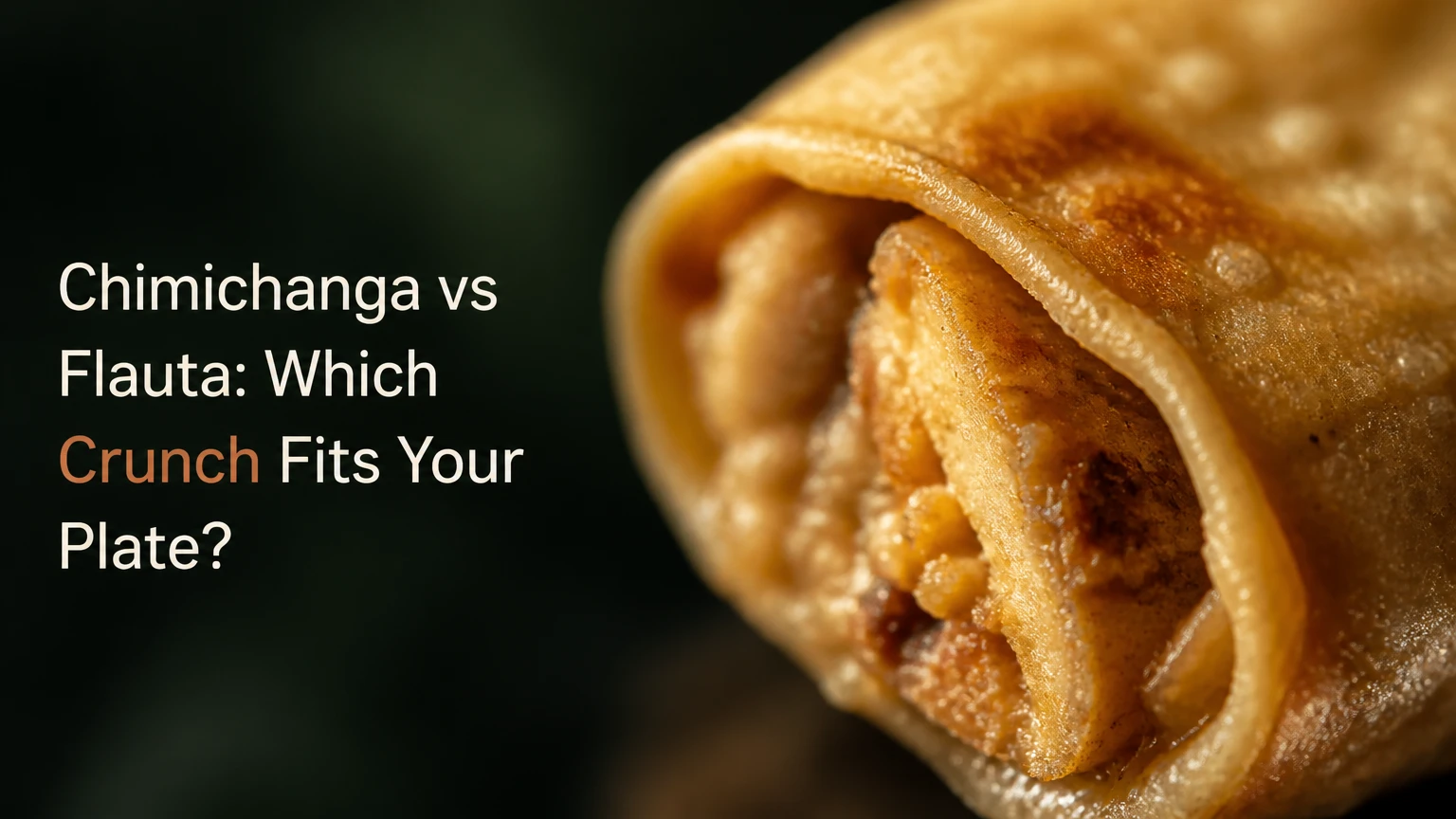
A chimichanga is a large, sealed flour-tortilla burrito that is fried and commonly filled with meat, beans, rice, and cheese. A flauta is a narrow, tightly rolled tortilla cylinder, usually made with corn and filled with concentrated shredded meat or potatoes. Choose the chimichanga for a substantial sauced entrée; choose flautas for sharper crunch, smaller portions, and dipping.
Key Facts at a Glance
- A chimichanga normally uses a 10- to 12-inch flour tortilla and yields one large fried entrée.
- A flauta usually uses a 5- to 7-inch corn tortilla and arrives as three to five rolled pieces.
- Chimichangas contain layered fillings, while flautas use a narrow, compact filling line.
- The chimichanga is sealed at the ends through a burrito-style fold; a flauta has an open-ended tube.
- Flour tortillas produce a blistered, breadier shell, while corn tortillas produce a thinner, more brittle crunch.
- Typical restaurant prices range from $12-$18 for one chimichanga and $9-$14 for a flauta plate, depending on location and sides.
What Is the Difference Between a Chimichanga and a Flauta?
The main difference is structural: a chimichanga is a fried burrito, while a flauta is a tightly rolled fried tortilla. That structure determines the tortilla, filling volume, texture, serving size, sauce strategy, and likelihood of leaking during cooking.
The word flauta means “flute” in Spanish, describing the long, narrow shape. Culinary usage varies by region and restaurant. In many Mexican contexts, flautas are associated with corn tortillas, while some restaurants use flour tortillas or apply the word to similarly rolled fried foods.
Chimichangas developed as a Southwestern and Mexican-American specialty, with Arizona frequently associated with their popularization. Their exact origin is disputed, and several restaurants have claimed early versions. The reliable distinction is culinary rather than historical: a chimichanga follows burrito architecture, then receives a frying step.
A flauta follows the logic of a rolled taco. The filling is placed in a narrow line, the tortilla is rolled firmly, and the finished cylinder is fried until rigid. The terms flauta, taquito, taco dorado, and rolled taco overlap in some menus, so tortilla type and regional usage matter more than the label alone.
How Do Their Structures Change the Eating Experience?
A chimichanga has a sealed, layered interior and a thick flour shell; a flauta has a compressed center and a thin corn shell. Chimichanga bites alternate between tortilla, filling, cheese, and sauce, while flauta bites emphasize shell fracture, seasoned meat, and fresh toppings.
| Attribute | Chimichanga | Flauta |
|---|---|---|
| Typical tortilla | 10-12-inch flour tortilla | 5-7-inch corn tortilla |
| Shape | Rectangular sealed packet | 1- to 1.5-inch rolled cylinder |
| Filling depth | 1-2 inches across the center | 0.25-0.5-inch narrow strip |
| Ends | Folded and closed | Open-ended |
| Shell texture | Blistered, flaky, moderately thick | Thin, rigid, shattering |
| Typical serving | 1 unit | 3-5 units |
| Sauce position | Often over the shell | Usually beside or over toppings |
| Best bite profile | Soft, rich interior with crisp exterior | Crisp shell with concentrated filling |
The chimichanga shell can feel closer to fried bread because flour tortillas contain wheat flour, fat, and often leavening or chemical tenderizers. A corn tortilla has a more pronounced toasted-corn flavor and usually breaks with a cleaner snap when sufficiently dry.
The open ends of a flauta are functional. Oil reaches the tortilla edges quickly, which helps create a uniform crisp shell, but loose filling can escape. A sealed chimichanga retains moisture better, although that same moisture can soften the interior shell beneath a sauce blanket.
Which One Is Crispier?
Flautas are usually crispier than chimichangas because their thin corn tortillas contain less bulk around a narrow filling and spend more of the meal exposed to air. A chimichanga can also become very crisp, but its thicker flour shell and moist interior create a softer center.
Crispness depends on more than tortilla identity. Oil temperature, tortilla moisture, filling quantity, and holding time all matter. A flauta fried at 325°F with a wet filling may turn greasy and flexible, while a chimichanga fried at 375°F can develop a firm, blistered surface.
What Goes Inside Each Fried Dish?
Chimichangas support layered fillings; flautas work best with compact fillings that stay in place during rolling. The practical rule is to fill a chimichanga to roughly one-quarter of its tortilla area and a flauta with a pencil-width line that leaves clear edges.
| Filling style | Chimichanga use | Flauta use | Moisture rule |
|---|---|---|---|
| Shredded chicken | 3-4 ounces with beans and cheese | 1-1.5 ounces alone | Drain broth before rolling |
| Shredded beef | 3-4 ounces with rice or beans | 1-1.5 ounces with a little cheese | Cool until barely warm |
| Refried beans | 2-3 tablespoons | 1 tablespoon as a binder | Use thick beans |
| Mexican rice | 2-3 tablespoons | Usually excluded | Remove excess liquid |
| Cheese | 1-2 ounces | 0.5-1 ounce | Avoid watery fresh cheese |
| Seasoned potato | 3-4 ounces with egg or cheese | 1-1.5 ounces mashed | Press out steam before filling |
| Cooked vegetables | 2-3 tablespoons | 1 tablespoon finely chopped | Sauté until dry |
A chimichanga can hold contrasting textures because its large interior distributes weight across a broad packet. Common combinations include shredded chicken with refried beans and cheese, seasoned beef with rice, or scrambled egg with potato and mild peppers for a breakfast version.
A flauta needs restraint. Large chunks create gaps that make rolling difficult, and wet fillings steam the shell from within. Shredded chicken, finely pulled beef, mashed potato, and tightly minced vegetables are more reliable than chunky salsa, loose rice, or unstrained beans.
Are Flautas Always Made With Corn Tortillas?
Flautas are traditionally associated with corn tortillas, but flour-tortilla flautas appear on some restaurant menus and in home cooking. A long flour version may be labeled a flauta because of its shape, even though the tortilla changes the flavor and shell texture.
A corn tortilla gives the most recognizable toasted flavor and brittle crunch. Flour produces a more flexible roll and a slightly thicker, less granular shell. When ordering, ask which tortilla the kitchen uses if the distinction affects your choice.
How Are Chimichangas and Flautas Cooked?
A chimichanga is folded, sealed, and fried for about 2-3 minutes at 350-375°F; a flauta is rolled tightly and fried for about 3-5 minutes at 350-360°F. These are typical home-cooking ranges, not universal restaurant specifications, because oil depth and product size change the timing.
| Cooking factor | Chimichanga | Flauta |
|---|---|---|
| Oil temperature | 350-375°F | 350-360°F |
| Typical fry time | 2-3 minutes | 3-5 minutes |
| Oil depth | 1.5-3 inches | 0.5-1.5 inches |
| Tortilla preparation | Warm until flexible | Steam or lightly fry before rolling |
| Holding device | Seam-side-down start or toothpick | Toothpick or wire rack support |
| Interior target | Filling already hot | Filling warm and dry |
| Visual finish | Golden, blistered packet | Even golden-brown cylinder |
| Drain time | 1-2 minutes | 1-2 minutes |
How to Fry a Chimichanga Without a Blowout
- Warm a 10- to 12-inch flour tortilla for 10-20 seconds per side on a dry skillet.
- Place 1 to 1.5 cups of hot, relatively dry filling in the lower center.
- Fold the bottom edge over the filling, tuck both sides inward, and roll into a compact packet.
- Place the seam underneath and add one toothpick if the fold feels loose.
- Fry at 350-375°F, starting seam-side-down, for 2-3 minutes.
- Drain on a rack rather than directly on paper, then add sauce immediately if serving smothered.
The filling should be hot before assembly. Cold beans and refrigerated meat require more time to heat through, but the shell browns quickly, producing a dark exterior around a lukewarm center.
A chimichanga is finished when the shell is evenly golden and the packet feels firm when lifted with tongs. If cheese is present, warm fillings help it melt without extending the frying time.
How to Fry Flautas Without Unraveling
- Heat 6-inch corn tortillas under a damp towel for about 20 seconds in a microwave, or soften them briefly in a skillet.
- Add 1-1.5 ounces of dry shredded filling in a narrow line.
- Roll from one edge while applying firm, even pressure.
- Secure the seam with a toothpick, or pin two to three flautas together.
- Fry seam-side-down first at 350-360°F for 3-5 minutes, turning as needed.
- Drain upright or on a wire rack, then remove toothpicks before serving.
The tortillas must bend without splitting. A dry corn tortilla fractures along the roll, while an overheated tortilla can become too soft and absorb oil before the surface sets.
A flauta is ready when the cylinder feels rigid and the seam remains closed after turning. The shell should sound lightly hollow when tapped with tongs.
Which Is Better for Texture, Fullness, and Sauce?
The chimichanga wins for fullness and integrated richness, while the flauta wins for clean crunch and dipping. Sauce preference is the deciding factor: a chimichanga can support queso or chile sauce across its surface, whereas flautas are better with salsa, crema, guacamole, or a controlled drizzle.
| Decision criterion | Chimichanga | Flauta | Practical winner |
|---|---|---|---|
| Fullness | 600-1,000 typical meal calories, depending on filling and sides | 300-700 per plate, depending on count and toppings | Chimichanga |
| Crispness | Firm exterior, softer interior | Crisp shell throughout | Flauta |
| Sauce tolerance | Handles 0.5-1 cup sauce | Best with 2-4 tablespoons sauce or dip | Chimichanga |
| Portion control | One large unit | Three to five smaller units | Flauta |
| Sharing | Requires cutting into portions | Easy to distribute individually | Flauta |
| Fork-and-knife meal | Common | Common but more hand-friendly | Chimichanga |
| Filling variety | Four to six components work well | One or two components work best | Chimichanga |
| Holding quality | Softens quickly when smothered | Loses crunch after extended topping | Slight flauta advantage |
The calorie ranges above are typical estimates, not standardized nutrition data. Restaurant recipes differ substantially because oil absorption, cheese quantity, side dishes, and sauce volume vary.
Neither dish automatically qualifies as a low-calorie choice. The American Heart Association recommends limiting saturated fat and monitoring portion size, and fried foods can make both goals harder when cheese, creamy toppings, and large sides are added.
What Are the Main Types?
Chimichanga and flauta varieties differ mainly by filling, sauce, tortilla, and service style. The most useful distinction is whether the variation changes the dish’s structure or only changes its seasoning.
| Variation | Tortilla | Filling | Typical finish | Best setting |
|---|---|---|---|---|
| Smothered chimichanga | Flour, 10-12 inches | Beef, beans, rice, cheese | Chile sauce or queso | Full entrée |
| Arizona-style chimichanga | Flour, 10-12 inches | Meat and beans, limited wet ingredients | Dry crisp shell with salsa | Crunch-focused meal |
| Breakfast chimichanga | Flour, 10-12 inches | Egg, potato, chorizo-style sausage, cheese | Salsa or green chile | Breakfast service |
| Chicken flauta | Corn, 5-7 inches | Shredded chicken | Lettuce, crema, cheese | Standard platter |
| Beef flauta | Corn, 5-7 inches | Pulled beef | Salsa and avocado | Richer platter |
| Potato flauta | Corn, 5-7 inches | Seasoned mashed potato | Crema and cabbage | Meat-free option |
| Flour flauta | Flour, 6-8 inches | Chicken or beef | Salsa or queso | Regional restaurant variation |
A potato flauta is not merely a substitute for meat. Mashed potato gives the roll internal cohesion, but excess steam can soften the tortilla, so the potatoes should be cooked dry and cooled slightly before assembly.
Breakfast chimichangas need special attention to moisture. Scrambled eggs should be set rather than wet, and potatoes should be browned or drained before they enter the tortilla.
Which Dish Costs Less and Takes Less Time?
A flauta plate usually costs less per diner and takes less assembly time, while a chimichanga uses more filling and produces a larger single portion. Typical home costs are $2.50-$5 per chimichanga and $1.50-$3 per flauta, excluding pantry oil and major side dishes.
| Measure | Chimichanga | Flauta |
|---|---|---|
| Typical home ingredient cost | $2.50-$5 each | $1.50-$3 each |
| Typical restaurant price | $12-$18 | $9-$14 |
| Assembly time for four servings | 12-18 minutes | 8-14 minutes |
| Total cooking time | 30-40 minutes | 20-30 minutes |
| Protein per serving | 3-4 ounces | 3-5 ounces across a plate |
| Common side count | Rice and beans, 2 sides | Lettuce, salsa, crema, 1-2 sides |
Restaurant prices are typical United States ranges from casual Mexican and Tex-Mex menus, not fixed market prices. Location, labor, protein choice, and included sides can move the price well outside these bands.
Flautas can become more expensive when a plate contains five pieces, premium beef, guacamole, and multiple garnishes. A single chimichanga may still provide more food per dollar for a diner seeking a heavy meal.
Can You Bake or Air-Fry Them?
Both dishes can be air-fried, but flautas usually retain their intended texture more successfully because their thin shells need less surface browning. Baking reduces oil use, yet neither method perfectly reproduces the blistered crust created by immersion frying.
| Method | Chimichanga setting | Flauta setting | Typical time |
|---|---|---|---|
| Deep fry | 350-375°F | 350-360°F | 2-5 minutes |
| Shallow fry | 0.5-1 inch oil | 0.25-0.5 inch oil | 4-8 minutes |
| Oven bake | 425°F, brushed oil | 425°F, brushed oil | 12-20 minutes |
| Air fry | 375-400°F, light oil | 375-400°F, light oil | 8-14 minutes |
| Reheat refrigerated | 375°F oven | 375°F oven | 8-15 minutes |
For an air-fried chimichanga, use a smaller 8- to 10-inch tortilla, keep the filling dry, and place the seam underneath. For flautas, lightly brush the outer surface with oil and leave space between pieces so hot air can reach the seam.
The limitation is structural. Air frying dries the exterior through circulating heat, but it does not create the same rapid oil contact that produces a deeply blistered flour shell or a glassy corn shell.
Why Do Chimichangas and Flautas Fail?
Most failures come from excess moisture, overfilling, or an unstable seam. Chimichangas split when the folded packet is too full or the tortilla is dry; flautas crack when the corn tortilla lacks flexibility or unravel when the roll is not secured.
| Failure | Likely cause | Immediate fix | Prevention |
|---|---|---|---|
| Chimichanga blowout | Overfilled packet | Remove from oil and reduce filling | Limit filling to 1-1.5 cups |
| Chimichanga cold center | Refrigerated ingredients | Warm filling before assembly | Use hot beans and meat |
| Soggy chimichanga | Sauce added too early | Drain and re-crisp briefly | Sauce immediately before eating |
| Flauta cracks | Dry tortilla | Steam under damp towel | Warm every tortilla in a covered stack |
| Flauta unrolls | Weak seam | Fry seam-down or pin rolls | Use toothpicks for the first batch |
| Greasy shell | Oil below 325°F | Raise heat and fry smaller batches | Check oil with a thermometer |
| Burned exterior | Oil above 375°F | Lower heat and remove dark pieces | Monitor temperature continuously |
| Filling leaks | Chunky or wet center | Refill with dry shredded mixture | Leave 0.5 inch clear at edges |
What Expert Cooks Check First
Experienced cooks check filling moisture before checking oil temperature. A dry shell cannot remain crisp when its interior releases steam and liquid, so draining meat and reducing salsa often improves the result more than changing the frying time.
The second check is batch size. Adding too many pieces lowers oil temperature, increases frying time, and creates greasy tortillas. A 10-inch skillet should usually hold two to four flautas or one large chimichanga without crowding.
The third check is the cooling rack. Paper towels absorb surface oil but can trap steam against the bottom shell. A wire rack over a sheet pan preserves more crunch, especially for flautas prepared in batches.
Which Should You Choose?
Choose a chimichanga for a rich, complete entrée with layered fillings and substantial sauce. Choose flautas for maximum crunch, smaller portions, easier sharing, and a plate built around salsa, crema, lettuce, and guacamole.
Choose a Chimichanga for a Hungry Diner
A chimichanga is the better choice when one large entrée must combine protein, starch, beans, cheese, and tortilla. Its sealed packet also travels better for a short journey before toppings are added, although sauce should remain separate.
Chimichangas are less suitable for grazing, formal finger-food service, or diners who dislike heavy flour tortillas. The filling density can make the first half satisfying and the second half overly rich if the packet contains cheese, beans, rice, and queso.
Choose Flautas for a Crunch-Focused Meal
Flautas suit diners who rank shell texture above filling variety. Three or four pieces create a more controlled portion, and each can receive a different amount of salsa or crema.
Flautas are less suitable when you want rice, beans, and cheese distributed throughout every bite. Their narrow filling channel leaves little room for layered ingredients without weakening the roll.
Choose Flautas for Parties
Flautas are easier to serve at gatherings because individual pieces can be arranged on a platter and picked up with minimal cutting. Keep sauces in separate bowls and add lettuce or crema shortly before serving.
Fried flautas still soften after prolonged contact with wet toppings. For a 30-minute serving window, hold them on a rack in a 200°F oven and dress them in small batches.
Choose an Air-Fried Version for Lower Oil Use
Air-fried flautas generally need less oil on the surface and finish in about 8-12 minutes at 375-400°F. Air-fried chimichangas also work, but flour tortillas can become leathery if the packet is oversized or underfilled.
Lower oil use does not guarantee a low-calorie plate. Cheese, creamy toppings, large tortillas, and side dishes remain significant sources of energy.
Chimichanga vs Flauta FAQ
Is a flauta the same as a taquito?
A flauta and a taquito are closely related rolled fried tortillas, but menu terminology varies. Flautas often indicate longer rolls, frequently made with corn tortillas, while taquitos may be shorter and more uniformly narrow. Restaurant usage is inconsistent, so ask about tortilla type, length, and filling.
Can you make a flauta with flour tortillas?
Yes, flour tortillas can make flautas when they are rolled into long, narrow cylinders and fried. Flour flautas have a softer, more blistered shell than corn flautas. Use a 6- to 8-inch tortilla and a smaller filling line to prevent the roll from opening.
Which dish is easier for beginners?
Flautas are usually easier because each piece uses less filling and requires a simpler roll. Beginners should warm corn tortillas, use 1-1.5 ounces of dry filling, and secure the seam before frying. Chimichangas require accurate folding and careful filling control to prevent leaks.
How do you keep fried tortillas crispy?
Keep fried tortillas on a wire rack, avoid stacking them, and add wet sauces immediately before serving. For holding, use a 200°F oven for up to 30 minutes. Paper towels alone can trap steam against the underside and soften the shell.
Can chimichangas and flautas be frozen?
Both can be frozen before frying when the filling is fully cooled and relatively dry. Freeze in a single layer, then transfer to an airtight container. Fry or air-fry from chilled or partially thawed conditions, adding several minutes while checking that the center reaches serving temperature.
Are corn tortillas healthier than flour tortillas?
Corn tortillas are often smaller and may reduce portion size, but tortilla choice alone does not determine whether a fried dish is healthier. Oil absorption, cheese, filling quantity, sauces, and side dishes have a larger effect on total calories and saturated fat.
The Bottom Line
Chimichanga vs flauta is a choice between a sealed, filling-heavy flour packet and a narrow, crunch-first rolled tortilla. Select the chimichanga for a hearty sauced meal with multiple interior layers. Select flautas for crispness, portion control, easy sharing, and fresh toppings served separately.