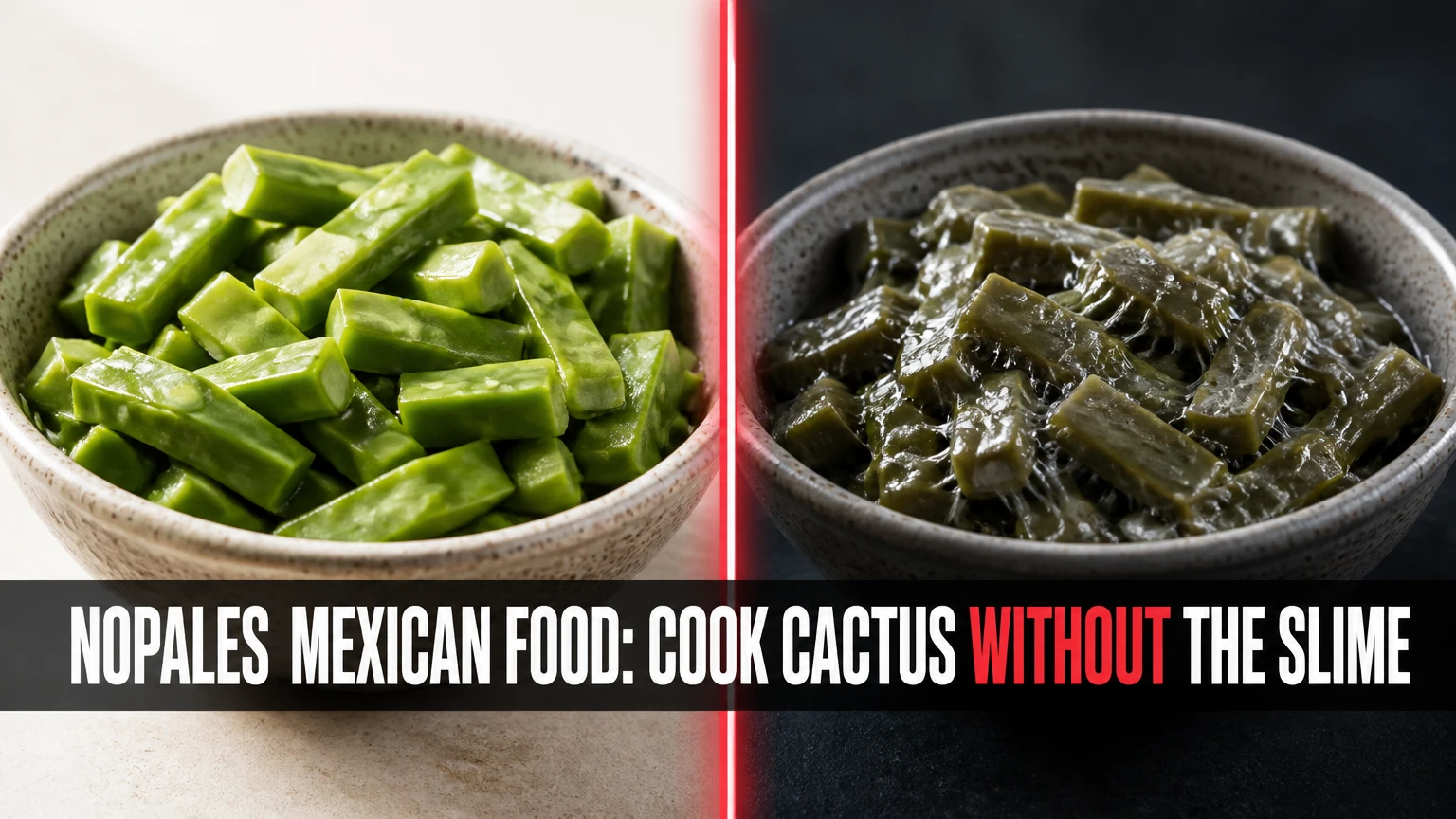
Nopales Mexican food means dishes made with the tender edible pads of prickly pear cactus, usually from the Opuntia genus. Nopales taste mildly tart and green, with a crisp bean-like texture, while their natural mucilage creates a sticky liquid called baba that cooks either into a sauce or gets rinsed away.
Nopales Mexican Food at a Glance
- Nopales are immature or tender prickly pear cactus pads, commonly called nopalitos after cutting.
- Fresh cactus has a mild vegetal flavor with tart, citrus-like notes and a texture between green beans and bell peppers.
- Sliced nopales release mucilage during heating; boiling and rinsing reduce it, while dry cooking concentrates flavor.
- A tender pad should be bright to medium green, flexible without being limp, and free from large scars or sunken areas.
- Fresh whole pads typically take 10-15 minutes to clean and 15-20 minutes to boil.
- Jarred or canned nopalitos are convenient, fully cooked, and usually require rinsing because their brine tastes salty or acidic.
What Are Nopales in Mexican Cuisine?
Nopales are the flattened stems of prickly pear cactus, rather than conventional leaves. The botanical group most often used for food belongs to Opuntia, a cactus family native to the Americas and deeply associated with Mexican agriculture, regional cooking, and national symbolism.
The word nopal generally refers to the pad, while nopalito often means a young pad or prepared strips and cubes. Spanish names vary by market. You may see whole pencas, sliced tiras, diced nopalitos, or small cambray pads.
Mexico’s National Institute of Anthropology and History documents the long culinary and cultural importance of the nopal in Mesoamerican foodways. The ingredient appears in home cooking, market stalls, regional stews, grilled plates, egg dishes, and meatless tacos. Its importance is practical as well as symbolic: cactus grows in dry conditions where many leafy vegetables require more irrigation.
What Do Nopales Taste and Feel Like?
Fresh nopales taste mildly grassy, faintly tart, and slightly citrusy, with an underlying flavor similar to green beans or green bell pepper. The surface feels firm and moist when raw, then becomes tender and pleasantly crisp after brief cooking.
Flavor changes with the method. Boiling produces a clean, mild vegetable suitable for a cold salad, while grilling adds char and keeps the pad intact. Dry pan cooking gives deeper roasted flavor, although the strips can become chewy if left over high heat.
Nopales are not naturally spicy. Chili, onion, garlic, lime, tomatillo, and fresh herbs supply most of the heat and aromatic character in finished Mexican dishes.
How Does Nopal Mucilage Work?
Nopal mucilage is a water-holding polysaccharide that creates the slippery liquid known in Mexico as baba. Cutting the pad exposes internal cells, and heat draws out more of that viscous material.
Mucilage is not a sign of spoilage. It is a normal part of the cactus and can be useful in soups, braises, and sauces because it adds body without flour or starch. For salads and tacos, most cooks prefer a cleaner, drier texture, so they remove it through boiling, draining, rinsing, or evaporation.
The best technique depends on the dish. A cold salad benefits from thorough rinsing, whereas a saucy stew can retain some baba for a naturally thicker broth.
Should You Remove All the Slime?
Remove most mucilage for salads, egg dishes, and dry taco fillings. Retain a small amount for soups, green sauces, and stews where body and moisture improve the final texture.
A common mistake is treating mucilage as a single problem with one mandatory solution. Boiling removes more surface viscosity but can dilute flavor, while dry cooking preserves flavor and requires closer heat control. Experienced cooks choose the finish before choosing the cleaning method.
How to Clean and Cook Fresh Nopales
Fresh nopales require thorn removal, trimming, cutting, and cooking. A practical batch of 1 pound of pads produces approximately 3-4 cups of sliced or diced cactus after trimming.
Before You Start
| Item | Typical requirement | Practical specification |
|---|---|---|
| Fresh pads | 1 pound | 4-6 medium pads, depending on size |
| Cleaning time | 10-15 minutes | Longer for heavily thorned pads |
| Boiling time | 15-20 minutes | Medium simmer, not a violent boil |
| Equipment | 4 items | Gloves, cutting board, knife, colander |
| Aromatics | 3 options | Onion, garlic, or tomatillo husks |
| Water | 2-3 quarts | Enough to cover the cut cactus |
Step 1: Hold the Pad Safely
Put on thick kitchen gloves, or grip the base with metal tongs while placing the pad on a stable cutting board. Avoid rubbing the surface with a bare towel because nearly invisible glochids can lodge in fabric and later reach your skin.
Step 2: Scrape the Thorns and Trim the Edge
Use a sharp knife held nearly flat against the pad. Scrape from the wide center toward the edge, shaving off visible spines and the small raised areoles that hold glochids. Turn the pad and repeat on the other side.
Cut away the narrow base and approximately 2-3 millimeters from the outer edge. Rinse only after scraping, because running water can move loose glochids onto the sink and nearby utensils.
Success checkpoint: the surface should feel smooth when checked with the knife spine, not with your fingers.
Common mistake: pressing hard enough to remove thick flesh, which wastes edible pad and creates uneven cooking.
Step 3: Slice or Dice the Pads
Cut the cactus into strips about 5 millimeters wide for tacos, or dice it into pieces 1-1.5 centimeters across for salads and egg dishes. Keep whole pads for grilling.
Uniform pieces matter more than decorative cuts. Thin strips release mucilage quickly and cook faster, while thick pieces hold a firmer bite and need more evaporation time.
Step 4: Boil With Aromatics
Place the cut nopales in 2-3 quarts of water with a 5-centimeter piece of onion, one garlic clove, and 1 teaspoon of salt. Add 2-3 tomatillo husks if available; many Mexican cooks use them to help manage foam, although they are optional rather than essential.
Bring the pot to a simmer over medium heat. Cook uncovered for 15-20 minutes, stirring once or twice. The pads should shift from vivid green to olive green and become fork-tender.
A small pinch of baking soda can soften texture and reduce perceived viscosity, but excessive baking soda produces a soapy taste and mushy cactus. Use no more than 1/8 teaspoon per pound unless a recipe specifies otherwise.
Step 5: Drain, Rinse, and Dry
Pour the cooked nopales into a colander and rinse under cold running water for 30-60 seconds while tossing them gently. Drain thoroughly, then press them lightly against the colander or spread them on a clean towel before seasoning.
Success checkpoint: the strips should be moist but separate, with no long strands of slime connecting them.
Common mistake: adding wet cactus directly to a hot tortilla or filling, which makes the dish watery.
Which Cooking Method Works Best?
Boiling is the most reliable method for reducing mucilage, grilling gives the strongest char, and dry pan cooking provides the best balance between flavor concentration and texture. The correct choice depends on whether the cactus will be served cold, folded into a filling, or presented whole.
| Method | Heat and time | Mucilage result | Best application |
|---|---|---|---|
| Boiling | Simmer, 15-20 minutes | Lowest after rinsing | Ensalada de nopales, eggs |
| Grilling | High heat, 4-5 minutes per side | Moderate retention | Whole-pad plates, tacos |
| Dry pan cooking | Medium-high, 8-12 minutes | Evaporates gradually | Onion and chile fillings |
| Roasting | 220°C / 425°F, 15-20 minutes | Moderate reduction | Sheet-pan vegetables |
| Pressure cooking | High pressure, 3-4 minutes | Very soft texture | Soups and blended sauces |
How Do You Grill Whole Nopales?
Brush cleaned whole pads with a thin film of oil and grill them over high heat for 4-5 minutes per side. The pads are ready when grill marks appear, the color darkens, and the center bends without collapsing.
Do not crowd the grill. Steam prevents browning and leaves more mucilage inside the pad. After grilling, cut the cactus into strips and season with lime, salt, onion, or a fresh chile sauce.
Grilled nopales work well beside beans, rice, roasted vegetables, and corn tortillas. They are less suitable for a cold salad because the intact pad retains more moisture than boiled and rinsed strips.
How Do You Pan-Sear Nopales Without Slime?
Heat a wide dry skillet over medium-high heat, add sliced nopales in a single layer, and cook for 8-12 minutes. Stir every 1-2 minutes until the released liquid evaporates, then add oil, onion, and chile during the final 3-4 minutes.
A wide pan increases evaporation. A covered skillet traps steam and prolongs the sticky stage, so keep the pan uncovered. Add salt near the end because early salting can draw out additional water before browning begins.
Which Nopales Should You Buy?
Choose fresh whole pads for the firmest texture and longest refrigerated life, cleaned fresh nopalitos for convenience, and jarred or canned cactus for pantry meals. Baby cambray pads are tender enough to cook whole but may cost more per pound.
| Product | Typical price | Refrigerator or pantry life | Best use |
|---|---|---|---|
| Whole fresh pads | $1.50-$3.00 per pound | 1-2 weeks untrimmed | Grilling, custom cuts |
| Fresh cleaned strips | $2.00-$4.00 per pound | 3-5 days unopened | Fast salads, eggs |
| Canned diced nopalitos | $2.00-$4.00 per 15-ounce can | 1-2 years unopened | Weeknight fillings |
| Jarred nopalitos | $2.50-$4.50 per 32-ounce jar | 1-2 years unopened | Large batches, stews |
| Cambray pads | $3.00-$6.00 per pound | About 1 week fresh | Whole-pad grilling |
Prices are typical United States retail ranges and vary by season, region, package size, and whether the store is a Mexican market or a conventional supermarket.
Select pads that are medium green, firm, unwrinkled, and free from wet sunken spots. Very large old pads can be fibrous. Extremely soft pads may have lost quality even when their color remains acceptable.
Are Jarred or Canned Nopales Better?
Jarred and canned nopalitos are both useful, but neither reproduces the crisp texture of fresh cactus. Jarred products often contain larger pieces and a pronounced vinegar or salt profile, while canned diced products are convenient for soups, scrambled eggs, and mixed fillings.
Read the label for water, salt, vinegar, onion, and preservatives. Drain the cactus, rinse it under cold water for 30-60 seconds, and taste before adding more salt or lime.
What Mexican Dishes Use Nopales?
Nopales fit dishes that need a tender green vegetable, a tart counterpoint, or a filling that remains substantial without heavy starch. Common applications include ensalada de nopales, scrambled eggs, tacos, quesadillas, soups, stews, and grilled vegetable plates.
| Dish | Cactus form | Supporting ingredients | Typical serving |
|---|---|---|---|
| Ensalada de nopales | Boiled strips | Tomato, onion, cilantro, lime, cheese | 3/4-1 cup |
| Nopales with eggs | Boiled dice | Eggs, onion, chile, tomato | 1/2 cup cactus per portion |
| Grilled cactus tacos | Whole or sliced pads | Tortillas, beans, salsa, avocado | 2-3 tacos |
| Nopales in green stew | Boiled strips | Tomatillo, onion, beans, herbs | 1 cup |
| Nopales with mushrooms | Pan-seared strips | Mushrooms, garlic, chile | 1-1 1/2 cups |
Ensalada de Nopales
For four servings, combine 4 cups boiled, rinsed, and drained cactus with 2 medium diced tomatoes, 1/2 small white onion, 1/3 cup chopped cilantro, the juice of 2 limes, and 1/2 cup crumbled fresh cheese. Add salt only after tasting.
The salad should be bright and moist, not watery. Drain the cactus for at least 5 minutes before mixing, and chill it for 20-30 minutes if serving with beans or grilled food.
Nopales for Tacos
Use 1/2 cup cooked strips per person, then combine them with sautéed onion, mushrooms, beans, or scrambled egg. A warm tortilla, acidic salsa, and a creamy element such as avocado balance the cactus better than a heavy filling does.
Nopales do not imitate the chew of meat. Their advantage is a fresh, lightly crisp vegetable texture that stands up to chile sauces and charred tortillas.
How Do Nopales Compare With Alternatives?
Green beans are the closest everyday substitute for texture, while green bell pepper supplies a similar fresh vegetal note but lacks the cactus character and mucilage. Okra can replace nopales in a thick stew, although okra produces a different viscosity and a more pronounced flavor.
| Alternative | Texture after cooking | Flavor match | Best substitute situation |
|---|---|---|---|
| Green beans | Crisp-tender, 6-8 minutes | Mild and grassy | Salad or sauté |
| Green bell pepper | Soft-crisp, 5-7 minutes | Green and fresh | Tacos with onion |
| Okra | Tender and viscous, 8-12 minutes | Earthier | Thick soup or stew |
| Zucchini | Soft, 5-8 minutes | Mild, less tart | Large-volume filling |
| Green asparagus | Firm, 4-6 minutes | Herbal and sweet | Grilled vegetable plate |
Substitution changes the cooking process. Green beans need no thorn removal or mucilage control, while okra should be managed with acidity, high heat, or minimal stirring depending on the desired texture.
Are Nopales Nutritious?
Nopales are a low-calorie vegetable that contributes fiber, water, and micronutrients, but nutrition varies by cultivar, maturity, preparation, and serving size. The USDA FoodData Central database is the best reference for a packaged product because brine can substantially increase sodium compared with fresh cactus.
A practical serving is 3/4-1 cup cooked cactus. Fresh or boiled nopales can fit vegetarian, vegan, and high-fiber meal patterns, while cheese, salted sauces, and preserved products change the meal’s sodium and energy profile.
Nopales are not a replacement for medical treatment. People using glucose-lowering medication should discuss substantial dietary changes with a qualified clinician, because cactus products may affect post-meal glucose response in some studies and individual responses differ.
How Should You Store Fresh and Cooked Nopales?
Store unwashed whole pads in a breathable produce bag in the refrigerator crisper for approximately 1-2 weeks. Store cleaned fresh strips for 3-5 days, and refrigerate cooked cactus in a sealed container for 3-4 days.
| State | Container | Storage temperature | Typical limit |
|---|---|---|---|
| Whole unwashed pads | Produce bag | 1-4°C / 34-40°F | 1-2 weeks |
| Cleaned raw strips | Covered container | 1-4°C / 34-40°F | 3-5 days |
| Cooked and drained cactus | Airtight container | 1-4°C / 34-40°F | 3-4 days |
| Opened jarred cactus | Covered, brine retained | 1-4°C / 34-40°F | 5-7 days |
| Frozen blanched strips | Freezer bag | -18°C / 0°F | 2-3 months |
Freeze blanched, cooled, and well-drained strips in 1-cup portions. Thawed nopales become softer, so use them in eggs, stews, or sauces rather than a crisp salad.
Discard cactus with a sour odor unrelated to its vinegar brine, mold, gas-producing bubbles, or a slimy coating that remains abnormal after rinsing. Natural baba is expected; spoilage has additional sensory signs.
Why Are Nopales Bitter, Salty, or Still Slimy?
Nopales become bitter mainly from mature fibrous pads, excessive browning, or a strong chile or acidic sauce rather than from normal mucilage. Saltiness usually comes from canned or jarred brine, while persistent slime usually results from inadequate evaporation, overcrowding, or insufficient rinsing.
Use the following corrections:
- Too slimy: rinse cooked cactus for another 30-60 seconds, drain, then dry-pan it for 3-5 minutes.
- Too salty: rinse preserved cactus, soak it in fresh water for 5 minutes, and drain before seasoning.
- Too bitter: mix with tomato, lime, onion, or a mild sauce; discard pads with a fermented odor.
- Too soft: use the batch in soup, eggs, or a blended sauce instead of trying to restore firmness.
- Tough or fibrous: cut away thick edges and cook longer with moisture, or reserve the pads for stock.
A practitioner rule is to taste preserved cactus before adding salt. Brine varies widely between brands, and recipes written for fresh pads often over-season jarred products.
What Are the Safest Handling Practices?
Glochids are tiny barbed hairs that can irritate skin even when the large spines have been removed. Use thick gloves, tongs, or a stable cutting technique, and clean the cutting board and sink after preparing raw pads.
Do not handle a scraped pad with bare fingertips to test smoothness. Run the back of a knife along the surface, then rinse the pad and tools separately from ready-to-eat foods.
If a glochid reaches the skin, use adhesive tape or tweezers under strong light. Avoid rubbing the area, which can push fine hairs deeper. Seek medical advice if irritation persists, the eye is affected, or swelling develops.
The Bottom Line
Nopales Mexican food is easiest to master when the desired texture determines the cooking method. Boil and rinse sliced cactus for a clean salad, dry-pan it for concentrated taco filling, or grill whole pads for char and presentation. Buy fresh pads for texture, prepared nopalitos for speed, and rinsed preserved cactus for reliable pantry cooking.
Frequently Asked Questions
Can You Eat Nopales Raw?
Yes, young tender nopales can be eaten raw after careful thorn removal and washing, but raw cactus has a firmer texture and more noticeable mucilage than cooked cactus. Slice it very thinly and use a small amount in a salad first. Most home cooks blanch or sauté nopales for a smoother texture and easier seasoning.
Do Nopales Need to Be Peeled?
Nopales do not need peeling because the edible surface remains attached to the pad. They do require scraping or trimming to remove spines, glochids, raised areoles, the narrow base, and the outer edge. Removing too much skin wastes edible flesh and does not improve tenderness.
Can You Cook Nopales Without Boiling Them?
Yes, dry-pan cooking, grilling, roasting, and broiling all work without boiling. Dry methods evaporate mucilage in the cooking vessel and preserve more concentrated flavor, but they require space, frequent monitoring, and careful heat control. Boiling remains easier when preparing a large batch for cold salad.
Why Do Nopales Turn Olive Green?
Nopales turn olive green because heat changes their pigments and softens their cell structure. The color shift usually indicates that the cactus has cooked through, not that it has spoiled. Bright green raw pads often become olive green after 15-20 minutes of simmering.
How Much Nopal Should You Serve?
Serve approximately 3/4-1 cup of cooked nopales as a vegetable portion, or about 1/2 cup inside an egg or taco filling. A pound of fresh pads commonly yields 3-4 cups after trimming and cooking, although pad thickness and discarded edges affect the final amount.
Can You Replace Nopales in a Mexican Recipe?
Replace nopales with green beans for a crisp salad, bell pepper for a fresh taco filling, okra for a thick stew, or zucchini for a mild high-volume vegetable. The substitute will not reproduce cactus mucilage, so adjust cooking time and sauce thickness rather than exchanging equal ingredients without tasting.