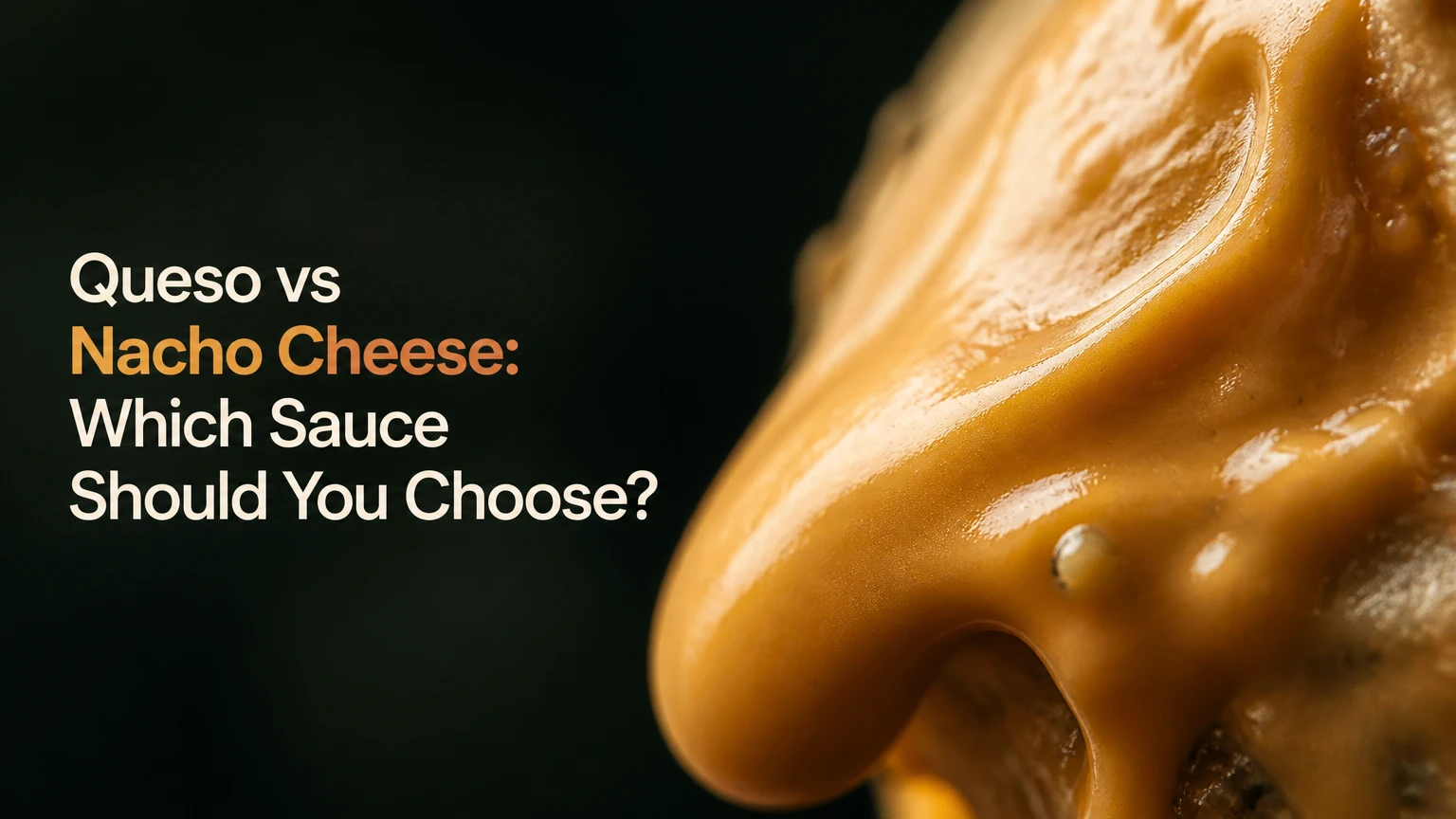
Queso is a broad name for a cheese-based dish or dip, while nacho cheese usually means a smooth, stabilized cheese sauce designed for chips and prolonged holding. Queso may taste fresher and more complex but thicken quickly; nacho cheese is typically more uniform, salty, and heat-stable. The best choice depends on flavor, texture, scale, and serving time.
Key Facts at a Glance
Queso describes a dish or dip category, not one fixed recipe.
Queso fundido is commonly melted natural cheese served hot, often with toppings.
Nacho cheese describes a sauce style associated with smooth, stable coating and dispensing.
Sodium citrate can turn natural cheese into a stable sauce at home, but that sauce is not automatically commercial nacho cheese.
Room-temperature fluidity does not make any cheese sauce safe to leave unrefrigerated.
Choose queso for fresh flavor and choose nacho cheese for holding stability, consistent coverage, and large-volume service.
What Is the Difference Between Queso and Nacho Cheese?
The main difference between queso and nacho cheese is category, not color. Queso is a Spanish word meaning cheese and can refer to a Mexican melted-cheese dish, a Tex-Mex chile dip, or a white cheese dip. Nacho cheese is a more specific sauce style associated with the cheese topping served over nachos, especially in cinemas, stadiums, cafeterias, and quick-service restaurants.
The terms overlap in everyday restaurant language. A restaurant may call a smooth processed cheese dip “queso,” while a home cook may make a nacho-style sauce from cheddar and sodium citrate. Therefore, appearance alone cannot identify the difference. A bright orange sauce may contain natural cheese, processed cheese, dairy solids, vegetable fat, starch, or several of those ingredients.
| Criterion | Queso | Nacho cheese |
|---|---|---|
| Culinary category | Dish, dip, or melted-cheese preparation | Cheese sauce style or commercial product |
| Common cheese base | Monterey Jack, Asadero, Oaxaca, Chihuahua, American cheese | Cheddar solids, American cheese, whey, processed cheese |
| Typical flavor | Dairy-forward, chile, onion, tomato, or spice notes | Salty, tangy, cheddar-like, sometimes mild |
| Texture | Pourable when hot, thicker as it cools | Smooth and pumpable across a wider temperature range |
| Stabilization | Processed cheese, starch, milk proteins, or blended methods | Emulsifying salts, starches, gums, or industrial processing |
| Best setting | Fresh appetizer, table service, home gathering | Nachos, concessions, cafeterias, high-volume service |
| Cooling behavior | Usually thickens or firms within 15-45 minutes | Often stays fluid longer, depending on the formula |
| Main weakness | Can break, skin, or congeal | Can taste salty, artificial, or one-dimensional |
Is queso always made with real cheese?
Queso is not always made entirely from natural cheese. Traditional preparations such as queso fundido generally center on melted cheese, but Tex-Mex queso dip may use processed American cheese, a processed cheese product, cream cheese, or a blend with natural cheese.
“Queso” is therefore a culinary label rather than a regulated ingredient specification. Check the ingredient panel when the distinction matters. “Cheese,” “pasteurized process cheese,” “cheese product,” and “cheese-flavored sauce” describe materially different formulations.
Is nacho cheese real cheese?
Nacho cheese may contain real cheese, processed cheese, cheese powder, whey, or a combination. Homemade nacho-style sauce made with cheddar and sodium citrate contains real cheese, whereas some commercial products obtain much of their cheese character from cheese solids, dairy ingredients, flavorings, and stabilizers.
The word “nacho” does not guarantee a particular cheese percentage. A product’s ingredient list and Nutrition Facts panel provide more reliable information than its orange color or serving format.
Why Do Queso and Nacho Cheese Melt Differently?
Queso and nacho cheese melt differently because cheese proteins, water, and fat need a stable emulsion to remain smooth. Natural cheese can release fat when overheated, while processed cheese and emulsifying salts help disperse fat through water and prevent large curds from forming.
Casein proteins hold much of cheese’s fat and moisture in a structured network. Heat softens that network, but excessive heat can tighten proteins and separate the sauce into oil and water. Acidity, cheese age, moisture level, shredding size, and heating speed all affect the outcome.
Queso recipes often use one or more practical stabilizers:
- Evaporated milk adds water and milk proteins.
- Cornstarch thickens the liquid and limits fat separation.
- American cheese contributes emulsifying salts and moisture.
- Cream cheese adds body and a more forgiving emulsion.
- Low, gradual heat protects the casein structure.
Sodium citrate works differently. The salt binds calcium in the cheese, allowing casein to disperse through added water and surround fat droplets. Sodium phosphate can provide a similar effect in processed formulations. A homemade sauce made with sodium citrate is a modern cheese emulsion with nacho-style behavior, regardless of whether the cook calls it queso.
Does queso use cornstarch while nacho cheese uses sodium citrate?
Queso may use cornstarch, flour, processed cheese, or no added stabilizer, while nacho cheese may use sodium citrate, sodium phosphate, starch, gums, or a combination. The distinction is typical rather than absolute because recipes and commercial formulas vary widely.
Cornstarch thickens a sauce by absorbing water, so too much can create a pudding-like texture. Sodium citrate creates a smoother emulsion, but excessive amounts can add a sharp, salty, or metallic taste. Neither ingredient alone determines authenticity or quality.
What Are the Main Types of Queso?
The main queso types are queso fundido, chile con queso or Tex-Mex queso dip, and queso blanco. These preparations differ in cheese, liquid, toppings, texture, and intended service rather than belonging to one standardized recipe.
| Queso type | Primary ingredients | Typical texture | Typical service |
|---|---|---|---|
| Queso fundido | Oaxaca, Chihuahua, Asadero, or Monterey Jack | Stretchy, molten, lightly browned | Skillet or shallow dish, eaten immediately |
| Chile con queso | Cheese, chile, onion, tomato, milk, or processed cheese | Spoonable or dip-like | Tortilla chips, tacos, or shared appetizer |
| Queso blanco | White American cheese, Monterey Jack, cream cheese, milk, green chile | Smooth, pale, pourable | Chips, vegetables, burritos, enchiladas |
| Restaurant queso dip | Processed cheese, natural cheese, dairy, peppers, spices | Creamy and moderately stable | Chip basket or plated appetizer |
| Chorizo-style queso | Cheese sauce with browned sausage and aromatics | Thick, textured, savory | Hot appetizer, usually served immediately |
Queso fundido deserves special clarification. The name means melted cheese, and the preparation is commonly broiled until bubbling, sometimes with browned sausage, mushrooms, peppers, or onions. It may stretch from a spoon but is not necessarily a thin dipping sauce.
Tex-Mex queso dip is more adaptable. Processed cheese gives it smoothness, while tomatoes, green chiles, jalapeños, onion, cumin, and milk provide its recognizable flavor. A natural-cheese version can taste more pronounced but requires closer temperature control.
What Are the Main Types of Nacho Cheese?
The main nacho cheese types are commercial concession sauce, canned or jarred shelf-stable sauce, refrigerated retail dip, and homemade sodium-citrate cheese sauce. Each type trades ingredient simplicity, flavor complexity, holding time, and convenience differently.
| Nacho cheese type | Common formulation | Holding profile | Best use |
|---|---|---|---|
| Concession sauce | Water, whey, cheese solids, oil, starch, salts | Pumpable during controlled hot holding | Stadiums, cinemas, cafeterias |
| Canned or jarred sauce | Processed cheese, starch, gums, preservatives | Shelf-stable unopened | Pantry convenience and quick snacks |
| Refrigerated dip | Dairy, cheese, stabilizers, peppers | Refrigerated, usually reheated gently | Home nachos and sandwiches |
| Sodium-citrate sauce | Natural cheese, water or milk, sodium citrate | Smooth while warm, reheatable | Gourmet home cooking |
| Plant-based nacho sauce | Cashew, potato, oil, starch, or vegan cheese | Formula-dependent, often moderately stable | Dairy-free diets |
Commercial nacho cheese is engineered for consistency. Industrial producers may use heat processing, modified starch, cellulose gum, whey, vegetable oil, and emulsifying salts so the product tolerates pumping, reheating, and repeated exposure to air.
Homemade sodium-citrate sauce behaves similarly to nacho cheese but can deliver stronger flavor. A typical starting point is 2%-3% sodium citrate based on the weight of the cheese, with enough water or milk to achieve the desired pour. The exact amount depends on cheese age, moisture, and sauce thickness.
Which Has Better Flavor and Texture?
Queso usually wins for fresh dairy flavor and regional character, while nacho cheese wins for uniform smoothness and predictable coating. Queso can include browned aromatics, roasted chiles, fresh tomatoes, and distinct cheese flavor; commercial nacho cheese usually prioritizes consistency over complexity.
Aged cheddar, Jack, Asadero, and Chihuahua cheese each contribute different levels of sharpness, elasticity, and moisture. Queso fundido made with Oaxaca cheese can develop strands, while a Monterey Jack dip tends toward a creamy pour. Commercial sauce often has a softer, saltier flavor that remains recognizable at different temperatures.
Texture determines the better choice in practice. Queso is attractive when served in a small skillet and eaten within 20 minutes. Nacho cheese is more effective when every chip needs an even coating after the sauce has sat in a warmer or dispenser.
Winner by criterion: Queso wins flavor complexity and fresh texture; nacho cheese wins smoothness, consistency, and coating reliability.
Which Stays Melted Longer?
Nacho cheese generally stays fluid longer because its emulsion includes stabilizing salts, starches, gums, or processed cheese ingredients. Queso typically thickens as it cools, although a queso recipe containing American cheese, evaporated milk, or sodium citrate can remain spoonable for several hours.
Typical home performance varies by formula:
| Sauce | Comfortable serving window | Cooling result | Reheating result |
|---|---|---|---|
| Queso fundido | 10-20 minutes | Firms and becomes stretchy | May turn oily if overheated |
| Natural-cheese queso dip | 20-45 minutes | Thickens and may skin | Usually recoverable with milk |
| Processed queso dip | 45-120 minutes | Thickens gradually | Usually smooth on low heat |
| Sodium-citrate sauce | 60-180 minutes | Thickens but remains emulsified | Reheats smoothly with added liquid |
| Commercial nacho sauce | Product-dependent, commonly several hours in equipment | Often remains fluid | Designed for controlled reheating |
A longer liquid window does not mean a sauce can sit safely at room temperature. Texture stability and microbial safety are separate properties.
Winner by criterion: Nacho cheese wins prolonged fluidity, but queso can match it when formulated with a reliable emulsifier and held correctly.
How Do You Make Smooth Queso?
Smooth queso requires freshly grated cheese, moderate moisture, and gentle heat. A dependable home method takes about 15-20 minutes and uses 12 ounces of cheese, 1 cup of evaporated milk, 2 teaspoons of cornstarch, and aromatics cooked before the cheese enters the pan.
Step 1: Prepare the cheese and aromatics
Grate 12 ounces of Monterey Jack, Asadero, or mild cheddar from a block. Toss the shreds with 2 teaspoons of cornstarch, then cook 1/2 cup of diced onion and 1 minced jalapeño in 1 teaspoon of oil for 3-4 minutes.
Freshly grated cheese melts more cohesively than pre-shredded cheese because anti-caking coatings can interfere with hydration and create a rough surface. You will know the aromatics are ready when the onion softens without browning heavily.
Step 2: Add the liquid
Pour 1 cup of evaporated milk into the pan and warm it until steaming, approximately 65-75°C or 150-167°F. Do not bring the milk to a rolling boil.
A bare simmer provides enough heat to melt cheese without aggressively tightening the proteins. The common mistake is adding cheese to boiling liquid, which encourages curdling and oil release.
Step 3: Melt the cheese gradually
Reduce the burner to low and add the coated cheese in four portions, whisking after each addition. Wait until one portion is nearly smooth before adding the next.
The queso is ready when the sauce looks glossy and flows from a spoon in a continuous ribbon. If the mixture becomes thick, add warm milk 1 tablespoon at a time.
Step 4: Season and serve
Stir in diced green chiles, tomatoes, cumin, or a small amount of hot pepper after the cheese has emulsified. Serve immediately in a warmed bowl, skillet, or fondue vessel.
The main mistake at this stage is holding queso over direct high heat. A warm water bath or slow cooker on its lowest setting is gentler than a hot burner.
How Do You Make Nacho-Style Cheese Sauce?
Nacho-style cheese sauce can be made in 5-10 minutes with 8 ounces of cheese, 1 cup of water or milk, and 16-24 grams of sodium citrate. The most important factor is dissolving the citrate before adding finely grated cheese, which lets the casein disperse instead of forming rubbery clumps.
Step 1: Measure the ingredients
Use 8 ounces, or 227 grams, of finely grated cheddar, Colby, Jack, or a blend. Measure 16 grams of sodium citrate for a mild starting level, equal to about 7% of the cheese weight? No, the practical percentage is 2%-3%, so use approximately 5-7 grams for 227 grams of cheese.
Add 1 cup of water or milk. Milk produces a rounder flavor, while water lets the cheese taste more directly. Use less liquid for a dip and more liquid for a pour.
Step 2: Dissolve the sodium citrate
Place the liquid and 5-7 grams of sodium citrate in a saucepan. Heat to steaming while whisking until the powder dissolves completely.
Undissolved citrate can create uneven seasoning. The liquid does not need to boil.
Step 3: Add the cheese
Add the grated cheese in small handfuls while whisking continuously. Keep the heat low to medium, and continue until the sauce becomes glossy and uniform.
You will know the emulsion has formed when no visible strands remain and the sauce coats a chip without breaking into oil. A blender can smooth a stubborn batch, but blending hot liquid requires a vented lid and careful handling.
Step 4: Adjust the consistency
Add warm liquid 1 tablespoon at a time if the sauce is too thick. If the sauce tastes metallic or overly salty, dilute it with more unsalted liquid and add additional cheese if needed.
Do not add more sodium citrate simply because the sauce is thick. Citrate stabilizes the emulsion, but liquid controls much of the final viscosity.
Which Is Better for Parties, Cooking, or Nachos?
Queso is better for small gatherings and dishes where fresh flavor matters, while nacho cheese is better for large groups, long service windows, and uniform chip coverage. Recipe compatibility also matters because a thick queso can overpower delicate fillings, whereas a thin commercial sauce may make baked dishes watery.
| Use case | Better choice | Practical reason | Limitation |
|---|---|---|---|
| 4-8 guests, immediate service | Queso | Fresher flavor and customizable toppings | Requires prompt serving |
| 20-50 guests | Stabilized queso | Better flavor with improved holding | Needs a slow cooker or water bath |
| 50-plus servings | Commercial nacho cheese | Consistent dispensing and portion control | Less complex flavor |
| Loaded tortilla chips | Either, based on timing | Queso tastes fresh; nacho sauce coats evenly | Chips soften under either sauce |
| Enchiladas or casseroles | Queso or cheese sauce | Integrates with baking and fillings | Very stable sauce may become oily if baked too long |
| Sandwiches and burgers | Nacho-style sauce | Smooth spread and controlled flow | Strong salt can dominate the dish |
| Queso fundido presentation | Queso fundido | Browning and cheese stretch are central | Short serving window |
| Dairy-free nachos | Plant-based nacho sauce | Formulated starches and oils provide body | Flavor depends heavily on the product |
For nachos served immediately, queso offers a more distinctive result. For a buffet where chips are replenished over two hours, stabilized nacho cheese reduces texture complaints and waste.
Can You Substitute Queso for Nacho Cheese?
You can substitute queso for nacho cheese when the dish is served hot and soon after preparation. The substitution works less well in a pump dispenser, a long buffet, or any application requiring a thin sauce to remain fluid for several hours.
To make queso behave more like nacho sauce, use a processed cheese component, evaporated milk, or sodium citrate. Keep the sauce warm rather than hot, cover the surface to reduce skin formation, and stir before serving.
To make nacho cheese behave more like queso, add cooked onion, green chile, tomato, cumin, or fresh herbs after warming. Add toppings shortly before service because watery vegetables can thin the sauce and dilute its flavor.
What can replace sodium citrate?
American cheese, processed cheese, evaporated milk, cornstarch, and sodium phosphate can all contribute to stability, but they are not interchangeable in identical quantities. Cornstarch thickens; sodium citrate emulsifies; processed cheese contributes both water-soluble emulsifying salts and dairy solids.
A cornstarch-based sauce is the easiest substitute for a home dip. It will usually be thicker and less glossy than a sodium-citrate sauce.
How Much Do Queso and Nacho Cheese Cost?
A typical homemade queso batch costs about $5-$10 for 6-8 servings, while homemade nacho-style sauce costs approximately $4-$9 for a similar yield. Retail and commercial prices vary by package size, cheese content, brand, location, and whether the product is shelf-stable.
| Cost factor | Homemade queso | Homemade nacho-style sauce | Commercial nacho cheese |
|---|---|---|---|
| Typical batch size | 5-7 cups | 4-5 cups | 1-5 gallons |
| Typical home cost | $5-$10 | $4-$9 | $8-$35 package-equivalent |
| Active preparation | 15-20 minutes | 5-10 minutes | 0-5 minutes |
| Equipment | Saucepan or slow cooker | Saucepan, whisk, scale | Warmer or dispenser for volume |
| Portion cost, typical | $0.65-$1.65 | $0.50-$1.40 | $0.20-$0.90 |
| Main cost driver | Natural cheese and toppings | Cheese and sodium citrate | Package size and dispensing system |
Commercial nacho cheese often becomes economical at high volume because it reduces labor, batch variation, and cleanup. Homemade queso usually provides better value when the goal is flavor rather than the lowest portion cost.
Is Nacho Cheese Safe at Room Temperature?
Nacho cheese is not automatically safe at room temperature because fluidity does not control bacterial growth. Perishable cheese sauces should remain cold or stay under approved hot-holding conditions, and the FDA Food Code commonly specifies 57°C or 135°F or higher for hot holding in food-service settings.
The USDA Food Safety and Inspection Service describes the temperature range from 40°F to 140°F as the “Danger Zone.” Follow local regulations, product-label instructions, and time limits rather than assuming a shelf-stable texture indicates shelf-stable food.
Opened queso and refrigerated cheese sauce should be cooled promptly in shallow containers, refrigerated at 40°F or below, and used according to the product’s instructions. A typical home practice is to use leftovers within 3-4 days, although the manufacturer’s label takes priority for packaged products.
Commercial unopened cans and pouches may be shelf-stable because they undergo controlled processing and sealed packaging. That property does not transfer to homemade sauce or an opened container.
What Common Problems Affect Each Sauce?
Queso most often fails through overheating, poor cheese selection, or insufficient liquid, while nacho-style sauce most often fails through incorrect emulsifier measurement, inadequate dispersion, or moisture loss. Recovery depends on whether the sauce is merely thick or has fully separated.
| Problem | Likely cause | Best first fix | Prevention |
|---|---|---|---|
| Grainy queso | Boiling, aged cheese, or acid shock | Whisk in warm milk over low heat | Melt gradually below a simmer |
| Oily queso | Excess heat or insufficient water | Add warm milk and whisk gently | Use evaporated milk or starch |
| Rubbery queso | Protein overheating | Remove from heat and add liquid | Avoid direct high heat |
| Thick nacho sauce | Evaporation or too little liquid | Add warm water or milk gradually | Cover during holding |
| Metallic nacho sauce | Excess sodium citrate | Dilute with unsalted liquid | Weigh citrate at 2%-3% |
| Lumpy nacho sauce | Citrate not dissolved or cheese added too fast | Blend carefully or whisk over low heat | Dissolve citrate first |
| Skin on either sauce | Surface evaporation | Cover directly or stir periodically | Use a lid or surface cover |
| Watery sauce | Too much liquid or wet toppings | Reduce gently or add cheese | Measure liquid and drain vegetables |
One practitioner rule matters more than most recipes: fix temperature before adding ingredients. A broken queso often needs gentler heat, not more cheese. A thick nacho sauce usually needs liquid, not more emulsifying salt.
Another counterintuitive point is that pre-shredded cheese can fail even when the label names a good melting variety. Cellulose or starch coatings can prevent close contact between shreds, so block cheese remains the safer choice for smooth homemade queso.
Which Should You Choose?
Choose queso for fresh flavor, visible toppings, and service within 15-45 minutes. Choose nacho cheese for consistent texture, low labor, large groups, or applications where the sauce must remain fluid during holding.
For the home cook
Choose homemade queso if you have Monterey Jack, Asadero, or another moderate-moisture cheese and plan to eat it immediately. Choose sodium-citrate sauce if you want to use aged cheddar or another flavorful cheese without accepting a grainy, oily result.
For a game-day host
Choose stabilized queso made with natural cheese plus a modest amount of processed cheese or sodium citrate. The blend provides stronger flavor than many commercial sauces while tolerating a 1-3 hour serving period in a slow cooker on low.
For a concession operator
Choose commercial nacho cheese with equipment approved for the product. Pumpability, heat-holding instructions, portion control, sanitation, and local food-code compliance matter more than whether the sauce contains a higher percentage of natural cheese.
For a cook choosing by nutrition
Compare labels rather than category names. Sodium, saturated fat, calories, dairy allergens, and serving size can vary substantially between a natural-cheese queso, a processed dip, and a plant-based sauce.
FAQ
Is queso healthier than nacho cheese?
Neither category is automatically healthier. A queso made from natural cheese may have a shorter ingredient list, but cheese itself can be high in saturated fat and sodium; commercial nacho cheese may contain more sodium, starch, or added fat. Compare serving sizes and Nutrition Facts panels for a meaningful decision.
Can queso be frozen?
Queso can be frozen, but thawed texture may become grainy or oily because water and fat separate during freezing. A stabilized queso or sodium-citrate sauce usually reheats better than queso fundido. Thaw it in the refrigerator, then warm it gently while whisking in 1-2 tablespoons of liquid.
Why does restaurant queso stay smooth?
Restaurant queso often uses processed cheese, emulsifying salts, evaporated milk, starch, or a controlled blend of these ingredients. Restaurants also hold it in warmers that maintain a consistent temperature. Fresh homemade queso placed in a cold bowl lacks both the formulation and temperature control that preserve restaurant texture.
Is queso blanco the same as nacho cheese?
Queso blanco is not the same as nacho cheese. Queso blanco usually describes a pale cheese dip made with white cheese, milk, cream, or green chile, while nacho cheese describes a sauce function and texture. A white nacho sauce can exist, and an orange queso can exist.
Why does queso harden faster than nacho cheese?
Queso hardens faster because natural cheese proteins and fat return toward a firmer structure as the sauce cools. Nacho cheese often contains emulsifying salts, starches, gums, or processed cheese that keep water and fat dispersed. More stabilizer and moisture generally mean a longer fluid window.
What is the best cheese for homemade nacho sauce?
Mild or medium cheddar, Colby, Monterey Jack, and American cheese are reliable choices. Aged cheddar gives stronger flavor but may need more liquid and careful emulsification. A practical blend is two parts cheddar to one part Monterey Jack, with sodium citrate measured at roughly 2%-3% of the cheese weight.
The Bottom Line
Queso vs nacho cheese is primarily a choice between fresh culinary character and engineered stability. Queso is the better option for immediate service, regional flavor, toppings, and a skillet presentation. Nacho cheese is the better option for prolonged holding, even coating, dispensing, and large-scale service. For a home compromise, use flavorful natural cheese with a measured stabilizer and gentle heat.