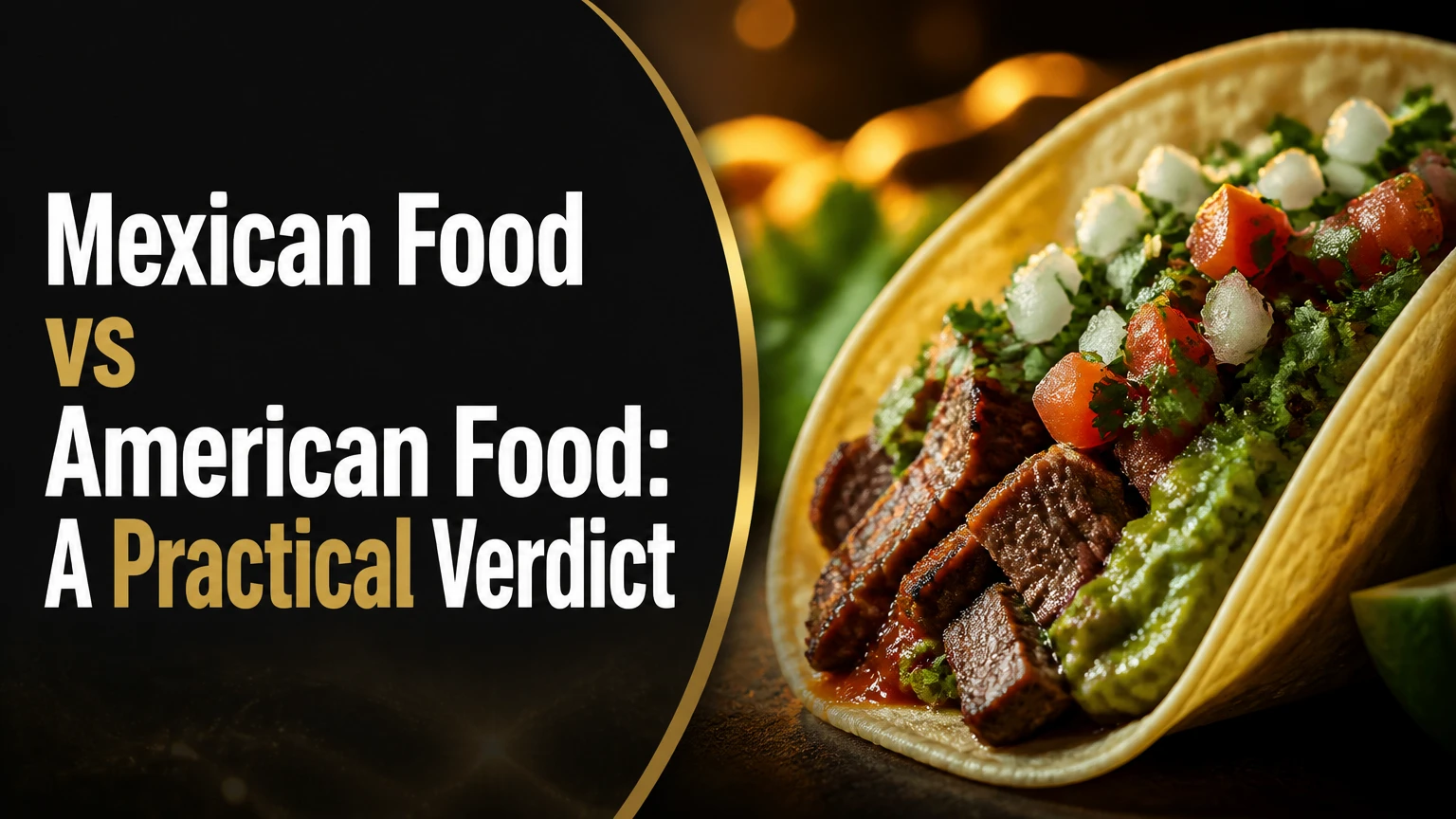
Mexican food and American food differ most in their culinary foundations, not in a simple spicy-versus-mild divide. Mexican cuisine commonly builds meals around maize, beans, chiles, herbs, salsas, and layered sauces, while American cuisine spans regional traditions centered on wheat, dairy, meat, seafood, grilling, baking, frying, and immigrant-created adaptations.
Key Facts at a Glance
- Mexican cuisine was added to UNESCO’s Representative List of the Intangible Cultural Heritage of Humanity in 2010.
- Nixtamalization uses an alkaline solution to turn dried maize into masa with improved texture and greater availability of niacin.
- American food is a regional family of cuisines that includes New England seafood, Southern cooking, barbecue, Midwestern baking, and Southwestern traditions.
- Mexican dishes are often assembled from several components, such as a tortilla, filling, salsa, beans, herbs, and a sharp garnish.
- American meals can be prepared in under 20 minutes, while traditional barbecue and some Mexican braises commonly require 8-16 hours.
- Neither cuisine is automatically healthier; cooking method, portion size, sodium, added sugar, and ingredient quality determine the nutritional result.
What Do Mexican Food and American Food Mean?
Mexican food refers to the cuisines of Mexico, shaped by Indigenous Mesoamerican foodways, Spanish colonial ingredients and techniques, and distinct regional environments. American food refers to the United States’ broad culinary landscape, where Indigenous traditions, European settlement, African American cooking, immigration, industrial food production, and local agriculture interact.
The distinction matters because “American food” is not one fixed menu. A Maine lobster roll, Louisiana gumbo, Kansas City barbecue, Navajo fry bread, New York pizza, California-style produce cooking, and a Midwestern hotdish express different histories and ingredients. Mexican cooking has the same internal diversity, from northern wheat-flour traditions to Yucatán citrus and achiote preparations.
The Smithsonian’s National Museum of the American Indian documents Indigenous contributions to foods and agricultural systems that shaped the United States. UNESCO describes traditional Mexican cuisine as a cultural model based on farming, ritual practices, community customs, and culinary techniques, rather than as a list of restaurant dishes. That distinction prevents two common errors: treating Tex-Mex as identical to Mexican cuisine, and treating fast food as the full definition of American cooking.
How Do the Flavor Systems Differ?
Mexican cuisine usually creates flavor through contrast and layering: chile heat against acidity, toasted spices against fresh herbs, and earthy beans against bright salsa. American cuisine has no single flavor system, but many familiar United States dishes emphasize browning, smoke, dairy richness, sweetness, salt, and savory meat or vegetable stock.
Mexican cooks may toast dried chiles, spices, seeds, or maize before grinding them, which adds roasted depth without relying only on heat. Lime, tomatillo, vinegar, pickled vegetables, fresh cilantro, epazote, and raw onion provide acidity or herbal lift. A mole can combine many ingredients into one sauce, while a taco may keep each component distinct.
American flavor techniques often begin with browning. Maillard reactions create the crust on a burger, roast, biscuit, or baked casserole, while smoking adds phenolic aromas from hardwood. Regional sauces then establish identity: vinegar-based sauces in the Carolinas, tomato and molasses profiles in Kansas City, or pepper-forward seasoning in central Texas.
| Culinary attribute | Mexican cuisine, typical pattern | American cuisine, typical pattern | Practical consequence |
|---|---|---|---|
| Primary starch | Maize masa, rice, wheat in northern regions | Wheat bread, pasta, potatoes, maize, rice | Tortillas often replace sliced bread |
| Acid source | Lime, tomatillo, vinegar, sour fruit | Vinegar, pickle brine, citrus, tomato | Both cuisines use acidity to balance fat |
| Heat source | Jalapeño, ancho, guajillo, chile de árbol, habanero | Black pepper, hot sauce, cayenne, chile peppers | Mexican heat varies by chile and preparation |
| Main aroma technique | Toasting, roasting, grinding, slow simmering | Browning, grilling, smoking, baking, frying | Texture and aroma differ before seasoning |
| Common fresh finish | Cilantro, onion, radish, salsa | Pickles, slaw, herbs, relishes, sauces | Garnishes can change a dish’s balance |
| Sauce role | Salsa, adobo, mole, pipián, chile broth | Gravy, barbecue sauce, cheese sauce, pan sauce | Mexican sauces may carry the dish’s identity |
Which Ingredients Define Each Cuisine?
Maize, beans, and chiles form a useful shorthand for Mexican cuisine, but the phrase “holy trinity” can oversimplify a food system that also depends on squash, tomatoes, tomatillos, cacao, amaranth, avocado, herbs, seafood, poultry, and regional fruits. American cooking similarly depends on more than meat, wheat, and dairy, with Indigenous maize, wild rice, beans, seafood, greens, legumes, and local produce remaining important.
Nixtamalization is one of Mexican cuisine’s defining technical processes. Cooks simmer dried maize in water with food-grade calcium hydroxide, rest it for roughly 8-16 hours, wash away loosened skins, and grind the kernels into masa. The process changes aroma, softens the grain, improves dough handling, and increases the body’s access to niacin.
| Ingredient or ingredient group | Mexican culinary role | American culinary role | Typical examples |
|---|---|---|---|
| Maize | Masa for tortillas, tamales, sopes, tlacoyos | Sweet corn, grits, cornbread, polenta-style dishes | Corn tortilla, cornbread |
| Beans | Protein, filling, side dish, purée | Soups, baked dishes, chili, salads | Black beans, pinto beans, navy beans |
| Chiles | Fresh, dried, smoked, pickled, or powdered seasoning | Hot sauce, regional stews, Southwestern dishes | Poblano, ancho, jalapeño |
| Wheat | Flour tortillas, breads, noodles in northern regions | Bread, pasta, pastries, pizza, biscuits | Sonoran flour tortilla, sandwich bread |
| Dairy | Crema, queso fresco, aged cheeses | Cheddar, cream, butter, yogurt, processed cheese | Queso fresco, cheddar |
| Seafood | Coastal stews, ceviche, grilled preparations | New England, Gulf, Pacific, and Great Lakes traditions | Fish taco, clam chowder |
How Regional Is Mexican Food?
Mexican cuisine is highly regional, and a dish from Oaxaca may use different chiles, herbs, starches, and cooking equipment from a dish in Sonora or Yucatán. Regional climate, Indigenous language communities, trade routes, coastline, livestock, and colonial history all influence the result.
Oaxacan cooking is associated with multiple mole traditions, tlayudas, maize preparations, and chapulines. Yucatán cooking uses achiote, sour orange, habanero, and underground or pit-style roasting techniques. Baja California is known for seafood, battered fish tacos, cabbage, and border-region innovation. Northern Mexico uses wheat flour more heavily than many central and southern regions.
Tex-Mex is a United States regional cuisine with Mexican influences, particularly associated with Texas and the borderlands. Yellow cheese, cumin-heavy ground-beef fillings, large flour tortillas, chili con carne, and combination plates often identify Tex-Mex, although restaurants vary widely. Tex-Mex is not “fake Mexican food”; it is a distinct cuisine shaped by migration, local agriculture, commercial supply chains, and United States dining habits.
What Is the Difference Between Mexican Food and Tex-Mex?
Mexican food and Tex-Mex overlap in ingredients but differ in historical development, seasoning patterns, dish formats, and regional identity. Mexican food reflects Mexico’s many regional cuisines, while Tex-Mex developed in the United States and often uses flour tortillas, yellow cheese, ground beef, cumin, and larger plated portions.
That distinction helps diners order accurately. A birria taco, Oaxacan mole, Yucatecan cochinita-style preparation, or tlacoyo belongs to Mexican culinary traditions, while a chili-cheese enchilada plate or large beef-and-bean burrito may fit Tex-Mex conventions. Neither label guarantees quality or authenticity.
How Regional Is American Food?
American food is best understood as a network of regional cuisines rather than a single national flavor profile. Indigenous foodways, West African culinary knowledge, European settlement, Asian and Latin American immigration, industrial agriculture, refrigeration, diners, and restaurant chains all shaped the modern table.
The American South includes soul food, Lowcountry cooking, Cajun and Creole traditions, biscuits, greens, fried chicken, rice dishes, and legumes. Barbecue varies by region, with Texas commonly emphasizing beef and oak, Carolina traditions using acidic sauces, and Kansas City styles favoring sweet, thick sauces. New England cooking highlights shellfish, potatoes, dairy, and coastal preservation.
The Midwest is associated with casseroles, hotdishes, grains, dairy, sausages, and baking, while California cooking often gives produce, seafood, and multicultural fusion a larger role. The United States also has Native American cuisines that should not be reduced to historical influences, because contemporary Indigenous chefs and communities continue to develop living food traditions.
| American regional tradition | Signature ingredients | Common techniques | Representative dishes |
|---|---|---|---|
| Texas barbecue | Beef, oak smoke, salt, black pepper | Smoking at 225-275°F | Brisket, smoked sausage |
| Carolina cooking | Pork alternatives, vinegar, mustard, greens | Smoking, braising, stewing | Vinegar barbecue, collard greens |
| New England | Clams, lobster, potatoes, dairy | Steaming, baking, chowder-making | Clam chowder, lobster roll |
| Louisiana | Rice, okra, seafood, peppers, aromatics | Roux-making, simmering, stewing | Gumbo, jambalaya |
| Midwestern comfort food | Potatoes, wheat, dairy, ground meat | Baking, casserole cooking, frying | Hotdish, pot pie |
| Southwestern cuisine | Maize, chiles, beans, squash | Grilling, roasting, stewing | Green chile stew, posole-style soups |
Which Cuisine Is Healthier?
Neither Mexican food nor American food is inherently healthier. A bean soup with maize tortillas, grilled fish, salsa, and vegetables can provide fiber, protein, and moderate fat, while a deep-fried restaurant platter can be high in sodium and calories; the same dish-level distinction applies to a home-cooked American grain bowl versus a heavily processed fast-food meal.
The strongest nutritional comparison uses measurable attributes:
| Meal example | Typical calories | Protein | Fiber | Main nutritional risk |
|---|---|---|---|---|
| Bean soup, 2 maize tortillas, salsa | 450-700 | 18-30 g | 12-20 g | Sodium from broth |
| Grilled fish tacos, 3 small tacos | 500-850 | 25-40 g | 6-12 g | Added sodium or fried toppings |
| Cheeseburger with fries | 900-1,400 | 30-55 g | 4-9 g | Saturated fat and sodium |
| Barbecue plate with sides | 800-1,500 | 35-70 g | 5-14 g | Sauce sugar and large portions |
| Vegetable chili with cornbread | 500-850 | 18-30 g | 12-22 g | Sodium in canned ingredients |
| Fried chicken with biscuit and slaw | 900-1,600 | 30-55 g | 3-10 g | Fried fat, sodium, refined starch |
Mexican cuisine offers many naturally gluten-free foundations because maize, beans, rice, potatoes, and squash contain no gluten. Cross-contact still matters in restaurants, and flour tortillas, shared fryers, seasoning blends, and sauces can introduce wheat. American cuisine offers equally strong vegetarian, gluten-free, and high-fiber options, but diners must often move away from refined bread, processed meat, and cream-heavy sides.
A practical rule is to choose the cooking method first. Grilled, steamed, roasted, simmered, and bean-based dishes usually make portion control easier than deep-fried, heavily breaded, or cheese-dominated meals.
Which Cuisine Is Spicier?
Mexican cuisine generally offers a broader range of chile-specific heat, but Mexican food is not automatically hot. Chiles contribute heat, fruitiness, smoke, bitterness, or color, and cooks can remove seeds, dilute sauces, or choose mild varieties such as poblano and ancho.
American food also includes significant chile heat, especially in Southwestern cooking, Louisiana cuisine, hot-sauce culture, and modern fusion restaurants. The difference is that Mexican cooking often treats chiles as structural ingredients, whereas many American dishes add hot sauce as a condiment.
| Chile or seasoning | Approximate Scoville range | Flavor profile | Common use |
|---|---|---|---|
| Poblano | 1,000-2,000 SHU | Green, earthy, mild | Rellenos, roasting |
| Jalapeño | 2,500-8,000 SHU | Fresh, grassy | Salsa, pickling |
| Ancho | 1,000-2,000 SHU | Raisin-like, mild, deep | Mole, adobo |
| Chile de árbol | 15,000-30,000 SHU | Dry, sharp, nutty | Salsa and broths |
| Habanero | 100,000-350,000 SHU | Fruity, intense | Yucatán-style sauces |
| Cayenne | 30,000-50,000 SHU | Direct, dry heat | Hot sauces and spice blends |
Scoville figures vary by cultivar, growing conditions, and testing method. Heat-sensitive diners should request salsa on the side, identify the chile used, and ask whether a sauce is roasted or raw, because preparation changes perceived intensity.
Which Is Faster to Cook?
American convenience cooking is usually faster for a complete home meal, particularly when the meal uses a sheet pan, skillet, prepared bread, or pre-cut ingredients. Mexican food is equally fast when the cook uses prepared masa, canned beans, fresh salsa, and quick-cooking fillings, but traditional sauces and braises extend the schedule.
| Meal or technique | Active time | Total time | Main constraint |
|---|---|---|---|
| Smash burger and salad | 15-25 minutes | 20-30 minutes | Cooking several portions |
| Sheet-pan chicken and vegetables | 15 minutes | 35-50 minutes | Oven heating and roasting |
| Bean tacos with fresh salsa | 20-30 minutes | 25-40 minutes | Tortilla warming and assembly |
| Fresh masa tortillas | 35-50 minutes | 45-70 minutes | Pressing and cooking batches |
| Mole-style sauce | 90-180 minutes | 3-6 hours | Toasting, grinding, simmering |
| Barbacoa-style braise | 45-75 minutes | 8-12 hours | Low-temperature tenderizing |
| American smoked brisket | 60-90 minutes | 10-16 hours | Stable smoker temperature |
The comparison changes in a professional kitchen. A taco station can assemble an order in 3-7 minutes, while a barbecue restaurant may prepare meat overnight and serve it quickly during service. Time-to-plate therefore measures mise en place as much as cooking speed.
What Do Mexican and American Meals Cost?
Typical casual restaurant prices overlap, with a small taco order often costing $8-$18 and a burger meal commonly costing $12-$25 in the United States. Ingredient prices vary more than cuisine labels because seafood, beef, labor, location, portion size, and restaurant format dominate the final bill.
| Purchase situation | Mexican food, typical United States price | American food, typical United States price | Cost driver |
|---|---|---|---|
| Street-style meal | $8-$18 | $10-$20 | Portion and local labor |
| Fast-casual entrée | $11-$20 | $12-$25 | Protein and side dishes |
| Sit-down entrée | $16-$35 | $18-$40 | Service, rent, and ingredients |
| Home meal for four | $18-$45 | $20-$55 | Protein, produce, and prepared items |
| Special-occasion dish | $35-$90 | $40-$120 | Seafood, specialty cuts, labor |
Beans, rice, maize tortillas, seasonal vegetables, and dried chiles can make Mexican home cooking economical. American home cooking can also be inexpensive when based on beans, grains, potatoes, eggs, seasonal produce, and bulk preparation. Restaurant comparisons become misleading when a $3 taco is compared with a full burger combination including fries and a drink.
How Do Cooking Methods Compare?
Mexican cooking often combines direct heat with grinding, simmering, steaming, roasting, and fermentation or preservation. American cooking commonly emphasizes baking, grilling, frying, smoking, braising, and skillet browning, although both cuisines use nearly all of these methods.
Nixtamalization is a chemical transformation, not simply boiling maize. Food-grade calcium hydroxide loosens the hull, changes the grain’s structure, and supports masa formation after washing and grinding. A home cook should use measured food-grade lime, not construction lime, because product purity and intended use differ.
American barbecue requires stable heat and patience. A smoker may run at 225-275°F, but a fixed internal target of 203°F is not universal. Tenderness, probe resistance, connective-tissue conversion, and resting time matter more than a single thermometer number, because different cuts finish at different temperatures.
What Are the Most Important Technique Checkpoints?
- Masa should feel like soft, damp modeling clay rather than crumble when pressed.
- A tortilla press should produce an even disk about 2-3 millimeters thick.
- Dried chiles should smell fruity or earthy, not dusty or rancid.
- Salsa acidity should be tasted after salt because salt changes perceived sharpness.
- Smoked meat should rest for at least 30-120 minutes, depending on size.
- Braised meat should separate under gentle pressure before serving.
- Fried food should drain on a rack, not remain in a pool of oil.
A practitioner rule matters here: fix texture before seasoning. More salt cannot repair dry masa, and more smoke cannot repair undercooked connective tissue.
Which Cuisine Works Better for Dietary Needs?
Mexican cuisine is often easier to adapt for gluten-free and plant-forward meals because maize, beans, squash, rice, and fresh produce provide useful foundations. American cuisine offers broader packaged-food availability and extensive vegetarian, vegan, low-carbohydrate, and allergen-aware options, but diners must inspect breads, sauces, shared fryers, and processed ingredients.
| Dietary need | Easier starting point | Safer dish pattern | Main verification step |
|---|---|---|---|
| Gluten-free | Mexican cuisine | Maize tortillas, beans, grilled fillings | Ask about flour cross-contact |
| Vegetarian | Both cuisines | Bean tacos, vegetable chili, grain bowls | Check stock, cheese, and cooking fat |
| Vegan | Both cuisines | Beans, salsa, roasted vegetables, rice | Confirm dairy and animal-derived broth |
| Lower sodium | Home cooking in either cuisine | Fresh herbs, citrus, unsalted beans | Control stock, cheese, sauces |
| Higher fiber | Mexican cuisine often has an advantage | Beans, vegetables, maize, whole grains | Limit refined fried sides |
| Low spice | American cuisine is often simpler | Roasted vegetables, baked dishes, mild soups | Request sauces separately |
No cuisine guarantees allergen safety. Peanut, tree-nut, dairy, wheat, egg, and shared-fryer risks depend on the specific kitchen rather than the cuisine’s name.
What Mistakes Change the Result?
Mexican cooking loses character when every dish uses the same commercial chili powder, flour tortilla, or bottled hot sauce. American cooking loses quality when cooks chase speed in techniques that require time, especially smoking, braising, dough fermentation, and resting.
- Using stale dried chiles: Old chiles produce flat bitterness. Replace them when the aroma is weak, leathery, or dusty.
- Making dry masa: Add warm water one tablespoon at a time, rest the dough for 15 minutes, then test another tortilla.
- Overheating salsa: Boiling a fresh salsa for too long removes its raw acidity. Cook only the ingredients intended for roasting.
- Rushing smoked meat: Raising the smoker temperature can dry the exterior before collagen softens. Hold the temperature steady and judge tenderness.
- Slicing immediately: Cutting a large roast at once releases internal juices. Rest it under loose covering before serving.
- Comparing restaurant categories unfairly: A fast-food burger and a regional Mexican tasting menu measure price and labor, not cuisine quality.
The counterintuitive truth is that “authentic” does not mean historically frozen. Mexican and American cuisines both change through migration, technology, commerce, and household adaptation. A dish can be traditional, regional, modern, or hybrid without its quality being settled by the label alone.
Which Should You Choose?
Mexican food is the stronger choice when you want chile-driven complexity, maize-based gluten-free options, bean-centered meals, salsa customization, or a meal assembled from many fresh components. American food is the stronger choice when you want broad regional variety, familiar comfort dishes, fast skillet meals, smoked foods, bakery items, or easy large-group service.
Choose Mexican Food for Layered Flavor
Select Mexican food when toasted chiles, fresh herbs, citrus, beans, masa, and contrasting textures appeal to you. A meal of grilled vegetables, beans, maize tortillas, and salsa can remain filling without relying on a large portion of meat or dairy.
Choose American Food for Speed and Familiarity
Select American food when you need a predictable meal in 20-40 minutes or want a format that guests can customize. A baked potato bar, burger station, sheet-pan dinner, or vegetable chili can serve different preferences with limited last-minute cooking.
Choose Mexican Food for Gluten-Free Flexibility
Choose Mexican food when maize tortillas and rice provide a practical alternative to wheat bread. Confirm preparation methods, because restaurant kitchens may warm maize and flour tortillas on the same surface or fry them in shared oil.
Choose American Food for Large Groups
Choose American food for gatherings when batch cooking and self-service matter most. Chili, barbecue, baked pasta, cornbread, roasted vegetables, and layered salads can be prepared in large quantities, while taco fillings and toppings can provide a similarly flexible Mexican-style spread.
Choose Either Cuisine for Health Goals
Choose the dish with more vegetables, beans, whole grains, or fruit and less deep-frying, refined starch, added sugar, and excess sodium. A grilled fish taco plate may outperform a cream-heavy casserole, while a bean chili may outperform a fried combination platter, regardless of national label.
FAQ
Is Mexican Food More Authentic Than American Food?
Mexican food and American food both contain traditional and modern cuisines, so “more authentic” is not a useful universal ranking. Authenticity depends on region, community, ingredient history, preparation, and the cook’s intended tradition. Tex-Mex is authentically Tex-Mex, even though it is not identical to food from Oaxaca, Puebla, or Yucatán.
Is Mexican Food Cheaper Than American Food?
Mexican food can be cheaper when meals rely on beans, maize, rice, seasonal vegetables, and dried chiles. American food can match or beat that cost with potatoes, grains, eggs, legumes, and batch cooking. Typical United States home meals for four range from about $18-$55 in either cuisine, depending mainly on protein and convenience ingredients.
Can Mexican Food Be Mild?
Mexican food can be completely mild because chile varieties range from low-heat poblano and ancho to intensely hot habanero. Diners can request salsa separately, choose roasted vegetables or bean dishes, and ask which chile appears in a sauce. Flavor complexity does not require high Scoville heat.
Which Cuisine Uses More Cheese?
American food generally uses more dairy in familiar comfort dishes, including cheddar, cream sauces, butter, and processed cheese. Mexican cuisine uses queso fresco, crema, aged cheeses, and regional dairy products, but many traditional dishes center on maize, beans, chiles, vegetables, or seafood rather than heavy cheese.
Is Tex-Mex Mexican Food?
Tex-Mex is a United States regional cuisine influenced by Mexican foodways, border communities, Indigenous ingredients, and local United States ingredients. Flour tortillas, yellow cheese, cumin-heavy seasoning, ground-beef fillings, and large combination plates commonly signal Tex-Mex. Calling it a separate cuisine is more accurate than calling it inauthentic Mexican food.
What Is the Best First Dish to Try?
A first dish should match your tolerance and preferences. Mild bean tacos with fresh salsa introduce maize, beans, acidity, and chile without excessive heat, while a burger, vegetable chili, or regional barbecue plate introduces American cooking through familiar textures. Ask for sauces separately so you can compare the base flavors.
The Bottom Line
Mexican food vs American food is not a contest between one cuisine and another. Mexican cuisine usually offers stronger maize, chile, salsa, bean, and regional-sauce traditions, while American cuisine offers exceptional regional range in baking, grilling, smoking, seafood, comfort food, and large-scale meal formats. Choose by dish, preparation, dietary need, budget, and time rather than by stereotype.