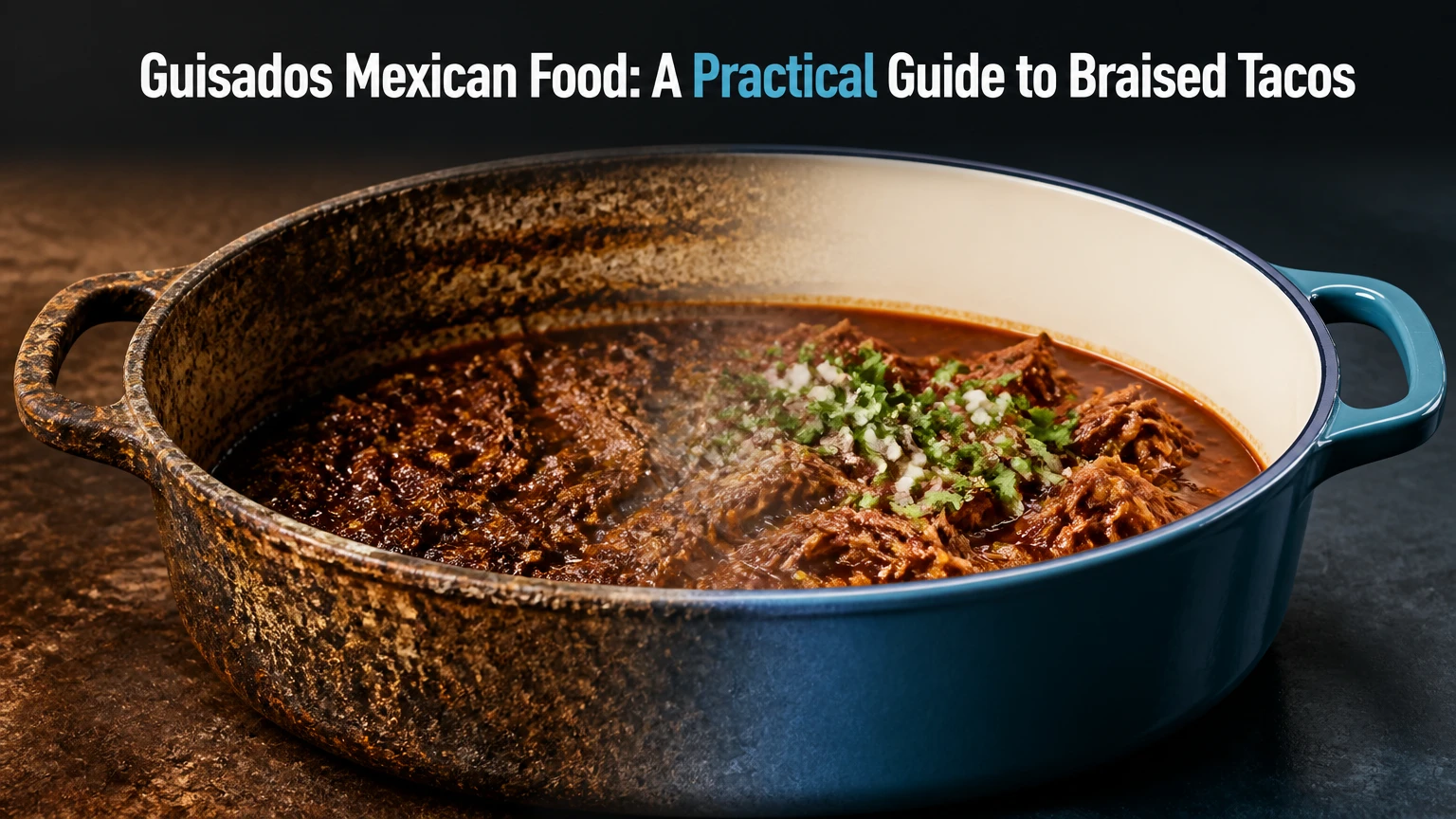
Guisados Mexican food refers to Mexican stews, braises, and saucy cooked dishes prepared by simmering meat, vegetables, eggs, or legumes with aromatics and chiles. Guisados are commonly served in corn tortillas with rice, beans, or both, especially at home-style eateries and taquerías de guisados that offer several fillings during daytime service.
Key Facts at a Glance
- A guisado is a preparation style, not one specific Mexican dish.
- The cooking method usually combines a seasoned salsa or recaudo with a filling and gentle simmering.
- Common bases include tomato, tomatillo, dried chiles, fresh chiles, onion, garlic, and herbs.
- Guisado tacos are often built with two warm corn tortillas plus rice or beans beneath the filling.
- Typical home preparation takes 45 minutes to 3 hours, depending on the ingredient and cut.
- Guisados usually offer more sauce, tenderness, and variety than fast-cooked grilled tacos.
What Is Guisado Mexican Food?
Guisado Mexican food is Mexican comida casera built around simmering ingredients in a seasoned liquid until the flavors combine and the filling reaches the desired texture. The word guisado can describe a stew, braise, cooked filling, or the finished dish placed inside a tortilla, so its meaning changes slightly by region and restaurant.
The method belongs to Mexico’s broad tradition of home cooking, where a salsa transforms inexpensive ingredients into a complete meal. UNESCO’s 2010 inscription of traditional Mexican cuisine recognized the importance of staples such as corn, beans, and chile within a living culinary system. Guisados fit that system because they connect a cooked sauce, a main ingredient, and a tortilla or grain-based accompaniment.
A taquería de guisados normally prepares several dishes in advance and keeps them warm in pots or trays. Customers choose fillings from the day’s selection, and the cook spoons each one onto tortillas, often adding rice, beans, onion, herbs, or a fresh salsa.
Guisado Is a Method, Not a Flavor Profile
Guisados do not all taste alike. A red chile braise may be smoky and earthy, while a tomatillo preparation can be tart and herbal; a creamy poblano dish may be mild, and a mushroom guisado may rely more on garlic and epazote than on chile heat.
Diana Kennedy, whose books documented regional Mexican cooking for English-speaking readers, emphasized a useful distinction: “Mexican food is not hot, it is highly seasoned.” The statement captures why heat level alone cannot define a guisado. Toasting, roasting, blending, reducing, and seasoning determine the final character.
How Does a Guisado Work?
A guisado develops flavor in stages: aromatics create the base, the main ingredient absorbs the salsa, and gentle heat reduces the liquid without drying the filling. The cooking vessel may be a cazuela, Dutch oven, saucepan, or heavy skillet, although the best vessel depends on volume and ingredient size.
1. Build the Salsa or Recaudo
Cooked guisado sauces commonly begin with onion, garlic, tomato, tomatillo, fresh chile, dried chile, or a combination. Dried chiles are briefly toasted, softened in warm water, and blended with aromatics; over-toasting creates bitterness that sugar cannot fully repair.
A sauce should be strained when dried chile skins or seeds would create a coarse texture. Salt can be adjusted after reduction because simmering concentrates both flavor and sodium.
2. Brown the Filling When Appropriate
Firm vegetables and many cuts of meat benefit from brief browning because surface color adds roasted flavor. A wide pot prevents crowding, and 1-2 teaspoons of cooking fat per serving usually provides enough lubrication for a home batch.
Browning is not mandatory for every guisado. Mushrooms, eggs, leafy greens, and delicate fish can become rubbery or dry if treated like a large roast. For those ingredients, soften the aromatics first and add the main ingredient later.
3. Simmer Gently
Add the salsa and enough stock or water to keep the mixture moist, then reduce the heat until the liquid barely bubbles. A practical target is approximately 85-95°C, or 185-205°F, although visual bubbling is more useful than a thermometer in an ordinary kitchen.
Tough meat becomes tender when connective tissue gradually converts to gelatin. A hard boil can tighten muscle fibers while evaporating liquid too quickly, so a low simmer usually produces a better texture in 90 minutes to 3 hours.
4. Reduce and Balance
The finished sauce should cling to the filling rather than pool heavily on the tortilla. If the sauce is thin, uncover the pot for 5-15 minutes; if it is too concentrated, add stock or water one tablespoon at a time.
Balance depends on the ingredients. Tart tomatillo sauces may need roasted onion or a small amount of sweetness, while rich chile sauces often need acidity from lime or a mild vinegar. Adjust salt only after the sauce reaches its final volume.
Which Ingredients Define a Guisado?
The defining ingredients are a cooked salsa, a substantial filling, and a starch or tortilla used to carry the sauce. Mexican guisados can include meat, vegetables, legumes, eggs, or seafood, and regional recipes often use local herbs and chiles rather than a universal spice blend.
| Component | Common examples | Main function | Typical result |
|---|---|---|---|
| Aromatics | Onion, garlic, roasted tomato | Build savory depth | Sweet, rounded base |
| Chile element | Guajillo, ancho, pasilla, chipotle | Add color and flavor | Earthy, smoky, or fruity sauce |
| Green element | Tomatillo, poblano, jalapeño | Add acidity or freshness | Tart green salsa |
| Filling | Chicken, beef, mushrooms, potatoes | Provide substance | Tender, firm, or creamy texture |
| Thickener | Tortilla, pepita, beans, reduction | Give body | Sauce that coats the filling |
| Serving base | Corn tortilla, rice, refried beans | Carry and absorb sauce | Stable, filling taco |
Red, Green, and Creamy Sauce Families
Red guisados usually rely on tomatoes and dried chiles such as guajillo, ancho, or pasilla. Green versions commonly use tomatillos, cilantro, fresh chiles, or herbs, while creamy preparations pair roasted poblano strips with dairy and onion.
| Sauce family | Typical ingredients | Flavor profile | Example dish |
|---|---|---|---|
| Red chile | Tomato, guajillo, ancho, garlic | Earthy, savory, mildly sweet | Bistec en pasilla |
| Green chile | Tomatillo, jalapeño, onion | Tart, herbal, bright | Chicharrón en salsa verde |
| Chipotle tomato | Tomato, onion, chipotle | Smoky, medium heat | Tinga de pollo |
| Mole | Dried chiles, spices, seeds, aromatics | Dense, layered, bittersweet | Mole with chicken |
| Creamy poblano | Poblano, onion, corn, crema | Mild, rich, sweet | Rajas con crema |
Which Guisados Should You Try First?
Tinga de pollo is the safest first choice for diners who want shredded meat, tomato, and smoky chile flavor without an especially challenging texture. Rajas con crema is a strong vegetarian introduction, while chicharrón en salsa verde suits diners who enjoy a soft, sauce-saturated texture.
| Guisado | Main filling | Texture | Typical heat | Best starting point |
|---|---|---|---|---|
| Tinga de pollo | Shredded chicken | Moist, fibrous | Mild to medium | First-time diner |
| Rajas con crema | Poblano and corn | Soft, creamy | Mild | Vegetarian diner |
| Papas con chorizo | Potato and seasoned sausage | Tender, crumbly | Mild to medium | Hearty breakfast |
| Bistec en pasilla | Thin-sliced beef | Tender, saucy | Mild to medium | Dark chile flavor |
| Mole with chicken | Chicken and mole sauce | Tender, velvety | Mild to medium | Complex seasoning |
| Chicharrón en salsa verde | Fried pork skin | Soft, porous | Medium | Texture-focused diner |
| Hongos con epazote | Mushrooms and herbs | Meaty, juicy | Mild | Meat-free savory option |
Tinga de Pollo
Tinga de pollo combines shredded chicken with tomato, onion, and chipotle, producing a smoky sauce that works well in tacos, tostadas, or rice bowls. The chicken should remain moist enough to absorb sauce without becoming watery.
Some restaurants prepare tinga with chicken breast, while others use darker meat for greater moisture. Ask whether the filling contains dairy or additional chile if you need a mild serving.
Mole With Chicken
Mole is a thick sauce rather than a single fixed recipe. Mole poblano may include dried chiles, spices, seeds, nuts, and a small amount of chocolate, while mole verde often uses pumpkin seeds, herbs, and green ingredients.
Mole deserves attention to allergies. Peanut, tree nut, sesame, and seed ingredients vary by recipe, so diners with allergies should ask before ordering.
Rajas con Crema
Rajas con crema consists of roasted poblano strips cooked with onion, corn, and crema. The dish is usually mild, but poblano chiles vary naturally, and a restaurant may add hotter chiles to its house version.
The best rajas retain distinct pepper strips rather than dissolving into a uniform sauce. Corn contributes sweetness, while crema softens the roasted chile flavor.
Papas con Chorizo
Papas con chorizo pairs diced potato with strongly seasoned Mexican sausage. The potatoes should be tender inside, lightly browned at the edges, and coated with the sausage’s chile-colored seasoning.
This filling is dense and satisfying, making it useful for breakfast or a high-calorie meal. It may contain dairy in the accompanying beans or crema, so check the complete plate rather than the filling alone.
How to Order Guisados at a Taquería
Order guisados by asking which fillings are available, how spicy each one is, and whether the tortillas, beans, or rice contain ingredients you avoid. A typical order includes one or more tacos, two tortillas per taco, and a spoonful of rice or beans beneath the guisado.
A useful ordering sequence is:
- Ask for the day’s guisados.
- Request a description of unfamiliar sauces.
- Choose one mild, one medium, or two contrasting fillings.
- Confirm whether beans are prepared with cooking fat.
- Ask for fresh salsa separately if the filling is already hot.
- Eat saucy tacos soon after serving to protect the tortilla.
A specialized counter may offer a sample spoon, but availability varies. In Mexico, service commonly peaks from morning through mid-afternoon because guisados are associated with breakfast, lunch, and daytime comida rather than late-night grilled taco service.
How Much Do Guisado Tacos Cost?
Typical guisado tacos cost about 20-45 Mexican pesos in local Mexican markets and approximately $3.50-$5.50 in many United States taquerías, although city, portion size, rent, and ingredients can change the price substantially. These figures are practical ranges, not a universal menu standard.
| Setting | Typical price per taco | Typical meal cost | Portion pattern |
|---|---|---|---|
| Mexican market stall | 20-35 MXN | 60-120 MXN | Two tortillas, rice or beans |
| Mexican neighborhood counter | 30-45 MXN | 90-150 MXN | Larger filling, house salsa |
| United States taquería | $3.50-$5.50 | $12-$22 | One substantial taco |
| Premium urban restaurant | $5.50-$9.00 | $18-$35 | Smaller tortilla, plated sides |
A serving of three tacos can be filling because rice, beans, and sauce add substantial volume. Diners with smaller appetites can order two tacos first, then add another filling after comparing portion size.
How Long Do Guisados Take to Cook?
Guisado cooking time ranges from 25 minutes for quick vegetable dishes to 3 hours for tough meat cuts. Preparation often takes 20-45 minutes, while simmering requires 15 minutes for mushrooms or peppers, 30-60 minutes for chicken, and 2-3 hours for beef chuck or shoulder cuts.
| Dish type | Prep time | Simmer or cook time | Make-ahead window |
|---|---|---|---|
| Rajas con crema | 20-30 minutes | 15-25 minutes | 2 days refrigerated |
| Papas con chorizo | 15-25 minutes | 25-40 minutes | 3 days refrigerated |
| Tinga de pollo | 25-40 minutes | 35-60 minutes | 3 days refrigerated |
| Bistec en pasilla | 25-40 minutes | 45-75 minutes | 3 days refrigerated |
| Mole with chicken | 45-75 minutes | 60-150 minutes | 3-4 days refrigerated |
| Beef guisado | 30-45 minutes | 2-3 hours | 3-4 days refrigerated |
Time, Temperature, and Texture
Chicken is ready when the thickest piece reaches a safe internal temperature of 74°C, or 165°F. Beef becomes fork-tender when connective tissue has softened, which depends more on time and cut than on a single internal temperature.
A covered pot retains moisture but slows reduction. An uncovered final stage concentrates the sauce, so experienced cooks often cover during tenderizing and uncover only after the filling is soft.
Guisados Versus Grilled Tacos
Guisados are the better choice for tender, sauce-rich fillings and broad vegetarian variety, while grilled tacos are better for diners who prioritize rapid service, browned edges, and a drier bite. The practical decision depends on texture, wait time, portability, and tolerance for rich sauces.
| Criterion | Guisado tacos | Grilled tacos |
|---|---|---|
| Main cooking time | 25 minutes to 3 hours | 5-15 minutes per batch |
| Dominant texture | Tender, moist, saucy | Seared, firm, sometimes crisp-edged |
| Best holding method | Covered pot or steam table | Immediate service from grill |
| Vegetarian range | Mushrooms, rajas, nopales, beans, eggs | Grilled vegetables, cheese, mushrooms |
| Tortilla risk | Sauce can cause tearing | Lower moisture, better structural stability |
| Flavor development | Reduction and simmering | Browning and smoke |
| Ideal meal context | Daytime lunch or home-style meal | Fast dinner or late-night order |
Guisados are not automatically more authentic than grilled tacos. Both belong to Mexican food traditions, and a restaurant may specialize in one method because of regional practice, kitchen equipment, or service model.
Are Guisados Spicy?
Guisados range from mild to very hot, and the name does not predict heat level. Rajas con crema, mole, potato fillings, and many tomato-based stews are often mild, while chipotle, habanero, or heavily seeded chile sauces can become medium or hot.
Heat also depends on preparation. Removing seeds and membranes can reduce some heat, but chile variety, quantity, and cooking time matter more than seeds alone. Ask for “sin picante,” “poco picante,” or “muy picante” when ordering, then request hot salsa separately so the filling remains balanced.
Vegetarian and Dietary Options
Vegetarian guisados include rajas con crema, mushrooms with epazote, nopales with tomato and onion, potatoes with chile, lentils, beans, and scrambled eggs with salsa. Vegan choices require additional questions because crema, cheese, butter, and animal-based cooking fat may appear in otherwise vegetable dishes.
| Dietary need | Safer guisado choices | Ingredient to verify | Ordering instruction |
|---|---|---|---|
| Vegetarian | Rajas, mushrooms, nopales | Cooking fat, broth | Ask whether the salsa is meat-free |
| Vegan | Nopales, mushrooms, beans | Crema, cheese, lard | Request no dairy and vegetable cooking fat |
| Gluten-free | Corn tortilla, rice, beans | Flour tortillas, bouillon | Confirm shared preparation practices |
| Dairy-free | Tinga, nopales, chile vegetables | Crema, cheese, butter | Order without dairy toppings |
| Nut allergy | Tinga, simple chile sauces | Mole, pipián, seed blends | Ask for the complete sauce ingredient list |
Corn tortillas are naturally gluten-free, but cross-contact can occur in shared kitchens. Mole and pipián require the most ingredient scrutiny because recipes frequently include seeds, nuts, or thickening agents.
How Do You Keep Guisado Tacos From Falling Apart?
Use two warm corn tortillas and place a small layer of refried beans or rice beneath the guisado to reduce direct liquid contact with the tortilla. Drain excess sauce with the serving spoon, then add the filling immediately before eating.
Common Problems and Fixes
| Problem | Likely cause | Immediate fix | Prevention |
|---|---|---|---|
| Torn tortilla | Excess liquid or one thin tortilla | Add a second tortilla | Use rice or beans as a barrier |
| Tough meat | Hard boil or insufficient time | Add stock and simmer 30-45 minutes | Keep heat low |
| Bitter chile sauce | Burned dried chiles | Dilute with fresh sauce | Toast 10-30 seconds per side |
| Watery filling | Covered pot throughout | Reduce uncovered 5-15 minutes | Measure liquid conservatively |
| Rubbery mushrooms | Cooked too long | Add fresh sautéed mushrooms | Simmer briefly |
| Bland sauce | Salt added before reduction | Adjust after reducing | Taste at each stage |
One practitioner rule matters more than most recipes: sauce thickness should match the serving format. A bowl can hold a loose stew, while a taco needs a sauce that coats the filling and does not run immediately through the tortilla.
Another counterintuitive point is that reheating can improve a chile-based guisado but damage a dairy-based one. Tomato and chile sauces often become more integrated overnight; crema-based sauces can separate when boiled, so reheat them gently over low heat.
How Should You Store and Reheat Guisados?
Refrigerate cooked guisados within two hours, store them in shallow containers, and use them within 3-4 days. Reheat the filling until steaming throughout, then warm tortillas separately on a dry skillet or comal.
For batch cooking, cool the sauce and filling quickly before refrigeration. Reheat only the portion needed for one meal because repeated warming reduces texture and increases food-safety risk.
Freeze tomato-based chicken, beef, bean, and vegetable guisados for approximately 2-3 months in airtight containers. Creamy dishes and potato-heavy fillings may change texture after freezing, so they are better prepared fresh or refrigerated for a shorter period.
Which Guisado Fits Your Situation?
First-time diners should begin with tinga de pollo, rajas con crema, or papas con chorizo because these options offer recognizable ingredients and moderate seasoning. Adventurous diners should try chicharrón in green salsa or a regional mole, while vegetarians should prioritize mushrooms, nopales, rajas, or beans after verifying cooking fat.
- For mild spice: Choose rajas con crema, simple mole, or potato fillings.
- For smoky flavor: Choose tinga with chipotle or a roasted chile beef stew.
- For a vegetarian meal: Choose mushrooms, nopales, rajas, or lentils.
- For a filling breakfast: Choose potatoes, beans, eggs, or sausage.
- For takeout: Choose thicker fillings with less loose sauce.
- For gluten avoidance: Choose corn tortillas, rice, and beans after confirming kitchen practices.
- For dairy avoidance: Choose tomato-based tinga or nopales without crema and cheese.
Guisados are less suitable when you want a crisp tortilla, quick cooking, or a light meal with raw toppings. Grilled tacos usually win those situations because their fillings contain less liquid and arrive faster.
FAQ About Guisados Mexican Food
Is guisado the same as carne guisada?
No. Guisado describes a broad category of cooked dishes, while carne guisada specifically means meat prepared in a sauce or stew. The exact recipe varies by region, with some versions using tomato, dried chiles, potatoes, vegetables, or a thickened broth.
Are guisado tacos healthy?
Guisado tacos can provide protein, fiber, vegetables, and carbohydrates, but nutrition varies by filling, tortilla count, cooking fat, and portion size. Bean, mushroom, nopales, and vegetable guisados are often lighter than creamy or heavily fatty options, although restaurant recipes differ.
Can you make guisados without meat?
Yes. Mexican vegetarian guisados include rajas con crema, mushrooms with epazote, nopales, potatoes with chile, lentils, beans, eggs, and seasonal vegetables. Replace meat stock with vegetable stock and verify that beans and sauces do not contain animal-based cooking fat.
Why are guisado tacos served with rice or beans?
Rice or beans provide structure and absorb excess sauce before the liquid reaches the tortilla. The base also adds starch and satiety, which helps explain why two or three guisado tacos can feel more substantial than the same number of lightly filled grilled tacos.
What is the best tortilla for guisados?
Fresh corn tortillas are the standard choice because their flavor complements chile-based sauces and their thickness supports a moist filling. Two tortillas are more reliable than one, especially when the guisado contains loose sauce or is held for several minutes before eating.
Can guisados be eaten with rice instead of tortillas?
Yes. Rice, beans, and guisados form a complete plate, and many home cooks serve the stew without tortillas. Rice works particularly well with mole, tinga, chile beef, beans, and other sauces that benefit from a bowl rather than a handheld format.
The Bottom Line
Guisados Mexican food is a flexible Mexican cooking tradition centered on simmered fillings and concentrated sauces, not a single recipe or spice level. Choose tinga de pollo for an approachable introduction, rajas or mushrooms for vegetarian options, and a chile-based beef or mole preparation for deeper flavor. Use warm double tortillas, rice or beans, and a low simmer to preserve the defining texture of a good guisado.