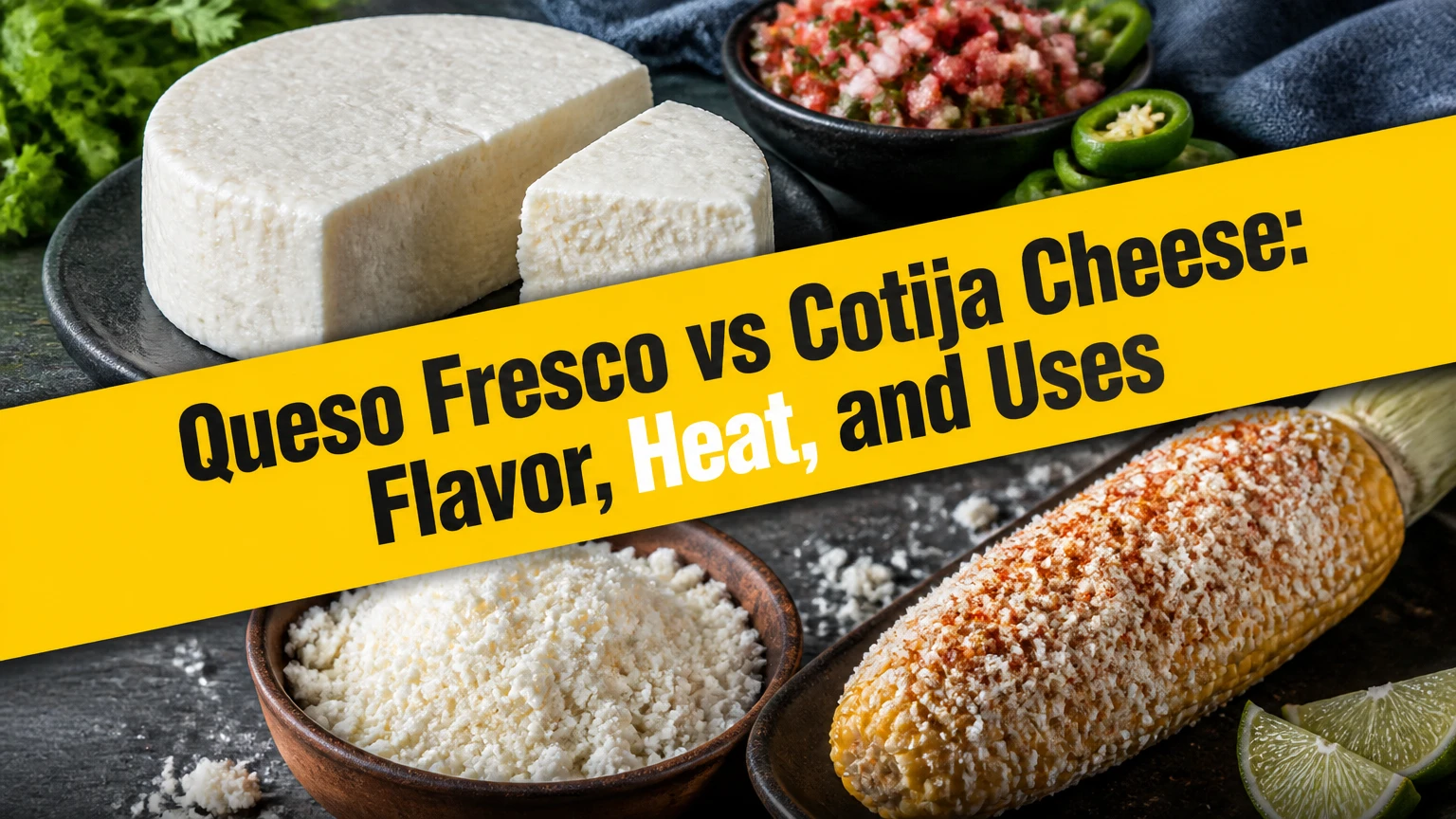
Queso fresco is a young, moist Mexican cheese with a mild milky flavor, while cotija is a drier, aged cheese with a salty, savory, concentrated taste. Choose queso fresco for cooling tacos, stuffing, and creamy contrast; choose cotija for grating over elote, beans, tostadas, and other dishes that need a sharp finishing flavor.
Key Facts at a Glance
- Queso fresco is generally fresh and high in moisture; cotija is aged and substantially drier.
- Queso fresco tastes mild, milky, and lightly tangy; cotija tastes salty, savory, nutty, and sometimes pungent.
- Neither cheese normally becomes a smooth, stretchy topping when heated.
- Queso fresco softens and warms; cotija usually keeps a firm, granular structure.
- Cotija requires less volume to season food because its salt and flavor are concentrated.
- Queso fresco usually fits mild dishes better, while cotija works best when a recipe needs a pronounced savory finish.
What Are Queso Fresco and Cotija?
Queso fresco is a fresh Mexican cheese made primarily from cow’s milk, although some regional or artisan versions include goat’s milk. Producers coagulate the milk, drain the curds, press them briefly, salt the cheese, and sell it while the flavor remains clean and the moisture remains high.
Cotija is a Mexican cow’s-milk cheese associated with Cotija de la Paz in Michoacán. Producers salt and mature it for a substantially longer period, reducing moisture and concentrating its flavor. Young cotija can crumble like a firm feta, while older cotija becomes hard enough to grate.
The names describe different cheese categories rather than interchangeable brands. “Fresco” signals freshness and limited aging, whereas cotija identifies a traditional style whose texture changes with maturation. Retail products vary, so package labels, firmness, moisture, and saltiness matter more than the name alone.
How Are the Cheeses Made?
Queso fresco commonly reaches sale shortly after production, often within one or several days, depending on the producer and distribution chain. Cotija may mature for several months, and artisan wheels can age longer. A universal 100-day minimum should not be treated as a reliable rule for every commercial product because aging standards and labeling practices differ by producer and market.
| Attribute | Queso fresco | Cotija tierno | Cotija añejo |
|---|---|---|---|
| Milk | Cow’s milk, sometimes goat’s milk | Cow’s milk | Cow’s milk |
| Typical aging | Fresh, commonly days | Young, often under several months | Several months or longer |
| Moisture behavior | Moist and perishable | Moderately dry | Dry and dense |
| Typical retail form | Plastic-wrapped block or tub | Crumbling block | Wedge, wheel, crumbles |
| Primary use | Filling, garnish, cooling contrast | Crumble topping | Grated seasoning |
How Do Texture and Aging Differ?
Queso fresco is soft, moist, and crumbly, with enough elasticity to hold together in a taco or on a bean dish. Cotija is firmer and drier because aging and salting remove water, creating a brittle texture that breaks into crumbs or fine shavings.
A fresh cheese carries water into a dish. That quality gives queso fresco a cooling, substantial bite, but it can also create wet spots if the cheese sits on salsa, broth, or juicy meat for too long. Cotija contributes less water and more concentrated seasoning, so a small sprinkle can affect the whole bite.
Queso fresco also varies more noticeably among brands. Some supermarket blocks are rubbery and compact, while ranch-style versions may have a fragile, irregular curd. Cotija varies by age: younger cheese can be sliceable, while older cheese may resist a knife and work better with a box grater.
Which Cheese Tastes Milder?
Queso fresco is the milder cheese. Its flavor is usually milky, lightly acidic, and restrained, so it balances chile, lime, roasted meat, and refried beans without dominating them.
Cotija has a stronger flavor because salt, fermentation, and moisture loss concentrate its savory character. Good cotija may offer nutty, grassy, or funky notes, but heavily salted commercial cotija can taste mainly saline. Taste a small piece before seasoning the rest of the recipe.
Queso Fresco vs Cotija Cheese: The Verdict
Choose queso fresco when the dish needs moisture, mild dairy flavor, or relief from heat. Choose cotija when the dish needs salt, umami, dry crumble, or a grating cheese that remains visible on the surface.
| Decision criterion | Queso fresco | Cotija cheese |
|---|---|---|
| Flavor intensity | Mild, milky, lightly tangy | Strong, salty, savory, sometimes pungent |
| Texture | Soft, moist, crumbly | Firm, dry, brittle, granular |
| Aging | Fresh or minimally aged | Young to mature, commonly months |
| Heat response | Softens and warms without stretch | Stays firm and dry |
| Moisture effect | Adds roughly 1-2 tablespoons moisture per 2 ounces, depending on brand | Adds little moisture per 2 ounces |
| Typical serving | 1-2 ounces per person | 0.5-1 ounce per person |
| Best role | Filling, cooling garnish, contrast | Finishing seasoning, crumble, grating |
| Typical U.S. retail price | About $4-$8 per pound | About $6-$12 per pound; artisan versions can cost more |
The listed moisture and prices are typical retail and kitchen ranges, not universal specifications. Nutrition panels and package sizes differ, and cheese counters may price small artisan pieces at a higher effective per-pound rate.
How Do Salt and Moisture Change a Dish?
Queso fresco generally contributes less salt per bite than cotija, but the exact difference depends on the brand and the serving size. Cotija should be treated as both a cheese and a seasoning ingredient, especially when it finishes beans, corn, soup, or meat.
A reliable kitchen rule is to delay final salting until after adding cotija. For a recipe serving four, start with 1 ounce of cotija, taste, and add more in 0.5-ounce increments. With queso fresco, cooks can usually add a fuller 2-4 ounces without making the dish aggressively salty, although the package label remains the authority.
Do Queso Fresco and Cotija Melt?
Queso fresco and cotija do not usually melt into the smooth, elastic layer needed for quesadillas or cheese dips. Queso fresco softens and becomes warm, but its curds tend to hold their shape; cotija dries further and remains crumbly under direct heat.
The failure comes from structure, not from a lack of heat. Fresh, acidified, and aged cheeses have protein networks and moisture levels that prevent the flowing melt associated with Oaxaca, Chihuahua, Monterey Jack, or low-moisture mozzarella.
Use queso Oaxaca or Chihuahua for a stretchy quesadilla. Use queso crema for a smooth dip, or combine a melting cheese with a small amount of cotija after cooking for stronger flavor.
| Cooking situation | Queso fresco result | Cotija result | Better cheese choice |
|---|---|---|---|
| Quesadilla skillet, 375-425°F | Soft curds, no stretch | Dry crumbs, no stretch | Oaxaca or Chihuahua |
| Hot elote, 140-170°F serving temperature | Warm, soft crumble | Firm salty crumble | Either, depending on salt level |
| Bean topping, 150-180°F | Warms and partially softens | Remains granular | Queso fresco for mildness |
| Oven casserole, 350°F for 20-30 minutes | May dry at edges | May harden and brown | Monterey Jack or asadero |
| Cold taco garnish | Moist and tender | Dry and sharp | Choose by desired contrast |
Which Cheese Fits Each Dish?
Queso fresco fits dishes where dairy should soften chile heat or add a moist, mild bite. Cotija fits dishes where a small amount of dry, salty cheese should remain distinct after cooking.
| Dish or application | Recommended cheese | Typical amount for four servings | Reason |
|---|---|---|---|
| Tacos with chile-seasoned filling | Queso fresco | 3-4 ounces | Cools the filling without adding heavy salt |
| Elote or esquites | Cotija | 1-2 ounces | Supplies a salty, savory finish |
| Refried beans | Queso fresco | 2-3 ounces | Adds mild dairy contrast |
| Chilaquiles | Cotija | 1-2 ounces | Holds texture over salsa and chips |
| Tostadas | Cotija | 1-1.5 ounces | Stays dry over beans, lettuce, and crema |
| Enchilada topping | Queso fresco | 3 ounces | Provides soft, visible crumbles |
| Salad with citrus dressing | Queso fresco | 2-3 ounces | Matches fresh acidity and crisp vegetables |
| Grilled vegetables | Cotija | 1 ounce | Adds concentrated savory flavor |
| Stuffed peppers | Queso fresco | 4 ounces | Gives a mild, moist filling |
| Soup garnish | Cotija | 0.5-1 ounce | Adds flavor without diluting broth |
Using both cheeses can work when their functions remain separate. Add queso fresco inside or beside the dish for texture and cooling contrast, then finish with a small amount of cotija for salt and aroma. The pairing is especially useful on tacos, bean tostadas, and corn with lime.
Is Queso Fresco Better for Spicy Food?
Queso fresco is usually better for spicy food because its mild flavor and moisture reduce the perceived intensity of chile. Queso fresco does not chemically neutralize capsaicin, however; dairy fat and dilution change the eating experience rather than remove the compound.
For a taco with a very hot salsa, use 1 ounce of queso fresco per serving, then add lime or avocado for additional richness. Cotija can work with chile too, but its salt may make a strongly seasoned filling taste harsher.
Is Cotija Best for Elote?
Cotija is the classic choice for elote because the dry, salty crumble adheres to mayonnaise or crema and remains distinct against sweet corn. Queso fresco can replace it when a softer, milder topping is preferred, but the result will be less savory and may release more moisture.
For four ears of corn, use approximately 1-2 ounces of finely crumbled cotija. Add lime before tasting for salt, since acid can make the cheese seem less sharp while preserving its seasoning effect.
Which Cheese Is Better for Nutrition and Food Safety?
Neither cheese is automatically healthier; the better choice depends on serving size, sodium level, fat content, and whether the product is pasteurized. Cotija often contains more sodium by weight because aging and salting concentrate its solids, while queso fresco may have more water per serving.
Queso fresco also needs careful handling because fresh soft cheeses can support the growth of harmful bacteria when contaminated or stored improperly. The U.S. Food and Drug Administration advises people at higher risk of severe foodborne illness to “avoid eating queso fresco-type cheeses” when the products are made with unpasteurized milk or handled unsafely.
Pregnant people, older adults, young children, and people with weakened immune systems should choose clearly labeled pasteurized cheese and keep it refrigerated. A milk allergy requires avoiding both cheeses. Lactose tolerance varies, and cotija’s aging may reduce lactose compared with fresh cheese, but neither product should be assumed lactose-free.
| Consideration | Queso fresco | Cotija |
|---|---|---|
| Water content | Higher, often roughly 45%-60% | Lower, often roughly 30%-40% |
| Sodium concentration | Brand-dependent, commonly moderate | Brand-dependent, commonly high |
| Serving starting point | 1-2 ounces | 0.5-1 ounce |
| Pasteurization concern | Important because it is fresh and soft | Still important, especially for artisan cheese |
| Allergy status | Cow’s milk protein present | Cow’s milk protein present |
| Best label check | Pasteurized milk, refrigeration date | Sodium, milk source, aging statement |
Published nutrition values vary enough that a package label should override generic comparisons. A reduced-sodium queso fresco may contain less sodium than a heavily salted cotija, but one brand’s label cannot represent every cheese in the category.
How Should You Store Them?
Store queso fresco and cotija at 40°F or below in a sealed container, and use clean utensils to prevent contamination. Queso fresco usually has the shorter practical life after opening, while a dry cotija wedge generally keeps longer when protected from air and surface moisture.
Use the manufacturer’s date and storage instructions first. As a typical household guideline, use opened queso fresco within 5-7 days when refrigerated, and use opened cotija within 2-3 weeks if the package remains clean and tightly sealed. These ranges are not guarantees.
Discard either cheese if it develops unusual slime, pink or black mold, a strong ammonia odor, or a sour smell beyond its normal flavor. Do not scrape mold from a moist fresh cheese and continue eating the remainder.
Can You Substitute One for the Other?
Queso fresco and cotija are poor one-for-one substitutes because they differ in moisture, salt, firmness, and flavor intensity. A substitution works only when the cook adjusts the amount and accepts a change in the dish’s texture.
Use mild feta, ricotta salata, farmer cheese, or pressed cottage cheese when replacing queso fresco. Use Parmesan, Pecorino Romano, aged feta, or dry feta when replacing cotija, although each alternative changes the regional flavor profile.
| Original cheese | Substitute | Starting ratio | Main adjustment |
|---|---|---|---|
| Queso fresco | Mild feta | 0.75 ounce per 1 ounce | Reduce salt and rinse if very briny |
| Queso fresco | Ricotta salata | 0.75 ounce per 1 ounce | Add a little crema or yogurt for moisture |
| Queso fresco | Farmer cheese | 1 ounce per 1 ounce | Add lime and salt gradually |
| Cotija | Parmesan | 1 ounce per 1 ounce | Use a fine grate and taste before salting |
| Cotija | Pecorino Romano | 0.5-0.75 ounce per 1 ounce | Reduce salt because Pecorino is intense |
| Cotija | Dry feta | 1 ounce per 1 ounce | Crumble finely and check brine level |
Do not substitute mozzarella for cotija when the goal is a dry, salty garnish. Mozzarella supplies stretch and moisture, which solves a different culinary problem.
Common Mistakes and Practical Fixes
Mistake 1: Expecting a gooey melt. Queso fresco and cotija will not produce the texture of Oaxaca or Chihuahua cheese. Add a designated melting cheese first, then use either Mexican cheese as a finishing ingredient.
Mistake 2: Adding queso fresco too early. Moisture from salsa, broth, or meat can make the crumble wet. Pat the cheese dry, crumble it immediately before serving, and keep it off the dish until plating.
Mistake 3: Salting before adding cotija. Cotija can push an already seasoned dish past the point of balance. Cook with half the usual added salt, add the cheese, and correct only after tasting.
Mistake 4: Treating every cotija as equally aged. A young cotija may crumble softly, while an older wheel can be hard and intensely salty. Adjust the grate size and portion to the cheese’s actual firmness.
Mistake 5: Buying based only on color. White color does not prove freshness, authenticity, or quality. Check the date, pasteurization statement, texture, sodium, and refrigeration condition.
Mistake 6: Leaving queso fresco at room temperature. Fresh cheese should not sit out during a long meal. Refrigerate leftovers promptly and follow local food-safety guidance for perishable dairy.
Which Cheese Should You Choose?
Choose Queso Fresco for Mild, Moist Contrast
Choose queso fresco for tacos, enchiladas, refried beans, salads, stuffed vegetables, and dishes with aggressive chile. Queso fresco is also the safer flavor choice when several people have different salt preferences because diners can add a little more without quickly overwhelming the plate.
Queso fresco is not ideal for recipes that need stretch, long storage, or a dry topping that remains crisp. Its water content can soften tortillas, chips, and fried surfaces if added long before serving.
Choose Cotija for Salty Finishing Flavor
Choose cotija for elote, esquites, tostadas, chilaquiles, grilled vegetables, and bean dishes that need a concentrated savory accent. Cotija is efficient because 0.5-1 ounce per serving can deliver substantial flavor.
Cotija is not the best choice for delicate cream sauces or lightly seasoned dishes. Its salt and pungency can cover subtle vegetables, mild beans, or fresh herbs.
Choose a Different Cheese for Stretch or Sauce
Choose Oaxaca, Chihuahua, asadero, Monterey Jack, or mozzarella when the recipe requires a smooth melt. Choose queso crema, cream cheese, or a melting-cheese blend when the desired result is a pourable sauce.
The correct substitute follows the cheese’s function. A dry garnish, a mild filling, and a stretchy melt require different protein, moisture, and salt profiles.
Frequently Asked Questions
Can You Use Queso Fresco on Hot Tacos?
Yes, queso fresco works well on hot tacos when added immediately before serving. The cheese will soften from residual heat but should remain crumbly rather than melt into a sauce. Drain wet salsa and meat first if the tortilla needs to stay firm.
Does Cotija Cheese Taste Like Parmesan?
Cotija resembles Parmesan in its dry, salty, savory finishing role, but the flavors are not identical. Cotija can taste sharper and saltier, while Parmesan often has a more pronounced nutty and brothy character. Use less cotija first, then adjust after tasting.
Is Queso Blanco the Same as Queso Fresco?
Queso blanco and queso fresco are related but not always identical. Queso blanco commonly refers to a fresh acid-set cheese made with vinegar or citrus, while queso fresco can involve rennet, bacterial acidity, or other production methods. Regional labels and recipes use the names inconsistently.
Can You Freeze Queso Fresco or Cotija?
Freezing is usually a poor choice for queso fresco because ice crystals damage its soft curd and create a crumbly, watery texture after thawing. A firm cotija wedge tolerates freezing somewhat better, but its texture can still become brittle. Refrigeration gives better results for both cheeses.
Which Cheese Lasts Longer After Opening?
Cotija generally lasts longer after opening because its lower moisture and higher salt concentration slow quality loss. Queso fresco usually has a shorter practical refrigerator life, often about 5-7 days after opening. Follow the package date and discard cheese with abnormal mold, slime, or odor.
Can You Eat Queso Fresco During Pregnancy?
Pregnant people should choose queso fresco made with pasteurized milk and keep it refrigerated according to the package instructions. Fresh soft cheese made from unpasteurized milk carries a higher food-safety risk. The FDA specifically warns higher-risk consumers about queso fresco-type cheeses, so the milk label matters.
The Bottom Line
Queso fresco and cotija answer different cooking needs. Queso fresco is the better choice for a mild, moist, cooling bite, while cotija is the better choice for a dry, salty, concentrated finish. For the query queso fresco vs cotija cheese, select queso fresco for fillings and heat relief, cotija for elote, tostadas, and seasoning, and a melting cheese when you need stretch.