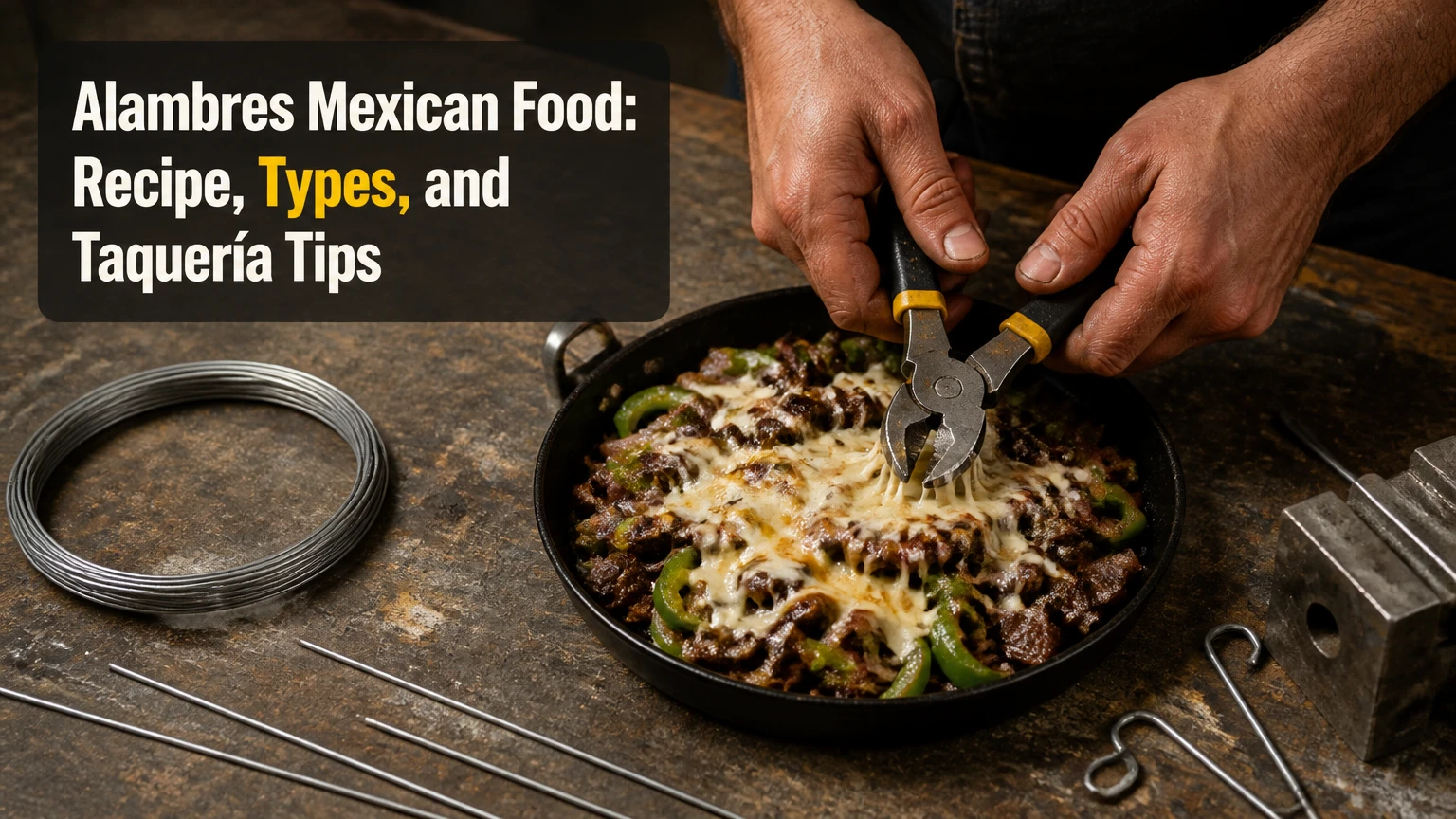
Alambres Mexican food is a griddled dish of chopped or thinly sliced meat cooked with bacon, bell peppers, onions, and melted cheese, then served with warm tortillas. The name alambre means “wire” or “cable” in Spanish because older versions were associated with skewered ingredients, while contemporary taquerías usually prepare the mixture on a plancha or skillet.
Key Facts at a Glance
A typical alambre combines seared meat, bacon, onion, bell pepper, and melting cheese.
Modern alambre is usually cooked loose on a flat-top griddle rather than on skewers.
A home batch for four people takes about 25-30 minutes and uses 500-700 grams of protein.
Oaxaca and Chihuahua cheeses provide the most characteristic stretch, while Monterey Jack is a practical substitute.
Alambre is usually served as a taco filling with corn or flour tortillas, salsa, lime, and avocado.
Restaurant prices vary by city, portion size, meat choice, and whether the dish arrives in a skillet or molcajete.
What Is Alambres Mexican Food?
Alambres are Mexican griddle dishes built around browned meat, rendered bacon, sautéed vegetables, and melted cheese. The mixture is commonly served family-style on a hot platter or divided among tortillas, making it closer to a cheesy skillet filling than to a conventional rolled taco.
The name connects the dish to alambre, the Spanish word for wire. Some accounts describe early preparations in which meat and vegetables were threaded onto wire or skewers, but the restaurant version most diners encounter today is chopped and cooked directly on a plancha. The historical explanation is useful, although recipes vary by city and taquería.
Alambre is especially associated with northern and central Mexican taquería cooking, where large griddles make it possible to sear ingredients quickly and serve several orders at once. The dish is rich, salty, smoky, and highly adaptable. It can use beef, chicken, seasoned sausage, marinated pastor-style meat, or vegetables.
What Goes Into an Alambre?
A standard alambre contains a protein, cured bacon, onion, bell pepper, and a semi-soft cheese that melts smoothly. Garlic, black pepper, cumin, jalapeño, poblano, mushrooms, pineapple, and salsa may appear depending on the cook and the regional style.
| Component | Typical quantity for 4 | Culinary function | Common substitute |
|---|---|---|---|
| Thin-sliced beef | 600 g | Savory protein and browned crust | Chicken thigh, 600 g |
| Bacon | 120 g | Rendered fat and smoky salt | 2 tbsp neutral oil |
| Bell pepper | 1 large, 150 g | Sweetness, color, and texture | Poblano pepper, 2 medium |
| White onion | 1 medium, 180 g | Aromatic sweetness | Red onion, 1 medium |
| Melting cheese | 250 g | Moisture, cohesion, and stretch | Monterey Jack, 250 g |
| Tortillas | 16 small | Serving vehicle | Lettuce cups, 16 leaves |
Bacon is traditional in many restaurant-style versions, but it is not the only source of cooking fat. A vegetarian preparation can use avocado oil, butter, or a neutral oil and still retain the defining combination of griddled vegetables and melted cheese.
Why Does Alambre Taste So Savory?
Alambre tastes deeply savory because high heat browns the meat and vegetables while rendered fat carries smoky, salty flavors across the pan. The cheese then coats the small pieces, reducing the sharp separation between protein, aromatics, and peppers.
The cooking order matters more than a long ingredient list. Bacon should render first, meat should brown in a relatively open surface, and vegetables should cook after the protein is removed. Returning everything at the end prevents the meat from spending too long in vegetable moisture.
The browning reaction is commonly called the Maillard reaction. It develops when amino acids and reducing sugars react at a hot, relatively dry surface. Water slows browning because the surface remains near the boiling point until moisture evaporates.
A practical restaurant rule is to keep the cooking surface around 200-230°C, measured at the pan or griddle surface. A home cook does not need laboratory precision, but the meat should hiss immediately when it touches the pan without releasing enough liquid to form a simmering pool.
Which Cheese Works Best?
Oaxaca cheese gives alambre the most recognizable stringy texture, while Chihuahua cheese provides a smooth, rich melt with slightly more body. Monterey Jack is easier to find in the United States, and low-moisture mozzarella works when stretch matters more than traditional flavor.
| Cheese | Melt behavior | Flavor profile | Best use |
|---|---|---|---|
| Oaxaca | Long, elastic strands | Mild and milky | Classic taco-style alambre |
| Chihuahua | Smooth and creamy | Mild, buttery | Beef or mixed versions |
| Monterey Jack | Fast, even melt | Mild and rich | Accessible home substitute |
| Low-moisture mozzarella | Strong stretch, less creaminess | Mild and neutral | Budget or supermarket option |
| Pepper Jack | Smooth with chile heat | Spicy and tangy | Hot chicken or vegetarian version |
Shred cheese from a block whenever possible. Pre-shredded cheese often contains starches that can make the melt less fluid, although pan temperature and cheese moisture also influence the result. Add cheese after the meat and vegetables are recombined, then cover the pan for one to two minutes.
Which Alambre Type Should You Order?
Alambre de res is the most dependable first order for diners who want the classic beef-and-cheese profile. Chicken is lighter and more forgiving in seasoning, al pastor brings a sweet chile contrast, mixto offers several meats in one serving, and vegetarian alambre replaces meat with mushrooms and additional vegetables.
| Variant | Main protein | Typical flavor | Typical Mexico price |
|---|---|---|---|
| Alambre de res | Beef steak, 150-200 g per diner | Rich, peppery, deeply savory | 120-220 MXN |
| Alambre de pollo | Chicken breast or thigh | Mild, smoky, adaptable | 110-200 MXN |
| Alambre al pastor | Marinated seasoned meat | Sweet, chile-forward, tangy | 130-240 MXN |
| Alambre mixto | Beef, chicken, sausage | Rich, salty, varied | 160-300 MXN |
| Alambre vegetariano | Mushroom, poblano, zucchini, corn | Earthy, sweet, cheesy | 90-180 MXN |
Prices are typical street-taquería ranges rather than fixed national rates. Tourist districts, premium cuts, larger portions, and delivery fees can raise the final bill substantially.
Is Alambre Spicy?
Alambre is not automatically spicy because the core recipe usually gets its heat from optional chiles or salsa rather than from the meat mixture itself. Jalapeño, serrano, poblano, chipotle, or a chile-based marinade can change the heat level without changing the dish’s basic structure.
Ask for sin picante for a mild order, or request salsa separately so each diner can adjust the heat. A roasted green salsa usually contributes acidity and fresh chile flavor, while a red salsa may add dried-chile depth and more concentrated heat.
How Do You Make Alambre at Home?
A four-serving beef alambre takes approximately 10-15 minutes to prepare and 12-15 minutes to cook. The decisive factor is a wide, hot skillet that lets the meat brown instead of steaming in its own moisture.
Before You Start
| Requirement | Home target |
|---|---|
| Total time | 25-30 minutes |
| Servings | 4, or 16 small tacos |
| Difficulty | Moderate |
| Beef | 600 g thin-sliced steak |
| Bacon | 120 g, chopped |
| Cheese | 250 g, shredded |
| Pan | 30 cm cast-iron skillet or griddle |
| Tortillas | 16 corn or flour tortillas |
Use flank steak, sirloin, skirt steak, or ribeye. Partially freeze the beef for 20-30 minutes, then slice it 3-5 millimeters thick against the grain. Thin pieces cook rapidly and remain easier to chew.
Step 1: Prepare the Ingredients
Slice the beef against the grain, chop the bacon into 1-centimeter pieces, dice the onion, and cut the bell pepper into strips about 5 millimeters wide. Shred the cheese and keep it refrigerated until the final stage.
Season 600 grams of beef with 1 teaspoon kosher salt, ½ teaspoon black pepper, and ½ teaspoon garlic powder. Optional additions include ½ teaspoon ground cumin or 1 tablespoon Worcestershire-style seasoning.
You will know it worked when: every ingredient is cut small enough to fit into a tortilla without requiring further chopping.
Common mistake: cutting vegetables into large chunks causes uneven cooking and makes the filling difficult to scoop.
Step 2: Render the Bacon
Place 120 grams of chopped bacon in a wide skillet over medium-high heat. Cook for 4-6 minutes, stirring twice, until the pieces are browned and approximately 2 tablespoons of fat remain.
Transfer the bacon to a plate. Leave the rendered fat in the skillet, but remove excess fat if the pan contains more than 3 tablespoons.
You will know it worked when: the bacon is crisp at the edges and the fat is liquid but not smoking heavily.
Common mistake: starting with maximum heat can burn the bacon before enough fat renders.
Step 3: Sear the Beef
Raise the heat to high and add the beef in a single layer. Cook for 2-3 minutes on the first side and 1-2 minutes after turning, using a second batch if the skillet is crowded.
Transfer browned beef to the bacon plate. The center can remain slightly underdone because the meat returns to the pan later.
You will know it worked when: browned edges appear and the skillet has no large pool of liquid.
Common mistake: adding all the beef to a small pan lowers the surface temperature and produces gray, simmered meat.
Step 4: Cook the Onion and Pepper
Add the onion and bell pepper to the same skillet. Cook for 4-5 minutes, stirring occasionally, until the onion softens and the pepper retains a slight bite.
Add 1 minced garlic clove during the final 30 seconds if desired. Add jalapeño or poblano at this stage for controlled heat.
You will know it worked when: the onion has translucent edges, the pepper has browned spots, and the vegetables still hold their shape.
Common mistake: covering the skillet traps steam and creates soft vegetables without useful browning.
Step 5: Recombine and Season
Return the beef and bacon to the skillet. Stir for 60-90 seconds so the ingredients combine and the beef finishes cooking.
Taste before adding more salt because bacon and cheese can contribute significant sodium. A squeeze of lime at this stage adds acidity without making the filling wet.
You will know it worked when: the beef reaches a safe internal temperature appropriate to the cut and the filling contains no raw center.
Common mistake: simmering the mixture for several additional minutes makes thin beef chewy.
Step 6: Add the Cheese
Spread 250 grams of shredded Oaxaca, Chihuahua, or Monterey Jack over the hot mixture. Turn off the heat, cover the skillet, and wait 1-2 minutes until the cheese melts.
For a browned cheese surface, use an oven-safe skillet under a broiler for 1-2 minutes, watching continuously. The cheese should melt across the filling rather than become a separate crust.
You will know it worked when: the cheese stretches from a spoon and clings to the meat and vegetables.
Common mistake: adding cheese while the pan contains excess liquid can produce a greasy, broken sauce.
Step 7: Warm and Serve the Tortillas
Warm 16 tortillas on a dry skillet for 20-30 seconds per side, or wrap them in a clean damp towel and heat them briefly. Serve the alambre immediately with salsa, lime wedges, chopped cilantro, and avocado.
A typical taco uses 45-60 grams of filling. Four people can receive four tacos each, although restaurant portions may provide fewer, larger tacos or a shared platter.
What Equipment Gives the Best Sear?
A cast-iron skillet or outdoor plancha gives alambre the strongest browning because both retain heat when cold meat enters the cooking surface. A nonstick skillet is easier to clean but should remain below the manufacturer’s maximum heat recommendation.
| Equipment | Useful surface size | Heat behavior | Best adjustment |
|---|---|---|---|
| Cast iron skillet | 28-32 cm | High heat retention | Preheat 4-5 minutes |
| Carbon-steel plancha | 35-50 cm | Fast recovery and wide space | Cook restaurant-size batches |
| Stainless skillet | 28-30 cm | Strong browning, sticking risk | Preheat with oil |
| Nonstick skillet | 26-30 cm | Gentle release, lower heat tolerance | Cook meat in two batches |
| Electric griddle | 1,000-1,500 cm² | Adjustable broad surface | Set 200-220°C |
Do not place a cold mountain of ingredients onto a small pan. A wide cooking surface is more valuable than a deeper pot because alambre depends on evaporation and contact browning.
How Does Alambre Compare With Similar Mexican Dishes?
Alambre differs from fajitas, tacos de bistec, and a quesadilla because the meat, vegetables, and cheese are cooked together as one filling before serving. Fajitas usually emphasize separately grilled strips, tacos de bistec center on seasoned meat, and a quesadilla uses a tortilla as the primary cheese container.
| Dish | Cooking format | Cheese role | Typical serving |
|---|---|---|---|
| Alambre | Chopped griddle mixture | Covers and binds filling | Shared skillet or tacos |
| Fajitas | Grilled strips | Optional topping | Platter with tortillas |
| Tacos de bistec | Small seasoned beef pieces | Usually absent or secondary | Individual tacos |
| Quesadilla | Tortilla cooked with cheese | Main interior filling | Folded tortilla |
| Choripán-style taco | Grilled sausage | Usually absent | Bread or tortilla serving |
Alambre is a better choice when diners want a rich, cohesive filling with multiple textures. Fajitas are preferable when each ingredient should remain distinct, while tacos de bistec suit diners who want a simpler meat-forward order.
Is Alambre the Same as a Kebab?
Alambre is not the same as a kebab in its modern form. The word preserves a skewer association, but contemporary Mexican alambre is generally chopped, griddled, and finished with melted cheese rather than served as separate pieces on a skewer.
Some cooks still prepare skewered versions for grilling, especially when interpreting the name literally. Those versions can be flavorful, but they do not have the same integrated cheese, bacon, and tortilla-filling format found at many taquerías.
How Much Does Alambre Cost?
A street-taquería alambre in Mexico typically costs about 120-180 MXN for a standard platter, while a sit-down restaurant commonly charges 220-350 MXN for a larger serving. In the United States, a typical restaurant order often falls between $14 and $25 before tax, depending on location and portion size.
| Setting | Typical price | Portion pattern | Common extras |
|---|---|---|---|
| Mexico street taquería | 120-180 MXN | 1-2 diners | Tortillas, salsa |
| Mexico casual restaurant | 180-280 MXN | 2 diners | Avocado, rice, beans |
| Mexico premium restaurant | 280-350 MXN | 2-3 diners | Molcajete or cast iron |
| United States taquería | $14-$20 | 1 diner | Tortillas and salsa |
| United States full-service restaurant | $20-$25 | 1-2 diners | Sides and garnish |
Confirm whether the listed price includes tortillas. Some restaurants price the skillet filling separately and charge for additional tortillas, cheese, avocado, or premium cuts.
Is Alambre Healthy, Keto, or Gluten-Free?
Alambre can fit a high-protein or lower-carbohydrate diet when served without tortillas, but bacon, cheese, and cooking fat raise its calorie and saturated-fat content. The dish is naturally gluten-free when all seasonings, sauces, and tortillas are certified gluten-free and prepared without cross-contact.
A typical 300-gram beef serving without tortillas may provide approximately 500-700 calories, 35-50 grams of protein, 30-45 grams of fat, and 5-15 grams of carbohydrates. These are practical estimates, not laboratory nutrition values, because steak cut, bacon quantity, cheese, and oil change the calculation.
For a lighter version, use chicken thigh or breast, reduce bacon to 60 grams, use 150 grams of cheese, and increase mushrooms, peppers, and onions. For keto service, omit tortillas and add avocado or a leafy salad. For a dairy-free version, omit cheese or use a dairy-free melt, understanding that texture and flavor will change.
Can Vegetarians Eat Alambre?
Vegetarians can eat alambre when the meat and bacon are replaced with mushrooms, poblano, zucchini, corn, or firm tofu. Use 2 tablespoons of oil, season the vegetables with salt and garlic, and add cheese at the end as usual.
The best vegetable combination includes one ingredient with browning potential, such as mushrooms, and one with water content, such as zucchini. Cook mushrooms first so their moisture evaporates, then add faster-cooking vegetables.
What Are the Most Common Alambre Problems?
The most common alambre failures are steamed vegetables, chewy meat, watery filling, and broken cheese. Each problem usually comes from excess moisture, an overcrowded pan, incorrect slicing, or excessive heat during the final melt.
| Problem | Likely cause | Immediate fix | Prevention |
|---|---|---|---|
| Gray, wet beef | Crowded skillet | Remove liquid, sear in batches | Use 28-32 cm pan |
| Chewy beef | Thick slices or overcooking | Add lime and serve with salsa | Slice 3-5 mm against grain |
| Soggy peppers | Covered pan or low heat | Cook uncovered 2-3 minutes | Keep vegetables in one layer |
| Oily cheese | Excess fat or overheating | Blot surface and stir gently | Drain bacon fat to 2 tbsp |
| Clumpy cheese | Cold or low-quality shred | Cover off heat for 2 minutes | Shred a whole block |
| Bland filling | Under-seasoned layers | Add salt, lime, and salsa | Season meat before searing |
An important practitioner rule is to season each major component lightly rather than adding all the salt at the end. Bacon and cheese make late correction difficult because the filling can become salty before the vegetables taste seasoned.
Another useful rule is to remove the meat before it appears fully finished. Thin slices continue cooking during recombination, and the cheese stage adds additional retained heat.
How Should You Serve Alambre?
Serve alambre immediately in warm corn or flour tortillas with salsa, lime, cilantro, and avocado. The filling can also be placed over rice, folded into a burrito, spooned onto tostadas, or served alone as a skillet meal.
| Serving format | Filling amount | Best accompaniment | Practical situation |
|---|---|---|---|
| Small tacos | 45-60 g each | Salsa and lime | Four-person meal |
| Large flour tacos | 75-100 g each | Avocado and onion | Hearty single serving |
| Rice bowl | 150-200 g | Beans and lettuce | No-tortilla meal |
| Tostada | 60-75 g | Refried beans and salsa | Crisp-texture contrast |
| Skillet platter | 600-900 g total | Tortillas on the side | Shared restaurant order |
Salsa verde adds acidity and fresh chile flavor. Roasted red salsa adds deeper chile notes. Pickled onions can cut through the richness more effectively than additional cheese.
Frequently Asked Questions
What Cut of Beef Is Best for Alambre?
Flank steak, skirt steak, sirloin, and ribeye all work for alambre when sliced thinly against the grain. Sirloin offers the best balance of cost and tenderness, while ribeye gives the richest result. Partially freezing the beef for 20-30 minutes makes 3-5 millimeter slices easier to produce.
Can Alambre Be Made Without Bacon?
Alambre can be made without bacon by using 1-2 tablespoons of avocado, canola, or other neutral oil. The finished dish will lose some smoky saltiness, so add smoked paprika sparingly, use a roasted chile, or choose a strongly browned mushroom to replace part of the missing depth.
Is Alambre Served With Rice and Beans?
Alambre is commonly served with tortillas and salsa, but restaurants may add rice, beans, avocado, or a salad. The accompaniments depend on the establishment’s menu rather than a universal rule. A skillet portion is often intended for sharing, while taco portions may arrive without side dishes.
What Does Alambre Mean in English?
Alambre means “wire” or “cable” in English. The culinary name is linked to skewers or wire, although most present-day versions are cooked directly on a plancha or skillet. The name describes the dish’s culinary history more reliably than its modern serving format.
Can I Prepare Alambre Ahead of Time?
You can chop the ingredients and shred the cheese up to one day ahead, but the finished filling is best cooked and served immediately. If reheating leftovers, use a covered skillet over medium heat for 3-5 minutes, adding a teaspoon of water only if the mixture has dried.
The Bottom Line
Alambres Mexican food is a hot griddle preparation of browned meat, bacon, peppers, onions, and melting cheese served with tortillas. Choose beef for the classic savory profile, chicken for a lighter and adaptable meal, al pastor for sweet chile flavor, mixed meat for variety, or vegetables for a meat-free version. For the best home result, slice the protein thinly, cook in batches, keep the vegetables uncovered, and add the cheese only after the filling is fully combined.