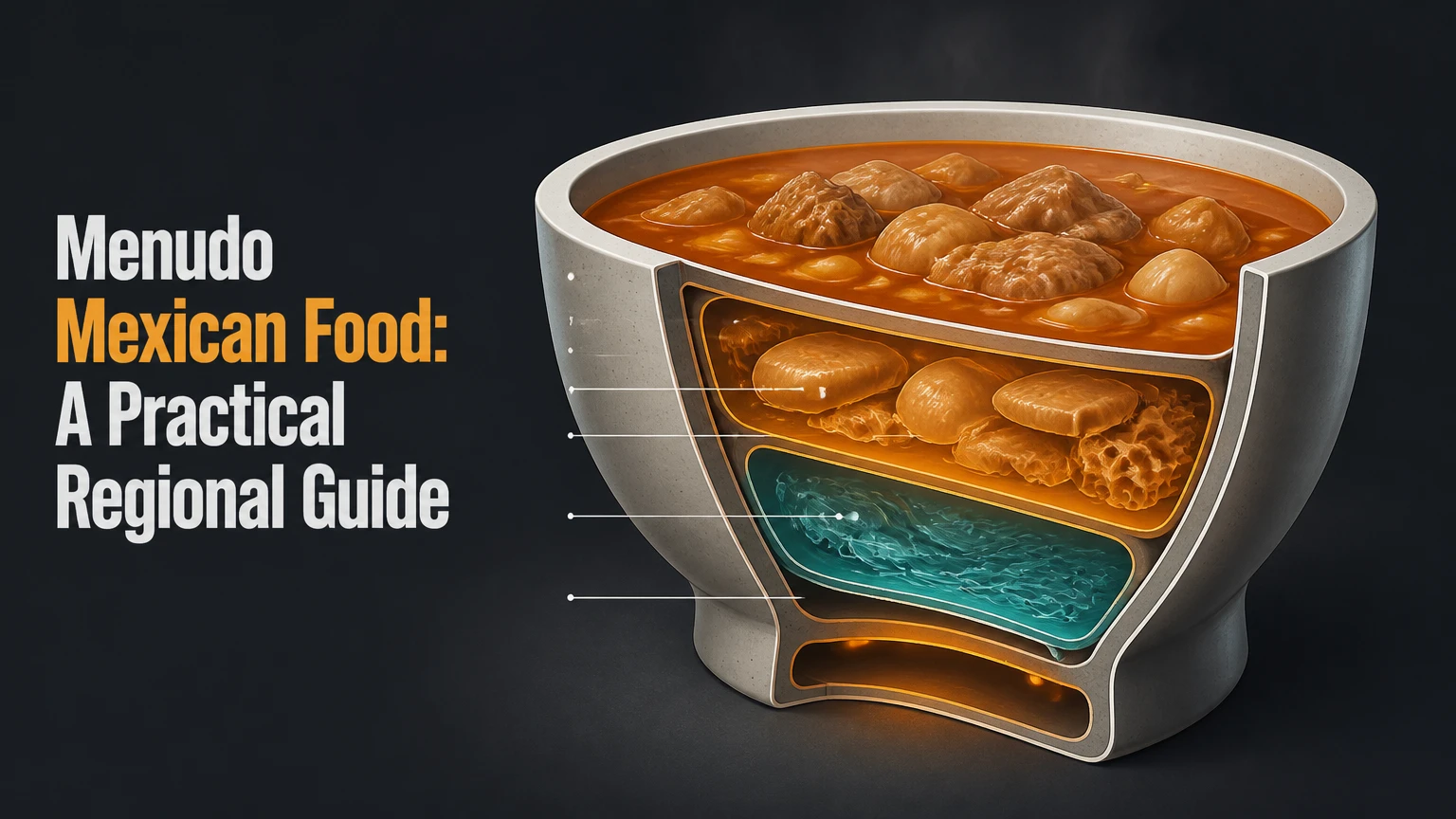
Menudo Mexican food is a traditional Mexican soup made primarily with beef tripe, hominy, and a seasoned broth. Menudo rojo uses dried red chiles, while menudo blanco leaves the broth uncolored and menudo verde uses green ingredients in regional variations. The soup is commonly served at weekend family meals with lime, onion, cilantro, and oregano.
Key Facts at a Glance
Menudo is a slow-cooked Mexican soup centered on beef tripe, which is cleaned and simmered until tender.
Menudo rojo gets its color and depth from dried chiles such as guajillo and ancho.
Hominy is nixtamalized corn; it is common in many Mexican-American versions but is not universal across Mexico.
A typical stovetop batch takes 4-6 hours, including preparation and simmering.
Honeycomb tripe gives menudo a ridged surface and a moderately chewy texture; pata adds gelatin and body.
Traditional garnishes, especially lime, onion, cilantro, and oregano, are part of the flavor design rather than decoration.
What Is Menudo Mexican Food?
Menudo Mexican food is a soup of beef tripe cooked in a long-simmered broth, often with hominy and dried chiles. In Mexico, the dish may also be called pancita, while mondongo can refer to related tripe soups whose ingredients and seasoning differ by region.
Beef tripe means an edible portion of a cow’s stomach. Honeycomb tripe comes from the reticulum and has a ridged interior; smooth blanket tripe has a flatter surface and a softer, less textured bite. Menudo can include more than one cut, and some cooks add beef foot, called pata, to increase gelatin and richness.
Menudo is strongly associated with Saturday or Sunday meals because the tripe needs extended cooking and the finished soup improves after resting. Large pots also make sense for family gatherings, since a batch can feed eight to twelve people and reheat well. In many households, the soup appears at holidays, celebrations, and morning gatherings.
The dish is often associated with relief after late-night celebrations. That reputation describes cultural use, not a proven medical treatment. Broth, salt, fluid, carbohydrate-rich hominy, and a hot meal may feel restorative, but menudo does not medically reverse impaired judgment, dehydration, or other effects of excessive drinking.
Why Does Menudo Need Long Cooking?
Menudo needs long cooking because heat and moisture gradually soften tripe’s connective tissue. A gentle simmer of 2.5-4 hours usually produces a tender, pleasantly chewy texture, while pressure cooking shortens the active cooking period but does not eliminate preparation and finishing time.
Tripe should simmer rather than boil aggressively. A hard boil can make the pieces contract and produce a tougher bite, while steady heat allows collagen and connective tissue to soften. The broth becomes fuller when pata is included because beef foot contributes collagen-rich connective tissue.
Hominy behaves differently from tripe. Nixtamalized corn has already undergone an alkaline treatment that changes its texture and improves its ability to absorb broth. Canned hominy can become too soft if cooked for the entire process, so many cooks add it during the last 30-60 minutes.
Dried chiles contribute color, aroma, and fruit-like depth. Guajillo supplies a clean red chile flavor with modest heat; ancho adds sweetness and dried-fruit notes. Toasting should last only 30-60 seconds per side because scorched chiles make the broth bitter.
Expert Insight: Tenderness Is a Texture Decision
A fork test alone does not define finished tripe. Tender menudo tripe should yield to a fork while retaining enough resistance to chew. If the pieces collapse like shredded meat, the pot has moved toward a softer texture than many traditional preparations intend.
Which Menudo Style Should You Choose?
Menudo rojo is the most recognizable choice for diners seeking a red chile broth, while menudo blanco is the clearest test of tripe preparation. Menudo verde is brighter and less common, and pancita or mondongo may use different regional proportions, names, and hominy practices.
| Style or name | Broth ingredients | Hominy pattern | Typical flavor and texture |
|---|---|---|---|
| Menudo rojo | Guajillo, ancho, garlic, oregano | Often included, 2-4 cups per batch | Earthy, red, mildly spicy, full-bodied |
| Menudo blanco | Clear stock, garlic, onion, oregano | Optional, region-dependent | Clean beef flavor, direct tripe character |
| Menudo verde | Tomatillo, green chile, cilantro | Optional, usually less standardized | Tangy, herbal, fresh, medium heat |
| Pancita | Tripe-focused stock, red or clear seasoning | Often omitted in some regions | Concentrated, chewy, meat-forward |
| Mondongo | Tripe with local vegetables or seasonings | Variable by recipe | Regional variation, often thicker or stew-like |
Regional categories are useful guides, not strict legal definitions. A restaurant in Sonora may call a red preparation menudo, while another cook uses pancita for a similar soup. Ask whether the bowl includes hominy, pata, and red chile before ordering if those details matter.
Is Menudo Rojo Spicy?
Menudo rojo is usually mild to medium in heat because guajillo and ancho provide more color and aroma than sharp chile heat. Fresh jalapeño, crushed red chile, or chiltepin added at the table determines much of the final heat level.
The broth’s red color does not prove that the soup is hot. Remove chile seeds and veins for a gentler result, or add árbol chiles for more heat without greatly increasing the quantity of red chile paste. Strain the blended sauce to remove tough chile skin.
What Goes Into a Traditional Pot?
A practical 8-10 serving pot uses 3 pounds of cleaned beef tripe, 1-2 pounds of hominy, onion, garlic, oregano, salt, and enough water or stock to maintain a soup consistency. Menudo rojo also needs approximately 6-8 dried guajillo chiles, with ancho or árbol chiles adjusted to taste.
| Ingredient | Typical quantity for 8-10 servings | Function | Practical substitution |
|---|---|---|---|
| Beef tripe | 3 lb, 1.36 kg | Main protein and chewy texture | 2 lb tripe plus 1 lb beef foot |
| Hominy | 2-4 cups cooked | Sweet corn texture and starch | 1 cup dried hominy, soaked overnight |
| Guajillo chiles | 6-8 pods | Red color and mild chile depth | California chiles |
| Ancho chiles | 1-3 pods | Sweet, raisin-like background | Extra guajillo plus a small pinch of paprika |
| White onion | 1 large | Aromatic base and garnish | Yellow onion |
| Garlic | 1 head for stock, 3 cloves for chile sauce | Savory aroma | 2 teaspoons granulated garlic |
| Mexican oregano | 1-2 tablespoons total | Herbal finish | Marjoram plus a pinch of dried oregano |
| Beef foot, pata | 1-2 lb, optional | Gelatin and body | Extra tripe, with a thinner broth |
Food safety begins before seasoning. Keep raw tripe refrigerated at 40°F or below, use a separate cutting board, wash hands after handling it, and do not rely on lime or salt as a substitute for heat. Acid reduces odor but does not make raw organ meat safe to eat.
Which Tripe Is Best for Menudo?
Honeycomb tripe is the most versatile choice for menudo because its ridges hold chile broth and its thickness remains pleasantly chewy after extended cooking. Smooth tripe cooks effectively but gives a more uniform, less textured bite; mixed cuts create greater variation within each bowl.
| Tripe cut | Surface | Typical cooking time | Best use |
|---|---|---|---|
| Honeycomb, reticulum | Ridged honeycomb pattern | 3-4 hours stovetop | Textured menudo rojo |
| Blanket, rumen | Broad and smooth | 2.5-3.5 hours | Softer, uniform pieces |
| Book, omasum | Layered folds | 3-4 hours | Mixed-cut pots with pronounced chew |
| Mixed tripe | Several stomach sections | 3-4 hours | Family-style batches with varied texture |
Ask the butcher whether the tripe is pre-cleaned. Many markets sell bleached or partially cleaned tripe, but the label does not guarantee that it is ready to cook without inspection. Trim thick exterior fat and rinse away residue before cutting pieces approximately 1 inch across.
How Do You Make Menudo at Home?
Make menudo by cleaning and blanching the tripe, simmering it with aromatics, blending and straining the chile sauce, then combining the sauce and hominy for a final simmer. A typical stovetop batch takes 4-6 hours, costs approximately $35-$70 in the United States, and requires a 10-12-quart pot.
Before you start
Yield: 8-10 servings
Active preparation: 45-60 minutes
Total stovetop time: 4-6 hours
Difficulty: Moderate
Equipment: 10-12-quart pot, blender, fine-mesh strainer, cutting board, knife
Main ingredients: 3 pounds tripe, 2-4 cups hominy, 6-8 guajillo chiles, onion, garlic, oregano
Success factor: Clean tripe and gentle cooking matter more than adding extra chile
Step 1: Clean and Cut the Tripe
Rinse 3 pounds of tripe under cold running water, trim excess fat, and cut it into 1-inch pieces. A 30-minute soak in cold water with 2 tablespoons of salt and the juice of 2 limes can reduce surface odor, but rinse the pieces afterward.
A separate brief blanch improves control over aroma. Place the tripe in a pot, cover it with water, boil for 10 minutes, drain, and rinse the pieces before beginning the main simmer. This step is optional when the market has supplied thoroughly cleaned tripe, but it is useful for a strong-smelling batch.
Success checkpoint: The pieces smell clean and meaty rather than sharply sour or barn-like.
Common mistake: Leaving lime or salt on the tripe without a thorough rinse can create a harsh flavor.
Step 2: Simmer the Tripe With Aromatics
Put the tripe in a clean stockpot with one halved onion, one head of garlic, and 2 teaspoons of salt. Add enough water to cover the meat by approximately 2 inches, bring the pot to a boil, skim foam, and reduce the heat to a low simmer.
Cover the pot partially and cook for 2.5-3 hours. Check the liquid every 45 minutes and add boiling water if the tripe becomes exposed. Cold water interrupts the simmer and extends cooking time.
Success checkpoint: A piece bends and yields when pressed with a fork, but it still has a slight chew.
Common mistake: Judging tenderness after the first hour guarantees an undercooked, rubbery result.
Step 3: Build and Strain the Red Chile Sauce
Remove stems and most seeds from 6-8 guajillo chiles and 1-2 ancho chiles. Toast them briefly in a dry skillet, soak them in hot water for 15 minutes, and blend them with 3 garlic cloves, 1 teaspoon Mexican oregano, and 1 cup soaking liquid.
Strain the sauce through a fine-mesh sieve before adding it to the pot. Straining removes chile skin and seeds that otherwise create a gritty broth. Do not use soaking water if the chiles smell musty or contain visible debris.
Success checkpoint: The sauce pours smoothly and tastes fruity, savory, and slightly bitter-free.
Common mistake: Burning the pods, even for a few extra seconds, gives the entire batch a burnt flavor.
Step 4: Add Chile Sauce and Hominy
Pour the strained chile sauce into the simmering tripe and stir thoroughly. Add 2-4 cups of drained canned hominy during the last 30-60 minutes, or add soaked dried hominy earlier according to the package instructions.
Continue simmering uncovered until the broth reaches the desired concentration. Taste for salt only after the chile sauce and hominy are incorporated because both change the soup’s balance.
Success checkpoint: The broth coats a spoon lightly, and hominy is tender without splitting apart.
Common mistake: Adding canned hominy at the beginning can turn the kernels soft and starchy.
Step 5: Rest, Garnish, and Serve
Turn off the heat and rest the pot for 15-20 minutes before serving. Ladle the soup with tripe and hominy into warmed bowls, then offer chopped white onion, cilantro, Mexican oregano, lime wedges, fresh chile, and warm corn tortillas or bolillo.
Garnishes alter the bowl’s balance. Lime cuts richness, onion adds raw sharpness, cilantro adds herbal freshness, and oregano releases aroma when rubbed between the palms. Add them individually rather than mixing all garnishes into the pot.
Which Cooking Method Is Most Practical?
The stovetop gives the most control over texture, the pressure cooker saves the most elapsed time, and the slow cooker works best when convenience matters more than sauce development. Equipment changes the schedule, but none of these methods removes the need to clean, trim, and season the tripe.
| Method | Active cook time | Total typical time | Best feature | Main limitation |
|---|---|---|---|---|
| Stovetop | 30-45 minutes | 4-6 hours | Direct texture and salt control | Requires liquid checks |
| Slow cooker | 20-30 minutes | 8-10 hours | Minimal supervision | Chile sauce may taste less concentrated |
| Pressure cooker | 35-50 minutes | 2-2.5 hours | Fast tenderizing | Pot capacity limits large batches |
| Pressure plus simmer | 50-70 minutes | 2.5-3.5 hours | Fast tripe with better finishing | Requires two cooking stages |
For a pressure cooker, cook cleaned tripe with aromatics and water for approximately 45-60 minutes at high pressure, then allow a natural release. Add chile sauce and hominy afterward, and simmer uncovered for 20-30 minutes so the flavors integrate.
A slow cooker benefits from preheating the chile sauce in a skillet for 5-10 minutes before adding it. That extra step removes a raw chile taste that can remain in a long, low-temperature cook.
How Does Menudo Compare With Pozole?
Menudo is defined by beef tripe, while pozole is defined by a broth built around nixtamalized corn and commonly uses chicken or another meat. Both may include red chiles, onion, lime, oregano, and cabbage or fresh toppings, but their central proteins and textures are different.
| Feature | Menudo | Pozole rojo | Pozole verde | Caldo de res |
|---|---|---|---|---|
| Defining ingredient | Beef tripe | Hominy with meat | Hominy with green sauce | Beef and vegetables |
| Main texture | Chewy tripe, gelatinous broth | Plump hominy, tender meat | Plump hominy, herbal broth | Beef fibers and vegetables |
| Typical chile profile | Guajillo and ancho | Guajillo, ancho, or árbol | Tomatillo and green chile | Often no chile paste |
| Typical cooking time | 4-6 hours stovetop | 2.5-4 hours | 2.5-4 hours | 2-3 hours |
| First-time accessibility | Offal-centered | Familiar soup texture | Bright and herbal | Mild, vegetable-forward |
Choose pozole if you want hominy and chile flavor without tripe. Choose menudo if the chewy offal texture and collagen-rich broth are the reason you are ordering the dish.
Where Can You Buy or Order Menudo?
Mexican restaurants, carnicerías, prepared-food counters, and regional markets are the most reliable places to find menudo. Restaurants often serve it on weekends because a long simmer and large batch make daily production less efficient, but weekend-only availability is a tendency rather than a universal rule.
| Buying situation | Typical US price | Typical portion | What to ask |
|---|---|---|---|
| Small local restaurant | $12-$18 | 16-24 oz | Rojo or blanco, hominy included |
| Large specialty bowl | $16-$24 | 24-32 oz | Pata included, tortillas or bread |
| Prepared market container | $10-$18 | 24-32 oz | Reheating instructions and date |
| Home batch | $35-$70 total | 8-10 servings | Tripe origin and hominy cost |
Order “menudo rojo con maíz” for the familiar red broth and hominy combination. Request menudo blanco if you want to evaluate the quality of the stock and tripe without dried chile sauce. Ask for lime, onion, oregano, and fresh chile separately so the bowl remains adjustable.
Expert Insight: Restaurant Color Is Not a Quality Test
A dark red broth can come from well-toasted chiles, excessive chile paste, or an overly reduced batch. Menudo blanco is often a better diagnostic bowl because odor control, stock seasoning, and tripe texture are easier to assess without a strong red sauce.
What Problems Occur Most Often?
The most common menudo failures are unpleasant odor, rubbery tripe, thin broth, excessive heat, and broken-down hominy. Each problem has a different cause, so adding salt or chile indiscriminately can make the final bowl worse.
| Problem | Likely cause | Immediate correction | Prevention |
|---|---|---|---|
| Strong barn-like aroma | Poor cleaning or no blanch | Strain, rinse solids, replace broth, continue simmering | Inspect, soak, and optionally blanch |
| Rubbery tripe | Insufficient time or heat | Simmer 45-60 minutes longer | Maintain a gentle, covered simmer |
| Thin broth | Excess water or late seasoning | Reduce uncovered and adjust salt | Start with water 2 inches above tripe |
| Bitter broth | Burned dried chiles | Dilute with unsalted stock and add fresh sauce | Toast briefly without darkening |
| Too much heat | Excess árbol or fresh chile | Add unsalted stock and more hominy | Build heat at the table |
| Mushy hominy | Added too early | Add fresh cooked hominy near service | Use the final 30-60 minutes |
A strong smell cannot always be repaired after several hours of cooking. If the odor is sharply unpleasant after blanching and rinsing, discard the liquid and reassess the tripe rather than trying to conceal the problem with more chile.
How Should You Store and Reheat Menudo?
Cool menudo in shallow containers and refrigerate it within 2 hours, or within 1 hour when the surrounding temperature exceeds 90°F. Refrigerated menudo keeps for 3-4 days, while frozen portions retain useful quality for approximately 2-3 months.
Divide a large pot into containers no deeper than 2 inches to speed cooling. Reheat each portion on the stovetop until steaming throughout, or use a microwave with frequent stirring. Add a small amount of water if the gelatin-rich broth thickens in the refrigerator.
Freeze the broth and tripe together if convenience matters, but hominy may become softer after thawing. For the best texture, freeze the soup without hominy and add freshly heated hominy during reheating.
Do not repeatedly cool and reheat the entire pot. Heat only the portion needed for one meal, because repeated temperature changes reduce quality and increase food-safety risk.
Is Menudo Nutritious?
Menudo provides protein, fluid, sodium, and carbohydrates when hominy is included, but its nutrition varies substantially with tripe quantity, pata, fat removal, and serving size. A restaurant bowl can be high in sodium, so people monitoring sodium intake should request less added salt and limit salty accompaniments.
Tripe is not a high-fat ingredient by itself compared with many fatty beef cuts, although the broth can gain fat from attached tissue and pata. Chill the soup overnight and remove the solidified fat from the surface if you want a lighter bowl.
Menudo is not suitable for someone who dislikes chewy textures or wants a quick meal. Even pressure-cooked menudo requires ingredient preparation, and the dish is a poor choice when the cook cannot safely handle raw organ meat or control cooling temperatures.
Frequently Asked Questions
Does menudo always contain hominy?
No, menudo does not always contain hominy. Many US-Mexican restaurant versions include canned or cooked nixtamalized corn, while some regional Mexican preparations emphasize tripe and broth without corn. Ask for “con maíz” or “sin maíz” when ordering if the distinction matters.
Can beginners enjoy tripe in menudo?
Beginners often find honeycomb tripe easier to approach than smooth tripe because its texture is distinctive but not slippery when properly cooked. Start with a small bowl of menudo rojo con maíz, add lime and onion, and choose pieces that have softened without losing their chew.
Can menudo be made without dried chiles?
Yes, menudo blanco is made without a red chile sauce. Season the stock with onion, garlic, oregano, salt, and fresh garnishes, then add lime and fresh chile at the table. The clear broth exposes the tripe’s aroma and texture more directly than menudo rojo.
Why is menudo often served in the morning?
Menudo is often served in the morning because families commonly prepare it as a weekend meal after an overnight or early-morning simmer. The hot broth, hominy, salt, and garnishes make the dish feel restorative, although the popular la cruda association is cultural rather than a medical claim.
Can canned hominy replace dried hominy?
Canned hominy can replace dried hominy in most home menudo recipes and reduces preparation time substantially. Drain and rinse the kernels, then add them during the final 30-60 minutes. Dried hominy offers a firmer texture but generally requires soaking and a longer separate cooking period.
What is the best first style to order?
Menudo rojo with honeycomb tripe and hominy is the most approachable first order for many diners because the red broth supplies familiar chile depth and the corn softens the chewy meat texture. Choose a well-reviewed restaurant that serves lime, onion, cilantro, and oregano separately.
The Bottom Line
Menudo Mexican food is a slow-cooked beef tripe soup whose identity comes from tender, chewy offal, seasoned broth, and regional serving customs. Choose rojo for dried-chile depth, blanco for a clean test of the stock, or verde for a tangy variation. Use honeycomb tripe, cook gently for 4-6 hours, add canned hominy late, and serve the finished bowl with lime, onion, cilantro, and oregano.