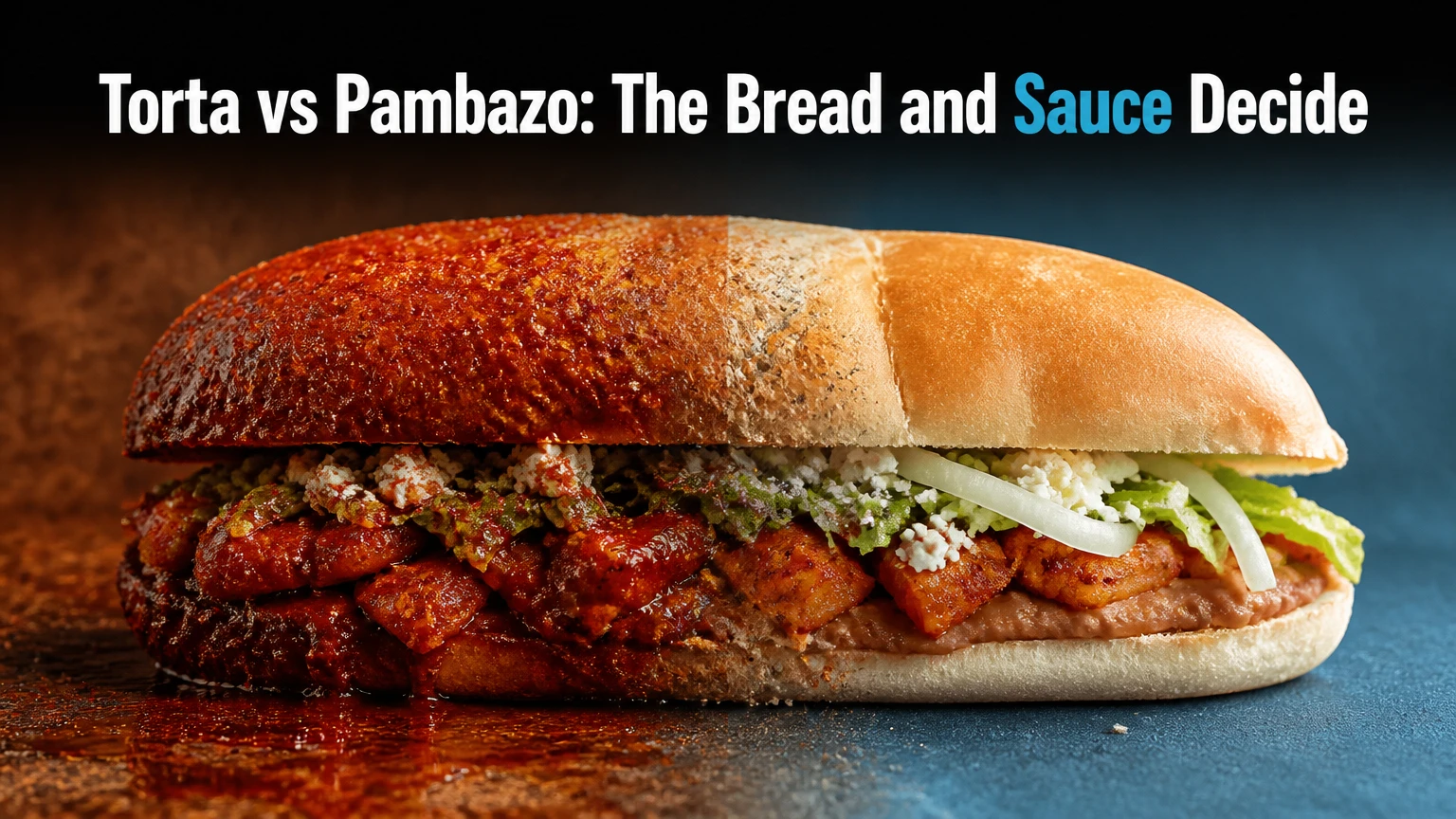
A torta is a broad Mexican sandwich category built on a firm roll with flexible fillings and toppings, while a pambazo is a specific sandwich coated in guajillo sauce and fried. The torta emphasizes layered contrast and portability; the pambazo emphasizes sauce absorption, a crisp fried surface, and a warm potato-based filling.
Key Facts at a Glance
- A torta usually uses a telera, bolillo, or another sturdy wheat roll; a pambazo traditionally uses dense pan bazo bread.
- A pambazo is dipped in guajillo chile sauce before frying; an ordinary torta is not.
- Torta fillings can include ham, milanesa, eggs, beans, cheese, vegetables, or cooked meats.
- The classic Mexico City pambazo combines potato and chorizo with lettuce, crema, and fresh cheese.
- A torta typically takes 5-10 minutes with prepared fillings; a pambazo usually takes 20-30 minutes.
- A torta is the better portable choice, while a fresh pambazo delivers the stronger fried-sauce flavor.
What Is a Torta?
A torta is a Mexican sandwich made with a wheat roll split horizontally and filled with one or more proteins, spreads, cheese, and vegetables. The word describes a preparation category rather than one fixed recipe, so a torta may be served cold, toasted, pressed, or assembled around a cooked filling.
The most common breads are the telera, a relatively flat roll with three raised sections, and the bolillo, a more tapered roll with a firmer crust. Bread choice changes the eating experience: a telera gives a broad, soft interior for layered ingredients, while a bolillo provides more crust and resistance.
How Are Tortas Built?
Tortas are built through controlled layering. A cook commonly toasts the cut sides, adds beans or a fat-based spread near the bread, places the main filling in the center, and finishes with avocado, lettuce, tomato, pickled peppers, or cheese.
Moisture management determines whether a torta stays coherent. Refried beans, mayonnaise, avocado, or butter can reduce direct contact between watery vegetables and the crumb, although no spread can prevent sogginess indefinitely if the sandwich sits wrapped for hours.
What Is a Pambazo?
A pambazo is a specialized Mexican sandwich whose defining process is coating the bread with red guajillo chile sauce and frying the coated roll on a hot griddle. The name is associated with pan bazo, a dense, low-gluten style of bread that can absorb sauce while retaining enough structure to be handled.
Traditional pambazos often contain seasoned potato and chorizo, then receive shredded lettuce, Mexican crema, and crumbled fresh cheese. Regional recipes vary, but the dipped-and-fried bread remains the central identity marker.
Is a Pambazo a Type of Torta?
A pambazo can be grouped with Mexican tortas in the broad sense that both are filled bread sandwiches, but Mexican food terminology usually treats pambazo as its own named specialty. The distinction matters because a regular torta does not require sauce dipping or frying, while those steps define a traditional pambazo.
How Does the Bread Change the Result?
The torta’s bread protects a layered filling, whereas pambazo bread is selected for controlled liquid absorption. Telera and bolillo are ready to eat after slicing and toasting; pan bazo must tolerate guajillo sauce, surface frying, and the weight of a hot filling.
| Bread | Typical shape | Structural behavior | Best sandwich use |
|---|---|---|---|
| Telera | Flat oval, 3 ridges | Soft center, moderate crust | Layered torta with beans and vegetables |
| Bolillo | Tapered, short baguette shape | Firmer crust, resilient crumb | Toasted torta with juicy fillings |
| Pan bazo | Compact, dense round or oval roll | Absorbs sauce without immediate collapse | Dipped and fried pambazo |
| French roll substitute | Small oval roll | Moderate strength, variable crumb | Practical torta substitute, not ideal for pambazo |
A soft hamburger bun is a poor choice for either demanding preparation. It compresses under layered fillings in a torta and can disintegrate during pambazo dipping.
Why Does Pambazo Bread Need a Short Dip?
Pan bazo absorbs enough sauce to color and flavor the crust, but prolonged soaking moves liquid into the crumb faster than frying can remove it. A brief dip, often about 1-2 seconds per exposed surface, gives the cook a workable coating without turning the center into paste.
Bread age also matters. A slightly day-old roll often performs better than a very fresh, airy roll because its crumb has less free moisture and greater resistance to handling.
How Are They Prepared?
A standard torta requires slicing, toasting, spreading, filling, and optional pressing. A traditional pambazo requires cooking the filling, blending and straining guajillo sauce, dipping the bread, frying both sides, and garnishing immediately.
| Stage | Standard torta | Traditional pambazo |
|---|---|---|
| Bread preparation | Slice and toast 1-2 minutes | Slice, fill, then coat with sauce |
| Main filling | Prepared meat, egg, cheese, or vegetables | Potato and chorizo, usually cooked 10-15 minutes |
| Sauce step | Optional spread or salsa inside | Guajillo sauce coats the entire exterior |
| Cooking finish | Optional griddle press for 1-2 minutes | Fry about 2-3 minutes per side |
| Total active time | 5-10 minutes with ready filling | 20-30 minutes including filling and sauce |
A Reliable Torta Sequence
- Slice a telera or bolillo horizontally.
- Toast the cut sides on a lightly greased griddle for 1-2 minutes.
- Spread beans, mayonnaise, avocado, or another moisture-control ingredient.
- Add the main filling, such as milanesa, ham, egg, or seasoned vegetables.
- Add cheese and melt it if the sandwich is served hot.
- Finish with lettuce, tomato, pickled jalapeños, or avocado.
- Close and press briefly if a crisp exterior is wanted.
The success checkpoint is a roll that holds its shape when lifted with one hand. A common mistake is adding tomato or salsa directly against the lower crumb, which creates a wet base before the filling is fully eaten.
A Reliable Pambazo Sequence
- Cook diced potatoes until tender, then combine them with browned chorizo.
- Blend dried guajillo chiles with garlic, onion, salt, and enough water for a pourable sauce.
- Strain the sauce so chile skins do not tear the bread.
- Fill the pan bazo while the potato mixture is hot.
- Dip the exterior briefly, covering the crust without saturating the interior.
- Fry on a lightly generous film of oil or cooking fat for 2-3 minutes per side.
- Open carefully and add lettuce, crema, and fresh cheese.
The success checkpoint is a red, lightly crisp surface with a soft but cohesive center. The main failure is frying a cold, heavily filled sandwich, which burns the coating before the middle becomes hot.
Torta vs Pambazo: Which Differences Matter Most?
The torta wins for customization, portability, and speed. The pambazo wins for integrated chile flavor and a more distinctive contrast between fried exterior, tender crumb, and savory filling.
| Decision factor | Torta | Pambazo | Practical winner |
|---|---|---|---|
| Bread | Telera or bolillo, usually uncoated | Dense pan bazo coated in chile sauce | Torta for availability |
| Preparation | 5-10 minutes with cooked fillings | 20-30 minutes from basic ingredients | Torta for speed |
| Texture | Crusty or toasted bread, layered interior | Fried chile crust, soft sauced interior | Pambazo for contrast |
| Filling range | Egg, milanesa, ham, vegetables, beans | Potato-chorizo dominant, with regional variations | Torta for choice |
| Portability | Usually manageable in paper or foil | Sauce and oil require immediate eating | Torta for travel |
| Flavor | Fresh, savory, creamy, pickled | Earthy chile, fried bread, rich filling | Pambazo for intensity |
| Typical Mexico price | About $3.50-$6 | About $3-$5 | Pambazo for lower entry price |
| Typical United States price | About $8-$14 | About $7-$12 | Pambazo for lower entry price |
Which Is Easier to Eat?
A torta is easier to eat because its bread remains comparatively dry and its fillings stay between two stable surfaces. A pambazo is messier because guajillo sauce, cooking fat, crema, and loose potato pieces escape as the fried bread softens.
For commuting, desk lunches, school meals, or outdoor eating, choose a torta. For immediate service at a market stall or kitchen table, the pambazo’s mess is manageable and part of its appeal.
Which Has More Flavor?
A pambazo usually has the more concentrated bread flavor because the chile sauce is fried directly onto the roll. A torta can be more complex overall because the cook can combine toasted bread, creamy spreads, pickled peppers, cheese, fresh vegetables, and a seasoned filling.
The difference is not simply “mild versus spicy.” Guajillo chiles are often valued for color and dried-fruit notes more than extreme heat, while a torta’s heat depends on jalapeños, chipotle, salsa, or another selected ingredient.
What Variants Matter?
Torta variants are defined mainly by their fillings and regional bread choices, while pambazo variants are defined more strongly by sauce treatment and local filling traditions. The same word can therefore cover very different portion sizes, heat levels, and textures.
| Variant | Region or association | Defining filling or bread | Main eating characteristic |
|---|---|---|---|
| Torta de milanesa | Widely served in Mexico | Breaded chicken or beef cutlet | Crisp center with avocado and cheese |
| Torta ahogada | Guadalajara, Jalisco | Firm birote with slow-cooked meat | Bread partly or fully covered in chile sauce |
| Torta Cubana | Mexico City street-food tradition | Several meats, egg, cheese, and vegetables | Very large, rich, multi-layered portion |
| Torta de tamal, or guajolota | Mexico City | Steamed tamal inside a bolillo | Soft, starchy breakfast sandwich |
| Pambazo de papa con chorizo | Mexico City and central Mexico | Potato and chorizo | Classic fried, sauced sandwich |
| Pambazo de shredded beef | Regional market variation | Seasoned shredded beef | More meaty, less potato-heavy texture |
| Veracruz-style pambazo | Veracruz tradition | Soft white roll with beans, ham, and peppers | Often served without chile dipping |
A torta ahogada should not be confused with a pambazo. Both may involve sauce and a messy eating method, but the ahogada traditionally uses a firm regional roll and a different sauce system, while the pambazo’s bread is coated before frying.
What Do They Cost and How Long Do They Take?
Typical Mexico street-food prices are about $3.50-$6 for a standard torta and $3-$5 for a traditional pambazo, although city, portion size, rent, and filling quality can change those ranges. In the United States, typical restaurant prices are approximately $8-$14 for a torta and $7-$12 for a pambazo.
| Situation | Torta estimate | Pambazo estimate | Main cost driver |
|---|---|---|---|
| Mexico street-food purchase | $3.50-$6 | $3-$5 | Filling size and neighborhood |
| United States restaurant | $8-$14 | $7-$12 | Labor, location, imported ingredients |
| Home preparation time | 10-20 minutes | 30-50 minutes | Sauce and filling preparation |
| Typical restaurant order time | 5-10 minutes | 8-15 minutes | Queue and griddle workload |
The pambazo often costs less at a street stand because potato extends the filling and the bread itself is inexpensive. Home cooks may find the opposite: the torta is cheaper because it needs fewer components and less cooking fat.
How Do Nutrition and Portion Size Compare?
A standard torta commonly falls near 600-800 calories, while a fried potato-and-chorizo pambazo often reaches approximately 700-950 calories. These are practical estimates, not universal nutrition facts, because bread size, oil absorption, cheese, crema, and filling quantity vary widely.
| Serving example | Typical calories | Main variable | Lower-calorie adjustment |
|---|---|---|---|
| Vegetable and bean torta | 450-650 | Spread and cheese quantity | Use extra vegetables, less cheese |
| Torta de milanesa | 650-900 | Fried cutlet and avocado | Grill the cutlet, reduce spread |
| Potato-chorizo pambazo | 700-950 | Frying fat and chorizo amount | Use more potato and less chorizo |
| Large multi-filling torta | 1,100-1,500+ | Multiple proteins and cheese | Choose one protein and half the cheese |
The calorie difference usually comes from preparation rather than the sandwich label. A lightly toasted torta with vegetables may be substantially lighter than a small pambazo fried generously in cooking fat, while a large multi-filling torta can exceed both.
Which Keeps Better?
A torta keeps its quality longer because the bread is not saturated before serving. A wrapped torta is usually best within several hours, while a pambazo is best immediately and loses its crisp surface rapidly after refrigeration.
For storage, cool fillings before assembling a torta if the sandwich will travel, separate wet toppings when possible, and wrap the bread loosely enough to avoid trapped steam. Reheat a torta in a dry skillet or toaster oven at moderate heat; a microwave softens the crust.
Pambazos are difficult to restore after refrigeration. Reheat them uncovered in a skillet or toaster oven until the center is hot, but expect the chile coating to become softer than when freshly fried.
What Can You Substitute at Home?
A telera or bolillo is easy to replace with a sturdy French roll, ciabatta, or small Italian roll when making a torta. Pan bazo is harder to replace because ordinary airy bread absorbs guajillo sauce too quickly and may split during frying.
| Missing ingredient or tool | Torta substitute | Pambazo substitute | Expected trade-off |
|---|---|---|---|
| Telera | Bolillo or ciabatta | Not applicable | Torta remains structurally reliable |
| Pan bazo | Not applicable | Dense white roll, lightly stale | Less authentic absorption and shape |
| Griddle | Heavy skillet | Heavy skillet | Similar browning with smaller cooking area |
| Oaxaca cheese | Monterey Jack or low-moisture mozzarella | Fresh cheese garnish | Different stretch or salt level |
| Mexican crema | Sour cream thinned with water | Plain yogurt with salt | Tang remains, texture changes |
A practical home rule is simple: substitute freely for torta bread, but treat pambazo bread as a technical ingredient rather than a decorative choice.
Common Mistakes and How Can You Fix Them?
Torta and pambazo failures usually come from moisture, temperature, or timing errors rather than missing specialty ingredients. The most reliable correction is to control where liquid goes and ensure every hot component reaches the sandwich at the right stage.
| Failure | Likely cause | Immediate fix | Prevention |
|---|---|---|---|
| Torta bottom turns soggy | Tomato or salsa touches crumb | Remove wet layer and toast bread | Add beans or fat first |
| Torta falls apart | Soft roll or overloaded filling | Reduce filling by 20-25% | Use telera or bolillo |
| Pambazo disintegrates | Bread soaked too long | Use a fresh dry roll and shorter dip | Dip for about 1-2 seconds |
| Pambazo burns outside | Heat too high or filling cold | Lower heat and cover briefly | Warm filling before dipping |
| Sauce tastes harsh | Chile seeds, skins, or undercooked aromatics | Strain and simmer sauce | Blend, strain, then cook |
| Garnishes wilt completely | Added before frying | Add lettuce and crema after frying | Finish at the last moment |
One counterintuitive rule matters: a drier roll is often better for a pambazo than a fresh roll. Fresh bread may feel superior when eaten plain, but its higher internal moisture makes it less predictable under sauce.
Another practitioner rule is to fry the coated sandwich immediately. Waiting even a few minutes allows sauce to migrate inward, so the crust loses its ability to brown before the crumb becomes saturated.
Which Should You Choose?
Choose a torta when portability, customization, supermarket availability, or fast preparation matters most. Choose a pambazo when you want a guajillo-coated fried roll, a potato-based filling, and a richer street-food experience served immediately.
Best Choice for a First-Time Taster
A chicken milanesa torta is the safest introduction because its crisp cutlet, avocado, cheese, and pickled pepper components are easy to identify separately. A pambazo is better for an adventurous eater who specifically wants chile sauce integrated into the bread.
Best Choice for a Work Lunch
A standard torta is the practical winner. It can be wrapped, transported, and eaten at room temperature with fewer spills, especially when watery toppings are added sparingly.
Best Choice for a Quick Home Meal
A torta wins when cooked fillings are already available. A pambazo becomes worthwhile when potatoes, chorizo, dried guajillo chiles, and a heavy skillet are already in the kitchen.
Best Choice for a Vegetarian Meal
A bean, avocado, cheese, and roasted-vegetable torta offers the easiest vegetarian format. A vegetarian pambazo can use potato, mushrooms, beans, or squash, but the cook must verify that the chorizo has been omitted and that the sauce contains no animal-based cooking fat.
Best Choice for Lower Heat
A torta gives more control because the cook can remove pickled peppers or use a mild salsa separately. A pambazo can also be mild, but the guajillo coating remains part of the bread and cannot be removed after frying.
The Bottom Line
Torta vs pambazo is fundamentally a comparison between a flexible sandwich category and a defined sauced-and-fried specialty. The torta is faster, cleaner, more customizable, and easier to reproduce with substitute bread. The pambazo is more process-dependent, messier, and more distinctive because pan bazo absorbs guajillo sauce before griddle frying.
For daily convenience, order the torta. For a fresh market-style meal with fried chile flavor, order the pambazo.
Frequently Asked Questions
Is a pambazo spicy?
A pambazo is usually chile-flavored but not automatically very hot. Guajillo chiles contribute red color, mild heat, dried-fruit notes, and earthy flavor; cooks can increase heat with hotter chiles or serve a separate salsa alongside the sandwich.
Can a pambazo be made without chorizo?
A pambazo can be made without chorizo by filling it with potato and beans, mushrooms, squash, or seasoned shredded beef. The bread still receives the defining guajillo coating and griddle frying, so the sandwich remains recognizable as a pambazo.
Can you eat a torta cold?
A torta can be eaten cold or at room temperature, particularly when the filling is already cooked and the bread is sturdy. Cold tortas travel better when tomato, salsa, and other wet toppings are packed separately and added shortly before eating.
What cheese works best in each sandwich?
Oaxaca or Chihuahua cheese melts well inside a hot torta, while queso fresco is commonly crumbled over a pambazo after frying. Monterey Jack can substitute for melting cheese, and mild farmer cheese can replace fresh Mexican cheese when necessary.
Are tortas always made with meat?
Tortas are not always made with meat. Beans, eggs, cheese, avocado, roasted vegetables, and tamal fillings all produce recognized meat-free or meatless versions, because “torta” describes the bread-sandwich format rather than one mandatory protein.
Why is a pambazo red?
A pambazo is red because its bread is coated with a sauce made from dried guajillo chiles and then fried. The color becomes deeper as the sauce contacts the hot cooking surface, while the bread absorbs chile flavor into its outer crumb.