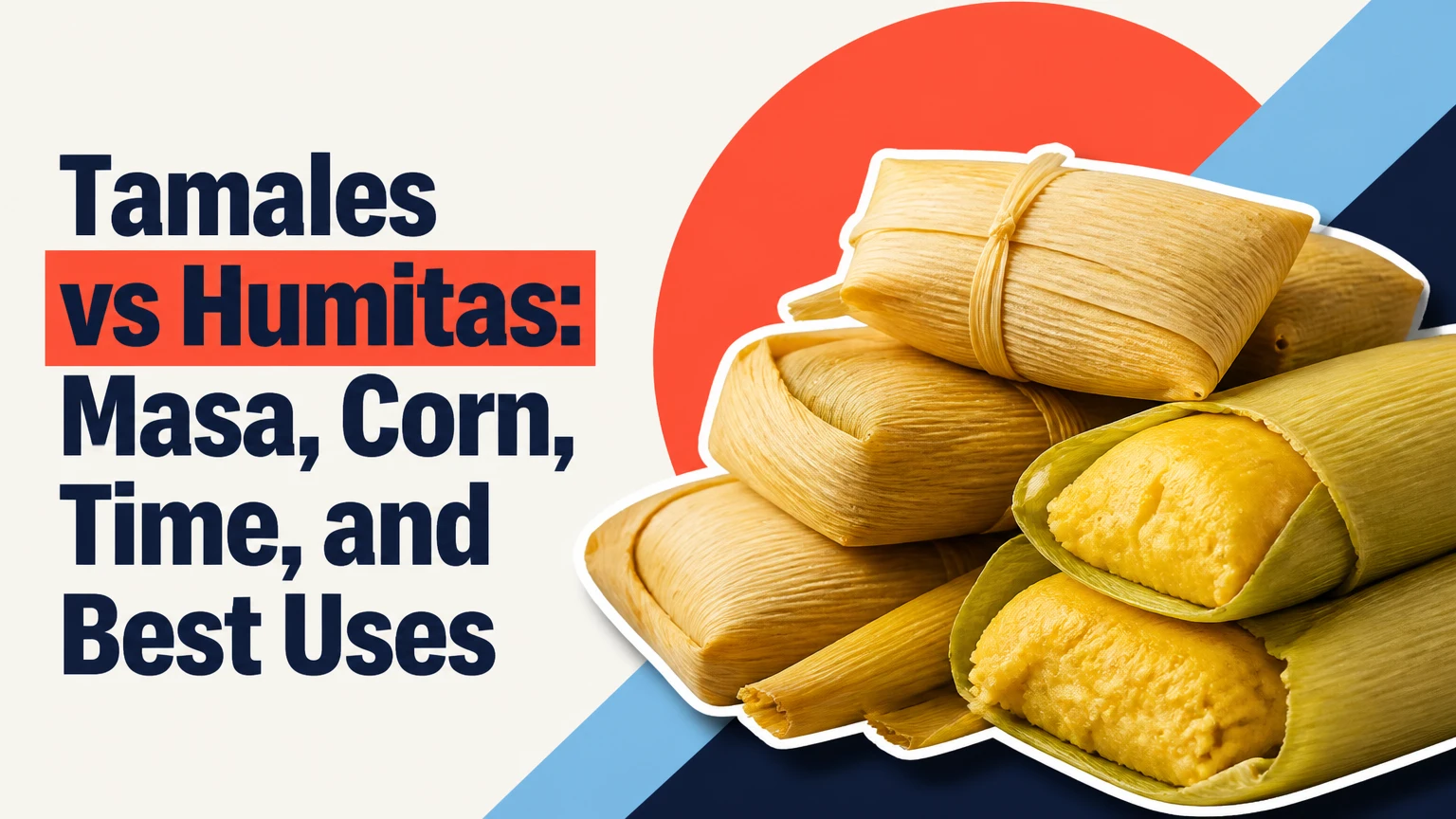
Tamales and humitas are corn-based parcels, but they are not the same dish. A typical tamale uses prepared masa made from dried corn and often contains a seasoned filling, while a humita uses fresh ground corn, usually has a softer texture, and lets the flavor of young corn lead. The best choice depends on texture, season, fillings, and batch size.
Key Facts at a Glance
- A standard Mexican tamale uses nixtamalized corn masa, while a humita generally uses fresh ground choclo without nixtamalization.
- Tamales commonly contain meat, beans, cheese, vegetables, or chile-based fillings; humitas are often cheese-forward, onion-seasoned, or sweet.
- Dry corn husks are typical for many tamales; fresh green husks are typical for humitas.
- Typical home preparation takes 3-5 hours for a large tamale batch and 1.5-2.5 hours for humitas.
- Tamales usually steam for 60-120 minutes; humitas commonly boil or steam for 30-60 minutes.
- Tamales freeze more reliably because their cooked masa has less fresh-corn moisture.
What Are the Two Dishes?
A tamale is a broad family of steamed corn dough dishes found across Mexico, Central America, and parts of South America. In the familiar Mexican format, dried corn is treated with calcium hydroxide, ground into masa, seasoned with salt and fat, spread on a wrapper, filled, folded, and steamed. The word tamal is singular in Spanish; tamale is the common English singular.
A humita is an Andean corn parcel made from fresh young corn, called choclo in much of South America. Kernels are grated or ground into a wet paste, then combined with ingredients such as onion, cheese, butter, herbs, chile, or sugar before cooking inside corn husks. The term and recipe vary by country.
The central distinction is raw material, not merely geography. A tamale is usually built around prepared dough, whereas a humita is built around fresh corn pulp.
Tamale and Humita Definitions
| Attribute | Typical tamale | Typical humita |
|---|---|---|
| Main corn input | Dried field corn or masa harina | Fresh young corn or choclo |
| Dough treatment | Often nixtamalized, hydrated, and ground | Grated or blended raw kernels |
| Usual wrapper | Dried corn husk or banana leaf | Fresh green corn husk |
| Common filling profile | Meat, beans, chile, cheese, or vegetables | Cheese, onion, herbs, chile, or sugar |
| Texture after cooking | Firm, fluffy, or bread-like masa | Moist, creamy, soft, or cake-like |
| Main cooking method | Upright steaming | Boiling or steaming |
The categories overlap at the edges. Fresh-corn tamales, Brazilian pamonha, Venezuelan hallacas, and several regional masa parcels do not fit a single universal template. A comparison becomes accurate only when the specific regional version is named.
How Do Corn, Masa, and Starch Behave?
Nixtamalization changes dried corn by soaking and cooking it in an alkaline solution, typically limewater made with calcium hydroxide. The process loosens the hull, changes the grain’s flavor and texture, improves the availability of niacin, and helps produce cohesive masa. The University of California Agriculture and Natural Resources describes nixtamalization as a process that improves the “nutritional and culinary properties” of maize.
Fresh-corn humitas skip that alkaline treatment. Their structure comes from the natural starch, water, and soluble solids in young corn, with added fat, cheese, eggs, or a small amount of meal depending on the regional recipe. Fresh corn therefore gives humitas a sweeter aroma and a wetter batter, but also makes moisture control more difficult.
Both dishes set through heat. Corn starch absorbs water and gelatinizes, turning a loose mixture into a cohesive cooked mass. Tamale dough gets additional structure from ground corn particles and whipped fat, while humitas depend more heavily on the concentration and maturity of the corn.
Corn Mechanics Compared
| Mechanism | Tamale effect | Humita effect | Practical consequence |
|---|---|---|---|
| Alkaline treatment | Creates traditional masa properties | Usually absent | Flavor and dough behavior differ |
| Corn moisture | Usually controlled with broth or water | Naturally high in fresh kernels | Humita batter can become loose |
| Fat | Lard, shortening, or oil tenderizes masa | Butter or oil enriches corn paste | More fat usually means a softer bite |
| Starch setting | Masa firms during steaming | Fresh-corn paste firms during boiling or steaming | Both need adequate heat and rest |
| Particle size | Fine or medium masa grind | Textured grate or blended paste | Coarse corn gives more chew |
| Resting | Helps masa finish firming | Helps the packet become sliceable | Immediate serving can seem too soft |
A useful practitioner rule is to judge moisture before adding a thickener. If fresh corn releases a large pool of liquid when grated, drain part of it before adding meal or starch. Excess added flour can make the humita pasty rather than naturally creamy.
What Are the Biggest Flavor and Texture Differences?
Tamales usually taste more savory because the masa contains salt, broth, fat, and a concentrated filling. Humitas taste more directly of corn because fresh kernels supply aroma and sweetness throughout the paste rather than only in the center.
Texture separates them even more clearly. A well-made tamale can be fluffy and tender, with enough structure to peel away from the wrapper. A humita is generally moist and cohesive, closer to a steamed corn pudding or soft cake, although Argentine and Chilean versions can be firmer after boiling.
Sensory Comparison
| Sensory feature | Tamales | Humitas |
|---|---|---|
| Corn flavor | Toasted, earthy, masa-like | Fresh, milky, grassy, or sweet |
| Exterior texture | Fluffy, tender, or firm | Moist, creamy, or cake-like |
| Filling impact | Often concentrated in the center | Usually integrated into the corn paste |
| Fat perception | Noticeable in the dough | Usually lighter unless cheese or butter is abundant |
| Sweetness | Usually low in savory forms | Moderate to high in sweet or young-corn forms |
| Serving temperature | Hot, warm, or reheated | Best hot or warm soon after cooking |
Humitas are not automatically lighter. A cheese-rich Ecuadorian humita can contain substantial fat, and a sweet version may include sugar, raisins, or other additions. Likewise, a vegetable tamale with an oil-based masa may be less dense than a large parcel filled with rich ingredients.
How Do Regional Forms Change the Comparison?
Regional names describe families rather than fixed recipes. Mexican tamales often use masa and salsa-based fillings, while Oaxacan tamales may use wetter masa wrapped in banana leaves. Nacatamales from Nicaragua are larger meal parcels that can include masa, rice, vegetables, and several seasoned components.
Humitas also differ sharply by location. Ecuadorian versions are commonly savory, soft, and enriched with cheese or eggs. Peruvian and Bolivian humitas may be savory or sweet. Argentine and Chilean preparations often include basil, onion, or sweet pepper and may be boiled directly in salted water.
| Region | Dish form | Wrapper | Typical flavor and structure |
|---|---|---|---|
| Mexico | Masa tamal | Dry husk or banana leaf | Chile, beans, cheese, or seasoned filling |
| Oaxaca, Mexico | Regional tamal | Banana leaf | Wet masa with rich chile sauces |
| Nicaragua | Nacatamal | Banana leaf | Large parcel with masa and multiple fillings |
| Ecuador | Humita | Fresh corn husk | Soft savory corn paste with cheese or egg |
| Peru and Bolivia | Humita | Fresh corn husk | Savory chile versions or sweet cinnamon versions |
| Argentina and Chile | Humita | Fresh husk | Onion, basil, pepper, cheese, boiled or steamed |
The wrapper is not a reliable origin marker by itself. Banana leaves occur in several tamal traditions, and corn husks occur in multiple fresh-corn preparations. The dough or paste remains the stronger identifying feature.
Which Takes More Time and Equipment?
Tamales require more labor because the cook must prepare or hydrate masa, cook a filling, soften wrappers, assemble many parcels, and steam a tall batch. Humitas usually reduce the filling work, but fresh corn must be husked, stripped, grated, or blended, and its moisture must be balanced.
Typical home timings vary by batch size. A batch of 24 tamales can take 3-5 hours from preparation through steaming, while 12-16 humitas often take 1.5-2.5 hours. These are practical ranges, not universal cooking standards.
Time, Labor, and Cost
| Measure | Tamales | Humitas |
|---|---|---|
| Typical batch size | 24-50 parcels | 12-24 parcels |
| Active preparation | 2-4 hours | 60-120 minutes |
| Cooking time | 60-120 minutes | 30-60 minutes |
| Typical home equipment | Steamer, bowl, pot, wrappers | Grater or blender, pot, wrappers |
| Typical ingredient cost per parcel | $1.50-$4.00 | $1.25-$3.50 |
| Main labor bottleneck | Spreading and filling masa | Processing and draining corn |
A large tamale steamer is useful but not mandatory. A stockpot with a rack can work if the parcels remain above the waterline. Humitas need a wide pot for boiling or a stable steamer rack, and fresh husks require careful handling because they tear more easily than soaked dry husks.
How Are Tamales and Humitas Prepared?
Tamales and humitas use the same broad sequence: prepare the corn base, season it, wrap it, and cook it in moist heat. Tamales need a cooked or ready-to-eat filling and a masa consistency that spreads thinly; humitas need a fresh-corn paste that holds a mound without flowing through the wrapper.
Tamale Workflow
- Prepare the wrappers. Soak 24-30 dry corn husks in hot water for about 30 minutes, then rinse away grit and drain them.
- Mix the masa. Combine about 2 pounds of prepared masa or masa harina adjusted with broth, 1 cup of fat, salt, and seasoning. Add liquid gradually.
- Whip for tenderness. Beat the fat and masa until the mixture becomes lighter and spreadable. The traditional float test is useful, but masa thickness and hydration matter more than the test alone.
- Cook the filling. Use approximately 2-3 cups of fully cooked, cooled filling for 24 medium tamales. Warm filling can soften the dough during assembly.
- Spread and fill. Place 2-3 tablespoons of masa on the smooth side of each husk, leaving the narrow tip clear. Add 1-2 tablespoons of filling.
- Fold and steam. Fold the sides inward, close the bottom, and stand parcels upright. Steam for 60-90 minutes, checking water levels without flooding the masa.
- Rest before serving. Let tamales stand for 10-15 minutes after cooking. The masa continues to firm and separates more cleanly from the husk.
You will know a tamale is ready when the masa peels from the husk with little residue and feels set rather than wet. A sticky surface can mean undercooking, excessive liquid, or immediate serving before the dough has rested.
Humita Workflow
- Save suitable husks. Remove wide, undamaged inner husks from 8-12 ears of corn. Rinse them and blanch briefly if they are stiff.
- Process the kernels. Cut kernels from the cob, then grate or pulse them into a textured paste. Avoid turning the corn into a completely smooth liquid.
- Control moisture. Let the paste stand for 5 minutes, then drain visible liquid if the mixture pours rather than mounds.
- Build the seasoning. Cook diced onion in butter or oil until translucent. Add salt, herbs, chile, or sweet spices according to the regional style.
- Combine carefully. Mix the corn paste with the seasoning and cheese. Add egg only when the recipe requires it, because excess egg can loosen the batter.
- Wrap with room to expand. Overlap two husks, place 1/2-3/4 cup of paste in the center, fold the sides inward, and tie with a husk strip.
- Cook gently. Boil in salted water or steam for 30-60 minutes. Avoid aggressive boiling that can separate weak packets.
- Rest briefly. Wait 5-10 minutes before opening. The hot starch needs time to stabilize.
A properly filled humita packet feels full but not stretched tight. Leave approximately 1 centimeter of expansion space around the paste, especially when the mixture contains egg or a high proportion of liquid corn.
Are Humitas Healthier Than Tamales?
Neither category has one fixed nutrition profile. A typical savory tamale may provide approximately 250-450 calories, while a medium humita may provide roughly 180-350 calories, but recipe size, fat, cheese, sugar, and filling change those figures substantially.
Fresh corn gives humitas more water and often more intact kernel components. Masa tamales can be more energy-dense because fat is mixed throughout the dough. Nixtamalization also improves calcium availability when lime treatment is used correctly, although the final nutritional result depends on the flour, recipe, and serving size.
Dietary Fit
| Dietary concern | More adaptable option | Important condition |
|---|---|---|
| Vegetarian meal | Humita or vegetable tamal | Check cheese, stock, and cooking fat |
| Dairy-free meal | Vegetable tamal | Use oil and omit cheese |
| Gluten-free meal | Both traditional versions | Verify masa harina and packaged seasonings |
| Lower-fat meal | Vegetable humita | Limit cheese, butter, and added oil |
| Higher-protein meal | Filled tamal | Use beans, egg, or another protein-rich filling |
| Lower-sugar meal | Savory tamal | Avoid sweet humita recipes |
Corn itself is naturally gluten-free, but cross-contact can occur in commercial masa harina, prepared fillings, and shared kitchens. People with celiac disease should verify labeling and preparation practices rather than relying on the dish name.
How Should You Store and Reheat Them?
Cooked tamales usually keep their quality better than humitas because masa tamales contain less fresh-corn water and tolerate freezing. Refrigerate either dish within two hours of cooking, use shallow containers, and reheat until the center reaches 165°F, the food-safety endpoint recommended by the U.S. Department of Agriculture.
| Storage method | Tamales | Humitas |
|---|---|---|
| Refrigerator at 40°F or below | 3-4 days | 2-3 days |
| Freezer quality window | 2-6 months | 1-2 months |
| Best reheating method | Steam 15-25 minutes | Steam 10-20 minutes |
| Microwave method | Wrapped, covered, 1-3 minutes | Covered with a damp towel, 1-2 minutes |
| Main quality risk | Drying masa | Watery or crumbly paste |
Cool parcels in a single layer before refrigerating. For freezing, wrap tamales in an airtight freezer bag or container and label the date. Thawing overnight in the refrigerator gives more even reheating, although frozen tamales can go directly into a steamer with additional time.
Humitas can be frozen, but their fresh-corn texture changes more readily. A previously frozen humita may become slightly grainier or release water after reheating, so humitas are strongest when cooked near the corn harvest.
What Commonly Goes Wrong?
Dense tamales usually result from overly wet masa, insufficient fat aeration, coarse hydration, or undercooking. The float test can help diagnose a heavy mixture, but a floating masa ball does not guarantee success because too much whipped fat can create a fragile, greasy dough.
Watery humitas usually result from immature supermarket corn, thawed frozen corn, or failure to drain the paste. Canned corn is the least reliable option because its liquid and processing can produce a loose mixture with muted fresh-corn flavor.
Troubleshooting Table
| Problem | Likely cause | Recovery |
|---|---|---|
| Tamale masa stays sticky | Understeaming or excess liquid | Steam 15-20 minutes longer, then rest |
| Tamale feels dense | Heavy hydration or insufficient mixing | Add liquid gradually next batch and whip fat thoroughly |
| Filling leaks out | Too much filling or weak fold | Use 1-2 tablespoons and overlap the husk |
| Humita becomes watery | High-moisture corn paste | Drain liquid and add a small amount of cornmeal |
| Humita packet bursts | Overfilled or tied too tightly | Leave 1 centimeter of expansion space |
| Wrapper tears | Dry or brittle husk | Soak longer or overlap two husks |
Expert rule of thumb: adjust the corn base before adjusting the cooking time. Extra steaming cannot reliably rescue a mixture whose water content is fundamentally too high.
Another counterintuitive point is that very fresh sweet corn is not always ideal for humitas. Extremely juicy kernels can produce a thinner paste than slightly mature field corn, which often has enough starch to create a stable parcel.
Which Should You Choose?
Choose tamales for a filling-centered meal, a large gathering, or long-term storage. Choose humitas when fresh corn is available and the desired result is a soft, corn-forward dish that can be served quickly.
Choose Tamales If You Need Batch Cooking
Tamales are the stronger choice for parties and meal preparation because their wrappers stack efficiently, their fillings can be prepared a day early, and their cooked masa reheats with relatively little texture loss. A 24-50 parcel batch justifies the setup time better than a small six-piece batch.
Tamales also offer more savory variation. Beans, vegetables, cheese, chile sauces, and cooked fillings can all be combined with the same basic masa. Tamales are less suitable when the cook wants the unmistakable aroma of fresh corn or lacks a steamer with enough vertical space.
Choose Humitas During Fresh Corn Season
Humitas are ideal when ears of young corn are inexpensive, sweet, and plentiful. The dish requires less filling assembly and usually cooks faster, making it practical for a summer meal or a small family batch.
Humitas are a poor substitute for tamales when you need freezer meals, firm handheld parcels, or a strongly seasoned center filling. Their flavor is more dependent on corn quality, so out-of-season produce can produce bland or watery results.
Choose by Cooking Experience
Beginners often find humita assembly simpler because there is no thin layer of masa to spread evenly and no separate filling to portion. However, controlling fresh-corn moisture is a real technical challenge, especially with frozen or canned kernels.
Cooks who already make masa-based dough may find tamales more predictable. The ingredients are easier to standardize, and masa harina provides repeatable hydration compared with corn that varies by harvest, storage, and variety.
Tamales vs Humitas: Final Decision
Tamales and humitas share corn, wrappers, and moist-heat cooking, but the primary distinction is decisive: tamales usually use prepared masa from dried corn and support substantial fillings, while humitas use fresh ground corn and emphasize a soft, naturally corn-forward paste. Pick tamales for savory variety, gatherings, and freezing; pick humitas for fresh-corn flavor, shorter cooking, and a softer texture.
Frequently Asked Questions
Can I Make Humitas With Frozen Corn?
Frozen corn can make humitas, but the result usually has less aroma and more free moisture than fresh choclo. Thaw the kernels completely, drain them, pulse them into a coarse paste, and add cornmeal only if the mixture cannot hold a mound. Frozen corn works best for a practical substitute, not for peak seasonal flavor.
Are Tamales Always Made With Nixtamalized Corn?
No. Many traditional tamales use nixtamalized masa, but the wider tamal family includes fresh-corn preparations and regional doughs with different processing histories. Nixtamalization is a defining feature of many masa tamales, especially Mexican styles, but it should not be treated as a rule for every corn parcel called a tamal.
Can I Use Banana Leaves for Humitas?
Banana leaves can wrap humita-like mixtures, but fresh corn husks are the conventional wrapper in many Andean versions. Banana leaves create larger, more flexible packets and add a different aroma. Because they do not fold like narrow husks, adjust the shape, tying method, and cooking arrangement to prevent the paste from spreading.
Do Tamales and Humitas Need to Be Served With Sauce?
Tamales often benefit from salsa, chile sauce, crema, or another accompaniment because the masa and filling create a substantial base. Humitas are commonly served plain or with a small amount of cheese, sauce, or herb garnish because their fresh-corn flavor is more delicate. Sauce is optional for both dishes.
Which Dish Is Better for a Vegetarian Dinner?
Humitas are often the easier vegetarian choice because cheese, onion, herbs, and corn form the central mixture without requiring a separate filling. Vegetarian tamales offer greater variety when made with beans, mushrooms, squash, or cheese, but the cook must verify that the masa contains vegetable fat and vegetable stock rather than animal-derived ingredients.